Ervin Somogyi

Menu
  • About
    • Bio
    • Bio – Humorous
    • Resumé
  • Guitars
    • Guitar Models
    • Guitars: Custom Options
    • Special Projects
    • Visual Echoes & Tasteful Accents
    • Pricing
  • For Sale!
    • Brazilian Rosewood Sets For Sale
    • The Mexican Festival Model Guitar
  • Artwork
    • Lutherie-Inspired Artwork
    • Artwork (2)
    • Peghead Veneers as Art and Accents
  • Articles
    • Articles & Essays
    • Articles featuring Ervin
  • Books
    • Books
    • Videos
  • Teaching
  • Contact

Category: Features By Ervin

Lutherie Trivia

by Ervin Somogyi

Trivia are inconsequential things. They come from the Latin trivium, which means three roads [tri: three + via: path or road]. It was the custom during the days of the Roman Empire to put up public bulleting boards at points where three or more roads converged, on the presumption that these points carried sufficient traffic to warrant such information-disseminating devices. Onto these bulletin boards were put not only proclamations of general importance, but also notes and notices of local interest and color, public announcements, news, gossip, etc. Since the bulk of the information on these boards was of the homely. local and everyday type, such snippets of information came to be known as trivial, or trivia.

All woodworkers know what a kerf is: it is the space made by the path of a sawblade through a piece of material that is being cut. Most people don’t realize that kerfs are the only known things in the universe that get bigger and bigger until they disappear. Think about it. Other things only get smaller until they disappear. This is exactly the kind of trivial fact that will, if used properly, make you a sure success on your next date.

Luthiers all know what a flitch is: it is a stack of slices of wood or material cut serially from one larger piece. Flitchcomes from Old Teutonic flikkjo, which referred to a side (slice) of an animal, which had been cured (dried and aged). While originally flikkjo was a cured side of any farm animal, it eventually came to refer only to pork. According to historical records a fourteenth-century noblewoman in the Sussex County town of Dunmow, England, attempted to encourage marital contentment by offering a prize called a Dunmow Flitch to any man who would swear that after a year of marriage he still enjoyed marital harmony. The flitch became a symbol of domestic happiness. Parenthetically, the fact that the flitch by then referred to pork gave rise to the phrase “bringing home the bacon” — the byword for a good husband. Unfortunately, according to existing records, only eight Dunmow Flitches were awarded over a span of five centuries. Perhaps some records were lost.

While wood is the luthier’s material of choice, the more basic fact is that he works with a material. That is, he works with a form of matter, the primal substance which is the source of all things. Matter comes from from the Latin mater, which means mother. Matter is, literally and metaphorically, the primordial and essential Mother from which all things come. That language has preserved this connection illustrates how unspeakably important the mother is, in the human condition. But I’d be careful in using this trivium on your next date.

Padouk is a beautiful red hardwood which is sometimes used in lutherie. It’s proper name is Andaman padouk, as it grows only on the Andaman islands which lie halfway between India and Malaysia in the Indian Ocean. Padouk is, in fact, the islands’ only resource of any commercial interest. Years ago, when England had a worldwide empire, the British established a penal colony on these sweltering tropical islands, whose sole work was the logging and harvesting of this special wood. Commercial logging of padouk is no longer done with convict labor, but it’s hard for me to see a plank of this lovely material without thinking of the poor creatures who were once forced to sweat out their lives in cutting it. Also, it makes me think that other woods we use probably have interesting stories behind them, too. The Andaman Islands have left a small footnote in literature as well as in woodwork, in that the villain in Arthur Conan Doyle’s Sherlock Holmes story The Sign Of The Four was an Andaman Island native; in proper colonial fashion, he was described by the author as savage, brutish and ugly.

A computer run on medical records has shown that 69% of the piano players suffer back pain. That’s bad. But not as bad as the 73% of the harpists who hurt similarly. You’re better off as a guitarist, according to the same survey: only 33% of them voice that complaint.

Instrument making is the work of both individual craftsmen and factories, and their work is respectively called lutherie and manufacturing, referring to the fact that individual craftsmen make a few things by hand and factories produce much greater quantities of products by using machinery and division of labor. However, “manufacturing” is a misnomer, as it is rooted in the Latin mano + factus, which signify “hand” + “made” or “done”, and it literally means hand-made. Today, of course, manufactured goods are as far from being hand-made as the people in charge can manage. Mass produced goods are made in factories (once again, from factus: making), which word literally signifies “the places where things are made”.

Most of us know that the Association of Stringed Instrument Artisans (A.S.I.A.) holds a national Symposium every year or two, comparable to the Guild of American Luthiers’ Conventions. And most of us know that these two events are functionally comparable. Yet, their etymologies differ slightly, possibly in a way that can be seen as humorous.Convention comes from con (with) and venire (come, come together; venue, from the same root, generally means place, location, site, position or ground). So a convention is a coming together in a place for a common purpose, activity or discussion. Symposium, on the other hand, comes from syn (together: as in synonym, synchronous, synthesize, syntax, syndicate or synergy) and posein /variantof potein (to drink, as in potion or potable; or Poseidon, the water God) — in other words, a drinking together. This meaning comes down to us from the Greek and Roman custom of having a convivial meeting after a dinner, together with drinking, for the purpose of having intellectual conversation and mutual enjoyment. Put in a more homely way, a symposium is your basic drinking party.

We work with woods from all over the world: it’s one of nature’s most plentiful resources. England, however, has rather little of it: it is, in fact, Europe’s only wood importing country. England used to be mostly covered by forests (remember Sherwood forest and Robin Hood?) but from the seventeenth century on its forests were systematically cut down in service of the needs of the Industrial Revolution, which that country gave birth to. For one thing, raw wood was needed for construction of England’s growing cities and also to build ships for navies of war, commerce, trade and exploration. Second, huge amounts of coal and firewood were needed to stoke the furnaces of the growing iron and glass working industries. As the ground was dug up and trees were cut down, the forests began to disappear. Simultaneously, English landowners found that raising sheep on their lands [to supply the textile industry’s ravenous need for wool] was more profitable than having peasant farmers on it — so they further cut their lands bare to make pastures for sheep and thereby displaced the traditionally rural peasant population into the cities, where it could provide the labor pool for the Industrial Revolution’s work force. The upshot of such deforestation was that the English soil became rapidly denuded of its natural protective cover and erosion on a ferocious scale became, for the first time, a fact of life. Floods and flooding in towns became common events — so much so that drowned domestic animals were often found lying on the ground after a storm had passed. This has given us the phrase about a downpour so intense that it rained cats and dogs.

All plant life has an innate heliotrophism; that is, the tendency to grow toward sunlight and to follow it on its course across the sky. Sunflowers come to mind as an example, but trees do this too — albeit their ability to move is not so noticeable. Trees will want to face the sun with those parts of themselves that first receive sunlight in the morning, and they’ll twist a little bit throughout the day to try to follow it. The degree of twisting will be a function of the species of tree, how much sun it’s getting through the canopy of its neighboring trees, etc. But as a result, over the years, a tree will grow in a corkscrew pattern which is sometimes discernible through the bark and certainly underneath it: just look at some of the trees and telephone poles in your neighborhood. You’re looking at wood runout.

Not all trees exhibit the same orientation of runout. Because the earth rotates on its polar axis and most sunlight lands at the equator, trees in the Northern and Southern hemispheres stand in a mirror-image rotational-angle relationship to the sun. Think of it: artists in the Northern hemisphere prefer Northern light because it’s the most even, and Southern exposures are useful to other purposes. But on the other side of the equator it’s the opposite. And just so for trees. The resultant heliotrophic effect is that trees in the Northern hemisphere tend to turn clockwise, as seen from above (or even below), and trees in the Southern hemisphere tend to turn counterclockwise.

Tropical-region hardwoods get an interesting bonus in the matter of runout. They get the “sunspin effect” in alternating directions as the sun travels back and forth seasonally across the equatorial axis: they get to grow like Northern hemisphere trees some of the time, and like Southern hemisphere trees some of the time. Thus they can grow in layered, alternating directions as a result. This is why woods like mahogany, zebrawood, purpleheart, etc. can grow with internal structures of mixed-direction grain — which property gives them great stability. This kind of interlocked grain is nature’s own plywood.

Hardwoods and softwoods are not named because they are actually hard or soft. Taxonomists have labelled them according to the shapes of their leaves. Softwoods are, by definition, trees that have long, thin leaves; hardwoods are identified by their having broad, flat leaves. The fir that your flooring may be made of, which can stand up to many years of use, is a softwood. On the other hand balsa wood is a hardwood.

Balsa wood, which some luthiers use for bracing, is a South American tropical hardwood named for its use and not its discoverer nor its Latin name: balsa, in Spanish, means raft. Raft-wood is simply the tree that people made rafts out of since the time they first noticed that it wasn’t all that good for flooring.

Good luck on your next date! With any luck it’ll produce an anecdote or trivium worth writing down. And if you know any other trivia to add to this list, I’d love to hear about them.

(reprinted from “American Lutherie” #36, Winter 1993)
Posted in Features By Ervin, Humor & Personal Anecdotes

Whence the Steel String Guitar? – 2/2

PART 2 OF 2

by Ervin Somogyi

In Part 1 of this article I wrote about the origins of the steel string guitar from the vantage point of the macro socio-economic culture of the New World. I used the Spanish guitar, which was developing simultaneously with it, a point of reference and comparison whereby to have a better understanding of both. In this section I will continue to examine the genesis of this most American instrument, take a look at the structural and design elements that make it a unique instrument, and take a guess at its future.

THE SUBCULTURES OF MODERN GUITAR MAKING

The Spanish guitar has come to us out of a European tradition in which fine things are made by, and associated with, individual craftsmen. This doesn’t mean that Spanish (and pre-Spanish) guitars weren’t produced in large numbers in guilds and factories: they were. And it is not that hand craftsmanship is inherently superior to other forms of organization of production. It is rather that the roots of European lutherie predate the industrial revolution and hand craftsmanship was the main option for a long time. As such, the level of skill brought to lutherie was quite high, as a visit to any museum with a good collection of historical string instruments will show. But because this kind of lutherie was associated with real individuals — despite the historical existence of numerous major centers of large-scale production of musical instruments — a tradition has been created whereby modern Spanish guitar makers are the inheritors of some past heroes to look up to and whose work they can emulate and not depart too radically from. These revered icons are people like Antonio deTorres, Hermann Hauser, Luis Panormo, the Fletas, the Ramirezes, Francisco Simplicio, Santos Hernandez and other famous European makers. Modern Spanish guitar luthiers like to think of themselves as walking in these originators’ shoes, or at least on the path that they traveled. As I said, none of this has stopped Spanish guitars from being produced in great numbers in factory settings; but the basic design has not changed much in all this time because its acceptability is still rooted in the traditional look — as well as the fact that the design continues to be a successful tone producer.

On the other hand, American factories were for many decades the only source of steel string guitars. Lutherie in the European craftsman’s sense of the word never took hold on this side of the Atlantic, and the Martin, Gibson, Washburn and Epiphone guitar companies, more than any other brands, have provided the models and standards of what a steel string guitar ought to be. Accordingly, the design of the steel string guitar has always been subordinated to the requirements of the production process, and this has in turn dictated the possibilities of the guitar as a musical instrument. With the exception of the prolific Larson brothers, and jazz guitar makers such as John D’Angelico and Mario Maccaferri in the early 20th century, no individual luthiers became prominent, successful or famous 1. In consequence, however, the contemporary American steel string guitar maker is deprived of a personal link to the past and he must either identify with a largely production tradition, or claim independence from tradition and sort of give birth to himself 2. There is now a small core of very good contemporary individual steel string luthiers who could serve as models to others. They’re all from the postwar period, and it’s not the same as having pioneer models from a hundred and fifty years ago. Yet, it’s a beginning.

THE STEEL STRING GUITAR’S “X” BRACING

The “X” bracing associated with Martin guitars is the model, pattern, template and standard used the world over for reinforcing steel string guitar faces. Pretty much all steel string guitar bracing is based on that model (fig.1). Those who don’t copy Martin’s “X” bracing outright produce minor variations of it, making the tone bars or fan braces a little flatter or taller, or longer or shorter, or spacing them farther apart or closer together, etc. This is all for good reason: the “X” brace works. Well-crafted steel string guitars using this bracing system can produce sounds that no other arrangement of parts has been found to surpass in either volume or warmth. Not least, “X” bracing is the steel string guitar’s chief distinguishing structural and tonal feature that sets it apart from the Spanish guitar, which is almost universally constructed and voiced with fan bracing.

Fig. 1 Interior view of a Martin guitar face: it is the model for virtually all steel string guitar bracing as depicted in any book, how-to video, newspaper/magazine story, published lutherie article, or guitar magazine/trade journal advertisement.

Interestingly, the “X” brace, which we all think of as being well adapted to handling the pull of metal strings, was being used by the Martin Guitar Company as early as the 1850s, when it was (along with every other manufacturer) making only gut string guitars — a full sixty to seventy years before metal string guitars came into general use. Of course, in those early times and for those stringings, the “X” brace was comparatively small and delicate.

Structurally speaking, gut strung guitars didn’t require “X” bracing — even when soundboxes were enlarged and scale lengths increased. But the structural reason why “X” bracing works so well in the modern steel string guitar is that it is most resistant to distortion in the area in front of the bridge, where the stresses pushing down on the face are greatest. The reason for its tonal success is that it succeeds in unifying the face, for vibratory purposes, better than anything else previously devised. It seems unlikely that “X” bracing was the result of any tonal considerations in the way of improvement over the possibilities given by the fan bracing universally used in the Spanish guitar of that time: fan bracing was only first being used in these at about the same time as the earliest “X” braces appeared in the United States, and there would have been little if any frame of comparative reference at the time. Both, in fact, seem to have been developed simultaneously out of the earlier smaller fan and ladder-braced instruments, as well as from the pursuit of different social imperatives, musical challenges, commercial needs, and plain old mechanical inventiveness 3.

It seems to me undeniable that we have the Larson brothers Carl and August — already mentioned above — and not the Martin Company or any other manufacturer to thank for adapting the gut-string guitar’s “X” bracing successfully to the needs and design of the modern steel string guitar. To repeat: starting in the 1890s, they made the first steel string guitars sturdy enough to not collapse under the pull of steel strings, and yet not so overbuilt that they lacked sound. The Larsons achieved this in part by enlarging and beefing up (with increased size and laminated construction) the previously too delicate “X” bracing, by doming their guitar tops, by reinforcing the guitar necks, and by increasing the size, shape and gluing surface of the bridge. These design advances notwithstanding, it wasn’t until the 1920s that such guitars were produced in sufficient numbers by factories for them to become — as it were — principal players in the popular market.

SUMMING UP

The commercial, developmental, musical, technical and artistic history of the guitar has been a complex one. The design and parameters of the Spanish guitar have been largely set for a hundred and fifty years. Classical guitars made a hundred years ago and guitars made today don’t look all that different from one another; the traditional look of the instrument has prevailed. At the same time this instrument’s music has of course advanced and its repertoire been enlarged, and the techniques for its playing have been refined although not changed much. The steel string guitar, in comparison, is experiencing a contemporary explosion of design, shape, dazzling and original ornamentation, technique, music, and, not least of all, seriously talented makers and players.

To date, many books have been written about one or another aspect of how all these things came to be, and about the individuals who wrote and played significant guitar music — and many more will yet be. But there exist a few pivotal elements and individuals behind the success of the guitar as we know it today, without which almost none of us in the business (at any level) would be able to survive. I would say that the worldwide acceptance of the Spanish guitar can rightly be attributed to the DuPont employee who discovered nylon, if only by accident, in 1930: within fifteen or twenty years this led to making an instrument which had until then been notoriously expensive to put strings on, and therefore limited to being a middle class musical object, all of a sudden accessible to the masses 4. Also, the worldwide popularity and acceptance of the flat-top steel string guitar as we know it today is, in my opinion, attributable to the genius of the Larson brothers who, regardless of how cheaply (and therefore accessibly) a guitar could be made in their day, made the first ones that could be used without sooner or later collapsing under the pull of metal strings.

While the hand/small-scale making of guitars has grown on this continent to compare with anything that exists in Europe, so has factory guitar making grown. And then some. Industrial-level guitar making such as has dominated the American scene since the beginning has been rapidly spreading — into Japan, Korea, Mexico, the Philippines, and now China: anywhere, as a matter of fact, where there is cheap labor. I’m not optimistic in contemplating the future of American lutherie — as far as the making of any kind of guitar goes — from the standpoint of the requisite basic hand skills that an individual must master in order to become a self-sufficient and skilled workman. The roots of such skills need to be put into place rather early in life for them to be fruitfully and fully integrated into one’s adult work and, from what I’ve seen, today’s younger generation is much more deficient in such basic skills than my own was. Young people don’t seem to tinker, futz, putter, sculpt, whittle, make model airplanes, play with erector sets, fix up old jalopies very much, or participate in imaginative play/role playing with real things 5 — as opposed to engaging in virtual pastimes designed by people who have been paid to do that — and the manual arts in this culture are, in general, lagging far behind ability to manipulate 6 computers and other electronic devices. I think this is a fundamental loss the results of which won’t be understood or missed, or perhaps even noticed, for another generation. If we are or have been in any sort of golden age of guitar making, it will have been built on a combination of manual skills and creative intelligence, not labor and time management in the service of acquiring practical, technical and virtual skills.

1. Even the Larson brothers, who had made pioneering contributions and significant innovations to steel string instrument making, were forgotten after their deaths — until they were rediscovered by American musicologists, and the guitar culture, of the 1960s. A large part of the reason for this is that, unlike the Spanish luthiers whom we know of who made guitars under their own names, the Larsons produced instruments under many others’ labels, including Euphonon, Prairie State, Maurer, Dyer, WLS (“World’s Largest Store”), Stahl, Stetson, Leland, Meyer, Larson and other labels.

2. I think it’s interesting that the highest-quality European guitars are associated with an individual maker’s name, and that young luthiers try to make a career out of furthering their own names as associated with their products. In this country, however, it’s not uncommon for young luthiers to try to market their instruments under a commercial-sounding name to which they’ve subordinated their own, such as: Running Dog, Moonstone, Bear Creek, Timeless, Golden Wood, Evergreen Mountain, etc. This is an interesting cultural difference.

Another one is that since at least the 1930s, when Andres Segovia was concertizing around the world, it’s been common — in classical guitar performances or recordings — that the maker of the guitar being played is mentioned in the concert program or on the record jacket. To my knowledge this was unknown for the steel string guitar and its music until the late 1970s, when I began asking that my name be mentioned on record jackets as the maker of the guitar being played. Of course, this has a lot to do with the fact that there really was no significant steel string solo guitar outside of John Fahey, Leo Kottke and Doc Watson, until the Windham Hill label established solo guitar music as a viable musical genre in the mid 1970s.

3. Although gut-strung guitars do not and never did, strictly speaking, require “X” bracing, it undoubtedly worked to make the guitar a more successful musical instrument than the earlier, smaller, ladder-braced and fan-braced versions had been. As far as the advent of the “X” brace on American shores goes, it seems likely to me that it was noticed that (1) lightly constructed longitudinal or diagonal bracing elements made better sound than the ladder bracing which was common to earlier guitars, and that (2) diagonal bracing that bound the topwood’s fibers together in a cross-grain latticework would (3) enable guitars to survive seasonal climate changes better than braces which simply followed the grain, as fan bracing does. After all, the early American makers and players all had the greatly-changing East Coast seasons to deal with. This (4) would also have gone hand in hand with the fact that, unlike the concurrently developed Spanish classical guitar and its increasingly formal middle-class uses, Martin, Washburn, Gibson, etc. were making instruments in these greatly-changing East Coast climates for the playing of steadily increasing-scale popular and folk musical entertainments at both indoors and outdoors events. “X” bracing served the needs of wooden soundboxes played under those ambient and atmospheric conditions.

4. The DuPont company found it could make stockings and fishing line out of this new substance. But it was fishing community of Southern Spain, and the fishermen of the Spanish port of Cadiz in particular, that brought the attention of this inexpensive new guitar-string-substitute material to its guitar playing community; thus it was really the flamenco guitar players of Andalusia who discovered the nylon guitar string. My thanks to luthier and guitar authority R.E. Brune for these insights.

5. Toys, dolls, tools, furniture, paint, clay, wood, camping equipment, clothing, etc., as opposed to what might appear on a computer or television screen. It’s what Piaget called “formal operations”, which he identified as an important developmental stage in his study of how young humans grow.

6. It’s an ironic choice of a word within the context of this discussion, given that it originally meant “use of the hand to effect something”. Another irony is that “manufacture”, which has the same root [manu, mani, or manus , meaning hand], originally meant “the making of something by hand”. These things are manifestly so.

Posted in Features By Ervin, Guitar theory, history, opinions, sociology, wisdom, & insights Tagged steel string guitars

Whence the Steel String Guitar? – 1/2

PART 1 OF 2

by Ervin Somogyi

Although guitar-like stringed instruments have been identified in tomb paintings from as long ago as biblical Egypt, guitars themselves only emerged as instruments with their own identity in sixteenth century Europe — and what we think of as the modern guitar didn’t exist before about 1850. As its “invention” by Antonio de Torres — who is considered to be the father of the modern guitar — preceded both nylon and metal string-making technologies these, and earlier, guitars were all (like violins) gut-strung.

THE GUITAR IN AMERICA

It is difficult to overestimate the importance of stringed musical instruments in nineteenth century American popular culture. The guitar, the mandolin, the fiddle, the banjo, etc. were all very user-friendly; they were portable, they were affordable, and one could learn to play recognizable music on them fairly easily. They were, along with song, the solvent for any social activity; they were how people entertained themselves, acculturated themselves, met one another, and simply passed time when they weren’t at work. Music societies and clubs, reams of printed music of simple and romantic ballads, guitar and mandolin bands and orchestras, music methods and instruction of every type, dances and musical social events, formal and informal parlor get-togethers, outdoors festive entertainment, traveling musical shows, etc. were a mainstay of social life in the days before there were movies, radio, television, theatre, widespread literacy, organized sports, the vast modern array of self-improvement activities, or easy means of traveling (and destinations to travel to) in one’s leisure time. People simply occupied themselves with music a lot 1. And what an immense musical market this was for those on the supply end! This is where factories such as Gibson, Washburn, Epiphone, Harmony and Martin come into the picture.

For all these reasons that existed within the context of the American musical, social and cultural market, the steel string guitar as we have known it has not been associated with the genius of any individual luthiers — certainly not in the way the pioneers of the Spanish guitar are thought of. The pioneer American makers whose names we associate with the guitar today, such as Martin, Washburn and Gibson, aimed at and achieved production, not lutherie. In contrast with the trained-craftsman inception of the classical guitar, the steel string guitar has been a creature of the factory. Those pioneers who survived and thrived at guitar making did it in a thoroughly businesslike way through establishment of production facilities, organized advertising campaigns, systematic catalog sales, targeting of the greater instrument-teaching community, widespread marketing of a multiplicity of features/options/designs [exactly like we sell cars today], large-scale subcontracting of assembly operations, importing and, finally, hard-working distribution, sales and shipping networks. There were scores of small and independent makers in and near the big cities all throughout the 1800s and later, to be sure, but they were serving a mass market of enormous size, and their individual identities became entirely subordinated to it 2. In consequence, the small-scale American makers — whether they made a product under someone else’s brand name or their own — are all forgotten. The single exception to this is the Larson brothers (see below), who, from the 1890s to the 1930s, made pioneering contributions and significant innovations to steel string instrument-making. Yet, even their work was largely lost to memory and would now be forgotten had it not been rediscovered in the folk music culture of the 1960s. The steel string guitar has never been the Star in the same sense that the classical guitar has been the Prima Donna in much of the music played on it: it’s been far too populist and popular an instrument 3.

THE IMPACT OF METAL STRINGS

The overwhelming majority of guitars of the mid-to-late 1800s were gut-strung. Gut strings were expensive: a single one could cost as much as a working man’s weekly disposable income; therefore the guitar tended to be owned by middle class people who could afford to feed it.

But metallurgy and wire-making technology was making great strides in the early and mid 1800s, driven largely by the huge migration of settlers moving Westward; they needed wire for fencing with which to mark their homesteads, farms, ranches, and fields. Untold thousands of miles of wire for fencing were thus made . . . and in the process some of the wire was adapted to the needs of musical instruments. When metal strings became available they were quickly found to be one-fifth the price of gut strings, and longer lasting, and louder — which of course made them doubly appealing to a growing mass market.

However, the quest for louder guitars came up against the laws of physics and most of the first guitars strung with steel strings didn’t last long: they commonly developed bent necks, warped faces, pulled-off bridges, and suffered various other failures 4. Starting in the late 1800s, brothers Carl and August Larson made the first durable steel string flat-top guitars in response to these circumstances. The success of their designs were based in two things: first, excellent workmanship; and second, the intelligent application of engineering-sense to flat-top instrument making. In fact, their seminal contributions are recognized today largely because their instruments have survived — when most of their predecessors’ and contemporaries’ have not. This is yet more remarkable in light of the fact that the Larson brothers’ overall production was minuscule in quantity compared with factories that were turning out thousands of instruments yearly 5..

At about the same time as the Larson brothers were inventing the durable flat-top steel string guitar, Orville Gibson was solving the same structural problems by making his steel-strung guitars arch-topped; while that design/technique is the subject of a separate article, it should be pointed out that here also, as far as the emergence of any individual American craftsmen whose names might be associated with improvements in the steel string guitar is concerned, only that of one other — Lloyd Loar — has come down to us.

Once the Larsons and Orville Gibson had created durable versions of the steel string guitar, it participated in all the musical fads and ferment that came and went in the late 1800s; but it didn’t become an instrument made in large numbers or with a principal identity of its own until the 1920s — surprisingly late in its history. There simply wasn’t sufficient critical mass of interest in its sound until then, and the factories had not seen it as a moneymaker. Gibson made the first factory-made steel string guitar produced in quantity — the archtop jazz L5 — in 1922. Martin & Co. switched to making mostly flat-top steel string guitars only in 1929, after almost a hundred years of having made everything else. And the rest, as they say, is history.

COMING INTO ITS OWN

While the flat-top steel string guitar became accepted into the popular musical mainstream in the 1930s, it only began to be taken as a serious instrument in the 1950s. Before then the steel string guitar was, musically — at least in white society — something fairly tame and sedate; it had found its place mostly as a parlor instrument or as a rhythm, accompanying or orchestral instrument and, as mentioned above, as an instrument of broad and frequently informal social entertainment. With the exception of the archtop guitar’s extensive use in jazz by prominent players such as Django Reinhardt, there was no solo guitar to speak of until the 1950s. There wasn’t even any serious or challenging body of music for the steel string guitar until recently and, outside of jazz and blues, most songs played or accompanied were folk melodies, simple ditties, classical transcriptions, fiddle tunes adapted to the guitar, or orchestral arrangements.

The folk music culture of the nineteen sixties brought into mainstream consciousness the Mississippi Delta blues stylists and singers who would otherwise now be forgotten but who have influenced a new generation of blues players and singers. Individuals like Hank Snow and Merle Travis pioneered the playing of actual melodies on the guitar. Doc Watson, within our lifetime, became the first serious steel string guitarist the world knew, and remained the only one for about ten years. He was eventually joined by players like Clarence White and Dan Crary, who became seminal influences in opening up the musical possibilities of flatpicked steel string guitar — and John Fahey and Leo Kottke, who are the initiators of the continually growing fingerpicking idiom which now includes players such as Alex de Grassi, Chris Proctor, Peppino D’Agostino, Duck Baker, Stefan Grossman, Peter Finger, Ed Gerhard, Tim Sparks, Martin Simpson, Pat Donohue, Doyle Dykes, Michael Hedges, Jacques Stotzem, Pierre Bensusan, John Renbourn, Lawrence Juber, Shun Komatsubara, and many, many others. This music is enriched by its receptivity to and inclusion of elements of folk, ethnic, ragtime, Celtic-Irish, jazz, blues, Latin, Caribbean, African, and classical music — and those instrumentalists such as Dale Miller and Steve Hancoff who are transcribing from such influences for the guitar must also be acknowledged. Then, one mustn’t forget to include mention of the re-popularization of Hawaiian slack-key music through the efforts of musicians such as Keola Beamer. Finally, no list is complete without mentioning Chet Atkins, whose influence and work with the guitar is impossible to overstate and requires a book all its own. obtainable. The list of individuals who have been prominent in the various types of its played music is long and includes prominent players of bluegrass, blues, folk, country, jazz, fingerpicking, ethnic, balladeering, fusion, new age, and just about every other idiom. Nonetheless it is most important to note, with regard to the history of the modern steel string guitar, that it is so new that many of the very important people in its musical development are still alive, and their music freely obtainable 6.

If the Spanish guitar was established as a serious instrument within the timeline starting with Torres and ending with Segovia, then one could equally maintain that this — now — is the golden age of the steel string guitar. Within the past fifty years it has gone from being a mostly unknown backwater to the point that it has worked itself into all music, especially ethnic music, worldwide — and is now being used to play music that is serious, complex and challenging.

In the second installment of this article we’ll continue to examine the cultural and economic forces that gave birth to the steel string guitar, although from not so Macro a point of view. We’ll also examine the main structural/tonal element that is the signature difference between the steel string guitar and its Spanish sibling — namely, the “X” brace — and how it came into being.

1. Actually, people in those days threw themselves into musical fads with an energy and on a scale that is hard for modern folks to appreciate: the mandolin craze dominated popular music for about ten years — during which guitar music took a back seat; jazz became its own craze — but not initially for mainstream white people; banjo music was extraordinarily popular for some years, during which sales of other instruments leveled off. Steel strings themselves got a major boost in 1915, when bands playing at the San Francisco Pan-Pacific Exposition ignited a serious craze for the whiny steel-string sound of Hawaiian music which had, until then, been middlingly in vogue. Hawaiian music became the style of the day and pianists, guitarists, mandolinists, etc. fell in love with and played endless Hawaiian rhythms and melodies; in fact, so huge was this new interest that for several years after the Exposition companies such as Martin were making and selling more Hawaiian guitars and ukuleles than anything else. But somehow, through all these musical fads, influences and cycles, the guitar seems to have had greater staying power than its companions the mandolin, banjo, and the ukulele.

2. Consider, also, that there were no prominent solo guitarists such as the Spanish guitar makers had already begun to make individual and personal instruments for — and would continue to make them without competition, until steel string guitar players first began to become soloists in the 1950s.

The earliest Spanish guitarists were stars such as Sor, Pujol, Tarrega, Llobet, etc., whose names we remember today. But even before these came to the fore, the Cremonese (and other) European violin makers had since the 1600s been making instruments for the likes of Sarasate, Paganini, and countless other prominent individual, court and concert violinists, etc.

By way of contrast, the earliest Heroes of the Guitar that American culture produced were the Depression-era folk singers like Woody Guthrie and the singing-cowboy heroes that were simultaneously manufactured in large numbers by 1930s Hollywood.

3. This is quite literally true. Musical culture in which individual personalities became societally prominent had its genesis in the courts and wealthy patrons of European capitals. This became fully as true for performers and for composers as for instrument makers. Socio-economically, this has always been a package-deal kind of thing.

4. Mandolins, etc, could hold up because they had shorter necks and their faces were arched to hold the bridge tensions. But guitars had no such protection: their faces were bigger but flat, their necks were long and unreinforced, and their bridges were small with inadequate gluing surfaces. Consequently, the necks warped, the bridges pulled off and the faces caved in. Furthermore, the same guitars would often be marketed with both metal and gut strings, without any structural provision being made for the increased tension other than a retrofit tailpiece.

Or, people would put the cheaper metal strings on whatever guitar they had simply because they were affordable. A steel string guitar’s high “e” cost about ten cents; a gut one about fifty cents: that was a week’s disposable money for a lot of people. And if one wanted to pick their music in vigorous Nick Lucas style rather than to pluck in the gentler, more romantic parlor-balladeering style, then one could fray one’s way through a whole set of expensive gut strings in a single evening.

5. Today there’s an appeal to the small-scale business or operator. But in the early days of rapid American economic expansion, when large immigrant populations struggled to establish themselves in the ferment of its commercial culture and plunged into business possibilities which all seemed wide open, “big” was admired and “small” was not. It’s sometimes difficult to evaluate just how large a factory or the scale of operation might actually have been, because businessmen learned quickly to aim high and to exaggerate in order to project success. Photographs of otherwise modest production facilities were sometimes doctored to make them look like sizeable industrial complexes; in musical instrument production figures were inflated, sometimes by the direct method and sometimes by including imported instruments as well as made ones, etc. The Washburn Company — which was in reality a very large complex of subcontractors, factories and importers — in 1900 alone claimed production of 100,000 instruments. If this is accurate, then it very likely included instruments imported from Europe. But it is a nice, big, round number which is remembered more than a hundred years after the fact.

6. My thanks to Dan Crary and Muriel Anderson for these perspectives.

Posted in Features By Ervin, Guitar theory, history, opinions, sociology, wisdom, & insights Tagged steel string guitars

STEEL STRING GUITAR BASICS

Almost everybody knows that a steel string guitar has metal strings, as opposed to classical guitars, which are strung with nylon. But many people don’t know anything else about the steel string guitar’s construction, its parts, its materials, or its origins — other than that they know and associate the name Martin with such guitars. This is intended to be a beginner’s level introduction to this versatile and interesting stringed instrument.

Classical Guitar
Steel String Guitar


Why are there six strings? 

Seventeenth and eighteenth century guitars had five strings, or sometimes five pairs of strings. These were used to play music which was fairly simple in structure in that much of it comprised of single note melody runs and chords made up of only a few notes. These instruments all replaced earlier, four-string ones which played even simpler monophonic music.

In due time it was found that the addition of a sixth, lower, string made the guitar a much more satisfyingly expressive instrument. It could then play a wider and more complex range of music, and also, by virtue of the addition to the bass register, the music sounded richer. Today, with the exception of a few guitars which have eight or ten strings and are used to play extended-range music, all guitars have six (or six pairs of) strings. It is, in fact, the arrangement that works best to express almost all music, as humans like it, today: if the guitar had fewer or more strings it would be limited in that it would not express some music very well, or it would become a specialist toward expressing some other kinds of music very well indeed. Six is, in effect, the most workable compromise yet found for guitars.

Lutes, interestingly, had a very similar history. The first lutes had six courses (five doubles and a single high string), or eleven strings. As lute music and technique changed, and as audiences grew larger and created a need for louder and louder lutes, luthiers kept on enlarging the beast until in the Baroque era — in which both music and decorative art were over the top in lushness and complexity — the lute had twenty-eight strings. No single one of these models of the lute ever dominated, by the way; they just kept on growing until they couldn’t grow any more. Today, lovers of early music have generally preferred the eight-course lute (seven doubles and one single) . . . as the best compromise instrument that allows them to play both the simpler early music and also the more lush Baroque repertoire. In exactly the same way — except for the fact that it is dominant — the six string guitar is a compromise that has defined what the guitar ought to be.

Were there always metal string guitars?

No. The technology for making metal strings developed late. The first guitars were strung with gut, as had been violins and early bowed and plucked instruments. The early gut was problematic: it was usually uneven, and it didn’t last very long. The ability to produce thin, strong and evenly thicknessed gut strings was made possible by adapting rope-making technology — the twisting together of a few thin strands of material into something even and strong — which had been used ever since there were sailing ships for which to make ropes.

This technology itself got a mighty boost when European nations from the fifteenth century onwards found themselves competing in the building of navies and oceangoing vessels of commerce, conquest and exploration. There was a rather sudden demand for large quantities of strong, reliable, and durable rope; and so braided rope came into being. This technology was adapted, in due time, to the smaller-scale ‘ropes’ of musical instrument string making. The first instruments that we would recognize as the modern guitar had six strings that were made of gut that was twisted and braided together just as rope was. This early (gut-strung) Spanish guitar eventually led to the birth of the steel string guitar.

Parenthetically, the ropes and rigging on large ships allowed the sailors to climb high up and do the balancing acts and high-wire maneuvering necessary to work the sails. This was delicate work, and one needed the agility of a cat up there. These ropes came to be called ‘catlines’ (pronounced ‘catlins’) — the root of which later gave us catwalk, a maneuverable path high up off the ground in theatres and other large buildings). Later, as musical instrument’s strings were produced in the same way as ‘catlines’ were — although on a smaller scale — these came to be called ‘catgut’ in spite of the fact that they were in reality made from strips of sheep’s intestines instead of fiber, cotton, or hemp.

How did the steel string guitar originate?

The steel string guitar, as we know it, developed within a few decades of the Spanish guitar. It did not come out of any of the European guitarmaking centers of Spain, Germany, France or Italy, but rather developed in the United States. It did so in response to the growing musical needs of a rapidly expanding and mobile population, and a steadily increasing popular culture. This growth was key, because it created a huge demand. And it coincided with the time when technology made possible, for the fist time, the availability of plentiful and cheap wire strings instead of the tempermental and expensive gut ones.

Wiremaking technology was itself a late development of the industrial revolution. It occurred hand in hand with the astonishingly fast conquest and subdivision of the American landmass by hordes of settlers who needed wire fencing to mark the boundaries of their land and keep their cattle from wandering off into their neighbors’. Thus, wire was produced in huge quantities. And as wire for fences was produced, so could wire strings be made cheaply for guitars. Wire strings had been made previously, but before the industrial revolution these were laborious to produce. But now, as I said, there was an exponentially growing market for musical instruments within a migrating and expanding population.

Those early metal-string guitars were made quickly, cheaply and in large quantities in the factories and production shops of the day. It was an advantage that one could learn to strum on a guitar more easily than learning to play a violin or a piano; it made chord harmonies that were pleasant to listen to; and it could accompany singing, which made it a social instrument. Moreover, metal strings would last a long time — whether you stayed put or moved around, and in all weathers. Gut strings, which had been the only choice until then, were expensive (a single string could cost a week’s disposable income for the average workingman!), were affected by weather so as to change their tuning, and frayed and wore out easily. With the advent of metal strings, the guitar became an accessible, affordable, and popular folk instrument that didn’t need to be re-tuned every time you picked it up. I should add that guitars had all been made exactly the same way up until then, and were geared to the (lesser) pull of nylon strings; the first of these guitars to have metal strings put on them didn’t last. But that problem was quickly overcome by making guitars meant for steel strings sturdier.

Nylon guitar strings were developed in the 1940s as an outgrowth of the search for uses for a new kind of stretchy fluorocarbon polymer substance that had been discovered by accident in the DuPont laboratories in 1930. Some practical uses turned out to be in nylon stockings (silk ran too easily) and nylon monofilament for fishing lines. In fact, the first musicians to put nylon monofilament on their guitars — in lieu of gut strings — were the fishermen-musicians of the Spanish Mediterranean seaports. Incidentally, as Southern Spain is the cradle of flamenco those fishermen would have been playing flamenco when they partied; thus we are all indebted to the flamenco community for helping to discover that nylon could do for the classical and flamenco guitars what metal strings did for the steel string folk guitar. Albert Augustine, in collaboration with Andres Segovia, manufactured the first successful nylon guitar strings in 1948 — thus allowing the classical guitar to be played and enjoyed by millions of people.

What is the importance of the Martin brand? 

One of the first of the steel string guitar makers to establish themselves in the United States was a transplanted German woodworker, C.F. Martin, whose great-grandson now presides over the Martin factories. While there have been many steel string guitarmakers and many steel string guitars, it has been the Martin brand more than any other — and especially the Martin dreadnought guitar — which really put steel strings on the map, just as as Henry Ford put the early automobile on the map. The Martin dreadnought is the most common, popular and familiar steel string guitar on the planet today. Everyone recognizes it. Everyone copies it. Historically, it has been the example and model for modern steel string guitars in general, and the Martin guitar in particular has been the standard against which other steel string guitars have been judged.

Besides the strings, what is the difference between a Martin and a Spanish guitar? 

The difference in stringing is obvious, but this is only a superficial difference. The most meaningful differences are internal and structural, and have to do with the fact that the steel string guitar must be built to withstand relatively great string tension, compared to the nylon or gut strung guitar. Being built differently, they produce tone differently. And being driven by metallic and polymer strings, respectively, they also will produce different tones and tonalities. From an engineering standpoint, these are different instruments that share the same name. The principal elements unique to the steel string guitar are its smaller neck size, shorter strings, the X-bracing under the face, and the design of the bridge.

How are steel string guitar necks different from Spanish guitar necks?

There are three main differences. First, given the constant pull from metal strings, a reinforcing element is needed to protect an otherwise relatively thin and flimsy neck from warping or bowing. Formerly, non-adjustable hardwood or metal rods were commonly used. Today, virtually all steel string guitars have adjustable tensioning rods with access ports either behind the nut or through the soundhole. Spanish guitar necks are under much less of a load and have not needed reinforcing rods.

The second difference is in the shape of the neck, which serves a particular playing style. Spanish guitars were developed primarily for that style of playing in which the thumb is anchored behind the neck, allowing the wrist to bend and extend the fingers of the left hand over the fretboard while the fingers of the right hand pluck the strings. Accordingly, this neck is wide and the back of it is a somewhat flattened, gentle curve. The steel string guitar was developed originally for a playing style in which the thumb of the left hand wraps itself around the neck and the right hand plays the strings with a plectrum. Therefore, the steel string guitar neck is narrow with closer string spacing. It also has a somewhat Vee-shaped cross-section with a softly rounded peak in the back. This feature optimizes the ability of the player to wrap his hand around the neck, and its “v” shape fits into the valley between the thumb and the other fingers. It’s quite an efficient design.

The third thing is that steel string guitar fingerboards are crowned or curved, whereas Spanish guitar fingerboards are usually flat. There are several reasons for this. First, it’s easier for a left hand to bar over the stiffer metal strings on a slightly curved surface. Second, a slightly arched plane of strings (as the violin’s strings are arched over the fingerboard) makes it slightly easier for a player to play the strings with a plectrum.

Why is the steel string guitar bridge different from the Spanish? 

Spanish guitar bridges are designed so the strings can tie onto them directly. This design works well within the holding power of the glue joint that attaches the bridge onto the guitar face. With the advent of metal strings, however, it was found that the forces acting on the bridge were so great that such bridges could, in time, become unglued. A better solution was to anchor the strings to the underside of the face itself, and bypassing the possibility of glue failure at the bridge. Thus, in steel string guitars, the strings pass through the bridge into the guitar’s body cavity.

There’s an equally important second difference in that the Spanish guitar saddle — the bone (or plastic) piece in the bridge on which the strings rest — is perpendicular to the strings, while the steel string saddle is at an angle. This is necessary because the mass and stiffness of metal strings affects their vibrational activity and creates out-of-tuneness. The rate of change in these factors increases with the diameter of the strings: with equal-length strings the out-of-tuneness would increase with the diameter of the string. Accordingly the heavier, stiffer strings are compensated for this function by being made longer, and the slanted saddle is called a compensated saddle.

How is bracing important? 

All guitars have internal bracing, whose acoustic functions far outweigh its structural ones in that the manner of bracing shapes the possibilities for sound. Spanish and steel string guitars have different, characteristic bracing because they need to accomplish different tonal tasks.

The Spanish guitar, being subject to the lesser pull of nylon strings, has been found to function very well with thin braces which run parallel or almost parallel to the grain of the top wood. Steel string guitars are under significantly more driving load and consequently need more substantial bracing bars to withstand the resultant pull and torque. It’s these deformational pressures which have brought about the use of the “X” brace, which is the standard internal support for steel string guitar faces. An important function of the “X” brace is to support the part of the guitar face in front of the bridge from sagging downwards, as it would otherwise do.

Why not use one kind of bracing on all guitars, but sized to the structural pull of the string tensions, and the music to be played? 

The fan-braced guitar is a European invention and the “X” braced guitar is an American one; they were invented virtually simultaneously and very likely independently on one another. The first “X” braced guitars were of course made with and for gut strings, as were the Spanish ones; but both of these were descended from earlier versions of guitars that had ladder (three or four parallel braces that went across the grain) bracing.

Consider the fact that the modern Spanish guitar was first made in Seville, and the first modern American guitars were made in New York.

The Spanish guitar makers made guitars within a climate that was reasonably consistent. The American guitar was born in the large Eastern population centers, and then traveled West into all climates, humidities, and altitudes. The seasons on the Eastern seabord are notoriously extreme . . . and guitars are made of wood, which reacts to weather. It was discovered that guitars could survive the seasonal expansion and shrinkage of their materials (in those environments) better if their braces went across the grain and locked its fibers into place against movement. The “X” brace accomplished exactly that; fan braces didn’t really need that kind of protection.

Why are there so many sizes and shapes of steel string guitars to choose from, while classic guitars are all very nearly the same size and shape?

The answer has to do with the culture of the guitar and its music. The classical guitar is considered almost perfect by its adherents, and significant innovations are not encouraged. Builders are largely of a mindset to refine the established design elements, but not to alter them. The steel string guitar world, however, is not bound by such thinking and is consequently free to invent new versions and features as long as someone will buy them. Much of this impetus comes from the commercial industry’s need to constantly develop new products — much as the automobile industry has the same need. In both, consequently, models are sometimes released which are actually worse than previous ones. If a famous classic guitar maker were to ever develop a new model of guitar which sounded worse but was instead marketed for some saleable and innovative feature of design, his professional reputation would take decades to recover. But in the world of the steel string guitar, especially on the factory level, no one thinks twice about such excursions into commercialism.

Another and more interesting reason is that steel string guitar music and its playing techniques are changing. Change creates new needs, and these call forth new design efforts. In the classical guitar world these factors are moving ahead comparatively slowly as technique, repertoire, and acceptability of design are comparatively frozen. Moreover, one of the principal changes affecting the steel string guitar is that whereas it has for most of its existence been principally an accompanying and backup instrument (for voice and/or other instruments), it has strongly grown into a new identity within the past forty years as a solo instrument. In 1950 there were no steel string guitar soloists, interpreters, arrangers or composers; today there are many, and some of them are astonishingly good. As musicians have begun to explore and discover new tonal, dynamic and compositional possibilities, the steel string guitar has for the first time experienced demands on it whereby it is expected to function at higher levels of responsiveness to technique, liveness, expressiveness in tonal coloration, texture and subtlety, dynamic range in volume as well as sound quality, evenness, projection, sustain, playability, fidelity of intonation all the way up and down the neck, and, finally, ease of amplification and recordability. And this instrument is expected to do these things on sound stages, in recording studios, concert halls, auditoriums and in small rooms, as well as outdoors. This is a very exciting time for the steel string guitar and no one is aware of any reason to think these factors will not continue to grow for decades to come.

Posted in Features By Ervin, Guitar theory, history, opinions, sociology, wisdom, & insights Tagged steel string guitars

Specific Top Thickness In the Guitar

(NOTE: this article is still in progress)

© 2013 Ervin Somogyi

Top thickness is, along with bracing, the most debated and tinkered-with area of guitar making. It is so for two absolutely important reasons. The first is that the physical characteristics of the top set the stage for tone — along with the corollary that the lighter the construction of the top is, the better the sound. The second is that there’s a minimal top thickness/stiffness that must be respected if the plate is not to cave in under string load. If sound is one’s objective, then the luthier’s balancing act is in finding the correct balance point between the imperatives of ‘light construction’ and ‘not too light’.

In my work, I take my tops to a target deflection under a standard weight rather than to a predetermined, formulaic thickness. I’ve worked like this for a long time now and have written about my thinking and techniques at length. Still, my method may not work for everyone. There are a lot of guitar makers out there who swear by specific target measurements, and I’m not sure I have the right to say they’re wrong to do so; my own preferred method is simply different. The question comes up, then, of what is the proper justification for focusing on one or another specific number for top thickness? And, what would that number be? Well, it seems to me that a good place to begin would be to have some idea of where the measurements that we do know about, read about, have heard about, and use come from.

PAST GUIDANCE AND WISDOM

Many of my generation of American luthiers got our start by reading Irving Sloane’s seminal book Classic Guitar Construction, which appeared in 1966. This was, after A.P. Sharpe’s 32-modest-pages long Making the Spanish Guitar (published in 1957) the first available ‘real’ book on guitar making. Sloane advised the reader to make his tops 3/32” thick — which measurement is equivalent to.094”, or 2.34 mm. Mind you, this instruction appeared before any of the two-dozen-plus books on lutherie that are now available, and before the plenitude of secondary sources of information that now exist. How did Mr. Sloane — who was not only writing very early in the game but had, as far as I can ascertain, only built a few guitars on his own then — come up with this number? Well, perhaps by reading Sharpe’s book (he recommended the same measurements) and very likely by measuring some guitar tops and by talking with some makers.

He probably didn’t speak with Vicente Tatay, one of the early Spanish luthier-transplants to the U.S., though. Tatay came from a prominent Valencian family of guitar makers and presumably knew what he was doing, guitar-making-wise, even before he took his plunge into the New World1 . Once here, he wound up working out of a store in Greenwich Village and became, by so doing, one of Mr. Sloane’s fellow New Yorkers. There’s a wonderful article by Steve Newberry, published in American Lutherie (“Vicente Tatay and His Guitars”, issue #66, Summer 2001, pp. 47-49) about the state of lutherie and its lore in the U.S. many years ago. It is told from the point of view of the author who, as a teenager, became fascinated by Mr. Tatay’s work and talked him into being allowed to hang out in Tatay’s shop after school hours and be of some help by sweeping, cleaning, etc. In exchange he got to observe Mr. Tatay at work, of course. This turned out to be a mixed pleasure: Mr. Tatay is described as having been a gruff, cantankerous, cranky and closed-mouthed chain smoker who had an explosive temper and spoke only Spanish. Still, one afternoon toward the end of the Summer, in an uncharacteristic moment of expansiveness and letting down his guard, Mr. Tatay motioned the young Newberry over to his workbench and, using hand gestures and some coins, indicated to him that the secret to his lutherie was to make the guitar top about the thickness of a nickel in the middle, and the thickness of a dime at the edges. (I should add that a lot of Spanish guitar making in those days was done just like that: by skilled feel and eye, and with amazing accuracy.) Tatay might or might not have known the numerical values of his thicknesses but he certainly knew how to work to such tolerances at the workbench. Incidentally, the breadth of a nickel and a dime are .075” and .050” (i.e., 1.9 mm and 1.34 mm), respectively. Give yourself a treat and look that article up; it’s as well written as anything Mark Twain ever wrote.

Four other books on guitar making followed Irving Sloane’s pioneering work on guitar building. Classic Guitar Making by Arthur Overholtzer, published in 1974, immediately doubled the available information on this subject2 . The other three were Donald Brosnac’s The Steel String Guitar; Its Construction, Origin, and Design (1973), David Russell Young’s The Steel String Guitar; Construction and Repair (1975), and Irving Sloane’s follow-up book Steel String Guitar Construction (1975). These were the first sources of published information on the steel string guitar and their recommended guitar top measurements were 3/32” (.094”), 3/32” (.094”), and 7/64” (.109”), respectively. Overholtzer’s top measurements took into account wood density: for classic guitars his recommendations are 3/32” (0.094”) for soft spruce and 1/16” (.062”) for hard, dense spruce. For steel string guitar tops he recommends 3/32’ to 1/8” (.094” to .125”).

With the exception of Mr. Overholtzer, who had been a violin maker for some years previously, the others were pretty much acting as novice discoverers, craftsmen, and pioneers — as I myself was, except that I hadn’t written a book yet. I think it’s safe to assume that these young makers/authors were following each others’ and the Martin Company’s leads; and I was certainly following theirs. The Martin Guitar Company comes into this discussion because it was the premier steel string guitar producer of that time and would have been everyone’s main point of reference for making that kind of guitar. Mr. Sloane, whose second book Guitar Repair (1973) focused on steel string guitar repair procedures, was surely on this track: the book was photographed on the Martin Guitar factory premises, and the repair procedures that are described were carried out on the Martin company’s workbenches. Ditto Mr. Brosnac; I asked him, in a recent conversation, where he got his book’s recommended measurements from; he told me that he got them from Jon Lundberg, the legendary Berkeley-based Martin guitar retro-voicing pioneer, who was in those days possibly the world’s leading expert in that guitar3 . Both Overholtzer and Sloane seemed to take a lot of cues toward their classic guitar making from the work of Robert Bouchet (1898-1986), a noted and innovative French builder.

In 1987, twelve years after the last of the above books was published, the bibliography of guitar making took a major step forward when William Cumpiano and Jon Natelson published Guitarmaking: Tradition and Technology. This was the first book to address making both classic and steel string guitars and its recommended top thicknesses were the most comprehensive yet in recognition that not only does size of guitar and species of wood used make a difference, but that different makers have significantly different building designs and ways of using their materials. Accordingly, top thicknesses are suggested rather than instructed. Top thickness targets for classic guitars are given as around .100” (2.5 mm) for spruce and .110” (2.8 mm) for softer wood such as cedar. For steel string guitar the recommendation is 1/8” (.125”, or 3.17 mm) for a first-time project, but otherwise ranging from .095” up to .130” (2.4 mm to 3.30 mm) depending on size and shape of instrument as well as species of wood used. One can see that thinking about top thickness was getting more sophisticated.

CURRENT RULES-OF-THUMB FOR TOP THICKNESSES

So, according to published instructions to those dates, top-measurement for classic guitars are4 : 1/10” (.100”) to 7/64” (.110”), or 2.5 mm to 2.8 mm; 3/32” (.094”), or 2.34 mm; And for steel string guitars, they are: 3/32” (0.094”/.095”) to 7/64” (0.109”), or 2.38 mm to 2.77 mm; and from 1/8” (.125”) to a fat 1/8” (.130”), or 3.17 mm to 3.30 mm

Does this get us anywhere? Well, sort of. It tells us that, at least in the classic guitar, one can go as thin as 1/16” (about 1-1/2 mm) and still have the instrument hold together. That’s useful to know — as is the fact that Overholtzer is in a minority in promoting such thinness; he and contemporary luthier Greg Smallman go remarkably thin, but very few others follow suit. As for steel string guitars, we have no published accounts of whether there is a top-thickiness limit that’s below 3/32”; if anyone one has tried to push that envelope they haven’t written about it.

I’ll address some additional specifics further below, but for starters you should know that Tatay’s top-shaping approach is the traditional one used by Spanish classic and flamenco guitar makers: the top is made to its target dimension in the middle but it is thinned in the outermost inch and a half or two of the lower bout, from the waist down. We know this because work of this type is found in the instruments of established classical guitar makers whose work has been carefully measured and studied. Experts can even date certain classic guitars through specific variations in their measurements, which will have been documented from the various periods of their makers’ careers5 .

Flamenco guitars, unfortunately, lack the social and academic respectability of their rosewood-built brothers and have not received such formal attention; they get played a lot but not studied. Ditto steel string guitars. And speaking of these, Sloane’s and Overholtzer’s recommendations of uniformly thick classic-guitar-top measurements, previously cited, actually come out of the steel string guitar making tradition in which the top is the same thickness throughout, without any selective tapering or thinning.

VARIATION AND INCONSISTENCY

While both steel string and nylon string guitar makers tend to follow their own top thickness recipes, the former work to top measurements that are far less agreed upon or consistent than are the target measurements for the latter. Therefore those measurements — ranging, as we’ve seen, from .094” to as much as .130” — are not so useful to rely on as guides. This great variation is attributable to six main influences, the most important two of which I consider to be the following:

First, there needs to be a lack of dimensional consistency from maker to maker in steel string guitars because steel string guitars come in so many shapes and sizes. This itself is a function of industrial priorities of (1) needing to make one brand of guitar distinguished from another in the marketplace (hence different physical parameters), (2) different orchestral uses for the guitar as the provider of mass musical entertainments, and (3) the need to make mass-market products durable. There is a legitimate logic for producing workhorse/beater guitars in a mass-entertainment culture: consider the fact that there is nothing like Willy Nelson’s guitar among classic musicians.

And second, in the absence of a craft tradition in which independent luthiers ongoingly seek ways of refining their work, the newer generations of steel string guitar makers have — knowingly or not — been copying copies of copies of copies of copies of copies of copies . . . of mostly Martin guitars, but also Gibsons, Guilds, Harmonys, Epiphones, etc. 6

While copying — or imitation, as Oscar Wilde put it — is the sincerest form of flattery, it does cut down on investigation, discovery, originality, increased understanding, and improvement. Nonetheless, copying copies of copies of copies of copies of copies has worked well enough for a long time, and the top thickness measurements put forward in various books and plans are generally taken more or less as givens without being questioned. For that matter, how could it be any different unless one has had any other experience to compare against?

More important than this blind acceptance, though, is that, more or less by default, these guitars’ sound is attributed to this or that variation of “X” bracing (or fan bracing) rather than to any more reasoned and optimal thicknesses of soundboards. As far as steel string guitar making goes, ways of refining and fiddling with “X” bracing and its offshoots have consequently received lots of attention. Look in any modern guitar magazine for pictorial examples of this: every brand has its own version of the “X” with different angles, different scalloping and profiling of the main legs of the “X”, different height of their intersection, variously profiled finger braces, differently spread tone bars, etc. No one ever mentions differential top thickness, basic plate tapering, etc.7

MY OWN EXPERIENCE

I’ve made my steel string guitar tops thinner and lighter over time; I’ve found others’ typical construction to be too heavy. I’ve used many variations of “X” bracing in them, and even tried fan-bracing on a few. I’ve also made my Spanish guitars with thinner and thinner tops; I’ve mostly used traditional fan bracing on them but have done a little lattice bracing also, and even some “X” bracing.

The upshot of this trajectory is that I like the sound of my steel string guitars with comparatively thin tops and coupled “X” bracing, more than I like the sound of my (and others’) classic guitars that have thin tops plus either fan bracing or lattice bracing. I find that I can get a rich, deep, and pleasing sound from my thinnish-topped steel string guitars. But classic guitars with thin tops — both my own and others’ — have a quality of sounding a bit sharp, or harsh, or spare, and in general musically uninteresting to my ear, even though they may be loud. I like a richer, mellower, more complex sound. If any of you have heard the sound of a Friederich [also spelled Friedrich much of the time] guitar you’ll know what I’m talking about.

These are, admittedly, my personal preferences. But they are also shared by many others. Matters of tone have both subjective and objective components, of course. The objective part has to do with the things that tonewoods are known to realistically do when worked to this or that thickness. The subjective part has to do with musical tastes and with whether or not these woods produce sound and tone coloration that give pleasure.

In this regard, in the matter of nylon string guitars, we can return our attention to the matter of the differences between Sloane’s and Tatay’s recommended Spanish guitar top thickness. You’d expect that guitars with tops .094” thick would produce sounds different from those produced by guitars with tops tapered from .075” to .050”, wouldn’t you? But, oddly, along with the various instruction to “do it like this” or “do it like that” that appear in various books there’s no accompanying explanation of just exactly what it is that you get if you follow those recommendations. Sometimes, in the more scientific presentations, there are graphs or photographs of testing for monopole, dipole, and tripole Chladni patterns; these show that these guitars do have clear monopoles and dipoles, etc. [See Chladni photos from p. 121 of Engineering The Guitar] It is useful to know where various vibrational areas are most dominant, and at approximately what frequencies these tend to be most active. Most readers will not be sufficiently sophisticated to get more than this fundamental sense of how the average guitar works, though; I’m certainly not. And one is still left to infer many things from the sizes and shapes of the various blotches and wiggle-patterns in the photos. I have found them to not be of as much use as I would have liked in trying to understand some of the more specific aspects of frequency response.

An important clue is contained in Steve Newberry’s article, previously cited, when he states that Tatay’s guitars were loud (emphasis his; he really wanted to make a point). Interestingly, other words that are used to describe an impressive sound are: ‘powerful’, ‘brilliant’, ‘projective’, ‘full’, ‘rich’, ‘resonant’, ‘piano-like’, and so on. “Loud” merely suggests volume — a quality that is basic and not likely to imply character or complexity. I mean, when is the last time you heard any kind of explosion or crash described as being, say, rich or resonant? Also, the sound of an exploding volcano or an avalanche would probably be described as a roar instead of merely loud, which suggests the preponderance of a certain segment of the frequency spectrum, so I’m of the opinion that colloquial speech carries more information that one might at first think. In fact, many “sound” words such as bang, roar, thunk, and crash are onomatopoeic; that is, the word captures something of the actual sound it’s identifying. But before exploring this further — which we will do further below in the section titled ‘Correct Top Thickness’ — let us take a brief look at how woods do their tonal work.

WOODS’ AND GUITARS’ VARIOUS ACOUSTICAL TASKS

Tonewoods, by definition, make a sound — all by themselves. You have only to tap the good ones to get a surprisingly bell-like ring, when they are suspended in the air while held from just the right nodal spot. Compared with ordinary woods that merely go thud, thunk, or boink regardless of how or where they are held, such a response indicates a liveness and, especially, a high-frequency capacity. Indeed, tonewoods are sometimes described as being vitreous, which means glass-like — and of course having the ringing and sustaining vibrational quality associated with that material. If you tap these same woods while holding them at different nodal points they will also give you a lively and sustaining low-pitched hum. Such woods can do it all. Many rosewoods, spruces, cedars, redwood, cocobolo, wenge, padauk, etc. are bona fide tonewoods8 . Bubinga, teak, maple, cherry, oak, ash, African blackwood, zebrawood, Goncalo Alvez, ebony, olive, myrtle, koa, walnut, bocote, ziricote, and mahogany are generally not — or very little, at best.

There are significant differences between steel and nylon string guitars. The woods might all be the same; but the stringing, structure, and mechanical tensions these guitars operate under are hugely different. Steel string guitars want to produce a bright sound, not a bassey one, as a function of their basic construction and stringing. The natural voice of the fan-fretted nylon strung classic guitar, on the other hand, is the opposite: the bass is normally stronger than the treble. This is likewise a function of its basic design, construction and stringing.

Finally, I admit that I’m giving voice to my prejudices with a bit of factual information to justify them. The fact is that all kinds of really successful guitars have been made with exactly such “unsuitable” woods. I’m merely describing gradations of qualities, not absolutes. The real key is not what selection of wood you may have made, but what you’ll do with it. Keep in mind that beauty contests of all kinds, in which there’s a “best” followed by a bunch of “runners up” is one of the great artificialities of human culture. If this weren’t so, then only the lucky man married to the one single “best” woman would ever be happy and all the rest of us would get assorted runner-ups and rejects. Along those lines, I believe that Donald Trump believes that he has the best of the best in everything.

Yet, these are not at all the desired target sounds for these instruments. In any discussion about classic guitars it is essential to recognize that the ‘best’ instruments have treble notes that sound brilliant. They not only stand up to the bass notes, but they have their own very clear identity: that’s the standard by which these guitars are judged. ‘Best’ is here defined by the ‘romantic’ standard that Andres Segovia created, and which standard is still applied even to the newer classic guitars with thinner tops (about which I’ll say more further below). When an experienced classic guitar player puts his hands on any guitar that he’s never played before, his left hand immediately goes to the twelfth fret position and the first notes he plays will be the high ones; it’s the acid test, pretty much the first thing one does. It’s sort of like stepping into a new racing car and immediately revving the engine to get a sense of its power.

And what is this brilliance? Well, listen to some of Segovia’s early recordings in which he plays expressively and romantically. He emphasizes some of the high notes in such a way that their smoothly accented ping becomes part of the romantic sensibility of the song. Those notes are rich, very musical, and they sparkle.

On the other hand, in any discussion about the steel string guitar, the ‘best’ ones are those that have a full, good, solid, vigorous, punchy, present, and open low end response. Historically, the quest for a strong bass response has been the main factor behind the creation of the larger steel string guitar bodies such as the dreadnoughts and the jumbos. Low-end response is important in the steel string guitar; but smaller soundboxes can’t give it easily. (It is interesting to note that the Spanish guitar, in spite of having every opportunity to grow physically bigger along with its metal-strung cousin has — with only one technical exception — not done so. That exception is the Mexican mariachi bands’ bass guitar, the guitarron — which has a specific target sound and muscal use that is its own. The traditional classic guitar has long since found its optimal size.9 )

I think it is to the guitar’s credit that while its various standard designs and stringings produces sounds that are not, as I said above, the ideal target responses, the guitar’s design has sufficient internal and dynamic flexibility that any soundbox can be tweaked so as to bring out and emphasize the target frequencies. This is where the luthier’s skill comes in — and within the larger context of making Spanish and steel string guitars, the luthier’s challenges in making either one of these models of the guitar are directly opposite. I repeat: to achieve a good target sound in the steel string guitar the maker has to ‘build in’ a good bass response, which the instrument will normally lack. In the nylon string guitar — to achieve a good target sound — the maker has to ‘build in’ a good treble response, which the instrument will otherwise lack. (NOTE: these things are precisely the topic of chapter 32 of my book The Responsive Guitar.)

TONE PRODUCTION AND THE LOGIC OF MATERIALS USE

Bass response is associated with a top membrane that is loose enough, while also sufficiently ‘held together’ with bracing, to move as a single unit. This can be visualized as a sail that is billowing in and out under the wind. A thin, relatively flimsy top that is held together by any interconnected latticework of bracing will be able to billow back and forth, in unison with itself, and at relatively low frequency. In the guitar, this is called monopole movement10. Furthermore, any specific high-frequency potential or behaviors of the topwood — i.e., of the material itself, independent of the interconnected bracing lattice — are not so relevant to this mode. This is because metal strings themselves, by virtue of their own mass and stiffness, will bring plenty of high frequency signal into the system. One doesn’t need the wood to bring its own additional high-frequency contribution into the soundbox.

On the other hand, treble response is associated with a top membrane that is stiff enough to allow high-frequency/low amplitude motion, and which is not simultaneously ‘drowned out’ or overshadowed by dominance of monopole movement. The more the monopole is suppressed, and the top is prevented from moving like a sail or undulating like gentle waves — and the more it is enabled to move in rippling fashion in small-to-tiny sections — the better the high end. This is usually identified in the literature as dipole and tripole movement. Put in different words, the more that the top discharges its energy by billowing in and out like a bellows or a sail (monopole), the less energy is left over for the high end (dipole and tripole). And vice-versa. As with electronic speakers, it takes much more energy to produce low-frequency sound than it does to produce high-frequency sound.

The trick, obviously, is to not make the plate so loose that you lose the high-frequency end, nor so tight that you lose the low-frequency end. You want both, and the luthier’s task essentially becomes one of management-of-energy-budget. And thus, at this point, the question of ‘correct stiffness’ can finally meet up with some numbers that are associated with ‘correct thickness’.

SOME PROBLEM-SOLVING TOOLS

I’ve discussed the Cube Rule enough that I don’t have to repeat it here, except to remind us that it applies to length as well as height or thickness. In the matter of length, however, the Rule is inverted. The longer something with a weight on it is, the more it sags ; the shorter something with the same weight on it is, the less it sags — all in accordance with the Cube Rule. And, we should be speaking of deflection instead of stiffness in these matters: stiffness is, strictly speaking, a quality that is independent of dimension. Furthermore, if we’re comparing stiffnesses and deflections, the fact is that you don’t get the same difference going “up” from smaller to bigger as you do when going “down” from the bigger to the smaller. Cubed quantities don ‘t yield multiplicative proportional differences like that. For instance, reducing 100 by 10% brings you to 90, but increasing 90 by the same 10% doesn’t get you back to 100; it only gets you up to 99. You can get different results with the math if you’re not careful11.

Let’s assume that you’ve been making pretty successful dreadnought guitars with tops at .090”. Dreadnought soundboxes are 21” long and have scale lengths of 25.4”. Let’s also assume that you’ve been commissioned to make an 18” long parlor guitar with the same scale length, and it of course needs to also sound good. It would make sense to figure out the logical top thickness of that 18” length guitar, based in your current 21” guitar criteria; you’d want a number that represents equivalent deflection; these guitars would both, after all, be functioning under the same string load. Interestingly, there are two distinct methods whereby one could arrive at an answer: an intuitive one and a mathematical one. In the interest of comprehensibility, I’m going to describe only the former; the latter is full of complicated mathematical formulas.

THE INTUITIVE METHOD

Let’s start with the fact that Guitar A is 21” long and Guitar B is 18” long, and that the difference in lengths is 3”.

  • 3/21 = proportional difference in length, from the point of view of Guitar A, is about 14%
  • 3/18 = proportional difference in length, from the point of view of Guitar B, is about 16%

It won’t work to assume that differences of 14% and 16% can be considered to average out at 15% for the sake of convenience. Guitar B is 14% shorter than Guitar A, and guitar A is 16% longer than guitar B. We need to work with real numbers and we can’t get around this.

We could do some math around the above quantities, again keeping in mind that (1) deflection changes geometrically with thickness, and (2) geometrically as the inverse of length, and (3) that the math will give you different numbers depending on whether you’re going from smaller-to-larger or larger-to-smaller. A 14% loss or a 16% gain in length means that these guitars can be designated as having lengths of 1.00 and .86, or 1.00 and 1.16. (It would be a bad idea to label these guitar tops as 1.16 and .86 respectively; we’d be counting the difference twice.) On the other hand, the math for this involves both direct and inverse Cube relationships and it gets just a little a bit tedious.

So, instead, one could cut to the chase by recognizing that, precisely because we are dealing with Cube and Inverse Cube quantities, the change in measured deflection from a 14% decrease in length will be “cancelled out” by a 14% decrease in thickness. The Cubed loss/gain of one will match the inverse of the Cubed loss/gain of the other. As a basic example, if you make something twice as long you weaken it to 8 times the original deflection; if you make it twice as thick you increase the measured stiffness to 1/8 as much deflection (even though thinking of “increasing stiffness to less deflection“ sounds confusing). In any event, 1/8 x 8 = 1, and net gain or loss are cancelled out.

I repeat: the longer something is, the more it sags under a weight (larger deflection number); the shorter something is, the less it sags under the same weight (smaller deflection number). Now, remember that we’re at 14% and 16% levels of size difference, depending on which direction you’re looking at this from. If we’re making 21” guitars at .090”, then we’d make 14% shorter guitars 14% thinner for them to have equivalent measured deflection. The .090” top would become a .0774” top. That seems easy. But that’s not the whole story: the guitar top’s width also has some bearing on the top’s stiffness.

FACTORING IN THE PLATE WIDTH

An 18” long guitar is 86% the length of a 21” guitar; and it will probably also be narrower by some proportion. Let’s assume that the 21” guitar has a 16” lower bout and the 18” guitar has a 15” lower bout. I repeat yet again: thickness/height varies as the Cube; length varies as the inverse of the Cube; and width affects stiffness in a linear way.

The math for making these adjustments with respect to equalizing stiffness is interesting because translating width measurements into thickness measurements (as when a narrower guitar top needs to be thicker in order to maintain constant deflection, or when a wider top needs to be thinner in order to maintain constancy of deflection) involves translating a linear quantity into a cubed or cube-root one. Finally, the 16” to 15” shift is an approximation because these are not rectangular plates.

We can deal with these numbers as follows:

  • Guitar A is 16/15 (106%) the width of Guitar B,
  • and Guitar B is 15/16 (94%) the width of Guitar A;

Therefore, as far as plate width influencing plate thickness goes:

Guitar A, being wider than B, needs to be thinned by the cube root of that 106%. Reciprocally, guitar B, being narrower than Guitar A, needs to be left thicker by the cube root of the percent of difference. These calculations will yield small numbers — something on the order of .002” .

One can more easily affect these numbers by how one braces the top: it’s otherwise very difficult to remove exactly .002” of wood. Metal, yes: machine shops do that kind of work all the time; but wood shops, not so much. Otherwise one can get calculation-happy very quickly by trying to figure out these balancing acts mathematically. I can tell you, however, that after a while one simply develops a feel for what is right. And the math is still a useful, if cumbersome, guide for whenever one has a project that is way outside of one’s experience. If you really want to go ahead and remove small amounts of thickness forget about using sanders and learn to use a hand plane.

Finally, one would think that a smaller guitar will be more stressed per inch of top than a larger guitar — because the considerable pull of the strings is spread out into a smaller top plate; each inch of top has to hold up to more pull. That certainly sounds logical, yet it is incorrect — because of the inverted Cube-Rule relationship between area and resistance to deflection. As we’ve just been learning, a larger top plate is looser than a smaller one of the same thickness, in direct proportion to the Cube Rule. Therefore one can legitimately say that a larger guitar top will be more stressed per inch than the one on a smaller instrument, because its top will be more yielding to the strings’ pull. Each square inch of a larger top has less ability to hold up to string pull than each sauare inch of a smaller top of the same thickness. What we’re seeing is that smaller surfaces have enormously more resistance to deflection in an inverted Cube-Rule way. It gets wonderfully complicated.

[AS I WROTE ABOVE, THIS ARTICLE IS STILL UNDER CONSTRUCTION]

FOOTNOTE 1) Officially, Tatay wasn’t making ‘classic’ guitars. According to authority Richard Brune, this was in the days before Spanish guitar makers recognized any difference between ‘classic’ and ‘flamenco’ guitars; that distinction didn’t take hold until as late as the mid 1950s. Until then, the guitar makers simply made ‘guitars’ to order — either with cheap domestic cypress or expensive imported rosewood, depending on the client’s budget. But while Tatay, who lived from 1889 to 1942, would not ‘officially’ have been making ‘classic’ guitars he was certainly doing so technically: he was following the techniques that informed the creation of soundboxes that merely weren’t yet being called that.

FOOTNOTE 2) The earliest photograph of me as someone involved in woodworking appears in this book, on page 21. It was taken in 1972 in back of MacBeath Hardwoods, in Berkeley. The store had received a shipment of Brazilian rosewood and had given me a call to drive over and pick out some. About a hour after I arrived a van full of the Overholtzer contingent pulled up, disgorged itself like the proverbial Thousand Clowns, and they started going through the same pile. The man standing with Mr. Overholtzer is Mr. MacBeath senior, the owner. I’m the bearded guy in the background. The planks of wood on the scale (it was being sold at a princely $1.25 per pound!) next to these gentlemen were the ones I’d already picked out.

FOOTNOTE 3) I was living in Berkeley myself in those days and knew Jon Lundberg; he owned and was running Lundberg’s Music store, a great magnet for friends of the steel string guitar. Richard Johnston, who has recently written two comprehensive books on the Martin guitar’s history, was working for Jon Lundberg at the time; I remember exditedly walking into that store and showing Richard the very first guitar I ever made. Don Brosnac was living in San Francisco then. All of us in this small community knew one another.

FOOTNOTE 4) For the record, and chronologically, here’s what later authors have recommend for top thickness:

  • 1971, The Classical Guitar, by Donald Mcleod and Robert Welford: “between 2 and 3 mm” (This is a British book, unknown to Americans until much later than its date of first publication)
  • 1981, Make Your Own Classical Guitar, by Stanley Doubtfire: “2 mm at the minimum”.
  • 1986, A Guitar Maker’s Manual, by Jim Williams: .125” (3.2 mm) for steel string guitars, and .100” (2.5 mm) for nylon string guitars
  • 1993, Making Master Guitars, by Roy Courtnall (classic guitars), including:
    • (1) Daniel Friedrich: 2.1 mm in the middle; 2.2 mm at the periphery; 2.5 mm in upper bout (note that this is the only maker on this list who makes his tops thinner in the middle! I know that luthier Dake Traphagen has worked the same way, but this technique has to be the subject of a separate article)
    • (2) Jose Romanillos: appx. 2.75 mm in the middle to 2.0 or 1.9 mm at the edge
    • (3) Robert Bouchet: 2.0 to 2.1 mm thickness overall
    • (4) Roy Courtnall: no less than 2.5 mm in the middle, or 2.0 to 2.3 mm at the edge
  • 1996, The Guitar Maker’s Workshop, by Rik Middleton (classic guitars): 2.5 mm at the center to slightly less than 2.2 mm at the edge, but not less than 1.5 mm
  • 2004, Build Your Own Acoustic Guitar, by Jonathan Kinkead* (steel string guitar): “1/8” (3 mm)” * also spelled Kinkade throughout the book
  • 2006, Step-By-Step-Guitar Making, by Alex Willis (steel string): 3/32” (2.5 mm) at center, and 5/64” (2 mm) at perimeter
  • 2007, Classical Guitar Making, by John Bogdanovich (classic) .100” under the bridge, and .090” to .095” otherwise 1/16” (.0625”), or 1.59 mm;
  • Mr. Tatai: 0.075” to 0.050”, or 1.9 mm to 1.34 mm (the thicknesses of a nickel and a dime)

FOOTNOTE 5) I should add, as a caveat, that the canonic ‘Spanish lutherie tradition’ is Andalusian and Madridean — where the most famous Spanish luthiers worked — but not Valencian. Valencia, the home of the Tatay family, is on Spain’s East coast; and it seems to have been more a center of production-oriented lutherie. According to Google, the Tatay Company has grown into a concern that currently produces 40,000 instruments annually. As far as I know, no Andalusian or Madridean maker operates at that level. Also, in illustration of the importance of the Valencian school in Spanish guitar making, the Casa Zavaleta’s (Zavaleta-guitarras.com) inclusion on Google cites more than two dozen historical guitar makers of that school and region.

FOOTNOTE 6) A strong third reason — besides the absence of a strong crafts tradition, but closely associated with it — is the absence of a strong teaching tradition. I won’t beat the existing guitar schools up for doing the best they can: they are all, after all, fairly new arrivals on the scene. But their efforts don’t (and cannot) extend past a beginner’s level education in making-and-assembling-guitar-parts. This education lasts as little as ten days to as much as several months. It’s a great starter kit but, necessarily, cannot be more than that.

In comparison, there are respected schools of furniture making that turn out competent journeymen craftsmen and which put their students through several years of training — which includes design, proportion, a variety of woodworking techniques, history, joinery, and finishing. The better violin-making schools have a four-year curriculum! A large part of the problem is that many people simply don’t know that there’s any more to making a guitar than its just being a more complicated woodworking project than, say, making movie sets. You know: looking good but nothing substantial behind the façade. I think you can appreciate that just learning to put a guitar together — with very little actual joinery (sand-flat-apply-glue-line-it-up-and-then-clamp-it is not a difficult skill to master) or tone-making savvy going on — is not going to provide a realistic foundation for any kind of success. A hobby, maybe; but not an income.

The other important influences are:

  • Even if we were to consider that a viable craft tradition in this area has by now been established, there has been an absence of individual makers whose work is important enough to have set a standard worth studying. Lutherie by skilled individuals is too new. The importance of a viable craft tradition is that craftsmen — if they are paying mindful attention to the work and their materials and not simply working to recipe formulas — are in effect continually seeking and prototyping new designs.
  • Any interest in the qualities of steel string guitar construction and its relation to sound has been a scientific backwater. These instruments have been mostly considered folk instruments, designed to be bought and played, period, and uninteresting enough to be seriously looked at. They have lacked the cachet of having been subject any systematic, serious examination by scientists. Almost all of the studies that have been published are about classic guitars.
  • The whole kit-and-caboodle-issue of the relationship between structure and sound has been bypassed by a focus, among manufacturers as well as players, on the use of amplification. Who needs to worry about the fine points of dimensional optimizing when one knows that consumers will expect to get their sound by plugging their guitars in and setting the dials of their amps and effects modules?
  • Finally, there’s the bedrock influence of the Industrial Revolution. Three paragraphs before this footnote citation I’d mentioned that Sloane and Overholtzer’s recommendations of uniformly thick classic-guitar-top measurements actually come out of the steel string guitar making tradition in which the top is the same thickness throughout, without any selective tapering or thinning. This itself is rooted in the Modern Tradition of Industrial Production in which the wood is put through a sander, followed by the braces being glued onto the thinned-to-a-target measurement plate that the machine spits out at the other end. There’s much less craftsmanship, hand-work, or time-consuming concern with the fine points and subtleties expended in what are, basically, mass-produced products for a mass-market. The academic and intellectual implication of this is that if and when such instruments are formally studied, the results are based in the study of instruments that have all been made under these conditions, with no control group of a different architecture to compare against.

FOOTNOTE 7) This is a generalization, of course: there have been Spanish guitar factories cranking out guitars just as efficiently and formulaically as anything that these steel string guitar factories have done — with similar results as far as tone goes. But I believe this generalization holds up as containing some useful truth.

Also, the phenomenon of no one ever mentioning top thickness is merely a public one and, in private, it is not true that these dimensions go unquestioned. Many luthiers are fascinated by the idea of “correct” top thickness and live with a nagging suspicion that there may be ‘better’ top thicknesses out there than the ones they’re using. When luthiers get together the question ’how thick do you make your tops?’ is frequently asked. And makers often feel protective of that specific piece of information, if theirs differs from the norm.

And other makers don’t. An example of this comes from a conversation that I once had with flatpicker extraordinaire Dan Crary. He told me that when Bob Taylor — whose guitars Crary has long played and endorsed — took him on a tour of his production facilities, Taylor explained to him the tonal reasons for his guitar tops’ being made to exactly .109” thickness.

Incidentally, none of the methods, techniques, procedures, or measurements so far mentioned are “wrong”. Far from it. All of them are merely an account of How Things Have Been Done At This Or That Time. And all of them offer a peek at Truth. One can appreciate this by noticing, for example, that none of them urge that guitar tops be made 1/4” thick.

FOOTNOTE 8) Brazilian rosewood (dalbergia nigra) was originally used to make marimbas: the sections were simply cut to size and length that would produce a specific musical note!

There is, in addition, a separate category of guitar making woods that are also called ‘tonewoods’ but really aren’t so in this sense of the word. That is, they are used for making guitars and will of course therefore make sounds, but they don’t have anything like the vitreousness of true tonewoods — or perhaps only a little bit. There are also selections of normally ‘live’ woods such as rosewood, spruce, cedar, etc. that don’t give you much sound: that’s where proper wood selection comes in. A large separate category of notvery-live woods, furthermore, is made up of the visually spectacular species such as the figured/ornamental maples, walnuts, and mahoganies. Figuring is a direct function of plentiful movement and irregularity in the grain; the greater the figure the crazier the grain. This feature always makes such woods less stiff than a straightgrained sample of the same material is, and therefore less able to vibrate in a vitreous, sustained manner; they’re ropey and floppy rather than brittle. The sheer beauty of such woods sometimes makes up for their less-than-full sound, but the fact is that such materials serve, mechanically, to absorb string energies rather than to move with them. The sound will consequently be shorter in duration (less sustain), and will be mellower, less rich, and with less bite and sparkle. Nonetheless, under string load, all of these will make sound.

FOOTNOTE 9) The physics of sound-producing energies dictates this. It takes much more energy to generate bass response than it takes to generate high-frequency signal, and the nylon string guitar has a much smaller energy budget than the steel string guitar does. If you designed a nylon string guitar to use that limited energy for bass response (as in the guitarron), you wouldn’t have much treble response at all.

FOOTNOTE 10) To further underline the importance of looseness to the billowing action, imagine a ship with sails made of plywood; the billowing action will pretty much cease. While loss of monopole is not disastrous in a sailboat (it merely needs adequate surface area of sail, without it being so heavy that the boat will capsize), a guitar needs topwood that will move.

FOOTNOTE 11) You can get a fuller sense of this by looking at a table of cubed quantities. You can immediately see that the Cubed intervals are bigger in one direction and smaller in the other.

CUBED NUMBER INTERVAL DIFFERENCE CUBED NUMBER INTERVAL DIFFERENCE
1 cubed = 1 1 14 cubed = 2,744 547
2 cubed = 8 7 15 cubed = 3,375 631
3 cubed = 27 19 16 cubed = 4,096 721
4 cubed = 64 37 17 cubed = 4,913 817
5 cubed = 125 61 18 cubed = 5,832 919
6 cubed = 216 91 19 cubed = 6,859 1,027
7 cubed = 343 127 20 cubed = 8,000 1,141
8 cubed = 512 169 21 cubed = 9,261 1,261
9 cubed = 729 217 22 cubed = 10,648 1,387
10 cubed = 1,000 271 23 cubed = 12,167 1,519
11 cubed = 1,331 331 24 cubed = 13,824 1,657
12 cubed = 1,728 397 25 cubed = 15,625 1,801
13 cubed = 2,197 469
Posted in Features By Ervin, Guitar theory, history, opinions, sociology, wisdom, & insights

The State of the Contemporary Guitar – 4/4

PART 4 OF 4   (Part 1,  Part 2,  Part 3)

by Ervin Somogyi

In the last installment of this series I wrote about what future changes can most be expected from factory-level guitar making. These, according to the industry’s own sources, have to do with advances in tooling, mechanization and technology, as well as in use of alternative materials in response to the dwindling and increasingly expensive supplies of traditional woods. These changes go hand in hand with the fact that quality of product is defined completely differently by commercial makers than by small-scale ones.

Quality, for the factory man, is identical with the degree of speed, efficiency and consistency attained in the making and assembly of identical things. This cannot be so for individual or small-scale makers, however, for obvious reasons: a lot of them work at vastly different levels of skill and creative talent and they may have different ideas of “best”, even though these ideas typically exist in reference to the objectives of good sound, playability, and user-friendly design. Frankly, hand-making can be so absurdly labor intensive that only adherence to the emotionally felt end of Getting Something Done Right would seem to justify it. It’s been pointed out that comparing a handmade guitar to a factory made one is like comparing a painting to a toaster. While this sounds too affected and cutesy to be true at first hearing, it bears scrutiny. A painting is something which some individual somewhere took some time and effort to make, and it was likely made to please or satisfy some impulse. A painting might be good or bad or beautiful or charming or tacky, or personally meaningful. It may be original, interesting, spiritual, or well composed — or not. Some paintings can be amateurish, expressive, or static. Some speak to issues, emotions, ideals or themes. Some can be startling, even fascinating. And some paintings are timeless, significant and really great. A toaster, on the other hand, will do what it was designed and built to do, every time, or one fixes it or discards it. One does not normally think of a toaster as being a nice try, a masterpiece, original, happy, sad, thematic, childish, unintelligible, profound, clichéd, abstract, derivative or timelessly great. Toasters are not about being personally meaningful in any way. A handmaker is trying to make a useful tool for a musician, and to please himself in this effort. A factory’s main goal is to make mass produced goods to sell to a mass market. Qualitatively, these goals are about as different from one another as goals can be.

The quantitative differences are great, too. Small scale makers are competing for laughably infinitesimal niches of the market under conditions and with resources far different from those available to commercial producers. The small maker is ridiculously undercapitalized; he only rarely has an advertising budget, employees or staff; and his tooling is modest and often home-made. But, most importantly, inefficiency and expenditure of time are not his deadly enemies. In fact, to him, they’re his advantages. Whereas commercial producers have to assemble guitars quickly and efficiently, the small scale maker does not: his task is to refine and improve the product identified with him. Let me explain what I mean.

There now exists for the first time a body of steel string instrumentalists who bring wider, international sensibilities of musical voicings to their music. These musicians are also for the first time, in addition to being focused on the standard compositional and rhythmic aspects of their music, very much tuned in to the sounds and voicings they can get out of their boxes. Guitarists such as Ed Gerhard and Martin Simpson are for the first time playing steel string guitar music with pauses in it . While this is not a flashy enough development to have gotten much media attention it is, in fact, one of the most significant single developments in steel string guitar music in the past thirty years, and its threshold importance cannot be overstated. Pauses are what allow you to really hear a sound. An example of this new sensibility appears in the May-June 2000 issue of Fingerstyle Guitar in which Tim Sparks, a talented fingerpicker from North Carolina, says about a recently released recording that he “was trying to emulate the evocative sounds of crying, moaning and laughing that one hears in Klezmer violin or clarinet”. To talk about sound and expressiveness in this way is new, and it bespeaks a new need musicians have of their guitars. They will, at their own pace, seek out those makers and instruments from which they can get the warmth, dynamics, voicings and ergonomics that they want. Within my experience with my own clients these requests have included specific qualities of enhanced sustain, piano-like volume, responsivity and sensitivity to left-hand technique, brilliant and singing trebles, evenness of volume and responsiveness all the way up the neck, fidelity of intonation all the way up the fingerboard, necks comfortable to classically trained guitarists, guitars built for specific open tunings and/or designed around a player’s specific body size, superior recordability without need for equalization, great tonal expressiveness and depth, extremely specific action and intonation setups, ergonomic designs to get around a player’s physical limitations, and a wide range of dynamics and tonal colorations. The purpose of any and all of these qualities is to make someone’s music more satisfying, period. I think that such work — namely, really custom-working with a musician in a way that goes beyond merely mechanical things like fingerboard width, copying some features of the popular Brand X model, or beautifully intricate fingerboard inlays — will grow in importance for guitarmaking.

One of the forces fueling the quest for better sound is the fact that almost anyone can now record and burn their own CD albums. And many do. Since these individuals are expressing something out of themselves and largely for themselves, it’s perfectly understandable to think they’d sooner or later be on the lookout for a better guitar than they now have.

I think the demand for better guitars will have a general effect of encouraging refinement of design and more formal study of structure, acoustics, dynamics and playing technique. Small scale makers especially will want to learn the fine acoustical and ergonomic points of their craft, such as what effect ten thousandths of an inch less in the thickness of a top will have on bass response, how a bridge 2 mm higher will affect a note’s onset gradient, what difference the use of fir or redwood in braces might make, or what impact on sound the diameter of the soundhole has. Such minutiae are really — and always have been — the guts of lutherie work. As I mentioned in Part 2 of this series, classical guitar luthiers have long focused on the minutiae and subtleties of internal construction in the recognition that the relationship between structure and sound is what it’s all about. This is only beginning to be understood by steel string guitar makers, and the young ones are hungry for information. There will be increased dialogue between luthiers and musicians who are wanting guitars which are tonally ahead of them. This is not quite the same as a manufacturer agreeing to produce an individual musician’s signature-model guitar: sound doesn’t work like that, although commerce does. The process of wider learning has already begun with the establishment, in the past years, of several American lutherie schools; these are increasingly drawing students from abroad. Overseas students, especially from Japan, are also seeking and finding apprenticeship opportunities, most notably with members of the Northern California guitarmaking community. Northern California is not only becoming the Pacific Rim’s most active hotbed of lutherie activity but is also becoming a point of destination for both makers and students from all over this country.

In the end, whereas commercial makers will become more efficient at automation, mass production and marketing, custom makers will become more skilled, sophisticated, and experienced in doing the work on a small scale. The logic which drives commercial production is to eliminate delays, inefficiency and errors in production by eliminating the human factor as much as possible. The logic which informs custom making is to eliminate errors in production by increasing skill and mindfulness in the human element as much as possible. The fact that the imperatives which drive these groups are so opposite illustrates how little they have in common in spite of the fact that they are making products which look virtually identical.

I expect to see other changes too. Since small scale makers are more able to spend time on individual projects than commercial operations can, I expect to see significant advances in artistic creativity and design as applied to ornamentation and custom work. Grit Laskin, Larry Robinson and I are spearheads in this movement at this time. The fact that such work is likely to be one-of-a-kinds or limited small editions, rather than the computer-operated designs produced in large quantities by commercial operations, makes them both more interesting and valuable, in my eyes. Since small scale makers are not in a position to capitalize their businesses to the point of using space-age materials, I expect their explorations into alternative materials to be largely limited to the use of real woods, real seashell, etc. And even if superplastics should become cheaply available, the rationale for a handmaker to use them escapes me.

Carleen Hutchins has become famous in the violinmaking world for developing a family of violin instruments which vary in size in calculated and specific increments for the purpose of giving bowed instruments voices in all parts of the spectrum, from alto to tenor to baritone to contralto and everything in between. Banjos and mandolins of similarly premeditated sizes were made in the 1920s for the banjo and mandolin orchestras which were popular at the time. Guitarmakers have not yet, to my knowledge, entered the area of designing dedicated instruments around the specific problems of voicing — but as soon as a body of musicians arises whose music will be enriched by such, then small scale makers will be the first to make them.

When this happens, I think it will likely start in regard to the fact that steel string guitars (unlike classicals) are commonly played in many open tunings: it’s an important and unique part of the steel string guitar’s life. The significance of this is that open tunings not only change the sensibility and voicing of a guitar as a function of their mode, key or harmony, but they also change the guitar’s energy dynamics (bright or mellow response, etc.) as a function of how much tension the strings put on the system. The player’s whole sound is dependent on how his guitar is tuned. And, if the player has a preferred tuning, then there’ll be a mode of construction that will make his guitar sound the best at that tuning and stringing. It makes sense to explore guitar design, soundboard thickness, refinements in bracing, optimal soundhole and bridge size, etc. with respect to the problems of a variety of specific stringings and tunings, and these will serve the needs of musicians who are, in effect, specialists. I think this will be one of lutherie’s growth areas in the future, and one in which commercial operations, which are best suited to standardization of design in the service of large scale production processes, are not likely to be able to compete effectively.

I should say a few, final, words about the growth and future of the guitar culture in general. When I was young the guitar was a nice instrument which people like Joan Baez, the Kinsgston Trio, Bola Sete, the Everly Brothers, Bob Dylan, Muddy Waters, Jose Feliciano, Elvis Presley, Peter, Paul and Mary, etc, etc. played on stage when Andres Segovia wasn’t in town, and about as often as not it was something that you bought a ticket to go hear. But along with the growth of both lutherie and commercial guitarmaking an entire culture of guitar life has been created, not only in this country but internationally. This culture and ferment includes a vast body of students, teachers, players, pickers, pluckers, strummers, sliders and twangers; an equally vast body of instrumental recordings and published sheet music; the creation of a staggering corps of serious musicians and musical groups of all parts of the musical spectrum; the creation of music schools and lutherie schools, guitar departments of music conservatories, music societies, music camps and festivals, and workshops of many stripes; the appearance of annual contests, competitions, and prize awards for guitar events; the establishment of a huge network of agents, venues, tourings, bookings of gigs from beer-joints to concert hall appearances to stadium-filling extravaganzas, along with all the merchandising that goes along with these; the entering of MTV and other media involvement; the appearance of publications, newsletters, trade journals, magazines and internet websites for every kind of musical idiom that the guitar participates in (bluegrass, classical, rock, blues, folk, fusion, ethnic, experimental, etc.); commercial musical merchandising events and shows such as NAMM, vintage trade expos, and handmade guitar exhibitions; the creation of an international network of retailers, importers and exporters, experts, collectors, representatives and agents, middlemen, materials suppliers, shippers and insurers, and even museum curators knowledgeable about contemporary musical instruments; and, lastly, regional instrument makers’ organizations such as the Northern California Association of Luthiers, and professional shows such as the Guild of American Luthiers’ conventions, the Guitar Foundation of America’s conferences, and the Association of String Instrument Artisans’ symposia.

As I said before, this is not bad for something that a bunch of skinny hippies had a hand in starting, and it’s taken on a life of its own. Parts of it are humble and informal, and parts of it are Big Business. And it doesn’t seem to be slowing down.

(reprinted from Fingerstyle Guitar, #43, 2001)

Posted in Features By Ervin, Guitar theory, history, opinions, sociology, wisdom, & insights Tagged The State of the Contemporary Guitar

The State of the Contemporary Guitar – 3/4

PART 3 OF 4     (Part 1,  Part 2,  Part 4)

by Ervin Somogyi

This is the third installment of an article on the historical development, the present state of, and anticipated future changes in guitar design and guitar making. In both earlier installments I outlined this path by examining the historical development of both the classical and the steel string guitar.

As I pointed out previously, design of classical guitars is very largely internally driven. That is, by the needs of its music. Classical guitarmakers are trying to make tools for musicians who are focused on qualities of sound such as sustain, separation, dynamics, clarity, projection, evenness, balance, richness and timbre — all of which provide a palette of tone with which the music can be expressed and through which the music sounds better, more complex and more interesting. The classical musician’s concern with nuances of tone and voicing have not applied to the steel string guitar until recently. Music for this instrument has primarily been amplified and/or accompaniment, and has served to show off composition, style, rhythm, accompaniment skills, percussion (Michael Hedges started a whole new industry of such playing style), and also effects and volume. But there has not been a need for an acoustic sound which can stand on its own merits and which enhances and expresses tonal qualities of musicality, as there has been for the classical guitar. Design in steel string (as well as electric) guitars has been externally driven, by commercial producers of guitars and electronics and all their marketing — as well as by the needs of the greater musical performance culture of folk, Celtic/Irish, blues, jazz, bluegrass, R & B, gospel, country, rock, ethnic, rock and roll, New Age, fusion and popular music.

I think predictions about the future must take these root influences into account. However, since there are two main influences or traditions out of which guitars are made today (factory and craftsman), there will likely be two sets of answers to the question about what the future will bring. Or three, to the extent that there’s overlap. Let me explain what I mean.

In the first of these articles I described the trajectory of growth of American lutherie over the past thirty years. Concurrently, there has also been a spectacular explosion of factory production. In my professional lifetime the names of Breedlove, Taylor, Larrivee, Bourgeois, Rainsong, Collings, Ovation, Goodall, Fox, Godin, Gurian, Mossman, Santa Cruz, Gallagher, Dean, Tacoma, etc. and a host of electric guitar brands such as Alembic have been added to the earlier established commercial producers — and that’s just in the U.S. and Canada. This list will doubtless grow.

By the rules and logic of operating at a factory or commercial level and surviving in that competitive business one has to think, plan, implement and advertise changes and improvements of the product in terms of (1) use of advanced technologies such as computer-operated tooling, (2) use of improved-yet-cheaper, alternative, and space-age materials, including things like ultraviolet-cured finishes, (3) introduction of variety and new, heretofore unavailable, models, (4) streamlined and more efficient methods of production, (5) improvements in quality, (6) celebrity endorsements, and (7) higher per-dollar value, presented to the consumer’s attention through continually changing and increasingly sophisticated advertising. There is a truth and a logic in these things, and they will underlie much of what the guitar playing public will be exposed to, and buy, in the future. Because I see these as being very much the wave of the future for commercially made guitars, I’d like to say more about several of them.
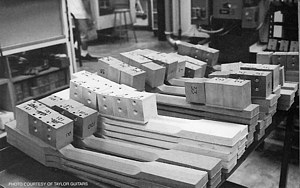
Advances in Efficiency and Technology

Factory production of guitars has become amazingly sophisticated, compared to how such work was done only twenty years ago, and is likely to continue on this course. Most notably, the changes are in the area of technical supermechanization and computerization in the service of efficiency and productivity. Parts are now routinely cut and shaped by computer-guided tooling, and human labor is increasingly limited to asssembly of parts, administrative support (office work, recordkeeping, accounting and billing, supply requisitioning, R & D, payroll, marketing and management), training, subcontracting, and tool maintenance — exactly as in any automobile assembly line. Subcontracting has grown to be an important part of all factory production, which is increasingly becoming a forum for the speedy assembly of components made by someone else and, increasingly, this someone else is in a foreign country where labor costs are low. Vacuum clamping has revolutionized the holding of parts as they are shaped and glued and has speeded up these processes dramatically, and new fast-drying glues made specifically for industrial production speed these processes along even further. New ultraviolet-cure finishes involve new technology coupled with the use of a new material, and have the advantage of allowing a guitar to be completely finished in around four hours, compared with days or weeks for the same results to be achieved with lacquers or urethanes. Electronics are continually improving and we have more and better ones to choose from than ever before. Guitarmaking at all levels has shifted from use of more or less trained and skilled labor into reliance on a general and institutionalized infrastructure of jigs, forms, molds and fixtures, the purpose of which is to insure error-proof repetitive operations by relatively unskilled workers.

The reliance on the new computer-operated tooling is daunting and dazzling to those who don’t work at that level. Insofar as its purpose is to eliminate as much as possible of the human factor in the production of identical parts, it is entirely logical to assume that one of the next steps will be to eliminate, as much as possible, the human component in the assembly operations. This is being done now robotically in the automobile-making and electronics industries. As commercial guitarmaking involves many of the same repetitive operations as any other manufacturing process has, there is no reason whatsoever to think that some form of robotics won’t be brought into guitarmaking as soon as it is feasible. The use of computers in record-keeping, inventorying, billing, designing and prototyping, desktop admaking and marketing, etc, — unknown twenty years ago — is now so commonplace as to be entirely unremarkable and even essential. Everyone has computers, beepers, faxes, cellular phones, modems, call-waiting, etc.

New and alternative materials

After technological advances, the next big item in the picture of changing commercial production is the growing reliance on new materials, finishes (already mentioned), adhesives and processes. Use of plastics and synthetics is steadily on the rise, starting in the l970s with Ovation’s space-age synthetic cast-body design, Adamas’ aluminum necks, phenolic resin fingerboards, increasing use of epoxy-graphite neck reinforcements, etc, etc, and currently ending in Rainsong’s graphite instrumens and Martin’s recent release of a guitar made out of high quality formica. Bet your boxers that we’ll see more of this kind of thing in the future. New quick-curing wood glues, cyanoacrylates and epoxies are now used commonly because of their obvious savings in time. The Breedlove guitar company has committed itself to using various plentifully available and sustainable yield domestic woods as an alternative to the traditional but rapidly disappearing rosewoods and other exotics; and their guitars are being found to sound good. Amplification systems are continually evolving and improving and have resulted in the steadily growing culture of acoustic-electric instruments: to list the newest equipment alone would probably fill up at least a page of text. The larger factories such as Taylor, Collings and Larrivee have switched to the new ultraviolet-cure urethanes; these are much easier to apply than other finishes, look good, and increase both productivity and profitability. And as soon as this technology becomes more easily affordable, smaller factories can be expected to follow suit.
Production of New Models

Commercial enterprises must produce new products continually. They are in the business of making mass-produced products for a mass market, and the mass market requires newness and differentness. Accordingly, new models appear regularly as old ones fade from popularity and/or new market niches are identified to be exploited. Thus we have the ongoing parade of small guitars, large guitars, entirely new models, re-issues of previous guitars, anniversary and commemorative issues, travel guitars, blue/green/red guitars, student guitars, collector’s editions and presentation models, use of materials in new combinations, electronics, features, etc., etc. Variety sells.

Improved Quality

It’s natural and logical to ask how all these things improve the quality of the final product. Making something faster sounds postive; but one might equally ask what is the advantage of making a plastic guitar more quickly, outside of the bottom line. This doesn’t seem like an unreasonable question. One should understand that the notion of quality in manufactured products is different than the notion of quality in individually made products. According to a guitar industry spokesman at a recent trade symposium, quality, from a factory point of view, is the same as replicability of components and efficiency of assembly. That is, the factory man considers quality to be the measure of how efficiently his parts can be identically made and how fast his instruments can be assembled in a consistent and trouble free manner. I’m not making this up: this is how the language is used. Some elements of design and assembly may in fact result in improvements in structure and response in a guitar, but these are incidental to the streamlining of the production operations. In fact, all the elements of the future of commercial production which I’ve been describing have more to do with the conditions of production than with the end product. I repeat: for commercial producers Quality = Efficiency of Assembly Process. If you trouble to peruse the professional and trade literature you will find that no other criterion is ever mentioned.

However, from the end user or musician’s point of view quality has nothing to do with any of this: it has to do with how playable a guitar is and how good it sounds. This also is, normally, the attitude of the small scale maker, for whom efficiency is important but secondary to his concern for creating a personal and effective tool for the musician. While the main ideal behind factory guitars is that they be made quickly, strong and salable, the highest ideal behind the handmade instrument is quality of sound, playability, and craftsmanship — even if the craftsman is inexperienced and falls short of this goal. These concerns, and how they are likely to play out in the future within the context of competition with factory made products such as those described above, will be the topic of the next, and final, installment of this series.

(reprinted from Fingerstyle Guitar, #42, 2001)

Posted in Features By Ervin, Guitar theory, history, opinions, sociology, wisdom, & insights Tagged The State of the Contemporary Guitar

The State of the Contemporary Guitar – 2/4

PART 2 OF 4    (Part 1,  Part 3,  Part 4)

by Ervin Somogyi

It has been pointed out that the classical guitar was established as a serious instrument within the timeline starting with Antonio Torres and ending with Andres Segovia. And one could equally maintain that this — now — is the golden age of the steel string guitar. Within the past forty years it has gone from being the virtually unknown backwater to the point that it has worked itself into all music, especially ethnic music, worldwide, and is now being used to play music that is serious, complex and challenging. The steel string guitar is experiencing an explosion of design, shape, dazzling and original ornamentation, technique, music, and, not least of all, seriously talented makers and players. From this, all kinds of glowing predictions have been made, and are continually made, about the nature and course of the guitar’s future. The logic seems to be that if there’s growth, things will grow in good directions, right? Well, yes, of course, you bet; just like the stock market. But if we want to project the direction of small-scale and commercial-level guitarmaking and design into the future, it will be a big help to understand what factors have driven change until now, and why.

We should start with the recognition that steel string and classical guitars are supposed to accomplish distinct musical tasks. This sounds obvious but, in fact, specific and different things are required and expected of these instruments by their players, their listeners, and even by the makers. Exactly what these guitars are expected to do, and how the luthier’s or factory’s work relates to producing these results, are the main subject of this article.

A very important difference between classical and steel string guitars is that classicals are typically not miked or amplified in performance, while steel strings are. Another is that the classical guitar is very largely a solo instrument, while in general only the fingerpicking steel string guitar is. The flatpicked steel string guitar is almost always a group instrument and often accompanies singing; being a group or accompanying instrument corresponds to the classical guitar’s secondary use. A third difference is that while classical guitars are, with few exceptions, played in standard tuning, the steel string guitar (particularly the fingerpicked one) is often played in quite a number of open tunings. This has great implications for both tone and musicality. A fourth is that steel string guitars’ internal construction is so different from classicals’ (for reasons of their needing to withstand greater string tensions as well as their different tone-producing dynamics) that they can be considered to be different instruments — to the point that steel string luthiers usually cannot make a good classical guitar, and vice versa. Some years ago Spanish luthiers started to make steel string guitars: they failed, stopped it, and haven’t tried again. This subject is highly interesting and so complex that I can only mention it in passing. It really needs its own article.
Let’s take a close look at the classical guitar first. On the level of serious performing, the challenge in building a good classical guitar is to produce the volume and projection necessary for a large hall. On the level of serious chamber (small setting) playing, the challenge is that it have all the voicings, dynamics and subtle tonal qualities which the repertoire and the player’s technique require. Let’s hear what some classical guitar authorities have to say on the subject:

Noted French classical luthier Daniel Friedrich speaks at length in Roy Courtnall’s book Making Master Guitars: “My early guitars were relatively simple; pleasant to play, and the sound was quite ‘explosive’. Since about l973 I have increased the weight and the guitars have more sustain, and a richer, sweeter sound, but they are still easy to play. . . Over the years I have tried to master the various qualities that different guitarists look for. Some players attack the strings heavily and they want a long sustain. This contrasts with the Latin-Americans like Alvaro Pierri, Roberto Aussel and Eduardo Fernandez, who want a sound that is more explosive, full-bodied, higher in contrast and very coloured, because they play with a lighter style. The pupils of Lagoya are looking for a sound that is powerful and sustained with a very even response. My personal taste, along with my style of playing tends towards a sound that is full-bodied, full of charm and depth, and more like a piano than a harpsichord. . . [For a period] I used East Indian rosewood which is often lighter in weight than Brazilian. This allowed me to make lighter instruments which are more sensitive to vibrato and tonal contrasts.”

Tom Humphrey, maker of the ‘Millenium’ model classical guitar, is quoted in the February l996 issue of Acoustic Guitar: “[My basic philosophy of guitar making is] simply that great guitars are conceived and constructed exclusively for the purpose of playing music. Yet to date no existing classical guitar has fulfilled all the musical requirements: dynamic range, sustain, voice balance and clarity, articulation, voice separation, volume and projection, color, and quality of sound. These elements are all part of the music being written for classical guitar.”

Sharon Isbin speaks on this subject in the August, l990, Acoustic Guitar: “The instrument I select must be able to respond to a wide variety of musical demands, from the contrapuntal complexities of a Bach fugue, to exotic tone contrasts in contemporary music, to the sensuality of Spanish music. [I test play . . . for] the following categories: sustain . . . beauty of tone . . . dynamic and timbral contasts . . . clarity and speed of response . . . balance . . . resonance . . . intonation . . . [absence of problematic] condition . . . and comfort.”

It’s not hard to find similar quotes from Narciso Yepes, Julian Bream and other classical guitar luminaries, but three are enough to illuminate a very impressive spectrum of goals for the luthier to aim towards. These statements, moreover, speak loudly to the fundamental consideration of classical guitar design — that the guitar is designed to be played by a musician with a trained musicality and technique, for people who are listening without distractions. Every serious classical guitarist’s main fantasy is to play in a concert hall, on a guitar that will be equal to the task.
In contrast, there is no such acoustic musical tradition, requirement of, or format for the steel string guitar or player. To begin with, technique and sensibility are still being developed: look at the relatively recent contributions of people like Leo Kottke, John Renbourn, Michael Hedges, Martin Simpson and Peppino D’Agostino. Second, the guitarist almost invariably plays into a microphone or amplification system which, unless it’s a very good quality system, renders the natural sound and power of the instrument secondary. The challenge for the steel string guitar luthier is threefold: first, to produce an instrument which requires the least electronic equalization in studio or stage conditions — in other words, a microphone-friendly guitar. This is important because microphones “hear” sound differently than the ear does: a guitar which sounds fine unamplified can easily sound dull, boomy or uneven when played into a microphone, and a guitar which records well does not necessarily sound good to the ear. The second challenge is to produce an instrument which, if it is not going to be electronically boosted out of all proportion to how it actually functions, can hold its own and be heard in a group musical setting. If accompanying voice, the guitar can’t be so loud that it drowns out the singer: its task in this setting is to accompany and be heard clearly, but not dominate. The third, and most acoustically important, challenge is to build a guitar which is actually and noticeably (that is, to those players who are sensitive to coloration and quality of tone, even if they do not yet have the language to articulate this to the layman) more responsive, sensitive, loud, even, musical, has superior dynamics and is easy to play.

Another important factor to be taken into account is that the repertoire for the serious steel string guitar, comparable to that which the classical guitar player has had available for over a century, is only beginning to exist. Much of what is available are arrangements, adaptations and transcriptions of earlier folk, traditional and fiddle tunes. Flatpickers such as Doc Watson, Tony Rice and Dan Crary have done seminal pioneering work in this area. But steel string guitar music which is to be taken seriously — that is, music which is well composed, which can be savored as it is listened to, and within which the dynamic possibilities of the guitar are explored and expanded — is only now being written, transcribed, arranged and played for the first time, most actively by fingerpickers, transcribers and arrangers such as Steve Hancoff, Ed Gerhard, Pat Donohue, Peppino d’Agostino, Peter Finger, Chris Proctor, Martin Simpson and a growing host of talented others. Likewise, the audience for a steel string guitar sound which can be appreciated on its own merits and which operates on a level of sophistication beyond the basic ability to discriminate bass from midrange from treble, is only beginning to emerge — as is also a common language for the qualities of steel string guitar sound. Tim Sparks (in the May-June 2000 issue of Fingerstyle Guitar magazine) is the first steel string guitarist I know of to articulate a need for qualities of voicing, coloration and response as specific as those which individuals in the classical guitar network [re-read to the quotes above] have been using and thinking in terms of for a long time. This is an important step forward.

For all the reasons outlined above, innovations and evolution in the classical guitar have generally been internally driven — by the needs of the music and by the sound-making and projective capacity of the soundbox — and the success of the design is judged by how well the soundbox can generate tone in response to the player’s skill. Such innovations normally have to do with bracing, wood thickness and mass, bridge design and stringing: the exterior aspect of the guitar is hardly affected. Currently, the luthiers best known for radical innovations in classical guitar design are Richard Schneider and Tom Humphrey — whose guitars do look different externally — and Greg Smallman, whose guitars don’t. The bulk of successful, world class classic luthiers — people like Friedrich, Romanillos, Brune, Velazquez, Ruck, Gilbert, Oribe, Elliott, Fleta, Ramirez, Hauser, Contreras, Kohno, Hopf, Bernabe, etc, etc, etc. — are known for refining the traditional design and producing a superior variation of it. But not for radically redesigning anything.

For contemporary steel string and electric guitars, on the other hand, multiplicity of shape, features and sound are hugely driven by external factors — that is, by the commercial producers, the marketers and the market. Steel string and the electric guitars are mostly mass market instruments: look at the advertising. The commercial music industry makes great efforts to introduce different and new brand- and feature-identifiable guitar models and to make them as attractive and saleable as possible through ad campaigns. Purchases are driven by endorsements and advertising at least as much as by personal or musical need, and success for commercially produced models is measured by viability in the marketplace as opposed to [re-read the quotes above] how well it plays music. Again, look at the advertising in any guitar/music publication during the past ten years. I’m not trying to insult the many talented individual luthiers who are producing wonderfully crafted steel string or electric guitars, nor the manufacturers who are trying to make a living by the rules of doing business. I am pointing out, though, that steel string and electric guitars pretty much have existed as commercially produced merchandise which has no unity of musical purpose outside of (1) accompanying singing and/or other instruments, generally in an amplified way, and (2) capturing a market niche for the producer. This is unfortunate, because most people don’t know what utterly beautiful sounds a well made steel string guitar is capable of making, nor what a revelation its lyricism and expressiveness can be. For an example, listen to anything recorded by Ed Gerhard. He produces a sound that can be savored and which is set off by the intelligent and sensitive use of something not much in evidence in a lot of steel string guitar music, although it is a normal element of much classical music: pauses.

Most musicians or would-be musicians are (and I think will always be) happy to get and play any number of comercially made guitars, and will be perfectly satisfied with their performance. However, those players who desire something unusual or unique, or want specific qualities of sound and response because their music is better for it, or simply want the personal touch, are more likely to find these in the instruments of any of the better hand makers. I see this as a trend which, while not exactly new, has only relatively recently become viable.

Part of the growth of steel string guitarists’ capacities to seek and find better guitars is the gradual emergence of a common vocabulary toward the discussion of steel string guitar sound. This vocabulary includes qualities like (l) loudness, (2) clarity, (3) evenness, and (4) sustain, which are self-explanatory. It also includes (5) dynamic range: the ability of an instrument to play quietly as well as loudly, to sound differently whether played near the bridge or near the soundhole, and in response to different attacks or picking strokes; (6) coloration: the mix of fundamental to overtone content in combination with sustain, which gives sound its richness, texture and “flavor” so a guitar can sound sweet, dry, evocative, romantic, sad, etc.; (7) projection: having to do with whether a guitar throws its sound out far from the player and whether it does so in a focused and directional way or radiates it in a multidirectional manner, or whether it primarily creates a cloud of sound which stays near the player; (8) voicing: related to dynamic range, and having to do with the rise-peak-decay envelope of the notes as controlled by the player: better guitars can make sharp, choppy or sweetly weeping sounds as well as smooth pear-shaped ones, depending on technique; (9) articulation: the quality of clarity, flow and connectedness in the music as a function of how even the same note sounds when played on different strings, as well as the player’s ability to get crisp, sharply defined notes or more fluid and rounder-edged ones from the same instrument; (10) separation: the ability of an instrument to make chordal music in which each string can be heard distinctly, as opposed to getting a cloud of undifferentiated sound; and, not least, (11) intonation: getting a steel string guitar to play perfectly in tune is more difficult than for a classical one, for reasons that are interesting and complicated and which deserve an article of their own. Because until recently an awful lot of steel string guitar playing consisted of strumming on first, second and third position chords, this has been a non-issue. But it’s changing.

Given this change in the musical environment and the types of expansion and growth we can now see in it, what changes could we expect, in response, for how future guitars are to be made and sound? I’ll address this topic in the next two installments of this series. In the meantime, check out some of Ed Gerhard’s music on a good sound system and see how many of the above described qualities of sound you can hear.

(reprinted from Fingerstyle Guitar, #41, 2000)

Posted in Features By Ervin, Guitar theory, history, opinions, sociology, wisdom, & insights Tagged State of the Contemporary Guitar

The State of the Contemporary Guitar – 1/4

PART 1 OF 4      (Part 2,  Part 3, Part 4)

by Ervin Somogyi

This is the first of a four part series on the state of contemporary American guitarmaking. I intend to sketch out the general landscape of how the guitar developed historically, what it is now, and, lastly, what shape I think it is likely to take in the future. As I am a professional luthier, I’m going to tell this story from my hands-on perspective. It’ll be a nice change from the editorial voice of commercial/music/factory industry, which already gets a lot of copy space. This is just as well, in my opinion, because the story of American lutherie is well worth knowing.
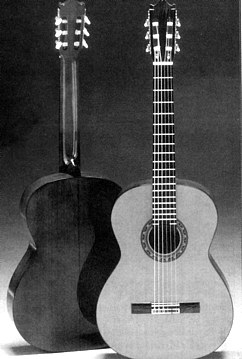
When I began building guitars thirty years ago there were very few independent guitarmakers around. Those few who had gravitated to this work were generally creative, not able or willing to work within the mainstream system, and personally rather eccentric. Borrowing or stealing what little guitarmaking lore had leaked over from Europe, virtually all of these early builders made classical and flamenco instruments in the “old fashioned” way — with carpentry tools. The mainstream system, as far as guitarmaking was concerned, consisted of American factories such as Martin, Gibson, Harmony, Guild, Gretsch, and Fender. Such Japanese and Taiwanese guitar factories as existed were turning out ornamental crap, and the only real luthiers anyone had ever heard of — like Ramirez, Torres, Orville Gibson, Santos Hernandez, C.F. Martin, Simplicio, Hauser, the Larson brothers and D’Angelico — were all long dead. This was not a lutherie environment rich in promise. Those very first independent guys really had a hard time fitting in, and they paid a high price for being trailblazers. Not a few of them fell by the wayside into craziness or simply disappeared, unable to make a living at lutherie. Their legacy to us is that they formed a nucleus of interest and possibility for newcomers who also wanted to work wood with their hands, to create something that had beauty and gave pleasure, and to have a life which offered a different flavor of meaning than that of American pop culture. We, who came later, owe them a lot.

American guitarmaking has come a long way since those early days by several measurable standards. First, a generation of American musical instrument makers has preserved, refined and extended an originally European tradition of woodworking which had lain moribund with disuse in this country, and made it viable. Second, whereas thirty years ago a luthier was mostly an object of curiosity and an anachronism, handmade lutherie (whether you are making two guitars a year or forty) is now a more or less familiar and accepted part of the American landscape. Consequently it is now more possible for a luthier to make, if not a living, at least some money at it. Third, the guitars which are being produced now are, on the average, much better than the average instrument produced then. Fourth, a generation of instrument makers has evolved which is not made up so much of hardcore mavericks, but rather of established professionals and intelligent amateurs who take their work seriously and with a great deal of justifiable pride. Fifth, an entire (and continually growing) body of literature and have been created by this group, where there were none at all before. Sixth, this general growth of interest in musical instrument construction has created the conditions which have made possible the rise of two national luthiers’ organizations; furthermore, these not only provide active forums for free exchange of information to anyone who has interest in this craft, but are in fact the leading sources of information for young instrument makers overseas. And, lastly, we have created the first generation of American luthiers who are considered world class. Not bad, for a bunch of guys who started out as self-taught hippies.

In this time, factory production has changed dramatically as well. While lutherie has grown from the romantic passion of the slow, carefully working amateur and enthusiast to the serious business of making a living — with all the jigging, tooling up, scheduling and paper/office work this requires — factory production has become almost unrecognizable in its investment into technology and large scale, high-speed and automated production. The use of new and synthetic materials has become common. Operator-run work stations are rapidly being replaced by computer-operated ones. Subcontracting has become an essential partner to assembly operations. Marketing and business strategies have become at least as important as design of product. And advertising has become an essential tool for assuring the public that the products in question are the best, the cutting edge, the state of the art, and even the most patriotic purchase. This has become an astoundingly sophisticated, complex and highly competitive business.

Whether you are a fan of individual lutherie or commercial/ factory production, these are the two main legs, so to speak, on which contemporary American guitarmaking stands. They are also the frame of reference for the writing of these articles. And, in order to bring this frame into better focus, I want to sketch out its beginings.

Origins of the Classical Guitar

The classical guitar is the first modern guitar. It is European in origin and it supplanted the earlier vihuelas, Baroque guitars, lutes, guitarras batentes and citterns to become the dominant portable stringed instrument of its time. Its body shape has been more or less universally agreed on for some l50 years, with rather little variation from one maker’s design to another apart from minor differences in size, internal bracing layout and the signature shape of each maker’s peghead.

The standardization of parameters for the modern guitar came into being with the work of Antonio de Torres around 1850, ending a period of extraordinary experimentation and diversity of design which followed the disappearance from use of the earlier fretted instruments. This quest for a more satisfactory musical instrument occurred within the context of a general European cultural expansion in music and musical entertainments, which was itself created by the social and political changes that gave rise to a new European middle class — a class with sufficient resources of disposable time and money with which to cultivate a taste for the various arts. If the design of the modern guitar was crystallized in the work of Antonio de Torres, it was then cast in concrete by the work and influence of Maestro Andres Segovia between l890 and l950. Segovia took an instrument which was considered a folk instrument at best, and virtually singlehandedly made it serious and respectable the world over. The students he taught, and in turn their students, are the leaders of the world of the classical guitar today. In their playing, in their teaching, in their promotion of proper playing technique, and in their position of moral authority these individuals have, together with the luthiers who made their instruments, defined what the classical guitar can do, needs to be, and is. I must add that everything said here about the classical guitar applies to flamenco guitars as well. Even though these instruments are played in distinctly different musical networks, there is evidence that there was no meaningful distinction made between “classical” and “flamenco” guitars, by either the makers or even most musicians, until the 1950s.

Classical and flamenco guitars originated within a tradition of hand craftsmanship of stringed instruments. This is not so much because hand craftsmanship is inherently superior, as that the roots of European lutherie predate the industrial revolution and its relentless mechanization of all modes of production. Hand craftsmanship was the only option for a long time. This is not a bad thing, because the level of skill brought to lutherie was unbelievable — as a visit to any museum with a good collection of historical string instruments will show. And, because this kind of lutherie was associated with real individuals, a tradition has been created whereby modern classical guitarmakers are the inheritors of some past heroes to look up to and whose work they can emulate. These revered icons, cousins to the illustrious icons of violinmaking (Amati, Stradivarius, etc.), are people like Antonio Torres, Hermann Hauser, Luis Panormo, the Fletas, the Ramirezes, Simplicio, Santos Hernandez and other historical European makers. Modern classical luthiers like to think of themselves as walking in these pioneers’ footsteps, or at least following the path that they traveled. None of this has stopped classical guitars from being produced in great numbers in factory settings; but the basic design has changed only minimally because the acceptability of this guitar’s design is still rooted in the traditional look, and traditional expectations still attach to it. The name of the game in contemporary classic guitar lutherie is adherence to and refinement of — rather than experimentation with or departure from — traditional design. Anyone who has ever gone into a classical guitar store will have been struck by the fact that, besides differences of coloration of their woods and minor details of design, these instruments all look remarkably alike. There are exceptions to this, of course, but as a rule it is the rare classical guitar maker who can make substantive changes in traditional design, and survive. This inflexibility of design does not apply, however, to the steel string guitar: quite the opposite, actually.
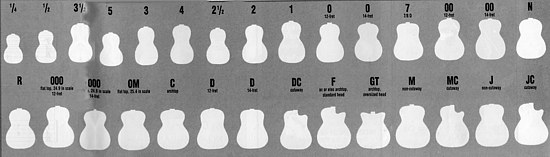
Origins of the Modern Steel String Guitar

Steel string guitars, unlike classicals, do not come to us from a tradition of handmaking. Also, unlike classicals, steel string guitars come in many shapes and sizes and seem to thrive on variety. There are dreadnoughts, jumbos, weird little travel guitars, concert models, parlor guitars, orchestra models, twelve and fourteen fret neck guitars, cutaways, bowlbacks and flatbacks, flat tops and arch tops, multiple neck instruments, electrified models, six stringed and twelve stringed and drone stringed guitars, fanned-fret and taper-bodied and bubble-top guitars, space-age plastic guitars, etc — not to mention the explosion of ornamental decoration and inlay which is the current rage, and, finally but not least, shapes or designs which are associated with a specific maker like Steve Klein, Larry Breedlove, Stefan Sobell, George Lowden, Jeff Traugott, myself and others. This list, moreover, is bound to expand. This plentitude is shaped by some important factors.

The steel string guitar is an American instrument, not European. It is much more a child of the mass market and technology than it is of tradition. Because of this, it is short on heroes, pioneers, or personal models. The first steel stringed guitars were made in this country by Old World trained violin and guitar makers who quickly went to small factory production in response to the needs of the American market — which were for plentiful, cheap, and easy-to-hear folk, parlor and band instruments. The godfathers of the steel string guitar aren’t seen as having established American lutherie; those whose names we remember today, such as Martin and Gibson, aimed at and achieved production, which is a different thing altogether. In fact, production became the model, and factories were for many decades the only sources of steel string guitars. Individual American lutherie in the craftsman tradition — with the exception of the Larson brothers and later John D’Angelico — did not flourish. In consequence, the contemporary steel string guitar maker has been deprived of a personal link to the past and must either identify with a largely factory/production tradition, or claim independence from tradition and sort of give birth to himself. There is now, finally, a small core of very talented contemporary steel string luthiers who serve as models for others. But, significantly, they’re all of the postwar generation and most of them are still alive. It’s not the same as having pioneer models from a hundred and fifty years ago.

In terms of having an individual musical identity of its own, the flat-top steel string guitar only began to be taken as a serious instrument some forty years ago, about the time when white society at large embraced the folk music movement. Before that, the guitar had an oddly divided life. In mainstream culture it was used largely in a parlor setting or as a folk, rhythm, band and accompanying instrument. In fringe society, on the other hand, jazz players like Django Reinhardt, Charlie Christian, Lonnie Johnson and Eddie Lang brought the guitar to life with an energy and musicality that was astoundingly original, and Delta blues players like Mississippi John Hurt, Robert Johnson and Big Bill Broonzy played soulful and evocative music of heartstopping expressiveness. But, outside its use in jazz and blues, there was no solo guitar to speak of until the 1950s. There wasn’t even a body of music specific to the guitar until relatively recently; most songs played or accompanied have been folk, traditional or popular melodies or fiddle tunes adapted to the guitar, or orchestral arrangements. The folk music culture of the sixties brought into public consciousness the Mississippi Delta blues stylists and singers who would otherwise now be forgotten but who strongly influenced a new generation of players, singers and music. Individuals like Hank Snow and Merle Travis pioneered the playing of actual melodies on the steel string guitar; this was subsequently refined wonderfully in the music of Chet Atkins. Doc Watson, within our lifetime, became the first serious steel string guitarist the world knew — and remained the only one for about ten years. He was joined by players like Clarence White, Tony Rice and Dan Crary, who became seminal influences in opening up the musical possibilities of flatpicked steel string guitar — and John Fahey and Leo Kottke, who are the initiators of the continually growing fingerpicking idiom which presently includes players such as Alex de Grassi, Chris Proctor, Peppino D’Agostino, Duck Baker, Peter Finger, Ed Gerhard, Martin Simpson, Don Ross, Pat Donohue, Doyle Dykes, Michael Hedges, Jacques Stotzem, Pierre Bensusan, John Renbourn, Bola Sete, Shun Komatsubara, Tim Sparks, and many, many others. This music is enriched by its receptivity to and inclusion of elements of folk, ethnic, ragtime, Celtic-Irish, jazz, blues, Latin, Caribbean, African, and classical music — and those instrumentalists such as Larry Coryell, Tim Sparks and Steve Hancoff who are transcribing for the guitar from orchestral and pianistic influences must also be acknowleged.

I mustn’t forget to include mention of the popularization of Hawaiian slack-key music through the efforts of musicians such as Keola Beamer, George Winston and Raymond Kane. And then, there’s the slide guitar. The list is long. Nonetheless, it is most important to note, with regard to the history of the modern steel string guitar, that it is so new that many of the very important people in its musical development are still alive (just like the postwar guitarmakers) and their music freely obtainable. I should also mention, finally, the phenomenally widespread and significant growth in this generation of the electric guitar, its music and its players — although this is a subject so far outside the scope of this article that its adherents have not only their own separate demographics, culture, magazines, icons, discography, books and publications, but clothing as well. All in all, the steel string guitar has had a long gestation period in which to soak up many complex and varied musical influences, strains and flavors — in exactly the same way the classical guitar simmered between about 1730 (the end of the dominance of the lute) and 1850. I think such simmering is a very good thing, and I’ll address some of the things this has led to in the next installment of this series.

(reprinted from Fingerstyle Guitar, #40, 2000)

Posted in Features By Ervin, Guitar theory, history, opinions, sociology, wisdom, & insights Tagged The State of the Contemporary Guitar

Principles of Guitar Dynamics and Design

by Ervin Somogyi

I’ve been building guitars for 22 years. I started out building flamenco guitars, which are my first real love. I still play them. Flamenco sank its harpoon into me early on and hasn’t let go; it’s a wonderful music.

The flamenco crowd, I soon learned, is not able to support a luthier. They have enough money to buy themselves Gaulois cigarettes, but that’s about it. The next logical step was to make classic guitars. I quickly found that the classical players are, to the luthier, not a very user-friendly group. They are picky and critical, and since I basically didn’t know what I was doing I found it impossible to please them. It was not a happy experience.

Steel string guitar people have a very different mind set. They are by and large prone to being uncritically friendly, accepting, and encouraging. Their comments are liberally peppered with statements like “Wow!” and “That’s great!” I found their company very appealing. I was able to thus delude myself that I was doing something worthwhile — until 1977, when I was invited to participate as one of seven exhibiting luthiers at the important Carmel Classic Guitar Festival. It was a turning point for me. Seeing my instruments next to those of serious and competent luthiers forced me to reevaluate the quality of the work I had been doing. Up to that point I had managed to live a fantasy and make a very meager living at it. I’ve solved one of those problems since, but I’m still working on the second one.

In spite of their critical stance, the classical crowd has a very useful tool: a disciplined approach which is in large measure missing among steel string luthiers. The classical guitar people that I meet really seem to pay attention to what they’re doing in an organized way. They measure, they listen, they interact much more freely and much more sophisticatedly with guitar players. They have a greater vocabulary in common about tone color, what the guitars do, what they don’t do. Steel string guitar people do not yet have the tradition of this kind of discipline, but I think that will change when the more freeflowing character of the steel string guitar world recognizes the benefit and advantage of it.

The guitar is a relative newcomer to the stringed instrument scene. Before the guitar, the lute was absolutely the most popular plucked string instrument in the Western world. The lute served a very specific musical purpose, which it was no longer able to fulfill as the nature of musical tastes and entertainment changed with the rise of the European middle class. The lute became less and less a courtly chamber instrument and was more often expected to perform for the new bourgeoisie in larger halls and rooms. That was when the problems began. Lutes were really not loud enough. Instrument makers kept making lutes bigger and adding strings, but there were many problems with these approaches. The piano came into being in this period for the same reason: its sound could carry.
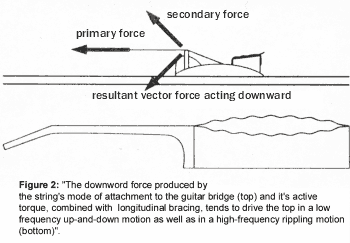
As far as I’m concerned, the guitar replaced the lute as the most popular plucked string instrument because it was able to solve the problem that the lute could not: being heard in a large room. It did so through the development of three specific design features: the bridge with a saddle positioned in the middle of the soundboard; the vibrating back; and longitudinal bracing.

Let’s talk about the bridge first. The lute’s bridge is simply a tie block. The forces acting on the bridge of the lute are almost exclusively in line with the pull of the strings. This drives the face in a specific and limited way, tending toward high-frequency, low-amplitude motions. (See Figure 1) The significant thing about the design of the contemporary guitar bridge is that not only is there a longitudinal force acting, as in the lute, but by virtue of the break angle of the strings as they pass over the saddle a vector force is created which actually pushes downward on the face. This drives the face in a different way, creating different tonal possibilities. (See Figure 2)

The fact that the guitar bridge is in the middle of the lower bout creates yet more tonal possibilities, but I’ll get back to this point later.
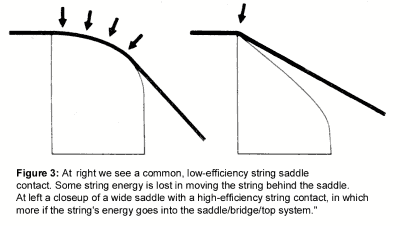
The saddle, in addition to helping to create the strings’ downward push, is an important coupling mechanism between the strings and the guitar face. If you do nothing to the guitar except change the saddle from a tight fit to a loose fit, you will absolutely lose volume. The fit is critical. Physicists have found that the guitar is a very inefficient sound-producing system. On the average, for each stroke of the strings, about 95% of the kinetic energy thus generated goes to mechanical vibration and is also dissipated as heat and friction. Only about 5% of the moving energy of the strings becomes sound — and if you lose some of this energy at the saddle you will get a disproportionate loss to the instrument. I am concerned that the material the saddle is made of be noncompressible, hard and stiff. I don’t use plastic because I feel it will absorb and damp some of the string vibrational energy. I’ve almost always used bone, except at one point where I was using melamine from cut-up dinner plates.

The average saddle is 3/32″ to 1/8″ wide. I use saddles that are 3/16″ or more wide because it makes a saddle wide enough to offer adequate intonation compensation on a steel string guitar. The rationale for intonation compensation is the subject of another talk, but I want to say one thing about the contact characteristics between the strings and the saddle. If you have two virtually identical guitars one of which has the strings resting on a single high point of the saddle, and the other with the strings resting on a significant portion of the saddle’s top, I think you’ll find this second guitar works better. There is a better and more efficient coupling of kinetic string energy to the saddle by virtue of that extended contact. I can’t prove this, but I suspect if you pay attention to it you’ll get better results. (See Figure 3)

The second feature of the guitar that made it more successful than the lute was the vibrating back. The lute has a sound chamber with its own natural resonant air frequency, as does the guitar. But by virtue of its construction the lute’s sides and back are one piece and very rigid. If you have a second vibrating diaphragm, which the guitar back is, more possibilities come into play because the guitar’s back is active — it actually does something. Try this: put your guitar in its case and gently tap on or near the bridge and listen to the sound you get. This is the sound of the top only, with the back damped. Then lift the guitar partially out of the case so it’s not lying on its back and tap it the same way again. You’ll hear a very different sound. This is the sound of the top interacting actively with the back. In a similar way, when you are playing a guitar the strings excite the bridge and the face and then the air mass, which in turn excites the back, and the back starts to vibrate in some frequency relationship to the movement of the top. The most successful guitars have the back tuned in relationship to the top so that they act together and make a guitar that really projects. In physics this phenomenon is called constructive interference. When the top and the back are mismatched in vibrational activity they are in effect fighting each other, and this is called destructive interference. It is the same phenomenon you observed in high school physics class when you hung a weight from a rubber band and tried to move the weight by tugging on the rubber band: you had to do it at a certain frequency, and when you found that frequency the weight moved with little effort on your part. Otherwise the mass of the weight created resistance to its movement. In this example you are like the guitar top — the driver — and the weight is the guitar back. In the guitar the back contributes to projection and sustain — or relative lack of them, if the top and back plates are working against each other.

The third factor in the success of the guitar was the pioneering use of longitudinal bracing, in tandem with a more centrally located bridge. Lutes had only ladder bracing, with the bridge at 1/6 the length of the face from its bottom. Longitudinal bracing allows the bridge to couple to a larger portion of the soundboard than otherwise and impel it to movement. Positioning the bridge nearer the middle of the soundboard helps in this, because a central point of initial impetus usually means you can drive a larger plate and larger air mass. This simply translates to greater volume. Tap at the edge of any guitar soundboard, and then tap in the middle and listen to only the loudness of response, regardless of tone: you’ll immediately hear what I mean.

The importance of longitudinal bracing is central to the success of the guitar because the guitar is basically an air pump, and in lutherie we need to concern ourselves with how efficiently the guitar can pump air. All other considerations, such as choice of woods and how pretty they are, must be subordinated to this if you want to make a successful guitar.

One way you can get a reading of this air-pumping function is to gently tap a guitar top at the bridge while holding your other hand in front of the soundhole. You will feel a displacement of air from within the sound cavity. You can feel the guitar breathe on you. On better guitars you can feel more air coming out because the top is more responsive; it responds more to the energy of your finger. Dead-sounding guitars won’t be found to breathe on you as much.

A second way of getting a reading as to how freely the guitar is able to pump air is in the sound of the tap tone you just delivered, if you did this exercise. Again, this is very subjective, but still a very useful comparative way to get some sense, some keying in as to what is going on. If the guitar top is tight, stiff, overbuilt, heavy past certain limits (which most commercial guitars are), it’ll sound somewhat like a table top — high, tight, and solid. If the guitar top is free to move, the pitch of the tap tone will go down and the sound emitted will be markedly more open. Obviously there are limits in making soundboards light past which you shouldn’t go because you’ll destroy the integrity of the guitar, but most guitars are so overbuilt that I don’t think you have to be afraid of going in this direction. If you will go around the guitars in the exhibition hall, I’ll be very surprised if you don’t find that the better ones are just more responsive when you do something as simple as tapping.

There are yet other ways of keying in as to how sensitive the guitar is, how sensitive to the vibration and energy of the strings the guitar top and back can be. One fun way is to use a so-called super ball. If something has high internal damping then energy put into the system — in this case the kinetic energy generated via gravity by dropping this ball to the ground — is dissipated by mechanical distortion into heat and internal friction, and this ball won’t bounce back up very high. This particular ball bounces up off the floor almost to its starting point, so it does not have high internal damping. You can get one of these balls and go around the exhibition hall… (laughter) …and bounce this off the tops of some guitars. Some guitars will produce a higher bounce than others. This is kind of a childishly dumb thing to do but it’s a lot of fun (laughter). Some guitars are instructive and you can really learn something from this: the higher the bounce, the more solidly the top is constructed; the less the bounce, the more yielding and responsive the top is. This is really not much different from what the strings do, except that strings are expected to make music when they move the soundboard.

While I believe the degree to which a guitar is successful is in direct relation to the extent that you can free the soundboard up to pump air, this is only part of the story. There are many specific ways in which the guitar top moves, vibrates and flexes in its use of string energy so as to generate a wide spectrum of tones. The lower bout, the area surrounding the bridge, is the main arena for this activity. Let’s examine some of what goes on here when the bridge moves.

How does the bridge work? In what way will the bridge couple with the face? In what way does the bridge transmit the kinetic energy of the strings to the rest of the system so we can ultimately hear music? The guitar bridge moves in three modes: (1) it pumps up and down as a unit; (2) it rocks backward and forward in line with the pull of the strings; and (3) it seesaws sideways around the center line, at right angles to the strings. (See Figure 4) You get a hands-on sense of how much the bridge moves laterally in the following way. Put your fingertips very lightly on one end of the bridge, then tap on the other end. Unless the guitar is heavily overbraced you’ll feel lateral displacement as the bridge rocks from side to side. You’ll feel the motion on one end of the bridge as you tap the opposite end. You may feel a lot or you may feel only a little, but you will feel something. Classic guitar bridges move laterally a lot more than steel string guitar bridges do, by virtue of both construction and bracing.

I’m going to bypass entirely the subject of top selection so let’s assume for the time being that we’ve picked a good piece of wood for the top. Then we have to figure out how to work and shape it. I’m going to try to simplify for you my image of how the top vibrates. I have the innards of a little music box here. This is dime-store stuff but it’s a useful indicator of a fundamental principle of guitar dynamics. (Winds up music box and holds up to the audience). Now this thing here, nobody can hear it. You’re not supposed to hear it. There’s no resonator on it. It’s not exciting enough air for anyone to hear it. The instant you put this on a surface that can take its vibrational energy and excite more air… well, let’s see what happens. (Places the music box on the surface of a table) Maybe you people in the front rows can hear this? Now this isn’t a guitar, it’s a piece of fine furniture. (Laughter). When I place the music box on the top of this guitar the sound can probably be heard a few more rows in the back. So, the guitar will take the energy and excite yet more air with it. And what of the specific sound quality? To make a long story short, what I hear when I put this gizmo on the perimeter of a guitar top is a bright and tinny sound: the high notes are really kind of shrill and piercing. The bass notes in the song are not very distinguishable in quality from the high notes. Now I put the music box, this sophisticated frequency generator, on this guitar near the bridge — a very important place. I notice that there is much more range. Placed over the bridge I can hear lows as well as the highs. This is not a $4000 signal generator, but it shows what a guitar will do when stimulated in different places. If we did this enough we would conclude that driving of the midportion of the guitar face results in a generally fundamental, bassy, full, and loud sound. Activation of the perimeter results in treble activity. This makes perfect sense, as the center of the soundboard is the most yielding part and is thus able to support high amplitude, low frequency activity. The edge, being more rigid, is the logical place for high frequency, low amplitude activity to occur. The top can move as in Figure 5, acting more or less as a unit. That’s bass. The top can also move as in Figure 6, shaking and quivering like a bowl of jello left on your washing machine during the spin cycle. That’s treble.
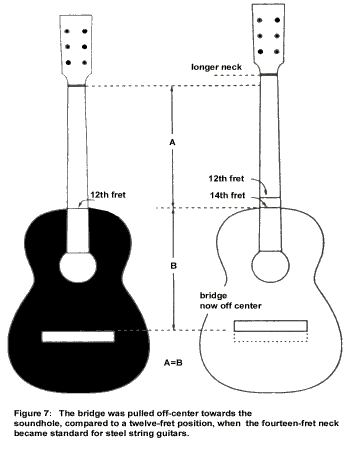
This is an important clue to brace design. In planning a bracing system, these are the kinds of top motion which you have to plan for, and plan for with respect to a point of primary excitation of the soundboard, in addition to considerations of selection of woods, thicknessing, and bracing. That is, whatever else you do, you have to plan it with regard to where the bridge will be.

Historically, the bridge was placed smack-dab in the middle of the lower bout of early guitars, with a twelve-fret neck sticking out of the body. (See Figure 7) In the 1930s, in response to musicians wanting a more fully accessible fingerboard, steel string guitar makers discovered that players could have an extra two frets worth of fingerboard by making a fourteen-fret-to-the-body neck. This involved shifting the point of bridge attachment that much nearer the soundhole, but bypassed the need to install a cutaway into the instrument. It was a quick fix, and a successful one. But it also required planning the bracing around the new point of bridge attachment. If you install a bridge at the fourteen-fret neck position on a guitar previously braced for a twelve-fret neck you will have acoustic interference from the bracing, and a less than successful guitar. Bracing work involves positioning, as well as shaping.
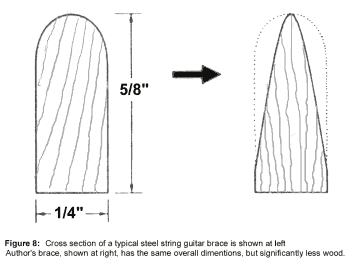
Bracing is a complicated and never-ending puzzle. I’m sure that throughout my lifetime, and maybe even my children and grandchildren’s lifetimes, controversy will rage about what is the best bracing system. The fact of the matter is that successful guitars have been built with just about every conceivable bracing system. Superb guitars are built with symmetrical bracing systems. Wonderful guitars are built with asymmetrical systems. I’m led to believe that a bracing system as a recipe approach has little virtue. It’s best when it’s part of a context, an thought-out process. To say only that I use X bracing, or Sitka spruce, is by itself relatively meaningless. I will touch on this again in a few minutes.

Traditionally, guitars were strung with gut and came out of a European tradition of individual people like ourselves working in small shops. They paid a lot of attention to what they were doing, the skills being passed on by the best makers into their families for generations. The tradition of making steel-string guitars, however, is American and has almost always been a factory one. Until recently there have been very few independent luthiers making steel string guitars.

You’ve all seen this kind of guitar top before: this is a Martin guitar top. This is the standard today. It is the pattern, the most common way to construct and brace a steel-string guitar in the world. Almost everyone copies it. This is the Somogyi version of the X braced guitar top. Let me talk to you about how these two differ. Before I get into this, though, I want to say that I’m not picking on the Martin guitar design; I have this Martin top because the Martin people were nice enough to give me one when I asked. Other companies I asked a top from, didn’t.

To understand my thinking about guitar soundboard design I want to talk to you about the strength-to-weight ratios of woods and about basic guitar dynamics. The strength-to-weight ratio is a number that expresses how strong or stiff something is, per unit of mass. It is my opinion that it is important to know this about the woods you use. I place weights on my woods when taken to certain standard sizes and measure the deflection; weigh in grams for a measure of mass. Guitar dynamics are the study of how a guitar top moves.

In his book Understanding Wood Bruce Hoadley says that the load bearing capacity of a piece of wood is reduced by 50% when you reduce its height by 20%. This is a pretty startling statistic. So if you take, as an example, a floor joist that is a 2 x 10, and then take another that is a 2 x 8, the latter has only half the load bearing capacity of the former. This strength-to-height relationship has some bearing on the design of guitar braces.

This is a cross section of your average guitar brace. (See Figure 8) Usually it’ll be quartersawn or close to quartersawn. The possibilities for designing braces are virtually endless, ranging along a continuum from low and flat to high and thin, and complicated by whatever contour of scalloping and high points exist along their lengths. What I want to achieve when I make a guitar is done in part by picking woods that have a favorable strength to weight ratio. I want woods that are strong and lightweight. Therefore one way in which my braces are different from standard lies in my choice of materials. Secondly, I and other luthiers like myself are concerned with maximizing the strength to weight ratios of our soundboards. We want to make the guitar as strong as we can while making it as lightly constructed as we can. We don’t want to reduce the height of braces significantly, because as Mr. Hoadley points out, the cost of this to brace strength is considerable. But we want to reduce the mass. I would like to invite you to later step up here and pick up both of these sample tops and compare just how much wood is in each one. You’ll notice that one feels noticeably heavier than the other. My way to achieve this difference is to leave the height on the brace but to lessen mass by making the brace slimmer. This probably does remove some strength, but I believe that it does so in a favorable relationship to the weight that is lost. My approach is to have thin, high braces throughout my guitars. (See Figure 8)
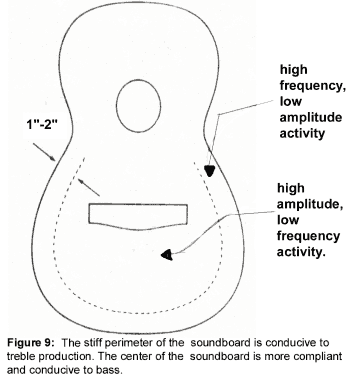
Fred Dickens: You seem to be using the terms stiffness and strength interchangeably. Is that your intention?

I take my woods down to a standard thickness which is greater than the final thickness, put a weight on it and measure how much deflection there is. I call this stiffness and do use this word interchangeably with strength.

About guitar dynamics: are some fundamental differences between steel string and classic guitars, which affect bracing. In part because the steel string guitar is driven by a much heavier metal string, the tendency for it is to be very bright and trebly. The nylon string guitar, on the other hand, wants to be bass-heavy (within the potentials of nylon string response) when left to its own devices. The job of the luthier is to work the wood so as to shift the response spectrum in the desired direction. It’s very hard to make a well balanced classic guitar that has a clear, ringing treble: that’s the whole trick. Likewise, it’s really difficult to make a steel string guitar that has a rich, deep, satisfying bass. You have to do specific things to the soundboards to achieve these things. Furthermore, a luthier has to figure out how to achieve a balanced sound — how to get energy input from the point of primary excitation of the face — the bridge — in both types of guitars to adequately effect both high frequency, low amplitude vibrations and low frequency, high amplitude movement. While there are endless things to be said about bracing systems, plans, and distribution, as well as the selection of bracing woods, I want to remind you of the indicator that we got earlier from that little music box where we heard bright, shrill notes from the edge of the soundboard and heard mellower notes from the soundboard’s center. It reveals that one should pay attention to the perimeter if one wishes to manipulate the high end frequency response of the guitar, and pay attention to the area near and around the bridge if one wishes to manipulate the low end. (See Figure 9) For these reasons you will notice that the profiles of the braces in my guitar top differ from the profiles of the braces in the Martin guitar top, even though their layout is about the same in both cases: my X is lower and my perimeter bracing is higher.

In the steel string guitar, an X brace system is almost always notched together at the intersection of the two main braces. This is an important load-bearing point, and it takes us back to our thinking about strength-to-weight ratios and Bruce Hoadlely’s formula. The main effect of notching the legs of the X brace so they can be fitted together is to turn two large, strong braces into the equivalent of two much smaller and weaker — but still massive — braces. (See Figure 10) This circumstance is bound to affect the response you get from a guitar. The typical factory way of capping the otherwise open X notch is to glue a little piece of muslin cloth on top. If you are concerned with strength to weight ratios and the load bearing capacity of your braces, I think it makes no sense to shoot yourself in the foot by cutting a huge notch in your braces, after all the work you’ve done, without trying to reestablish their original strength by bridging the notch cut. (See Figure 11) Bridging, or capping, the X notch will tie one part of the interrupted brace to the other part, and will prevent the opening and closing of the notch under soundboard movement.

While the X brace is ostensibly designed to have a certain strength, but the minute you cut a notch into it and leave the notch uncapped it’s much, much weaker than before.
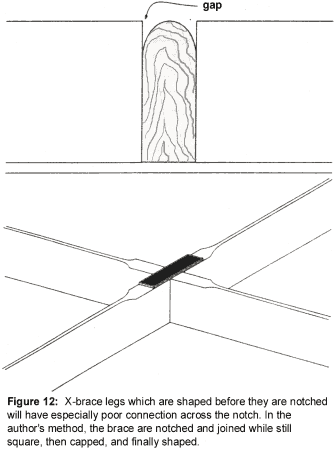
One way that I know this is important is by testing it. I made a guitar some years ago which had a capped X brace, but its sound was not satisfying to me. I thought that the bracing was too stiff for the sound that I wanted and I concluded that I would get better results if I shaved the X brace down. I reached in through the soundhole with a palm plane and shaved about 3/16″ off, right through the cap. With the newly-lowered X braces and opened X joint, the character of that guitar’s bass response changed radically. I had changed the strength to weight ratio of the X too much. I recapped the X brace at its intersection and again the sound changed noticeably, for the better. What an astonishing difference removing and regluing a fraction of an ounce of wood made, so long as it was in the right spot. Cutting through that little cap turned out to be a useful mistake for me to have make.

There are a lot of people now capping their X brace joints, including the Japanese. They, by the way, seem to pay more attention to details in the construction of their guitars, even the factory ones, than any American manufacturer I’m aware of.

Audience: have you ever taken the cloth patch from the intersection of the X brace and replaced it with a wood bridge?

I have, but you have to cut back quite a bit to get a flat enough gluing surface to get a cap onto. It’s more of an operation than you might think. One thing you’ll notice on my guitar top is that even though my X braces are tapered in cross-section they are rectangular in cross-section at their intersection: this makes a really tight and very efficient joint. (See Figure 12) I don’t take any wood from inside the notch, as happens when braces are rounded before they are notched together.
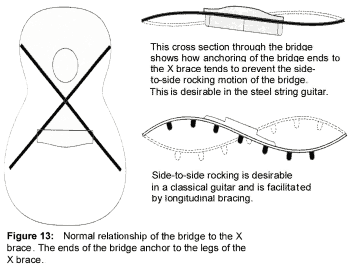
Audience: you talked about the shape of the braces but could you talk a bit on the angle of the intersection of the X brace?

My way of thinking is to concentrate on the bridge activity in relation to brace position. These always work in relationship to one another. Let’s take the Martin X brace pattern for an example: the wings of the bridge are normally coupled onto the legs of the X brace as you can see here in Figure 13. Do you recall my example some minutes ago of tapping on one wing of a bridge and sensing the movement of the other wing? In all guitars this is an important bridge motion. In the steel string guitar this coupling is defined by the angle of the X and allows certain degree of bridge rocking. This motion will support the creation of a steel string guitar sound. This sound, then, is made as a function of the effectiveness of the bridge-brace coupling.

In the classic guitar the bridge has more freedom to move in this rocking mode, because the classical guitar usually has longitudinal braces which more or less allow this lateral movement. Those of you who were at Robert Ruck’s workshop might have heard him say that some of his models that had angled fan braces responded differently. It is my belief that these angled braces are dynamically and acoustically replicating the anchoring work of the X brace, which acts to inhibit bridge rocking compared with longitudinal bracing.
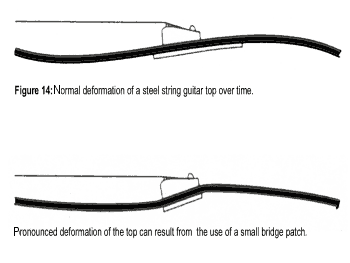
Therefore, if we change the angle of the X on a steel string guitar so that the bridge is not so fully held back in its rocking movement, if the bridge is freed or otherwise encouraged to move more actively in this way, then the response spectrum of the guitar will be shifted toward that of a classic guitar — you will get a higher, brighter sound. So that’s my way of answering that.

Colin Kaminski: could you comment on bridge patch size, selection and stiffness and what kind of tone you can expect from these variables.

I had a very instructive disaster some years ago. had built a guitar that had the most wonderful, heavenly bass of anything I had ever made. The treble was OK but the bass had a gorgeous, lovely tone like honey, full and rich, and unencumbered by harmonics that you could distinguish. I loaned it to a friend who mistreated it. He brought it back after a month, during which time he had had another luthier cut the bridge down. This was unforgivably stupid of him and I was very upset. But mainly, the guitar no longer had the tone. I replaced the bridge. I weigh everything: I think one of the most useful lutherie tools is a triple beam balance. Working with strength-to-weight ratios means needing to know how much things weigh, and I don’t want my bridges to be heavier or lighter than a certain optimal range of about 35 grams. Anyway, this other luthier had messed up my bridge so I put a new one on, reestablishing an original parameter of the instrument. But the tone didn’t improve. I didn’t know what else to do so I hung the guitar on the wall. One day I was walking by it and noticed that the light from the windows reflected in the lacquer of the face revealed a noticeable deformation. I became aware of it then because the light was focused on it. The face was markedly distorted and dimpled specifically at the bridge and all around it. What had started as a straight, flat piece of wood had become bent all around the bridge by the torquing action of the strings. And this had been allowed to happen because there was virtually nothing under the bridge to guard against this kind of deformation. At that point I started to install bigger bridge patches on my guitars. (See Figure 14)

One of the things I’ve learned to do in lutherie is to think long term. The guitar is not going to be the same down the road. In a year or so woods will have settled, strings will have pulled something into or out of alignment, and this is one of the forces which guitars are subject to. The distortion in this guitar was caused because I had put in a very small bridge patch, and I don’t do that any more. It cost me the most wonderful bass I’ve ever had, but I learned something from it.

Audience: Did you ever know what caused the loss of that great tone?

No, I never know anything for certain. Everything in lutherie is intelligent guesses. My guess was that because I had noticed a sudden, marked deformation of the face around the bridge, a physical change had occurred which affected the tensile strength of the face and affected its movement. My response t it was to replace the bridge because it had been cut down, and I chose not to put a new bridge patch under it later. I don’t believe it would have distorted as it did had it had a larger bridge patch to begin with — and perhaps it would not have had the same tone then, as the mass would have been different. But whatever it had, it would probably have retained its sound. I kept the guitar on the wall and it was sold to someone who was wonderfully happy with it.

This is another factor in lutherie. The instruments you’re going to like, other people might not; the instruments you might feel indifferent to, others may not be able to live without. So that story had a happy ending. Someone got a good guitar and I learned something.

Audience: you say anything about the domestic woods which are being used instead of the traditional imported woods?

Yes. Do you remember my comments on the nature of the constructive interaction between the guitar top and the guitar back, in a better guitar? Well, the shift from the traditional rosewoods into the “alternative” woods will have to come to terms with this. These are not going to be bad woods, but they will do different things and we need to come to grips with that.

Brazilian rosewood is like glass, and it goes “pinnnnnnngggg” when you tap it. It has very little internal damping, which means that when you put energy into it in the form of a tap (or playing on a string) it’s not dissipated away in heat and internal friction. It’s retained in the form of mechanical vibration, excitation of air, and hence sound. The maples and mahoganies and walnuts have much less of that. So as the back begins to move, if the back has more internal damping, you’ll get a different sound, one characterized by shorter duration of tone. To the degree that you can couple the action of the back with the action of the top you’ll have projection, but this relationship needs to be worked out for each wood individually. There’s no reason you can’t have a good non-rosewood guitar. But I find that talking categorically about woods is not very useful because there can be such great variation within a species. maples are wonderful; others I’m not interested in. The same with walnut. Some koas are as dense as rosewood and some are practically so light that if you sneeze the board blows over. Mahogany, likewise, is much more different from board to board than rosewood is. That’s the virtue of rosewood: it’s much more uniform in working properties. I can only say, good luck to you in your quest for the best sound you can make. Good luck to all of us.

(reprinted from American Lutherie, #36, Winter, 1993)

Posted in Features By Ervin, Guitar theory, history, opinions, sociology, wisdom, & insights

Categories:

How I became a guitar maker

Guitar theory, history, opinions, sociology, wisdom, & insights

Thoughts, essays, & musings

Humor & Personal Anecdotes

What I’ve been up to, thinking, and otherwise doing

© Ervin Somogyi 2026. Powered by WordPress