Craftsmanship, Sound, ‘The Right Look’, Materials, and the Marketing of the Guitar
May, 2010
Everyone in the guitar making and selling business makes their guitars as shiny and beautifully attractive as they can. They also cite their guitars’ sound as a selling point. And they invariably tell you or imply that their wares have good quality. Why would they not? A further selling point might also be that you should buy a particular guitar because some prominent person out there has one just like it. Is this quality? Not at all: it’s simply how the world works.
I’ll return to the subject of sound further on.
ON QUALITY AND CRAFTSMANSHIP/WORKMANSHIP
One can quibble endlessly about what is and what is not Quality. I pointed out in a previous essay that quality means quite different things to different people. For the buyer, it is greater functionality, durability, craftsmanship, and satisfactoriness. For the manufacturer it generally means problem-free production, consistency of product (minimal number of rejects/seconds), and a good bottom line. For the seller it means sellable, and no complaints or returns.
Let’s look at this from your perspective. For you as a buyer Craftsmanship/ Workmanship will have to do with anything that is done purposefully and with skill. Therefore, you might want to find out what you’re really paying for in terms of who had done what work. It is increasingly common for luthiers to get their guitar necks, bridges, and other parts made by a CNC service. So the question for you becomes: am I paying for your luthier’s craftsmanship, or for his assembling parts that he subcontracted with someone else with high-tech equipment to make? Don’t get me wrong, technology embodies a lot of skill and craftsmanship: someone had to create the machinery and the computer software that will do a complex task at the touch of a button. But technology, by itself, offers no craftsmanship of its own: it is aimed at well-greased rote procedures. And you should know whether you’re being expected to pay for actual craftsmanship or someone else’s prior (and expensive) craftsmanship that is embodied in a (bought or leased) push-button format. Amazingly, this makes no difference to some people.
Still, as long as we are focused on craftsmanship, there are things that one should expect to see, hear, and find on an expensive new guitar (vintage guitars are subject to different standards) that won’t be features of cheaper instruments. My own list would include the following. They are all features that my guitars have, and each one of them takes extra time, attention and effort to do.
** Impeccably clean workmanship. ‘Workmanship’ here implies hand work, not machine work. That means smooth, ripple-free surfaces that bespeak of good wood preparation, a lack of visible file or sandpaper marks, and crisp joints, seams, and edges. The finish should be mirror-smooth and free of the tiny scratches that buffing wheels leave. If you’re considering buying a guitar I’d recommend that you spend a good ten or fifteen minutes carefully looking it over to get a sense of the workmanship in it; use a magnifying glass if necessary.
** All-wood construction and appointments such as bindings and purflings. This comes automatically on classic guitars, but steel string guitars very often have plastic bindings and tuner buttons, etc., because the market has long since accepted these. Wood is better. Solid wood is best for soundbox construction; plywoods are characteristic of cheaply made instruments.
** Mitered [like picture-frame corners] purfling joints. Every angled juncture of line elements should be a mitered joint, not a butted one.
** If tone is your focus, then straight-grained body woods are more desirable (and also more scarce) than highly figured and wavy ones. The straighter the grain the more stable and predictable are the vibrational properties of the soundbox.
** The body woods on expensive acoustic guitars are traditionally rosewoods. The most expensive of these are straight-grain Brazilian; the second choice is East Indian. Other woods on expensive guitars can be alternative rosewoods, figured maple, figured koa, and figured mahogany. Topwoods are typically spruce, or sometimes cedar. In my opinion European spruce and Sitka spruce have equivalent tonal potential, in spite of the fact that most people have been taught to believe that the former is better than the latter. Being an import, it’s merely more expensive.
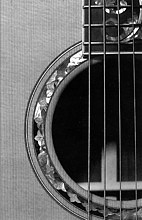
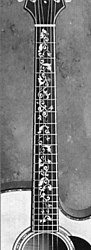
** A certain amount of customizing (without altering the identity of a guitar) is a real plus; it is not unreasonable to expect some original inlay work such as beautiful shop-made rosettes. Some guitars are so ornamented that they stop being guitars and have become artwork that uses guitar-shaped wood as a canvas. Such guitars really belong in art galleries, not music stores.
** Delicate elements such as small-profile heels. A guitar’s typical neck-heel curve is a 4″ diameter one, achieved by the front roller of a belt sander. Smaller heel curves require more work and are ergonomic: they let the left hand get closer to the high frets.
** Ergonomically offset strings: there should be more clearance between the first string and the edge of the fretboard (so that the string doesn’t pull off during play) than between the sixth string and its edge of the fretboard.
** Evenly spaced strings. You’d be surprised at how many guitars are sloppy on this feature.
** Rounded, not beveled, fret ends. Rounded ends provide more playing area than beveled frets do
** If at all possible, custom-shaped necks contoured and matched to the individual’s hand and style of playing. But this is more likely when commissioning a new guitar instead of buying an already-made one.
** If the guitar is a cutaway model, the cutaway should blend seamlessly into the neck and heel, without the ‘corners’ that many guitars offer. In fact, seamlessness of construction is always a clue that something is better made.
** Heelcaps are best if they are an extension of the surface of the back, rather than being a stepped point of discontinuity. This goes to the fact that, historically, the most expensive and prized guitars have been made using the Spanish method, in which the necks are firmly part of the guitar body. This allowed the heel and the back to become one uninterrupted surface. Lately, and especially in steel string guitars, bolt-on necks have been making inroads into high-priced guitar territory; heels and guitar backs do not meet in such cases. Traditionalists think this manner of building guitars is of second-best level construction.
** Intelligent voicing. Most buyers won’t know what to look for, but the guitar’s responsiveness will be the proof of this factor. If the guitar’s sound surprises and pleases you, you’ll have one of these in your hands. Your pleasure will be the fruit of years of experience on the maker’s part.
** Extensive hand work at every stage and level of the instrument. Production facilities make money in direct proportion to how much time they can save at each step. One should expect to see handmade rosettes rather than commercially bought ones, on fine guitars; and also tasteful additional touches such as wrap-around fingerboard bindings and heelcap inlays. If aesthetics are something unfamiliar to you, consider taking an art appreciation class in night school. Or pay someone who knows what’s what for a few hours of their time.
** Thin finishes. These are more work-intensive to apply and buff out, but make a louder and more responsive guitar than would be possible with ‘standard’ finishes. The difference in tap tone between a naked guitar top or back, and one that is covered (and damped) by a standard finish, is shockingly obvious the first time it is heard.
** Instrument playability should be remarkably easy. This will have to do with the and correct set and relief of the neck and an optimal height of the strings above the frets. Steel string guitars should have about 2/32″ clearance between the twelfth fret and the first string, and 3.5/32″ clearance between the twelfth fret and the sixth string. For classic guitars these numbers can be increased by 1/32″. When these things are done correctly the guitars play cleanly, with no string buzzes.
** On the bridge, the saddle should hold the strings at about 1/2″ above the guitar’s face, in steel string guitars as well as classic ones. In either case, the saddle should protrude above the bridge itself by at least 1/16″ and not more than 1/8″.
** Most guitars, especially steel string instruments, don’t play perfectly in tune. You should expect an expensive guitar to not have this problem, either from string to string across the fretboard, nor up and down the fretboard at any and all positions. Intonation-compensated saddles are necessary to ensuring that the guitar plays in tune. When considering a particular guitar, it will pay you to sit down with it in a quiet room and actually, carefully, listen to it.
** The guitar’s center-of-balance is a positive design feature. If the guitar is going to be played in a sitting position, its mass needs to be well distributed on either side of the waist so the guitar sits on the player’s lap without effort.
** Superior design: all the guitar’s lines, proportions, and curves, will all be deliberately considered and matched to its other lines, proportions, and curves. The aesthetic will be pleasing to look at and one won’t tire of it quickly. Simple though this sounds, anything that has a classic, timeless look is based in years of thought and experience. I’ll have more to say about this further below, in the section titled “The Right Look”. Also, taking an art appreciation class as I mentioned above can be a big help.
** Finally, hopefully, an expensive guitar should have a sound that’ll knock your socks off. People describe the best guitars with words such as piano-like, full, rich, clear, sweet, warm, powerful, transcendent, and evenly responsive.
SOUND IN GUITARS
If your expensive guitars doesn’t sound all that good then you’ve paid a lot of money for furniture, a fancy planter box, or a costly birdhouse. As far as guitar sound goes, a basic thing is this: Nylon string guitars, by virtue of their design and stringing, naturally opt to be bass-heavy; they don’t naturally want to produce the brilliant, singing trebles that serious musicians are willing to pay the big bucks for. Contrarily, steel-string guitars are biased toward producing high-frequency signal: they want to sound bright at the expense of a full, rich, and present bass. In this regard, the guitar maker’s challenge in making these different soundboxes is exactly opposite. He needs to apply his skills toward eliciting a good treble from the Spanish guitar, and likewise toward coaxing a good bass response out of the steel string instrument. And, in both, the luthier strives to make instruments that have an even response on all strings and in all positions. These are no easy things to do.
Better guitars have superior dynamic range. This means that a guitar can follow the player’s lead: it plays quietly when played softly, keeps up with the player as he attacks the strings with more and more vigor, and switches gears easily with his in-the-moment musical inspiration and touch. Therefore the guitar can not only speak with power, but also with flexibility and subtlety. Second and third-tier guitars have a narrow dynamic range and sound pretty much all the same no matter how they’re played: this will work fine for playing rhythm but it makes them less suitable to be musically expressive. Many players don’t yet know about this dimension of guitar sound and the first time they meet a guitar with a notably open and flexible voice it comes as a revelation.
A better guitar should also, in my opinion, have a highly colored sound. That means that the soundbox emits a rich mix of fundamentals and overtones. Players describe such sound with words like rich, smoky, complex, or as having many voices — as though there were ‘a choir inside the guitar’. And the this sound is invariably a harmonious and blended one; no one element or component overshadows the other ones. Unfortunately many guitars, even pricey ones, sound somewhat shallow, colorless, or thin in comparison — although this may not make sense to anyone who hasn’t yet heard a guitar with a genuinely full voice. It will mean something to those of you who already enjoy orchestral music, or know things with fullness and complexity of taste or smell, or have experience of artwork that has richness of color and texture.
Such tonal qualities are the fruit of a lifetime of hands-on work in the making and voicing of guitars. This has necessarily involved making lots of mistakes and blunders, but people who buy really good guitars get the benefit of all that. In fact, that history is literally embedded (although invisibly) in each guitar that leaves an experienced maker’s shop.
Finally, while it is easy for me to throw words like brilliant, smoky, full, rich, deep, vibrant, and present at you, it will be worth your while to find someone who’s played an perhaps even recorded with a guitar with these qualities, or at least heard such guitars being played, and have a conversation with that person. Or, if you can, you should to a maker’s shop, or to any of the new boutique dealerships that cater to high-end guitars only, and play one. The more experienced ear you have, the better choices you will make.
‘THE RIGHT LOOK’
I think that really good guitars are complete packages in that, along with sound, playability, workmanship, etc., they also have something like ‘the right look’ — even though that probably sounds a bit weird. But to illustrate this, let me tell you about a personal experience.
Some years ago I tried to introduce my artwork to a very high end gallery, imagining that they couldn’t possibly turn down something as original and unique as my stuff was. Uh… wrong! The owner, a very successful, smart, well-regarded, and highly positioned authority in his field, commented that my work looked ‘cheap and gimmicky’. I was floored and offended.
I eventually understood that the man had not been trying to insult me. He had in fact been delivering a neutral but accurate assessment: within the canon of the work that he dealt in and sold, my stuff really didn’t measure up. As far as he was concerned, my work didn’t look like the things his clients would spend a lot of money on. Running a gallery, his standard was the artistic or aesthetic appearance as the main clue to the underlying artistic skill, sensibility, and integrity of design and structure.
In truth, there is a ‘look’ to special things that are expensive that is different from the look of ordinary things. You have only to look in any upscale magazine that offers expensive merchandise to see examples. Things that have ‘the right look’ involve the totality of the package, including one’s response to it. The words ‘tasteful’ and ‘elegant’ come to mind. Furthermore, this is never accidental: it is done purposefully out of an artistic sensibility and level of design skill that have taken years to master, hone, and temper. It makes for a certain tastefulness, or richness, or effortlessness-of-looking-at-it (sort of like unexpectedly seeing a gorgeous sunset, or experiencing the thrill of a sudden insight about something fundamental). And this is worth something all by itself. As far as is known, we are the only species that can have such an experience.
While ‘the right look’ can be obvious to anyone who has been introduced to such things, it can be problematically subtle for the inexperienced person. Ordinary things are, in a hundred different ways, visually off the mark: they are aesthetically out of balance in some way that the novice can easily miss at first glance. But I had been abruptly made aware of this distinction by being told that my work was, in effect, gaudy. Or, rather, the statement that my work was ‘gimmicky’ meant that I was trying too hard and without understanding the rules of harmony, balance, understatement, and good taste. I was, in the gallery owner’s opinion, in effect putting lipstick on a pig (NOTE: not that a lot of high priced stuff isn’t just that, but that’s not what we’re talking about here).
The good news for you, as a customer or buyer, is that you don’t have to be able to create the ‘right look’; you merely have to be able to recognize it. And that’s not that hard to do; it certainly doesn’t need to take years of experience. Let me give you an example. Make a trip to some clothing outlets (from boutiques to Costco!) and look at the clothes they sell. The designer clothing looks a heck of a lot nicer than the regular stuff, doesn’t it? You recognize it immediately. And it invariably costs more. Well, the thing that attracts your eye to it is that it looks better (NOTE: some of it — especially in ‘high fashion’ — might not make any visual sense; but even it looks too exotic it will nonetheless look expensive). There’s something unmistakable about that and designers get paid a lot of money to make that happen. And the kicker is: it doesn’t matter if someone else doesn’t react to the thing the same way you do: all that matters is that you know that you do.
The same principles apply to lutherie. If you simply look at some guitars — I mean simply get out of your own way and quietly pay some attention to them for a few minutes — you’ll find that some of them look quite lovely to your eyes while a lot of others don’t. You may be surprised, when you first notice this, at how you haven’t noticed it before: the difference is so obvious. I’m not talking glitz here: I’m talking loveliness, which is something that goes beyond glitz. If you pay further attention, you’ll discover reasons for your reactions. They’ll have to do with a sense of line, felicity of contour, color harmony, naturalness, balance, proportion, and authenticity. Guitars, in their own way, can fully look like Dior, Oshkosh B’Gosh, or Liberace.
I don’t think that the gallery owner who turned my work down felt that he owed me any explanation for what he said to me. Neither did he feel any obligation to educate me to the standards and aesthetics that made his business (and it was a very successful one!) viable. But that’s what I’m trying to do now: educate you.
MATERIALS
Proper materials are important, of course, for every reason you can think of, and I’m not going to repeat all the marketing hype that invariably focuses on wood, quality, rarity, endangeredness, etc. etc. Overall, materials account for only a small part of the cost of an expensive hand-made guitar: the bulk of the price is in the skill and labor. In expensive factory made guitars, quite a lot of the price tends to be in the profit margin, as a lot of the labor will, quite frankly, have gone into figuring out how to minimize the labor and not improving the product.
As I said above, the best defense against being taken for a ride is to become as educated as possible: you should be able to tell the difference between a race horse and a painted nag with a nice saddle. If this means paying someone knowledgeable to give you some useful pointers, then you should consider doing it.


 By the rules and logic of operating at a factory or commercial level and surviving in that competitive business one has to think, plan, implement and advertise changes and improvements of the product in terms of (1) use of advanced technologies such as computer-operated tooling, (2) use of improved-yet-cheaper, alternative, and space-age materials, including things like ultraviolet-cured finishes, (3) introduction of variety and new, heretofore unavailable, models, (4) streamlined and more efficient methods of production, (5) improvements in quality, (6) celebrity endorsements, and (7) higher per-dollar value, presented to the consumer’s attention through continually changing and increasingly sophisticated advertising. There is a truth and a logic in these things, and they will underlie much of what the guitar playing public will be exposed to, and buy, in the future. Because I see these as being very much the wave of the future for commercially made guitars, I’d like to say more about several of them.
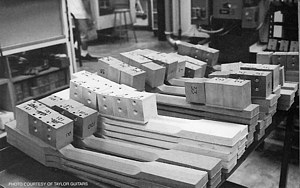 After technological advances, the next big item in the picture of changing commercial production is the growing reliance on new materials, finishes (already mentioned), adhesives and processes. Use of plastics and synthetics is steadily on the rise, starting in the l970s with Ovation’s space-age synthetic cast-body design, Adamas’ aluminum necks, phenolic resin fingerboards, increasing use of epoxy-graphite neck reinforcements, etc, etc, and currently ending in Rainsong’s graphite instrumens and Martin’s recent release of a guitar made out of high quality formica. Bet your boxers that we’ll see more of this kind of thing in the future. New quick-curing wood glues, cyanoacrylates and epoxies are now used commonly because of their obvious savings in time. The Breedlove guitar company has committed itself to using various plentifully available and sustainable yield domestic woods as an alternative to the traditional but rapidly disappearing rosewoods and other exotics; and their guitars are being found to sound good. Amplification systems are continually evolving and improving and have resulted in the steadily growing culture of acoustic-electric instruments: to list the newest equipment alone would probably fill up at least a page of text. The larger factories such as Taylor, Collings and Larrivee have switched to the new ultraviolet-cure urethanes; these are much easier to apply than other finishes, look good, and increase both productivity and profitability. And as soon as this technology becomes more easily affordable, smaller factories can be expected to follow suit.
 It’s natural and logical to ask how all these things improve the quality of the final product. Making something faster sounds postive; but one might equally ask what is the advantage of making a plastic guitar more quickly, outside of the bottom line. This doesn’t seem like an unreasonable question. One should understand that the notion of quality in manufactured products is different than the notion of quality in individually made products. According to a guitar industry spokesman at a recent trade symposium, quality, from a factory point of view, is the same as replicability of components and efficiency of assembly. That is, the factory man considers quality to be the measure of how efficiently his parts can be identically made and how fast his instruments can be assembled in a consistent and trouble free manner. I’m not making this up: this is how the language is used. Some elements of design and assembly may in fact result in improvements in structure and response in a guitar, but these are incidental to the streamlining of the production operations. In fact, all the elements of the future of commercial production which I’ve been describing have more to do with the conditions of production than with the end product. I repeat: for commercial producers Quality = Efficiency of Assembly Process. If you trouble to peruse the professional and trade literature you will find that no other criterion is ever mentioned.
 A very important difference between classical and steel string guitars is that classicals are typically not miked or amplified in performance, while steel strings are. Another is that the classical guitar is very largely a solo instrument, while in general only the fingerpicking steel string guitar is. The flatpicked steel string guitar is almost always a group instrument and often accompanies singing; being a group or accompanying instrument corresponds to the classical guitar’s secondary use. A third difference is that while classical guitars are, with few exceptions, played in standard tuning, the steel string guitar (particularly the fingerpicked one) is often played in quite a number of open tunings. This has great implications for both tone and musicality. A fourth is that steel string guitars’ internal construction is so different from classicals’ (for reasons of their needing to withstand greater string tensions as well as their different tone-producing dynamics) that they can be considered to be different instruments — to the point that steel string luthiers usually cannot make a good classical guitar, and vice versa. Some years ago Spanish luthiers started to make steel string guitars: they failed, stopped it, and haven’t tried again. This subject is highly interesting and so complex that I can only mention it in passing. It really needs its own article.
 It’s not hard to find similar quotes from Narciso Yepes, Julian Bream and other classical guitar luminaries, but three are enough to illuminate a very impressive spectrum of goals for the luthier to aim towards. These statements, moreover, speak loudly to the fundamental consideration of classical guitar design — that the guitar is designed to be played by a musician with a trained musicality and technique, for people who are listening without distractions. Every serious classical guitarist’s main fantasy is to play in a concert hall, on a guitar that will be equal to the task.
 This is the first of a four part series on the state of contemporary American guitarmaking. I intend to sketch out the general landscape of how the guitar developed historically, what it is now, and, lastly, what shape I think it is likely to take in the future. As I am a professional luthier, I’m going to tell this story from my hands-on perspective. It’ll be a nice change from the editorial voice of commercial/music/factory industry, which already gets a lot of copy space. This is just as well, in my opinion, because the story of American lutherie is well worth knowing.
 American guitarmaking has come a long way since those early days by several measurable standards. First, a generation of American musical instrument makers has preserved, refined and extended an originally European tradition of woodworking which had lain moribund with disuse in this country, and made it viable. Second, whereas thirty years ago a luthier was mostly an object of curiosity and an anachronism, handmade lutherie (whether you are making two guitars a year or forty) is now a more or less familiar and accepted part of the American landscape. Consequently it is now more possible for a luthier to make, if not a living, at least some money at it. Third, the guitars which are being produced now are, on the average, much better than the average instrument produced then. Fourth, a generation of instrument makers has evolved which is not made up so much of hardcore mavericks, but rather of established professionals and intelligent amateurs who take their work seriously and with a great deal of justifiable pride. Fifth, an entire (and continually growing) body of literature and have been created by this group, where there were none at all before. Sixth, this general growth of interest in musical instrument construction has created the conditions which have made possible the rise of two national luthiers’ organizations; furthermore, these not only provide active forums for free exchange of information to anyone who has interest in this craft, but are in fact the leading sources of information for young instrument makers overseas. And, lastly, we have created the first generation of American luthiers who are considered world class. Not bad, for a bunch of guys who started out as self-taught hippies.
 Classical and flamenco guitars originated within a tradition of hand craftsmanship of stringed instruments. This is not so much because hand craftsmanship is inherently superior, as that the roots of European lutherie predate the industrial revolution and its relentless mechanization of all modes of production. Hand craftsmanship was the only option for a long time. This is not a bad thing, because the level of skill brought to lutherie was unbelievable — as a visit to any museum with a good collection of historical string instruments will show. And, because this kind of lutherie was associated with real individuals, a tradition has been created whereby modern classical guitarmakers are the inheritors of some past heroes to look up to and whose work they can emulate. These revered icons, cousins to the illustrious icons of violinmaking (Amati, Stradivarius, etc.), are people like Antonio Torres, Hermann Hauser, Luis Panormo, the Fletas, the Ramirezes, Simplicio, Santos Hernandez and other historical European makers. Modern classical luthiers like to think of themselves as walking in these pioneers’ footsteps, or at least following the path that they traveled. None of this has stopped classical guitars from being produced in great numbers in factory settings; but the basic design has changed only minimally because the acceptability of this guitar’s design is still rooted in the traditional look, and traditional expectations still attach to it. The name of the game in contemporary classic guitar lutherie is adherence to and refinement of — rather than experimentation with or departure from — traditional design. Anyone who has ever gone into a classical guitar store will have been struck by the fact that, besides differences of coloration of their woods and minor details of design, these instruments all look remarkably alike. There are exceptions to this, of course, but as a rule it is the rare classical guitar maker who can make substantive changes in traditional design, and survive. This inflexibility of design does not apply, however, to the steel string guitar: quite the opposite, actually.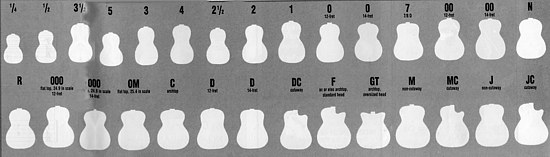
 The guitar is a relative newcomer to the stringed instrument scene. Before the guitar, the lute was absolutely the most popular plucked string instrument in the Western world. The lute served a very specific musical purpose, which it was no longer able to fulfill as the nature of musical tastes and entertainment changed with the rise of the European middle class. The lute became less and less a courtly chamber instrument and was more often expected to perform for the new bourgeoisie in larger halls and rooms. That was when the problems began. Lutes were really not loud enough. Instrument makers kept making lutes bigger and adding strings, but there were many problems with these approaches. The piano came into being in this period for the same reason: its sound could carry.
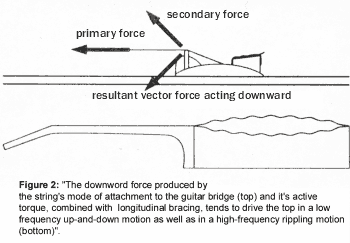 The fact that the guitar bridge is in the middle of the lower bout creates yet more tonal possibilities, but I’ll get back to this point later.
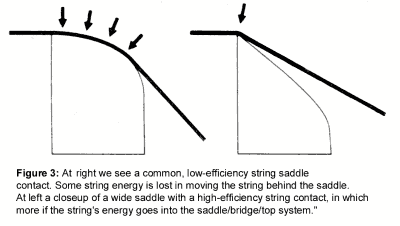 The average saddle is 3/32″ to 1/8″ wide. I use saddles that are 3/16″ or more wide because it makes a saddle wide enough to offer adequate intonation compensation on a steel string guitar. The rationale for intonation compensation is the subject of another talk, but I want to say one thing about the contact characteristics between the strings and the saddle. If you have two virtually identical guitars one of which has the strings resting on a single high point of the saddle, and the other with the strings resting on a significant portion of the saddle’s top, I think you’ll find this second guitar works better. There is a better and more efficient coupling of kinetic string energy to the saddle by virtue of that extended contact. I can’t prove this, but I suspect if you pay attention to it you’ll get better results. (See Figure 3)
 While I believe the degree to which a guitar is successful is in direct relation to the extent that you can free the soundboard up to pump air, this is only part of the story. There are many specific ways in which the guitar top moves, vibrates and flexes in its use of string energy so as to generate a wide spectrum of tones. The lower bout, the area surrounding the bridge, is the main arena for this activity. Let’s examine some of what goes on here when the bridge moves.
 Activation of the perimeter results in treble activity. This makes perfect sense, as the center of the soundboard is the most yielding part and is thus able to support high amplitude, low frequency activity. The edge, being more rigid, is the logical place for high frequency, low amplitude activity to occur. The top can move as in Figure 5, acting more or less as a unit. That’s bass. The top can also move as in Figure 6, shaking and quivering like a bowl of jello left on your washing machine during the spin cycle. That’s treble.
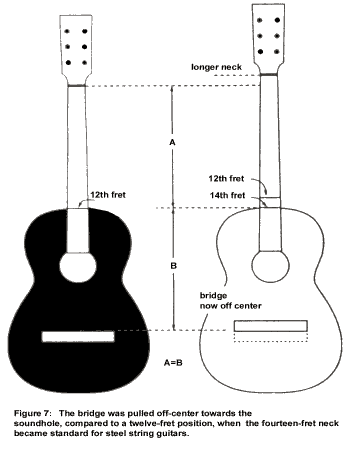 Historically, the bridge was placed smack-dab in the middle of the lower bout of early guitars, with a twelve-fret neck sticking out of the body. (See Figure 7) In the 1930s, in response to musicians wanting a more fully accessible fingerboard, steel string guitar makers discovered that players could have an extra two frets worth of fingerboard by making a fourteen-fret-to-the-body neck. This involved shifting the point of bridge attachment that much nearer the soundhole, but bypassed the need to install a cutaway into the instrument. It was a quick fix, and a successful one. But it also required planning the bracing around the new point of bridge attachment. If you install a bridge at the fourteen-fret neck position on a guitar previously braced for a twelve-fret neck you will have acoustic interference from the bracing, and a less than successful guitar. Bracing work involves positioning, as well as shaping.
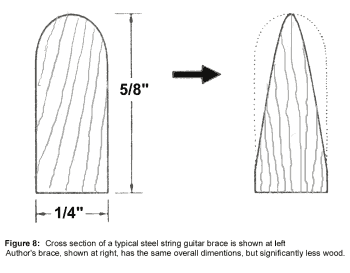 This is a cross section of your average guitar brace. (See Figure 8) Usually it’ll be quartersawn or close to quartersawn. The possibilities for designing braces are virtually endless, ranging along a continuum from low and flat to high and thin, and complicated by whatever contour of scalloping and high points exist along their lengths. What I want to achieve when I make a guitar is done in part by picking woods that have a favorable strength to weight ratio. I want woods that are strong and lightweight. Therefore one way in which my braces are different from standard lies in my choice of materials. Secondly, I and other luthiers like myself are concerned with maximizing the strength to weight ratios of our soundboards. We want to make the guitar as strong as we can while making it as lightly constructed as we can. We don’t want to reduce the height of braces significantly, because as Mr. Hoadley points out, the cost of this to brace strength is considerable. But we want to reduce the mass. I would like to invite you to later step up here and pick up both of these sample tops and compare just how much wood is in each one. You’ll notice that one feels noticeably heavier than the other. My way to achieve this difference is to leave the height on the brace but to lessen mass by making the brace slimmer. This probably does remove some strength, but I believe that it does so in a favorable relationship to the weight that is lost. My approach is to have thin, high braces throughout my guitars. (See Figure 8)
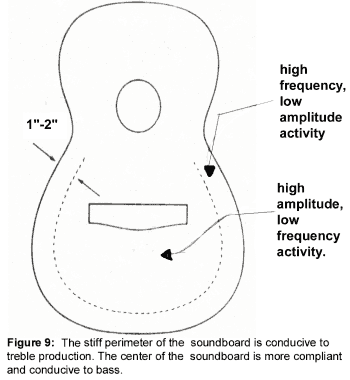 While there are endless things to be said about bracing systems, plans, and distribution, as well as the selection of bracing woods, I want to remind you of the indicator that we got earlier from that little music box where we heard bright, shrill notes from the edge of the soundboard and heard mellower notes from the soundboard’s center. It reveals that one should pay attention to the perimeter if one wishes to manipulate the high end frequency response of the guitar, and pay attention to the area near and around the bridge if one wishes to manipulate the low end. (See Figure 9) For these reasons you will notice that the profiles of the braces in my guitar top differ from the profiles of the braces in the Martin guitar top, even though their layout is about the same in both cases: my X is lower and my perimeter bracing is higher.
 (See Figure 10) This circumstance is bound to affect the response you get from a guitar. The typical factory way of capping the otherwise open X notch is to glue a little piece of muslin cloth on top. If you are concerned with strength to weight ratios and the load bearing capacity of your braces, I think it makes no sense to shoot yourself in the foot by cutting a huge notch in your braces, after all the work you’ve done, without trying to reestablish their original strength by bridging the notch cut. (See Figure 11) Bridging, or capping, the X notch will tie one part of the interrupted brace to the other part, and will prevent the opening and closing of the notch under soundboard movement.
 While the X brace is ostensibly designed to have a certain strength, but the minute you cut a notch into it and leave the notch uncapped it’s much, much weaker than before.
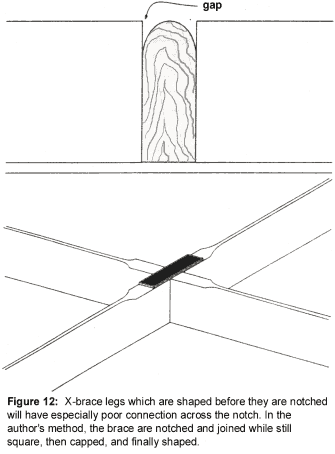 I have, but you have to cut back quite a bit to get a flat enough gluing surface to get a cap onto. It’s more of an operation than you might think. One thing you’ll notice on my guitar top is that even though my X braces are tapered in cross-section they are rectangular in cross-section at their intersection: this makes a really tight and very efficient joint. (See Figure 12) I don’t take any wood from inside the notch, as happens when braces are rounded before they are notched together.
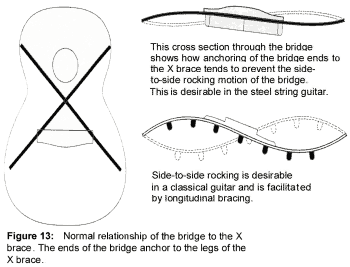 some of his models that had angled fan braces responded differently. It is my belief that these angled braces are dynamically and acoustically replicating the anchoring work of the X brace, which acts to inhibit bridge rocking compared with longitudinal bracing.
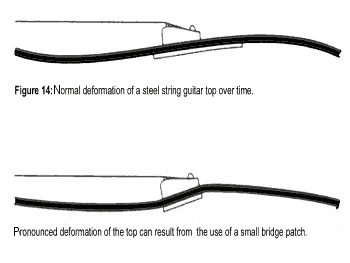 I became aware of it then because the light was focused on it. The face was markedly distorted and dimpled specifically at the bridge and all around it. What had started as a straight, flat piece of wood had become bent all around the bridge by the torquing action of the strings. And this had been allowed to happen because there was virtually nothing under the bridge to guard against this kind of deformation. At that point I started to install bigger bridge patches on my guitars. (See Figure 14)