Ervin Somogyi

Menu
  • About
    • Bio
    • Bio – Humorous
    • Resumé
  • Guitars
    • Guitar Models
    • Guitars: Custom Options
    • Special Projects
    • Visual Echoes & Tasteful Accents
    • Pricing
  • For Sale!
    • Brazilian Rosewood Sets For Sale
    • The Mexican Festival Model Guitar
  • Artwork
    • Lutherie-Inspired Artwork
    • Artwork (2)
    • Peghead Veneers as Art and Accents
  • Articles
    • Articles & Essays
    • Articles featuring Ervin
  • Books
    • Books
    • Videos
  • Teaching
  • Contact

Author: esomogyi

Tromp l’Oeil and Wabi-sabi in Guitars

by Ervin Somogyi

I’ve recently completed a guitar that has a new kind of ornamentation on it – at least for me. And as far as I know it’s quite different from any ornamentation anyone else has ever done on a guitar. The immediate impression it makes is that an accident had happened to the guitar: that someone had carelessly allowed paint to drip or spatter on it. But this effect is all carefully rendered wood inlay. There’s nothing careless or accidental about this at all.
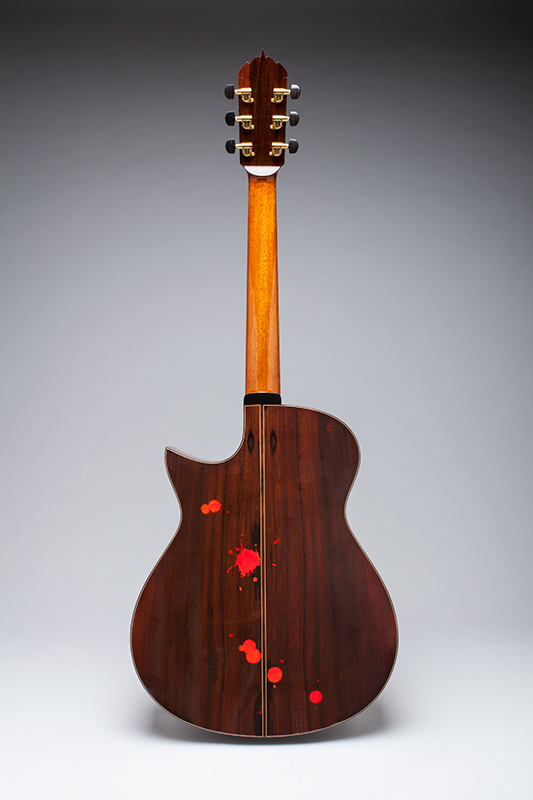
I hope that others will like this look as much as I do. My initial inspiration for it didn’t exactly coame out of any blinding artistic idea that I woke up with one morning, though. It came out of a need to fix some problem spots in a set of otherwise beautiful guitar making wood whose flaws would make it unsuitable to use on a first-class instrument. The most common fix for any blemish is to do some inlay work, or patching, or staining, or painting-over to hide the flaw. But if there is more than one of these, and if they’re not close together, then one has to do a large-scale job of a this-will-fix-all-of-it type, or one has figure out how to deal with this multiplicity in a different way that can’t look like some clumsy fill-and-patch job. Sometimes, in order to achieve an artistically coherent look, one is called on to do decorative fix-its in spots that don’t need “fixing”. And in either case, if this work is going to be done on an expensive guitar then the work has to look perfect. I thought about this project for a few weeks.

A NOTE ABOUT ARTISTRY IN GENERAL

Until now art and ornamentation of any type have been rendered in traditional Western (and Eastern) ways. That is, art and decoration have been . . . well . . . artistic and decorative, regardless of whether the work has been painted, inlaid, carved, or anything else. Such work has always had to make some visual sense, even if its orderliness came out of something that looked chaotic – such as Jackson Pollock’s work, which has spilled over into fabric design, etc. Artistic work has always followed the rules of one or another of its modes, whether it be directly representational, geometric, stylized, abstract, Art Nouveau, ethnic, School of Realism, Art Deco, Japonesque, symbolic, Scandinavian, portraiture, African, Southwest American Indian, Naturalist, calligraphy/words, Arts and Crafts style, filigree, symbolism, religious iconography, mosaic pixel work, Dutch Renaissance, Cubism, mandalas, Impressionism, Appalachian primitive, figurative, marquetry, Zen, Dadaist, aboriginal, Islamic, Judaic, Celtic, Indian, Chinese, modern, post-modern, or . . . . well, you get the idea. All of it had, and has to be, somehow, visually coherent according to its tradition or sensibility and obey its appropriate principles of execution, shape, line, balance, proportion, ideal, and aesthetic. Basically, if artistry/ornamentation went to college, it would generally get a pass-or-fail grade. You know: it’s either bad art or good art, yes or no, period.

ABOUT THIS PARTICULAR GUITAR

One morning I did wake up with a concept of a coherent-yet-not-overdesigned look that could work and that by my standards wouldn’t look contrived or cute or echoing other people’s work . . . such as inlaying some swimming fishes, or jigsaw-puzzle shaped pieces of wood or shell, or dice or dominoes. That idea was: paint spatter. (Inlaying a few falling leaves might have worked too, but a lot of people have already done leaf work and I thought those images had too relaxed and laid-back a spin by now. You know: been there, done that.) I liked the idea of something that would arrest the eye and have a bit of shock-of-the-unexpected value.

I bought some sheets of poster paper and spent some time dripping, sprinkling, and splattering paint all over them to get a sense of likely sizes, impact-spreads, drip patterns, and drip densities. I tried different colors too. Red soon turned out to be the right choice, given the colors of the guitar woods. Overall, none of the drips looked bad (I mean, how wrong-in-itself can a drip look?) But some samples looked very bland. Others would be very challenging to inlay into wood – especially the really tiny spots. Yet others would probably bring the crime scene people in. Eventually I came up with a combination of spattering that, when arranged on a canvas that was the size and shape of my guitar, felt right.

I just went ahead and did it, without thinking ahead to come up with a name for it for when I needed to start to talk to people about this decorative treatment. That came at the very end, when I understood that I’d combined trompe l’oeil and Wabi-sabi into this instrument’s ornamentation. I should explain what these terms mean.

Trompe l’oeil is French for “a trick of the eye” or “tricking the eye”. It is a style of European painting that rose to prominence in the Baroque era but which originated much longer ago. Technically, it is a two-dimensional work that carries something called perspectival illusionism: this is when painters would paint things that were so realistic that they looked three-dimensional on a surface that everyone knew was flat. One example of trompe l’oeil was to paint coins on bar tops that would look so realistic that customers would try to pick the coins up. The illusion didn’t look painted: it looked three-dimensionally REAL. Another was to paint a picture in which something seemed to be jumping out of the canvas and even obscuring some of the frame. An older iteration was to paint a door into a wall, perhaps in the middle of a mural, to make the room look as though it were larger and led to another room.

Wabi-sabi, on the other hand, is a Japanese concept that is outside of Western traditions of thought. Wabi-sabi has to do with an appreciation for the beauty of things that are natural, simple, unpretentious, ephemeral and passing. They might be in full bloom, or somewhat worn, or well into entropy and decay. It is understood that all things are passing. And it is an awareness of that direction, and its transitions, and being able to hold them precious for the moment, that is the underlying sensibility. As I said, this idea is not quite in the forefront of Western thought. The closest thing I know of is the Latins’ celebration of the Dia de los Muertos (the Day of the Dead), where those who have been here and have passed away are acknowledged and celebrated. It’s not quite the same thing as Wabi-sabi, really, but it does give a nod to the stream of life. The Western ideal, in comparison, is fundamentally divided between (1) the secular stance of strive forward to be successful in the here-and-now, but keep it realistically short term and don’t get ahead of yourself, and (2) the religious stance of behave yourself now and be patient; it’s really the afterlife that you want to be focused on.

My own take on Wabi-sabi also has to do, in part, with my sense that one thing that is important in an artist’s work is that there can always be a way — in any and all the disciplines of art that I listed above – in which the work looks right . . . and there can also a way in which it can look not right . . . or incomplete . . . or amateurish . . . or somehow not fully realized. Well, there are always rules for how a work should be executed and what it ought to wind up looking like or representing. The rules may be very, very subtle. But that’s what teachers, guides, mentors, and masters are for: to know and teach the sensibility and the rules, and to help us internalize them.

Opposed to any and all of this is Nature, NONE of which looks wrong. No matter how many of anything Nature may produce — trees, leaves, dogs, mountains, landslides, puddles, flowers, dead animals, stones, oceans, sunsets, rust spots, broken things, etc. – they all look right. Nature is incapable of looking wrong . . . at least in any of the ways that most people and artists can achieve. Wabi wabi taps into this. (There is a book titled Wabi-Sabi for Artists and Craftsmen that does a pretty good job of explaining this mode of seeing the world, for anyone who is interested in knowing more about it.) And, clearly, things that are man-made can participate in Wabi-sabi also. The closest association to Wabi-sabi in Western art that I can think of leads brings the word factitious to mind. It means “artificial; made by man and not by nature”. But this is a word that one seldom hears in daily conversation and that doesn’t at all rise to the level of a philosophy about seeing the world.

My personal sense of the Wabi-sabi of life in general (besides in guitar making and art) is that it carries an appreciation of some essential and indelible beauty of that which used to be pristine but which has signs of wear and use, and may even be worn out . . . like all the aging people (whom I am increasingly resembling) who aren’t considered physically or cosmetically attractive in this society . . . and that there is, at bottom, no way for any of these, or them, or us, or me, or you, to truly look wrong.

Posted in What I've Been Up To

On Tonal Bloom

by Ervin Somogyi

There is an element of guitar sound that is called “tonal bloom”. This is the phenomenon in which, when one strums a chord on a guitar (in an otherwise quiet room) and the sound comes out of the soundbox, then within a half second or a second the sound gets louder. It literally wells up out of the soundbox and becomes fuller, without the player having done anything other than his initial strum. Not all guitars can do this. Typically, a guitar’s sound emerges pretty much at some maximal loudness consistent with how vigorously the strings have been strummed – like racehorses that come out of the starting gate at pretty much full speed from the get-go. The main difference between race horses and guitars in this regard is that while a guitar’s sound comes out at full initial volume it dies off over the next few seconds; the horses strive to maintain top speed without slowing down or stopping, until the finish line. But “tonal bloom” is different: the sound gets louder all by itself, as though one had adjusted the volume knob. It’s quite a surprising and even dramatic thing for a guitar to do.

I noticed some time ago that my guitars have a capacity for tonal blooming. I noticed it mostly because I do a lot of listening (and I have, parenthetically, written an article about the ins and outs of listening; I’m going to repeat some of that information below). The thing is, it took me a long time to teach myself how to listen and what to listen for, and part of what I learned is how most of us have never learned to listen to sounds for their own sake or for the information that raw sound contains: we’ve instead been taught to pay attention to cognitive verbal information. In any event, I teach these listening skills in my annual guitar-voicing classes. I devote a long morning in each of them, to learning how to listen to a guitar and what to listen for. How else would anyone ever know how to assess whether a new guitar is in any way better than a previous one, or if a particular guitar in the music store is better than its neighbor on the wall? It is for this learning experience, and the analysis and comparisons that are involved, that I ask of each student that he or she bring a guitar of his or her own making to the class, and that we will be taking a close look at. These listening-and-analyzing sessions also include a guitar of my own, by the way, and these comparing sessions become opportunities for some very useful learning experiences to occur. The whole point of them is to enable my students to pay close attention to a guitar’s trajectory of sound: that is, how the sound emerges out of any guitar, what kind of sound it is, and the shape of the envelope of tonal rise-and-decay.

Let me tell you a bit about how I organize my listening sessions. First of all, they take place in a large conference room: that gives the guitars a chance to “sing”. I’m lucky in that my shop is right next to a library that has a conference room available for community meetings and gatherings, exhibitions, private events, etc. and I sign up for it every time I teach my class. My students and I take our [usually five to eight] guitars with us into that room, tune them, set them up on guitar stands, and then spend about two hours listening to them systematically . . . in pairs. I have the students sit facing away from me, halfway across the room (I don’t want them to see which guitar they’re listening to, and I want them to be sitting at more or less the same distance from the guitar), as I play a musical chord on two of the brought instruments. This works as follows: I assign each guitar a number and I announce which aspect of tone I want to focus on; and I tell them which “numbers” I’m playing (for example: “#1 and #3”). I play a chord three times on guitar “A”, each time allowing it to decay into silence. Then I play the same chord three times on guitar “B”, again allowing it to decay into silence each time. Then I repeat the same on guitar “A” a second time, and likewise on guitar “B”. Each pairing consists of two guitars being played twice each . . . with very short pauses between guitars.

A chord carries a surprising amount of information; it is, after all, the voice of the guitar using all six strings; and in these listening sessions we become aware of just how rich that voice is. We can get a reliable sense of bass, treble, balance, warmth, projection, in-tune-ness or not in-tune-ness, overall quality of sound (i.e. whether it’s brittle, thin, harsh, sweet, full, mellow, etc.), whether the sound is colored by overtones or tends to be fundamental, and, finally sustain. As an example, it usually comes as a surprise to learn that some guitars have a sustain of 8 seconds from strum to silence, while other guitars that look very similar can hum along for almost fifteen seconds. I leave short pauses between chords to allow the ear to relax; and the repetition of the chords on both guitars allows for better, more thoughtful comparisons.

Then, I play repeat this routine in the same way, on two different guitars. I repeat these exercises with every possible combination of two guitars . . . until we’ve heard all of them. I repeat: we are listening for a single particular aspect of tone. And if anyone wants to have another listen comparing guitar “X” with guitar “Y”, we take the time to do that.

Then, we repeat the entire cycle, listening for a different aspect of tone. We have a cycle for (1) bass, (2) for treble, (3) for sustain, (4) for balance, and (5) for volume. I have everybody make silent comparisons (we have open discussions afterwards, but not during) and take notes. The students have clipboards and take notes. Eventually, out of all the listenings and note-taking, some of the guitars invariably float to the top as being judged “better” than the others, and some are pretty much agreed to have lots of room for improvement. None of this is personal, by the way: it’s simply a field trip through sound. Finally, after we have arrived at our opinions, we take a close look at the guitars themselves to see what features of construction might correlate with our heard impressions. And we discuss. All in all, having access to that conference room is amazingly helpful.

It was in these listening tests that I first noticed that my guitars have a voice that exhibits “tonal bloom”, and that very few other guitars do. I didn’t quite know what to make of this finding for a long time, but I kept on noticing it every time I have had an opportunity to strum on several guitars. And so did some of my students.

Then, last year, a friend called my attention to an interesting YouTube clip that showed a really cool experiment. Someone had filmed what happens when you set a number of metronomes into motion discordantly: that is, metronomes that are set to the same speed but wildly out of sync with each other. The sight of a number of metronomes clicking away quite chaotically, almost like school kids frantically trying to get their teacher’s attention, or perhaps like a bunch of baby birds clacking away frantically asking to be fed, is a bit of a giggle – but there was a serious point to this: after a few minutes the metronomes all adjusted their beats so as to move in perfect lockstep with each other! – just like those AMAZING SYNCHRONIZED PERFORMERS who entertained the world in the opening ceremonies of the Beijing Olympics. There are a number of YouTube clips of the metronome phenomenon on the Internet, but a couple of the ones I most like are:

[NOTE: this one seems to appear in several versions, one of which seems to have been doctored and is a bit hokey. Try to find the good version.]

The metronome phenomenon is not magic: it’s physics. The mechanism behind it is this: if you place any number of out-of-synch metronomes on a platform that is solid and that absorbs and nullifies the energy of the metronomes’ vibrations, then these continue to beat out of synchronicity forever. But if you place them on a platform that isn’t rocksolid, that jiggles a little bit to their vibrations, and that allows the metronomes to share their vibrations with their neighbors (and thus have an impact on them), then these eventually modulate each other and soon end up moving in perfect lockstep. If this were looked at from an interpersonal rather than a mechanical point of view, it would sound rather like an idealized version of what happens to couples when they are in effective couples therapy: they are able to take on one another’s energy and work in synch.

Anyway, I had a sudden insight about tonal bloom. I understood that this “lining up of functional or vibrating elements” that is demonstrated in the behaviors of these metronomes is also what happens in a guitar. That is, provided that – like the energy-receptive platform that the interactive metronomes rest on – that guitar’s parts and components are lightly enough constructed so that they can respond to, and with, one another. In other words, tonal bloom occurs when the guitar’s various quadrants and sections have the ability to “get in line” with each other’s vibrational motions and work as a team. It is this “lining up” that takes up to a second (think of soldiers or school kids being told to form a line, and you have the idea).

Now, one might ask: so what? What’s so great about a guitar that shows this time-lag tonal bloom, anyway? The thing about the metronomes is really cool, but . . . how is this a benefit, or even desirable, in a guitar? These are not bad questions.

My answer is this: in the average (and by my standards overbuilt) guitar which is deficient in such accommodating capacity, each part and section of such an instrument will, when activated, simply be “doing its thing” (as set by the mechanical realities wood thickness, bracing, etc.) – and, like a wind-up toy, that thing only – every time one strums a chord or plays a note. In a way, such a sound is a bit like a cake that is always made to the same recipe and with the same ingredients; there are no surprises and every slice, section, and layer of such a cake tastes like every other slice, section, and layer. In the typical guitar, some of its vibrating sub-sections might be a bit out of wave-phase with each other, and they stay that way and offer no surprises. Personally, I think that such a degree of built-in rigidity will, to some degree, keep the instrument from functioning at full efficiency or capacity. This brings us to an interesting question, because mention of “efficiency” or “capacity” leads most people to automatically think “volume” (well, you say, the soundbox is really about energy management, budgeting, and maximal use, is it not?) But I don’t mean only volume, even though that is an entirely worthy goal to strive for in guitar making. I can agree that a given guitar that is more sturdily constructed than my guitars are might produce more volume. But basic loudness is only a part of a guitar’s potential job description. The other part is having depth and flexibility of tone. These are about what the soundbox can do all by itself, and also what it can do as a direct result of how it is played, insofar as how yummy, dense, varied, and rich that guitar’s sound can actually be. To return to the example of a cake all of which tastes the same, try to imagine a cake whose flavors change depending on the manner in which it is sliced up and served.

Tonal depth and flexibility are topics for a future article – as is the separate issue of tonal evenness/balance. But for the time being, I just wanted to introduce you to the concept of tonal bloom.

Posted in Guitar theory, history, opinions, sociology, wisdom, & insights

Is It Art, Or Craft?

By Ervin Somogyi

I’ve been asked to contribute some thoughts about what Art vs. Craft means to me. This simple-sounding request is actually a bit complex. Here is my thinking about art and what it signifies for me, in a nutshell, and with a bit of historical context added.

FOR STARTERS, WHERE DID “ART” COME FROM, ANYWAY?

From the time the first cave man had the urge to smear pigment onto a cave wall, art has been . . . well . . . something that only humans seem to do. It is an attempt at representation . . . of things that are both concrete and abstract. As far as we know, no other animal has or needs a representational life. It should be no surprise to anyone that art of any kind is a product of time, place, and culture. On the other hand the human need to engage in the act of representation is, very much by itself, a deep and surprising mystery.

Whether it is painted, carved, cast, written, or anything else, art is symbolic. It is also, most certainly, the proverbial elephant being felt by the blind men who thought the elephant was a tree, a leaf, a rope, a snake, or a house depending on what part of the beast they were touching. No one seems to know what art really is any more than we know what gravity is, despite the fact that we’ve lived with both art and gravity for millennia. As far as the latter is concerned, physicists today are butting their heads against the seemingly basic task of comprehending not only what gravity is, but why it should even exist — along with such esoteric questions as why do atoms even have mass? The quest for that knowledge is great fun and frustration and, as far as I can tell, as compelling as is trying understand how a painting of a can of Campbell’s Tomato Soup is great art. In any event I think this will be a more interesting story if I simply tell you what art means to me personally. But before I do that, I need to give you some general background.

SOME FACTOIDS AND STATISTICS

As far as man-made things go, the U.S. Bureau of Labor Statistics tells us that there are more than twenty thousand different job descriptions of work that a citizen can do, all of which represent some cog in the great economic machine or thread in the great social fabric. Some of these jobs are quite useful in amazingly oddball ways. But how does being an artist fit into this? What, exactly, is one to make of the . . . uh . . . astonishingly useless, personal, and highly impractical act of dabbing paint onto a piece of canvas? Who on earth would ever have started that kind of thing? And what were they thinking at the time? I mean, you can’t eat it, wear it, ride it, climb it, grow it, smoke it, have sex with it, or use it to change a flat tire. You just look at it.

Well, as I said, art is an act of representation. It is an effort or effect that carries some kind of significance. Humans seem to have a need to do that. I’m pretty sure that the reason for this is that art gives a particular kind of satisfaction or release. It is sometimes described, subjectively, as being that which makes sense to you in such a way that you experience a momentary glimpse of a different reality; or being half-reminded of something that one had long ago forgotten. I think of it as an in-the-moment a liberation from tension — as when one has a sense of “Aaah! That’s it!”, or when one has completed some inner task and thinks “O.K., I can stop now”, and lays the burden down. But that’s just me; as an elephant being palpated by blind men, art can really be a hobby, a business, occupational therapy, a practical outlet for creative energies, a political statement, an avocation, a quest for status and power, a personal obsession or depravity, a quest for the transcendent and the sublime, or some combination of these. Art can multi-task like you wouldn’t believe and expensive images of Campbell’s soup, vulvas, sunsets on Mars, and the Virgin Mary riding a Harley have been known to fit somewhere, somehow, into this spectrum.

MY OWN APPROACH AND MINDSET

I seem to have an artistic bent. I have always been like this and I cannot account for it; I just accept it as I do the fact that I’m right-handed. Some people explain this by citing brain organization or chemistry. In any event, I am drawn to things, images, designs, and effects that have beauty of a timeless kind, more so than things that seem trendy, fashionable, merely clever, or otherwise temporary. I don’t know that I consciously look at things in this way, but I do know that I get more pleasure out of looking at (and making) artistic designs that look and feel “right” and satisfying to look at; and in my case I seem to gravitate toward more abstract and geometric imagery.

I know that words like “right” and “satisfying” are subjective words, and hence hard to define. But consider that these might actually mean something. The latter, for example, comes from the Latin satis + facere, meaning “enough done” or “to make full”. In other words, it leaves you not wanting or desiring more. I think good art is art that satisfies, that doesn’t leave you unfulfilled by somehow being incomplete or out of balance. It doesn’t leave you wanting more, nor feeling stuffed. Pornography leaves you wanting more, and I’m not just talking about naked people; pretty much any of the glitzy and artistically done ads and commercials with high production values that one sees everywhere nowadays, and whose job it is to persuade you to want one more thing, are pornographic by that standard. Cheap merchandise of all types, as well as artfully delivered sales pitches, always leave one vaguely dissatisfied. Political sloganeering is often disguised as art, and it exists to leave one feeling better or worse than one really is. Calm, balanced equanimity — i.e., satisfaction — is not what any of these is about.

A WORD ABOUT THE BIRTH OF “ART vs. CRAFT”

Today, there exists a division between “art” and “craft” which was, historically, not recognized. To the Greeks art and craft were one and the same, and it was a public phenomenon, not a private one. Art eventually became divided from craft, not because they are actually separate things, but rather because society (and its needs) changed.

That change started with the growth of the Middle Class and institutions such as the Organized Church, during the Renaissance — which is often thought of as being a time of art and culture but was equally a time of exploration, conquest, and political and mercantile expansion. As the Middle Class and the Organized Church grew in both size and influence their members found they could afford — and thus learned to desire — the private ownership of wealth in the form of land, art and other things. (The Ruling class had always done this, of course, but its numbers were never significant.) In any event, as these new demographics and institutions grew, so did Art and Craft. Put in plain economic language: as demand grew so did supply. (We are seeing a similar growth today in China and its trying-mightily-to-be-prosperous neighbors.)

As far as “art vs. craft” goes, this division has been justified by the idea that craftwork represents artisanal creations that have some practical use or application, while “pure” artwork is more spiritual/creative, and eschews the merely practical. In a way, this division encapsulates the polarities around which the Middle Class and the Organized Church coalesced: one is concerned with the here-and-now and the other is concerned with the more abstract and transcendent “after now” . . . at least in theory; in fact, both of these have, like Mafiosi, always pursued their temporal territory, power, influence, wealth, and authority very jealously. In a further attempt to justify the separation between art and craft, “fine art” is currently sometimes also defined quite openly as that work which is sold in art galleries. Hmph.

Along those lines, some people in that world define art as comprising of paint on canvas or paper, glass, bronze, steel, and marble — but not other materials such as wood, fabric, leather, aluminum, ceramic, fiberglass, or plastic. I repeat: hmph. There is an interesting wrinkle to the private ownership of art, in that it most easily attaches to concrete objects like paintings, statuary, and other collectibles. It’s a bit more problematic to “own” intangible and ephemeral art such as music, theatre, dance, poetry/literature, and even some memorable athletic performances; these are harder to possess and keep, and the art must be refreshed at every performance.

In any event, from my point of view, these lines in the sand are artificial and bogus. When art became divided from craft it was at the same time wedded to money, as part of the societal shift that served (1) how citizens of the community claimed identity and/or defined themselves, as well as (2) the commercial needs of the growing art-biz world and its adherents. As to the Greeks of yore, whether or not any of them or their institutions could have taken on the role of being the patrons and owners of privately held art, they appear as a group to instead have formed their cultural sense of the world, and of themselves, not through possession of goods but through tragic and comic theatre, the Olympic games, and public statuary. While there no doubt existed Greek misers, misanthropes, and idiots (the original meaning of which word was “one who does not participate in community events but rather attends to his affairs by himself”) the meaningful culture of the classical Greece was a public and social one. Aside from that, the Greeks didn’t have plastic or concrete and their clothing was practical rather than artistic. They didn’t use much wood in their public art because most of their statuary was intended to be situated outdoors, and that material wouldn’t have lasted as long as marble does. Those old Greeks may have lacked a fashion industry, but they weren’t fools.

(Parenthetically, though, they weren’t saints either. The Greek economy ran largely on owning slaves, which their philosophy and culture — as well as those of all the tribes and nations around them — seemed to freely accept. I mean, let’s put love of art and truth into a proper wider context here, although I grant the Greeks that they (starting with Plato, at least) seem to have been the first to question the morality of slavery.)

MY TAKE ON THE MATTER

Many of the discussions that take place about art are often beside the point, because this is a territory in which words aren’t really useful. What I mean by this is that there’s a good chance that if you asked an artist what he was trying to accomplish in this or that work he’d be insulted that he had to explain it to you. Having to use words would be a sort of admission of failure to communicate at a basic level.

I don’t think that “art” is something that some “artist” puts into something that he’s making, and which makes that object more attractive and spiritual in direct proportion to that artist’s talent. In my own case it is more a channeling of something that comes through me but that I don’t think is really mine in the sense that I “own” it as though I’d “invented” it. Interestingly, the word “invent” comes from the Latin in (in, into, or upon) + venire (to come — as in Julius Caesar’s veni, vidi, vici, meaning “I came, I saw, I conquered”); in other words, to come upon. It does not denote originating or creating anything so much as finding it — as when one does an inventory.

For myself, I don’t believe that there’s any meaningful difference between “art” and “craft”. I am all right with the idea that, outside of the commercial history of the thing, the Mona Lisa was/is a great crafts project. Good created work of any kind is something that has a special personal significance that really can’t be measured in pounds, colors, dollars, medium, or inches. And then there’s also Art With A Capital F which doesn’t measure up regardless of what standard one uses. But I can tell you that good artcraft gives me a specific and subjective kind of endorphin rush.

MY ARTISTIC METAPHYSIC

I make guitars for a living. I work with, and love, wood. I don’t know how that came about except that, without having had art training, I spent a lot of time carving, molding, whittling, and gluing things on my own as I grew up — often using this plentiful, malleable, and available material. But there is also, for me, a metaphysical component in my present work. The metaphysic I bring to my work stems, I think, largely from significant losses and dislocations I experienced early in life. I won’t go into that other than to mention it; further commentary is outside the scope of this writing.

Perhaps because of those losses and dislocations, however, I can relate to working wood as an act of reclamation and a sacrament. It is, for me, a bringing of things from the past together with things for the future. It is also an act of symbolically bringing dead things to life. I don’t believe that you need to have traumatic life experiences to see wood for what it really is, though: it is nothing else than the skeletal remainder of a life form that once lived, took in nutrients, grew, adapted to its conditions, participated in the cycles of the seasons, took in sunlight and converted carbon dioxide into oxygen, produced seed and sap and fruit, interacted with other life forms by giving them food and shelter, held the soil together as it put its roots out, propagated itself, lived a long life, and then died. Actually, was probably killed — just as animals and plants everywhere are killed to serve our species’ needs. Every piece of spruce or cedar I’ve ever made into a guitar top has been some 125 to 400 years old [count the annular rings in your own guitar top] — and that’s just in the eight or ten inch wide slice I normally use: the oldgrowth spruces and cedars are often six feet in diameter! It seems remarkable to me to work with part of a tree that was alive when the philosopher Baruch Benedict Spinoza ground his glass lenses for a living, when William Shakespeare and Wolfgang Amadeus Mozart were expressing their creative genius, when Francisco Pizarro conquered Peru, when Anton van Leeuwenhoek made the first microscope and gave mankind its first awareness of microbial life, or when our great-great-great-greatgreat-great-great-great grandparents were courting — and which was furthermore almost certainly alive until within our own lifetimes. The phrase about not seeing the forest for the trees comes to mind in this regard, although it’s more like not seeing the tree for the wood. I feel that by working with this unique material I’m able to participate in life in a larger, deeper and more intimate way than by having a regular, ordinary job.

Reality isn’t all that simple and linear, though. I have observed that regardless of what one does for a living, or how extraordinary or fascinating that might be, there comes a point . . . at around the twenty-year mark . . . when it becomes interesting to do something else. In my case also, the excitement of making guitars hit a wall at around my own twenty-year mark; I began to be receptive to doing something new. It was at that point that I got interested in doing artistic woodwork without the need to also build a guitar along with it. The result was a body of wood carvings and inlays that is based in and inspired by the techniques, traditions, and materials of traditional guitar and lute making. In terms of the art-craft divide, this work lacks the practical usefulness of being a guitar, and is more genuinely “art”, or at least “really cool decoration”. For me, that distinction is not important: I get a thrill from producing both guitars and wood carvings/inlays — either by themselves or in combination. Part of this body of work can be seen on my website.

Finally, each of us, as adults, carries our early life experiences inside of ourselves until we die. I certainly do. And this internalization has, quite naturally, informed my understanding and expectations of the world. Therefore, as far as the “Ervin as an artist” package goes, I believe that I produce my artwork — whether in guitar or art-for-the-wall form — in part so as to contribute beauty to a world which I see as being sorely lacking in it.

ART/BEAUTY: IN THE EYE OF THE BEHOLDER?

Finally — not that this has anything significant to do with the matter at hand — there is a longstanding academic debate among . . . uh . . . perfectly worthy pedants and polemicists as to whether beauty (which is an alias that Art sometimes travels under) lies in the object or the eye of the beholder. It seems to me that this kind of either-or question is of the “have you stopped beating your wife yet?” type; it disallows an answer outside of its own categories. Art and craft, if one wishes to make the distinction, are actually a kind of partnership between object and viewer, which is a concept that I first came across in Robert Pirsig’s book Zen and the Art of Motorcycle Maintenance, and which I commend to your attention. Also, for anyone interested in knowing more about the ins and outs of the human creative process, I also recommend The Dynamics of Creation, an entirely accessible and enlightening book by British psychiatrist Anthony Storr.

Posted in Thoughts, essays, & musings

On the Challenges to the Luthier in Mastering Both Steel String and a Classical Guitar Making

Harder Than Getting A MacArthur Grant; Easier Than Long-Term Weight Loss.

by Ervin Somogyi

This is the text of chapter 32 of my book The Responsive Guitar.  It is different from the others in that isn’t about guitarmaking principles, dynamics or techniques of musical instrument woodworking.  Rather, it describes, to the best of my knowledge, the human networks that use either the Spanish or steel string guitar as their principal point of musical/cultural reference. For purposes of keeping it manageable, I am focusing specifically on the classical guitar rather than on the more general and inclusive category of the Spanish guitar.  While flamenco guitars are not all that different from the classic version, their cultural network certainly is.  I address the flamenco guitar separately, in chapter 33 of my book.  Otherwise, I am focusing on the steel string guitar in its two most common acoustic guises of fingerpicking and flatpicking instrument.

In my division of the material into “classical vs. steel string” I have been arbitrary in that I have left out entirely a huge network of guitar players who, for lack of a better word, I would call the Chet Atkins/folk/popular school, which falls in between the two polarities of the guitar that I’m going to discuss.  This middle group comprises of musicians who are everything from formally trained to self-trained, who play on both steel string and nylon string guitars, who play both acoustically and electronically, who play with both plectrums and fingers, and who play the most astonishingly broad spectrum of playful-to-popular-to-“serious” music imaginable: old standards, freshly minted compositions, folk songs, marches, ragtime, anthems, hymns, impressionistic ditties, favorites of the classical repertoire, Broadway show tunes, fusion/arrangements of everything you can imagine, and everything else you can think of except maybe flamenco and Indian ragas. They have, as a musical subculture, their own palette of techniques, tastes, standards, and musical boundaries.  Many of them play with great verve, talent, imagination, and musical intelligence.  And, in the best folk and popular music tradition, they often sing along with the playing.  To repeat: while none of this may seem relevant to a book on how to build a guitar, the message of this chapter is that it actually is, for anyone willing to take a wider view.

Many luthiers make classical guitars and many make steel string guitars, but hardly any make both — at least, not successfully.  The woodworking skills necessary to build one kind of guitar are largely the same as those required to build the other, but these are, even if thoroughly mastered, insufficient by themselves to producing a successful guitar. This is because the musical tasks these instruments are expected to accomplish are markedly different, and the sounds that are created have to be acceptable to their listeners.  Classical guitars will usually wind up in the hands of players who are taught (or will be taught, if they are serious beginners) to expect to be soloists most of the time.  Being thus 100% responsible for the musical experience of their audiences, such players need to have not only mastery of rigorously learned technique, but control of a whole palette of sounds. Moreover, players will aspire to play for audiences that will listen politely and attentively and, hopefully, with discernment with regard to musical nuance and subtlety.  In contrast, steel string guitars will very largely wind up in the hands of players who will be looking to making music as part of a group, who will more often than not be accompanying singing, and who will in general be playing sounds which are electronically amplified, either through pickups or into microphones.  They will not expect to play solo for a quiet audience, unless they are playing for just themselves or a few friends.  All this is slowly changing, but at present it is mostly true, and is likely to remain mostly true forever.  As far as their respective instruments go, classical guitar players have long needed guitars that can deliver specific qualities of tone and responsivity such as evenness, dynamic range, coloration, timbre, and separation of tone.  Steel string guitar players have, in one blunt phrase, not needed such a thing until rather recently.  Guitar makers for both of these networks have quite properly and sensibly striven to deliver exactly the things that have been wanted, expected, and needed, and nothing more.

Classical and steel string guitar subcultures are organized in their own specific ways around different musical interests.  They have their particular hierarchies of personalities, authority, playing technique, music, language, etiquette, musicography, history, tastes and values.  (As a small but telling example, so thoroughly is the Spanish guitar associated with things European that the sizes and measurements of these instruments are almost invariably conceived of and given in metric and decimal terms.  The steel string guitar, in comparison, being an American invention, is always thought of and described in inches and fractions of inches.)  I’m going a little bit out on a limb in addressing the sociology of guitar culture and my observations and opinions will undoubtedly collide with others’ contrary ones.  On the other hand, I’m not making any claims other than that these are mine.

But first, in order to better understanding the classical and steel-string guitar cultures, I think it’ll be useful to have a brief outline of the history and development of their instruments.

A FIVE-PARAGRAPH-LONG HISTORICAL OVERVIEW (which can be skipped if you want)

The Spanish guitar, as we know it, is the first modern guitar.  It supplanted earlier fretted instruments such as the vihuela, the lute, and the cittern.  Its body shape has been more or less universally agreed on for some time, with rather little variation from one maker’s design to another apart from differences in nuance and embellishment such as the soundhole rosette and the peghead design.  This standardization of parameters came out of a period [the 1700s and 1800s] of remarkable experimentation and diversity of design that followed in the vacuum left by the decline of the guitar’s most successful predecessor, the lute.  It was also accompanied, as Western society in general grew and changed, by a huge expansion in varieties of musical entertainments.  The design of the modern Spanish guitar was crystallized in the work of Antonio de Torres around 1850, and the classical version of it was then cast in cement by the work and influence of maestro Andres Segovia in the period from about 1900 to about 1960.  Segovia took an instrument that was not considered serious and virtually single-handedly made it respectable.  The students he taught, and their students in turn, are the leaders of the world of the classical guitar today.  In their playing, in their teaching, in their promotion of proper playing technique, and in their position of moral authority these individuals have, together with the luthiers who made their instruments, defined what the classical guitar should do, needs to be, and is.  The name of the game in contemporary classic guitar lutherie is adherence to and refinement of — rather than experimentation with or departure from — traditional design.  There are exceptions to this, of course.  But, as a rule, it is the rare classical guitar maker who can make substantive changes in traditional design, and survive.

The steel string guitar, in contrast (in both the flat-top and arch-top versions) has been much more a hotbed of experimentation and departures from the norm.  This has to do with the fact that while the classical guitar emerged from a tradition of individual craftsmanship, with an identifiable point of origin in the work of a single craftsman (Antonio Torres), the steel string guitar — particularly the flat-top — is a creature of factory production with a much slower arc of development and a much more diffuse pedigree.  It is a folk instrument that only began to be taken seriously about fifty years ago, and it is still struggling to become “respectable”.  From early on and until well into my own lifetime it has been used mostly as a parlor instrument or as a folk, rhythm, and accompanying instrument in both formal and informal social settings.  It was, musically (and particularly in white society), something largely tame and sedate.

With the possible exception of the archtop’s use in jazz, there was no solo steel string guitar to speak of until the 1950s.  There wasn’t even a separate body of music for it until recently; outside jazz and blues, most of its songs (whether played or accompanied) were folk melodies or fiddle tunes adapted to the guitar, or orchestral arrangements.  Individuals like Hank Snow and Merle Travis pioneered the playing of actual melodies on the guitar.  Doc Watson, within our lifetime, became the first serious flatpicking steel string guitarist the world knew — and remained the only one for about ten years.  He was soon joined by players like Clarence White and Dan Crary, who became seminal influences in opening up the musical possibilities of flatpicked steel string guitar — and John Fahey and Leo Kottke, who are the initiators of the continually growing fingerpicking idiom.  This list absolutely must include the overwhelming musical influence of Chet Atkins, who, more than all the above players combined, popularized the use of the electric, steel string, and nylon string guitar in the furthering of melodic music of virtually all contemporary types.

Two things are important to note, with regard to the history of the modern steel string guitar.  The first is that it is so new that many of the very important people in its musical development are still alive, and their music freely obtainable.  The second is, in my opinion, even more important: the American guitar rose to preeminence in the first half of the twentieth century largely because of its pervasive participation in radio and movie entertainments [especially Westerns] and thereby became associated with popular and financially viable social myths.  Specifically, from the 1920s through the 1950s this guitar became associated with the voice of the struggling but honest working man: the good guy.  By the time of the folk music movement of the 1960s, when it first became a vehicle for protest among educated and middle class white people, the guitar had already become an icon of the ordinary individual who was facing a hard life in good faith and with a clear conscience.

If the classic guitar was established as a serious instrument within the timeline starting with Torres and ending with Segovia, the steel string guitar first came into its own through the remarkable efforts and artistry of the Larson Brothers starting in the early 1900s.  One can reasonably maintain that we are now in the middle of the Second Golden Age of the guitar.  Within the past fifty years it has gone from being a virtually unknown backwater to the point that it has worked itself into all music, especially ethnic music, worldwide, and is now commonly being used to play music that is serious, complex and challenging.  The steel string guitar is experiencing an explosion of design, shape, dazzling and original ornamentation, technique, music, and, not least of all, seriously talented makers and players.

CLASSIC AND STEEL STRING GUITARS AS TOOLS

If, as stated initially, musicians use classical and steel string guitars for such different musical purposes, then one can legitimately ask just what is it, exactly, that these guitars are supposed to do?  And how does the luthier’s work relate to what the musician wants?

The answers are several.  One important difference in function, already mentioned, is that classical guitars are typically not played into microphones or amplified in performance, while steel string guitars are.  Another is that the classical guitar is typically a solo instrument, while only the fingerpicking steel string guitar is.  The flatpicked steel string guitar is normally a group instrument and it usually accompanies singing.  Notice how the next guitar you see on television is being used.  Given these basic differences, what qualities of sound do these instruments strive to have in common?  Mainly, just two: maximal audibility and evenness of response.  (Of course, we’re talking about better-quality instruments here, not just any old cheap ones; no one expects much of anything from the cheap ones except that they make adequate plucking, strumming or twanging sounds.)

A concern with maximal audibility is self-evident; one simply wants a guitar that can be easily heard. Evenness of response is trickier.  Steel string guitars, by their nature, want to be bright and trebly.  It is one of the specific challenges of the steel string guitar luthier to balance out the guitar’s response by bringing out a satisfying bass.  The classic guitar is opposite in this regard: it naturally wants to have a strong low end.  It is the challenge of the classic guitar luthier to bring out a brilliant and satisfying treble — no easy thing to do — out of the givens of the classic guitar’s size, wood thickness, and bracing.  After that, on a purely technical level, getting an even response (including a midrange that matches the bass and the treble) is the area of greatest specific challenge to the luthier who wants to make either kind of guitar.

On the level of performing, the challenge in building a good classical guitar is to produce the volume and projection necessary for a large room while retaining all of the subtle tonal coloring required by the repertoire.  Here are some samples of classical guitar authorities’ statements on the subject:

Noted French classical luthier Daniel Friedrich speaks at length in Roy Courtnall’s Making Master Guitars: “My early guitars were relatively simple; pleasant to play, and the sound was quite ‘explosive’.  Since about 1973 I have increased the weight and the guitars have more sustain, and a richer, sweeter sound, but they are still easy to play. . . Over the years I have tried to master the various qualities that different guitarists look for.  Some players attack the strings heavily and they want a long sustain.  This contrasts with the Latin-Americans like Alvaro Pierri, Roberto Aussel and Eduardo Fernandez, who want a sound that is more explosive, full-bodied, higher in contrast and very coloured, because they play with a lighter style.  The pupils of Lagoya are looking for a sound that is powerful and sustained with a very even response.  My personal taste, along with my style of playing tends towards a sound that is full-bodied, full of charm and depth and more like a piano than a harpsichord. . . [For a period] I used East Indian rosewood which is often lighter in weight than Brazilian.  This allowed me to make lighter instruments which are more sensitive to vibrato and tonal contrasts.”

Tom Humphrey, maker of the “Millennium” model classic guitar, is quoted in the February 1996 issue of Acoustic Guitar:  “[My basic philosophy of guitar making is] simply that great guitars are conceived and constructed exclusively for the purpose of playing music.  Yet to date no existing classical guitar has fulfilled all the musical requirements: dynamic range, sustain, voice balance and clarity, articulation, voice separation, volume and projection, color, and quality of sound.  These elements are all part of the music being written for classical guitar.”

Sharon Isbin speaks on this subject in the August, 1990, Acoustic Guitar:  “The instrument I select must be able to respond to a wide variety of musical demands, from the contrapuntal complexities of a Bach fugue, to exotic tone contrasts in contemporary music, to the sensuality of Spanish music.  [I test play . . . for] the following categories: sustain . . . beauty of tone . . . dynamic and timbral contrasts . . . clarity and speed of response . . . balance . . . resonance . . . intonation . . . [absence of problematic] condition . . . and comfort.”

It’s not hard to find similar quotes from Narciso Yepes, John Williams, Julian Bream and other classical guitar luminaries, but three are enough to illuminate a very impressive spectrum of goals for the luthier to aim towards.  These statements, moreover, speak loudly to the fundamental considerations of classical guitar design — that the guitar is designed to   be played for people who are listening to it without distractions.  Every formally trained classical guitarist’s main fantasy is to play in a concert hall, on a guitar that will be equal to the task.  Moreover, the guitarist’s instrument is expected to have not only evenness of response from bass through treble, but all the way up and down the fingerboard for each string.  Why is this important?  Because a lot of the music is melodic and relies for effect on individual notes in certain runs or successions.  If one plays enough compositions each note on the neck eventually gets a chance to shine and sometimes be emphasized; one really can’t have any dead notes anywhere without one spoiling a particular piece of music.

There is no such acoustic musical tradition or format for the average steel string guitarist (at least not yet, and most certainly not in the realm of public entertainment, which is where the money is).  He almost invariably plays into a microphone or amplification system that renders the natural sound and power of the instrument secondary.  The challenge for the steel string guitar luthier is threefold.  First, is to produce an instrument which requires the least electronic equalization in studio or stage conditions — in other words, a microphone-friendly guitar.  This is important because microphones “hear” sound differently than the ear does and a guitar which sounds fine unamplified can easily sound dull, boomy or uneven when played into a microphone.  The second challenge is to produce an instrument which is noticeably more responsive, sensitive, even, loud, and easy to play than the average.  The third is to build a guitar which can hold its own and be heard in a group musical setting.  If accompanying voice, the guitar can’t be so loud that it drowns out the singer: its task is to accompany and be heard, but not dominate.

The repertoire for the serious steel string guitar, such as that which the classical guitar player has had available for a century, does not yet exist.  Much of what is available are arrangements, adaptations and transcriptions of earlier folk and fiddle tunes.  Original and serious steel string guitar music — that is, music which can be savored as it is listened to (and in which dynamic possibilities over and above simple rhythm and speed are explored) — is being written and played for the first time just now, most actively by fingerpickers and arrangers such as Ed Gerhard and Martin Simpson.  As importantly, the repertoire for the fingerstyle guitar is moving in genuinely new directions of rhythm, tonality and technique.  The radically new percussive style of playing that Michael Hedges first brought to the guitar is being evolved into new musical dialects by the work of talented players such as Preston Reed, Claus Boeser-Ferrari and Peppino D’Agostino.  The audience for a steel string guitar sound which can be appreciated on its own merits and which operates on a level of sophistication beyond the basic ability to discriminate bass from midrange from treble — and includes a wide and nuanced array of tapping, drumming, stroking, pulling and hitting sounds — is only beginning to emerge.  As is also a common language for the qualities of steel string guitar sound.

THE BASES OF CONTEMPORARY GUITAR DESIGN

For the reasons outlined above, innovations in classical guitars are generally internally driven — by the needs of the music, and the tone-making and projective capacity of the soundbox — and the success of the design is judged by how well the soundbox can generate tone in response to the player’s skill.  Such innovations normally have to do with bracing, wood thickness and mass, and stringing: the exterior aspect of the guitar is not much affected.  Currently, the luthiers best known for radical innovations in classic guitar design are Richard Schneider and Tom Humphrey — whose guitars do look different externally — and Greg Smallman, Sergei de Jonge, Dernot Wagner and Matthias Dammann, whose guitars don’t.  The bulk of successful, world class classic luthiers — people like Friedrich, Romanillos, Velazquez, Ruck, Gilbert, Oribe, Elliott, Fleta, Ramirez, Hauser, Contreras, Brune, Kohno, Hopf, Bernabe, etc., etc, etc. — are known for refining the traditional design and producing a superior variation of it.  But not for redesigning anything.

For the steel string guitar, in contrast, multiplicity of shape and feature has been hugely driven by external factors — that is, the market.  The steel string guitar is mostly a mass-market instrument.  Look at the advertising; or go to a trade show.  The commercial music industry makes great efforts to introduce different and new brand- and feature-identifiable guitar models in such a way as to render them distinguishable from the competition (whether meaningfully or meaninglessly), and to make them as attractive and saleable as possible through ad campaigns.  Guitar purchases seem to be in general driven by advertising at least as much as personal or musical need, and success for commercially produced models is measured by viability in the marketplace as opposed to [re-read the quotes above] how well it plays music.  I’m not trying to insult the many talented individual luthiers who are producing wonderfully crafted steel string guitars, nor the manufacturers who are trying to make a living by the rules of doing business.  I am pointing out, though, that steel string guitars have long existed as commercially produced merchandise which has lacked unity of musical purpose outside of (1) accompanying singing and/or other instruments, and (2) capturing a market niche for the producer.  Those players desiring specific qualities of sound and response are most likely to find them in the instruments of some of the small-scale hand makers.

THE NEEDS OF THE MUSICIAN AND THE ROLE OF THE LUTHIER

The training of a classical guitar luthier teaches him that parts of an individually made classical guitar are made as they are for some reason [having to do with tone and responsiveness], and critical thinking is part of the maker’s mindset.  Steel string guitar luthiers, the new kids on the block after generations of exclusively factory production for the music marketplace, don’t get this kind of training.  In fact, their main model is the factory product.  In consequence, steel string guitars are composed of many parts that are made that way because others do it like that.   This generalization will be true for most aspects of top, bracing and bridge design, scale length, choice of materials, body styles, and so on.  This is slowly changing.

If classical guitar players value the tonal qualities and workmanship of their guitars, what do steel string guitar players look for and value in their instruments?   A rather broad archival search reveals that acoustic musicians have been comparatively inarticulate on this topic.  Statements showing awareness of the guitar as a producer of tone — as opposed to a tool with which to play arrangements — are somewhat basic, spare and diffuse in focus and content, especially when compared with the specific language that classical guitar people are comfortable in using.  This is consistent with what one would expect given the largely limited and unexplored musical use of the steel string guitar to date.  Please do not consider the following quotations to be reflections of any critical attitude on my part; they are merely randomly selected soundings on the state-of-the-mindset.

  • Alex de Grassi (Frets, July 1980) says that he has a taste for an instrument with percussive playing; his guitar “has action high enough so that you can play notes very clearly, and yet it still plays easily.  It has a really good dynamic range; you can play close to the bridge and get a very steely sound, or play up towards the neck and get a soft sound, almost like a nylon string”.
  • Charles Sawtelle (Frets, November 1985) says of his choice of guitars: “I tend to select these guitars — and they select me, you know.  It’s sort of mutual agreement that you end up with the guitar that you end up with.  I attract guitars that are really kind of beat up.  I like that because I’m not worried about scratching them. . . [and] I like [action] higher than a lot of people do . .”
  • Leo Kottke (Frets, May 1986): “[people want] . . . the organic, natural sounds you get from an acoustic guitar”.
  • Pierre Bensusan (Frets, October 1979), on his Lowden guitar: “I told [Lowden] to get the balance between the bass and the treble much more subtle for me.  I wanted a little more bass. . . It’s good to be impressed several times a week by [your] instrument”.
  • Pat Metheny (Frets, April 1985), on one aspect of sound: “I’m famous for some bizarre tunings.  I’ll not only retune a guitar, but string it backwards, upside down — anything to get a weird sound”.
  • Tony Rice (Frets, April 1980), on his preferences: “What I want is a pounding sound on each note; not a crispy crackle or a booming bass — just a richness, a tone that contains higher frequencies and lower frequencies, for a balanced tone”.
  • Will Ackerman (Frets, December 1979) feels that his strings’ “slightly higher action allows them a stronger, more defined sound”.
  • Mark O’Connor (Frets, October 1980) speaks glowingly of his guitar because “it sounds like a piano”.  He’s referring to the volume, of course, rather than its notes’ onset and decay gradients.
  • Leo Kottke (Acoustic Guitar, November 1992) on his Taylor guitar: “I had different requirements.  Taylor was willing to do just about anything I wanted, and I’ve got a guitar now that works well for me.  I’m now hearing what I want to hear when I play that guitar”.
  • Bozo Podunavac (Frets, November 1980) believes that his guitars’ tone is enhanced by being heavier and more massive than other guitars, tops so heavily constructed that never deform under the strings’ pull, and a smaller than standard soundhole.
  • Nick Kukich (Acoustic Guitar, February 1993) on the OM guitar: “I can see why all these fingerpickers are in love with it, because it has such great response.  You just barely touch it, and the guitar explodes with sound”.
  • Fred Carlson is a former student of Charles Fox.  While one could hardly call his beautifully unique, whimsical and “offbeat” guitars mainstream lutherie, his mind is on the right track.  He says (Frets, November 1982): “My initial desire was to see how light I could make something and still make it strong enough, because you get an amazing kind of resonance with lightness.”
  • Martin Simpson: “What I want is an instrument which reflects the builder.  I am more interested in the effect of the builder’s guitar on my playing than the reverse.  [While] it is surely obvious that the player plays and the builder builds, [I feel] it is the creation of the luthier in his or her full powers that inspires and furthers my [own] work.  Each guitar affects the player differently, and certain builders’ work literally resonates better for some players than others.”

With these last three quotes I want to speak to yet another difference I notice between classical and steel string guitar luthiers having to do with their attitude toward, and quality of respect for, their work.  For serious classical guitar makers the work seems to include some moments of authentic experience of their materials in which an honest appreciation for these, as well as the instruments themselves, is possible.  This may be a convention or a pose, but it is consistently spoken of and seems genuine.  The serious steel string guitar makers in general seem to have a different quality of connection to their work.  I don’t get the sense that they are so much amazed by their guitars as that they experience themselves as craftsmen-technicians in control of the process and materials (or wanting to be in control of them) and turning out a product, however good.  I don’t sense the kind of attitude in which reverence, awe, gratitude, humility or spiritual connection play a part.  At least, no one talks of it.  Rather, their focus seems to come out of the kind of professionalism which values efficiency, well-designed jigs, cleanness of work and finish, and some umbrella quality of improved sound which is stated without going into detail.  One example of differences in attitude is that the better classical guitar makers have always taken the time-consuming trouble to make their own soundhole rosettes because it’s the appropriate personal touch.  Steel string luthiers have not, until recently, invested themselves in this way, and hand makers have only begun to design their own soundhole decorations within the past few years.  I repeat: these things speak to what I’ve generally observed. There will be exceptions to each of these statements, and I am not stating any of them out of a motive to malign anyone.

THE MINDSETS BEHIND THE MUSIC; OR, TRANSMITTING GUITAR LORE (i.e., THE CULTURE OF TEACHING AND LEARNING)

Some of the most useful things to view in an examination of the guitar’s culture are the learning processes involved.  How do would-be musicians learn their music and become educated about their guitars?  How are information, value and attitude transmitted?  And what can this mean to the guitar maker?

Classical guitar players normally learn technique rather formally, taking classes either in a school or conservatory or from a teacher who operates out of learned rules which are passed from teacher to student.  If one is self-taught one does so from books which act as teachers.  There are different schools, methods, and approaches; but for each there will be a right way and a wrong way — for perfectly good reasons within the logic of the technique.  There is a large repertoire of music to be mastered, and the music is primarily learned by reading it and practicing it, not by hearing someone else play it or from records.  Accuracy and fidelity in playing only the printed notes and dynamics is stressed, as are the techniques for producing controlled variations of tone.  One practices, often for long years, in order to get the music and its nuanced interpretation right.

On the other hand, the music which is played on the steel string guitar is not yet nearly as standardized in repertoire, technique, sensibility or intent and is still open to attempts to find “better”, more evolved or simply different sound.  There may be four or five accepted arrangements of Albeniz’s, Scarlatti’s, or Barrios’ works; but there are endless arrangements and versions of Foggy Mountain Breakdown, Greensleeves, Cherokee or Rocky Mountain High.  Teaching is more informal, with greater stress on playing the music than on getting technique right.  The net result of this, musically, has been a ferment of experimentation, accidental discovery, moments of great spontaneous inventiveness, trying new things, and lots of pleasing discoveries in — and fusions of — style, technique and sound.  Not all fingerpickers, jazz players, bluegrassers, amplified musicians, etc. participate in this, but many do.  A prominent example was Michael Hedges, who studied at the Peabody Conservatory and successfully blended formal music theory and technique with new ideas about how to play the steel string guitar.  He managed to invent a whole new style. There are quite a few acoustic musicians who are self-taught and make their own recordings.  Peppino D’Agostino is a breathstopping guitarist who developed his technique on his own mostly because he wasn’t taught anything formally and was ignorant of the normal possibilities and limitations.  The same is true of Alex de Grassi.  Martin Simpson never went to music school, but instead spent years playing music everywhere and with everyone he could learn anything from and consequently has evolved a style in which a meld of blues, traditional folk, Celtic and rock can plainly be heard.  “Fusion” or “crossover” music like Paco de Lucia’s flamenco/jazz, or John McLaughlin’s Indian raga/electric are loved, imitated and admired — and, not accidentally, well outside the radius of what would be acceptable in strictly classical circles.

There is a down side to all this, of sorts.  Because acoustic and acoustic-electric popular music is so open-ended, much of the music is bad, and the lack of structure gives possibility to lowering of standard, as well as toward elevating it creatively.  But I feel this is the central characteristic of this musical culture: there is no one standard.  The culture is too democratic and anarchic — if also greatly driven and shaped by the commercial and mercantile interests [of finding the most saleable common denominator] of the music-biz establishment.

While many acoustic guitar players have gone to a music school or taken formal lessons (just as classic guitar players go to school to learn their craft) I believe that most prominent steel string guitar players — even now, but especially formerly — got to where they are through some combination of (a) being self taught and listening a lot, (b) learning from other players, or (c) getting valuable practical hands-on experience by playing anywhere and everywhere — in groups, with a friend or solo, for money or for fun, at parties, camping, etc.  In other words, learning through playing, as opposed to learning by practicing.  For beginners in general there is also (d) the modern, more electronic, approach to teaching yourself.  Since 1983, when a special issue of Frets magazine was devoted entirely to the issue of teaching [citing ‘teaching on tape’, ‘renting instruments’, ‘the computer link’, ‘books and basics’, and ‘doing your best’ as options in addition to finding a teacher], this topic has from time to time been covered in one or another of the trade magazines.

Consider an example of the different teaching styles.  While a folk music teacher might comment to a student that his variation of a technique or stroke “might also work” in a given song, a classic guitar teacher is likely to correct the student and admonish him to follow the taught form: this is justified by its giving better tone, or being more musical in keeping with the composer’s intent, or simply being the correct way: that’s how it’s written.  Another example, this one from my own life, is one that many of you can probably relate to.  When I was young I took piano lessons: for a long, long time I played scales and fingerings.  My cousin happened to be also taking piano lessons at about the same time, but from a more modern-minded music teacher, and he started playing real songs almost immediately.  That was what I wanted to do, and I couldn’t understand why I had to learn the scales.  If I’d stuck with it I might be better than he is by now, but that was not my focus then.

These musical learning experiences shape the student’s attitude not only about the music, but about whether or not he is entitled to his own independent opinions.  The average steel string guitar player can tell me pretty quickly whether or not he likes a particular guitar — even if he does not know how to articulate why.  Young classical players, on the other hand, have more than once asked me for permission to borrow a guitar in question so they could show it to their teacher and get their opinion.  I was amazed the first few times this happened, until I understood that from their point of view this is perfectly logical.  In a hierarchical system one seeks validation and guidance from higher levels.  Without trying to knock either of these networks or methods at the expense of the other, I’m describing them as I have experienced them.  They work by different rules.

 There is also a marketing implication from this.  If you want to be successful in the classic guitar network, then you must impress the teachers.  Then, they’ll spread the word to their students.  In fact, students in this network often buy their instruments from or through their teachers, or at the very least with their help.  It’s an active sideline for teachers, and it repays the luthier’s efforts to become friends with them.  Steel string guitar teachers don’t usually carry the same moral authority, however, and their students are more on their own when it comes time for them to buy their next guitar.  They’ll often go to a store and pick one out with a salesman’s or friend’s help.  Finally, a really famous player’s endorsement seems to carry weight with both these groups.

TALKING WITH THE MUSICIANS

For reasons outlined above — the formal training, the identification with a revered tradition of adherence to quality, as well as a more subtle identification with the musical tastes and values of a higher social class — classical players are picky and critical.  If you want to make guitars for them, your work must be impeccably clean.  Any beginning luthier who has ventured to show a guitar he has labored over for three hundred hours to a mainstream classical player who will take the time to look at it, will have experienced the fine-tooth-comb going-over and the finding of small flaws and imperfections.  It comes with the territory and is in no way different from the professional facade shown by a lawyer, doctor, or member of any professional group to a lay person who has asked a question touching on the former’s area of expertise.  It doesn’t have to be a cold response, either, although too often it will feel like one.  But with any luck it will be an informed one at some level.

Steel string guitar players are more recently coming to expect high standards in craftsmanship, as they are exposed to better and better instruments every year and the bar of what’s available out there rises.  I got used, early on, to acoustic guitar players’ voicing uncritical pleasure at simply seeing a handmade guitar.  More lately, while they still say complimentary things about one’s work, players will have become more sophisticated and experienced, and will now be more able to say discerning and intelligently critical things about sound, design, and playability.

There are different mindsets operating in these interactions.  I believe that acoustic musicians tend to voice admiration for anyone who could actually put together something as nice as a guitar, because (1) it’s polite, and (2) they remember how difficult and complicated their own last home project was and can relate to the work in that way.  It’s a personal response.  I believe, likewise, that since classical guitar players are purposely trained and aspire to play to a high standard which has cost them much time and effort to attain,it never occurs to them that anyone else would proudly and willingly show them anything that falls short of a high standard.  They have a more critical outlook and they will be on the lookout for flaws.  That is, after all, how their teachers have trained them: you point out mistakes and then administer correctives.  Significantly, one learns not only techniques through this process but also a Sense Of Enfranchisement To Guard The Standard.  The steel string guitar player, not having a stake in the heritage of woodworking that he’s being shown an example of, will act as though he’s being asked to admire the work.  The classical player will act as though he’s being asked to critique it; and whether or not he or she has any real expertise is beside the point.

THE GUITARS THEMSELVES

One of the most striking differences between the contemporary steel string guitar and classic guitar subcultures has to do with the manner in which the instruments themselves are defined and accepted by the members of their own networks.  This largely a direct outcome of these instruments’ respective histories of development.

Steel string guitars, largely because they have come to us through a tradition of factory production rather than individual-maker production, come in many sizes and shapes, are made of many woods (and plastics), and even come in colors: go to any music store and see the variety for yourself.  They are, as outlined previously, prodigiously varied mostly for reasons of marketing and of commerce rather than for considerations of tone, response, playability, or the needs of the music.  For the steel string guitar player, a guitar (of whatever size or color) is used for playing music by plunking, twanging, strumming or picking, etc. While any human being will prefer an expensive guitar with bells and whistles over a cheaper one, for the steel string guitar player there’s a surprisingly egalitarian acceptance of all varieties of this instrument: a guitar is considered to be a guitar pretty much regardless of its size, shape, or materials, and everybody understands what its use is.

This is not so, by and large, for the classic guitar crowd, however.  These individuals are hierarchical thinkers and for them what is and what is not a classic guitar is narrowly defined.  And even within the ranks of the accepted, there’s a definite hierarchy of quality.  This is the dark side of the classical guitar world.  For such individuals three considerations are paramount in taking a critical look at a guitar — the more so as one is a serious guitar player.  One is price: there is a pride that is taken in having an expensive instrument.  It is no different in this regard than the mentality one is unsurprised to find in the violin, automobile, home ownership, etc., worlds: the object is admired and revered as it is pricey.  Correspondingly, there is an element of contempt for cheap ones, even if they (in the case of automobiles) run well or (in the case of musical instruments) sound good.  The second consideration is brand or, rather, the maker.  This goes hand in hand with the first consideration.  In the pantheon of classical guitar making there are revered and famous makers whose instruments are much coveted and possession of one is considered to confer status.  In fact, you cannot have an expensive classic guitar without a noted maker’s name on it.  Finally, and least rationally, a classic guitar is only considered to be a serious instrument if it is made of rosewood, preferably Brazilian.  Anything else is a priori considered inferior, regardless of tone, playability, quality or maker: a guitar made of light colored woods is considered a folk or flamenco guitar and is not taken seriously.  You can get a lot of money for a Brazilian rosewood guitar but the same guitar made out of another wood is devalued, period.  Steel string guitarists are not entirely immune to such feelings, by the way, but they can pretty easily like a guitar whose body is made of maple, koa, mahogany, walnut, myrtle wood, oak, or many other domestic or exotic woods: it’s allowed.  But for the classic guitar the dark wood of his guitar is part of his uniform, and he will feel highly uncomfortable without it.

This is interesting in the light of the fact that Spanish guitar makers themselves, until well into the 1950s, made no distinction between their rosewood guitars and their non-rosewood (generally cypress) ones.  For them a guitar was a guitar, and they made guitars variously priced to suit their customers’ budgets.  The rosewood models were more expensive because the materials were more expensive.  The more affluent clients tended to be classical music buffs rather than folk or flamenco musicians and could spend the money for the more costly rosewood guitar: so that’s what they bought.  This pragmatic distinction caught on and the cost factor early on became an element of pride that has lost no momentum in this group.

I must add that, obviously, not every classic, steel string and folk guitarist has these behaviors and attitudes to such an overt degree, and there are many exceptions.  But the socio-economic truth that most underlies the guitar phenomenon is that classical guitar music — like violin but never fiddle  music — is associated with the musical tastes of the ruling class; folk, popular and ethnic music are not.

 SPEAKING AND INTERPRETING THE LANGUAGE

You will not sell a guitar to anybody unless you can speak his or her language.  This is fully as critical a skill as any in lutherie — and guitar players, like any culture or subculture, have their own language.  I believe that such language skills, unlike woodworking skills, can be learned but cannot be taught.  This is because the music of the classical and the steel string guitar come from different social classes and are connected to different ways of looking at the world.  Some may disagree with this view.  Still, it seems useful to examine examples of lutherie language to add to the statements already quoted previously.  I’ve found the following more or less at random in my library of books and magazines.  See if you can spot any differences:

Archtop:  In the Summer 1995 issue of Guitarmaker luthier John Monteleone writes a moving and eloquent eulogy for the late Jimmy D’Aquisto, in which he remembers his friend and mentor:  “ I can recall a valuable comment [D’Aquisto] made to me once when he said, ‘Don’t be in competition with other builders; you only need to compete with yourself.’  I couldn’t have said it better.  Jimmy was also eager to share his knowledge with anyone who genuinely shared his interest.  He unlocked this door to archtop guitar design and held it open for the rest of us to walk in and take a look around.”

Classical: Roy Courtnall’s Making Master Guitars quotes Jose Romanillos, who was for years personal luthier to Julian Bream, talking about his work:  “Guitar making is a great thing to do.  I find it very rewarding.  I am now completing my research for another book, which is about the development of the Spanish guitar from the sixteenth century.  It will cover the organization of the craft guilds, constructions, techniques, makers and so on, but I still have quite a lot more to do”.  About French luthier Robert Bouchet, also reviewed in this book, Romanillos says:  “Bouchet was a very clever man — he made some beautiful instruments.  He was inspired by Torres.  If you want to know about Bouchet, the Paris Conservatoire has his book, it’s all hand-written, a fascinating document.  He recorded everything about his guitars in it.  For the best ones he went to the Spanish prototype.  But his soundboards were very thin — he had to put the large transverse bar beneath the bridge, or the soundboard would sag.”

Steel String: John Decker of Rainsong Guitars [Hawaii] is quoted in the San Francisco Chronicleof Saturday, April 13, 1996, from an address to the Materials Research Society: “This instrument is constructed of graphite and carbon fiber in an epoxy matrix.  Since it contains no wood, it is impervious to water, heat and humidity.  In fact I’ve played it in a rainstorm.  It’s also much stronger than a wooden instrument.  You don’t have to worry when you’re traveling”.

Classical: In the Summer 1995 issue of Guitarmaker, Colorado luthier Duane Waterman speaks of his guitar making: “Woodworking, measurement, sensitivity, consistency of each instrument — all are important.  I don’t care where you start; you have to work years to get that down, no matter what you’re doing.  It takes years of dedicated work.  I find people who walk into this business, or want to get into this business of musical-instrument making, even classical guitars making, and they are of an opinion that if they are just smart enough or talk to the right people they will find this shortcut to making finer instruments rather than just okay instruments.  I’ve seen a lot of people go through this, and there is no short cut.  There is only work.  There is only experience.  For the first few years you’re getting down those mechanical things.  That is what I was able to get down with the steel-string guitars, so when I shifted over, I had all the construction-elements down in general, and I had my process under control.”

Steel String: David Bromberg, speaking about his music in the October 1990 issue of Acoustic Guitar: “For a while, when I first started playing solo, I was known as a hot guitar player.  Every place I’d go, after the show these guys would come backstage and say they wanted to play music together — but what they really wanted to do is gunfight with guitars.  Guitar gunslingers: they wanted to show me their hot licks and they wanted to play them at me.  They didn’t want to create music.  That’s very anti my feelings about music. One of the best things I play is rests.  I’m a really good rest player, and they’re very musical, the rests.”

Classical: Daniel Friedrich, quoted in Making Master Guitars, on his lutherie approach: “It is vital for me to work as long as possible with soundboards from the same tree — each tree possesses very different mechanical and physical properties.  I do not use soundboards for aesthetic reasons or because the wood is extremely regular and has close annual rings — this has nothing to do with sonority.  I begin by measuring the longitudinal flexibility, then the combined flexibility (transverse and longitudinal).  I note the weight.”

[60]  Steel String and Electric: Ren Ferguson of Gibson guitars, quoted in the October 1990 issue of Acoustic Guitar: “I think the people who build American industry, who knew so much and took such pride in what they did, were blue-collar workers.  And we’re still blue-collar workers”.

Classical: Gila Eban, former student of Richard Schneider and builder of Kasha-style classic guitars, in a panel discussion written up in the Jan. 1991 issue of Acoustic Guitar: “[The people who play our instruments] don’t see us.  A lot of classical guitarists are part of a cultural scene that has little or no respect for people who work with their hands.  If you’re a university professor who dabbles in furniture refinishing or builds a guitar from a kit over the vacation, OK.  But taking seriously people who work with their hands full-time, 40 to 80 hours a week, they really see themselves as above that.”

Classical: Kevin Aram, British classical guitar maker, responding to Gila in the same discussion: “That’s very true in England. I find it interesting that you should say that happens here because I have always put that down to the class system in England, where lutherie is considered a ‘trade’.  Far better to be a schoolmaster in a third-rate . . . school than, heaven forbid, run the risk of getting one’s hands grubby . . . I agree with Gila — I don’t think guitarists see us at all, only the finished guitar.”

Archtop: Jimmy D’Aquisto, interviewed in the December, 1980, Frets, on his guitar making approach: “The more mass added to the top, the more highs you get; the less mass, the lower the note.  Airspace works the opposite: the more airspace, the lower the note; the less airspace, the higher the note.  What I try to create is a circle in bracings so that the sound, instead of being carried out to the end of the guitar, the edges, has a way of returning back to the center.  This creates a sustaining quality that most guitars don’t have.”

Classical: Christopher Parkening, on his approach to teaching the classical guitar, in the June, 1980 issue of Frets: “We concentrate first on technique — sitting position, right- and left-hand position, filing of the nails, and the production of sound.  After the student works up a piece to a certain level, we can really work on interpretation of the music.  We also discuss recording techniques, performance and transcription.  I try to make the student independent of myself because I feel, as does Segovia, that all great artists are really self-taught.”

One additional difference in these guitars, and the language that is unconsciously used around them, is the one of how they are named or expected to be named.  All luthier-made Spanish guitars carry the names of their makers on their labels; such instruments are assumed to come out of a craftsman’s tradition which someone will want to take individual credit for, and they carry this personal stamp on their labels.  To do otherwise is unthinkable.  Factory made Spanish guitars usually have a brand name that sounds generically Spanish, and nobody minds that because they implicitly aren’t claiming any personal authorship.  In distinct contrast, most steel string factory guitars are labeled by the [original] factory owner’s personal name (e.g., Gibson, Bourgeois, Taylor, Breedlove, Larrivee, Martin, Gallagher, etc.)  without anyone necessarily assuming that any of these individuals actually lays hands on wood.  Furthermore, many individual American steel string guitar makers, in labeling their guitars, seem to aspire to the cachet of being associated with a manufacturing tradition.  Or, at least, they seem to prefer to identify their work with a brand name rather than to identify own names with their products.

 A COMPARATIVE TYPOLOGY

What kinds of differences do these statements, as well as the facts and circumstances described above, bring before us?  My take on them is as follows:

CLASSICAL GUITARSTEEL STRING GUITAR
Measurements usually thought of and given in metric and decimal measurementsMeasurements usually thought of and given in inches and fractions of inches
Links to the past; continuityLinks to self, own independence
Discussion in specifics re: qualities and attributesMore general designation and description of qualities, attributes
Greater discrimination; works with more broadly; intuitiveLess discrimination; works with facts detail; picky
Playing technique = controlTechnique = freedom
Learned appreciation for nuance, shadingsLess focus on nuance, subtlety
Subtlety of expressionBroader stroke expression
Formal study, practice, repetitionLess structured practice, inventiveness
Controlled passionAuthentic, spontaneous excitement
Grammatically and syntactically correct speech patternsInformal everyday speech; colloquial language
Reading is important in learning and understanding the musicListening is important to learning and understanding the music
Sight-reading skills are critical to playing the music correctlySight-reading is mostly irrelevant to playing the music correctly
Academic research, publishing is valuedFormal research, publishing is less important
Authority lies with the composer and the mentorAuthority lies with the musician and in the music
Musician interprets the composer’s musicMusician performs the music
Radical departures from form, materials, and tradition are suspectRadical departures may be okay
Methodical, careful, disciplinedPersistent, stick with it, do your best
Hierarchical mindset; caste systemSelf-reliant mindset; anarcho-democratic
Values informed, trained independenceValues self-reliant, self-found independence
A calling as much as a businessA business as much as a calling
Greater adherence to principles and rulesMore adherence to the practical
Principal frame of reference is white collar culturePrincipal frame of reference is blue collar culture
Association with the work of an individualAssociation with a brand name
Highest musical goal is the play the music “correctly”highest musical goal is to “be in the groove”
There’s a right way and a wrong way to play the musicThere’s a better way and a worse way to play the music
Subordinate/abandon one’s uniqueness for the sake of the musicExpress one’s individuality for the sake of the music
In the guitar, a sense of restrained elegance and understatement is goodIn the guitar, a bit of flash is a nice plus
The guitar has to be made of rosewoodThe guitar should have strings on it
If accompanying song, choose and play in a key that matches the singer’s voiceIf accompanying song, put on a capo to match the singer’s voice
Mostly caucasian male activityMostly white guys’ activity (except for Blues music)

I want to close by repeating my disclaimer: I have described the making and cultures of steel string and classical guitars as I have known and observed them.  There will be exceptions to everything I’ve said; yet I believe my statements to be essentially true.  I hope I’ve managed to interest, educate, and not offend the reader — or, failing in this, that I’ve managed to offend everyone equally.

Posted in Guitar theory, history, opinions, sociology, wisdom, & insights

The Wisdom of the Hands, and Craftsmanship as Heritage

Some thoughts about the dying out of (our) hand skills

by Ervin Somogyi

NOTE: This is the first of three related essays on the topic of hand skills. Each one is longish, and made longer by the fact that there are footnotes/ endnotes at the ends; this essay has 16 of them. My apologies for the inconvenience in reading that this may cause.

I’ve thought about writing an article about hand skills for quite a long time. They are largely what I’ve built my professional life around, and you’d think that the subject would be of interest to anyone who finds working with their hands to be a source of pleasure. I want to state at the outset, though, I really am interested in hand skills and what they mean, more than I am in craftsmanship — even though the word “craftsmanship” appears in the title. While hand skills and craftsmanship are closely related, they’re really not the same thing.

Craftsmanship is the visible face/identity/embodiment/proof of hand skills. The word attaches itself to the concrete result of one’s having purposefully applied skill, attention, and effort onto a material. This gets a bit of press because it is a phenomenon that’s more or less in the public realm [ENDNOTE 1]. Hand skills (and also body skills) on the other hand, are one’s private and personal property; they may occupy space in the historical record, but they otherwise reside in the individual rather than in the objects or services one might produce. They don’t get much press outside of when the hand/body skills are themselves the main product — as in gymnastics, dancing, martial arts, stage acting, or sleight-of-hand magic. And by hand/body skills I mean the eye-hand coordination, trained musculature, critical thinking, problem-solving, intuition, timing, aesthetic sense, dexterity, knowledge of the materials/medium, experience, attention, and even pride that operates operate behind such work.

I’m a woodworker; therefore insofar as hand skills apply to woodworking I also mean the use of traditional carpentry hand tools such as chisels, scrapers, hand saws and planes, pencil and paper, as well as common power tools such as sanders, bandsaws, routers, cordless drills, table saws, and drill presses. Whether or not electricity is involved, these are all tools whose operations are applied volitionally — that is, there is freedom of individual tasking, measuring, application, judgment, speed, force and timing involved in their operation.

On my part, I use no tools that are dedicated to performing one thing only, over and over again, at the press of a button. I approach lutherie in the traditional way in that I make virtually all the wood parts and component of my guitars, and I don’t farm out any work to be done by CNC machinery — which, these days, has grown into becoming quite an active industry in itself. As I get older I’m taking a longer-term view of my work and my preferred approach to it, and how these fit into the scheme of things. The overall view isn’t all that encouraging.

SOME BACKGROUND

Every few years modern society seems to have less and less need for manual skills of the traditional kind that I’ve supported myself with. As far as the making of any product or object goes, there is great emphasis on spending as little time on it as is humanly possible — whether this be in manufacturing, electronics, the chemistry lab, agriculture, high-tech, low-tech, or anything else. Or, increasingly: to get someone else to do it while we dabble in the virtual worlds of money, investments, and paper. There is concern among craftspeople that the manual arts are headed toward virtual extinction right along with tigers and panda bears. I mean, a few of these will certainly survive in zoos, but that kind of thing seems . . . well, heartbreakingly meager. And even this present discussion is unique: who ever mentions this phenomenon as a problem? You’d think that this was just too small a thing to have a discussion about. Or — silly and whimsical as it may sound — perhaps it’s so large that we can’t see it?

The New York Times has offered some exceptions to this silence. The August 19, 2012 issue features a positively scary front-page article by John Markoff titled “Skilled Work, Without the Worker; a New Wave of Deft Robots is Changing Global Industry”; and in a July 22, 2012 article Louis Uchitelle writes about “A Nation That’s Losing Its Toolbox”. I quote from the latter below. (If you go the New York Times website you can read both these articles; they’re well written and worth a few minutes of your time.)

“The scene inside the Home Depot on Weyman Avenue here would give the old-time American craftsman pause. In Aisle 34 is precut vinyl flooring, the glue already in place. In Aisle 26 are prefab windows. Stacked near the checkout counters, and as colorful as a Fisher-Price toy, is a not-so-serious-looking power tool: a battery-operated saw-and-drill combo. And if you don’t want to be your own handyman, head to Aisle 23 or Aisle 35, where a help desk will arrange for an installer. It’s very handy stuff, I guess, a convenient way to be a do-it-yourselfer without being all that good with tools. But at a time when the American factory seems to be a shrinking presence and when good manufacturing jobs have vanished, perhaps never to return, there is something deeply troubling about this dilution of American craftsmanship. This isn’t a lament, or not merely a lament, for bygone times. It’s a social and cultural issue, as well as an economic one. The Home Depot approach to craftsmanship – simplify it, dumb it down, hire a contractor – is one signal that mastering tools and working with one’s hands is receding in America as a hobby, as a valued skill, and as a cultural influence that shaped thinking and behavior in vast sections of the country.”

I’m inclined to agree with Mr. Uchitelle. Even though it’s hard to imagine hand craftsmanship dying out entirely, they’ve certainly not been getting much help or support from any direction. As a result, at this point, craftsmanship in this country is increasingly in the hands of minorities and immigrants: they have a lot of the building, making, cleaning, fixing, and handy-man jobs and the calluses that go with them. Basic vocational education in the U.S. has been declining for a long time, in spite of the fact that young people need jobs and skills. In contrast, Germany has preserved vigorous apprenticeship programs in the trades, and Canada has grants and support programs for its artists and craftsmen that put American efforts to shame. According to Harper’s index, of the 30 occupations with the largest American projected job growth over the next decade, only 4 require a college degree; guess how much people in those occupations will be paid. Another major shift is tracked through the fact that five decades ago the American manufacturing sector generated almost 30% of the gross domstic product and employed one third of the work force; today these numbers are 12% and 9% respectively. Colleges have graduated fewer and fewer chemical, industrial, mechanical and metallurgical engineers since the mid 1980s, partly in response to the reduced role in manufacturing, which had been a big employer of them. On the other hand, by 2011 the financial and banking industry, Wall Street, and people dealing in real estate generated 21% of the national income — double what it had been in the 1950s. These simple-sounding statistics actually represent how tens of millions of Americans live their lives. And this trajectory is itself the result of profound, complex social and geopolitical necessities which, like a gravitational field, make all things fall in one direction.

HAND SKILLS: THE MICRO, THE SEASONAL, AND THE MACRO
(OR: THE IMPERSONAL, THE PERSONAL, AND THE SOCIETAL)

I’ve come to see three distinct aspects of the geography that hand skills occupy (if I can put it like that) and this is one of three essays I’m writing to address each of these aspects in turn. They can be read separately, or as a systematic exploration of related ideas, or as one idea explored at different levels. This first essay is about the here-and-now geography of hand skills. It’s fairly concrete and not very controversial.

The second essay is about the relevance of hand skills and craftsmanship to the matters of daily life; it’s a bit more abstract and personal than the here-and-now view, but entirely pertinent nonetheless. I’d call that personal perspective The Micro View. Some readers will be more comfortable with presentations of the concrete and measurable; some will be comfortable with intangibles and ambiguity; I myself O.K. with complexity, ambiguity, and things intangible enough to be called metaphysical; to me, these feel closer to the truth of things. And when it comes to the truth of things, I’m reminded of the famous Jewish rabbi Hillel’s insight that we do not see things as they are; we see things as we are. The older I get the more amazing and profound that insight seems to be.

The third essay is the macro view; it’s about the “gravitational field” that I mentioned that hand skills and craftsmanship (and all other things) live within, and that acts on them all invisibly. But, like subatomic particles that can be “seen” inside a vacuum chamber when they’re shot with electrons or alpha particles, the forces that influence hand skills’ and craftsmanship’s trajectories can similarly be observed on the larger societal stage, if one knows what to look for. I want to show you that while the “gravitational field” seems invisible and intangible, it’s really not. And it is entirely awesome.

Hand skills do look like very different things, and take on different significance, depending on whether one is taking the macro or the micro view of them. One can write about the state of hand skills in modern society, as I’ve already touched on. But that doesn’t explain very much; it just describes. One can also focus on the nature and/or inherent importance of hand skills — and why their disappearance might, as Mr. Uchitelle says, be “deeply troubling”. The former is easy to write about: one can make a list of things such as how-it’s-done, how-it-used-to-be-done, who’s-doing-what, how-I-do-it, manual-skills’-various-advantages/ disadvantages/usefulness, or even my!-aren’t-those-hand-skills-awesome? — and then frame these from a technological, artistic, historical, economic, and/or sociological point of view.

Such narratives are mostly academic and expository: they cover the past but necessarily end in the present — where any and all documentation stops. The better ones do some research so that they can supplement the narrative with comparative data and statistics and sound authoritative; and the more adventurous can make predictions about what is to come. However, unless the material is extraordinarily well researched and narrated that sort of thing makes rather dry reading. Also, given the general track record of experts and prognosticators I’d say that the most astute and accurate predictions are the ones no one wants to hear and that are therefore squelched and pushed under the rug — so I wouldn’t, personally, place much stock in anything that sounds plausible and that finds its way into print about how things are likely to be. More significantly and to the point, however (because documentation for such does not exist), there is no hint in such writings that involvement with hand skills is innately good for the individual or for society in any way; the reader is left with the unspoken suggestion that the proper place for hand skills (other than obviously necessary ones such as dentistry, surgery, and bartending) is first at the workstation, and later in books and museums. The future, after all, lies before us and not behind us, right?

At the same time, the approach of examining hand skills for any personal and societal significance — in the sense of having innate worthwhile qualities — is relatively open-ended, somewhat elusive, and definitely harder to measure and statisticize. It consequently gets easily lumped in with the psychological and perhaps even the spiritual and metaphysical. I mean, where in a bookstore would one find anything on hand skills by themselves? On the arts/crafts/craftsmanship/How-To shelf? Or the psychology/spirituality section? Inquiring about the significance or necessity of hand skills is, by my standards, not much different from asking about the importance of a tree — but without resorting to the use of the standard economic, statistical, historical, biological, or practical yardsticks [ENDNOTE 2].

Yet, if handled right, such an inquiry really can touch on something vital. At least, I think so. Most ordinary people I have conversations with seem genuinely interested in the personal dimension of hand skills. Nerds, God bless them, really love the technical stuff. Pinning down the vital and magical part of hand skills is elusive, and complicated by the fact that this aspect of them is fully shared with just plain old bullshit — which offers things that are just as hard to pin down regardless of how earnestly and plausibly they are delivered. But outside of that, genuine elusiveness can make a thing interesting and is often a clue to its inner vitality and relevance; I offer as an example of this your own interest in anything that you care about. Bullshit, in my experience, lacks this hook entirely; like Teflon, nothing really sticks to it for long.

THREE FACTORS WORTH MENTIONING

I repeat: I’ve pretty much built my professional life on my own hand skills with traditional tools, as well as certain attitudes of discipline in wood craftsmanship — and as I get older I take a longer-term view of my work and how it fits into the scheme of things. The overall view is not warm and fuzzy, and there are enough reasons for this to fill several books. However, in the interest of keeping this narrative manageable, I offer three main factors.

FIRST: Hand work may be the human way, but it is not the American way [ENDNOTE 3]. Not really. The American way is oriented toward (1) getting someone else to do it for you, or (2) manufacturing; that is, the production, in quantity, of consumer goods for a population that was from the beginning, and continues to be, expanding faster and with greater energy than anything ever experienced in Europe — which has itself been the cradle of almost all the traditions of artistry and craftsmanship on this side of the Atlantic. Manufacturing, by the way, is a misnomer: it comes from the Latin mano (hand) + factus (making), which of course means “made by hand”. Today, that’s the last thing manufacturing is about, and — even though I cannot imagine a reality in which we’ll have no need of people who use their hands — the likelihood that the White House, the G.O.P., the banking industry, academia, or the people who bring us “cheap” oil and better living through chemistry will ever lobby for Manual Skills Awareness Week or National Trades Day is nil. I’d say that, on the whole, hand work survives despite the American way.

The SECOND factor is related to the first: our culture is based in a focus on “progress”. Nothing remains the same for long, nor is anything designed or intended to. Technologies, attitudes, the ways in which things are done, and skills sets of all kinds — including manual skills, of course — come and go. One example of a lost skill set is the thoroughly outdated modes by which people have communicated with one another — and I’m not just talking about land telephone lines, morse code, or the telegraph. Does anyone particularly mind that Beowulf is written in an incomprehensible form of our language that is no longer used? Well, outside of a few academics, not particularly. Or how about the same in Chaucer’s writings, or Shakespeare’s, or even Jane Austen’s? Ditto here. None of those archaic styles of address work all that well any more, and very few people miss them. Modern English is a perfectly adequate replacement. (Interestingly, Latin, Chinese, and Hebrew have been around in more or less the same form in which they were spoken since the time of Christ.)

Ditto, increasingly with the general mastery of traditional skills of “homemaking” (food preparation and preservation, making and mending clothes, etc.), mechanical and automobile repair, home workshop and garage projects of all kinds, etc.: these are increasingly the realm of people who are paid to do it. The human and social landscape has changed too much; society, technology, the movies, trades and arts, etc. have moved on — and so have the things that we occupy ourselves with during the day [ENDNOTE 4].

The THIRD factor, bluntly put, is: who cares about manual skills — as distinguished from product? Who cares about our hands’ abilities? It seems to me that those of us who use our hands to make a living in a field that we probably didn’t go to college to get a degree in — as well as some trained licensed professionals who did, and who all share a concern with doing the job in a meaningful way as opposed to just getting it done to specs, and whose lives are enriched by having manual skills — are just about the only segment of the general population who would be bothered by their erosion. Where is the societal crèche (if I could put it like that) that nurtures such values? Academic education is famously uninterested in the execution or furthering of hand work; that’s not its bailiwick. Ditto business; its focus is eternally on the bottom line. Except for the New York Times articles mentioned above, the media haven’t mentioned the erosion of manual arts as a problem; neither has the church, tabernacle, mission, synagogue, or temple. Political organizations, financial institutions, commercial/trade groups, and military and civic organizations are likewise silent on the subject: they’re all chasing different realities and priorities. Elementary education likewise ignores training the hands; the three R’s don’t include them. Finally, no one with any prominence, influence, or a platform for anything promotes or celebrates manual skills — as one might publicly acknowledge such common things as loyalty, courage, honesty, talent, academic or commercial achievement, athletic ability, success, or just plain wealth and clout [ENDNOTE 5].

I mentioned “trained licensed professionals” above. I have in mind conversations I’ve had with my dentist and my optometrist; both have mentioned that the advances in technology in their own fields are resulting in more streamlined techniques and standardized production of crowns and lenses which have eclipsed former less efficient methods that relied on more trained individual attention, discrimination, and skill — but that nonetheless produced subtly more satisfactory, craftsmanlike, and even elegant results. Well, think of it: why should there not be better and worse made crowns and lenses just as there are better and worse made guitars, cheeses, and lawnmowers? I’m sure that my dentist and optometrist are not the only ones who feel these things. Finally, the processes that we are witnessing seem to be, like the marching on of the seasons, global and unstoppable.

INTENT: AN INTERESTING POINT OF DIFFERENCE

I was having a conversation with a friend who needed an appliance repaired and was having difficulty in finding anyone who could do it. Our conversation naturally turned to how more and more things seemed to be being made that were not expected to be repaired. The idea behind them seemed to be to discard them and purchase new versions. Well, old things need to make way for newer things — from airplanes to clothes pins [you do remember clothes pins, don’t you?]. In household goods the ubiquitous substitution of plastic for parts that would formerly have been made of wood or metal does nothing but insure this turnover. In this vein, one aspect of lutherie that I appreciate is that I am making objects that I hope will be around in a hundred years, that are fully repairable when need arises, and that are worth repairing.

There is a dividing line between “doing business” and doing something for a different reason. Not everyone is motivated by the bottom line only; some will be following a desire to do/create something that has their personal stamp on it, or that represents them in some way, or do work that has some personal significance, or that will carry value and outlast them, or that speaks to some other aspiration or is a calling. If that work involves making objects and goods (as opposed to providing services) then one will want those things to be reliable, repairable, satisfying, and have a long half-life. And here we run into an interesting and pertinent equation that sort of got lost in the shuffle of the Industrial Revolution: if you want to produce something “better”, you have to put more of yourself, your materials, and your time and skills into it [ENDNOTE 6]. For purposes of this discussion, this is very much the realm of manual skills combined with personal attention. The formula is: if it’s coming out of your own hands, then whatever you create with them has a better chance of having personal significance — for one’s self and others [ENDNOTE 7].

HAND SKILLS AS HERITAGE

Manual skills are, in effect, orphans of social values. The way things are going, in the long run, a few hand skills are likely to be found useful and kept; a large numbers of them will be replaced by “newer” hand skills, and the rest will disappear. This seems exceedingly odd to me. I mean, we wouldn’t have had hand skills — some of remarkable sophistication — for thousands of years if they didn’t serve some useful function, would we? And yet, like the separation of church and state, we’ve come to something else that state is separate from.

And so we come to the question of how societal powers vs. our humble and temporary hand skills can coexist. Or, are past forms something to be sloughed off when they’re no longer useful, like a snake’s skin? While to the average person this probably seems as unremarkable as discarding the shells of seafood after it has been eaten, for me such treatment of a skill set that sets one apart (or has set one apart, as an individual, from the rest of humanity) represents something closer to abandonment of heritage. Sociologist Michael Hout of the University of California at Berkeley echoes this in his comment that “in an earlier generation we lost our connection to the land, and now we are losing our connection to the machinery we depend on.”

To be fair, nothing is forever and I’m sure the passing away of hand skills would not bother most people if such erosion — the loss of what is in effect a part of our heritage — were to be gradual and spread out over generations or centuries. But to witness permanent losses of anything that has informed and shaped one’s life from one generation to the next . . . as we are witnessing in the gutting of the very oceans, forests, and life-species of our planet — and less dramatically but just as fellingly* in the loss of handiness** of people in general. Increasingly, people who work with their hands are doing things that we call service jobs: in restaurants, laundries, gardens, medical technology, house cleaning, janitorial work, etc. If you’re paying attention, that’s hard to take without flinching.

[* This looks like a typo but it isn’t.]

[** It’s an interesting word in itself, and especially in this context.]

We all know that heritage and inheritance have to do with things that are passed on. They come from the same root: the heir, who is the receiver of something passed on. But I don’t believe the average person ever thinks about the difference between “heritage” and “inheritance” aside from the latter’s representing money and goods that one might receive upon someone else’s death. Heritage is a bit more diffuse . . . like national parks, one’s personal integrity, or a particular economic history and the expectations that might come from it. An inheritance might be the ’86 Ford Mustang you got when Uncle Milt passed away; your heritage is to have had Uncle Milt and how he taught you to whittle things out of wood when you were ten. I whittled when I was a kid; but who whittles any more? For that matter, when is the last time you heard or read that word?

Likewise tradition. According to the dictionary, it comes from the Latin traditio, which means a passing on, a handing or giving over, a relinquishing, and even a giving up. Incidentally, by an extension of this last meaning, the same root gives us the words traitor and betrayal . . . which are indeed a form of giving up or handing over. A tradition is something that we do or participate in, value, and that is not quantifiable. The bottom line is that if you don’t participate in hand skills you are in no position to pass such things on to anyone else, regardless of who else in your family might have practiced them.

HERITAGE AND CHANGE

Any long-term discussion of the place of hand skills in the world we live in would be incomplete without a consideration to how heritage and change coexist. And we do have change. Our society’s continual inventiveness and “progress” mandates the antiquation and obsolescence of most hand work. Skills, attitudes, and training are continually shifted as one product, technology, industry, design, approach, priority or need disappears and a new one comes to the fore. This is true in the laboratory, at the workbench, in the factory, in commerce, in film, in communications, in information gathering and dissemination, in electronics, in the kitchen, in the hospital, in the schoolroom, on the battlefield, in the marketplace, in the workplace, in aeronautics, in industrial extractive techniques, in construction, in agriculture, in general efficiency across the board, etc. At least, this is what things look like to me. If I may say so we have, like technological and mechanical nomads forever moving on to new territories, created a heritage and tradition . . . of loss of heritage and tradition. This an oxymoron that’s literally crazy-making, albeit we are conditioned to see it as rational and progressive.

The sociology, technology, and iconography of this progression is recorded in the many books that are continually being written about the way things used to be done, and where we’re likely to be headed, and choices that were made, or forced on us, or were handed down to us. I’m a serious bibliophile myself, so I’m happy to have interesting and well-written books about where the world as I know it came from. But I think it is important to understand that non-fiction books are mostly records and interpretations of the past; they are mirrors and museums, more so than fishing holes that are stocked with tonight’s dinner. Fiction books are about tomorrow’s dinner — or the dinner that we might otherwise have tonight.

O.K., so everything changes. Is there anything that doesn’t? Well, human motives haven’t changed much outside of being shaped this way and that by culture. But then human motives are not an artifact of culture; our protoplasm comes pre-loaded with them. Otherwise, in our very human embrace of the concrete and quantitative, some of the few cultural tools that have enjoyed the longest half-life are our various measuring sticks — much more so than any of the things being measured [ENDNOTE 8]. While these sticks have been called different things in different languages, they are in fact older than the pyramids. We call them things like:

(1) miles/kilometers/leagues/knots;
(2) hours/minutes/days/months/years;
(3) pounds/kilograms/tons/ounces;
(4) percentages and portions;
(5) dollars/pounds/franks/marks/rubles/yen/pesos;
(6) feet/meters/inches/light-years;
(7) quarters/ halves/wholes/eighths;
(8) most, least, biggest, best, worst, tallest, smallest, on-a-scale-of-one-to-ten;

On a more abstract yet still very human level there are also

(9) the perennial balancing of what comes in vs. what goes out; and
(10) the age-old calculation of mine vs. yours/ours vs. theirs. The one other man-made thing that seems permanent is:
(11) the desire to earn one’s bread by the sweat of someone else’s brow. For what it’s worth, this is foundational to Capitalism. Socialism, on the other hand, was predicated on a rejection of this.

FURTHER LOSSES: TRADITIONAL WOMEN’S WORK

These descriptions of losses also, I believe, must include traditional women’s work of the kind that doesn’t figure in GNP calculations. By this I mean the training that working-class women used to get so as to be equipped to be wives and run households: food buying, cooking and baking, doing the laundry and hanging up the wash, taking care of the kids, learning to assign chores, cleaning the house, making and mending clothing, budgeting, canning and preserving, working hard and being dutiful mates, perhaps growing some fruits and vegetables, perhaps doing some home schooling, and training the daughters to follow suit. Surely these all count as useful skills that have also been largely lost, no? And what urban women occupy themselves with such tasks today? Non-working class women have largely and traditionally been brought up to be above work, and to live by being something between ornaments and wombs; they could always rely on the help to get things done.

A common response to the working woman’s traditional domestic station is “that while it was once necessary we’ve now advanced to the point that these forms of drudgery are no longer necessary; and we have no time for them anyway now; women are liberated from all that and are part of the work force”. Well, true enough; women have moved on. But it strikes me that while in my mother’s day most housewives engaged in food preparation, it is now so rarified an occupation that, starting with Julia Child, a lot of its chief practitioners have become T.V. stars. Can openers, microwaves, and pre-processed foods of every kind have invaded every kitchen, and we spend almost as much time watching these shows as we do in actual food preparation. On the plus side, while I can’t say I’m likely to meet any woman who longs to go back to how things were, it is also true that there seems to be a resurgence of interest (at least in urban middle-class culture) in organic food, nutrition, cooking classes, healthy food, slow food, etc. — all of which I hope are here to stay.

I will return to this topic further on but I hope, for now, that I’ve made my point about losses with the above descriptions – with the caveat that the above applies largely to middle class women, and mostly Caucasian ones at that. Studies show that African-American women feel considerably less liberated today; they are more certain of having to work at something all their lives, whether they have had a choice about it or not.

IT’S NOT A SIMPLE GAIN/LOSS THING

In truth, innovation and obsolescence aren’t always a simple gain/loss equation. Part of the “loss” is that things are also transformed. I just touched on the loss of the domestic skills of sewing: you know, making and repairing clothing. Historically, the sewing machine was designed to help that work. But for some time now, sewing machine skills have been largely relegated to sweatshops, without anyone raising a peep. The humble home sewing machine has become an industrial tool at least as much as a personal one.

But, one might ask where else would the sewing machine wind up? I don’t know a single adult woman who doesn’t work; so who, exactly, is going to be sitting at home mending or making clothes these days? Sewing skills have been displaced and replaced by a whole world of new women’s roles, interests and behaviors. The day that husbands could no longer earn enough by themselves to ensure the survival of their households, or went to war so that the wives had to go to work, all these changes became inevitable. The bottom line is economic survival, always. It makes sense for me to accept that as soon as women were given the vote and allowed into schools and the workplace the sewing machine was doomed. I’m making no value judgment here: one thing simply, slowly, and unnoticeably became part of something else. Does it not seem to you that this is the reality? Returning to our topic of loss of hand skills: who has time to develop and perfect them in the modern world? And to turn the clock back, to reestablish a more stable world in which older skills sets help to hold everything together — which seems to underlie a lot of today’s political wishful thinking — seems to be somewhere between highly unrealistic and insane.

THE FLOW OF “PROGRESS”

This movement that I’ve been describing — which involves physical, mental, social and attitudinal capacities in addition to hand skills — is, as I’ve mentioned, usually attributed to large and uncontrollable forces of “progress” in its various forms. It is believed that all of this has to be this way; that any and all change is necessary — including, of course, any modern society’s degree of reliance or non-reliance on manual skills. Unless one is talking about an agrarian society, change sweeps the known and familiar away, like a stealth juggernaut [ENDNOTE 9].

A case in point is the phrase (and reality of) “planned obsolescence”. It didn’t come out of nowhere: it’s a tacit but essential societal value, and I think one could argue that most hand skills can be regarded as being like the next generation of hatchlings on a chicken farm: all of them will grow up and sooner or later wind up in our ovens, barbecues, and cooking pots. As such, however, regardless of what one thinks of or how one views the passing of hand skills, it seems to me that this phenomenon is not an operating principle in itself — such as a cyclic or pendulum nature of reality might be, and as it is considered to be in certain modes of non-Western thought. In Western thinking these shifts are a symptom, or result, of other factors of change. Therefore, it’s somewhere between pointless and irrelevant to have a serious discussion about the state of hand skills in and of themselves: they’re dependent on the operation of independent forces and principles.

Having said this, I think we’re at a let’s-stop-and-really-think-about-this point. If (1) hand skills are irrelevant to government, the media, the Church, the G.O.P., the White House, the Kremlin, academia, corporate business, Hollywood, etc. . . . . . . and if (2) there is a genuine underlying desire on people’s part to return to a stabler world in which older skills sets and attitudes help to hold everything together — and I believe this desire is endemic — then (3) the importance of such skills and attitudes, if any, must clearly reside . . . . . . where? Well, you’d certainly think it would be in the values-complexes of individuals who rely on these for (spiritual and/or physical) satisfaction and income, wouldn’t you? Who else but individuals such as you and I, the direct beneficiaries of such income and satisfactions, would pay any attention to such things and assign them any value? [ENDNOTE 10]

This might be a good time to again look at the media-as-the-public-voices-of-our-culture as being complicit in the things I’ve described up to this point: our sense of our lives as citizens and many of our social priorities are in large measure gotten through the media. In my case, my “real” life comprises largely of work and a bunch of other stuff that is lumped together under the description of “real life”. None of this involves solving crimes, chasing people around or scheming against them, hacking security codes, young love, corporate shenanigans, cooking gourmet food, having incredibly good looks and a great body, terrorism, regime change in the third world, space travel, finding a cure for cancer, or being victimized in such a way that I wind up on the six o’clock news. I don’t inhabit a commodious living space such as is commonly seen in movie and television sets and, all in all, the dramas in my life tend to be comprised of ridiculously mundane conflicts, defeats, and triumphs of the kind you never see on T.V. This can’t come as a surprise to anyone, right? On the other hand, almost all the models of social reality that we absorb from books, magazines, films, television, advertisements, the Internet, newspapers, stage productions, etc. are patently artificial. Hint: everybody involved is paid to write and do 99% of that — including the techs who do the C.G.I. touch-ups and Photo Shopping! [ENDNOTE 11]

INSTITUTIONAL PROGRESS: HOW IS IT ACTUALLY PROGRESS?

To paraphrase Pontius Pilate: what is progress? Well, at the risk of dating myself to the sixties I’d repeat again that, within a Capitalistic system, the systematic obsolescence of outdated skill sets is, by definition, societal progress. Capitalism, after all, is precisely about constant, steady growth — and the attendant need for re-training the workforce. This is how progress is measured. The GNP is, in fact, its touchstone indicator [ENDNOTE 12].

On the other hand, how could any of this be individual progress? Progress for the individual (outside of job promotions and professional advancement, that is) is measured with a different yardstick: there’s organic growth and maturation from youth through adulthood, and then aging. This is not different from an apple, really: it grows, ripens, and then withers. To ask whether the apple “makes progress” as a fruit nonsensical. The apologia for societal progress is always spoken in terms of Economics, demographics, the middle class, Balance of World Power, technology, “market share”, and mechanisms such as “Supply and Demand”. Human progress, on the other hand, is explained by citing physical, mental, psychological and spiritual factors of growth, maturation, and decline. Entire libraries have been written around the cleft between these respective realities. Please be smart enough to not confuse individual progress with societal progress.

THE PERSONAL VS. THE PUBLIC

It seems clear to me at this point that we keep on circling around and returning to the topic of disappearing hand skills as interpreted through a personal vs. a societal perspective, and that it seems to be a genuinely useful question. Really, what is there in between?

For myself, I can tell you that my brain has had enough to do in wrestling with the challenges of turning slices and chunks of woods into guitars; it is not actually up to comprehending the world and its changes. I am aware that, as I have gotten older and have added to my mental database, that I have an increasingly personal perspective on the matter of hand skills — rather than a statistical, societal, educational, historical, economic, moral, hierarchical, or intellectual one. I repeat: I’ve pretty much built my professional life on my hand skills, supplemented by certain attitudes of discipline in craftsmanship; and it’s been a life I’ve liked. On the other hand, I do believe that to the extent that we, as a people, move away from using our body parts and senses to get things done, we become insane — that is, isolated and cut off from things that keep us grounded in a life that makes sense. Put in different words, I think it’s healthy and beneficial to be reminded that we are creatures of the earth and that are, indeed, made up of the very same materials.

It is also argued here and there — although the dialogue is not exactly a heated one –that hand skills are not disappearing. Morphing and changing, yes; cycling between being important or negligible with the movement of the worldly pendulum, yes; dying out, no. The buggy whip industry is history; but our laptop, personal computer, and I-pad industries are in full swing. In short: that the situation on the whole is no worse than it’s ever been. The logic of this is arrived at also by citing the periodic resurgence of cottage industries in making specialty consumer products such as wines and beers, cheeses, bicycles [ENDNOTE 13], custom-designed shoes and clothing, jewelry, guitars, fixing up vintage cars, restoring antiques, or whatever the fashion of the times calls for. There’s an article in the July 5, 2012 New York Times about how sewing machine sales to individuals are significantly on the rise, along with great renewed interest in sewing, quilting, making things out of fabric, and in general being more self-sufficient instead of rushing off to the department store to buy something new. I’ve also become aware of late, through my partner and her network of friends, of how important the world of knitting, yarn stores, wool dyeing, knitting classes and books, etc. has become.

I am not fully persuaded by these kinds of arguments. My attitude comes from the fact that I’ve listened to many accounts of how someone’s father and/or grandfather had a home workshop in which he made furniture, fixed things, did machining work, puttered and tinkered, or did something else that bespoke of hours spent quietly and skillfully putting his hands to wood or paint or ceramic or metal; but very few people today have time for such pursuits any more. Also, you’d think that in times of economic hardship people would fall back on whatever personal skills they had and try to rely on them to make a go of things; but we have tens of millions of unemployed now, and I’m not seeing any large amount of turning toward things that one can do by one’s self. The groundwork for such possibilities is absent, and most people need jobs that are offered to them by an employer. As to the resurgence of interest in sewing and working with fabrics, I do have the sense that these activities are appealing to largely retired or approaching-retirement individuals; even many of my guitar making students are of this demographic: they’ve had regular jobs all their lives and now they want to do something different that they can simply love for its own sake. I’m not aware of any of this as representing anything like a groundswell. And I think we’ve all become impoverished in these processes.

As I said, the groundwork for jobs possibilities that may have existed in the past seems absent. Traditional craftsman-type hand skills have their own trajectory of learning and mastery, and these usually involve having loved some form of hand work and training it by having continuing experience of the materials, from early in life on. Today, formal preparation such as woodworkers, metal workers, electricians, pattern makers, dentists, cabinet makers, wood turners, boat makers, decorative wood carvers, construction workers of all types and machinists get almost invariably occurs after the teenage years, when people are going to schools or getting on-the-job training. In lutherie, European instrument makers have centuries-old traditions, some of them ridiculously rigid, of training and education; while these have fallen considerably into disuse since the passing of the Guild system, as far as I know many modern European luthiers have trained with a working luthier and/or in a school with a one or two-year long curriculum, before going off on their own. In Japan, which has been very much in the throes of its own modernization since 1945, traditional apprenticeships are now rare; but when they are offered they are understood to be a ten-year-or-longer commitment. American luthiers have largely read books and taken one or two week-long courses and then built a few guitars. They then can hang out their shingle, and from there on out it’s all hands-on, trial-and-error, and school-of-hard-knocks training, supplemented by DVDs, internet discussion forums, and the occasional luthier’s convention, show, or symposium [ENDNOTE 14]. While all this is par for the course for starting out in the craft, it is not exactly the same as getting a real education before going out on one’s own; that takes years. I’m not saying this to put anyone down, by the way; it’s just a mostly accurate commentary. Whatever we have or have not been in the past, I think we can agree that we are not now a nation of craftspeople; we are too removed from putting our hands on things. Who has the time to, any more? [ENDNOTE 15]

It is true, nevertheless, that creative loners and cottage industries whose work does not rely on automated procedures, and whose products appeal to a more personal level of people’s psyches, keep on cropping up. The individuals in this demographic themselves find appeal in the “artistry” and personal involvement in the work; buyers like the uniqueness of the things being made. This category includes a generation of bakers, wine and cheese makers, custom bicycle and furniture makers, makers of niche items such as fishing lures and knives, jewelers, custom clothes designers, potters, small-scale organic farmers, artists, hobbyists, various kinds of small-scale entrepreneurs (I guess one could include writers too) and, in spite of what I said above, a surprising number of luthiers (small-scale producers of stringed instruments) — all of whom use their hands to get things done. Others are so much all around us that we don’t notice them, both in the underground and the above-ground economy [ENDNOTE 16].

As far as making handcrafted wooden, ceramic, glass, leather, and metal objects and goods of all kinds goes, I heard an NPR program about all this activity that identified it as a three billion dollar a year industry. That was news to me. There’s also been a surge of interest in domestic foodstuff crafting: making cheeses, wines, beers, breads, specialty foods, and baked confectionaries. And in addition there are zillions of restaurants and diners out there and NONE of them are without their able kitchen staff. The upscale parts of these efforts do get some notice. However, while the financial health of the automotive and corporate industries are closely studied, no one to my knowledge has paid much attention to the bulk of “the crafts industry” other than to note that it’s members are mostly women — except in musical instrument making, which is oddly enough almost an exclusively male enclave. Therefore we don’t know much about the true size of it, where it might be headed, or its staying power.

You should be grateful for all the above people, too, regardless of their gender: can you imagine a world without musicians, and only white and wheat bread? This demographic works hard to survive through its own creative energy and efforts, and I can guarantee you that most of these don’t drive a Mercedes or BMW. But they all like what they do in spite of (or because of?) the fact that what they do is labor-intensive. And that undoubtedly has something to do with the fact that this work is, somehow, essential — if not to the society then certainly to the individual.

You may stop reading now if you’ve had enough, or go on to the next essay/installment on this topic. I’ll be done with it soon. There, we will continue to explore the matter of hand skills, only this time more from the perspective of inner motivations.

=========================================

ENDNOTES:

ENDNOTE 1: Craftsmanship is most often valued monetarily. It is nothing other than the skills that workers have traditionally brought to the workplace — be it the factory, the bakery, the office, the seaport, or the farm — as well as to their home projects after hours. It applies to working with sheetrock or a sewing machine, landscaping, gardening, typing and filing, making furniture, doing home repairs of all types, fixing up one’s car, replacing broken window glass, fly tying, putting up shelving, hanging a door, sharpening tools, food preparation, repairing a broken fence, braiding hair and doing nails, etc. The concept of the craftsman in his studio or workshop producing “well made” stuff is fairly new and limited; as far as I can determine it has its roots in the work of Henry Ford, when his assembly-line methods forced meaningful craftsmanship out of the workplace: work became rote, and independent of operator choice or initiative. There’s a contemporary echoing of the Ford-assembly-line mindset in the [the highly industrialized and successful] Taylor Guitar factory’s owner telling his workers that he “doesn’t want to see anyone doing lutherie [on his premises]”. Unrecognized forms of craftsmanship survive in all kinds of not-well paid occupations: in the kitchen, the office, the beauty salon, the garden, and even the pool hall.

ENDNOTE 2: Strange though the question about the importance of a tree might be, it is — in metaphorical form — at the center of the subject matter I’m addressing. I’m exploring whether or not hand skills are important in their own right and, if so, how. It’s no different from asking whether a tree is important in itself, or whether it is important only insofar as it is useful for something, and otherwise negligible. It’s a fundamental question. It’s about basic values. And that being the case, debaters who take opposite positions on this matter will often defend theirs — like the battle of The Alamo down in Texas — to the death.

The matter becomes more manageable if one ascribes some importance to hand skills and trees as part of a group. I mean, to talk about the importance of one tree, or one hand skill, is loaded with difficulty — especially if you are a participant in the thing being debate; that is to say, if you happen to be a tree or a person with a hand skill, how can you deny your own importance?

ENDNOTE 3: I’m using this phrase because I’ve liked it ever since the superman movies I saw when I was young impressed the phrase “truth, justice, and the American way” on my young consciousness. It sounds good. And it’s true. For guitar makers, a proof of this can be found in the recently passed Lacey act — which is an attempt to make it illegal to log and trade in endangered woods, and which I’ve written about elsewhere. The Lacey act was conceived and passed with commercial lumber-using interests in mind; it is otherwise heedlessly letting the needs of craftsmen and artisans fall between the cracks. No one in Washington gave the small-scale wood users such as guitar makers a thought. In contrast, Canada recognizes the value of its craftsmen and artists and has an active national grants program for fostering and supporting them.

ENDNOTE 4: One example of a lost skill set is the thoroughly outdated methods by which Walt Disney’s animated movies used to be made and which no one would ever think of resorting to again. When I was young all those movies were produced by studio artists, one hand-drawn and hand-painted frame at a time, then photographed one frame at a time, and then collated to create the illusion of movement and action. It took thousands of color images, each minutely different from the previous one in order to suggest motion, to make each hour-plus long movie. It took thousands of skilled hours of work hours to sketch, calibrate, color, and photograph each one. Then, once they were photographed, these still images lost their cinematic usefulness and became souvenirs at Disneyland.

Today, no one would make a movie in that manner; it would be prohibitively expensive. Instead, images are generated, enhanced, colored, and proportioned by [technicians who operate] computers. The artistry and hand skills that were formerly needed to make the older films are not needed and will probably never be used again. Speaking of film making, for that matter, there’s the related matter of the general disappearance of film in photography, negatives developing and processing, film photography equipment and techniques, and film itself. As far as still photography goes, the original camera-settings and darkroom skills have been made obsolete by point-and-click auto-focus cameras, zippy filters and lighting, and post-production Photoshop techniques.

ENDNOTE 5: It’s a safe bet that current reality will usually be reported in terms of “newsworthy” political, economic, technological, business-related, scientific, entertainment-industry, or military advances or losses. This will include things like jobs, national security, viability of the middle class, international trust and prestige, racism, plummeting educational test scores, teenage pregnancies, the stock market, the value of the dollar, cancer, the conspiracies of the liberal media, the latest TV dramas, votes/influence/corruption, what to do about illegal immigrants and/or the aged, abortion, depletion of natural resources, natural and man-made disasters, control of the White House, market share, family values, taxation, weight loss, sports, the spread of AIDS, world food and water supply, sports, the state of our competitive edge, poverty, Setting The Historical Record straight, statisticized information about this, that, and the other, homosexuality, Democracy, consumer confidence, trade imbalances, murders, thefts and scandals, global warming, justice, unemployment, degradation of the environment, God’s plan, military superiority, wars, arms races . . . and so on. There is also a large dollop of legal and ethnic developments, current social culture and politics, world economic shifts, proofs of erosion of the middle class, and commentaries on social mores interpreted through statistics and Biblical ethics. They are all reported, argued and espoused with the seriousness, focus, and single-mindedness of a water buffalo in rut — but with commercial breaks. Even the weather gets regular air time. Loss of hand skills — and certainly musical instrument making skills — is way, waaay, waaaaay down on the official list. No encouragement that I’m aware of comes from any media (and certainly not from any television, computer, gamester, or movie screen) for today’s youth to get their hands calloused or dirty; that’s blue collar work and everybody wants to be part of the middle class. What’s notable about these is that in all of them, regardless of whatever work, gain, or loss is being paraded about, it’s the meaningful part of any of it — the part that might make one feel that one’s day was personally well spent and that anyone is a little bit better for it — that gets ignored. We are, as a nation, fascinated by ranking, quantity, order of priority, and shock-and-awe.

ENDNOTE 6: You may recall the joke about the sign behind the counter of the neighborhood repair/fix-it shop: “FAST, CHEAP, AND QUALITY SERVICE. Pick any two”. One can play with this idea. Imagine a sign in a restaurant that reads: “INEXPENSIVE, QUICKLY SERVED, SATISFYING FOOD. Pick any two”.

ENDNOTE 7: A word about significance, here. Recently, the sports section carried a story of how Adam Scott, a golfer who had a four-shot lead in the final round of the British Open, surprised everyone by having such bad form in the final four holes that he lost to golfer Ernie Els — who was equally surprised — by one stroke. One wonders what, exactly, this says about skill as opposed to luck in golf — and, hence, the significance of winning? I mean, what exactly does Mr. Els’ victory mean, in this instance? It’s not a bad question. I’d say that if you can’t attach significance to the result, then you might think about connecting it to the intent. Doesn’t that sound like a sensible thing to do?

ENDNOTE 8: With the exception of deserts and mountains, some nations and a few castles, pyramids, and coastlines that have lasted for some centuries, everything else man-made — culture, forms of government, architecture, language, even Gods and religions — have changed. The other constants such as life, sex, death, gravity, the appeal of pleasure and the avoidance of pain, and the need to earn one’s bread by the sweat of one’s brow . . . are not man-made, and are likely to be permanent.

The institution of marriage, which we want to think of as timeless, is much younger than any of these. Historically, it arose with the concept of private property — and society’s consequent need to identify a legal heir to it. Engagement periods weren’t exactly romantic idylls: they were put in place to show that the bride wasn’t already carrying someone else’s child. Calculations of many sorts were obviously already in operation.

ENDNOTE 9: These independent forces and principles might be natural laws, but they’re just as likely to be artifacts of accepted and unquestioned social contracts and conventions. In the brilliant book The Production of Desire author Richard Lichtman points out that the social, economic, and psychological paradigms that have informed intellectual life in the 20th century — how we think the human psyche, Capitalism, the world, etc. work — are typically and unquestioningly accepted as being the natural and unavoidable state of things. Very few people concern themselves with understanding how things got to be as they are, in spite of the fact that these are fascinating and momentous narratives. Yet it’s impossible to talk about, let alone change, a thing meaningfully without a knowledge of the history and nature of that which is being looked at. It’s not unlike trying to make a really good guitar without having any idea of how the thing actually works.

ENDNOTE 10: Given the difficulties with producing income, I’d think it would be prudent to land on the satisfaction side of this equation, myself. But regardless of that, I’m unable to imagine that we’ll ever entirely get past the need for surgeons and dentists and at least a minimal number of tailors, builders, jewelers, hair dressers, immigrant farm workers, painters, gardeners, artisans, machinists, blacksmiths, masseurs, sculptors, guitar and violin makers, and even musicians.]

ENDNOTE 11: In what film, book, T.V. show, or stage production (except My Dinner With Andre, of course) have you ever seen anyone cook or eat an entire meal? Or struggle for a whole evening with their income tax? Or fix a screen door? Or read a magazine while sitting for forty minutes in a doctor’s or veterinarian’s waiting room? Or wash, dry, and sort a basket of laundry? Or watch all nine innings of a baseball game? Or sit through a whole game of poker or monopoly? Or . . . well, you get the idea. It’s almost all staged, timed, compressed, made up, rehearsed, choreographed, themed, dramatized, artificial . . . and reassuring that the order of things will prevail.

ENDNOTE 12: The trajectory is this: once everything in the world is gobbled up Capitalism will start eating itself, and then die.

And speaking of Capitalism, a movie critic recently reviewed a crime thriller and quipped that it was a Capitalist movie — in the sense that crime stories are the only genre in which people are motivated exclusively by the pursuit of money. That seemed like a sensible insight to me.

ENDNOTE 13: It occurs to me that a good name for a custom-made bike shop would be The Bespoke Cyclery.

ENDNOTE 14: I’m not putting anyone down by saying any of this; none of these are bad people. And I’m not saying that learning to build a guitar isn’t a respectable hand skill: it is exactly that. I’m just calling it as I’ve seen it; opportunities of any in-depth training are few and far between. As a matter of fact, I should add that there are some glowingly positive things about allowing people to learn from their own mistakes rather than their losing their most valuable and spellbinding learning experiences through having been too rigidly educated. And there are some very highly skilled luthiers practicing this art and craft today who have learned by sticking with it, doing increasingly better work, and by toughing it out. It’s just that most of them don’t teach anyone else — so the continuity and handing on factors are missing. There are exceptions to this, of course; but I’m talking about the situation in general. The basic cultural principle that seems to be operating here is: there’s money in doing; not so much in teaching. Go out and do. And later, if you have time, write a book about it. But if we’re focusing on continuity, then removing the mechanisms and traditions for the passing on of one’s skills, experience, and perspectives to one’s followers becomes a kind of . . . well . . . perversion, doesn’t it?

I’d think that being part of a tradition is entirely compatible with being a rugged individualist, which value our culture seems to hold onto with single-minded focus well into the 21st century. At the same time though, we are all urged, with even more force, to be staunch team players. Doesn’t anyone see a contradiction here? I mean, look at how we’ve treated our various societal, governmental, and industrial whistle blowers. Interestingly, this is very much the theme of Herman Wouk’s The Caine Mutiny, which was made into a film that you may have seen. The story’s central drama is that the Caine’s captain has a personality meltdown in the middle of an oceanic storm that is threatening to capsize his ship; his second-in-command takes control of the ship and saves it. He is subsequently court-martialed for mutiny. He is at the end saved by his very smart lawyer — in spite of the fact that the lawyer felt that his client (as well as the other officers) should have had greater loyalty to the captain in the middle of the typhoon because the captain had, after all, been a loyal and dutiful Navy team player for so many years. The kid who pointed out that the Emperor was naked could now be in danger of being put in jail for agitation and disseminating propaganda.

ENDNOTE 15: Not to continue to beat a dead horse but the time factor, while real enough, is somewhat of a red herring. The real culprit is the shift in people’s self-sufficiency and self-reliance — which represents a profound change in culture. I’ve already commented on the split between the cultural imperatives to be self-reliant and at the same time a good team player. And as far as my experiences in the world of woodworking go, let me share something else with you.

I am friends with some of the folks who work in the local lumberyards and wood outlets. They of course deal with woodworkers of all kinds: sculptors, contractors, cabinetmakers, weekend hobbyists, ebanistes, and amateurs. And they report on two categories of exchanges that pop up frequently enough that they become points of conversation. One is the example of a customer who walks in and wants to buy some wood for, say, making a bookcase. This customer walks in with no opinions, sense, idea, sense of color, or plan of his/her own, and expects to be told what kind of wood to buy that will be good for making a bookcase. And, incidentally, the customer is not interesting in purchasing or reading a woodworking book. I suspect that this kind of thing happens more frequently in modern urban centers than in the more traditional and people-sized communities, but here is a mindset of being prepared to be given all the information (and materials) necessary in order for a project to be carried through to a successful conclusion — with minimal involvement on the customer’s part. Does this not ring a bell with at least some of you who are reading this? (“Bookcasewood? You’re lucky: we just got a shipment of it in!”)

The second category of customer is one that is also being more frequently seen by wood purveyors: that of the modern, with-it, and technically savvy person who has researched the newest techniques for making something and is buying the raw materials in preparation for having the various components laser-cut so that they can be assembled with least waste of time and effort — and probably materials as well. Yet, it does not seem to occur to these sophomores that their projects will contain no craftsmanship of the traditional kind, at all: the skill and craftsmanship will have all gone into the planning and calculating. They are bypassing actual craftsmanship with all the élan of speeding along the interstate highway, right past all the towns that lie between the start of the journey and its final destination, and that might otherwise enrich the trip with points of interest. And does this not ring a bell with at least some of you who are reading this? (“Three hours? Man, you really assembled that fast!”)

ENDNOTE 16: This includes – certainly in the U.S. — craftspeople, artisans, and small-scale businesspeople who practice manual arts of various kinds for which, while schooling and informal classes exist for them, have to meet no (or nominal) formal certification or membership requirements. This group includes violin makers, artists, jewelers, sculptors, typists and computer programmers, musicians, tennis and ping-pong players, welders, wood turners, fighters, horticulturists, potters and ceramicists, tailors, furniture makers, organic farmers, jugglers, cooks, construction people, quilters, knitters, glass blowers, masseurs, beauticians/manicurists, decorative wood carvers, mosaicists, bow and knife makers, Rolfers, carpenters, etc. Those who do require more formal education and licensing to exercise their manual skills would be people like surgeons, dentists and dental technicians, mechanics, draftsmen, optical technicians, electricians, plumbers, demolition experts, chefs, etc.

Posted in Thoughts, essays, & musings

The G.A.L., Healsdburg, N.C.A.L., and Me – 2/2

I left off Part 1 of this narrative by mentioning that, in 2004, there had been a growing distance between me and Tim Olsen and the G.A.L., and that I’d managed to fill the void with writing my book. I’d actually begun to write that in 2002 but I hadn’t realized at the time how it would come to dominate my life — which it did, increasingly, until well into 2009. As far as my heart surgery of 2004 was concerned I think that having had a fender-bender with mortality helped motivate me to get that enormous project completed. And it was enormous. I described my experiences of writing that book and trying to get it published, in a separate article titled “My Adventures in Book Publishing”. I would previously have submitted this to the G.A.L. for eventual publication, but that organization didn’t really feel like my friend any longer. I put it on my website instead.

The thing about my book — which is actually a two-volume set — is that it’s differently organized and more comprehensive than any of the other books available at this time on the subject of instrument making. I have written about the whys, whens, whats, wheres, how muches, how do we know this, and what ifs as well as the hows, and included comparative, theoretical, experimental, aesthetic, personal, scientific, philosophical, and historical-developmental information that is nowhere else available. Those of you who have seen my book(s) know what I’m talking about. But, initially, my writing was going to catch a few people off guard with its unique way of presenting information, as well as the amount of it. I asked one of my students, who understands my thinking, to write a book review at the time of publication and submit it to the G.A.L. He did so. When the review hadn’t appeared more than a year later, he got in touch with Tim to ask when he might expect to see it; Tim said that he had decided to have someone else write a different review instead. Based in a third party conversation, I think that Tim never read my student’s submission. But either way, again: no thanks, no explanation, no apology; just a cold fiat.

That alternative review eventually appeared. While being pretty much on the mark, it had neglected to mention several elements that I felt would have been worth pointing out. The reviewer — one of the newer G.A.L. staff, it turned out — doesn’t seem to ever have been a guitar maker. I wrote a Letter To The Editor in response, pointing out the things that I felt were important that had been omitted. This led, very shortly, to two bizarre and unsatisfying telephone conversations (and several similar emails) with Tim. To my dismay, he seemed uninterested in my feelings or opinions about the G.A.L.’s review of my books, and he urged me, as a friend, to drop any response to it. But Tim had already shown me what kind of a friend he was (I mean, let’s face it: he’d dropped me like a hot potato when I was flat on my back in the hospital and of no discernible use to him) and I was getting an added strong whiff of what felt like personal disapproval and disdain. I had said in my Letter to the Editor that, nearing seventy and having a bad heart, these books were likely to be my legacy. Tim’s response to that was to tell me how dare I say such a thing? He really did. He obviously thought that I was playing the impaired heart card as some kind of sleazy manipulation for sympathy; for my part, I began to think that Tim can’t tell the difference between sympathy for a fellow human being and a disease, and that he finds both equally distasteful. I had also pointed out that my books, besides being chock-full of useful and pertinent information, represented the nicest visual and user-friendly product that I could put out: hard-cover, bound so that one could open the book out flat on the workbench without breaking the spine, with high quality glossy paper, color photos, nice dust jackets, font sized for the reading ability of the many grey-haired luthiers among us, and a special embossed slipcase. I added that, in Japan, they don’t call me a crass act for nothing. But I don’t think Tim appreciated that either.

Subsequent communication was unproductive. One particularly bizarre exchange has stayed with me, that resulted from my asking Tim what was he thinking to treat a long-term supporter like me so offhandedly. I don’t think he understood my question at all; he instead quite floored me by saying that “you have lots of friends; you’ve got a thousand friends; so why do you want approval from me?” Yes, he said exactly that. And he went on: “I’m not one of you: I’m not a guitar maker any longer” and again added: “so why do you want approval from me?”. That’s word for bizarre word. (Approval? Dude: how about just basic acknowledgement?) I replied, quite honestly, that if he had to ask I didn’t think I could tell him. I was certainly at a loss for words for the kind of person who would come up with an administrative distinction such as the fact that I make guitars while he no longer does — and try to use it 30+ years into things as a reason for distancing himself from me. That was surreal, to say the least: here I’d written two really good books about guitar making, as well as put out a DVD about voicing the guitar — which the G.A.L. has ignored — and was, once again put in the position of feeling very much like a non-person.

THE END OF THE ROAD

I must say that was a real low point for me. While getting such a load of cold-shouldering didn’t quite reduce my world to ashes (the Oakland Hills fire of 1991 actually did do that), the discovery of such a vast pool of hostile narcissism shocked me and stung like hell. It still hurts. I should add that by “narcissism” I mean the condition of someone’s lacking the capacity or desire to take someone else’s reality into account. “Hostile” is what it felt like to me: I got the sense that Tim enjoyed putting me in my place.

So, to sum up: I had rendered Tim and his organization many services, and I’d done them gladly and for free. But when all was said and done I was unable to detect an echoing of reciprocity, or even just basic regard; I was instead on the receiving end of a style of withholding from, and barely-concealed contempt for, someone in a subordinate position. Indeed, Tim’s style seems to be to make people feel helpless. I mean, the flip side of “I’m not one of you” is clearly “you’re not one of us”, right? At my most bitter, I thought that as the G.A.L. had served as the virtual Alma Mater within which I formed my social and intellectual identity as a luthier — and it really had — then that venerable institution, with Tim at its head, was really feeling like dear old F.U. In any event the door felt firmly closed to any input from me and I gave up hope of any reconciliation. I withdrew from membership in the G.A.L..

But be all that as it may, enough of that. With the conversations that I just referred to being the proverbial straw that broke the camel’s back, and my renewing my membership in the G.A.L. being firmly out of the question, then this might also be a good time to take a broader look at matters of splitting off and going off on one’s own in general.

Such actions are interesting in both the abstract and the specific if only because life is FULL of these kinds of things. Growth in most areas of adult life is, in fact, inseparable from a debit of some kind. Gain, pain of loss, learning, acquiring perspective, differentiating, fulfillment, success, moving on, failure, maturation and disintegration are all sort of a package-deal thing that is further spiced and flavored by the fact that personal betrayal is the kind of thing that people kill each other about. The key to surviving it all is: can you learn anything from any of it? A case in point in this matter of splits and divisions is the origin of Healdsburg Guitar Festival — whose beginning, in fact, came out of very much the same kind of split as the A.S.I.A.- G.A.L. one that I’ve described. The Healdsburg Guitar Festival (which is a close version of the G.A.L./A.S.I.A. Board of Directors’ original idea of the kind of show that the G.A.L. should have been promoting) came out of a split within The Northern California Association of Luthiers. Let me explain what this was all about.

THE BIRTH OF REGIONAL LUTHERIE ACTIVITY

In the beginning, as I said above, one of the things that made the early G.A.L. conventions so great was that their venues rotated between both coasts and the Midwest; however, the sheer amount of organizational work it took eventually rendered them into every-other-year West-Coast-only events. This scheduling came with an obvious plus and a minus for the West Coast members: we wouldn’t have to spend a lot of money on airplane tickets and shipping guitars to events on the opposite coast. But we’d have to wait two years between events on our own. On the one hand this alternating-year schedule eventually worked just fine for A.S.I.A. because it would be able to schedule its Symposiums (Symposia?) so as to alternate with G.A.L. Conventions. On the other hand, a West Coast event-vacuum was created. In 1992 the first American REGIONAL luthiers’ organization — something that people could drive to instead of having to buy a plane ticket for — was created to fill it: this was the Northern California Association of Luthiers (N.C.A.L.).

(NOTE: By the way, the G.A.L Conventions and the A.S.I.A. Symposia are of course both events at which people gather. The difference is etymological and a matter of, shall we say, focus. A Convention is from the Latin con + venire, meaning with + come or coming, as in a coming together with . . . Symposium, on the other hand, is from the Greek sym + potein (or posein), meaning with or together (as in symbiosis), and potein (or posein), meaning drink or liquid (as in potion, potable, potage, or Poseidon, the God of the seas). So to go to a Convention is to gather together for any particular reason, and talk; to go to a Symposium is to have a drinking party and have a convivial time.)

Painful and acrimonious as the G.A.L./A.S.I.A. split was, it was also a fertilizing influence on lutherie work in the rest of the country. It freed up time and territory for others. N.C.A.L. was created to fill the time gap between West Coast lutherie conventions. The bi-annual scheduling of A.S.I.A.’s Symposia created a similar vacuum and opportunity on the East coast. Local and regional groups had the opportunity to coalesce and carry on the work of both organizations in smaller doses, and to give continuing support and educational opportunities to members who lived reasonably nearby. The same happened in the geography in the middle, as exemplified by the Luthier’s Invitational of North Texas (L.I.N.T.), which is still going strong. The G.A.L. had created lots of aficionados who could and would do better as part of a local group that met every so often, than by working isolatedly in their garages and basements and going to a convention every two years.

N.C.A.L.

Getting back to NCAL, I was one of its five original founding members — although our group didn’t have a name at first; we were just guitar nerds getting together. The others were Marc Silber, Steve Newberry, Brian Burns, and Pat Smith. This was in 1992. While our initial group was small and happy to meet informally, we soon found that there others within driving distance who were happy to also show up. So, we needed a name, and in 1993 came up with BASSIC — the Bay Area Society of Stringed Instrument Crafters. One of our members, Colin Kaminsky, came up with that.

Pretty soon, even more people joined us. Northern California hosts just about as many independent instrument makers as the greater Portland, Oregon, area does. But while Portland has had its own handmade musical instrument show for decades, BASSIC yet lacked the cohesion of the Oregonian lutherie community. We had to create it. And, if we were going to do so, that cohesion was going to be achieved by BASSIC becoming a greater-than-simply-local organization; I mean, the Bay Area is larger than Portland. We accomplished this in several ways. First, it didn’t hurt that we were the only game in town. And we were all-inclusive: no one was turned away. We had bi-monthly meetings with scheduled presenters and Show-And-Tell opportunities — and had a regular newsletter (that was my personal project; I kept it going almost single-handedly for two years). Meetings were rotated to anyone’s shop who was willing to host the next meeting, so we roamed the region meeting-wise, from Santa Cruz to Healdsburg. This is a span that represents a three-hour-long car ride; we’ve been able to have meetings in Berkeley, Oakland, Lafayette, San Francisco, Felton, Petaluma, Martinez, and more.

We had plenty of enthusiastic members and within the first years of our excited growth we organized two full-blown handmade musical instrument shows in the Bay Area, as well as a third show in tandem with the main local crafts community organization. For the former we all chipped in, both exhibitions were great (with programs that had paid advertisements!) and we managed to break even on both events! We were quite proud, and justifiably so. By the way, I mentioned that BASSIC was the first regional lutherie organization, and I also said that Portland has had its annual musical instrument show for many years. The Portland show is institutional; as far as I know, it’s run by the local Forestry Center but there’s no separate regional luthier’s organization that co-produces or operates independently of it.

Then, as we were growing into genuinely regional organization, it was time to find a name that better reflected that reality. One of the rejects was the Professional Luthier’s Union of Northern California. One might think that this strong-sounding name would capture the aspirations and breadth of our organization, but its acronym, PLUNC, somehow didn’t project as much, uh, sheer string-instrument-making professionalism as we’d have liked. So we eventually settled on the ordinary-sounding NCAL: the Northern California Association of Luthiers.

I must say that NCAL has had a nice, long run. We had “Presidents” for some years (I was President for a while), but we eventually found that we could function pretty well without . . . ummm . . . adult supervision. NCAL is 20 years old at the time of this writing and is still going strong, in spite of the fact that none of us early members are very active in the organization any longer. The work has been taken on by others; at present the secretary-ship (which handles alerts for stuff for sale, date and place of the next meeting, announcements, notices of looking for help or services, etc.) is being handled by L.M.I., one of the two leading American lutherie supply houses. And the mailing list for this first American regional luthier’s group is up to about 400 members! Most meetings attract 20 to 40 people, usually from the area nearest the current meeting place.

THE HEALDSBURG GUITAR SHOW

And now we approach the time and reasons for the split that I mentioned. While NCAL happily chugged along as an informal and information-sharing community event, some of its members — primarily those for whom this was their day job, who were building or planned to build in greater quantity, and who were looking for a way to market their work — wanted something a bit more ambitious than a communal barbecue event as the year’s high point. People being people, economics being economics, and human restlessness and entrepreneurism being what they are, there was NO WAY that something like this was not going to sooner or later come up for discussion. And these entrepreneurs were now ready for a money-making event. Welcome to Capitalism, and all that.

The matter was debated back and forth at NCAL meetings without much resolution — just as happens in City Council meetings and labor-management negotiating sessions all over the world. After a while it became clear that agreement by consensus was never going to be reached in time to prepare for a Summer show, so three brave hotheads — Tom Ribbecke, Charles Fox, and Todd Taggart (founder of L.M.I.) — took the bull by the horns and simply went ahead and took it on themselves to find a venue and organize a handmade musical instrument event. As these worthies were living and working in Healdsburg (about an hour North of San Francisco), the Healdsburg Guitar Festival was born. It did have a bit of community and Chamber of Commerce support, but these three men actually started the festival that has by now become the premier handmade guitar show in this country. I take off my hat to them, and the greater lutherie community owes them: they created something important.

Fast-forward some years: the Healdsburg show, like the G.A.L. conventions, is now bi-annual. There’s simply too much work in organizing and running a commercial show. On the one hand, there is all the paperwork to be managed, as well as fees, security, correspondence, budgeting, organizing presentations and coordinating lectures and events, food catering, listening tests, sound equipment, physical setup and take-down, showrooms and sales rooms, advertising, getting sponsors, publishing a program-magazine (and coordinating the photographs, biographies and ads), deadlines, waiting lists, etc. etc. etc. On the other hand are the problems of growth: The Healdsburg festival has outgrown available facilities in that city and now takes place in Santa Rosa;. As a matter of fact, the festival has outgrown its first Santa Rosa location and is now in its second one. The Healdsburg Festival is run by L.M.I. Inc. and I doubt that these folks find it a big money-maker after all the costs are paid out. I’m grateful to them for taking this complicated task on; I mean, it’s not as though they have nothing else to do the rest of the time: they’re running a complex business.

[Parenthetically, for those of you who don’t know, L.M.I. (Luthier’s Mercantile, International) is one of this nation’s three largest lutherie supply and materials outlets; the others are the Stewart-MacDonald Company and Allied Lutherie, which Todd Taggard left L.M.I. to found. Both the G.A.L. conventions and the A.S.I.A. symposia have performed the additional and valuable commercial service to the lutherie community of giving these supply houses — as well as other independent vendors — a forum for meeting their customers face to face and make sales. Regardless of which exhibiting guitar maker sells or doesn’t sell anything at any show, the suppliers always sell stuff.]

It’s interesting for me to view the parallels between the two organizational splits that I’ve described. In each case their genesis was rooted in very similar economic and ambitional realities: things had reached a point at which someone thought there was money to be made. But one event was handled like a train crash — with drama, struggle for power, accusations, and lawsuits. The other was more like a fairly easy birthing in which the midwife mostly kept her hands off, and allowed neither mother nor child to be much damaged by the experience. Of course, there was a real treasury involved in the former, and Tim was going to get demoted (and perhaps ousted) from an organization that he’d helped found. As I said, welcome to Capitalism.

WRAPPING IT UP

To sum up, I’ve been a significant part of and participant in the above organizations and movements; this includes many years of memberships, writing articles (and books), showing my guitars at many events, and many educational experiences and opportunities of all types. I’m happy to have been a founding member of the first regional lutherie organization. And if anyone ever writes a comprehensive history of the first generation of American luthiers my narrative will be part of that. The divorce from the G.A.L. does leave me with an ache that’s not likely to ever go completely away. My distancing myself from it — and in its director’s having most emphatically distanced himself from me — has been a mutual loss. I mean, it’s loss for the Guild too. But, three and a half decades into this, I need to be met with more than just name, rank, serial number, it’s time to renew your dues, and we’ll let you know if we need something — which was pretty much how it was. And even now (at least as of October 2012) my books are not found on the G.A.L.’s website list of Recommended Lutherie Books.

I must confess that I’ve obsessed about finding a way to understand Tim. To the extent that I have managed to do so, this is based in several things. First, those of you who have seen the movie “The Silence of the Lambs” may remember the scene in which psychiatrist-turned-killer Hannibal Lecter is talking with F.B.I. agent Clarice Starling about the character structure of a serial killer (identified as ‘Buffalo Bill’) who is being hunted by the F.B.I.; and he asks her: what are his needs? Just so with Tim, although I must say that it was quite some time before I was able to see my situation in terms of Tim’s need to behave so as to make others feel insignificant. And second: where would he have learned this? Well, it can only be from being treated like that himself, by his earliest authority figure: his father. It is my assumption that Tim is telling the world, through his behaviors, the story of how he was treated by an unsupportive, withholding, and belittling caretaker when he was young and incapable of defending himself. It is likely also (this is how it works, folks) the essence of how he treats himself, family, and his employees. People behave as they’ve been behaved to; I see traces of all kinds of my own early formative influences carried out in my own daily actions. And I think my own contribution to this failure is in part that, for reasons of my own, I needed to believe in Tim in spite of ongoing evidence that didn’t justify such an effort. Well, we all have our limitations, but I belatedly managed to learn something about myself from this. I have to tell you: compared to the cost of life experience, my guitars are cheap.

Finally, outside of all this, and my personal feelings aside, I know that Tim Olsen’s accomplishment is to have devoted most of his life to keeping the Guild of American Luthiers going and successfully viable. To have kept such a vital organization alive for so long is a significant accomplishment and one that I would never have been able to carry through had I had that responsibility. As I said earlier on, instrument making by individuals started out from nothing in the United States, and the Guild of American Luthiers put it on the map, made it accepted, familiar, and even respectable. I wouldn’t be where I am, and able to tell this story, if it hadn’t been for the G.A.L.. Tim needs to be given credit for that. I furthermore believe that Tim was right in maintaining control of the direction of the Guild way back then, rather than surrendering the organization that he helped start to the we’re-on-the-board-of-directors-for-four-years-and-we’re-going-tomake-some-changes folks who went on to form A.S.I.A. — although I can appreciate with hindsight that he did, just as much as anything else, seem to see the Board’s behaviors moralistically, as something tinged with the sinfulness of being unable to stand up to temptation. Tim’s statements to me at the time suggested that. More recently his disapproval of me for daring to make public mention of personal weaknesses (i.e., my age and health) likewise suggests perception of a certain depleted moral fiber on my part.

As far as A.S.I.A. by itself goes, it is an organization that for all its good points has been so riven by disorganization, internal strife, and financial problems that I believe that the Guild would have long ago folded under such leadership (industrialist guitar maker Bob Taylor, who was with A.S.I.A. from the beginning, was from the outset of the opinion that it was an unnecessary organization). And I would have lost out on the relationship I had with the Guild and its various events between then and when I finally withdrew from it. At the same time, I am hopeful that A.S.I.A. will thrive; I like and admire it; it’s worthwhile; and it’s recently come under the direction of David Nichols (of Custom Pearl Inlay), who has a good head on his shoulders and some real business savvy.

Otherwise, things change and nothing is permanent. The Newport/Miami guitar show that was luthier Julius Borges’ brainchild, and which eventually became the Miami-Newport show, has come and gone away. Ditto the long-running Long Island Guitar Show. The Montreal Guitar Show and the Woodstock Guitar Invitational are here now to keep the Healdsburg Guitar Festival company, while other smaller shows have come and gone. The Northern California Association of Luthiers (NCAL) and the Luthiers’ Invitational of North Texas (LINT) are alive and well, as are other groupings that I hear about but haven’t met with yet. I don’t go to G.A.L. Conventions any more, but I continue to make guitars, write articles for other publications, teach, and show up at other shows and festivals. I hope to see you at one of them.

Posted in FAQs and Uncategorized, Humor & Personal Anecdotes

The G.A.L., Healsdburg, N.C.A.L., and Me – 1/2

By Ervin Somogyi

This is a personal account of my experiences with the Guild of American Luthiers, the Healdsburg Guitar Festival, and other guitar organizations with which I have had long-standing affiliation.

I’ve written a lot about the guitar and the world of the guitar; much of this has been practical and technical. As a matter of fact, most guitar-related writing has always been technical, archival, historical, anecdotal, iconographic, statistical, commercially oriented, or relying on interviews of personalities that have been significant in the guitar’s making or its music. But very little of any of that has been first-hand reporting on anything one has been involved in. I mean, let’s face it: guitar makers aren’t exactly writers. As I get older and have more and more to look back on and perhaps reassess, I’ve been doing more personal thinking and writing. I think this is pretty common with anyone who’s been doing something for a long time. I don’t know that anyone has yet written anything about their own experiences with the seminal organizations in their field of work, though. Much less has anyone written about these things retrospectively, as a sort of revisiting and summing up of one’s long-term experiences and insights, social context, watershed moments, one’s various victories and losses, etc. I thought that it might be interesting to write something like that. Also, someone may want to some day write a more in-depth future account of these times, activities, and organizations; why not have some material to refer to that was written by someone who was there? In any event this is a longish article, because I’m describing a forty-plus year-long history.

THE G.A.L.

I made my first guitar in 1970, and The Guild of American Luthiers was the first instrument makers’ organization in this country — or any country, really — that I ever heard of. I think it was the first such organization to have existed since the waning of the European Guild system three hundred years ago. However, while those groups had been closed to outsiders, the G.A.L. was open to anyone who cared to pay the membership fees. It was founded in 1972 by a few of the newly emergent and hardy members of the American guitar-making-by-hand community — one of whom was Tim Olsen, a Tacoma, Washington native who early on became (and has been ever since) the director of that organization. The G.A.L. was designed to serve as an information-sharing organ as well as a forum for periodic get-togethers to exchange knowledge, and to enable the members of this normally solitary profession to get to know one another. I worked at guitar making and repairing largely in a vacuum of excited but isolated inexperience, learning as I went along — until 1977, in which year I joined the G.A.L.. That was, coincidentally, the same period in which that organization was getting up steam and starting to become a point of common reference for the loosely unified brotherhood of workers such as I was — which included makers of guitars of all types, mandolins, ukuleles, lutes and other early instruments, harps, dulcimers, oddball experimental instruments, harpsichords, balalaikas, etc., and anybody else (except violin makers, who had long ago formed their own societies) who fancied any version of, or approach to, such work.

The arc of my growing up as a luthier is, as a matter of fact, intimately connected to the G.A.L.. I cannot overstate how important this organization was for me, personally and professionally, for the 34 years that I was a member: it helped to give me an identity. As I said, I became a member in 1977 (at the same time that my world was turned upside down at the Carmel Classic Guitar Festival that I’ve written separately about. That event was a seismic shock, but it was a one-time event; the G.A.L., on the other hand, was there decade after decade). As a new member I was a young guy who didn’t know very much and had a lot of questions. Gradually and unexpectedly over the years, as tracked by my participating in one G.A.L. convention after another, I grew into someone who had figured out some things and whose opinions carried weight. Having been asked more questions as the years went on by more and more people who knew less than I did, I’ve more or less become a source of information for others who were/are at an earlier stage of their own development. At the same time there have been fewer and fewer guitar makers who knew more than I did that I could ask questions of — at least as far as steel string guitars were concerned. I guess that must be what growing up is about and I’ve tried to not let it go to my head.

As I said, I pretty much grew up as a luthier on this path with the G.A.L.. I can also say, looking back these many years, that the G.A.L. pretty much grew up with me. In the three and a half decades of my association I became part of the Guild by actively participating in it in every way I could. It became part of my life by providing me with a forum for teaching and writing, for trying to figure out answers to lutherie’s questions, from which to be a better known luthier in general, and for the sheer companionship of similarly minded folks. And along the way the Guild grew from a modest grouping of anachronists to an organization with members all over the world who relied on it for information. I severed my affiliation with the G.A.L. and Tim Olsen in 2010; but, as I said, we had more or less grown up together.

The Guild’s early Conventions were mostly organized and run by Tim, his wife, and his brother- and sister-in-law. Tim was at that time making stringed instruments along with the rest of us — although he eventually gave that work up as he was running the Guild full-time and geting his salary from doing so. He and his office-team also worked above and beyond the call of duty by publishing the Guild’s newsletter. This was originally a rather modest folio, and it has since grown into today’s impressive glossy-and-full-color-page American Lutherie Quarterly. Simply tracking the early headquarters’ segue from its unassuming beginnings, with primitive printing equipment, to growing into a modern printing and publishing enterprise that handles photography and advertising and editing, publishes magazines and books, organizes Conventions, keeps up with correspondence and billing, and meets deadlines and a payroll . . . has been an amazing treat. Given that all that started out with literally nothing but youth, energy, and a vision, it’s at least as real an accomplishment as most of the rest of us have ever achieved.

The first G.A.L. Conventions were loosely organized and informal. To give you a sense of how modestly this all began, the first Convention I attended was in Tacoma in 1977. Accommodations were tents and sleeping bags (that we brought with us!) in Tim Olsen’s parents’ back yard — with majestic Mount Shasta looming on the horizon. Everyone shared the one bathroom that they had and I remember the absolute lack of hot water by the time it was my turn to take a shower. But we were young and excited and our backs weren’t yet bothered by sleeping on the ground. A few members had already made guitars for known musicians or written something that got published and we were impressed as all getout by being in their company.

Tim Olsen’s idea seems to have been, from the beginning, that the Guild should be an information-sharing organization above anything else. This idea was refined, over the course of the first few Conventions, by these events’ increasingly in-house direction. The Conventions had been open to the public in the first years, but it was generally felt that the time and effort the exhibitors’ spent trying to sell guitars to the public interfered with their equally strong desire to talk with, get to know, learn from, and teach one another. Public hours and private conversations don’t mix; so, public participation and attendance was discontinued and the scheduling was filled instead with lectures, workshops, demonstrations, tutorials, panel discussions, display opportunities for all kinds of new work, and even the occasional formal display of someone’s private collection of interesting stringed instruments. It wasn’t that the public was excluded, really; the Conventions simply weren’t publicly advertised and non-luthiers never became aware of these events.

EARLY GROWTH PAINS

Along with this coalescing of identity, of course, came problems of growth. First of all, the G.A.L. had incorporated itself as a non-profit and had acquired a Board of Directors. Tim was de facto running the Guild, and officially doing it as the Board’s employee. Second of all, wonderful though the G.A.L. Conventions were — and at first they had been annual events alternating in location between both coasts and the Midwest — the sheer amount of organizational work it took soon rendered them into every-other-year West-Coast-only events. While this was a convenience for us West-Coast luthiers it didn’t do much for the East Coast membership. But the Guild was thriving anyway: there was that much popular interest in this new craft.

Selling one’s work is too powerful a motivation to deny entirely, however, and by the middle 1980s the Guild’s Board of Directors was at least as business-minded as it was education-in-crafts minded. It wanted the organization to become more a more actively commercial forum for promoting guitars, both factory-made as well as hand made. It also wished to put the Guild on a more business-efficient footing and cut costs by outsourcing a lot of the work that Tim Olsen & his staff had been doing. Part of this thrust was a sense that the Guild should have some East-Coast presence to re-enfranchise the East-Coast membership; the Board members were mostly East Coast based at that time, so this was understandable. Tim, as an employee of the Board, was asked to make this happen. Yet, his concept of the Guild, as I said, had been information-centered and based in catering to the needs of the membership in general in an in-house way — without competing with production-made guitars, and without hiring the lowest bidders to edit and publish the newsletter and run the conventions, and certainly without commercial agendas. The matter was also complicated by the fact that Tim was going to be out of a job, or at least demoted. These differences in commercial outlook, geographic interests, and personal advantage/disadvantage ensured that a power struggle for control of the Guild would inevitably follow. It did. And it became nasty. What should have remained an inhouse difference/revolt was even written up in an investigative-journalism style article in Frets Magazine and readers across the nation were treated to various halves of the story and some finger-pointing — to be entertained, shocked, and informed by, I guess. To this day I don’t know why any of those readers would have cared, one way or the other.

THE BREECH-BIRTH OF A.S.I.A.

I wasn’t part of the G.A.L’s internal power struggles, and I didn’t know that they would eventually be resolved by the board of directors leaving the G.A.L. and starting a new organization. I was an involved G.A.L. member who simply felt very happy to be part of the only niche in the business that was for hand makers such as myself. In fact, I contributed a long Letter to the Editor to Frets Magazine in the middle of all this, in defense of Tim Olsen’s purist position. I was distressed at the acrimony that was being generated and wished to be helpful in some way, largely because of my personal regard for Tim. What I did was to volunteer to act as a gobetween so that I could at least convey information between the factions, without taking sides myself. I had been active enough in Guild affairs that I knew the people involved and they knew me; after all, we’d all been in the same line of work and had attended the same Conventions together. Within a relatively short time I invested eight-plus hours of my time in long-distance telephone calls to various Board members spread out through the East coast and the midwest, and Tim, hoping to find out and clarify positions and see who might have been willing to compromise, and where. (Remember, this was in the days when we were all struggling, and eight hours of long-distance bills represented some real money.)

I didn’t get anywhere in particular with this effort, ultimately, except to find a surprising amount of resentment and intransigence from several of the Board members. The more vociferous ones seemed to be the spark plugs behind an effort that they saw as moving toward growth and change, and that Tim saw as a power grab. There were certainly some personal agendas and a certain amount of frustration and righteous posturing mixed up in this, disguised as business-minded savvy. But also, as I said, the Board members were mostly East Coast people, and the G.A.L. was becoming a West Coast based organization, so there had to be an imbalance in operation.

More significantly, the Guild had grown sufficiently and had such cash flow and reserves that it was impossible that the logic of a more commercial use for it and its resources would not enter the picture. It was highly unlikely that running and using an organization that was so successful would not, ah . . . be tempting to the more business-minded, for whom the original educational focus of the Guild would likely hold the potential for being a stepping-stone to other things. Tim, being no less rigid than the others, but much more articulate, seemed to be in possession of all the most persuasive arguments in favor of keeping the Guild noncommercial, informational, and egalitarian on the level of the membership. Also, Tim told me that he didn’t understand the Board members’ motives; he believed that now that the Guild was solvent for the first time they were being envious and covetous. In fact, Tim said that he suspected that had led the Board into temptation by making the G.A.L. so solvent and attractive a plum. Tim was correct in that he didn’t understand the Board; it’s likely that they didn’t understand him either, for that matter. I’ve neglected to mention that Dick Boak, the president of the Board, had been (and was, and continues to be even now) one of the more prominent people in the management echelon of the Martin Guitar Company; no one with such a portfolio in that organization — or any other — would have had much interest in doing anything non-commercial. In any event, these positions were irreconcilable. Things got ugly.

At one point the Board acted unilaterally to freeze the Guild’s bank accounts and deny Tim from having access to any funds. As Tim was the business manager and in charge of disbursements (including his own salary), this move was designed to be fatal. As I said, things got ugly.

In 1985-6, in the aftermath of an unsuccessful lawsuit against Tim, and a successful countersuit by him, the Board of Directors understood that it had lost the battle and jumped ship. That group very quickly started the Association of Stringed Instrument Artisans (A.S.I.A.). This is a fine organization and I’ve attended several of its Symposia. It is a virtual East-Coast duplication of the G.A.L. and has alleviated East Coast luthiers’ need to travel across the country to attend the Guild’s [by now exclusively] West Coast events. But while the G.A.L. is run by a permanent staff and caters to mostly amateurs and part-timers plus a sprinkling of experienced old-timers, A.S.I.A. has in comparison suffered from three things. First, it is based in a political business model: every few years a new Board of Directors is voted in and the direction of the organization changes. This is hell on any continuity. Second, the main reason that A.S.I.A was even conceived of was to serve the needs of the professionally and commercially-minded segment of the lutherie population — as I said earlier, there was a lot of Martin Guitar Organization encouragement. But there aren’t enough commercially-minded members of A.S.I.A. to support a separate organization, and there never were. Thus, A.S.I.A. has become an East-coast version of the G.A.L., no more and no less, and it caters mainly to the same enthusiast demographic. Finally, the organization suffers from its acronym: A.S.I.A. Whenever it has advertised its gatherings A.S.I.A. symposia have attracted civilians who were under the impression that they would be viewing Korean ceramics, Japanese kimonos, and the like — instead of guitars. As for me, I of course stayed with the G.A.L. and was even nominated for its board of directors in 1986. As I recall I came in seven votes short of actually getting on the board; I got 203 and the fifth-place elected board member, Gila Eban, got 210.

This might be a good time for me to segue into a general commentary about Boards of Directors and Chief Executive Officers. My understanding of the rationale for a Board of Directors is that it provides the equivalent of Civilian Oversight for military or political matters. You know: to give a voice to people who have a different horse in the race, so to speak. This is, in theory, good. In reality, though, it gives people who are only in a position of authority for a relatively limited amount of time impetus to use that time to do something useful, noteworthy, and DISTINCT. This, I think, particularly likely to be true with young men who have not previously had any great amount of authority over others’ affairs, and have this limited window of time in which to make their mark. Note that I’m not saying any of the ideas or actions involved are good or bad: I’m identifying a natural dynamic — which isn’t helped by the fact that whoever has been at the helm the longest is likely to resist change and new input. As in any marriage, the various partners need to be well matched if harmony is to prevail. Lamentably, I believe that such a good match is equally rare in both these areas.

A TURNING POINT FOR ME

As I said, I grew up with the Guild of American Luthiers and it grew up with me. Between 1977 and 2006 I wrote many articles for American Lutherie magazine, attended most of the conventions, gave numerous public lectures and workshops, participated in panel discussions, led guitar listening tests, donated goods and materials to the auctions, contributed support and energy of all kinds, promoted the Guild in every way I could, and dutifully renewed my membership each year. I withdrew from the G.A.L. in 2010 because of an intractable breakdown of trust with Tim Olsen. He impressed on me that, after all this time, I held no personal value for him. No one likes to be told that.

My realization of the fact that this otherwise capable man could not or would not see me as a person, but only as an object or a thing — and with about as much value as a sackful of bottle caps at that — actually began in 2004. And it was, weirdly enough, on the occasion of my getting triple-bypass heart surgery. I’d been scheduled to attend the G.A.L. Convention that year but I was prevented from attending at the last minute by that medical procedure. I was, in fact, flat on my back in the I.C.U. during the Convention, full of morphine and other drugs, and I stayed there for nine days. This was no mere band-aid-and-superglue job, I must say; having your chest cut open is a serious experience. It majorly limits what you can do with your body for a long time afterward. It’s scary and there’s pain involved. You should avoid having this experience if you can.

Ironically — and specifically for reasons of safety and health — I had bought a car with air bags one month before this. A friend had been in a car collision shortly before and his life had been saved by his airbags — and I’d worried about being in an accident and being laid up because I was driving a car without that safety feature. So, as I lay in the I.C.U., with my chest wired together and tubes running into me and out of me, I could at least be thankful that I finally had air bags. To you existentialists out there I say: with a sense of humor like that, how can God be anything but a Marxist? A Groucho Marxist, that is. Anyway, I was pleased to get a note from Tim some two weeks after the Convention, as I was convalescing at home. He forwarded a poster sized get-well card that had been signed by a lot of the attendees, along with the information that “the Guild . . . had taken up a collection in [my] name and we were pleasantly surprised with how much had come in from that. Get well soon, Tim”. Quote unquote. Short and sweet! I waited several weeks for the money to be forwarded and when nothing happened I wrote Tim a letter saying that the moneys would be welcome: I was not working nor generating any income, and the medical bills were mounting up; so any help would be appreciated.

I cannot adequately express my surprise when Tim wrote me back a note saying: “You misunderstood what I said. We didn’t take the collection up for you. We took it up for us. Get well soon. Tim.” Wow. Verbatim, pro-forma, succinct, and that was it. But . . . where was there any friendship or even basic human acknowledgement in this? Tim had, in fact, just told me that they were pleased with the money they’d collected, using my name as leverage. Without asking me. As I lay in the I.C.U. And the subtext, quite obviously, was that I wasn’t getting a dime of it, and I could stop bothering him now because I’d never been its intended recipient in the first place. (Well, okay, I did get the signed card. But I never did get a dollar of actual help, or even genuine sympathy. You do understand my consternation, do you not?)

Having expected something at least minimally personal after having known Tim and been a contributive member of the G.A.L. for (at that point) twenty-seven years, I felt slighted, dismissed, betrayed and, quite frankly, dehumanized. I called Tim up a few days afterwards and asked him how he could do something so insensitive and thoughtless? Whatever response I might have expected, though, I instead found that it hadn’t registered on Tim that I’d have any feelings about this. He certainly didn’t seem to have any feelings of his own about the episode; it simply didn’t make a blip on his radar. He very matter-of-factly explained that he hadn’t instigated the collection; rather, one of the G.A.L. members had gotten up during the convention’s auction event and announced that I would have wanted to raise some money for the Guild if I’d been there, so how would people feel about chipping in some donations? The money had been raised for the Guild and not me, Tim went on, and if he had offended me through some personal failing he was sorry. As far as he was concerned this whole thing represented nothing more than a procedural glitch — the kind of thing set a bad precedent for auction running — and he would see to it that it didn’t happen again. The most appalling thing was how impersonally and matter-of-factly Tim told me all this: as though the episode had nothing to do with him and I was expected to say something like, “oh, o.k., why didn’t you say so in the first place? Thanks so much”. Personal failing indeed; it was a callous failure of empathy. And cheap. As I remember, I’d even donated a bunch of stuff to be sold at that same auction.

THE RESPONSIVE GUITAR BOOK PROJECT

My association with the Guild limped along somewhat after that memorable event but, like my body, never really regained full youthful vigor. I attended one more Convention but my heart (no pun intended) wasn’t really in it. What my heart was in during that time, instead, was writing my book about guitar making.

More on that in Part 2.

Posted in FAQs and Uncategorized, Humor & Personal Anecdotes

The Guitar as An Emergent System – An Interesting Perspective

by Ervin Somogyi

I get some interesting ideas and insights from books. Recently I read a thought-provoking one, The Social Animal, by New York Times writer David Brooks. It’s about the fantastic subtleties involved in growing up, learning, maturing, developing ourselves as individual and social personalities, and fitting into the world as social animals. It’s all complicated, really amazing and totally cool. In touching on the nature of such complicated systems, Brooks devotes a section of the book to emergent systems theory. I’d not heard about this before. But in reading Brooks’ description of this new way (for me, at least) of regarding how complex things work, I immediately thought of the guitar. For those of you who are interested, this information is contained in pages 107-112 of Brooks’ book; I will be liberally quoting and paraphrasing from the author’s remarks in this section.

THE ARGUMENT

Brooks introduces readers to emergent systems by describing how throughout most of human history, people have tried to understand their world through reductive reasoning. That is to say, they have been inclined to take things apart to see how they worked. Reductionism has been the driving force behind much of the nineteenth and twentieth century’s scientific research; the main idea here is that in order to comprehend nature, we must decipher its components; that once we understand the parts it will be easy to grasp the whole. It’s an intellectual Divide and Conquer mindset that applies to pretty much all formal areas of traditional study: biology, zoology, anatomy, botany, cytology, entomology, ichthyology, agronomy, herpetology, geology, mycology, ornithology, economics, and a whole series of other things. One can even go so far as to say that these are the intellectual equivalent of performing autopsies and inventories of things in order to understand them. (By the way, autopsies and inventories are, etymologically and essentially, quite similar. Autopsy comes from the Greek autoptes, meaning seeing with one’s own eyes. Inventory comes from the Latin in + venire, meaning to come upon — which root also gives us the word invent. To invent something was not to make, create, or originate it, as an “inventor” might; it literally meant for one to find, stumble upon, or discover something — with one’s own eyes, of course. We get the word inventory, from the same source: it is the action of finding something by one’s self. That’s not all that much different from checking something out with one’s own eyes.)

In illustrating his point about the prevalence of reductive reasoning, Brooks mentions that we have been trained to study atoms and superstrings in order to understand the universe; molecules to comprehend life; individual genes to understand complex behavior; prophets to see the origins of fads and religions; the helical structure of DNA to understand organic development; etc.. To repeat: we are encouraged to understand a problem by dissecting it into its various parts . . . and then subdividing these too, if we can. As a matter of fact, this idea gave us the word atom, which literally means “that which can’t be cut or split apart any further”. As far as personality is concerned, the scientific conceit is that we can understand a person if we just tease out and investigate his DNA and his environmental influences. Or, on a different level, it is believed that we can understand things like the violin and the guitar if we carefully examine the physical parameters of their various components. This deductive mode that we’ve all been encouraged to use is the hallmark of conscious cognition: it informs the sort of comprehension that is linear and logical. Science and engineering meet in the place where we see and grasp the world through its constituents, one step and link at a time. It is, in fact, the essential feature of the Western search for ultimate knowledge.

However, Brooks points out that the reductionist approach falls down in one important regard: it can’t explain dynamic complexity — which is the essential feature of a human being, a biological or ecological system, a culture, a society, a business community (such as the electronics or film industry), and even such things as political and military campaigns. Put in different words: autopsies are a great way to examine and comprehend static physical structure — such as the neuron or the brain; but they don’t work very well to grasp dynamic, interactive systems such as the mind — or even , as I suggested above, even a violin or a guitar. And it is not at all false to say that people who have been interested in these instruments as music-producers have studied them by essentially performing autopsies on them. Well, O.K.: I’ll grant you that it is easier to study a bird on the dissecting table than it is in flight. But doesn’t it occur to people that in doing so they might be missing something? In this discussion we are presently at a crossroads, and looking in the direction of the non-Western ways of attaining knowledge of the world.

EMERGENT SYSTEMS: AN EXPLANATION

Given all this, Brooks points out that recently, in scientific and academic communities, there has come about a greater appreciation for the structures of emergent systems. Emergent Systems are complexes that sort of come about by, of, and through themselves; they occur when their different existing elements come together and produce something that is greater than the sum of their parts. Or, to put it differently, the pieces of a system interact and something new emerges out of their interaction. Some given examples are when benign things like air and water come together and sometimes, through a certain pattern of interaction, a hurricane emerges; life, feathers, wings, and air can combine to produce flight; a man and a woman marry and produce a relationship; sounds and syllables come together and produce a story that has an emotional power that is irreducible to its constituent parts. The ocean is an emergent system. So is an economy. And so are the previously mentioned examples of dynamic complexity.

According to Brooks, one characteristic of emergent systems is that they don’t rely upon a central controller; instead, once a pattern of interaction is established, it has a “downward influence” on the behaviors of all the components. Brooks gives an example of an ant colony that stumbles upon a new food source. No dictator ant has to tell the colony to reorganize itself to harvest that source; instead, one ant, in the course of his normal foraging, stumbles upon the food. Then a neighboring ant will notice that ant’s change in direction, and then a neighbor of that ant will notice the change, and pretty soon “local information can lead to global wisdom”. The entire colony will have a pheromone superhighway to harvest the new food source. A change has been quickly communicated through the system, and the whole colony mind has restructured itself to take advantage of this new circumstance — without any conscious decision to make the change having been made. Yet, a new set of arrangements has emerged and, once the custom has been set, future ants will automatically conform.

Biological and meteorological emergent systems are very good at passing down patterns of phenomena and activity across many generations. Mountains, rivers, tides, and the rotation of the earth have produced predictable weather patterns. If you put ants in a large earth-filled container or tray, they will build a colony. They will also build a cemetery for dead ants, and the cemetery will be as far as possible from the colony. They will also build a garbage dump, which will be as far as possible from both the colony and the cemetery. No individual ant will have worked out the geometry. In fact, each individual ant may be blind to the entire structure. Instead the individual ants followed local cues. Other ants adjusted to the cues of a few ants, and pretty soon the whole colony had established a precedent of behavior. Once this precedent has been established, thousands of generations can be born and the wisdom will endure. Once established, the precedents exert their own “downward force”.

There are emergent systems all around, as I hinted above. Brooks points out that besides ants and bee colonies, the brain is also an emergent system. An individual neuron in the brain does not contain an idea, say, of an apple; but out of the pattern of firing of millions of neurons, the idea of an apple emerges. Genetic transmission is an emergent system; out of the interaction of many different genes and many different environments, certain traits such as aggressiveness might emerge.

THERE ARE EMERGENT SYSTEMS OF ALL KINDS

A marriage is an emergent system; when a couple comes in for marriage therapy, there are three patients in the room: the husband, the wife, and the marriage itself. The marriage is the living history of all the things that have happened between the husband and wife. Once the precedents are set, and have permeated both brains, the marriage itself begins to shape their individual behavior; it has an influence all its own though it exists in the space between them.

Cultures are emergent systems. There is no one person who embodies the traits of American or Mexican or Chinese culture. There is no dictator determining the patterns of behavior that make up the culture. But out of the actions of relationships of millions of individuals, certain regularities do emerge. Once those habits arise, then future members of those groups adopt them unconsciously.

This applies to all facets of a society, including things like the etiology of illness (i.e., how can you prove that smoking or living near a chemical plant actually cause cancer?), the character and behaviors of the middle class, and even poverty. For example, studies of poverty have shown that growing up in poverty can lead to a lower IQ. However, it has not been shown — through many studies — that there is any single thing in an impoverished environment that is responsible for the deleterious effects on poverty. Mr. Brooks cites the work of Eric Turkheimer of the University of Virginia, who spent years trying to find which parts of growing up with a poor background produced the most negative results. Turkheimer could easily show the total results of poverty, but when he tried to measure the impact of specific variables he found there was nothing there. He conducted a meta-analysis of dozens of studies that scrutinized which specific elements of a child’s background most powerfully shaped cognitive deficiencies. The studies failed to demonstrate the power of any specific variable, even though the total effect of all the variables put together were very clear.

Brooks points out that such a thing obviously doesn’t mean you do nothing to alleviate the effects of poverty. It means that you don’t try to break down those effects into constituent parts and deal with them ad hoc. It’s the total emergent system that produces its effects. Therefore, for people dedicated to improvements in social, economic, and interpersonal human affairs, the most intelligent and useful way to go is to fixate on whole cultures, not specific pieces of them. No specific intervention (i.e., band-aid technique) is going to turn anything around. On the other hand, if the difficult thing about emergence is that it is very hard to find the “root cause’ of any problem in an emergent system, but if it is possible for negative cascades to produce bad outcomes, then it is equally possible to have positive cascades producing good ones.

WHAT DOES THIS HAVE TO DO WITH THE GUITAR?

In the same sense that a marriage can be seen as an emergent system, so can making a guitar — depending on whether the guitar is considered to be merely parts and woods that are the passive recipients of assembly procedures and string energies that the maker and player will serially impose their will on (as is the case in production work, or playing music note-by-note). This is not all that different from viewing a marriage as something in which one partner can rigidly expect the other to assume a certain role, to have only certain needs and obligations, and to not participate or take part in behavioral or emotional alternatives . . . or is instead seen as something that has a soul, significance, integrity, and freedom to grow of its own.

By the way, either of these positions might or might not be considered unintelligible foolishness by some readers. It is my opinion that these ways of looking at things are both “correct” and “legitimate”. But they are by no means equivalent; they represent fundamentally different approaches to how one understands and relates to the world. Discussing “reality” from these different vantage points is rather like a bird trying to talk to a fish. As an illustration, try to imagine a luthier such as myself having a chat regarding the right way to make a guitar with an industrialist like Bob Taylor. Or, perhaps, a “liberal” having a conversation about family values with a “conservative”.

Getting back to the guitar (and making a successful one, in the sense of it having a good sound): does all the above not remind us, first of all, of how we have all been taught to think about achieving that result? One’s quest focuses on the guitar’s various specific parts and elements — most notably the top (it’s called the soundboard for a reason), and on specific elements of the top. This includes the choice of wood, its worked thickness and tapering, the pattern and positioning of the bracing, brace sizes and profiling, the bridge, the size of the soundhole, the tapering and shaping of the plate, the size and proportions of length to width, the top’s various specific vibrating modes, its mass, structure of the plate in terms of grain count, the string load the system is under (i.e., string gauge and scale), torque, coupling and decoupling points, doming vs. flat construction, energy vectors, grain count and orientation, Young’s modulus and stiffness-to-weight-ratios, wood moisture content, wood age and stability and, finally, the finish.

THE GUITAR AS AN “EMERGENT SYSTEM”

None of these factors are unimportant. It’s just that one doesn’t get very far by obsessing about any single one of these.* Also, there’s a lot more to the guitar and its sound than these structural and measurable data.

[* And it only gets one so far to treat these by formula. For that matter the same applies, on all levels, to current events, military events, and the current political scene in every nation. Citizens are forever being urged to focus on one or two currently best “pivotal” variables or measures by which to deal with economic conditions; or the problems of illegal immigration or international trade imbalances; or the most significant failing(s) of the opposition political party or troubling neighbor nation, etc.. Well, you get the idea.]

A discussion of the sound alone (i.e., the guitar’s voice, in the abstract) could take up a whole book, but I’m going to limit myself to a few of its qualities and characteristics a bit further on. A fuller discussion of that sound must also include who is playing the instrument, and what is his or her technique for pulling, picking, driving, strumming, hammering, tickling, stroking, or exciting the strings. Add to that, there’s the environment in which and conditions under which the guitar is being played: the size of the room, its acoustics, its temperature and humidity, the strings’ and the guitar’s own proper intonation, the guitar’s setup (i.e., its comfortable or uncomfortable mechanical playability), just exactly what is being played and what demands that music makes of the guitar — and even the age of the strings. The demands that the music and the strings make of the guitar will represent some constellation of dynamics, tonal balance (from bass to treble), head room (the ability of the guitar to play louder and louder without hitting an early limit), projection, warmth, volume, the proper amounts of sustain and midrange, overtones, clarity, separation, evenness of response from string to string and also up and down the neck, sweetness, color, brilliance, tambour, and the guitar’s “warming up” time. In addition, there’s the vigor of the player’s attack, the subtlety of his/her touch, and his/her general level of playing skill. Finally, from a Zen-ish point of view, there’s also the potential effect on the instrument of the player’s “vibe” and “spiritual mindset”. Add to all this the realm of psychoacoustics — that we hear things in part as a function of how we feel at the moment, and also how we have been trained to hear, and also our anatomical receptor equipment. And then there’s the entire body of scientific presentation of “the facts” through graphs, charts, Chladni patterns, holographic interferometric photography, oscilloscope representations of tonal peaks and valleys . . . and how this is all processed and understood. The bottom line is that there’s a lot of information present, enacted, and processed in every act of playing a guitar. And with all these factors being present whenever you hear guitar music, doesn’t it begin to seem that this qualifies as an Emergent System?

TWO PHENOMENOLOGICAL CLUES

As far as the guitar being an emergent system goes, it seems to me that there are two main phenomena going on. First, there’s the “skull barrier” side of coming to grips with the guitar. The “skull barrier” is Brooks’ phrase for the barrier between the conscious mind that is trying to juggle multiple factors simultaneously, and the mind that can handle those factors easily and without worrying about them. This applies to anyone who is trying to do any complicated work; it’s the barrier that has, on a different level, been called the Learning Curve. Brooks gives the example of learning to drive. At first one is almost paralyzed with keeping all the rules and requirements in mind: drive on the right side of the street, speed, traffic, braking and acceleration, timing, distance, pedestrians, stop signs and signal lights, right-of-way, listening to the radio, blind spots and obstructions in the field of vision, dashboard information, the rear-view and side mirrors, turn signals, bicyclists, road construction and detours, etc. etc. etc. Eventually, one does all of this without even thinking about it. While thinking about other things, actually. That’s the skull barrier. Brooks might just as easily have used the example of learning to use a typewriter, or — with an even greater skull barrier — learning a new language. The skull barrier certainly applies to guitar making; it can, in fact, be thought of as a very complicated somatic/cognitive/ intuitive language all its own.

Second: In addition to all the factors I’ve already listed, there’s a factor on the emergent systems side that I haven’t mentioned here yet — although I make reference to it in The Responsive Guitar. This is that the guitar actually functions as an emergent system, in that it interacts with itself, and also with the player. It’s just that few guitar makers have the vocabulary to talk about this and not come off sounding like used car salesmen or mystical nut jobs.

However, the truth is that, when they’re active, the guitar’s parts modulate one another. The modulation is contained in the innate elasticity of the vibrating plates (and other parts) that allows them to not just function as fixed acoustical-mechanical devices, but to adjust and accommodate in their behaviors to one another. In effect, to interact with and modify themselves, like dancers who respond to one another. Guitars can absolutely do this; they “warm up” and sound better after ten to thirty minutes of playing. How, exactly, do they do this?; no one really knows. They respond to the player’s touch as well; the better guitars even invite the player’s attuned touch so that the experience of playing is virtually interactive; it’s part of the magic. And this modulating phenomenon is only partly in the control of the maker: a lot of it is in the guitar itself. If this weren’t the case, then a guitar would always sound the same regardless of who played it, or when, or how; it would be an inorganic clone — which a well-made guitar is most certainly not. The luthier can acknowledge that this emergent phenomenon happens, or not; or he can either work to prevent it (overbuild) or to encourage it (get the balances “right”). But at bottom, the connections between the ability of the guitar’s vibrating plates to respond to each other and to the player, on the one hand, and the maker’s own specific work and interventions on the other, are mysterious.

Posted in Thoughts, essays, & musings

The Carmel Classic Guitar Festival of 1977

by Ervin Somogyi

When I began making my first guitar in 1970 I was more or less a hippie — that is, a bearded (but clean-smelling) young man who was living outside of mainstream culture. I embarked on that first project casually; as far as I knew it was going to be a hobby-project to tide me over until I got “a real job”. I didn’t know any American guitar makers in those days; I had not even heard of anyone outside of Spain or Germany to be making guitars by hand. Still, I’d spend a Summer in Spain and hung out around some of the guitar shops in Granada; and later, when I went to grad school in the late sixties I met a man, Art Brauner, who had built a guitar with the help of Irving Sloane’s pioneering book Classic Guitar Making. I was impressed; having been a student much more than anything else in my young life I’d not produced much of anything other than lecture notes, papers, essays, reports, and test results — but this fellow had made a real object! A real guitar made an impression, in spite of the fact that doing this kind of woodworking. was an odd way indeed to spend one’s time in those days; no one in my family had ever puttered with hobbies, done woodwork in the basement, welded, built models from kits, made furniture, or anything like that. Eventually, I built my first guitar — a classic guitar — using Sloane’s seminal book. I think all of us young American guitar makers used that book to get off the ground. And speaking of American guitar makers, I might mention the curious historical fact that of the handful of guitar makers who were working in California in the early 1970s, half were from some other country. American lutherie culture was in its very early stages.

I opened up a small guitar repair shop in 1971. One year later I took over retiring guitar maker Denis Grace’s larger shop, and for a long time made my living principally by doing all kinds of guitar repairs. It’s amazing that I survived, because I had no training, no experience, no knowledge, few tools, no teachers, no work discipline, no professional standards, and marginal skills. Still, I survived, and made a few guitars each year. Because I played flamenco I was making mostly Spanish (classic and flamenco) guitars, as well as lutes and dulcimers. I had made a few steel string instruments but, not knowing any better, I was merely making big Spanish guitars. I felt more or less pleased to think of myself as a luthier; I think the romance of it kept me going. It most certainly wasn’t the income; I remember that I grossed $1800 the first year and $2500 the second (I had a part-time job teaching, on the side, to help me pay my bills). But I didn’t really face up to how inadequate and amateurish my work was until 1977.

In that year I was invited to display my guitars at the Carmel Classic Guitar Festival, as one of seven luthier exhibitors. I’d been building guitars for five or six years by then and felt happy to be invited to show my work. I can tell you that while my parents could not begin to fathom what I was doing making guitars when I could have had such a promising career doing something reasonable, my friends had been unfailingly supportive and encouraging to me in my guitar making efforts. (Guess which set of people I put my faith in?) In any event, I went to Carmel feeling a little cocky and smug, thinking to impress the people there just as I had wowed my friends.

Carmel is an upscale vacation community four hours’ drive from San Francisco, The guitar festival — the first one I’d ever gone to — was a prestigious event that drew important people from all over this country and even a few from overseas. It had been organized by a prominent local classical guitar teacher, Guy Horn, to whom I remain indebted to this day. Among my fellow exhibitors were Jeffrey Elliott, Lester DeVoe, Randy Angella, and John Mello — all of whom went on to support themselves by making Spanish guitars.

The festival was a catastrophe for me. My work, in its full and splendidly careless amateurishness, was the worst of anyone’s there. Worse yet, this was revealed to everybody. The three-day long event was a disastrous, humiliating, and sobering experience and I came back from that event severely shaken and depressed. My friends had, in fact, been no help to me at all with their uncritical kindness: I hadn’t learned anything. I stared the fact (that I had been more or less wasting my time living out a hippie fantasy) in the face. It stared back at me.

Understandably, I experienced a crisis. It became clear to me that I had two choices: quit making guitars and do something else, or buckle down and do better work (I’d been to college, after all, and I could figure this kind of thing out). It took me several weeks of re-evaluating to realize that I actually liked making guitars enough to stick with it, and that the path was open to me if I wanted to apply myself and do professional-level work. That was my real starting point as a guitar maker. And it was within a year of that decision to do the best work I could, and not let things slide, that I started to make steel string guitars. The timing worked out: I was starting to meet serious steel string guitar players in that period — and specifically the first of my Windham Hill contacts. (NOTE: The timing was fortuitous in a much larger sense: that was when making [hopefully better] guitars was beginning to make a blip on the cultural radar; the folk (and rock and other) movement(s) of the sixties and seventies had certainly sparked the playing of them, but all the famous folk and popular singers, duets, and groups who used guitars — such as Peter, Paul and Mary, the Mamas and the Papas, the Kingston trio, the Beatles, Bob Dylan, the Weavers, Dave van Ronk, Johnny Cash, Elvis Preley, Simon and Garfunkel, Roy Orbison, Ricky Nelson, the Limelighters, the Everly Brothers, Ramblin’ Jack Elliott, Kate Wolf, the New Christy Minstrels, Phil Ochs, Ian and Sylvia, Joan Baez, etc. etc. etc. etc. etc. etc. etc. etc. etc. etc. — were all using store-bought guitars, not handmade ones; the appearance of these was still waiting in the wings, as it were.) In any event the Windham Hill door, it turned out, was one of the most important ones that had ever opened up for me. And one of that would have happened without my disgraceful showing at the Carmel Classic Guitar Festival.

I should explain my reference to Windham Hill a bit. My relationship with the Windham Hill music label in the late 1970s and through the ’80s was, along with and aside from the Carmel Classic Guitar Festival, a second significant turning point for me in my work. The timing was, for all the above reasons, and historically speaking, perfect.

The Windham Hill label introduced solo steel string guitar music to the public. Windham Hill’s impact on this specific music, and contemporary guitar music on the American and world scene in general, was phenomenal. The guitarists who recorded on that label were leading points of musical inspiration and reference for many young guitarists, both compositionally and acoustically — in part because, for the first time, the guitar was being recorded and listened to at the level of fidelity of sound previously occupied by classical music alone, and in part because no one before them had composed interesting and complex music for the steel string guitar alone*. And this acceptance of better-quality guitar music also became my point of entry into the world of serious lutherie. I was lucky to have met the Windham Hill guitarists when the Windham Hill phenomenon was just getting off the ground. That was the point in time when factory made guitars were showing their limitations and guitarists were for the first time needing genuinely better instruments.

(* This isn’t 100% true, but it’s close. The very first strains of solo guitar music came from John Fahey, Leo Kottke, Clarence White, and Doc Watson. They were pioneers and inventors; they just simply weren’t mass market successes in the way that Windham Hill was.)

I was also lucky to be living an hour from Palo Alto, which was the epicenter of that musical ferment. It helped that I’d figured some things out about guitars by then; I’d had six years of experience which I finally began to pay serious attention to after my disappointing showing at the Carmel Festival, and my instruments were by then finally good enough that people could consider playing and buying them. My steel string guitars performed well not only acoustically but also did exceptionally well in the recording studio; the players very much appreciated being able to make better recordings; and my word-of-mouth reputation grew. But none of this — other than the incidental fact of my living an hour away from a group of talented steel string guitar musicians — would have happened had I made a good showing at the Carmel Classic Guitar Festival. I would probably have continued to make classical guitars and my life would have gone off in a very different direction.

Posted in FAQs and Uncategorized, Humor & Personal Anecdotes

My Adventures in Book Publishing

by Ervin Somogyi

My writing of The Responsive Guitar and its companion volume Making The Responsive Guitar began casually, as most things do. I’d met Stephen Rekas, of the Mel Bay Publishing Company, at the 2001 Great Midwest Guitar show in Saint Louis; we were part of that year’s group of exhibitors. Over a dinner, he asked me whether I’d be interested in writing a book for his company. Mel Bay & Co. are of course known the world over for publishing music and teaching methods. Mr. Rekas explained that the Mel Bay company was looking to expand its line of titles; they had published Jose Oribe’s book The Fine Guitar some years earlier, and they were now wanting to publish other volumes about the instruments that much of its catalogue was supplying music for. They had heard about me; I’ve published quite a few articles; I’m known as a decent writer . . . and they thought I could write a good how-to book for them. What they wanted from me was a book on making steel string guitars, and they were going to approach other luthiers to write separate books about Spanish, archtop, and electric guitar making. After a thought process that didn’t last longer than the meal we were sharing, I agreed.

I like writing. I already knew the material and didn’t think I’d need to spend any great amount of time researching. I began to organize my thoughts and started on the manuscript very soon after I got back from the guitar show.

The Mel Bay Company and I formalized the matter with a written contract within about a month, and we were off and running. The job was to write a book on steel string guitar making that was “lavishly illustrated”, period. Mel Bay & Co. is a small, family-owned business and I found myself dealing directly with Bob Bay, the president and son of the company’s founder. First off, I was not going to receive an advance; however, after some negotiations, I got Mr. Bay to O.K. a $700 dollar budget with which to pay a photographer to take the necessary pictures. Well, O.K.

Usually, very little happens fast at the start of many projects besides the initial enthusiasm. But I waded in immediately, clattering away at my keyboard every day. My attitude was that, overall, this could be a nice project that wouldn’t make unreasonable demands on my time or energies and that I could maybe make a few bucks from. This is where the old adage about “if you want to make God laugh, tell him your plans” comes in. I wrote. I edited. I compiled. I kept files. The truth is that if you want to write a good quality book on something that you know anything about there are lots of details to include and many ways to organize them in writing. I kept on writing.

About ten or twelve months into this I got in touch with Mr. Bay to let him know that I hadn’t forgotten about the book project; I was busy writing it and, by the way, we really hadn’t agreed on the size or length of the project . . . so what did he think I was cranking out? Mr. Bay replied that what he envisioned was to be a minimum of 75 pages, and no more than 150, and of course lavishly illustrated! Hmmmmmm. I responded that I’d already written 350 pages (not counting space for photos) and hadn’t finished yet. Moreover, I wasn’t going to cut 200 pages out of my manuscript. Could we rethink this? During this time Stephen Rekas, my contact man, happened to get promoted and I was given a new contact person. Unfortunately, he knew nothing about my own project and was overwhelmed with several dozen others. He was, unfortunately, also difficult to get a hold of, and didn’t return calls.

Working in this kind of vacuum was frustrating. Our correspondence, such as it was, continued for a while. I was informed that I could write a book 384 pages long: the company’s binding machines maxed out at that much paper. They simply could not put a cover on a book that was fatter than that, and this established an absolute limit on the number of pages of manuscript I could turn in.

PHOTOGRAPHY

I didn’t think that Bob Bay’s desire for a ‘lavishly illustrated’ volume was going to work with a photography budget of only $700. I knew from having my own guitars photographed how expensive such work could be. But it seemed the best deal I was going to get. It also seemed probable that some portion of this cost was going to have to come out of my own pocket; on the other hand, I didn’t mind doing this for a good cause. It wasn’t going to work for me to take all the photographs: I’m not that good at it, and I wasn’t going to continually interrupt my lutherie work to take pictures. So, I made some fliers and put them up in the local photo/development centers, advertising for a photographer to shoot pictures for a guitar-making book.

Two people answered my call. The first one made it clear that he would only spend so much time working for $700; and at his hourly rate we’d eat through the budget in no time at all. The second, Bob Sondgroth, said he’d be willing to be flexible. It didn’t hurt that he’d studied with Ansel Adams. Sondgroth was at that time photographing office interiors and architectural exteriors for various corporate newsletters, catalogues, and sales brochures; this sounded to him like it could be an interesting project that he could learn something from. I want to say at the outset that meeting Bob turned out to be a total blessing; the project absolutely would not have gotten done without him and a personal friendship that I treasure has come out of it as well.

Initially, I’d thought that we could take all the necessary photos for my book in six sessions. This was predicated in bringing a number of lutherie steps, procedures, and instruments to given ready-to-photograph stages, plus a certain amount of coordination and juggling of the shop’s production schedule — and then calling the photographer over for a day. We’d have multiple camera locations in the shop, as well as dedicating a place (with backdrops, etc.) for the table-top images that we needed to have close-ups of.

Once we began photographing things in earnest the six-session plan of action flew right out the window. Would you believe that the photography sessions went on steadily, on an average of once every week or two, for more than four years? And each session went on for half a day or more. We always found more things to take pictures of: jigs, woods, tools, different designs for this or that part, action shots, location shots, promotional shots, organizational shots, work-background shots, work-series shots, wide-angle and macro shots, indoors and outdoors shots, technical shots, before-and-after shots, change-of-mind shots, shots of different exposures, angles, lighting and emphasis, table-top shots, alternative/comparative shots, detail and tool-setup shots, things we’d forgotten to shoot last time, and shots of diagrams, schematics, and drawings. We set up our tripod in every room in the shop, in guitar stores, on the street, in lumber yards, in secondary locations, and anywhere else that we needed to. Every location had different lighting, background, and assorted shooting conditions — including the time Bob, trying to frame an outdoor shot properly, actually backed into a moving car on the street and almost got run over. All in all, Bob took many thousands of photos, of which we finally selected 996 to appear in my books. Finally, when we’d shoot everything we needed to, and then some, Bob rented a scanning machine and scanned slides from dawn to dusk for three days straight (I forgot to mention that he’s from the old school: he took slides, not digital pictures) in order to have the kind of high-resolution digitized images that the modern printing industry requires. One might indeed say that my books are ‘lavishly (and s-lavishly) illustrated’.

EXIT MEL BAY

I knew at the outset that there were already about a dozen How-To books out (today, nine years after I started writing, I have fully two dozen of such in my library), and I saw no point in merely presenting another step-by-step instructional. It seemed to me that what I could best contribute, to set my book apart from all the others, was (1) my understanding of the relationship between soundbox design and the guitar’s voice and (2) my overview of how the modern guitar got to be how and what it is. This is not intended to be a tourist’s guide through guitar arcana, by the way: it is critically important to guitar design. Knowing this instrument’s developmental history helps to free one from the assumption that the guitar’s traditional (and/or contemporary) design features are cast in stone: every single one has been decided on by somebody, sometime, for some reason, and therefore can be re-thought. My intent was to include as much of the nuts-and-bolts, theoretical, and historical information as I could, and to do it in a way that the average reader could understand.

As time passed I of course kept on writing and the manuscript grew. I couldn’t stop myself from adding things: Where did that specific technique come from? How come other luthiers did this or that differently? Were some of these techniques better? And if so, in what regard? Which procedures had primarily tonal benefits, or time-saving or cosmetic-and-marketing ones? And did a particular kind of procedure benefit all guitars or only some kinds of guitars? For that matter, in what ways were the acoustic tasks of one kind of guitar the same or different from another’s?

Then, there were more practical questions: Why couldn’t one use fan bracing or ladder bracing on guitars that were normally ‘X’ braced? Or, what difference would it make if one made the braces just a little taller, or squatter, or moved them half an inch this way or that, or profiled them a bit differently? On another level, how is handmade any better than power-tool-assisted? And what are the upsides and downsides of using plastic or a space-age material, or simply a different wood? Then, on a purely technical level, how do shop working conditions (humidity, choice of glues, temperature, use of hand planes vs. sandpaper, use of premade parts, age of materials, etc.) affect the final product? And, finally, what do different authorities have to say about any of this? It was — and is — never-ending.

Eventually, I realized that my book was going to far exceed the capacity of the Mel Bay company’s binding machine: the total amount of photographs and illustrations alone was exceeding 100 pages (and ultimately came to about 150). I also knew that I wasn’t interested in cutting my manuscript down, and that they weren’t going to be interested in something as comprehensive as what I was working on. I asked to be released from my contract and they agreed.

THE SEARCH FOR A SECOND PUBLISHER

At that point I needed to find another publisher if I wasn’t going to have to pay for everything myself; I knew that Steve Klein’s very lovely book about his guitars had cost $50,000 to get into print, and mine was already twice the number of pages. The numbers scared me. So I put out feelers to a bunch of other publishers, mostly in the guitar/music/art/craft field, but some boutique publishers as well — both domestically and overseas.

My project wasn’t exactly going to be most publishers’ cup of tea, but I did find a few who showed some interest — although, in every case, not enough. One publisher was interested; but he wanted a very pared-down and dumbed-down version for sales to mass outlets such as Costco. I didn’t think that was quite my demographic. Another showed interest but would accept my manuscript only under several conditions. First, I’d have to sign away many rights to the book (including any say-so about cover design, internal design, marketing, retail and wholesale pricing, and editing. I’d also have to agree to his publishing only selected parts of the book — but not the whole — if he chose to do so). Second, I was offered five percent of the book’s wholesale price. I did the math and saw that if my book were to retail at $1000, and sold wholesale at a usual 50% discount, I’d get $25 per book sold. If I’d ever had even nickel signs — let alone dollar signs — in my eyes, this last one pretty much put those lights out.

I must say that the publishers’ blandishments were a rare treat of sorts. These included the old ‘a great way to get my name out’ routine, the promotional book-signing tour gambit, the ‘first necessary step toward a continuingly updated and expanded project’ enticement (which is a variation of ‘getting-your-foot-in-the-door’ tactic), and the ‘all the work they would put in to justify their lion’s-share of the income’ bit. The deals offered seemed to be one version or another of ‘give us the fruit of your labor, experience, and intellect; surrender most of your rights to it; and we’ll maybe pay you minimum wage in exchange’. Well, yes, these businesses need to survive too, and it’s a competitive market out there; but, obviously, one needs to be an already-well-known author in order to be well treated.

And by then my book was becoming too unwieldy to remain a single volume: simply picking the manuscript up now almost qualified as weight-training. I decided to split the work into two books and separate out the Why-Where-When-How-Much-And-Also-Their-Subtleties part of making a guitar from the basic How-To-Do-It steps. Because there was so much material, this separation would de-clutter the narrative on both ends of the discussion. But, more importantly, this was slowly shaping itself into a truly ground-breaking work: there was nothing as comprehensive as this out there. I knew this from my own library, of course, but also from the kind of feedback I was getting from friends, colleagues and former students who were kind enough to read the manuscript and make criticisms and suggestions. My motivation slowly transformed from a ‘Hey-wouldn’t-it-be-neat-to-have-my-name-in-print-and-make-a-few-bucks’ focus into an ‘This-is-a-sum-total-of-my-life’s-work-it-will-represent-me-after-I’m-dead-and-it-deserves-the-best-treatment-I-can-give-it’ undertaking. It was a significant shift.

THE NEXT CHALLENGE: FINDING GRANT FUNDING

After my book’s near-death experience with the world of publishers, I began to explore the world of grants. Various friends told me that there are lots of grants out there to help defray the costs of pretty much any project. I don’t think I could have made any headway at all with pursuing such options if I hadn’t, fortunately, met a professional grant-proposal writer, John Hammond, who also happened to be a guitar junkie. He worked for the University of California, knew the ropes and the paperwork and the lingo, and he offered to help with finding a suitable granting agency. With this resource, I got in touch with a number of grants and fellowship agencies.

Sadly, I was to have no great luck with these either. The thing is, you are no one as an individual who is not part of an organization: some weighty affiliation, backing or sponsorship is needed. Clearly, the thing to do was to seek an organization of some standing that had some connection with the purpose of the grant, to vouch for me and my bona fides. A music/musical instrument related outfit would obviously be the best choice. I asked the G.A.L. and A.S.I.A. whether either one would be interested in lending their name to my grant application. Both said no.

ACADEMIA

I then began to approach music departments at universities. I eventually made a promising contact with the ethnomusicology department at the University of California at Santa Barbara campus. There was interest there; my professional credentials and reputation were the deal makers. After some correspondence and a face-to-face meeting, we agreed that this department would sponsor (lend its name to) a grant application — for which it was understood that I would do all or most of the paperwork. (It was pointed out that, all in all, this would be a better deal than simply offering my manuscript to the University of California Press with these folks’ recommendation. Prestigious though the U. C. Press might be, this would once again put me in the world of dealing with a publisher who would take most of the pie.)

In exchange, I would of course have to do something for the ethnomusicology department. They asked that I give two lectures about the development of the modern guitar and its importance in modern music. I would do this in two subsequent semesters, each time addressing their graduate department, and this collaboration would be made official under the university’s Distinguished Lecturer program. Most universities have similar programs for bringing knowledgeable lecturers to their campuses on a short-term basis. This was the most hopeful possibility I had been able to come up with to date, and I was pretty excited. Wow! A university lecturer! Never mind that I had committed myself to organizing two separate graduate level presentations — and this with visual aids, signage, a slide show, and music segments in CD form that would illustrate my various points — in addition to everything else I was already doing. Plus, of course, the travel time.

In 2005 I traveled to the University of California at Santa Barbara to give a lecture on “The Guitar: What, How, Why, and the Tonewoods Involved”. The following year I returned there and gave a lecture on “The American Guitar: from Andalusia to St. Louis, from Segovia to Elvis, and from the Prairies to Carnegie Hall”. Both lectures quite well attended and received. They ought to have been, given how much time I spent planning and organizing them. Ray Kraut, my apprentice at the time, did yeoman’s work and spent literally an entire week in helping me get ready by taking many, many photographs, scanning them, organizing them into a power point presentation, and helping me to make and print out signage and handouts. I could not have done this without him.

To my great surprise and shock, the University dropped me like a hot potato as soon as my second lecture was over. The friendliness disappeared entirely. They had never heard about being sponsors of my grant proposal. And would I please stop bothering them as they were busy. No, I’m not making this up. I was entirely blindsided by this; I returned home without an explanation and went through an angry depression. I was, clearly, of no further use. The intermediary who had first put me in touch with the University, with whom I’d developed a cordial friendship and who had been present at my initial face-to-face meeting with the U.C. representative, was embarrassed and likewise unable to understand this unexpectedly cold behavior. Neither one of us felt that we’d misunderstood anything that the University had said or promised, nor that they had misunderstood my request for grant sponsorship. I felt had. And I never did receive an explanation for any of this. Obviously, one needs to be an already well-known academic in order to be well treated.

I was eventually able to make sense of this unhappy experience, in retrospect, by accepting that I’d managed to naively wander into one of academia’s ongoing interdepartmental war zones: I had basically volunteered to be cannon fodder in this particular department’s jockeying for position, budget, and brownie points. I had helped make someone look good. And I hadn’t understood that the way the game is played is to get your end of it in writing. Some months after this episode I sent the people involved a succinct letter consisting of a verb and a pronoun.

Well, back to the drawing board . . . except by now I was feeling that I’d pretty much run out of drawing paper. I saw that if this book were to ever see the light of day I would just have to raise the money and just pay for everything myself.

VOL. 1 AND VOL. 2: SOMETHING FOR EVERYONE

So: my original project had by now grown and divided into two volumes; one for The How-To and the other for the principles and analysis behind the Why-Where-and-How-Much. There was a further division necessary because I was writing for all friends of the guitar, and writing something that offers something to everyone is tough: you don’t want to leave material out, and you don’t want to clog the page with too much information; either way, you start to lose readers. I also wanted to keep my narrative free of the scientific formulas and jargon that would put a lot of readers off. Scientific explanations loaded with calculus, differential equations, and graphs of oscilloscope read-outs had never done all that much for me.

I decided that I needed to write a multi-tiered narrative. The main text (the subject matter of all the chapter headings) was going to be straightforward explanation, with just a bit of commentary and analysis. I wanted people to be able to go through the books one page after the other and feel that the narrative made sense and held together. But for readers who wanted all the information — actual, theoretical, comparative, and speculative, and not just The Basic Facts — I removed most this secondary material from the main text and put it into its own section in the back of the book, in the form of endnotes. Here, this corollary material is out of the way of readers who don’t want to be bothered by Too Much Immediate Information, and it is available for anyone who doesn’t mind taking the longer, more interesting, and detour-filled scenic route. The endnotes are in fact a book within a book and account for a full 1/3 of the text! They fill in gaps, provide ancillary and supplemental commentaries, more comparative analysis, exceptions, personal anecdotes, cross-references, insights, colorful guitar folklore, some of my own learning experiences that led to my making this or that discovery and, in general, contain just about as much real and thought-provoking information as the main text. The endnotes are real gems. I must tell you, though, that worthwhile though such a way of organizing a book might be, the time that put into all the necessary re-writing, correspondence, phoning, follow-up communication, cross-referencing, fact checking, indexing, editing, and keeping files on all this so as to avoid redundancies and inaccuracies, is something awesome.

DON AND TWILA BROSNAC

In 2007, as I was winding down the writing and wondering about the next step, I had a stroke of good luck. I was visited, out of the blue, by Don Brosnac and his wife Twila. Don had been one of the very early American lutherie authors, with four books to his name. I’d known him years ago but hadn’t had any contact with him for a long time; however, he was still very much tuned in to the guitar. It also turned out that the Brosnacs were now in the desktop publishing business! I described my writing project; they said they were well set up and able to do the page-layout work that my books needed — and they were interested in doing it. Page layout is just what it sounds like: arranging text in column form (based in book size), selecting type and size of font, margins, placing images and captions on the page (along with headings, call-outs, pagination, footnotes, etc.); creating accurate Corel-Draw graphs and gridded-images from line drawings, making endless suggestions that would result in a better publishing package and, not least, a lot of editing-and-clarifying-as-you-go. It’s a lot of work. But this was a match made in heaven! I hired them.

We went to work. I must say that I made life difficult for Don and Twila because I couldn’t stop myself from constantly making changes in the manuscript, which of course played havoc with their page-layout efforts. My heartfelt apologies to them for the trouble I put them to.

THE MONTREAL GUITAR SHOW

Fast-forward one year. I showed some of my guitars at the 2008 Montreal Guitar Show, which is held alongside the annual Montreal Jazz Festival. There, I had a serendipitous conversation with one of the principal organizers, Jacques-Andre Dupont. Jacques-Andre’s day job is as a successful marketing executive and he is a Friend of the Guitar the rest of the time. When I happened to casually mention that I was close to being done with writing my two-volume set of guitar books he instantly had an idea for a marketing opportunity: that my book release should become part of the following year’s Montreal Guitar Show. He proposed that I delay release of my books until then, at which time he would offer me a platform from which to do an official book-launching. He would put my book-release press conference on the official Montreal Show program; he would give me a room, equipment, and staff with which to hold an officially scheduled (and catered) event to which the media would be invited. These would report — to mostly the European media market, but also to the American one — on the publication of a significant book about the guitar as part of that year’s Festival activities. My book and I would get the benefit of this very advantageous sendoff, and the Guitar Festival would have the cachet of sponsoring the appearance of an important new work by one of today’s best known luthiers. It was a win-win, for sure. I accepted the offer: I absolutely was not going to get a better one.

A STROKE OF LUCK

If I felt frustrated by having to wait a whole year before I could release my darn-near completed book, this turned out to be an unjustified fear. It was actually a blessing in disguise.

Shortly after my conversation with Jacques-Andre (he’s very informal: everyone calls him that) I met Natalie Reid, a professional editor. In a more or less casual way I asked if she’d be willing read a chapter or two of my book — in spite of the fact that I honestly didn’t think that it needed any correcting or editing. She agreed to, and about a week later gave me her opinion. And oh, was I shocked when she told me that my material was no good; it drastically needed editing; it was full of circumlocutions, over-wordiness, lack of clarity, and superfluity! I was really not wanting to hear this. But she convinced me to listen to her; she knew what she was doing, was good at it, and to make her point rewrote a few paragraphs of what I’d shown her. I was surprised at how much more freely and easily her version read, than mine. I concluded that she was right: my manuscript would benefit from some serious pruning.

To give you an idea of what I’m talking about, the above paragraph is written as I was writing then; after Ms. Reid my writing became different, as follows: it’s shorter yet contains at least as much information: “Shortly after my conversation with Mr. Dupont I had a visit from an out-of-town friend who happens to be a professional editor. I told her about my project and casually asked if she’d be willing to look over a sample chapter. I was showing off; I didn’t believe that my work actually needed any editing. A few days later she shocked me by telling me that, in her opinion, my chapter was so full of problems that she recommended that I start over again! To prove her point, she edited and re-wrote part of it for me. My shock was even greater: her version read much more smoothly than mine. I was convinced that she knew what she was doing.”

I quickly found an editor whom I could afford (Ms. Reid was financially out of my reach, and she was quite busy in any event. This new editor, Diana Young, managed to turn a somewhat clunky narrative into a much more streamlined and clear work. I am grateful that I had year’s unexpected pause in my project, which allowed me to both discover the need for someone like Diana, and also to find her before it was too late.

PRINTING AND PRINTERS

As by now it had become clear that I was going to be my own publisher, I should mention that there are a number of things that come with this besides simply paying for everything. Aside from (1) producing a completed manuscript, a self-publishers needs (2) to register as a publisher, and use a name that no one else is using. A short search will reveal this. One then needs (3) an ISBN number, (4) a Library of Congress number, (5) a book jacket designer, which also involves deciding on book size, (6) to choose between hard-cover or soft cover; in either case there are options for binding materials as well as for choosing color vs. black-and-white; (7) to find a suitable printing company; (8) to get the entire manuscript scanned onto CDs which the printer needs in order to set up his presses; (9) choosing the paper to be used, (10) receiving and correcting proofs and okaying the final go-ahead — and all the back-and-forth communication that such processes require. Then there are (11) shipping costs, and if one has been dealing with an overseas printer then there are (12) even higher shipping costs, customs duties and paperwork (one hires a customs broker), and warehousing and trucking fees. I’ve already mentioned the need for (13) a competent editor and (14) someone to do the page design and layout, image scanning, Photo-shop work, etc. Finally, (15) one has to find storage for tons of books, and (16) deal with fulfillment of orders, which involves the fielding of inquiries, receiving orders, invoicing, wholesaling/ retailing, packing, shipping, insuring and tracking of packages, stocking and warehousing, accounting, keeping income tax records, dealing with returns and damaged packages and refunds, and generally coordinating everything. etc. It’s a piece of cake.

After that, comes the advertising and marketing. Don’t get me started. It requires entirely different resources, different problems, a different mindset, and different skills.

But first things first. Through a friend who had had several books published and had had her own learning curve, I found a printer — Pro Long Publishers, of Hong Kong. I dealt with three printers myself throughout much of this process — the other two being domestic — and I struggled with whether to support the American printing industry or to be unpatriotic and go overseas. This wasn’t a slam dunk by any means. Two things tipped the scale for me. First, the folks at Pro Long really wanted my business and they always returned calls and communications on the same [business] day or the following one at the latest, and gave me whatever information I’d asked for. If it was night-time they’d fax or email me. They were great with sending things (samples of paper, binding material, photos of different treatment options, quotes, timetables, etc.) in a timely manner. It also seemed that they were hardly ever away from the office; they were almost always available. Second, they were cheaper.

I don’t have a reliable opinion about how much more rapaciously competitive Chinese business people are than anyone else is, nor how much of the world’s economy China will eventually dominate, control, and displace American interests from. For me to try to grasp the ethics of economic competition that operate in these matters on even a national level — let alone an international one — is ludicrous. It’s something like watching a sci-fi/stock-car-rally extravaganza and wondering whether I should be rooting for the Colossal Fire-Breathing Insatiable Beast to defeat the Armored Mega-Monster Truck, or vice-versa. It’s just beyond my scale of thinking; but if anyone is to blame for any of this I’d start with Richard Nixon. In any event, I have to say I have seldom seen the level of service that I received, and I am both amazed and satisfied with my experience.

A RETROSPECTIVE ASSESSMENT

A friend asked me whether, in retrospect, writing my books has been worth it. My answer is: don’t do this for the money if you have anything better to do — unless you really want to write a book for the sheer ego-experience of it, or unless you’re near the end of your career and want to leave something as a legacy. Or unless there are lots of pictures of naked people and it might thus sell well. My full costs to produce these books have been beyond reasonable ability to calculate. Authors like John Grisham and Danielle Steele can make money by writing; almost no one else ever does.

My out-of-pocket costs for this project were on the order of $65,000. This paid for editing, page layout, photography, making graphs, scanning, printing, shipping and custom’s fees, storage, ink cartridges, mailing costs, long distance phone bills, professional proofreading, and a hundred other things. More than that, though, I spent about eight thousand hours of my life being a midwife to these volumes — without even counting my very time-consuming misadventure with the University of California. Money-wise, it is a cautionary fact that I’d have made more money if I’d simply stuck to my workbench and used the time to make some guitars; or, if nothing else, I’m pretty sure I’d have made at least as much money by selling used cars.

However, since I wasn’t selling cars nor making as many guitars as I would have otherwise, I did two things to help raise money. First, I borrowed about half the money this project took, from the bank. I’m still paying it back, although I’m making headway on the balance. Second, I put out a pre-publication offering to everyone on my personal email list: ‘buy the books from me now at a discounted price and I’ll send them to you when I receive them from the printer.’ I must say that effort helped. Overall I am glad that I produced these books: they will remain with all of you after I’m gone. And it helped enormously that I didn’t know, at the outset, what it was going to take.

Go out and buy my books.

Posted in Humor & Personal Anecdotes Tagged books

Posts pagination

Previous 1 … 3 4 5 … 10 Next

Categories:

How I became a guitar maker

Guitar theory, history, opinions, sociology, wisdom, & insights

Thoughts, essays, & musings

Humor & Personal Anecdotes

What I’ve been up to, thinking, and otherwise doing

© Ervin Somogyi 2026. Powered by WordPress