AN OPTICAL ILLUSION
Here’s a photo of a guitar that can present itself as an optical illusion.
Can you see it? Is the peak/point an innie, or an outie?
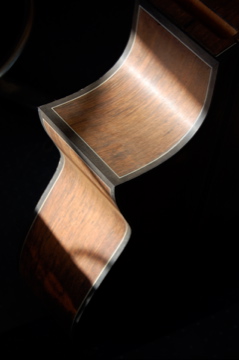
Here’s a photo of a guitar that can present itself as an optical illusion.
Can you see it? Is the peak/point an innie, or an outie?

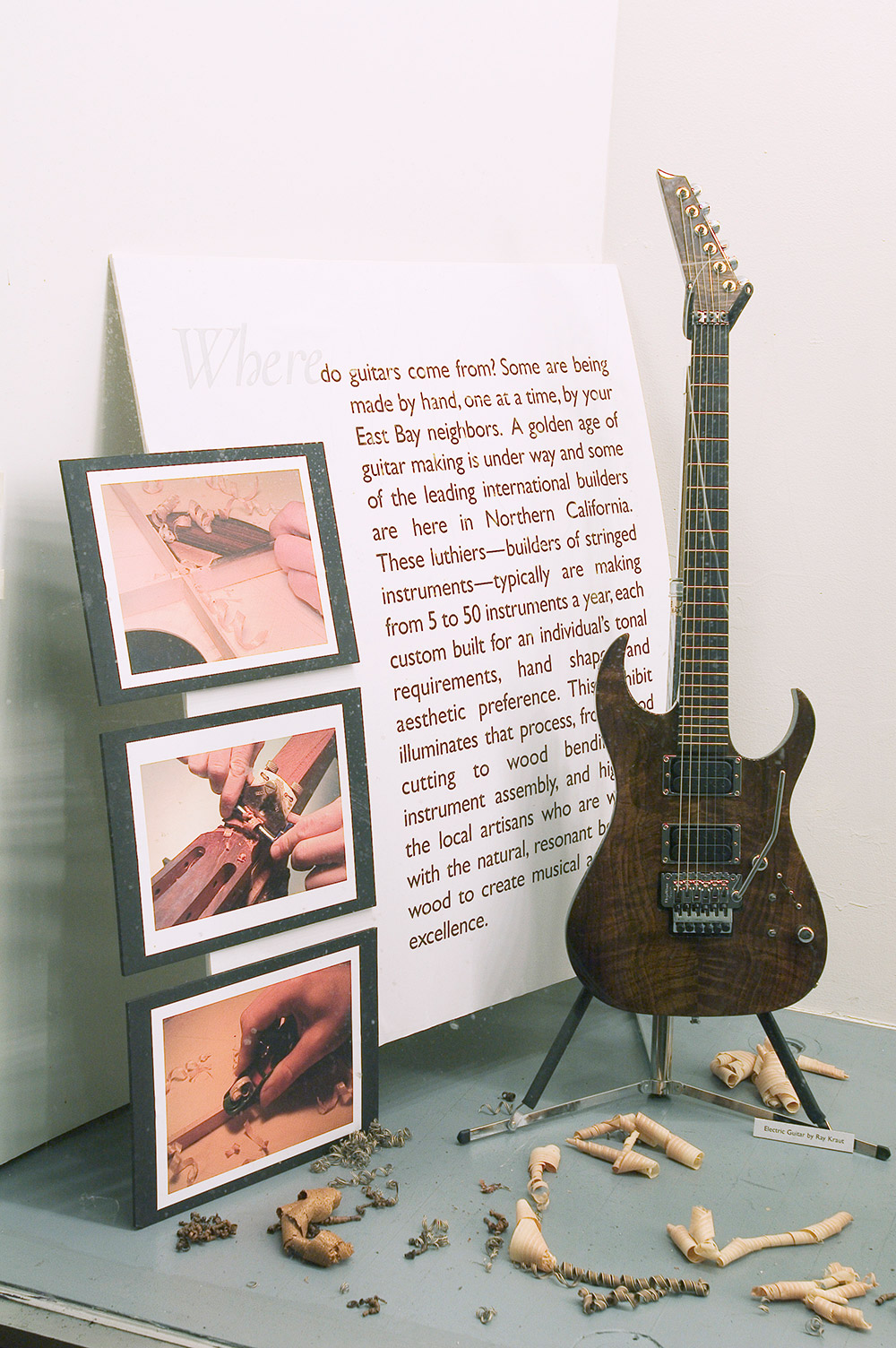


I’ve spent close to fifty years by now being fascinated by the six-string guitar, exploring its possibilities, and making various versions of it — despite the fact that underneath it all it is no more than a long-term but nonetheless a contemporary convention and a fad, and not essentially different from propeller airplanes, typewriters, lutes, galleons, vinyl records, bows and arrows, and the Roman Empire. It is simply a wonderful, useful, interesting, and effective cultural element and icon of our times . . . but by any long-range measure it is surely impermanent, and temporary.
The guitar as we know it is only some 170 years old and has ALREADY morphed into something that the originators would only recognize with difficulty. At the same time the challenges of daily life, of growing up, of finding meaning and significance, of the interactions between the sexes, of personal gain and loss, of identity, and the problems family and money and survival and responsibilities and bringing up children . . . are permanent and are the stuff of life itself. The guitar itself, morphed or not, is only a part of all that.
Speaking of the guitar’s having morphed, it’s morphed very interestingly. Let’s start with the fact that the humble guitar started out as something to plunk, twang, and strum songs on, and nothing more. I mean, Antonio Torres, the man who “invented” the modern guitar, was a carpenter, for cryin’ out loud, so there wasn’t much of a bottom line attached to making guitars. There were proto-guitars and guitar-like stringed instruments, but nothing approaching even a hobby as far as the modern guitar is concerned!
Actually, I mis-spoke with my comment on the guitar being useful for twanging and plunking on; that was mostly true of the American steel string guitar. The precursor of the Spanish guitar was being used early on to compose and play sophisticated melodies on; this speaks to the different cultures that had adopted the guitar; there were people even then who saw serious musical possibilities in it. Then, eighty-plus years later, about the time the guitar was beginning to be electrified, the acoustic steel string guitar’s voice began to be heard for the first time by itself and without accompanying instruments — in the singing cowboy movies of the 1930s and 1940s. You know: the ones where the good guy — the one with the white hat — fought off the black-hatted evil guys and through sheer virtue and pluck overcame them and won. As it happens, these movies served a social need. They came to the fore in the Depression-era social landscape in which people needed something to feel hopeful about. And Hollywood capitalized on that — and singing cowboys became stars!
At the ends of these morality-with-six-guns films the triumphant hero would pull his guitar out and sing a song. And instead of riding off into the sunset with the girl he departed with his horse and his guitar . . . with his sexual virtue intact. These movies were chaste; there was no sex in them and the hero’s chief love object was his horse. I can tell you with authority that that formula really works for ten-year olds. And it certainly did so for an American population that was beaten down by the Great Depression and sorely needed heroes and upbeat entertainment . . . especially when no one knew that the actors and actresses were, in real life, fucking like rabbits when off-camera.
And then, in the early 1950s, Elvis Presley came along and shocked everyone by swaying his hips seductively and strumming on his guitar on national television; it was the first time a whole lot of people had ever heard the guitar’s voice more or less by itself. In any event, while this history has failed to give the acoustic steel string guitar anything like the cachet of sophistication that the classic guitar has managed to attain, it did something else just as remarkable: it has driven the steel string guitar deeply and indelibly into people’s minds as something associated with the honest, hard-working, always-acting-in-good-faith-against-strong-odds working man and good guy. And winning.
Consider this: not one of you reading this has EVER seen ANY movie, film, or stage play, or tuned in to ANY TV show, or read ANY magazine or book … in which the bad guy plays the acoustic guitar.
It just isn’t done. The acoustic guitar is the hero’s instrument. The bad guy plays the piano, the organ, or the ELECTRIC guitar. Check this out for yourselves.
Wow.
Dr. Dovetail is a [humorous] advice column for luthiers. It consists of some earnest letters of inquiry that Dr. Dovetail has been helpful with.
Be it noted that no one is named who has objected to their name being used, and other names have been disguised to protect the innocent. There is no subtext, there are no hidden messages, there is no weirdness or backstabbing going on outside of my own silliness. If I really don’t like someone, I certainly don’t make fun of them in public. I go after them in sneaky ways.
On the other hand, nothing is trickier than writing humor. It’s more difficult than any other kind of writing; it’s impossible to not offend someone, no matter how hard you try. So if this isn’t going to be quite your cup of tea, please don’t read on.
– – – – – – – – – – – – – – – – – – – – – – – – – <> – – – – – – – – – – – – – – – – – – – – – – – –
Dear Dr. Dovetail:
I recently bought a Ribbecke guitar with a huge bulge in the lower bout on the treble side of the face, at my local flea market. The guy selling it said it didn’t need de-warping ‘cause it was made like that. He said it was a bubbled-top guitar. What’s the deal with this?
Signed: Bubbles, in Champaign (Illinois)
Dear Bubbles in Champaign:
What you have in your hot trembling hands, you lucky innocent, is one of the Ribbecke bubble-top guitars, manufactured in the 1970s. The genesis of the design is obscure: at first it was thought to be simply a metaphor for the essential post-modern deconstructionist paradigm. However, industrial sources report that it was the result of a search for a way to make guitars more sexy by giving them cleavage, and Ribbecke’s bulgey design ultimately provided the inspiration for the Miracle Bra. Having only a single bubbled mound on the treble side, however, these early attempts at representing cleavage came off as rather half-assed.
– – – – – – – – – – – – – – – – – – – – – – – – – <> – – – – – – – – – – – – – – – – – – – – – – – –
Dear Dr. Dovetail:
Having been a member of the National Luthier’s Guild for some years now I’m puzzled by the fact that its publication, Guitarmaker, is only published a few times a year. Other magazines are published at least six times a year, if not monthly or even weekly, and, given the sheer amount of interest in lutherie and woodworking out there, I’d expect that there would be more than enough material available to publish an informational journal more frequently. What is the explanation for such a lapse?
Signed: Elmore Pulitzer
Dear Elmore:
Being a somewhat in-house publication, it is felt that the normal rules and considerations don’t apply to Guitarmaker. It is furthermore felt that this publication, like other things in its publisher’s life, more than makes up in size and quality for what it lacks in frequency.
– – – – – – – – – – – – – – – – – – – – – – – – – <> – – – – – – – – – – – – – – – – – – – – – – – –
Dear Dr. Dovetail:
My wife recently surprised me by buying me a Humphries “millennium” guitar. The sense of occasion of the moment, unfortunately, was somewhat blunted by our getting into a heated argument about when the millennium actually began: in 2000, or in 2001? If I’m right, my wife threatens to return the “millennium” guitar and says I’m free to repurchase it myself on any date I wish. Can you help clarify this most vexing situation?
Signed: Stanley Kubrick (no, not that one)
Dear the-other-Stanley:
No need to worry: no actual, current time line is violated in the purchase of a Humphreys millennium instrument. Because the cachet of the current new millennium had already been co-opted by numerous commercial franchise ventures which had bought all rights to it, Mr. Humphreys’ guitars actually refer to the third millennium B.C.,which was still up for grabs. Keep your guitar and enjoy it. We understand these guitars are really great for playing old-timey music.
– – – – – – – – – – – – – – – – – – – – – – – – – <> – – – – – – – – – – – – – – – – – – – – – – – –
Dear Dr. Dovetail:
I keep hearing that luthiers and lutherie folks are diamonds in the rough. That is, lots of them don’t have a lot of formal schooling, but they’re really smart anyhow. Are any members of this group particularly educated in a formal way, and how well did they do academically before they went in for lutherie work?
Signed, P.H. Dee, PhD
Dear P.H. Dee:
Todd Taggart quickly comes to mind. He’s often told us that he was in the top 98% of his graduating class.
– – – – – – – – – – – – – – – – – – – – – – – – – <> – – – – – – – – – – – – – – – – – – – – – – – –
Dear Dr. Dovetail:
I’ve been excited to hear about Julian Gaffney’s new all-Brazilian-rosewood (top, back, sides, neck, braces, bridge and case) guitars, but have been hearing mutterings of dissatisfaction about these instruments. What gives? Brazilian rosewood isn’t all that bad a bad wood, is it?
Signed, Rio Janeiro
Dear Rio Janeiro:
We can only say that, for reasons which we don’t have the space to get into, it is generally felt that with the recent release of his “Save the Rainforest” line of Presentation Model all-Brazilian-rosewood guitars this man has hit rock bottom and begun to excavate.
– – – – – – – – – – – – – – – – – – – – – – – – – <> – – – – – – – – – – – – – – – – – – – – – – – –
Dear Dr. Dovetail:
I’ve been on the periphery of the world of lutherie for quite some time and informally followed the careers, successes and failures of some of the more prominent members of the guitarmaking community. I couldn’t help noticing that Ericson Reid, who had been active in guitarmaking and finishing, seems to have dropped out of sight. Does anyone know why?
Signed, Nah Yusseem Nahwa-Yudunt
Dear Nah Yusseem:
This firmly-established luthier made a bad mistake some time ago in building a guitar for a very important client who was connected with the Mob. He mistook the massage lotion for the wood glue and used it on that project. These substances look quite alike, you know, and this is an easy mistake to make. I’ve done it myself. Anyway, this individual had to leave town quickly and has gone into the Federal Luthier’s Protection Plan, and no one knows his whereabouts. We think he may have been sent to Costa Rica to work anonymously.
– – – – – – – – – – – – – – – – – – – – – – – – – <> – – – – – – – – – – – – – – – – – – – – – – – –
Dear Dr. Dovetail:
I’ve been hearing a lot about Ervin Somogyi lately: his unusual sense of design, his controversial politics, his pioneering nontraditional methods, his eccentric teaching style, his checkered work ethic, his highly Bohemian manners of personal behavior, his groundbreaking body of work, and the heroic array of medications that keep him going. This guy has made quite a splash. I hear he started out with nothing. Is this true?
Signed, Gudfur Nottingham
Dear Gudfur:
Yes. And common sentiment is that he still has most of it.
– – – – – – – – – – – – – – – – – – – – – – – – – <> – – – – – – – – – – – – – – – – – – – – – – – –
Dear Dr. Dovetail:
How long have Alembic guitars been around? I seem to have heard about them all my life. And didn’t Rick Turner make them?
Signed, Old Timer
Dear Old Timer:
Turner guitars have indeed been around for a long time. As a matter of fact, diggers at a prehistoric archeological site in North Central Southeastern Germany recently unearthed a perfectly preserved petrified wood Rick Turner guitar. Experts said it was the earliest example of a rock guitar they’d ever seen.
– – – – – – – – – – – – – – – – – – – – – – – – – <> – – – – – – – – – – – – – – – – – – – – – – – –
Dear Dr. Dovetail:
Why do archtop guitars have so much bigger pegheads than regular acoustic guitars?
Signed, Angelerenzorinaldi Manuelmauriccio
Dear Mr. Manuelmauriccio:
It’s because Italians have such long last names.
– – – – – – – – – – – – – – – – – – – – – – – – – <> – – – – – – – – – – – – – – – – – – – – – – – –
Dear Dr. Dovetail:
I’ve been trying to come up with a great, socko byline for my guitars, but I’m hitting a brick wall. All the good slogans have been taken. Do you have any advice for me?
Signed, Looking for a good Line
Dear Looking:
Before Boaz El-Laskin got on the bandwagon with his new slogan “Guitars so good you’ll plotz!” he was going to use “Miracle Guitars: if it sounds good, it’s a Miracle!”. This was originally intended to be marketed to seminary students, but he changed his mind after rethinking his demographic. It’s become available should you want it. Also, we hear that D. Angelico Corleone was going to release his new “il Padrone” model along with the slogan A Guitar You Can’t Refuse. But, since his mysterious disappearance, that one seems to be available as well.
– – – – – – – – – – – – – – – – – – – – – – – – – <> – – – – – – – – – – – – – – – – – – – – – – – –
Dear Dr. Dovetail:
I’ve been hearing about Larry Robinson’s inlay work for a long time and I finally got a hold of some of his books. Wow. Where does he come up with these complicated, intertwined, colorful designs and images? But aren’t they a bit on the busy side?
Signed, Snowblinded by m.o.p.
Dear Snowblinded:
Well, yes, but overall there’s general agreement that Robinson’s work is quite a lot better than it looks.
– – – – – – – – – – – – – – – – – – – – – – – – – <> – – – – – – – – – – – – – – – – – – – – – – – –
Dear Dr. Dovetail:
I’m a wealthy collector of fine things who is considering buying some guitars. My problem is that the most expensive guitars are made of rosewood, and my home is decorated in Danish modern style, so the guitars really wouldn’t match the décor. Do you have any suggestions?
Signed, Max from the Hamptons
Dear Max:
Why yes, I do, and your timing in asking this couldn’t be more perfect. Luddite’s Mercantile Inc. wood supplier in Healdsburg, California, has just received a large shipment of extremely expensive Brazilian rosewood which was recently culled from a pocket of the Amazon basin in which there has previously been little logging activity. This new wood is quite amazing. Far from looking like the same old dark Brazilian rosewood which everyone has been using for years, different samples of this new wood have the appearances of Danish maple, oak, Finnish birch, Dutch mahogany, and even Swedish chromed metal. Our staff feels that guitars made from unique materials would undoubtedly make the perfect accent statements to go with your couch, curtains, or gazebo.
– – – – – – – – – – – – – – – – – – – – – – – – – <> – – – – – – – – – – – – – – – – – – – – – – – –
Dear Dr. Dovetail:
I haven’t seen any of the Greedlove guitars around in a while and I heard that the company went out of business. What gives?
Signed, I. M. Curious
Dear I. M. Curious:
Unfortunately Greedlove & Co. got involved with the advertising company that was also Enron Corporation’s former Public Relations organ. Everything started to fall apart when, through the error of a dyslexic adman, the advertising for their new Domed-Top Guitars was spelling “domed” with a double “o”.
– – – – – – – – – – – – – – – – – – – – – – – – – <> – – – – – – – – – – – – – – – – – – – – – – – –
Dear Dr. Dovetail:
I‘ve been a guitar maker for a while now, but I’m finding the politics and egos involved are complicating my enjoyment of the work much more than I ever thought such things could. What advice do you have for a young guy with the hots to make it in this game, but doesn’t want to either take sides, get politicized, or alienate some people?
Signed, Disconcerted Dave
Dear Disconcerted Dave:
There are Four Golden Rules to follow in negotiating the complications and pitfalls of working with others. First, look for the humor in every situation. Second, don’t take sides. Third, never tell people everything you think.
– – – – – – – – – – – – – – – – – – – – – – – – – <> – – – – – – – – – – – – – – – – – – – – – – – –
Dear Dr. Dovetail:
I’m a bit disconcerted by the entry of so many foreigners into guitar making. Used to be that it was only real Americans that did this work — for instance like Roy Noble, one of the real old timers.
Signed, Patriotic
Dear Patriotic:
Yeah, I know what you mean, but in this case I have to pop your balloon. Roy Noble’s family originally came from Eastern Europe, where their family name was Nobulshitzky. They shortened the name to something easier to pronounce when they arrived here.
– – – – – – – – – – – – – – – – – – – – – – – – – <> – – – – – – – – – – – – – – – – – – – – – – – –
Dear Dr. Dovetail:
I’ve been reading Al Carruth’s articles for years now with increasing fascination. He has the most impressive grasp of musical acoustics and dynamics, and all done from a very scientific point of view. Yet, outside of his brilliant writings, no one I’ve talked to seems to know much about him. What can you tell me about this intriguing but shadowy figure?
Signed, Al Anon
Dear Al Anon:
In truth, Al is all but impossible to describe adequately. The best I can do is tell you the fact — widely agreed on by his friends — that if there were a contest for which First Prize would be a dinner with Al, then Second Prize would be two dinners with him. Third Prize would be three dinners with him. And so on. You get the picture.
– – – – – – – – – – – – – – – – – – – – – – – – – <> – – – – – – – – – – – – – – – – – – – – – – – –
Dear Dr. Dovetail:
I understand that luthier Martin Einstein has a PhD. in philosophy and is very smart. I met him once. I was standing on a ladder, trying to throw a tape measure up to the top of a flagpole, hoping to catch the flagpole’s tip. I needed to measure the flagpole’s height, you see, and I wasn’t having much luck. This fellow took one look at me and said, ‘hey, wouldn’t it be easier if you took the flagpole out of its socket, laid it out on the ground, and measured it like that?’ Then he walked on. I thought that was a pretty silly thing to say, don’t you?
Signed, Flagpoleman
Dear Flagpoleman:
Yeah. Obviously, he didn’t understand that you were trying to measure the flagpole’s height, not its width.
– – – – – – – – – – – – – – – – – – – – – – – – – <> – – – – – – – – – – – – – – – – – – – – – – – –
Dear Dr. Dovetail:
I’ve been hearing about something called the Doppler Guitar. Is it made by someone named Doppler? Who is he, and what are his guitars all about?
Signed, Coming & Going
Dear Coming & Going:
The Doppler guitar is the brainchild of luthier Martin Gibson. It’s based in the Doppler effect, in which objects approaching at high speed make a high-pitched sound and objects withdrawing at high speed emit a low-pitched sound — as when a car zooms past you on the highway as you are hitchhiking in the desert.
This enterprising designer saw a possibility of using this principle of physics to improve the response and tonal balance of his instruments. He is, at this time, attempting to patent a guitar the sound of which has its high end boosted as the player runs toward the audience with it; and the bass register is enhanced as one runs away from the audience, while playing the guitar. A special guitar harness is included at no extra charge, and this guitar provides something no other brand can boast of: tremendous aerobic and health benefits.
– – – – – – – – – – – – – – – – – – – – – – – – – <> – – – – – – – – – – – – – – – – – – – – – – – –
Dear Dr. Dovetail:
My brother and I used to see Gustav Taylor at many guitar shows, but haven’t seen him lately. Has he dropped out? We’ve been really hoping to see and play some of his newer guitars.
Signed, Isaiah Wahoppen
Dear Mr. Wahoppen:
I’m happy to tell you that Gustav is still making great guitars. He went through a rough patch a while back and has simply found it hard to get to his tables at shows, because of all the restraining orders against him. Watch for someone who looks heavily disguised and it’ll probably be him.
– – – – – – – – – – – – – – – – – – – – – – – – – <> – – – – – – – – – – – – – – – – – – – – – – – –
Dear Dr. Dovetail:
I’ve been reading your column for years and I think you’re making this stuff up. No one could write real letters like this. I’d like to see what would happen if you were hooked up to a polygraph.
Signed, Wired for Soundness
Dear Wired for Soundness:
You’re not the first one to bring this concern up. Not long ago I made an appointment with a luthier-polygrapher to settle people’s suspicions once and for all. Since he too had thought that I told incredible whoppers, he hooked me up not to a polygraph but a seismograph — in anticipation of getting truer readings. The needles held rock steady.
At least, until he plugged the machine in.
– – – – – – – – – – – – – – – – – – – – – – – – – <> – – – – – – – – – – – – – – – – – – – – – – – –
Dear Dr. Dovetail:
As a marketing student on my way to an M.B.A., I know that Ford, Oracle, 3-M, Toyota, Chef Boy-Ar-Dee, Pepsi-Cola, etc. have long since zeroed in on the perfect sound-byte for increasing sales and market share. I’m wondering what might be the absolute best marketing slogan you’ve ever come across from a guitar maker?
Signed, Future Biz-Whiz
Dear Future Biz-Whiz:
My personal favorite is from Ervin Somogyi’s pre-lutherie career, when he was making vacuum-cleaners. His slogan was Somogyi; Our Products Really Suck. His business went under just before the advertising campaing that was to use this line got off the ground. Too bad; he really had high hopes for it. We hear that he has been working on an entirely new model of guitar called “The Miracle Model”, to soon be marketed as “The Miracle Guitar: if it sounds good it’s a Miracle!”. We wish him luck.
– – – – – – – – – – – – – – – – – – – – – – – – – <> – – – – – – – – – – – – – – – – – – – – – – – –
Dear Dr. Dovetail:
My most embarrassing moment in lutherie happened one night when, in the dark, my girlfriend and I mistook the white glue for the massage lotion. The next morning the fire department had to be called in to hose us apart. Living in a small town, everybody was there to see the show. It was really embarrassing. Say, this is the “most embarrassing moments” column, isn’t it?
Signed: Togetherness in Tillamook
Dear Togetherness in Tillamook:
It is now.
– – – – – – – – – – – – – – – – – – – – – – – – – <> – – – – – – – – – – – – – – – – – – – – – – – –
Dear Dr. Dovetail:
I really need help. I’m an alcoholic with a bad problem that’s getting out of control. I’d like to try one of the 12-step programs, but I can’t afford them. What should I do?
Signed, My Wood is Drier Than I Am
Dear Dryer Woods:
I’m glad you wrote, because there’s a fix. Luthier’s Anonymous offers a fifteen-percent-off, ten-step, program which has had good results. To make the transition easier, L.A. takes you off the hard stuff gradually by putting you on a temporary diet of wines which are specially developed for luthiers — and which are the same stuff the National Luthier’s Guild bigwigs enjoy at their symposiums (have you ever noticed how sober they look?). The current offerings are the award-winning Vin du Pay Forever, this year’s best near miss Chateau Clos But No cigar, the somewhat overinflated Le GrandPinot Envee’, and the perennially asymptotic Maison Clos-To-Being-Done. Good Luck!
– – – – – – – – – – – – – – – – – – – – – – – – – <> – – – – – – – – – – – – – – – – – – – – – – – –
Dear Dr. Dovetail:
I’m puzzled by some aspects of Harry Fleishman’s persona. In his writings, he comes across as a thoughtful, highly professional and smart guy. But in person, when he lectures or gives classes, my impression of him is that he just woke up. Am I missing something? What gives?
Signed, Puzzled in Peoria
Dear Puzzled in Peoria:
Harry really is, in fact, a phenomenally gifted, charming, witty, and urbane man of penetrating intelligence who is, after everything is said and done, sparklingly brilliant. Because of this, the directors of lutherie events have long made it a point to ask Harry to mumble, stutter and say inane things when he makes public appearances. It makes people in the audiences not feel so bad about themselves.
– – – – – – – – – – – – – – – – – – – – – – – – – <> – – – – – – – – – – – – – – – – – – – – – – – –
Dear Dr. Dovetail:
As fur as hand-applied finishes go, do ya’ think that if’n I rubbed sausage grease all over mah guitar I could call it a French Polish finish?
Signed, Jes’ Wonderin’
Dear Jes’ Wonderin’:
That does it. I quit.
Dr. Dovetail is a [humorous] advice column for luthiers. It consists of some earnest letters of inquiry that Dr. Dovetail has been helpful with.
Be it noted that no one is named who has objected to their name being used, and other names have been disguised to protect the innocent. There is no subtext, there are no hidden messages, there is no weirdness or backstabbing going on outside of my own silliness. If I really don’t like someone, I certainly don’t make fun of them in public. I go after them in other sneaky ways.
On the other hand, nothing is trickier than writing humor. It’s more difficult than any other kind of writing; it’s impossible to not offend someone, no matter how hard you try. So if this isn’t going to be quite your cup of tea, please don’t read on.
– – – – – – – – – – – – – – – – – – – – – – – – – <> – – – – – – – – – – – – – – – – – – – – – – – –
Dear Dr. Dovetail:
My boyfriend is a luthier and I’ve been going to lutherie shows with him for some time now. I’ve noticed something odd going on. All the luthiers part their hair on the left. Is this some weird membership or dress code thing? Why do they all do this?
Signed, Puzzled in Topeka
Dear Puzzled:
Their mothers were all right handed.
– – – – – – – – – – – – – – – – – – – – – – – – – <> – – – – – – – – – – – – – – – – – – – – – – – –
Dear Dr. Dovetail,
I am thinking of hiring some luthiers for my guitar factory. I have heard that Leo Buendia is a fine luthier that I should get to work for me? What do you think?
Signed, Anxious
Dear Anxious,
You will be very lucky to get this man to actually work for you and I would waste no time in hiring him.
– – – – – – – – – – – – – – – – – – – – – – – – – <> – – – – – – – – – – – – – – – – – – – – – – – –
Dear Dr. Dovetail:
My teacher at the Roverto-Benn school gave me a lutherie problem to solve: A famous guitarist is playing a big concert in a renown music hall in City A at 8:00 p.m. City A is 200 miles from City B, and 300 miles from City C. A luthier in City B wants to sell the performer in question a guitar and starts hitchhiking with his guitar to City A, at noon. He averages thirty miles an hour. But, unfortunately, he forgets to take his medication along. A second luthier, in City C, also wants to sell a guitar to this musician. He starts driving his Yugo toward City A at 10:00 a.m., flooring it all the way. He averages 40 miles per hour. Unfortunately, he leaves his concert hall tickets at one of three bars he stops at to ask for directions.
Which luthier gets to the musician first and makes the sale?
Signed: Al Thumbs
Dear Al Thumbs:
Obviously, the luthier at the bar who found the mislaid concert hall tickets.
– – – – – – – – – – – – – – – – – – – – – – – – – <> – – – – – – – – – – – – – – – – – – – – – – – –
Dear Dr. Dovetail:
I’m a part-time luthier and computer hacker and I’ve just hacked into the central C.I.A. database files at Langley to find out what kind of dirt our top national security agency has gathered about the. board of directors of one of our larger lutherie supply organizations. Amazing!!! These people are the most incredible bunch of misfits and ne’er-do-wells I’ve ever read about. They’ve run their own businesses into the ground, cheated on their partners, colluded in price fixing of a vast array of their shoddy merchandise, have wild sex orgies at their annual sinposiums, and take drugs regularly. The most disturbing thing was that none of them seems to have ever been convicted of anything. Do these people have any previous convictions?
Signed, Amazed
Dear Amazed:
Well, yes; they all used to believe that honesty is the best policy.
– – – – – – – – – – – – – – – – – – – – – – – – – <> – – – – – – – – – – – – – – – – – – – – – – – –
Dear Dr. Dovetail:
I have a problem. I have two brothers. One is a luthier. The other was put to death in the electric chair for murder. My mother died in an insane asylum when I was three years old. My two sisters are both prostitutes and my father sells narcotics to high school students. Recently I met a girl from a reformatory where she served time for smothering her illegitimate child to death. I’m really in love with this girl and I want to marry her. My problem is this: if I marry her, how do I tell her about my brother who is the luthier?
Signed, Fred in Omaha
Dear Fred in Omaha:
It’ll sound better if you tell her he’s on the Board of Directors of a nationally prominent luthier’s supply organization with certain connections to a major national security organization.
– – – – – – – – – – – – – – – – – – – – – – – – – <> – – – – – – – – – – – – – – – – – – – – – – – –
Dear Dr. Dovetail:
I understand that individual guitar makers, having no advertising budget, are forced to market their instruments by going to guitar concerts and hawking them backstage, after the shows. Amazingly, some luthiers do very well at this. I’m told that Jason Kostal has been particularly fortunate in this method of marketing. How did he start?
Signed, For The Record
Dear For The Record:
This luthier’s early career in somewhat vague, but we have an unverified report that before he was a guitar maker he made grand pianos. He would drive them to concerts and haul them backstage to show musicians. It was working pretty well for him, but his back eventually gave out and he needed to lift lighter things.
– – – – – – – – – – – – – – – – – – – – – – – – – <> – – – – – – – – – – – – – – – – – – – – – – – –
Dear Dr. Dovetail:
Supposing you are making a guitar out of Egyptian Yew and Baltic Wormwood that have a density of six point two and five point nine pounds per cubic foot, respectively, at 26 degrees centigrade and 36% humidity. The woods are worked to .130″ during light Santa Ana wind conditions in October, when Young’s Modulus for the topwood is precisely 3. The braces are made out of Thuringian poplar felled at a 7000 foot elevation in December, with a grain count of 13 per centimeter. The air cavity is 17.85 liters and the soundhole is 4.25 inches in diameter. The bridge, made from rare aged Tasmanian Devilwood, weighs 39.7 grams at sea level at 60 millimeters of barometric pressure.
What would you expect the effect on the guitar’s 0,1,1 resonance dipole to be, and also on the impedance midrange transient of the 5000 to 8000 Hertz band (including bass signature roloff), of increasing the scale of this guitar by one centimeter?
Signed, Scientific Guitarmaker
Dear Scientific Guitarmaker:
None at all, unless you put strings on it.
– – – – – – – – – – – – – – – – – – – – – – – – – <> – – – – – – – – – – – – – – – – – – – – – – – –
Dear Dr. Dovetail:
I’ve been reading about the Kasha bracing system, with its radial asymmetrical bracing and impedance damping split bridges. I find this radical approach thought-provoking and intriguing, as it seems to come out of a heretofore unexplored concept of guitar acoustics that has ramifications into both monocoque and structural engineering, as well as exciting implications for entirely new bracing systems. Can you explain some of the dynamics and thinking behind this important contemporary breakthrough in guitar design?
Signed, Fascinated
Dear Fascinated:
No.
– – – – – – – – – – – – – – – – – – – – – – – – – <> – – – – – – – – – – – – – – – – – – – – – – – –
Dear Dr. Dovetail:
Frank Ford, of A.S.I.A.’s board of directors, is a well known repairman and an avid adherent of hide glues. He recently wrote the definitive History of Glue. Is this book any good?
Signed, Curious about Yellow
Dear Curious:
No one on the staff here could put the book down once they picked it up.
– – – – – – – – – – – – – – – – – – – – – – – – – <> – – – – – – – – – – – – – – – – – – – – – – – –
Dear Dr. Dovetail:
I hear Ervin Somogyi has broken ground as an artist by developing a new art form: woodcarving art inspired by the techniques and materials of lutherie work. Some people say this artwork-for-the-wall is pretty brilliant. What have you heard?
Signed, Aesthetic Woodworker
Dear Aesthetic:
The consensus in the art gallery world and among the doyens of the National Endowment is that at least Somogyi’s wall-art work, if not the man himself, is quite well hung.
– – – – – – – – – – – – – – – – – – – – – – – – – <> – – – – – – – – – – – – – – – – – – – – – – – –
Dear Dr. Dovetail:
I’m impressed with Michael Bashkin’s guitars, as well as his marketing acumen. He has worked hard at placing his instruments in the hands of prominent endorsers and is constantly striving to increase his market profile. What advertising blitz will we, the members of the public, be treated to next?
Signed, MBA plunker
Dear MBA plunker:
This man has really surpassed himself by recently signing an exclusive-use endorsement deal with the prestigious Gallaudet University Guitar Symphony Orchestra. They love the sound of his guitars! Look for their CD soon on the Music Mime label.
– – – – – – – – – – – – – – – – – – – – – – – – – <> – – – – – – – – – – – – – – – – – – – – – – – –
Dear Dr. Dovetail:
I want to buy a guitar, but am concerned that I find one that’s made with New Age Consciousness, with regard for all living things, and with an attitude of respect for the earth. What brand do you recommend?
Signed, Conscientious in Fargo
Dear Conscientious:
I’d try a Taylor. They don’t use laboratory animals to test their products. They use real consumers instead.
– – – – – – – – – – – – – – – – – – – – – – – – – <> – – – – – – – – – – – – – – – – – – – – – – – –
Dear Dr. Dovetail:
It’s been a long time since anyone’s heard about Larry Robinson, the famous guitar inlay artist. He made it Big Time in the seventies and eighties, but then ran into trouble with controlled substances, gambling debts to the Mob, various nervous breakdowns which led to hospitalizations and electroshock therapy and, of course, some sexual escapades notorious to the point of becoming legendary. What ever happened to him?
Signed, Reminiscing
Dear Reminiscing:
The individual you named has really cut a wide swath through the barrel bottoms of life, there’s no denying. After several attempts at drug rehab, counseling, and ultimately finding religion, his parole officer assures us that Robinson has turned his life around a full 360 degrees.
– – – – – – – – – – – – – – – – – – – – – – – – – <> – – – – – – – – – – – – – – – – – – – – – – – –
Dear Dr. Dovetail:
Me and my brother-in-law Biff went into partnership to import inexpensive Mexican guitars. Our business plan has been to rent a truck, drive to Mexico, buy a load of cheap guitars, and haul them back across the border to sell. We’ve done this a few times, buying the Mexican guitars for $50 each, driving them across the border, and selling them for $40 each, stateside. Cash flow is terrible, and we’re just scraping by. We’ve been tryin to figure out what to do about this situation. What do you think we oughtta do?
Signed, Mack from El Paso
Dear Mack from El Paso:
You obviously need a bigger truck.
– – – – – – – – – – – – – – – – – – – – – – – – – <> – – – – – – – – – – – – – – – – – – – – – – – –
Dear Dr. Dovetail:
I read that the National Luthier’s Guild. recently completed some rigorous controlled listening tests on guitars made by its members. What were the findings?
Signed, Acoustician in Nashville
Dear Acoustician:
The N.L.G. found that Nothing sounds better than a Manzer guitar. Much better, in fact.
– – – – – – – – – – – – – – – – – – – – – – – – – <> – – – – – – – – – – – – – – – – – – – – – – – –
Dear Dr. Dovetail:
It’s always interesting to know how various prominent luthiers got their start. After all, it’s not as though one could go to school to learn these skills, until recently, and all the old timers segued into guitar making from something else. One of the most fascinating individuals on the scene is Kasha Michael, who heads a world-famous enterprise that carries his name: how did he get his start in designing and making soundboxes?
Signed, Anecdotally Curious
Dear Anecdotally Curious:
He started out making caskets for dead pets.
– – – – – – – – – – – – – – – – – – – – – – – – – <> – – – – – – – – – – – – – – – – – – – – – – – –
Dear Dr. Dovetail:
The name C.F. Martin is known the world over. The first initial stands for “Christian”. It seems to me that to have four generations of the most famous guitar making dynasty in the world having this name can’t be an accident in this day and age. Do you know anything about the nexus between Christianity and guitars, which this name suggests? There’s probably a significant history, perhaps even an entire metaphysic, involved. Can you cast any light on this?
Signed, Christian luthier
Dear Christian luthier:
There’s been a lot of speculation about the nexus. You can read all about it in the recently published The Day Christ Died: The Real Story Behind “X” Bracing, which is available through The Luddite’s Mercantile catalogue.
– – – – – – – – – – – – – – – – – – – – – – – – – <> – – – – – – – – – – – – – – – – – – – – – – – –
Dear Dr. Dovetail:
I’ve been following Lewis Santer’s career for some years now, and I’m really impressed with his work. What accounts for his fabulous success as a repairman?
Signed, Motown groupie
Dear Motown groupie:
This man’s work is motivated by an attitude of extremely conscientious, almost compulsive, carefulness and fastidious attention to the smallest details. Why, he’s so meticulous that when he misplaces something, the place he finds that thing is not the last place he looks— just to make certain he didn’t lose it somewhere else! No one else we know of functions at this level.
– – – – – – – – – – – – – – – – – – – – – – – – – <> – – – – – – – – – – – – – – – – – – – – – – – –
Dear Dr. Dovetail:
I’m a psychologist and part-time luthier. In doing archival research for my doctor’s thesis in weird personality disorders, I’ve stumbled onto the fact that Bick Doak, who is associated with the Marlin Guitar Company’s custom shop for many years, once aspired to become an engineer as well as a writer of literature. He wrote at least one book in which he tried to combine engineering, fiction, ethics, marine science, whaling, theology and topology, but it seems to be out of print and I can’t find any references to it tell me what it was about either. Can you help?
Signed, Rosewood Sheepskin Man in Tulsa
Dear Rosewood/Sheepskin:
Mr. Doak has indeed had a varying palette of interests in his past lives. The book you refer to is Mobius Dick, (or What Goes Around Comes Around), which became an obscure but intensely studied cult classic some years ago. It was unfortunately doomed by vicious academic infighting between the engineering and ethics departments of the Universities at which the book was taught, that culminated in the unfortunate and subsequently hushed-up lawsuit between the Vatican and M.I.T. Psychologists have argued that the book, which carries the author’s first name in its title, is autobiographical. Pirated versions can still occasionally be found on the Vatican’s website. Mr. Boak is presently working on a specialty catalogue of inexpensive woods and materials for the guitar maker, titled Cheap Thrills In The Woodshop. We can hardly wait for it to come out.
– – – – – – – – – – – – – – – – – – – – – – – – – <> – – – – – – – – – – – – – – – – – – – – – – – –
Dear Dr. Dovetail:
Many luthiers have had previous careers in everything from business to photography to the arts, and have been successful in these. Furthermore, when they become guitar makers they often bring specific skills and attitudes from their former occupations with them, and use these to great advantage in mastering the skills of lutherie. I understand that one of the most prominent female luthiers on the scene today used to be a lawyer. What legal skills did she transfer over?
Signed, tax-accountant/guitar maker
Dear tax-accountant:
She actually wasn’t ever a lawyer: she was a dyslexic law student who dropped out when she found out she wouldn’t ever be joining the American Bra Association. But, even so, she did have a bit more trouble at first than the average second-careerist in transferring her legal skills over into lutherie. Due to a semantic misunderstanding, she believed that her guitars’ ease of playability needed to be actionable. She made many like that.
– – – – – – – – – – – – – – – – – – – – – – – – – <> – – – – – – – – – – – – – – – – – – – – – – – –
Dear Dr. Dovetail:
I went to the opening of a fancy new yuppie restaurant in my town and was attended by a most attractive waitress. When she asked me what I wanted I told her that I wanted a quickie from her, and she slapped me. She said that she didn’t do that kind of thing, and what did I want? Brought up short as much by her reflexes as by her looks, I repeated that I really did want a quickie from her. She slapped me again, and said for me to forget that, and what did I really want? I didn’t want to get hit again, so I left. What gives?
Signed, Bubba von Dresdner
Dear Bubba:
It’s pronounced keesh. We could recommend a good finishing school for you.
– – – – – – – – – – – – – – – – – – – – – – – – – <> – – – – – – – – – – – – – – – – – – – – – – – –
Dear Dr. Dovetail:
I’ve been hearing reports about Santer Instruments but I can’t quite get a fix on them. I hear that they have a guitar model called the “Zero Defcets”, which happens to be my name. Can you tell me something about its founder?
Signed, Zero Defcets
Dear Mr. Defcets:
Miroslav Santer is a man who has achieved the American dream. Originally an immigrant into the U.S. from New Jersey, Mr. Defcets started out with nothing. But like many self-made men he has, through sheer hard work and will power, made his way to the very highest pointof the Bell Curve.
– – – – – – – – – – – – – – – – – – – – – – – – – <> – – – – – – – – – – – – – – – – – – – – – – – –
Dear Dr. Dovetail:
I’ve long been fascinated at how guitar making work has attracted aficionados who previously have had other jobs, interests and careers. I’m particularly fascinated at how these creative individuals have brought with them the skills and disciplines of their former work lives — be they training in fine arts, machining, architecture, pattern-making, cabinetwork, commercial design, music or physics — and adapted them to guitar making. Have any luthiers come from the automobile making industry?
Signed, Edsel from Detroit
Dear Edsel from Detroit:
Why yes, there is one prominent luthier, whom we cannot name, who has come from that well-established industry. His current main project is a guitar with listener’s-side air bags. Frankly, it’s generally felt that his instruments really do need them.
– – – – – – – – – – – – – – – – – – – – – – – – – <> – – – – – – – – – – – – – – – – – – – – – – – –
Dr. Dovetail’s column will be continued in the second volume of this set.
I try to stay away from the news these days. The lies and lying really get to me.
Speaking of lying, there was a t.v. series called Lie To Me, starring actor Tim Roth, a while back. He played an expert in reading body language and facial expressions, who was brought in to solve a crime or mystery when something really bad had happened. Roth figured out who the bad guy was by interviewing people and following out those kinds of facial and postural clues. It was an interesting show; particularly because in explaining how various body and facial tics indicated lies, photos of various real politicians’ faces (when they were being interviewed, questioned, or just speaking) were used in illustration. My God but our leaders are brazen and mendacious.
———————-<>——————–
Having mentioned actor Tim Roth, I want to say that he starred in one of the best movies I’ve ever seen . . . and that no one has ever heard of. I found it by accident surfing channels late one night. It’s titled “The Legend of 1900” and, as I said, nobody has ever heard of it. But it’s a GREAT movie. It’s about a piano-playing prodigy who is born in the year 1900; it’s basically a romance, but without any actual romance — and with a cameo by actress Melanie Thiéry, who is one of the three most achingly beautiful females who have kept their clothes on that I’ve ever seen on a screen.
The musical high point of the film is a sequence in which the famous Jelly Roll Morton (“the Father of Jazz”) challenges the Tim Roth character to a public piano-duel. That sequence is to die for. Give yourself a treat some evening and watch this gem.
———————-<>——————–
On a different level entirely, I want to show you an image of my “Diospyros” guitar. Diospyros is the generic name for ebony, and this guitar is made up of lots of ebony tiles mixed in with contrasting tiles of Yellowheart wood. Overall, the pattern looks a bit like all the Midwest farmland that one flies over and sees if one looks out of the airplane window; or, on a different scale, a stylized version of the fitted-together-cobblestone streets one finds in Mexican towns.
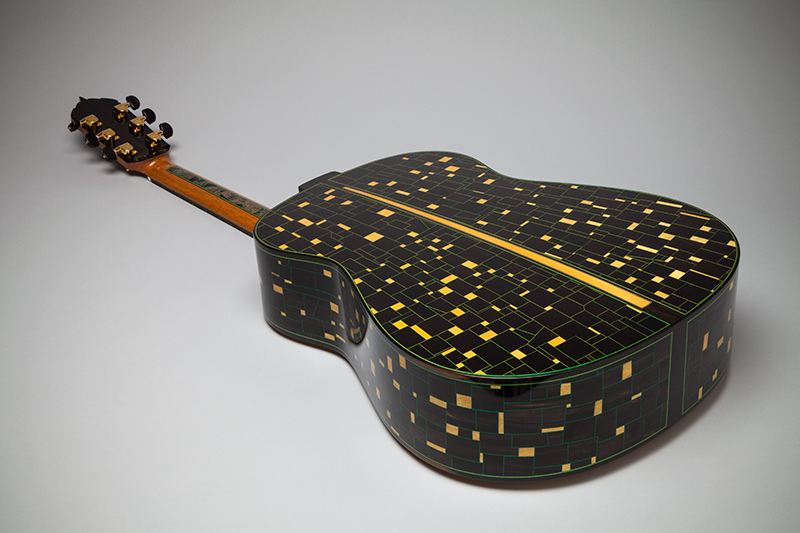
This guitar was, in fact, inspired by exactly that: the appealingly geometric look of the fitted-together cobblestones one can see on Mexican streets.
There’s a bit of a story behind this, of course. Part of that story has to do with how I notice, and get distracted by, the visuals in the world around me. I notice patterns, colors, textures, proportions, disproportions, continuities and discontinuities of line, evenness and unevenness, and all kinds of beauty in things no one else seems to notice. Textural stuff REALLY grabs my eye. This propensity really gets in my way when I’m trying to get anything done; so I try to hide when I’m working so as to get away from interruptions. Interruptions REALLY kill my focus and concentration.
Anyway, I was in a relationship with a woman some years ago. As I was married at the time it was, technically, an adulterous relationship — although my wife knew about it and really didn’t care. The marriage had, how should I put it, passed its “discard after . . . “ date.
This lady and I went to Puerto Vallarta for a week’s . . . uh . . . romantic getaway. Puerto Vallarta has long ago been converted into a tourist trap and is not nearly so pleasant a place in which to spend time as the travel industry might want you to think. The tourist hotels are about a mile out of town and isolated from the riff-raff. Those resort buildings are magnificent, impressively large, and soulless. They also jettison an awful lot of sewage directly into the ocean, not far from the town. Charming, that.
Puerto Vallarta is picturesque but has the scuffed and worn look of something that’s fallen on hard times. It’s right on the ocean; but the beach sand itself is a shockingly narrow strip . . . and it’s brown and looks dirty; it looks like a brown sugar truck had a major spill there. (The tourist hotels, in contrast, had imported tons of white sand that really does look nice, although the overall effect is that of an incongruous patch of white off in the distance, in the middle of an otherwise brown landscape.)
The main industry in the town is tourism, of course: the stores, restaurants, tours, crafts objects and imported merchandise, street vendors, etc. are all geared to that. (The crowning touch is that in order for the government to protect its tourist income, Puerto Vallarta is policed by soldiers from a nearby army facility who are armed not with pistols and rifles, but with machine guns.)
—————–<>——————
It was during this romantic getaway that I found out that I didn’t really like the woman I was with. She was . . . well, let’s just say that we were appallingly mismatched. It was sort of like going on a romantic hideaway trip and discovering that your partner is a transvestite.
This lady was smart, attractive, and, among other things, a competitive scrabble player. For months, she beat me every time we played. I didn’t really mind; I like words and playing with words, and I didn’t have anything riding on whether I won or lost. And, in any event, the more we played the better I got and the closer the gap between our scores became. We took the scrabble set down to Puerto Vallarta and it was while we were down there that I beat her at scrabble for the first time. MAN, WAS SHE PISSED! Outraged, in fact. And she had a major tantrum. Such . . . uh . . . misbehavior for such a seemingly trivial reason . . . well, it was pivotal for me. The relationship went quickly downhill after that.
In any event, after that tantrum, rather than to hang out with her, I walked around Puerto Vallarta a lot. As I walked, I noticed beautiful visual patterns and textures everywhere. I hadn’t quite realized until that week how much these things impinge on me; but IT WAS VERY PLEASANT for me to simply walk around and see the sights. I looked at wrought iron work on the houses, the colors of the buildings, the cobblestoned streets, iguanas for sale, etc. I learned a bit about Puerto Vallarta itself, too.
For instance: there are insect in that region that live in hidey-holes at the bottoms of small craters that they make in the dirt; if you go out of town you’ll see lots of these little conical craters in the soil. These “V”-sided craters are about the size of a walnut, and their sloped sides are lined with VERY FINE sand. Being fine sand, these craters are a lighter color than the surrounding dirt, and are therefore not hard to find; but of course insects don’t care about color. Anyway, when another insect walks into one of these conical depressions the sand all around is so fine that it cannot get its footing and it slides down to the bottom of the dip; then the insect jumps out of its hole, grabs the unsuspecting victim, and eats it. This predator is called a “Lolita” by the locals, by the way.
Who knew Puerto Vallartans were so literate? Anyway, it was fun to look and learn.
Fast-forward some years. I came into possession of a coffee-table book titled ARTEFACTOS, which has lots of photographs of arts and crafts artifacts from Latin America. One of the photos was of a beautiful cobblestones street of the kind I’d seen in Puerto Vallarta, where squarish and rectangular-ish stones (rather than more rounded or oval ones) were fitted together. Wow. That image just jumped out at me. And I filed that away as something that I could do something with at some point.
Fast-forward a few more years to when I had a hankering to make a guitar for myself — for no other reason than that I wanted to do something different from all the usual stuff. Enter the idea for the Diospyros guitar. The attached image is of this instrument.
I have to tell you that carrying this project out was VERY time consuming . . . but I didn’t really mind. Just like losing at scrabble. I was chasing something new simply because I really wanted to do it. And I could. And eventually the Diospyros guitar was completed.
———————-<>——————–
The thing of it is: it probably never would have been made had I not disliked that girlfriend as much as I did and stumbled on the otherwise invisible beauties of Puerto Vallarta. (I mean, who ever goes anywhere to look at pavement?) I have to tell you that in a weird way I feel indebted to her; the Diospyros came about, in part, with her unwitting help. I have more than once been struck by a philosophical sense of how an irritant can ultimately become a pearl.
———————-<>——————–
Speaking of “philosophical”, I had a Mondegreen experience with that word some years ago. A Mondegreen is a mishearing of a lyric or poetic line in which one imagines that something quite different has been said.
The Mondegreen originates from a Scottish ballad where the hero of the narrative is slain . . . “ and . . . [they] laid him on the green”. Someone heard that as “. . . and Lady Mondegreen” instead . . . and thus Mondegreens were born.
Anyway, when I was in High School there was a popular Harry Belafonte song called “Island in the Sun”. It’s a Caribbean tune that goes:
This is my island in the sun
Where my people have toiled since time begun
Though I may sail on many a sea
Its shores will always be home to me
Oh island in the sun
Hailed to me by my father’s hand
All my days I will sing in praise
Of your forests, your waters, and shining sand . . . etc. etc.
The song goes on to the phrase “. . . and Calypso songs philosophical . . .” And that’s when I Mondegreened. I thought Belafonte was singing “Calypso songs full of Soffy Cal”. I couldn’t figure out what Soffy Cal was. For years I thought it might be some exotic Caribbean substance.
O.K. I’ll clam up about that now. It’s just getting too nacreous and chatoyant around here.
More later.
-Ervin
The following is an excerpt from the new book that I’ve been writing for the past three-plus years. It will be another while before it sees the light of day; but it’s copyrighted and if any of you wants to use it for anything you have to ask permission to do so, and then give me attribution for it. Sorry about that: it’s how business works.
I had, in earlier writings, brought up the matter of top thickness and my refusal to reveal the magic numbers. Well, the top’s thickness is, along with the layout of the bracing, the most debated and tinkered-with area of lutherie. It is so for two absolutely important considerations. The first is that the guitar top is the “soul of the guitar” (that is, its physical characteristics set the stage for tone) along with the corollary that “the lighter the construction of the top is, the better the sound”; in fact, there is an adage among Spanish guitar makers to the effect that “the best guitars are built on the cusp of disaster”. And this brings us to the second consideration: there is a minimal top thickness/stiffness/strength that must be respected if the plate is not to cave in under string load. If sheer durability were one’s principal consideration then the guitar could be made of 2 x 4s ; that will make any instrument very durable indeed. But if sound is one’s objective, then the luthier’s skill lies in finding the correct balance point between the imperatives of ‘not too light’ and ‘not too heavy’ construction; and that balance point will be where the guitar is just strong enough to hold together.
In my work, I take my tops to a target deflection under a standard weight rather than to a predetermined, formulaic thickness. I’ve worked like this for a long time now and have written about my thinking and techniques at length. Still, my method may not work for everyone. There are a lot of guitar makers out there who swear by specific target measurements, and I’m not sure I have the right to say they’re wrong to do so. My own preferred method is different; it just means that, because of the variations of specific physical characteristics of any individual guitar top, each of my tops is a little bit different in thickness. The question comes up, then, of what is the proper justification for focusing on one or another specific number for top thickness? And, what would that number be? Well, it seems to me that a good place to begin would be to have some idea of where the measurements that we do know about, read about, have heard about, and use come from.
Many of my generation of American luthiers got our start by reading Irving Sloane’s seminal book Classic Guitar Construction, which appeared in 1966. This was, after A.P. Sharpe’s 32-modest-pages long Making the Spanish Guitar (published in 1957) the first available ‘real’ book on guitar making. Sloane advised the reader to make his tops 3/32” thick, which is equivalent to .094”, or 2.34 mm. Mind you, this instruction appeared before any of the two-dozen-plus books on lutherie that are now available, and before the plenitude of secondary sources of information that now exist. How did Mr. Sloane — who was not only writing very early in the game but had, as far as I can ascertain, only built a few guitars on his own then — come up with this number? Well, perhaps by reading Sharpe’s book (which recommends the same measurement), and very likely by measuring some guitar tops and by talking with some contemporary makers.
He doesn’t seem to have spoken with Vicente Tatay, one of the early Spanish luthier-transplants to the U.S., though. Tatay came from a prominent Valencian family of guitar makers and presumably knew what he was doing, guitar-making-wise, even before he took his plunge into the New World. Once here, he wound up working out of a store in Greenwich Village and became, by so doing, one of Mr. Sloane’s fellow New Yorkers.
There’s a wonderful article by Steve Newberry, published in American Lutherie (“Vicente Tatay and His Guitars”, issue #66, Summer 2001, pp. 47-49)about the state of lutherie and its lore in the U.S. many years ago. It is told from the point of view of the author who, as a teenager, became fascinated by Mr. Tatay’s work and talked him into being allowed to hang out in Tatay’s shop after school hours and be of some help by sweeping, cleaning, etc. In exchange he got to observe Mr. Tatay at work, of course. This turned out to be a mixed pleasure: Mr. Tatay is described as having been a gruff, cantankerous, cranky and closed-mouthed chain smoker who had an explosive temper and spoke only Spanish. Still, one afternoon toward the end of the Summer, in an uncharacteristic moment of expansiveness and letting down his guard, Mr. Tatay motioned the young Newberry over to his workbench and, using hand gestures and some coins, indicated to him that the secret to his lutherie was to make the guitar top about the thickness of a nickel in the middle, and the thickness of a dime at the edges. (I should add that a lot of Spanish guitar making in those days was done just like that: by skilled feel and eye, and with amazing accuracy.) Tatay might or might not have known the numerical values of his thicknesses but he certainly knew how to work to such tolerances at the workbench. Incidentally, nickels and dimes are about .075” (1.9 mm) and .050” (1.34 mm) in thickness, respectively. Give yourself a treat and look that article up; it’s as well written as anything Mark Twain ever wrote.
Four other books on guitar making followed Irving Sloane’s pioneering work on guitar building. Classic Guitar Making y Arthur Overholtzer, published in 1974, immediately doubled the available information on this subject. The other three were Donald Brosnac’s The Steel String Guitar; Its Construction, Origin, and Design (1973), David Russell Young’s The Steel String Guitar; Construction and Repair (1975), and Irving Sloane’s follow-up book Steel String Guitar Construction (1975). These last three were the first sources of published information on the steel string guitar and their recommended guitar top measurements were 3/32” (.094”) . . . 3/32” (.094”) . . . and 7/64” (.109”), respectively. Overholtzer’s top measurements took into account wood density and hence presumably stiffness: for classic guitars his recommendations are 3/32” (0.094”) for soft spruce and 1/16” (.062”) for hard, dense spruce. For steel string guitar tops he recommends 3/32” to 1/8” (.094” to .125”).
With the exception of Mr. Overholtzer, who had been a violin maker for some years previously, the others were pretty much acting as novice discoverers, craftsmen, and pioneers — as I myself was, except that I hadn’t written a book yet. I think it’s safe to assume that these young makers/authors were following each others’ and the Martin Company’s leads; and I was certainly following theirs. The Martin Guitar Company comes into this discussion because it was the best known steel string guitar producer of that time and would have been everyone’s main point of reference for making a steel string instrument. Certainly its most recognized and popular model, the Dreadnought, was that. (The Gibson company’s guitars were almost as well known as the Martins; however, all considerations of quality and tone aside, that company simply put fewer of its resources into advertising and its level of public recognition/popularity would have been consistent with that. The Guild company would have come in third in name-recognition; but it copied the Martin dreadnought shape, thus further reinforcing that model’s dominance.)
Irving Sloane, whose second book Guitar Repair (1973) focused on steel string guitar repair procedures, was surely in the Martin camp: the photos were taken on the Martin Guitar factory premises, and the repair procedures that are described were carried out on the Martin company’s workbenches — on Dreadnought guitars. That guitar model was David Russell Young’s and Don Brosnac’s primary focus as well, in their books. I asked Mr. Brosnac where he got his book’s recommended measurements from; he told me that he got them from Jon Lundberg, the legendary Berkeley-based Martin guitar retro-voicing pioneer, who was in those days possibly the world’s leading expert in that guitar — at least away from the Martin factory premises.On the other hand, both Overholtzer and Sloane seemed to take a lot of cues toward their classic guitar making from the work of Robert Bouchet (1898-1986), a noted and innovative French builder. While information in general seems to have been scarce in those days, Bouchet appears to have been relatively open with information. The established Spanish makers weren’t talking or writing anything about their approach to guitar making.
In 1987, twelve years after the last of the above books was published, the bibliography of guitar making took a major step forward when William Cumpiano and Jon Natelson published Guitarmaking: Tradition and Technology. This was the first book to address making both classic and steel string guitars; its recommended top thicknesses were the most comprehensive yet because it recognized that not only does (1) size of guitar and species of wood used make a difference, but that (2) different makers have significantly different building designs and ways of using their materials because (3) a guitar’s intended target sound might not be the same in every instance. A maker might use a thinner top with increased bracing, or a thicker top with minimal bracing, or a different bracing pattern entirely, or use different strings with different string pull and torque, etc. Accordingly, top thicknesses are suggested rather than instructed.
Top thickness targets for classic guitars are given as around .100” (2.5 mm) for spruce and .110” (2.8 mm) for softer wood such as cedar. For steel string guitar the recommendation is 1/8” (.125”, or 3.17 mm) for a first-time project, but otherwise ranging from .095” up to .130” (2.4 mm to 3.30 mm) depending on size and shape of instrument as well as species of wood used. One can see that thinking about top thickness was getting more sophisticated — although, given that these are all method-books, the suggested measurements must still all be considered to be Rules of Thumb.
In 2009 I published my two-volume book. In it, I didn’t give any specific measurements for optimal top thickness; instead, I dwelt on the practice of thinning to deflection rather than to dimension; this has always seemed to me a better guide than the thickness of the wood is, in order for one to most meaningfully track their progress over time. I also wrote at length about the balancing act that one is called on to make in matching a guitar’s bracing to its top’s stiffness. I furthermore said that I worked to thinner target dimensions than the average luthier does. It may have been self-serving of me to not mention a specific thickness for tops and keep that information to myself; but I don’t really believe that simply telling a young luthier to make his tops, say, two millimeters thick — and without mentioning the multiple other factors that have to be met correctly — is a high-quality communication. And my book does dwell at length on all the dynamic factors that I consider important.
In 2011 Australians Trevor Gore and Gerard Gilet published another ambitious two-volume book, Contemporary Acoustic Guitar: Design and Build. They do not seem to have fallen into the trap of advising a fixed target number for top thicknesses. They seem to have very intelligently advised working in an optimal range of thickness. That’s really the way to go, I think. Besides Gore’s and Gilet’s books, a number of other volumes on guitar making have also appeared, each of which suggests certain target numbers for top thickness.
Finally, I want to call one other book to your attention: Don Brosnac’s An Introduction to Scientific Guitar Design, published in 1978. It didn’t offer specific measurements for anything, but I want to mention it because it was the first book that looked beyond the how-to-do-it and who-did-it-first level to explore the guitar’s wider accessibility from a discipline other than that of basic woodworking. Up until then, everything else written had been (and would for years to come) be mechanical-level-instructional, archival, historical, and otherwise full of declarative sentences. But Brosnac’s was the first book to take a step back and address the more general topic of what else besides woodworking the guitar might be about— which made it interesting to me personally. That publication has since been followed by a fleet of books, articles, and essays that have examined the guitar as art, science, physics, wood technology, disciplined efficiency in production, engineering, acoustics, a collectible object, a genre/cultural icon, zen, an artifact of musical and/or economic history, etc. With the entry of many talented Born-Again-Christians into the field, I expect that there will sooner or later be a book about The Modern Christian Guitar too. Mr. Brosnac did pioneering work and the field is still wide open to new ways of understanding, and approaches to, this interesting instrument.
Anyway, getting back to top thicknesses: according to the published instructions that I’ve cited in the three decades between 1957 to 1987, top-measurement for classic guitars are:
1/10” (.100”) to 7/64” (.110”),
or 2.5 mm to 2.8 mm;
3/32” (.094”), or 2.34 mm;
1/16” (.0625”), or 1.59 mm;
0.050” to 0.075”, or 1.34 mm to 1.9 mm
(i.e., the thicknesses of a dime and a nickel)
. . . . . and for steel string guitars they are:
3/32” (0.094” or 2.38 mm) to 7/64” (0.109”
or 2.77 mm);
and from 1/8” (.125” or 3.17 mm ) to a fat 1/8” (.130” or 3.30 mm),
Does this get us anywhere? Well, sort of. It tells us that, at least in the classic guitar, one can go as thin as 1/16” (about 1.50 mm) and still have the instrument hold together. That’s useful to know — as is the fact that Overholtzer is in a minority in promoting such thinness; he and contemporary luthier Greg Smallman go remarkably thin, but very few others follow suit. As for steel string guitars, we have no published accounts of whether there is a top-thickness limit that’s below 3/32”; if anyone one (other than me) has tried to push that envelope they haven’t written about it, to my knowledge.
You should know two things. First, that stiffness/thickness numbers are just that: they are not very meaningful in the absence of information about doming and brace layout/treatment. And second, that Tatay’s previously mentioned top-shaping approach is the traditional one used by Spanish classical and flamenco guitar makers: the top is made to a target dimension in the middle but it is thinned in the outermost inch and a half or two of the lower bout, from the waist down, to another target dimension. We know this because work of this type is found in the instruments of established classical guitar makers whose guitars have been studied and carefully measured. Experts can even date certain classic guitars through specific variations in their measurements, which will have been documented from the various periods of their makers’ careers.
Flamenco guitars lack the social and academic respectability of their rosewood-built sisters and have not received such formal attention; they get played a lot but are not studied or otherwise paid serious attention to. Ditto steel string guitars. And speaking of these, Sloane’s and Overholtzer’s recommendations of uniformly-thicknessed classic-guitar-top measurements, previously cited, actually come out of the steel string guitar making tradition in which the top is the same thickness throughout, without any selective tapering or thinning. This itself follows from an efficient manufacturing methodology of putting the wood through a sanding machine and then using the wood that comes out the other end, without any further refinement– as opposed to the pre-Industrial European traditions of using hand tools in tapering, controlling, and achieving variable dimensions of the parts. Go team.
November 12, 2018
Someone asked about why I don’t post photos of current builds, comments, updates, etc. on the lutherie discussion forums. Well, there are several reasons. Mostly, I just don’t have the time.
I think that the Acoustic Guitar Forum is mostly a good thing; it gives individuals a chance to show off their latest work and get comments and information and support. I particularly am impressed by the postings such as one that I saw by JESSUPE (Jessupe Goldastini). What a painstakingly original and unique piece of work he’s accomplished! I have myselfposted my thoughts on various internet sites in the past. I did quite a bit of this some years ago on the ANZLF (Autralia/ New Zealand Luthier’s Forum), as well as on this one, and on a third one the name of which I’ve forgotten. These were mostly good experiences. But spending time on internet forums at this point in my life is not really for me; they can really soak one’s time up. And, frankly, not everyone behaves well.
Aside from all that, I have put everything I know and think about how guitars function, into my two books. My information is all there. Really: I’ve kept very little back except the specific thicknesses of my guitar woods. This is largely because there is no specific target thickness: each guitar top is a bit different in thickness. This is itself because I’m going for a specific stiffnessevery time, not a thickness. Each piece of wood is a little bit different, and it’s meaningless to give one number that would include tops for Jumbo guitars, and OM guitars, and OO guitars, and everything in between . . . that would furthermore include no information at all about bracing, string gauge, scale length, voicing procedures, doming, selective thinning within the same top, and the specifics of wood selection. PLUS: there are by now fully two dozen HOW-TO books that will give one or another specific number for top thickness. So the best I could do is to give an average thickness.
I produced a DVD a few years ago of a lecture that I gave in which I listed and explained the factors that are responsible for a guitar’s sound: voicing work, bracing, materials stiffness, and vibrating modes of guitar tops. I laid out everything that I’ve discovered and use that I consider important. I even brought some guitar bodies that had been voiced to different degrees of completion, and tapped on their tops to illustrate the progression of tap tones in my voicing work. Such tap tones audibly reveal how a guitar top “opens up”, and I find them indispensable as guides.
At the end, when the audience was asking questions, someone asked if they could see the final shapes of my bracing (that was producing those tones that had reflected my voicing efforts). I responded that he’d have to take my voicing class to see that level of the work. That may have been a mistake, and I got some blowback from it as the word spread that I was stingy and secretive with my work. I regret having sounded so flip and glib. I wish I’d had the presence of mind to have said the following — or something like it:
“I’ve described every principle and consideration that I find important in dealing with guitar sound: wood stiffness in guitars, optimal bracing, top vibrational motions, torque and string pull, an evenness of the vibrating gradient, the Cube Rule of stiffness, guitars as projectors and as diffusers, and top doming. [NOTE: this stuff is all in my books.] I’ve told you what I think, and why I think it, and I used visual aids and diagrams. I’ve talked about how I came to discover these important things, and even what mistakes I made along the way. And, mainly, these are precisely the factors that I work with as I make guitars the sounds of which everyone likes. Now, if I just show you the shapes and profiles of my bracing . . . youwillimmediatelyforgeteverythingIsaidandgohomeand copywhatyou’veseenmedo. And that, in my opinion, is really bad teaching”.
I said above that it may have been a mistake for me to refuse to show my final configuration of voiced bracing to the audience member who asked to see it. That’s half of it. The other half is: Are you kidding me?; you expect me to show you what it’s taken me four decades to figure out, just for the asking — and then criticize me when I say no? Pal, I just told you ALL the things that I think about in order to do the work that I do. I owe you that because I promised to speak about these things. But I draw the line there; that SPECIFIC stuff is entirely proprietary. I do not owe you to show you the specific fruits of forty-plus years of my learning curve just because you’ve bought a $10 ticket to a presentation I’m making.
I wish to be a cheering section for the honing of one’s own thinking skills. Also, I know something important that a lot of younger people don’t: things acquired without effort or equitable exchange — sort of like sex on demand — have no significance. You can stop reading now, by the way; I will post further postings on this matter but they are merely additional commentary.
May 20, 2018
Hi again. I want to repeat that you don’t have to read all this stuff. Or, if you do, try to pace yourself. And if you find this material interesting it’s perfectly all right with me if you share it, or part of it, with your friends. Or not.
I’ve been rambling on about maleness and femaleness. I think that ideas of maleness and femaleness are as deeply hardwired into our language as they are hardwired into our minds. As I suggested, it seems that the very word “environment” reeks of maleness. At least, that’s how it seems to have started out; these days there’s a bit of an ecological spin to it.
Ditto “patriotism”, which word is much on the political forefront these days, if only in the negative. The thing about both “patriotism” and “environment” is that they are such fundamental ideas that it never occurs to anyone to question them or see how they fit into the scheme of things. Instead, people consider that the scheme of things fits into them: they are that basic. Yet both are man-created concepts, and both of them seemingly trace back to maleness. “Patriotism” comes from the root-word “pater”, meaning “father”. Patriotism = loyalty to the fatherland. That root also gives us a whole slew of other words that begin with “pater” or “patr”. Many of them are pretty arcane, but we still use “patriot”, “patrician”, “patrimony”, “patriarchal”, and “paternity test” in everyday discourse. We also “patronize” people.
In view of that root, what’s the deal with naming a woman “Patricia”? Also, Athena was the Patron Goddess of Athens and the Patroness of the Arts. Read up on Athena; those words are used. But aren’t these all examples of those . . . uh . . . oxygenated moron things?
Given the discouragement that people feel with both the world and with government in general, I’d offer a gentler alternative to the forced, self-serving, ugly, and debauched version of Patriotism that people are rabidly claiming for themselves and/or hysterically accusing others of lacking or betraying. Become a Matriot. Believe in the gentler, healthier, and more nourishing principles. “Matriot”, of course, comes from the word “mater”, or “mother”.
Which brings me to Hillary Clinton, the most hated female of our generation. It’s true. People HATE her. I was listening to an interview with author Amy Chozick, who has just released a book about Ms. Clinton. Ms. Chozick has put a lot of research and work into her book and ran plentifully into people’s attitude that, well, a woman might be a good president . . . but not that one. Anyone but her! A lot of people, women included, have a visceral hatred of Hillary Clinton. Perhaps you are one such person.
Interestingly, and disturbingly, many people can give no reason for their hatred when asked; they just are adamant in their kneejerk revulsion of her. Pointing out that such irrationally held opinions are not based in anything real, or documented, or even dispassionately looked at does not seem to help. Fact-checking is lost on them. Hillary is literally the most investigated and accused-of-malfeasance person of our generation and no one has ever found anything to charge her with nor found her to be culpable of except being stiff and unspontaneous. Well, Trump did once comment (on national television) that Hillary urinates, and he labeled her as being disgusting for doing so. So there’s that. The fact that Trump has such feelings about bathroom breaks is the surest proof that neither Melania nor Ivanka ever urinate. He couldn’t stand it if they did. But it’s very odd that he didn’t comment on those Russian prostitutes . . .
. . . well, you know . . . when in Moscow . . . arrgkh . . . .
. . . . . . . . . . . . . . . . . . . . . . . . . . . . . . . . . . . . . . . . . . . . . . . . . . . . . . . . . . . . . . . . . . . . . . . . . . . . . . . . . . . . . . . . . . . . . . . . . . . . . . . . . . . . . . . . . . . . . . . . . . . . . . . . . . . . . . . . . . . . . . . . . . . . . . . . . . . . . . . . . . . . . . . . . . . . . . . . . . . . . . . . . . . . . . . . . . . . . . . . . . . . . . . . . . . . . . . . . . . . . . . . . . . . . . . . . . . . . . . . . . . . . . . . . . . . . . . . . . . . . . . . . . . . . . . . . . . . . . . . . . . . . . . . . . . . . . . . . . . . . . . . . . . . . . . . . . . . . . . . . . . . . . . . . . . . . . . . . . . . . . . . . . . . . . . . . . . . . . . . . . . . . . . . . . . . . . . . . . . . . . . . . . . . . . . . . . . . . . . . . . . . . . . . . . . . . . . . . . . . . . . . . . . . . . . . . . . . . . . . . . . . . . . . . . . . . . . . . . . . . . . . . . . . . . . . . . . . . . . . . . . . . . . . . . . . . . . . . . . . . . . . . . . . . . . . . . . . . . . . . . . . . . . . . . . . . . . . . . . . . . . . . . . . . . . . . . . . . . . . . . . . . . . . . . . . . . . . . . . . . . . . . . . . . uh . . . . . . . . . sorry. I lose a bunch of brain cells every time I think of that sort of thing. But no one censured Mr. Frump for his narrow-minded stupidity nor his lack of grace. And people do HATE Hillary. There is something seriously wrong here.
I’ve had some conversations of my own with people about these matters, and while I haven’t come away with any greater clarity I do sense that these are still hot topics a year after the election. People are very frustrated with both Hillary and the Democratic establishment. Interestingly, to me, almost all the conversations I’ve had were ones in which I was told whom to blame for the mishandlings of Hillary’s presidential campaign. Or commenting on Hillary’s various failings as Secretary of State. As though the whole thing was a massive tactical error on someone’s part . . . and without commenting on the incredible peccadillos of the opposition, the big picture, context, political history, Trump’s political track record of minus zero, etc.
Notice that I’m not saying this or that party is right or wrong; to even try to go there will inflame the situation further. I’m commenting on how polarized the matter is.
That is soooo weird and troubling.
You might ask from where do the Republicans get their ideas that Hillary is crooked, traitorous, dishonest, untrustworthy, repellent, and/or criminal? In my next newsletter, a doctor with a flashlight will show us exactly where those ideas come from.
More later.
May 10, 2018
I learned a new word the other day: androcracy (pronounced an-DROK-ruh-see). It means a system ruled by men.
Androcracy indeed; we’re all familiar with that. “Andro” is the Greek root for “male” or “maleness”; the Latin root is “vir”, as in “virile”. I’m under the impression that the Greeks also used “vir”, however, so I’m a bit confused on this point: Socrates’ wife Xantippe was famously a sharp-tongued scold and nag, and she was referred to as a “virago”.
Well, I suspect she had reason to be. Her hubby seems to have been gone all the time, talking philosophy all day long with other men, and in general building up his resumé as a great thinker. But not being a hubby. From everything I’ve ever read, he ignored his wife; he basically fled from her. He didn’t work as far as I know, and I don’t know what he could have brought home money-wise to make his wife happy (my guess is that he owned land and lived off his rents). As far as I know there’s never been any mention of whether he had children, although he probably did. Somehow, I doubt that Xantippe started out as a virago. Well, to the best of my knowledge domesticity was not a priority of any sort in Greek society; what was a priority was the polis, or community. At least, it was so among the citizens.
Well, certainly the male citizens; slaves and foreigners (called “exenos” in Greek, from which we get the word “xenophobia”) didn’t count. On top of that, in those days, women weren’t only not part of the social or political picture, but once they married they weren’t part of any picture at all — except maybe in mythology. They became invisible. At least, that’s what historians have concluded from the remaining writings, folklore, statuary, stories, etc. about Greek daily culture. Greek daily culture, as far as any extant literature or records show, was very male-centered. As a matter of fact men loved and adored each other in ways that would be viewed as very suspicious by some moderns.
There may have been heterosexual domestic life aplenty, but that’s the kind of thing that is so ordinary that no one ever puts any of it down on paper. At some future time archaeologists may be trying to decipher the American sense of normal domesticity by referring to surviving historical documents like our Tabloids’ reports on Angelina Jolie and Brad Pitt’s marriage, novels by the likes of Ayn Rand and Norman Mailer, media fare such as Divorce Court and Judge Judy, and things that Donald Trump and Woody Allen said.
“Virility” is defined by the Oxford English Dictionary as: “the period in life during which a person of the male sex is in his prime; mature or fully developed manhood or male vigor; power of procreation; male sexual potency; strength and vigor of action or thought”. Hmmmmm. I guess women must not have any of those attributes, urges, or capacities. Not if the Oxford English Dictionary doesn’t say so, and it doesn’t mention women at all as far as this kind of thing goes. So I guess there’s no doubt about it: virility is entirely a guy thing. Interestingly, I haven’t run across any female version of this word. There’s “chastity”, which is a behavior solely attached to women who aren’t fully developed in their womanhood nor frisky in the procreative department. Its male counterpart is “celibacy”, which is sort of an anti-virility stance. But there’s no female counterpart to “virility” that doesn’t border on sluttiness, at least that I know of. Women aren’t supposed to want to fuck. Surely Stormy Daniels is an aberration. Of course, perhaps she doesn’t want to be a sex object but merely does it because it pays the bills. You know, like most people’s jobs.
I’m sure that the word “virgin” — which of course means a woman who has not yet had sexual relations — connects in some way to the “vir = maleness” trope. I mean, they seem to have the same root. The Latin root for “virgin” is supposedly “virgo” or “virge”, but Virgo is also the name of a constellation; and that word is really not all that different from the Latin root for “male”. Hmmmm. “Virgo/vir” might be something like the similarity between the words “male”/“(fe)male”?
Even Spanish has this odd similarity: “hombre” and “hembra”.
How come they couldn’t come up with different words for genders that everybody since the beginning of time has agreed are not the same thing at all and perhaps not even from the same planet?
Maybe “virgin” was originally something like “vir + gen“, or “vir + gyne”, indicating that the male essence, when added to the primordial female essence, would start a process to bring some other essence into life and being. “Gen” is, after all, the root word for beginnings, growth, creating things, procreation, starting things, giving life, and of course generating things.
On another level (in medicine) we have mutagens, things that start mutations. Androgens are chemicals that stimulate maleness. Organisms in which gender is not easily identified as being either male or female are androgynous (i.e., male/female). And, more recently, there is the genome . . . the blueprint that everything starts from or begins with.
“Virtue” doesn’t exactly mean “manliness”, but it does mean something like it. VIRTue, VIRTual, VIRTuous and other words in which there is a “T” after the “VIR” come from a different root: virtus, meaning excellence, position, or link. The Oxford English Dictionary devotes almost an entire column to the many meanings and attributes of “virtue”, so it can mean lots of things. Two of them, however, are “chastity or purity on the part of a woman” and “the display of manly qualities”. So I think we’re still in the same polarized male/female ballpark here.
Getting back to plain old vir: “triumvirate” means ” the rule by/of three men”. Ergo, virology must be the study of men and maleness, no?
Well, actually, no. That word, and also virus and virulent, seem to descend from the root “virulentus”, which means “poison” or “poisonous”. It’s very suspicious to me that the roots of “man” and “poison” are so similar. Once again, couldn’t they find some other word that actually sounded different???
We’ve never had a triumgynate. We’ve never even had a gynate of any sort. We’ve only had gynecologists . . . who have virtually (there’s that pesky “T” again) all been men. Go figure. It does help to explain why the Greek Myths don’t mention the story of Gynocles and the Lion, or Androcles and the Lioness. Still, everything comes from Mothers, so my mind wants to play with the word origin (origyn makes more sense to me than origen).
Well, mothers indeed: everything does come from them and out of them. The root word for “mother” is mater . . . as in maternal, maternity, alma mater, matricide, matrimony, matrilineal, matrix, etc. I don’t think the word “mattress” comes from that root, though. “Mater” gives us the word material. “Material” is that out of which everything comes. Everything is made out of, or comes out of, material. Everything does really come out of the mother. Likewise, the matrix also has mother-like characteristics. It is that which holds and contains everything, and within which everything exists, and out from which things come.
Getting back to vir, I wonder if, somehow, the environment secretly refers to . . . all the men around us? Or all the maleness around us? How arrogant is that? Yet, there must be something to it. In ancient Greece once a woman was married the world hardly ever saw her again. Men did see prostitutes (the Greek word for which was “porne” by the way, from which we get pornography) out in the open – although certainly not in public places where The Men congregated to see and be seen, to be men of affairs, to discuss the matters of the world, do business, participate in the affairs of the community, vote, hang out and network, gossip and socialize, talk of poetry and war, hear the latest news, etc. I’m pretty sure that the agora (the open public space in the community) was an all-male environment – as was, as I mentioned, most of the remaining literature and whatever historical record that has survived from those times and that culture. (I suspect that Greek women were agoraphobic in the contemporary feminist meaning of the word.)
I mentioned that the focus of Greek socio-political thought was the polis, the community. It was the adult Greek male’s responsibility to participate in community events (for a fuller account of this, read some Edith Hamilton or H.D.F. Kitto). Polis gives us the words “political”, “policy”, and “metropolis”, and maybe even “polite” and “police”. Those citizens who kept to themselves and did not participate in the affairs of the community were called idiots. That’s where the word comes from. Idiot comes from the root idio, which means by itself or from itself. An idiot was someone who kept to themselves and didn’t participate in the community’s social, political, military, and economic affairs and culture. It’s the same root as in the words idiopathic and idiosyncratic – which describe a condition or phenomenon that is its own, that arises out of itself, and is not connected to a prior cause. Idiom, too; an idiom is some figure of speech or phrase that came about by itself by way of grammatical accident or convenience, but without being beholden or connected to, or deriving from, other words, roots, or common speech. “Idiotic”, likewise, bespeaks of: “man, you’re on your own on that one; no one else is on board with it or is even going anywhere near it. That’s all yours”.
Finally, does it not seem to you that, in a way, matrix is just as apt a word as environment is? They both refer to the . . . uh . . . vessel, membrane, or context that contains and holds everything — both literally and metaphorically. Except that it is a female/feminine counterpart to “environment”. The fact is that we exist in the Matrix of the world just as much as we exist in an Environment. Well, I think there must be some very good reason why the word patrix does not exist. Anybody out there agree with me? Do I see any raised hands? Hello? Anybody there?
More later.
I’ve been writing about the pivotal role Paco de Lucia had in the development of modern flamenco. In his defense, I don’t want to leave him as a two-dimensional person whose main contribution was to have a huge impact on flamenco – which is, furthermore, if you’ll pardon my saying so, a musical form that most audiences have no real understanding of; they cannot; it is literally foreign to them – fully as much as Ulan Bator and Beijing are foreign to us even though we may have seen a PBS travelogue about them and spent a week or two in each. Anyway, I’d like to take a minute to fill in some of the blanks here.
Paco was, in a sound-byte, simply without equal. He played the guitar with more verve and impeccable technique than anyone else ever had before, and I don’t think he has an equal among his contemporaries. He did make significant contributions toward bringing flamenco out of its provincial closet and onto the world stage, from where it has won many admirers and adherents the from all around the globe. He did this, as I’ve mentioned, through his introduction of new rhythms and melodies, inventive syncopation and counterpoint, his willingness to allow his flamenco to absorb and express other musical influences, and of course his flawless technique. In the process, I think Paco — and the entire flamenco music/ recording/film/touring culture that was with him and behind him — did change something essential about flamenco that is forever lost. What is gained in its stead is a new sensibility, a new sound and look that have value within a different context, and ever so much more commercial clout. To me, personally, the loss of something authentic and unique outweighs the gain of yet one more thing that is zippy and exciting and commercially viable. However, I say again: I think that flamenco’s birth pains and transformation into something other than what it started out as were inevitable the moment anyone started to play for paying audiences rather than for friends and family.
As it happens, in Paco’s case, it is important to note that those audiences pressured him to dazzle them with his technique and to stop wasting his time in accompaniment of song. I quote from D.E. Pohren’s book Paco de Lucia and Family: The Master Plan (ISBN: 0-933224-62-1, pp. 70-71): “Accompanying was not destined to be Paco’s role in flamenco. Even when he still wanted to participate in the festivals as an accompanist, the public would not permit it, for Paco had grown too big for an accompanying role. As I have written elsewhere, the last time I saw Paco accompany, he was doing a beautiful job bringing out the best in the singer Fosforito when the audience began getting impatient; the public at first timidly began suggesting (out loud) that Paco play something spectacular, then soon began demanding it in a most raucous manner, drowning out both Fosforito and Paco. So Paco had to open up with an impossible picado, some far-out chording, some complex counterpoint, all of which drove the audience wild with approbation and killed beyond repair the inspiration of Fosforito’s cante. Paco was hopelessly embarrassed, Fosforito managed a thin smile, and the insensitive masses thought it was all great.”
Speaking of the song and the singing, it was as I mentioned above CENTRAL to the old flamenco – whose gatherings were, essentially, singand-tap-and-clap-and-cheer-alongs. Everyone knew the songs, everyone knew the compas (the rhythms) and everyone joined in the revelry. And it was that ACTIVE PARTICIPATION that made it an INTIMATE experience. (Let me ask you: when is the last time you got together with friends and sang and danced?) It is also important to note that authentic flamenco is sung in Calo´, the gypsy language, and not Spanish. As soon as the flamencos toured outside of Andalusia, non-gypsy audiences wouldn’t have understood the words being sung (I speak Spanish and I can’t understand half the sung words, even after years of listening to recordings). More importantly, the new audiences wouldn’t have known the songs anyway; their experience would have been every bit like your attending the opera and seeing some actors in flashy costumes sing incomprehensible things loudly in another language. I mean, isn’t that what seeing your last flamenco performance was essentially like for you??? Modern flamenco is sung in Spanish, of course, but a bit of the original sensibility has been lost and flamenco has become something else in the greater transition. The bridge for this seems to have been guitar itself, as part of the entertainmentvalue of rhythmic musical performance. Whether or not anyone can understand or be moved by the sung words, pretty much any audience could and can relate to guitar playing. As a matter of fact, this circumstance speaks to the most visible tectonic shift in flamenco: originally the guitar’s function was to accompany the singer, but in a lot of the new stagey flamenco everything is there to accompany the guitar . . . and the various instruments often take center stage and riff off each other.
Despite pressures to dazzle his audiences guitaristically Paco de Lucia actually did have a long career in being an accompanist to, and collaborator with, singer Camarón de la Isla; they were close friends for many years and they made many fine recordings of flamenco song and guitar. However, Paco experienced his own tectonic shift when Camarón died of a drug overdose some years ago. The drug use itself was an artifact of how many flamenco artists were now traveling in a modern and dangerous fast lane of a type that hadn’t existed before. The effect of this loss of a close friend on Paco was that he was pushed into a deep grief for a year, during which time he hardly touched the guitar. When he came out of it, his music was more of the modern-band-type that I mentioned eight paragraphs ago.
Let me say another thing about flamenco music itself. I’d stated at the beginning of this writing that the old flamenco was by gypsies, for gypsies, and about gypsies, and that the very best of it occurred in private surroundings that included friends and neighbors . . . who ENJOYED IT DEEPLY. I first encountered this music many years ago through recordings, which are never as compelling as a live performance; and even now I listen to recordings much more than I go to live sessions. But even so, the MUSIC itself was, from the beginning, a grabber for me. It made me happy to listen to it. I fell in love with the rhythms, the sensibility and flow of the chording, and the depth and texture of musical expression of this exotic and out-of-the-way music that, frankly, was somehow accessible. And I’m far from the only person to have had this reaction; something about flamenco had this power . . . under which spell I still listen and play guitar today (I play flamenco). When I say “live sessions” I really do mean that: that music is ALIVE. The rhythms themselves are the heartbeat that one can tap one’s foot and clap one’s hands to. I think that this must be the “purity” that people speak about and that I mentioned before. And, for me, this is what has been lost in flamenco’s modern guise: the new flamenco is complex and flashy, and even amazing, but it’s not compelling to me. It lacks emotive power. It’s lost the steady, rhythmic heartbeat. Instead, it stands outside my door and bangs on it with technique, speed, and novel introduction/juxtaposition of instrumentation – but I don’t sense that it has any real interest in entering my space and saying anything personally significant to me. I do think that a lot of it is about the recording obligations and performance careers of the artists – which, quite honestly, aren’t the reason I buy the tickets.
Since we’re speaking of change, you have probably heard the cliché about how there’s change and then there’s change. Flamenco grew out of the life conditions of its early adherents that I described earlier and it was, in fact, CONTINGENT on them – exactly as everything (including ourselves and everyone we know) are dependent on conditions and context. And these are tricky quantities: change one thing and other things change too. I’ll give you an example of what I mean: One of the most famous of all flamencos was Diego del Gastor, who lived in the town of Moron de la Frontera, and who died in 1973 of a heart attack. Diego was a giant of “authentic” flamenco who had influenced many musicians before he died, as well as a whole new generation that has come since. Diego had been having fainting spells for a while; as it turned out in retrospect these were symptoms of cardiac insufficiency, but there was no doctor available in Moron to diagnose him and possibly forestall his death (there was a nurse/midwife, but she did not have anything like the training needed to deal with cardiac problems). So, to everyone’s shock and regret, Diego died. But had there been a good doctor in town . . . or two or three or four . . . then sooner or later there would probably have been a hospital. If there had been a hospital then there would have been an ambulance. If there had been an ambulance there would have needed to be streets wide enough for that sized vehicle . . . and telephone service to call for it. If there had been streets wide enough for such vehicles there would have been more cars. If there had been more traffic there would have been traffic lights . . . and an electrical grid. If there had been traffic lights and electricity there would have been more inhabitants. If there had been more inhabitants then the town would have needed a greater economic base. With a greater economic base . . . well, you get the idea; any little thing can be significant enough to be the thin edge of the wedge, as in the aphorism about how the kingdom was lost for want of a nail. And, in the matter under discussion, as the city/town grew and life conditions changed, the flamenco gatherings – which were never, from the beginning, about anything other than life conditions – would have changed with it.
(NOTE: I mentioned, above, that Diego del Gastor was a giant of “authentic” flamenco. He was . . . but I want to put this into perspective without diminishing him or his brilliance. In reality old flamenco was not one entity with one epicenter; it was a regional mix of Cadiz-flavor flamenco, Sevilla-flavor flamenco, Ronda-flavor flamenco, Lebrija-flavor flamenco, Huelva-flavor flamenco, Jerez-flavor flamenco, Algeciras-flavor flamenco, of course Moron-flavor flamenco, and so on. I say “flavor” rather than “style” because the differences were often matters of nuance, accent, and sensibility rather than something more categorical. Nonetheless, Moron-“style” flamenco got better press – at least in the English-speaking world – as you’ll get some insight into if you read and/or Google the references I cite further below.)
I wish to add that, aside from my long-term involvement in and love of flamenco, a lot of what I’ve just written is from personal experience, thinking, reading, conversations and hearsay, musings, general life experience, having been into and around flamenco since High School, and a Summer in Madrid and Granada studying flamenco. I never met Paco de Lucia and I don’t claim to know him; my most direct experience of him, aside from listening to his recordings, is to have seen him on stage, as a member of an audience. But he did manage to cast his spell over me nonetheless. Part of this spell is that, in his later photographs, he did not look happy as a person. I am guessing that this might have had something to do with the history I’ve been writing about and the pressures of the life style he lived under.
If you are interested in a fuller account of this remarkable music, I recommend that you (1) obtain a copy of D.E. Pohen’s The Art of Flamenco and (2) Google Steve Kahn’s The Flamenco Project, as well as Carl Nagin’s article on “The Ballad of Gypsy Davy”. And if any of you reading this should want to listen to re-releases of old flamenco recordings in cd form, you should know that the originals were recorded on 78 rpm records, which all had a short running time. The performers consequently had been instructed to speed the music and singing up so that the recording could be squeezed into the time allotment.
A week or so after I sent my friend Michael my response about Paco’s impact on flamenco, he responded with the following email:
“As you probably know, the UN has included flamenco in its “Proclamation of Masterpieces of the Oral and Intangible Heritage of Humanity.” When I first read about this “proclamation” of the “intangible,” I thought it was hilarious. I still think that, but now it occurs to me that, in its own bumbling, bureaucratic way, the UN was trying to articulate its version of your argument.
“From the get-go, the UN was all about preserving cultural expression. That, I guess, is what UNESCO was supposed to do. But, maybe a little like our own National Endowment for the Arts, UNESCO seemed to prefer the fossil over the facile – praising the opera house while ignoring the street musicians just outside.
“But in 2001, word got out that a commercial venture was planning to “develop” the celebrated Jemaa’ el-Fnaa Square in Marrakesh. (That’s the place that showed up in every other movie for decades, from “Around the World in Eighty Days” to Indiana Jones.) Everyone knew the Square was the center of the region’s cultural life – but it was constantly changing. Juicevendors, storytellers, puppeteers, singers, drummers, musicians, snakecharmers, dancers, prancers, vixens, etc.
“When advocates for saving the Square approached the UN for support, everyone realized they needed a whole new category. Even the usual catchall phrase – “oral tradition” – didn’t cover it. (What about all of those musicians who played without anything written down, just . . . fully present with their instruments and ENJOYING IT DEEPLY?)
“Someone came up with the phrase “oral and intangible heritage” to describe all of the other ways in which people give meaning and texture and depth to their lives, without necessarily involving a commodity. So Jemaa’ el-Fnaa Square was the inspiration for the first “Proclamation of Masterpieces of the Oral and Intangible Heritage of Humanity” in November 2001. By 2009, one hundred sixty-six “elements” were designated as oral/ intangible masterpieces.
“And one of them was flamenco.
“I wonder if there’s some sort of cultural Heisenberg principle at work here: there may be things we can’t observe without changing them. And the harder we try to locate them, the less we know about where they’re headed. Just naming them whisks them beyond our reach. Oral . . . intangible . . .”
Amen to that.
© Ervin Somogyi 2026. Powered by WordPress