Ervin Somogyi

Menu
  • About
    • Bio
    • Bio – Humorous
    • Resumé
  • Guitars
    • Guitar Models
    • Guitars: Custom Options
    • Special Projects
    • Visual Echoes & Tasteful Accents
    • Pricing
  • For Sale!
    • The Mexican Festival Model Guitar
  • Artwork
    • Lutherie-Inspired Artwork
    • Artwork (2)
    • Peghead Veneers as Art and Accents
  • Articles
    • Articles & Essays
    • Articles featuring Ervin
  • Books
    • Books
    • Videos
  • Teaching
  • Contact

Category: FAQs and Uncategorized

The G.A.L., Healsdburg, N.C.A.L., and Me – 1/2

By Ervin Somogyi

This is a personal account of my experiences with the Guild of American Luthiers, the Healdsburg Guitar Festival, and other guitar organizations with which I have had long-standing affiliation.

I’ve written a lot about the guitar and the world of the guitar; much of this has been practical and technical. As a matter of fact, most guitar-related writing has always been technical, archival, historical, anecdotal, iconographic, statistical, commercially oriented, or relying on interviews of personalities that have been significant in the guitar’s making or its music. But very little of any of that has been first-hand reporting on anything one has been involved in. I mean, let’s face it: guitar makers aren’t exactly writers. As I get older and have more and more to look back on and perhaps reassess, I’ve been doing more personal thinking and writing. I think this is pretty common with anyone who’s been doing something for a long time. I don’t know that anyone has yet written anything about their own experiences with the seminal organizations in their field of work, though. Much less has anyone written about these things retrospectively, as a sort of revisiting and summing up of one’s long-term experiences and insights, social context, watershed moments, one’s various victories and losses, etc. I thought that it might be interesting to write something like that. Also, someone may want to some day write a more in-depth future account of these times, activities, and organizations; why not have some material to refer to that was written by someone who was there? In any event this is a longish article, because I’m describing a forty-plus year-long history.

THE G.A.L.

I made my first guitar in 1970, and The Guild of American Luthiers was the first instrument makers’ organization in this country — or any country, really — that I ever heard of. I think it was the first such organization to have existed since the waning of the European Guild system three hundred years ago. However, while those groups had been closed to outsiders, the G.A.L. was open to anyone who cared to pay the membership fees. It was founded in 1972 by a few of the newly emergent and hardy members of the American guitar-making-by-hand community — one of whom was Tim Olsen, a Tacoma, Washington native who early on became (and has been ever since) the director of that organization. The G.A.L. was designed to serve as an information-sharing organ as well as a forum for periodic get-togethers to exchange knowledge, and to enable the members of this normally solitary profession to get to know one another. I worked at guitar making and repairing largely in a vacuum of excited but isolated inexperience, learning as I went along — until 1977, in which year I joined the G.A.L.. That was, coincidentally, the same period in which that organization was getting up steam and starting to become a point of common reference for the loosely unified brotherhood of workers such as I was — which included makers of guitars of all types, mandolins, ukuleles, lutes and other early instruments, harps, dulcimers, oddball experimental instruments, harpsichords, balalaikas, etc., and anybody else (except violin makers, who had long ago formed their own societies) who fancied any version of, or approach to, such work.

The arc of my growing up as a luthier is, as a matter of fact, intimately connected to the G.A.L.. I cannot overstate how important this organization was for me, personally and professionally, for the 34 years that I was a member: it helped to give me an identity. As I said, I became a member in 1977 (at the same time that my world was turned upside down at the Carmel Classic Guitar Festival that I’ve written separately about. That event was a seismic shock, but it was a one-time event; the G.A.L., on the other hand, was there decade after decade). As a new member I was a young guy who didn’t know very much and had a lot of questions. Gradually and unexpectedly over the years, as tracked by my participating in one G.A.L. convention after another, I grew into someone who had figured out some things and whose opinions carried weight. Having been asked more questions as the years went on by more and more people who knew less than I did, I’ve more or less become a source of information for others who were/are at an earlier stage of their own development. At the same time there have been fewer and fewer guitar makers who knew more than I did that I could ask questions of — at least as far as steel string guitars were concerned. I guess that must be what growing up is about and I’ve tried to not let it go to my head.

As I said, I pretty much grew up as a luthier on this path with the G.A.L.. I can also say, looking back these many years, that the G.A.L. pretty much grew up with me. In the three and a half decades of my association I became part of the Guild by actively participating in it in every way I could. It became part of my life by providing me with a forum for teaching and writing, for trying to figure out answers to lutherie’s questions, from which to be a better known luthier in general, and for the sheer companionship of similarly minded folks. And along the way the Guild grew from a modest grouping of anachronists to an organization with members all over the world who relied on it for information. I severed my affiliation with the G.A.L. and Tim Olsen in 2010; but, as I said, we had more or less grown up together.

The Guild’s early Conventions were mostly organized and run by Tim, his wife, and his brother- and sister-in-law. Tim was at that time making stringed instruments along with the rest of us — although he eventually gave that work up as he was running the Guild full-time and geting his salary from doing so. He and his office-team also worked above and beyond the call of duty by publishing the Guild’s newsletter. This was originally a rather modest folio, and it has since grown into today’s impressive glossy-and-full-color-page American Lutherie Quarterly. Simply tracking the early headquarters’ segue from its unassuming beginnings, with primitive printing equipment, to growing into a modern printing and publishing enterprise that handles photography and advertising and editing, publishes magazines and books, organizes Conventions, keeps up with correspondence and billing, and meets deadlines and a payroll . . . has been an amazing treat. Given that all that started out with literally nothing but youth, energy, and a vision, it’s at least as real an accomplishment as most of the rest of us have ever achieved.

The first G.A.L. Conventions were loosely organized and informal. To give you a sense of how modestly this all began, the first Convention I attended was in Tacoma in 1977. Accommodations were tents and sleeping bags (that we brought with us!) in Tim Olsen’s parents’ back yard — with majestic Mount Shasta looming on the horizon. Everyone shared the one bathroom that they had and I remember the absolute lack of hot water by the time it was my turn to take a shower. But we were young and excited and our backs weren’t yet bothered by sleeping on the ground. A few members had already made guitars for known musicians or written something that got published and we were impressed as all getout by being in their company.

Tim Olsen’s idea seems to have been, from the beginning, that the Guild should be an information-sharing organization above anything else. This idea was refined, over the course of the first few Conventions, by these events’ increasingly in-house direction. The Conventions had been open to the public in the first years, but it was generally felt that the time and effort the exhibitors’ spent trying to sell guitars to the public interfered with their equally strong desire to talk with, get to know, learn from, and teach one another. Public hours and private conversations don’t mix; so, public participation and attendance was discontinued and the scheduling was filled instead with lectures, workshops, demonstrations, tutorials, panel discussions, display opportunities for all kinds of new work, and even the occasional formal display of someone’s private collection of interesting stringed instruments. It wasn’t that the public was excluded, really; the Conventions simply weren’t publicly advertised and non-luthiers never became aware of these events.

EARLY GROWTH PAINS

Along with this coalescing of identity, of course, came problems of growth. First of all, the G.A.L. had incorporated itself as a non-profit and had acquired a Board of Directors. Tim was de facto running the Guild, and officially doing it as the Board’s employee. Second of all, wonderful though the G.A.L. Conventions were — and at first they had been annual events alternating in location between both coasts and the Midwest — the sheer amount of organizational work it took soon rendered them into every-other-year West-Coast-only events. While this was a convenience for us West-Coast luthiers it didn’t do much for the East Coast membership. But the Guild was thriving anyway: there was that much popular interest in this new craft.

Selling one’s work is too powerful a motivation to deny entirely, however, and by the middle 1980s the Guild’s Board of Directors was at least as business-minded as it was education-in-crafts minded. It wanted the organization to become more a more actively commercial forum for promoting guitars, both factory-made as well as hand made. It also wished to put the Guild on a more business-efficient footing and cut costs by outsourcing a lot of the work that Tim Olsen & his staff had been doing. Part of this thrust was a sense that the Guild should have some East-Coast presence to re-enfranchise the East-Coast membership; the Board members were mostly East Coast based at that time, so this was understandable. Tim, as an employee of the Board, was asked to make this happen. Yet, his concept of the Guild, as I said, had been information-centered and based in catering to the needs of the membership in general in an in-house way — without competing with production-made guitars, and without hiring the lowest bidders to edit and publish the newsletter and run the conventions, and certainly without commercial agendas. The matter was also complicated by the fact that Tim was going to be out of a job, or at least demoted. These differences in commercial outlook, geographic interests, and personal advantage/disadvantage ensured that a power struggle for control of the Guild would inevitably follow. It did. And it became nasty. What should have remained an inhouse difference/revolt was even written up in an investigative-journalism style article in Frets Magazine and readers across the nation were treated to various halves of the story and some finger-pointing — to be entertained, shocked, and informed by, I guess. To this day I don’t know why any of those readers would have cared, one way or the other.

THE BREECH-BIRTH OF A.S.I.A.

I wasn’t part of the G.A.L’s internal power struggles, and I didn’t know that they would eventually be resolved by the board of directors leaving the G.A.L. and starting a new organization. I was an involved G.A.L. member who simply felt very happy to be part of the only niche in the business that was for hand makers such as myself. In fact, I contributed a long Letter to the Editor to Frets Magazine in the middle of all this, in defense of Tim Olsen’s purist position. I was distressed at the acrimony that was being generated and wished to be helpful in some way, largely because of my personal regard for Tim. What I did was to volunteer to act as a gobetween so that I could at least convey information between the factions, without taking sides myself. I had been active enough in Guild affairs that I knew the people involved and they knew me; after all, we’d all been in the same line of work and had attended the same Conventions together. Within a relatively short time I invested eight-plus hours of my time in long-distance telephone calls to various Board members spread out through the East coast and the midwest, and Tim, hoping to find out and clarify positions and see who might have been willing to compromise, and where. (Remember, this was in the days when we were all struggling, and eight hours of long-distance bills represented some real money.)

I didn’t get anywhere in particular with this effort, ultimately, except to find a surprising amount of resentment and intransigence from several of the Board members. The more vociferous ones seemed to be the spark plugs behind an effort that they saw as moving toward growth and change, and that Tim saw as a power grab. There were certainly some personal agendas and a certain amount of frustration and righteous posturing mixed up in this, disguised as business-minded savvy. But also, as I said, the Board members were mostly East Coast people, and the G.A.L. was becoming a West Coast based organization, so there had to be an imbalance in operation.

More significantly, the Guild had grown sufficiently and had such cash flow and reserves that it was impossible that the logic of a more commercial use for it and its resources would not enter the picture. It was highly unlikely that running and using an organization that was so successful would not, ah . . . be tempting to the more business-minded, for whom the original educational focus of the Guild would likely hold the potential for being a stepping-stone to other things. Tim, being no less rigid than the others, but much more articulate, seemed to be in possession of all the most persuasive arguments in favor of keeping the Guild noncommercial, informational, and egalitarian on the level of the membership. Also, Tim told me that he didn’t understand the Board members’ motives; he believed that now that the Guild was solvent for the first time they were being envious and covetous. In fact, Tim said that he suspected that had led the Board into temptation by making the G.A.L. so solvent and attractive a plum. Tim was correct in that he didn’t understand the Board; it’s likely that they didn’t understand him either, for that matter. I’ve neglected to mention that Dick Boak, the president of the Board, had been (and was, and continues to be even now) one of the more prominent people in the management echelon of the Martin Guitar Company; no one with such a portfolio in that organization — or any other — would have had much interest in doing anything non-commercial. In any event, these positions were irreconcilable. Things got ugly.

At one point the Board acted unilaterally to freeze the Guild’s bank accounts and deny Tim from having access to any funds. As Tim was the business manager and in charge of disbursements (including his own salary), this move was designed to be fatal. As I said, things got ugly.

In 1985-6, in the aftermath of an unsuccessful lawsuit against Tim, and a successful countersuit by him, the Board of Directors understood that it had lost the battle and jumped ship. That group very quickly started the Association of Stringed Instrument Artisans (A.S.I.A.). This is a fine organization and I’ve attended several of its Symposia. It is a virtual East-Coast duplication of the G.A.L. and has alleviated East Coast luthiers’ need to travel across the country to attend the Guild’s [by now exclusively] West Coast events. But while the G.A.L. is run by a permanent staff and caters to mostly amateurs and part-timers plus a sprinkling of experienced old-timers, A.S.I.A. has in comparison suffered from three things. First, it is based in a political business model: every few years a new Board of Directors is voted in and the direction of the organization changes. This is hell on any continuity. Second, the main reason that A.S.I.A was even conceived of was to serve the needs of the professionally and commercially-minded segment of the lutherie population — as I said earlier, there was a lot of Martin Guitar Organization encouragement. But there aren’t enough commercially-minded members of A.S.I.A. to support a separate organization, and there never were. Thus, A.S.I.A. has become an East-coast version of the G.A.L., no more and no less, and it caters mainly to the same enthusiast demographic. Finally, the organization suffers from its acronym: A.S.I.A. Whenever it has advertised its gatherings A.S.I.A. symposia have attracted civilians who were under the impression that they would be viewing Korean ceramics, Japanese kimonos, and the like — instead of guitars. As for me, I of course stayed with the G.A.L. and was even nominated for its board of directors in 1986. As I recall I came in seven votes short of actually getting on the board; I got 203 and the fifth-place elected board member, Gila Eban, got 210.

This might be a good time for me to segue into a general commentary about Boards of Directors and Chief Executive Officers. My understanding of the rationale for a Board of Directors is that it provides the equivalent of Civilian Oversight for military or political matters. You know: to give a voice to people who have a different horse in the race, so to speak. This is, in theory, good. In reality, though, it gives people who are only in a position of authority for a relatively limited amount of time impetus to use that time to do something useful, noteworthy, and DISTINCT. This, I think, particularly likely to be true with young men who have not previously had any great amount of authority over others’ affairs, and have this limited window of time in which to make their mark. Note that I’m not saying any of the ideas or actions involved are good or bad: I’m identifying a natural dynamic — which isn’t helped by the fact that whoever has been at the helm the longest is likely to resist change and new input. As in any marriage, the various partners need to be well matched if harmony is to prevail. Lamentably, I believe that such a good match is equally rare in both these areas.

A TURNING POINT FOR ME

As I said, I grew up with the Guild of American Luthiers and it grew up with me. Between 1977 and 2006 I wrote many articles for American Lutherie magazine, attended most of the conventions, gave numerous public lectures and workshops, participated in panel discussions, led guitar listening tests, donated goods and materials to the auctions, contributed support and energy of all kinds, promoted the Guild in every way I could, and dutifully renewed my membership each year. I withdrew from the G.A.L. in 2010 because of an intractable breakdown of trust with Tim Olsen. He impressed on me that, after all this time, I held no personal value for him. No one likes to be told that.

My realization of the fact that this otherwise capable man could not or would not see me as a person, but only as an object or a thing — and with about as much value as a sackful of bottle caps at that — actually began in 2004. And it was, weirdly enough, on the occasion of my getting triple-bypass heart surgery. I’d been scheduled to attend the G.A.L. Convention that year but I was prevented from attending at the last minute by that medical procedure. I was, in fact, flat on my back in the I.C.U. during the Convention, full of morphine and other drugs, and I stayed there for nine days. This was no mere band-aid-and-superglue job, I must say; having your chest cut open is a serious experience. It majorly limits what you can do with your body for a long time afterward. It’s scary and there’s pain involved. You should avoid having this experience if you can.

Ironically — and specifically for reasons of safety and health — I had bought a car with air bags one month before this. A friend had been in a car collision shortly before and his life had been saved by his airbags — and I’d worried about being in an accident and being laid up because I was driving a car without that safety feature. So, as I lay in the I.C.U., with my chest wired together and tubes running into me and out of me, I could at least be thankful that I finally had air bags. To you existentialists out there I say: with a sense of humor like that, how can God be anything but a Marxist? A Groucho Marxist, that is. Anyway, I was pleased to get a note from Tim some two weeks after the Convention, as I was convalescing at home. He forwarded a poster sized get-well card that had been signed by a lot of the attendees, along with the information that “the Guild . . . had taken up a collection in [my] name and we were pleasantly surprised with how much had come in from that. Get well soon, Tim”. Quote unquote. Short and sweet! I waited several weeks for the money to be forwarded and when nothing happened I wrote Tim a letter saying that the moneys would be welcome: I was not working nor generating any income, and the medical bills were mounting up; so any help would be appreciated.

I cannot adequately express my surprise when Tim wrote me back a note saying: “You misunderstood what I said. We didn’t take the collection up for you. We took it up for us. Get well soon. Tim.” Wow. Verbatim, pro-forma, succinct, and that was it. But . . . where was there any friendship or even basic human acknowledgement in this? Tim had, in fact, just told me that they were pleased with the money they’d collected, using my name as leverage. Without asking me. As I lay in the I.C.U. And the subtext, quite obviously, was that I wasn’t getting a dime of it, and I could stop bothering him now because I’d never been its intended recipient in the first place. (Well, okay, I did get the signed card. But I never did get a dollar of actual help, or even genuine sympathy. You do understand my consternation, do you not?)

Having expected something at least minimally personal after having known Tim and been a contributive member of the G.A.L. for (at that point) twenty-seven years, I felt slighted, dismissed, betrayed and, quite frankly, dehumanized. I called Tim up a few days afterwards and asked him how he could do something so insensitive and thoughtless? Whatever response I might have expected, though, I instead found that it hadn’t registered on Tim that I’d have any feelings about this. He certainly didn’t seem to have any feelings of his own about the episode; it simply didn’t make a blip on his radar. He very matter-of-factly explained that he hadn’t instigated the collection; rather, one of the G.A.L. members had gotten up during the convention’s auction event and announced that I would have wanted to raise some money for the Guild if I’d been there, so how would people feel about chipping in some donations? The money had been raised for the Guild and not me, Tim went on, and if he had offended me through some personal failing he was sorry. As far as he was concerned this whole thing represented nothing more than a procedural glitch — the kind of thing set a bad precedent for auction running — and he would see to it that it didn’t happen again. The most appalling thing was how impersonally and matter-of-factly Tim told me all this: as though the episode had nothing to do with him and I was expected to say something like, “oh, o.k., why didn’t you say so in the first place? Thanks so much”. Personal failing indeed; it was a callous failure of empathy. And cheap. As I remember, I’d even donated a bunch of stuff to be sold at that same auction.

THE RESPONSIVE GUITAR BOOK PROJECT

My association with the Guild limped along somewhat after that memorable event but, like my body, never really regained full youthful vigor. I attended one more Convention but my heart (no pun intended) wasn’t really in it. What my heart was in during that time, instead, was writing my book about guitar making.

More on that in Part 2.
Posted in FAQs and Uncategorized, Humor & Personal Anecdotes

The Carmel Classic Guitar Festival of 1977

by Ervin Somogyi

When I began making my first guitar in 1970 I was more or less a hippie — that is, a bearded (but clean-smelling) young man who was living outside of mainstream culture. I embarked on that first project casually; as far as I knew it was going to be a hobby-project to tide me over until I got “a real job”. I didn’t know any American guitar makers in those days; I had not even heard of anyone outside of Spain or Germany to be making guitars by hand. Still, I’d spend a Summer in Spain and hung out around some of the guitar shops in Granada; and later, when I went to grad school in the late sixties I met a man, Art Brauner, who had built a guitar with the help of Irving Sloane’s pioneering book Classic Guitar Making. I was impressed; having been a student much more than anything else in my young life I’d not produced much of anything other than lecture notes, papers, essays, reports, and test results — but this fellow had made a real object! A real guitar made an impression, in spite of the fact that doing this kind of woodworking. was an odd way indeed to spend one’s time in those days; no one in my family had ever puttered with hobbies, done woodwork in the basement, welded, built models from kits, made furniture, or anything like that. Eventually, I built my first guitar — a classic guitar — using Sloane’s seminal book. I think all of us young American guitar makers used that book to get off the ground. And speaking of American guitar makers, I might mention the curious historical fact that of the handful of guitar makers who were working in California in the early 1970s, half were from some other country. American lutherie culture was in its very early stages.

I opened up a small guitar repair shop in 1971. One year later I took over retiring guitar maker Denis Grace’s larger shop, and for a long time made my living principally by doing all kinds of guitar repairs. It’s amazing that I survived, because I had no training, no experience, no knowledge, few tools, no teachers, no work discipline, no professional standards, and marginal skills. Still, I survived, and made a few guitars each year. Because I played flamenco I was making mostly Spanish (classic and flamenco) guitars, as well as lutes and dulcimers. I had made a few steel string instruments but, not knowing any better, I was merely making big Spanish guitars. I felt more or less pleased to think of myself as a luthier; I think the romance of it kept me going. It most certainly wasn’t the income; I remember that I grossed $1800 the first year and $2500 the second (I had a part-time job teaching, on the side, to help me pay my bills). But I didn’t really face up to how inadequate and amateurish my work was until 1977.

In that year I was invited to display my guitars at the Carmel Classic Guitar Festival, as one of seven luthier exhibitors. I’d been building guitars for five or six years by then and felt happy to be invited to show my work. I can tell you that while my parents could not begin to fathom what I was doing making guitars when I could have had such a promising career doing something reasonable, my friends had been unfailingly supportive and encouraging to me in my guitar making efforts. (Guess which set of people I put my faith in?) In any event, I went to Carmel feeling a little cocky and smug, thinking to impress the people there just as I had wowed my friends.

Carmel is an upscale vacation community four hours’ drive from San Francisco, The guitar festival — the first one I’d ever gone to — was a prestigious event that drew important people from all over this country and even a few from overseas. It had been organized by a prominent local classical guitar teacher, Guy Horn, to whom I remain indebted to this day. Among my fellow exhibitors were Jeffrey Elliott, Lester DeVoe, Randy Angella, and John Mello — all of whom went on to support themselves by making Spanish guitars.

The festival was a catastrophe for me. My work, in its full and splendidly careless amateurishness, was the worst of anyone’s there. Worse yet, this was revealed to everybody. The three-day long event was a disastrous, humiliating, and sobering experience and I came back from that event severely shaken and depressed. My friends had, in fact, been no help to me at all with their uncritical kindness: I hadn’t learned anything. I stared the fact (that I had been more or less wasting my time living out a hippie fantasy) in the face. It stared back at me.

Understandably, I experienced a crisis. It became clear to me that I had two choices: quit making guitars and do something else, or buckle down and do better work (I’d been to college, after all, and I could figure this kind of thing out). It took me several weeks of re-evaluating to realize that I actually liked making guitars enough to stick with it, and that the path was open to me if I wanted to apply myself and do professional-level work. That was my real starting point as a guitar maker. And it was within a year of that decision to do the best work I could, and not let things slide, that I started to make steel string guitars. The timing worked out: I was starting to meet serious steel string guitar players in that period — and specifically the first of my Windham Hill contacts. (NOTE: The timing was fortuitous in a much larger sense: that was when making [hopefully better] guitars was beginning to make a blip on the cultural radar; the folk (and rock and other) movement(s) of the sixties and seventies had certainly sparked the playing of them, but all the famous folk and popular singers, duets, and groups who used guitars — such as Peter, Paul and Mary, the Mamas and the Papas, the Kingston trio, the Beatles, Bob Dylan, the Weavers, Dave van Ronk, Johnny Cash, Elvis Preley, Simon and Garfunkel, Roy Orbison, Ricky Nelson, the Limelighters, the Everly Brothers, Ramblin’ Jack Elliott, Kate Wolf, the New Christy Minstrels, Phil Ochs, Ian and Sylvia, Joan Baez, etc. etc. etc. etc. etc. etc. etc. etc. etc. etc. — were all using store-bought guitars, not handmade ones; the appearance of these was still waiting in the wings, as it were.) In any event the Windham Hill door, it turned out, was one of the most important ones that had ever opened up for me. And one of that would have happened without my disgraceful showing at the Carmel Classic Guitar Festival.

I should explain my reference to Windham Hill a bit. My relationship with the Windham Hill music label in the late 1970s and through the ’80s was, along with and aside from the Carmel Classic Guitar Festival, a second significant turning point for me in my work. The timing was, for all the above reasons, and historically speaking, perfect.

The Windham Hill label introduced solo steel string guitar music to the public. Windham Hill’s impact on this specific music, and contemporary guitar music on the American and world scene in general, was phenomenal. The guitarists who recorded on that label were leading points of musical inspiration and reference for many young guitarists, both compositionally and acoustically — in part because, for the first time, the guitar was being recorded and listened to at the level of fidelity of sound previously occupied by classical music alone, and in part because no one before them had composed interesting and complex music for the steel string guitar alone*. And this acceptance of better-quality guitar music also became my point of entry into the world of serious lutherie. I was lucky to have met the Windham Hill guitarists when the Windham Hill phenomenon was just getting off the ground. That was the point in time when factory made guitars were showing their limitations and guitarists were for the first time needing genuinely better instruments.

(* This isn’t 100% true, but it’s close. The very first strains of solo guitar music came from John Fahey, Leo Kottke, Clarence White, and Doc Watson. They were pioneers and inventors; they just simply weren’t mass market successes in the way that Windham Hill was.)

I was also lucky to be living an hour from Palo Alto, which was the epicenter of that musical ferment. It helped that I’d figured some things out about guitars by then; I’d had six years of experience which I finally began to pay serious attention to after my disappointing showing at the Carmel Festival, and my instruments were by then finally good enough that people could consider playing and buying them. My steel string guitars performed well not only acoustically but also did exceptionally well in the recording studio; the players very much appreciated being able to make better recordings; and my word-of-mouth reputation grew. But none of this — other than the incidental fact of my living an hour away from a group of talented steel string guitar musicians — would have happened had I made a good showing at the Carmel Classic Guitar Festival. I would probably have continued to make classical guitars and my life would have gone off in a very different direction.

Posted in FAQs and Uncategorized, Humor & Personal Anecdotes

Guitars, Virtue, and Nudity: The Guitar as an Icon of Culture, Class Status, and Social Values

by Ervin Somogyi
 

In a recent conversation I was asked my thoughts on what, exactly, makes the guitar so alluring? What has made it so… well… so widely loved by people? I mean, it has managed to capture popular imagination so thoroughly that it is a bona fide world-recognized icon. Such things don’t happen by accident. So: how did it do it?

I don’t claim to definitely know what has made the guitar so easy to bond with; it’s neck-and-neck in acceptance with the violin — which, along with its separated-at-birth-twin the fiddle, has enormous currency in very different social-musical circles. I mean, I’m told that there are at least as many violins as guitars made annually world-wide, and somebody has to play them, right?

I more or less doubt that the reason we have perfected the designs of these instruments has to do with anything like a genetically innate sense of preferred shape; if it were, we’d have had guitars and violins 25,000 years ago. But the guitar has been said to be a stylized representation of the female form — the allure of which is certainly timeless. I do believe that there’s something to be said for the prettiness-in-simplicity of the guitar: it pleases the eye right off the bat: it consists visually of a few nicely curved lines (made by two bent strips of side wood rather than the violin’s broken-curved six) that contrast, in an uncomplicated way, with the (mostly) straight lines of the neck and frets. It’s a combination of line and curve that is so elemental that even Picasso found inspiration in it.

There are some obvious reasons for the guitar’s popularity. For one thing, it is portable and one can take it anywhere. In a word, it’s convenient. [NOTE: that word comes from the Latin con (with) and venire (come, or coming); in other words it comes with you; it’s at hand; things that are convenient don’t resist you or put up a fight.] Second, the guitar is capable of playing polyphonic music. Compared to wind, reed, percussion and bowed instruments which can play only one or two notes at a time, the guitar can play chords and melodically complex and interesting music. Third, the guitar is well suited to accompanying man’s primary musical instrument — the human voice — in all its ranges and registers. Indeed, this instrument’s first uses were mostly devoted to that; it was only gradually that the guitar developed its own voice.

Next, I believe that much of the guitar’s charm comes from the fact that it is a physically intimate instrument. As one strums or picks on it one hugs and enfolds it. One literally puts one’s arms around it, and even bends the body over it, as it rests on one’s lap. And there’s a genuine somatic pleasure in feeling it vibrate and respond . . . something a bit like the purring of a cat on one’s lap. At least, this is true of the nylon-string classic and the acoustic steel string guitar, when the player is sitting. I don’t think one should underestimate the sheer physical pleasure of playing this person-sized instrument. I mean, one also hugs one’s cello and harp in much the same way, and the bass drum hangs from one’s tummy; but these lack the guitar’s personal-size quality. Most other instruments don’t offer or require that much body-contact; hands yes, mouth yes, fingers yes, chin yes, ears yes . . . but not much else. The guitar is very much a physically user-friendly instrument.

A fifth reason for the guitar’s pleasingness, I think, is that it is made of wood. There’s something friendlier about wood than metal, ceramic, glass, or plastic can generally manage to provide; wood is warm and invites the touch and handling it has given pleasure ever since people began to use it. Other materials don’t offer quite so much of that.

And then, the guitar makes a lot of music easily accessible. Pretty much anyone can learn three chords in about ten minutes and actually play (strum) songs! And yet, this instrument can, from such a simple beginning, pull one in to an entire lifetime of learning and exploration without getting to the end of its musical, rhythmic, tonal, and expressive potential.

This potential is based in the guitar’s amazing versatility. Whereas most other instruments — whether they be plucked, bowed, percussion, or wind — can’t easily produce more than one voice, the guitar can express many. It can do this because it is capable of emitting a huge range of sheer sound depending on how and where it is played, plucked, strummed, hit, stroked, strung, thumped, or scratched. It can also play pretty much any mode of music and musical expression: fast, slow, rhythmic, syncopated, Phrygian, Myxolidian, Dorian, romantic, richly round and colored, tinny, sappy, sad, ominous, trills, contrapuntal, pop, percussive, sweet, ethnic, classical, blues, sea chanties, cantatas, country, flamenco, fiddle tunes, piano music, Hawaiian, fingerpicking, flatpicking, Klezmer, tremolo, bluegrass, folk, Celtic, gypsy, New Age, mariachi, spiritual, heavy metal, jazz, twelve-tone, mournful, happy, sharp and jangly, bossa nova, monophonic, polyphonic, waltzes, scherzos, schotisses, minuets, tangos, czardas, fado, lieder, Japanese/koto, tambor effects, chordal, choral, atonal, martial, Baroque, Indian, Arabic, Spanish, Balkan, Jewish, Mexican, Italian, ragtime, rock’n’roll, rubato, pizzicato, waltzes, minuets, fox trots, Huapango, madrigal, Andean, Chet Atkins style, Django style, campfire music, fusion, gospel, Caribbean/reggae, acid rock, dirges, tarantellas, show tunes, pop tunes, ballads, son, Bach, Afro-Cuban, klezmer, salsa, ska, New Age, electronic, skank, experimental, impressionistic, bebop, doo-wop, minimalist, Habaneras, Andean Huaynos and Cumbias, Christmas songs, lute and fiddle and piano transcriptions . . . and tons of arrangements of all the above, and every composer from every culture and period you can name, and more. This is sooooo awesome.
 

THE GUITAR AS SYMBOL

All these things certainly illustrate the fact that a large part of the guitar’s charm is that it is extraordinarily adaptive and user-friendly. But there’s more to the guitar’s popularity than a mere list of what music it can play and how comfy it is to hold it: the modern guitar has insinuated itself into world audiences and cultural demographics in strikingly different symbolic as well as musical ways. I don’t know if a lot of people think of the guitar as a symbol of anything, but it is. As to exactly what it symbolizes, bear with me a bit here as I lay out some context.

Symbols are proxies for, and represent clumps of, concepts. Concepts (any concept at all: “mother”, “left hand”, “river”, “love”, “Malaysia”, “protein”, “gearshift lever”, “kangaroo”, “honesty”, “blue”, “mud”, etc.) are formed by our collective sensory experiences (images, sounds, smells, touch, movement, hearing, feelings, etc.) and thoughts/ memories. Well, of course, you say: so what else is new? But the fact is that the guitar exists in a particularly rich and interesting soup of learned conscious and unconscious memories and life-associations. It involves much more of us than just our ears, fingers, and musical tastes. It’s the bedrock rolodex of what we personally know and identify with as members of any group that has any connection with the guitar. Indeed, its tremendous popularity has to be based on this being so. This personal involvement is as much an element of the guitar’s allure as are its musical adaptability and physical friendliness — particularly as one is normally not very conscious of the fine points of this personal involvement.

And, as participants a capitalist society, it is fair to say that we are discussing the guitar not from the point of view of a fan or admirer, but of a consumer (or at least citizen/member) of guitar culture.

I’ve written elsewhere and at length about the developmental, musical, commercial, technical, and cultural history of the modern acoustic guitar, but it wouldn’t hurt to quickly revisit that last one now: it’s relevant to the point I’m trying to make. In brief, the Spanish (gut or nylon string) guitar is a European invention. Originally used by the, er, disreputable and, uh, unwashed masses, Andres Segovia made it his life’s work to rescue this guitar from such ignominy and transform the [classical] guitar into a respectable instrument suitable for playing serious music in the Concert Hall. He succeeded well; the flamenco and folk guitars have had no such champion and have struggled to gain such acceptance.

The steel string guitar is an American invention that was, likewise, only a moderately accepted folk string instrument for much of its early life. It was mostly a creature of the, uh, unwashed masses. It struggled to compete with other popular string instruments such as the banjo, the fiddle, the ukulele and the mandolin — until about 1915, when the Pan-American World’s Fair brought it to people’s attention by partnering it with the then-new and gigantic Hawaiian music craze. The steel string guitar got another huge boost in popularity in the 1930s and 1940s when it became a centerpiece element in the singing cowboy movies. You know, the ones where the good guy (the one with the white hat) fought off great black-hatted odds and through sheer virtue and pluck overcame them and won. Then, at the end, he’d pull his guitar out and sing a song; and instead of riding off into the sunset with the girl he departed with his horse, his guitar, and his intact sexual virtue. I can tell you with authority that that formula really works for eleven-year olds. And it also worked for an American population that was beaten down by the Great Depression and sorely needed heroes and upbeat entertainment. An even more important source of solace and entertainment for people in these times was the radio — and the folk-and-country-music steel string guitar benefited massively by being heard over the airwaves by millions of people.

In effect, this folk guitar had begun to acquire a symbolic identity outside of and quite beyond its practical, social and musical uses.
 

O.K., SO . . . ???

Here, things get even more interesting. While this history has failed to give the acoustic steel string guitar anything like the cachet of sophistication that the classic guitar has managed to attain, it did something else just as remarkable: it has driven the steel string guitar deeply and indelibly into people’s minds as something associated with the honest, hard-working, always-acting-in-good-faith-against-strong-odds good guy. And this acculturation has been unquestioned and successful beyond belief. Consider: not one of you reading this has EVER seen ANY movie, stage play, or tuned in to ANY radio or TV show, or read ANY magazine or book . . . in which the bad guy plays the acoustic guitar. It just isn’t done. The bad guy plays piano, organ, or the electric guitar. There are NO exceptions to this that I know of: the American acoustic guitar is indelibly associated with Virtue, not Vice. Period. Isn’t this a totally cool yet never-consciously-spoken-of social identity? These things are also true, in a way, of the Spanish nylon-string guitar — except that it hasn’t had much of a supporting role in films, and it’s usually played in public by people wearing clean, pressed clothes. And really: who doesn’t want to think of themselves as the good guy?

But what about the electric guitar, you ask? Well, the electric guitar is also an American invention — and it is the black sheep of the guitar family. Played world-wide, it caters to a very different musical demographic. I don’t think it would be far wrong to posit that, given that Maestro Andres Segovia considered the flamenco/folk guitar to be something to get as far away from as fast and far as possible, the electric guitar would have been, by his standards, something to entertain Martians, but not people, with. I mean, no one particularly minds if the electric guitar player sweats while he plays his amped-up decibels under the stage lights, right? One can imagine what Segovia must have felt when his son, begotten rather late in the Maestro’s life, went through a teenage phase of being besotted with the electric guitar.

In any event, the pairing of the acoustic guitar with virtue has some interesting cultural corollaries which necessarily inform the lure and lore of today’s guitar. For instance, my own sense of the iconography of this instrument coincides, to some extent, with the iconography of the [more or less artistically photographed] nude female form. Let me explain what I mean.
 

THE GUITAR AS ICON

The guitar isn’t much of a feature in the world of historical painting as far as I know; and for good reason: much painting was done before the guitar even existed. But photography has come about within the lifetime of the modern guitar, and in the “nude art photography” books and magazines of the 1950s, 60s, 70s, especially, one can see the occasional Spanish guitar being used as a suitable accessory to highlight and contrast with the shape of the nude female form. The same is true in cheesecake pix of the same general period — except that the steel string guitar makes an appearance there. Also, in this genre, the partially clothed or perhaps hiding-behind-the-guitar model will be smiling coyly or beguilingly — and this, along with the fact that cheesecake pix are usually in color whereas “artistic” nudity is photographed in “classic” black and white — is a make-it-or-break-it factor. “Art” strives to inspire; “cheesecake” attempts to seduce. In the latter, the guitar is a prop whose job, along with the model’s coy smile and eye contact, is to suggest that there’s fun (rather than inspiration) to be had here.

The fun element I mentioned above is an ingredient that is used with some discrimination. In “real” or “serious” art photography the model does not express any emotion, much less make faces that, through any suggestion or depiction of enjoyment or pleasure, detract from the . . . cough cough . . . rarified artistic integrity of the oeuvre. The model looks off into the distance, or has her eyes closed. She’s untouchable. If she were real and you tried to approach her and chat her up she’d probably give you a withering look that would lay you out on the floor. And the props themselves (flowers, stones, and vases as well as the guitars) look equally sober. Happily, they are all usually in focus — although I suspect that this is ancillary to anything. But the point is, the Spanish guitar gives sober-looking naked people a touch of exclusivity and class that the steel string guitar doesn’t quite, and the electric guitar doesn’t at all.

To the extent that the cheesecake genre’s props are associated with fun stuff; non-electric (Spanish and steel string) guitars and smiles can go together (I mean, when is the last time you looked at a photograph of a naked babe in a negligee, in the bedroom, holding a saxophone or mandolin?) With electric guitars, on the other hand, things seem to work equally well if the player or model is enraptured, drugged, snarling, sneering, deadpan, or looking at the viewer with outright disdain. This version of the guitar is more familiarly a prop for the type of barely-clothed women who are otherwise showing off their muscles, muscle cars, Harleys, and other accessories of life in the fast lane. Finally, in contrast with its acoustic siblings, the electric guitar isn’t held against the body. At least, not in the same snug and intimate way — and especially not in action shots. There, it is usually hung on a strap and, certainly in the Rock Music version, it hangs down to the player’s crotch, There, the player plays it with largely extended arms (elbows open, definitely not in “holding” or “cradling” position) — in which position instrument’s neck suggests a certain, uh, phallic look. All in all it’s, uh, fairly lubricious. Finally, the decibel count is high. It’s definitely not the listening-to-Bert-Bacharach-in-the-background-with-a-glass-of-wine-by-the-fireplace-at-night kind of thing.

I’ve searched in vain for images of nudes (of either gender) holding trumpets or saxophones, playing pianos or drums or tambourines, plucking on the lute or Jaw harp, blowing on French horns or bagpipes, strumming a banjo or mandolin, or hammering on marimbas. There aren’t any. And one can honestly ask: why not? This must certainly mean something.

Finally, while I am hardly an expert in internet pornography, my researches have located only one image of ANY guitar whatsoever anywhere in cyperpornospace. And it was an ELECTRIC one, not an acoustic one. I think this goes with the reputation of the electric guitar as being the bad boy of the guitar family . . . but then again one suspects that adding a touch of culture and restraint is not, how should I put it, a priority in this domain. I might need to do some more research.

Parenthetically, there’s a parallel process with non-musical props. In “art” photography one will occasionally see the model with a bow and arrow; this usually suggests Diana, the Greek goddess of the hunt. It certainly suggests long-ago and classier things, albeit with a hint of danger and deadliness. There are also decorative vases and neutral outdoor scenery. On the other hand, it is exclusively in the world of contemporary pornography that one sees nudity paired not only with guitars but with rifles, pistols, knives, swords, or other implements that emphasize menace over warmth and safety. In cheesecake the non-musical accessories are generally domestic items such as fireplaces, oil paintings, beds, towels, pools and pool tables, fruit, trees and plants, wine glasses, and horses — and, I repeat, the musical props that one does see in these sets are generally not the ones you have to plug in. In that genre it somehow all works to convey a certain sense of . . . well . . . private coziness.

So, anyway, that’s it: the acoustic Spanish guitar (when it’s playing classical music, but definitely not in its flamenco or folk guise) has longstanding and amply documented associations with highbrow culchah. “Classic” and “classy” have the same root, unsurprisingly. One wonders about the pairing of “cheesecake” and “cheesy”. Insofar as the most expensive acoustic guitars are made of rosewood and spruce, the instrument echoes the formal black-white/dark-light sensibility of the average tuxedo (do you ever wonder about the significance of tuxedos and tails being pretty much only black and white? It’s a highbrow look).

The steel string guitar is currently trying to achieve greater respectability but it still has deep roots in the music of the folk — you know, people who wear brightly colored ordinary clothing, but who do not generally paint their hair nor guitars green or blue. The “rock” electric guitar, famously, doesn’t seem concerned with normal middle-class social approbation. The “country/rhythm-and-blues” electric guitar is loud and fun, but is not outrageous. Last but not least, the archtop guitar has gained a solid foothold on respectability in the rarified world of jazz . . . which was, until not long ago, exciting — but simultaneously disreputable — black people’s music: one had to go to a different part of town to hear that stuff.

In sum, I think that part of the guitar’s allure has to do with our traditional regard for its woods, design, engineering, artistry, physics, sonority, musicality, ergonomics, and historical origin. It also has to do with its phenomenal musical versatility and one’s cultural and social identification. As far as this last element goes, the guitar acts as a proxy for one’s uniform, in a way. One could say that, in addition to all the other things the guitar is and can do, it’s a sort of membership or i.d. card that helps pigeonhole one’s educational and social status. It is also an indication of people’s need for hierarchy, order, and boundaries that some versions of the guitar have been selected out for and dedicated to playing serious music, and some for playing fun music, and some for playing outrageous/outlaw music.

On a different level entirely, and without trying to be facetious, I also believe that there’s an argument to be made for a persuasive fit between the above socio-musical reality and the psychologically informed proposition that there are guitars for the ego, guitars for the superego, and guitars for the id. Not all guitar music soothes the heart of the savage beast; some stirs and stimulates it.

Posted in FAQs and Uncategorized

FAQ #13: Why Are There Differently Constructed Classical Guitars?

by Ervin Somogyi

I was recently asked the following question about classical guitars:

How is it that some of these guitars are very solidly made (they feel like they have a lot of wood in them, and their tap tones suggest a sturdy construction), while other guitars are quite evidently more lightly constructed and give off much more open tap tones? I know that some of these will have five fan braces, and some have seven, and some have nine, and so on . . . but outside of that shouldn’t these guitars all more or less be the same, as far as the basic structure of the soundbox goes?

This is not a bad question: having a multiplicity of fundamental constructions is confusing.

I have several answers. The first one is that the question itself comes out of an idea that “the classical guitar” is one kind of thing and one kind of thing only . . . more or less like the suggestion that “chocolate cake” is one thing only. There are in fact many recipes for, and versions of, a good chocolate cake, just as there are for classical guitars; the fact that one maker (or cook) is well known for producing one version of this or that does not mean that others cannot make perfectly good versions of their own.

People seem to have the idea that classical guitar music is . . . well . . . always pretty much the same classical guitar music. Well, no; let me offer a perspective on flamenco music by way of illustration of how every music changes. There is now “authentic” flamenco and “modern” flamenco, and “flamenco jazz”, and “fusion” flamenco, etc. But even in earlier and simpler days, when there was only “authentic” flamenco (that was more simply structured than the zippy and jazzed up modern versions, in which playing techniques were rudimentary, and in which the spellbinding riffs and fingerings that are taught today didn’t exist), it was not the monolithic thing that such a label suggests. For one thing, one couldn’t really make a living at it; most of the players had day jobs and they couldn’t practice eight hours a day. And they consequently stayed put wherever they lived and worked. And for that compelling reason, even at its earliest and simplest, flamenco was considerably varied in its local musical sensibility, emphasis, and detail. There was Jerez-flavored flamenco, Sevilla-flavored flamenco, Moron-flavored flamenco, Cordoba-flavored flamenco, Huelva-flavored flamenco, Malaga-flavored flamenco, Cadiz-flavored flamenco, etc., as well as the more rudimentary flamenco played in the smaller towns and villages. Remember: this was at a time when one’s life was town, family, and neighborhood based; electricity and entertainments that you didn’t produce for yourself were scarce, and travel and communication outside most communities were limited. Those who did travel and were more widely familiar with the music could distinguish one “version” from another. Finally, those performers who toured, and/or were more talented, and/or were in the right place at the right time, and who consequently became better known to the public, became de facto representatives of “real” flamenco. In reality, however, regardless of whether it was well known, or slightly known, or obscure, it was actually all perfectly good flamenco.

One could undoubtedly say the same things about jazz as one also could about chocolate cake, onion soup, and classical guitars. There is no way for any of these to have ever been of one type only. As far as consistency of form goes, consider that the only music that is known to always be homogeneous and consistent, from place to place and time to time, is army marching band music; and we all know how wonderful that is.

Getting back to the classical guitar: it is a creature of its time, just like anything else is, and one can gain a better understanding of it by paying attention to the relationship between this instrument, the music of its time, and the musical uses and repertoire that it has been expected to direct itself to. The modern guitar itself was first invented as an accompanying instrument for the human voice. As such, its sonorities, volume, and registers worked best when they were well adapted that most elemental of musical instruments, the human voice. For this reason the first Spanish guitar was (mostly) the folk guitar: the instrument used by ordinary people who sang everyday songs at weekend events, and which eventually evolved into the modern flamenco guitar as the accompanying instrument of choice for that music.

Of course, the same Spanish guitar* was soon put to use in “serious” musical performances that showed off the musical voice of the guitar itself. For such musical entertainments the best guitars were those with the greatest tone coloration and dynamic range (rather than any primary quality of just being bright and loud enough to be heard alongside and above the singing). And of course guitars would have been built with these “more serious” tonal qualities in mind.

[* NOTE: this was before the musical musical categories of flamenco, folk, or classical existed. Spanish guitar makers themselves, as late as the 1950s, didn’t make a distinction between “classical” or “flamenco” guitars. They made “guitars” at different price levels, using more or less expensive woods and features, etc. But the uses these instruments were put to were the owner’s affair. It should surprise no one that the middle class customers, who liked more formal music, could afford the more expensive rosewood instruments. After a critical mass was reached these dark wood guitars became associated with “serious” music, and came to be regarded as the “classical” guitar. The everyday folk, who were going to use their guitars to entertain themselves with, bought the cheaper guitars made with the local and light-colored Spanish cypress: these eventually became the flamenco guitar, by default. But even as late as the 1950s, a hundred years after the modern guitar’s size and shape were formalized, Spanish luthiers made only “white” and “black” guitars (guitarras blancas y negras), referring to the respective colors of the most common woods of choice for the backs and sides and not the musical use to which the guitar was going to be put.]

Once guitars with “more serious” tonal qualities appeared, and the Western musical repertoire became further enriched, there came further forks in the road for the guitar to negotiate. The music of the Romantic period needed to have a “romantic” voice that was rich in overtones, warmth, and nuance. Music of the Baroque repertoire is more lush and requires rich sustain and musical coloration. Music of the classical repertoire requires good separation of tone, evenness of response on all strings as well as all the way up and down the fingerboard, and also brilliant trebles. Players of the more modern atonal repertoire are happiest with guitars that have sharpness/crispness of tone, less sustain, fewer overtones, and better definition of notes. Now, the modern guitar was invented after some of these musical periods, so it could not have participated directly in those musics in their time: other musical instruments would have been in use. But, in due time, these qualities of tone were increasingly in evidence as the guitar emerged as a solo instrument and was adapted to play transcriptions of music with these varied and particular sensibilities.

On a more contemporary timeline, concert performers require projection, even if it obtainable at the cost of musical beauty; they need to be heard in the back row. For such uses, one needs a “far field” guitar — such as the Smallman lattice-braced guitars and the Dammann and Wagner double-top guitars. In these instruments and others like them, the quest for sheer volume at the expense of other qualities has come center-stage.

On the other hand chamber performers require much less projection and instead need guitars with close-up tonal warmth, interest, and complexity; the back row isn’t all that far away. For such uses one needs a “near field” guitar. Neither “far field” or “near field” guitars are better; they are simply different. One can get a sense of their musical personalities by simply listening to the quality of the notes one hears in guitar recordings; the notes played by contemporary players will have a spare sound compared to the lush warmth heard in Segovia’s older recordings.

For the player as well as the maker, today’s guitar is rather like standing in a buffet line: you can have some of this and some of that, but you can’t have some of everything. At least, not in one guitar. On the other hand you can go through the buffet line again and have more than one guitar. That’s perfectly o.k.

Posted in FAQs and Uncategorized, Guitar theory, history, opinions, sociology, wisdom, & insights Tagged classical guitars

A CHRISTMAS STORY

[November, 2016]

There’s a story that I’ve loved ever since I first heard it.  It comes courtesy of Alexander Woolcott, whom you may have heard of.  Mr. Woolcott was the Dean of American Letters in the 1930s and 1940s.  He knew everyone who was anyone and was the most respected single voice in the world of American arts and literature.  His opinion of who was who, and what was good or not good – in both literature and the theatre — carried great weight.

Woolcott lived in the Algonquin Hotel in Manhattan.  Because of Woolcott’s reputation and activities, the Algonquin management was good enough to set aside one of its rooms as a meeting place for anyone and everyone who was in town and desired stimulating and pleasurable conversation. The centerpiece of the room was a large round table — the fabled Algonquin Round Table.  And around it sat many of the most significant thinkers of the day in the fields of literature, the arts, science, business, sociology, the theatre, psychology, film, economics, books, culture in general and even politics — all in free exchange of their beliefs, ideas, and knowledge.  

The Algonquin round table ran from 1919 to 1929, in open discussion, and without any particular agenda other than to cast light on things and brainstorm.  As I said, anyone who was in town and cared to have serious conversation about past, current, and future events – or just  otherwise participate — was welcome to do so.  Our phrase ‘round table discussion’ originated there.  That cultural Mecca was the epicenter for one of the most significant outpouring of intellectual, artistic, economic, and creative thought and stimulation the modern world has known — and it was Mr. Woolcott’s invention and gift.  You can learn more about it through Wikipedia.

Woolcott was a writer as well as an opinion maker, and he penned the following Christmas story that has long been dear to my heart.  I’ll try to tell it as well as he did.   I like the story because it seems to recognize the good in people that often goes unrecognized.  It is, in its own way, a story about me, and you, and our neighbors.

I hope this doesn’t come off as too preachy and treacly.  But it’s a story that has always brought a lump to my throat, when I think of it.

The story begins on a cold, bleak Christmas Eve.  It’s Winter; the day has worn away, and it’s getting dark.  An icy, cutting wind is blowing through the town’s empty streets.  These are completely deserted.  The townspeople are at home, in front of their fires with their families, with festive Christmas dinners soon to be had.  All is quiet and still except for the whistle of the wind, and the incessant blowing of the sleety wind.  There is an unexpected movement in the stillness, however.  It’s an old beggar, poorly clothed and huddled in a doorway, trying to escape the freezing shafts of the wind.  The poor man looks like he’s seen much better days.  He moves along the street from doorway to doorway, slowly, trying to huddle out of the wind, and driven by the freezing cold.  He seems to have no destination other than any little shelter he can find.  After a while he reaches the town’s church, whose doorway is deeper and offers some greater degree of protection from the chill; he retreats into it as far as he can.  And, pressing his back against the door, he is surprised to find it yielding.  It has been left unlocked.  He pushes it open and, cautiously, goes into the church.

The building is empty.  All is quiet.  The lights of many candles illuminate the space with a warm and intimate glow.  And in the front, at the altar, a Christmas feast has been laid out.  There are also festively wrapped packages and presents in a pile on the floor; the congregation has made lavish gifts to the Christ Child to celebrate his birth.  Among the offerings and fineries there are bolts of expensive, colorful cloth.  And in the center of it all is a table laden with delicacies that will be consumed in a short while, when the church members come in for that night’s special Christmas service.

The old beggar looks at this display hungrily.  He hasn’t eaten in days.  Cautiously, he approaches the table, drawn to its odors and promise of plenty, looking about to see if anyone is going to raise an alarm.  But no: he is alone.  He takes a little food . . . and then some more food.  He eats, ravenously and gratefully, until he is satisfied.  It’s not cold in the church, but with his tummy full now, and his blood going to it, he feels the cold.  He wraps some of the cloths around himself to warm himself.  The fabrics are of bright, vibrant hues.

Being wrapped in such festive colors, and being surrounded by the churchly shine and glitter, the beggar remembers that many years ago, when he was a young man, he worked in a circus.  He was a juggler, and did his work in brightly colored clothing.  The colors, lights, and sparkle have reminded him of that circus life left behind long, long ago, and that he hadn’t thought about in many years.  

He has not done any juggling since he left the circus; and it occurs to him to wonder if he can still do it.  So he goes to a large fruit bowl in the middle of the table and takes some apples from it, and begins to juggle a few of them. He can still do it!  Slowly, revived by the food he’s just eaten, and being warmed up by his wrappings, and also loosening up the muscles of his arms and hands with the exercise of juggling, he gradually juggles faster.  His coordination starts to come back to him.  And he takes more apples from the bowl, and juggles them!  Pretty soon, he’s juggling more things than he’s ever juggled before.  He’s never juggled this well!  He’s inspired!  It is a magical, private moment.

But it is only a moment, and after a while the impulse and inspiration pass.  It’s time for him to go; people will soon be arriving.  The beggar puts the apples back into the bowl.  He removes his warming fabrics, re-folds them, and goes out, back into the cold dark night.  The church is silent.

Unbeknownst to the beggar, two priests have been watching him from an alcove behind a curtain.  After he has left, one of the priests turns to the other and says, “Did you see that?  Did you see what that filthy old beggar did?  He touched our Christ’s gifts.  He ate his food.  He played with it!  What a sacrilege!  What a desecration!”

His companion, who is the older and wiser of the two, slowly turns to him and says, “oh . . . is that how you saw it?  I saw it differently.  You know, our congregants are prosperous people.  Yes, they have bought many fine gifts for our Christ and our church.  But they lead comfortable lives and these things are easy for them to buy and give.  This old man, he gave a gift too.  But . . . he gave of his ability.  He gave of his skill.  He gave of himself.  Truly, he gave the finest gift of all”. 

 That, my friends, is a generous insight.  And at times I think that this is us, the artists and guitar makers and musicians . . . and parents and homemakers . . . and healers and teachers . . . and anyone else like us who do the best we can in spite of hardships . . . of which there are plenty all around us.

– – – – – – – – – – – – – – – – – – – – – – – – – – – – – – – –  

And, speaking of the finest gift of all, this brings me to someone who has made no discernible gifts to anyone, ever: the new prez, Mr. Trump; he never seems to have had a generous impulse or warm thought.  As I write this, the 2016 elections are three days behind me and I feel ill.  

Posted in FAQs and Uncategorized, Thoughts, essays, & musings Tagged Ervin's Thoughts, Stories

FAQ #11b: Guitar Voicing: Different Strokes for Different Folks? – [2/2]

August, 2014

One reason that the bringing out of a guitar’s best voice is the main challenge for steel string guitar makers today is that there is no agreed-on standard to aim for. This is so for two reasons. First of all, most of the makers of this instrument have never heard a steel string guitar with a really great voice of its own. Therefore their idea of great sound is frequently based in hearsay instead of direct experience, combined with a lifelong experience of having conventionally overbuilt guitars as their models. It is understandable that they’d knowingly or unknowingly copy these models – which, despite the fact that their own guitars might look distinctive, they are really copies of copies of copies of copies of copies of copies of the same essential concept/blueprint – in the belief that their job is done when such an instrument is faithfully replicated and strung up. I say these things without intending to offend anyone, but because this is the territory as I see it.

The second reason is that whereas classic guitars are all pretty much the same size and shape, steel string guitars come in a wide variety of shape, size, and depth. This complicates the acoustic part of the work. It does so in the same way that a marksman is always called on to do the same work in shooting, but his emphasis will vary slightly as his various targets are placed at different distances away. Same skills, somewhat different factors.

Classical guitar makers, in my opinion, have more of a clue as to the sounds that better guitars are capable of: they have more of an agreed-on standard for what the Holy Grail of sound is (it is largely thought of as having the power, clarity, projection, and otherwise operatic voice that one would expect from a concert guitar). They also have had access to musicians with better-trained ears and better guitars, as well as other examples of more optimally-realized modern and historical models to study, listen to, and emulate. In comparison, the most familiar and widely accepted steel string guitar is the one that you can always plug into an amp or play into a microphone.

What I said above about “getting the most out of a steel string guitar’s potential” probably sounds too simplified and vague to be very useful. But consider the matter in this way: an OM model guitar and a Dreadnought differ in a number of specific ways: woods, scale lengths, body depth, possibly stringing, etc. How is one to factor these differences in? The best thing that a luthier can do is to make a really good OM and/or a really good Dreadnought; each will have its own voice because it will have brought different things to the table, blueprint-wise and tone-wise, from the very beginning. To repeat what I said above, the guitar maker’s task is to bring those qualities fully out without overbuilding, underbuilding, or misbuilding. And in the case of guitar makers just as much as with marksmen and cooks, it takes time and experience to learn to do the work professionally and well.

Posted in FAQs and Uncategorized, Guitar theory, history, opinions, sociology, wisdom, & insights

FAQ #11a: Guitar Voicing: Different Strokes for Different Folks? – [1/2]

August, 2014

I was recently in a conversation with a client during which he asked whether I voice my guitars differently depending on whether they are OM models, or Modified Dreadnoughts, or Jumbos, or 00s, or whether I make accommodations within a given model depending on whether it will be played in standard or open tuning. It’s not a bad question, and it’s a topic that’s come up more than once. The assumption seems to be that something has to be done differently because these guitars are different sizes and shapes and uses, and will of course have different sounds. How could one recipe voicing approach possibly work for all of them?

My short answer is no, I don’t have different voicing tricks or techniques for my various guitar models. Not really. There may be nuances and difference of emphasis here and there, of course, but the procedures are basically the same in all cases: to progressively and systematically lighten the structure so that the voice of the guitar stops being choked by too much wood, mass, and stiffness and begins to open up. This is, in fact, no more nor less than every serious guitar maker’s challenge.

Chances are high that every luthier you will ever have a conversation with will give you his own perfectly-good-sounding reasons for whatever he does to his guitars’ woods in order to tease the best sounds out of them. These accounts will undoubtedly surprise you with their variety. And some of them are certain to be on the right track. Nevertheless, I do NOT believe that the chief task of these luthiers is to apply this or that particular recipe procedure to get “this kind” of sound out of one model guitar and “that kind” of sound out of another. The various guitar models and types, together with their individual factors of size, depth, wood selection, stringing, etc. set most of the tonal possibilities for what such a soundbox will be capable of. The luthier’s task is, simply, to get any soundbox to fully release its tonal potential. Period. Just as a cook cannot make any food taste better than what it can be, a soundbox of a given size and volume cannot do better than its best. Short of that end result one simply achieves… well… something less than that.

Posted in FAQs and Uncategorized, Guitar theory, history, opinions, sociology, wisdom, & insights

FAQ #9: Titebond vs. Hide Glue

September, 2013

Glue. All woodworkers use it. And what can one say about it that hasn’t been said already? — that is, aside from jokes like “My wife gave me a book titled The Complete History of Glue for my birthday. What was it like? Heck, once I picked it up I couldn’t put it down…”

Well, the principal function of any glue — outside of considerations of working time, adhesive strength, and materials compatibility — is simply to enable one surface to stick to another. Period. Therefore if the glue has been appropriately selected for the task at hand and applied correctly, all glues work satisfactorily: the glued parts all adhere together for a long time without bleeding, creeping, breaking down, discoloring the woods, or otherwise failing.

For woodworkers in general, hide glue and fish glue were the only glues available for a long time. More recently, synthetic and chemical glues have been developed which are more convenient to use, give extended working time, are waterproof, etc. For the general woodworker who is not committed to using epoxies and such for specialized purposes, Titebond (and the other aliphatic resin glues which are sold under a variety of names) pretty much heads the list of modern favorites. It works every time. The somewhat less convenient hide glue (made from animal hides and hooves) is still used by purists, craftsmen, and traditionalists. It works every time as well. Elmer’s White glue, that staple of school projects, is a polyvinyl glue which never gets really hard; hence most woodworkers don’t use it on serious projects.

The Titebonds and hide glues are certainly the favorite adhesives when it comes to making guitars despite the latter’s minor inconveniences of preparation and quick setting time. On the whole they give equivalent results, but with one significant difference. This is most noticeable to repairmen and restorers — those whose work requires them to take glue joints apart, or to deal with failed joints. The difference is that of destructive vs. non-destructive reversibility. What that means is that one can take a hide glue joint apart (if one knows how, and if one is willing to be patient) without removing of any actual wood. One cannot take a Titebonded joint apart without losing at least a little bit of the original wood: one undoes the joint and then needs to do some sanding or scraping to expose fresh wood. This might not seem like an important consideration in most woodworking, and it is pretty much irrelevant in factory-made guitars: there’s enough wood in these so that you can lose 1/64″ of thickness and still be all right. But in craftsman-level guitar work, which can allow for more carefully titrated and thicknessed parts, the loss of a few thousandths of an inch of wood may make a difference in sound.

There’s also a second consideration when it comes to doing repair and restoration work on a valuable collector’s instrument. In this realm, having the instrument be as fully original as possible is desirable: alterations and modifications of any kind can devalue the instrument. So, in these cases, it is preferable to find that the guitar has been held together with hide glue: the parts can be taken apart and reglued while maintaining fidelity to the original sizes, thicknesses, and specifications of the woods, not to mention the original intent and methodology of the maker. One can understand that a damaged Louis XIV chair that’s been epoxied together wouldn’t be considered authentic — and it would be priced accordingly.

I’d always assumed that Titebond was water soluble (after all, it dilutes easily with water when it’s still liquid) and that it could be removed completely, after it had hardened, if one wanted to spend enough time sponging and wiping it carefully away with warm water. It’s exactly what one can do with hide glue. But Titebond is a synthetic glue, not an organic one, and it has unexpected staying power. I should add that with both of these glues one heats a joint that is to be undone, so as to soften the glue and help it release its hold.

Titebond is only partially un-doable. This property of it impressed itself on me in an interesting and accidental way. I’d made a pencil holder a long time ago by pouring some Titebond into the bottom of a recycled plastic jar that had a rounded bottom edge and then dropping a bunch of ball bearings in for ballast — to ensure that it was heavy and stable enough to not tip over once I filled it with pencils and pens. The Titebond soon hardened and rendered the ball-bearing ballast permanent, and the jar held my pencils and pens nicely. Some years later I was able to afford a real pencil holder, so I transferred the pens and pencils and filled the old jar with hot water so as to melt the Titebond and reclaim the ball bearings. I thought it would take a few days of soaking for the Titebond to give way; the ball bearings were stainless steel and wouldn’t rust.
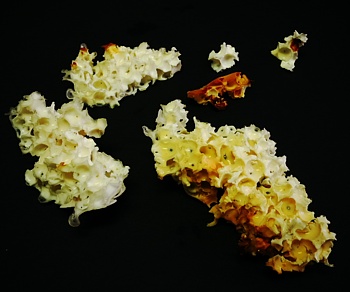
Well, to my surprise, the Titebond did soften but it didn’t dissolve at all; it was still there after three weeks of continual immersion in warmed water. It softened enough that I could squeeze the ball bearings back out, but what remained was a honeycombed, spongelike mass of rubbery aliphatic resin that looked like a coral reef — and that hardened up rock solid again as soon as it dried out. (See the accompanying photos.)

As it turns out, it’s not only the composition of the glue that makes the problem for repairmen and restorers. It also has to do with how the adhesive achieves its results. In the case of the newer glues such as Titebond, these grab onto the materials they come into contact with by means of penetrative adhesion: they sink into wood fibers and grab hold. And once there, they want to stay. The upshot is that undoing such a joint usually results in some splintering, tearing, or pulling up of wood fibers, and thus leaving a rough surface that will itself need to be smoothed before any regluing can occur.

In addition, whether or not there’s been pulling away of wood fibers, some of the Titebond will remain on the wood surface and, as I pointed out with my ball-bearings experience, Titebond will not simply wash away. Thus the usual way of post-Titebond surface preparation is to sand or scrape at the roughened sections (imagine trying to sand or scrape cold honey off a piece of plywood; it’s the same thing) until smooth wood is reached; then, one reglues.

Hide glue, on the other hand, achieves its results by molecular bonding. Titebond won’t hold very well onto something it cannot penetrate, such as glass. But hide glue will. In fact, it’ll hold on like a barnacle on a ship’s hull. In the old days before sand blasting, glass was decorated by covering the to-be-textured-or-highlighted area with hide glue; once this dried the hide glue was chipped off with a chisel and a hammer — and it would take some of the glass with it. The contrast between this newly chipped surface and the smooth original surface of the glass is how lettering and decoration in that medium used to be achieved! The really interesting part of this is that, molecular bonding aside, one can wash hide glue completely away without affecting the surface it has been applied to. Like campers, hikers, or guests with an ecological consciousness, hide glue can disappear without leaving any trace or litter behind it.

Posted in FAQs and Uncategorized

Concerning Somogyi Knockoffs

December, 2012

In Japanese:   

It has come to my attention that there have been some guitars recently introduced into the Japanese market that are using my “carved Carp top” design. They are doing so without my permission.

I am very much concerned about these knock-offs. I want to make it clear that Somogyi Guitars is not affiliated with those instruments and, I repeat, I have not given my permission to use my particular rendition of the carp design.

I understand that the carp is a traditional Japanese icon and that I am not the originator of that specific carp image. But I am the originator of that particular and specific artistic use of it on a guitar. I believe that my adaptation of that specific carp image to a guitar, in the way that I have done, is widely known and associated with me in Japan.

I am at present asking the company involved to immediately stop manufacturing and selling their guitars using my design in such a way as to create a similarity with any of my instruments.

I hope they will understand and honor my request and take the necessary steps to correct the problems.

Posted in FAQs and Uncategorized, Thoughts, essays, & musings

FAQ #8: Flat Vs. Domed Tops

September 22, 2012

Q: In your book you recomend 30′ for a top radius, if one decides to buy a commercialy made disc. On the other hand I saw that James Goodall and Robert Taylor use 50′ and 65′ radiused dishes and Jim Olson & Kevin Ryan make FLAT non-radius tops. Olson said that he feels that these produce more responsive tops. So why, exactly, do you recomend a 30′ one? Wouldn’t a 65′ one be better since it is closer to being FLAT?

A: It’s a question of balancing various factors — very similar to a cook’s gauging how much of this and/or that spice or flavoring to use in making a dinner.

In the guitar (instead of carrots, lamb, and oregano) the ingredients are the string tension, the torque from the bridge, the mass of the braced top (which is arrived at by any combination of top thickness and bracing mass), top bracing and reinforcement (that is, the pattern and layout of the braces, as well as their profiling and height), and desired target sound (the resultant mix of monopole and dipoles, as well as sustain and dynamics).

There is no “correct” way to make a guitar. If there were, they’d all sound the same — just as if there were only one recipe for making French onion soup: then all French onion soup would taste exactly the same. In the biological realm, it would be equivalent to having every wife, husband, boyfriend, girlfrend, son, daughter, etc. be clones. So let’s forget “the one best way” of doing something complex.

Jim Olsen holds that a flat top is the most responsive. Very well. But what, exactly, does that mean? Does this not have something to do with how thick and/or stiff the top is, or how it is braced? And how it responds to the mechanical pull of the strings? I suspect that it does. So if we were to imagine a VERY thin top that is made flat, it would be easy to imagine it buckling or caving in under the pull of the strings… unless the bracing were beefy enough to make up for the weakness of such a flat plate. In other words, you could make that flimsy face hold up by adding more reinforcing.

You could also/instead make that flimsy face hold up better by putting an arch or dome into it. Arched structures are stiffer and more stable than flat ones — just as a pointed or arched roof on a house will hold up to rain and snow better than a flat one. Western architecture took a mighty step forward when structural doming became possible: the materials themselves — rather than supports, trusses, beams, and buttresses — achieve the required structural integrity, Analogously, if you put a dome or arch into the guitar face, you could use less bracing and achieve the same stiffness with fewer materials (i.e. less mass).

Less mass is good; it means that the strings have to strain less to coax sound out of the top. The strings need to work harder to get sound out of a heavy top — exactly as a horse has to pull harder to make a heavily loaded wagon move. You can appreciate that different archings/domings induce different amounts of stiffness into a plate. As can different thicknesses of that plate. And so can different sizes and layouts of braces. These are, in fact, the three main ingredients of top-making, exactly as flour, water, and eggs are three main ingredients in bread making. And in both guitars and bread the ingredients can be mixed or combined in different ways to produce a successful product. In the guitar this goal is: a top that is intelligently constructed and reasonably lightweight (which goes to sound), and also able to hold up to the pull of the strings (which goes to long-term stability of the guitar).

In the guitar, ridiculously small (or small-seeming) amounts of these various ingredients can make a difference you can clearly hear. For instance, a bit more or less top thickness can offset a bit more or less doming. A bit more or less bracing can offset a bit more or less top thickness. And so on. Identifying and using only one of these factors as being “most important”, appealing though that idea is, turns out not to be realistic. If the guitar were a political construct rather than a mechanical one, then it would work best as a democracy in which every component is (not to make a pun) given its proper voice. To make one into a “leader” (in our sociopolitical sense of the word) is not what a guitar is all about.

Posted in FAQs and Uncategorized

Posts pagination

Previous 1 2 3 Next

Categories:

How I became a guitar maker

Guitar theory, history, opinions, sociology, wisdom, & insights

Thoughts, essays, & musings

Humor & Personal Anecdotes

What I’ve been up to, thinking, and otherwise doing

© Ervin Somogyi 2026. Powered by WordPress