Ervin Somogyi

Menu
  • About
    • Bio
    • Bio – Humorous
    • Resumé
  • Guitars
    • Guitar Models
    • Guitars: Custom Options
    • Special Projects
    • Visual Echoes & Tasteful Accents
    • Pricing
  • For Sale!
    • Brazilian Rosewood Sets For Sale
    • Guitar-Top Artwork for Sale
    • The Mexican Festival Model Guitar
  • Artwork
    • Lutherie-Inspired Artwork
    • Artwork (2)
    • Peghead Veneers as Art and Accents
  • Articles
    • Articles & Essays
    • Articles featuring Ervin
  • Books
    • Books
    • Videos
  • Teaching
  • Contact

Category: Humor & Personal Anecdotes

What I’ve Been Up To, February 2019

I try to stay away from the news these days.  The lies and lying really get to me.

Speaking of lying, there was a t.v. series called Lie To Me, starring actor Tim Roth, a while back.  He played an expert in reading body language and facial expressions, who was brought in to solve a crime or mystery when something really bad had happened.  Roth figured out who the bad guy was by interviewing people and following out those kinds of facial and postural clues.  It was an interesting show; particularly because in explaining how various body and facial tics indicated lies, photos of various real politicians’ faces (when they were being interviewed, questioned, or just speaking) were used in illustration.  My God but our leaders are brazen and mendacious.

———————-<>——————–

Having mentioned actor Tim Roth, I want to say that he starred in one of the best movies I’ve ever seen . . . and that no one has ever heard of.  I found it by accident surfing channels late one night.  It’s titled “The Legend of 1900” and, as I said, nobody has ever heard of it.  But it’s a GREAT movie.  It’s about a piano-playing prodigy who is born in the year 1900; it’s basically a romance, but without any actual romance — and with a cameo by actress Melanie Thiéry, who is one of the three most achingly beautiful females who have kept their clothes on that I’ve ever seen on a screen.

The musical high point of the film is a sequence in which the famous Jelly Roll Morton (“the Father of Jazz”) challenges the Tim Roth character to a public piano-duel.  That sequence is to die for.  Give yourself a treat some evening and watch this gem.

 ———————-<>——————–

         On a different level entirely, I want to show you an image of my “Diospyros” guitar.  Diospyros is the generic name for ebony, and this guitar is made up of lots of ebony tiles mixed in with contrasting tiles of Yellowheart wood.  Overall, the pattern looks a bit like all the Midwest farmland that one flies over and sees if one looks out of the airplane window; or, on a different scale, a stylized version of the fitted-together-cobblestone streets one finds in Mexican towns.
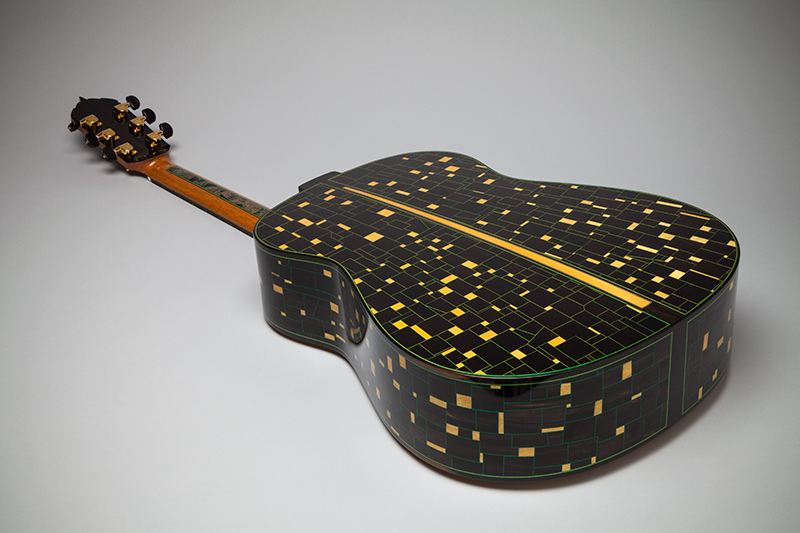
 

This guitar was, in fact, inspired by exactly that: the appealingly geometric look of the fitted-together cobblestones one can see on Mexican streets.

         There’s a bit of a story behind this, of course.  Part of that story has to do with how I notice, and get distracted by, the visuals in the world around me.  I notice patterns, colors, textures, proportions, disproportions, continuities and discontinuities of line, evenness and unevenness, and all kinds of beauty in things no one else seems to notice.  Textural stuff REALLY grabs my eye.  This propensity really gets in my way when I’m trying to get anything done; so I try to hide when I’m working so as to get away from interruptions.  Interruptions REALLY kill my focus and concentration.

         Anyway, I was in a relationship with a woman some years ago.  As I was married at the time it was, technically, an adulterous relationship — although my wife knew about it and really didn’t care.  The marriage had, how should I put it, passed its “discard after . . . “ date.

         This lady and I went to Puerto Vallarta for a week’s . . . uh  . . . romantic getaway.  Puerto Vallarta has long ago been converted into a tourist trap and is not nearly so pleasant a place in which to spend time as the travel industry might want you to think.  The tourist hotels are about a mile out of town and isolated from the riff-raff. Those resort buildings are magnificent, impressively large, and soulless. They also jettison an awful lot of sewage directly into the ocean, not far from the town.  Charming, that.

Puerto Vallarta is picturesque but has the scuffed and worn look of something that’s fallen on hard times.  It’s right on the ocean; but the beach sand itself is a shockingly narrow strip . . . and it’s brown and looks dirty; it looks like a brown sugar truck had a major spill there.  (The tourist hotels, in contrast, had imported tons of white sand that really does look nice, although the overall effect is that of an incongruous patch of white off in the distance, in the middle of an otherwise brown landscape.)

The main industry in the town is tourism, of course: the stores, restaurants, tours, crafts objects and imported merchandise, street vendors, etc. are all geared to that.  (The crowning touch is that in order for the government to protect its tourist income, Puerto Vallarta is policed by soldiers from a nearby army facility who are armed not with pistols and rifles, but with machine guns.)

—————–<>——————

It was during this romantic getaway that I found out that I didn’t really like the woman I was with.  She was . . . well, let’s just say that we were appallingly mismatched.  It was sort of like going on a romantic hideaway trip and discovering that your partner is a transvestite.

This lady was smart, attractive, and, among other things, a competitive scrabble player.  For months, she beat me every time we played.  I didn’t really mind; I like words and playing with words, and I didn’t have anything riding on whether I won or lost.  And, in any event, the more we played the better I got and the closer the gap between our scores became.  We took the scrabble set down to Puerto Vallarta and it was while we were down there that I beat her at scrabble for the first time.  MAN, WAS SHE PISSED!  Outraged, in fact.   And she had a major tantrum.  Such . . . uh . . . misbehavior for such a seemingly trivial reason . . . well, it was pivotal for me.  The relationship went quickly downhill after that.

In any event, after that tantrum, rather than to hang out with her, I walked around Puerto Vallarta a lot.  As I walked, I noticed beautiful visual patterns and textures everywhere.  I hadn’t quite realized until that week how much these things impinge on me; but IT WAS VERY PLEASANT for me to simply walk around and see the sights.  I looked at wrought iron work on the houses, the colors of the buildings, the cobblestoned streets, iguanas for sale, etc.  I learned a bit about Puerto Vallarta itself, too.

For instance: there are insect in that region that live in hidey-holes at the bottoms of small craters that they make in the dirt; if you go out of town you’ll see lots of these little conical craters in the soil.  These “V”-sided craters are about the size of a walnut, and their sloped sides are lined with VERY FINE sand.  Being fine sand, these craters are a lighter color than the surrounding dirt, and are therefore not hard to find; but of course insects don’t care about color.  Anyway, when another insect walks into one of these conical depressions the sand all around is so fine that it cannot get its footing and it slides down to the bottom of the dip; then the insect jumps out of its hole, grabs the unsuspecting victim, and eats it.  This predator is called a “Lolita” by the locals, by the way.

Who knew Puerto Vallartans were so literate? Anyway, it was fun to look and learn.

         Fast-forward some years. I came into possession of a coffee-table book titled ARTEFACTOS, which has lots of photographs of arts and crafts artifacts from Latin America.  One of the photos was of a beautiful cobblestones street of the kind I’d seen in Puerto Vallarta, where squarish and rectangular-ish stones (rather than more rounded or oval ones) were fitted together.  Wow.  That image just jumped out at me.  And I filed that away as something that I could do something with at some point.

         Fast-forward a few more years to when I had a hankering to make a guitar for myself — for no other reason than that I wanted to do something different from all the usual stuff. Enter the idea for the Diospyros guitar. The attached image is of this instrument.

I have to tell you that carrying this project out was VERY time consuming . . . but I didn’t really mind.  Just like losing at scrabble.  I was chasing something new simply because I really wanted to do it.  And I could. And eventually the Diospyros guitar was completed.

———————-<>——————–

The thing of it is: it probably never would have been made had I not disliked that girlfriend as much as I did and stumbled on the otherwise invisible beauties of Puerto Vallarta.  (I mean, who ever goes anywhere to look at pavement?)  I have to tell you that in a weird way I feel indebted to her; the Diospyros came about, in part, with her unwitting help.  I have more than once been struck by a philosophical sense of how an irritant can ultimately become a pearl.

———————-<>——————–

Speaking of “philosophical”, I had a Mondegreen experience with that word some years ago.  A Mondegreen is a mishearing of a lyric or poetic line in which one imagines that something quite different has been said.

The Mondegreen originates from a Scottish ballad where the hero of the narrative is slain . . . “ and . . . [they] laid him on the green”.  Someone heard that as  “. . . and Lady Mondegreen” instead . . . and thus Mondegreens were born.

Anyway, when I was in High School there was a popular Harry Belafonte song called “Island in the Sun”.  It’s a Caribbean tune that goes:


This is my island in the sun

Where my people have toiled since time begun

Though I may sail on many a sea

Its shores will always be home to me

Oh island in the sun

Hailed to me by my father’s hand

All my days I will sing in praise

Of your forests, your waters, and shining sand . . . etc. etc.

The song goes on to the phrase  “. . . and Calypso songs philosophical . . .”    And that’s when I Mondegreened.  I thought Belafonte was singing “Calypso songs full of Soffy Cal”.  I couldn’t figure out what Soffy Cal was.  For years I thought it might be some exotic Caribbean substance.

O.K. I’ll clam up about that now.  It’s just getting too nacreous and chatoyant around here.


More later.


-Ervin
Posted in Humor & Personal Anecdotes Tagged Ervin's Thoughts

The G.A.L., Healsdburg, N.C.A.L., and Me – 2/2

I left off Part 1 of this narrative by mentioning that, in 2004, there had been a growing distance between me and Tim Olsen and the G.A.L., and that I’d managed to fill the void with writing my book. I’d actually begun to write that in 2002 but I hadn’t realized at the time how it would come to dominate my life — which it did, increasingly, until well into 2009. As far as my heart surgery of 2004 was concerned I think that having had a fender-bender with mortality helped motivate me to get that enormous project completed. And it was enormous. I described my experiences of writing that book and trying to get it published, in a separate article titled “My Adventures in Book Publishing”. I would previously have submitted this to the G.A.L. for eventual publication, but that organization didn’t really feel like my friend any longer. I put it on my website instead.

The thing about my book — which is actually a two-volume set — is that it’s differently organized and more comprehensive than any of the other books available at this time on the subject of instrument making. I have written about the whys, whens, whats, wheres, how muches, how do we know this, and what ifs as well as the hows, and included comparative, theoretical, experimental, aesthetic, personal, scientific, philosophical, and historical-developmental information that is nowhere else available. Those of you who have seen my book(s) know what I’m talking about. But, initially, my writing was going to catch a few people off guard with its unique way of presenting information, as well as the amount of it. I asked one of my students, who understands my thinking, to write a book review at the time of publication and submit it to the G.A.L. He did so. When the review hadn’t appeared more than a year later, he got in touch with Tim to ask when he might expect to see it; Tim said that he had decided to have someone else write a different review instead. Based in a third party conversation, I think that Tim never read my student’s submission. But either way, again: no thanks, no explanation, no apology; just a cold fiat.

That alternative review eventually appeared. While being pretty much on the mark, it had neglected to mention several elements that I felt would have been worth pointing out. The reviewer — one of the newer G.A.L. staff, it turned out — doesn’t seem to ever have been a guitar maker. I wrote a Letter To The Editor in response, pointing out the things that I felt were important that had been omitted. This led, very shortly, to two bizarre and unsatisfying telephone conversations (and several similar emails) with Tim. To my dismay, he seemed uninterested in my feelings or opinions about the G.A.L.’s review of my books, and he urged me, as a friend, to drop any response to it. But Tim had already shown me what kind of a friend he was (I mean, let’s face it: he’d dropped me like a hot potato when I was flat on my back in the hospital and of no discernible use to him) and I was getting an added strong whiff of what felt like personal disapproval and disdain. I had said in my Letter to the Editor that, nearing seventy and having a bad heart, these books were likely to be my legacy. Tim’s response to that was to tell me how dare I say such a thing? He really did. He obviously thought that I was playing the impaired heart card as some kind of sleazy manipulation for sympathy; for my part, I began to think that Tim can’t tell the difference between sympathy for a fellow human being and a disease, and that he finds both equally distasteful. I had also pointed out that my books, besides being chock-full of useful and pertinent information, represented the nicest visual and user-friendly product that I could put out: hard-cover, bound so that one could open the book out flat on the workbench without breaking the spine, with high quality glossy paper, color photos, nice dust jackets, font sized for the reading ability of the many grey-haired luthiers among us, and a special embossed slipcase. I added that, in Japan, they don’t call me a crass act for nothing. But I don’t think Tim appreciated that either.

Subsequent communication was unproductive. One particularly bizarre exchange has stayed with me, that resulted from my asking Tim what was he thinking to treat a long-term supporter like me so offhandedly. I don’t think he understood my question at all; he instead quite floored me by saying that “you have lots of friends; you’ve got a thousand friends; so why do you want approval from me?” Yes, he said exactly that. And he went on: “I’m not one of you: I’m not a guitar maker any longer” and again added: “so why do you want approval from me?”. That’s word for bizarre word. (Approval? Dude: how about just basic acknowledgement?) I replied, quite honestly, that if he had to ask I didn’t think I could tell him. I was certainly at a loss for words for the kind of person who would come up with an administrative distinction such as the fact that I make guitars while he no longer does — and try to use it 30+ years into things as a reason for distancing himself from me. That was surreal, to say the least: here I’d written two really good books about guitar making, as well as put out a DVD about voicing the guitar — which the G.A.L. has ignored — and was, once again put in the position of feeling very much like a non-person.

THE END OF THE ROAD

I must say that was a real low point for me. While getting such a load of cold-shouldering didn’t quite reduce my world to ashes (the Oakland Hills fire of 1991 actually did do that), the discovery of such a vast pool of hostile narcissism shocked me and stung like hell. It still hurts. I should add that by “narcissism” I mean the condition of someone’s lacking the capacity or desire to take someone else’s reality into account. “Hostile” is what it felt like to me: I got the sense that Tim enjoyed putting me in my place.

So, to sum up: I had rendered Tim and his organization many services, and I’d done them gladly and for free. But when all was said and done I was unable to detect an echoing of reciprocity, or even just basic regard; I was instead on the receiving end of a style of withholding from, and barely-concealed contempt for, someone in a subordinate position. Indeed, Tim’s style seems to be to make people feel helpless. I mean, the flip side of “I’m not one of you” is clearly “you’re not one of us”, right? At my most bitter, I thought that as the G.A.L. had served as the virtual Alma Mater within which I formed my social and intellectual identity as a luthier — and it really had — then that venerable institution, with Tim at its head, was really feeling like dear old F.U. In any event the door felt firmly closed to any input from me and I gave up hope of any reconciliation. I withdrew from membership in the G.A.L..

But be all that as it may, enough of that. With the conversations that I just referred to being the proverbial straw that broke the camel’s back, and my renewing my membership in the G.A.L. being firmly out of the question, then this might also be a good time to take a broader look at matters of splitting off and going off on one’s own in general.

Such actions are interesting in both the abstract and the specific if only because life is FULL of these kinds of things. Growth in most areas of adult life is, in fact, inseparable from a debit of some kind. Gain, pain of loss, learning, acquiring perspective, differentiating, fulfillment, success, moving on, failure, maturation and disintegration are all sort of a package-deal thing that is further spiced and flavored by the fact that personal betrayal is the kind of thing that people kill each other about. The key to surviving it all is: can you learn anything from any of it? A case in point in this matter of splits and divisions is the origin of Healdsburg Guitar Festival — whose beginning, in fact, came out of very much the same kind of split as the A.S.I.A.- G.A.L. one that I’ve described. The Healdsburg Guitar Festival (which is a close version of the G.A.L./A.S.I.A. Board of Directors’ original idea of the kind of show that the G.A.L. should have been promoting) came out of a split within The Northern California Association of Luthiers. Let me explain what this was all about.

THE BIRTH OF REGIONAL LUTHERIE ACTIVITY

In the beginning, as I said above, one of the things that made the early G.A.L. conventions so great was that their venues rotated between both coasts and the Midwest; however, the sheer amount of organizational work it took eventually rendered them into every-other-year West-Coast-only events. This scheduling came with an obvious plus and a minus for the West Coast members: we wouldn’t have to spend a lot of money on airplane tickets and shipping guitars to events on the opposite coast. But we’d have to wait two years between events on our own. On the one hand this alternating-year schedule eventually worked just fine for A.S.I.A. because it would be able to schedule its Symposiums (Symposia?) so as to alternate with G.A.L. Conventions. On the other hand, a West Coast event-vacuum was created. In 1992 the first American REGIONAL luthiers’ organization — something that people could drive to instead of having to buy a plane ticket for — was created to fill it: this was the Northern California Association of Luthiers (N.C.A.L.).

(NOTE: By the way, the G.A.L Conventions and the A.S.I.A. Symposia are of course both events at which people gather. The difference is etymological and a matter of, shall we say, focus. A Convention is from the Latin con + venire, meaning with + come or coming, as in a coming together with . . . Symposium, on the other hand, is from the Greek sym + potein (or posein), meaning with or together (as in symbiosis), and potein (or posein), meaning drink or liquid (as in potion, potable, potage, or Poseidon, the God of the seas). So to go to a Convention is to gather together for any particular reason, and talk; to go to a Symposium is to have a drinking party and have a convivial time.)

Painful and acrimonious as the G.A.L./A.S.I.A. split was, it was also a fertilizing influence on lutherie work in the rest of the country. It freed up time and territory for others. N.C.A.L. was created to fill the time gap between West Coast lutherie conventions. The bi-annual scheduling of A.S.I.A.’s Symposia created a similar vacuum and opportunity on the East coast. Local and regional groups had the opportunity to coalesce and carry on the work of both organizations in smaller doses, and to give continuing support and educational opportunities to members who lived reasonably nearby. The same happened in the geography in the middle, as exemplified by the Luthier’s Invitational of North Texas (L.I.N.T.), which is still going strong. The G.A.L. had created lots of aficionados who could and would do better as part of a local group that met every so often, than by working isolatedly in their garages and basements and going to a convention every two years.

N.C.A.L.

Getting back to NCAL, I was one of its five original founding members — although our group didn’t have a name at first; we were just guitar nerds getting together. The others were Marc Silber, Steve Newberry, Brian Burns, and Pat Smith. This was in 1992. While our initial group was small and happy to meet informally, we soon found that there others within driving distance who were happy to also show up. So, we needed a name, and in 1993 came up with BASSIC — the Bay Area Society of Stringed Instrument Crafters. One of our members, Colin Kaminsky, came up with that.

Pretty soon, even more people joined us. Northern California hosts just about as many independent instrument makers as the greater Portland, Oregon, area does. But while Portland has had its own handmade musical instrument show for decades, BASSIC yet lacked the cohesion of the Oregonian lutherie community. We had to create it. And, if we were going to do so, that cohesion was going to be achieved by BASSIC becoming a greater-than-simply-local organization; I mean, the Bay Area is larger than Portland. We accomplished this in several ways. First, it didn’t hurt that we were the only game in town. And we were all-inclusive: no one was turned away. We had bi-monthly meetings with scheduled presenters and Show-And-Tell opportunities — and had a regular newsletter (that was my personal project; I kept it going almost single-handedly for two years). Meetings were rotated to anyone’s shop who was willing to host the next meeting, so we roamed the region meeting-wise, from Santa Cruz to Healdsburg. This is a span that represents a three-hour-long car ride; we’ve been able to have meetings in Berkeley, Oakland, Lafayette, San Francisco, Felton, Petaluma, Martinez, and more.

We had plenty of enthusiastic members and within the first years of our excited growth we organized two full-blown handmade musical instrument shows in the Bay Area, as well as a third show in tandem with the main local crafts community organization. For the former we all chipped in, both exhibitions were great (with programs that had paid advertisements!) and we managed to break even on both events! We were quite proud, and justifiably so. By the way, I mentioned that BASSIC was the first regional lutherie organization, and I also said that Portland has had its annual musical instrument show for many years. The Portland show is institutional; as far as I know, it’s run by the local Forestry Center but there’s no separate regional luthier’s organization that co-produces or operates independently of it.

Then, as we were growing into genuinely regional organization, it was time to find a name that better reflected that reality. One of the rejects was the Professional Luthier’s Union of Northern California. One might think that this strong-sounding name would capture the aspirations and breadth of our organization, but its acronym, PLUNC, somehow didn’t project as much, uh, sheer string-instrument-making professionalism as we’d have liked. So we eventually settled on the ordinary-sounding NCAL: the Northern California Association of Luthiers.

I must say that NCAL has had a nice, long run. We had “Presidents” for some years (I was President for a while), but we eventually found that we could function pretty well without . . . ummm . . . adult supervision. NCAL is 20 years old at the time of this writing and is still going strong, in spite of the fact that none of us early members are very active in the organization any longer. The work has been taken on by others; at present the secretary-ship (which handles alerts for stuff for sale, date and place of the next meeting, announcements, notices of looking for help or services, etc.) is being handled by L.M.I., one of the two leading American lutherie supply houses. And the mailing list for this first American regional luthier’s group is up to about 400 members! Most meetings attract 20 to 40 people, usually from the area nearest the current meeting place.

THE HEALDSBURG GUITAR SHOW

And now we approach the time and reasons for the split that I mentioned. While NCAL happily chugged along as an informal and information-sharing community event, some of its members — primarily those for whom this was their day job, who were building or planned to build in greater quantity, and who were looking for a way to market their work — wanted something a bit more ambitious than a communal barbecue event as the year’s high point. People being people, economics being economics, and human restlessness and entrepreneurism being what they are, there was NO WAY that something like this was not going to sooner or later come up for discussion. And these entrepreneurs were now ready for a money-making event. Welcome to Capitalism, and all that.

The matter was debated back and forth at NCAL meetings without much resolution — just as happens in City Council meetings and labor-management negotiating sessions all over the world. After a while it became clear that agreement by consensus was never going to be reached in time to prepare for a Summer show, so three brave hotheads — Tom Ribbecke, Charles Fox, and Todd Taggart (founder of L.M.I.) — took the bull by the horns and simply went ahead and took it on themselves to find a venue and organize a handmade musical instrument event. As these worthies were living and working in Healdsburg (about an hour North of San Francisco), the Healdsburg Guitar Festival was born. It did have a bit of community and Chamber of Commerce support, but these three men actually started the festival that has by now become the premier handmade guitar show in this country. I take off my hat to them, and the greater lutherie community owes them: they created something important.

Fast-forward some years: the Healdsburg show, like the G.A.L. conventions, is now bi-annual. There’s simply too much work in organizing and running a commercial show. On the one hand, there is all the paperwork to be managed, as well as fees, security, correspondence, budgeting, organizing presentations and coordinating lectures and events, food catering, listening tests, sound equipment, physical setup and take-down, showrooms and sales rooms, advertising, getting sponsors, publishing a program-magazine (and coordinating the photographs, biographies and ads), deadlines, waiting lists, etc. etc. etc. On the other hand are the problems of growth: The Healdsburg festival has outgrown available facilities in that city and now takes place in Santa Rosa;. As a matter of fact, the festival has outgrown its first Santa Rosa location and is now in its second one. The Healdsburg Festival is run by L.M.I. Inc. and I doubt that these folks find it a big money-maker after all the costs are paid out. I’m grateful to them for taking this complicated task on; I mean, it’s not as though they have nothing else to do the rest of the time: they’re running a complex business.

[Parenthetically, for those of you who don’t know, L.M.I. (Luthier’s Mercantile, International) is one of this nation’s three largest lutherie supply and materials outlets; the others are the Stewart-MacDonald Company and Allied Lutherie, which Todd Taggard left L.M.I. to found. Both the G.A.L. conventions and the A.S.I.A. symposia have performed the additional and valuable commercial service to the lutherie community of giving these supply houses — as well as other independent vendors — a forum for meeting their customers face to face and make sales. Regardless of which exhibiting guitar maker sells or doesn’t sell anything at any show, the suppliers always sell stuff.]

It’s interesting for me to view the parallels between the two organizational splits that I’ve described. In each case their genesis was rooted in very similar economic and ambitional realities: things had reached a point at which someone thought there was money to be made. But one event was handled like a train crash — with drama, struggle for power, accusations, and lawsuits. The other was more like a fairly easy birthing in which the midwife mostly kept her hands off, and allowed neither mother nor child to be much damaged by the experience. Of course, there was a real treasury involved in the former, and Tim was going to get demoted (and perhaps ousted) from an organization that he’d helped found. As I said, welcome to Capitalism.

WRAPPING IT UP

To sum up, I’ve been a significant part of and participant in the above organizations and movements; this includes many years of memberships, writing articles (and books), showing my guitars at many events, and many educational experiences and opportunities of all types. I’m happy to have been a founding member of the first regional lutherie organization. And if anyone ever writes a comprehensive history of the first generation of American luthiers my narrative will be part of that. The divorce from the G.A.L. does leave me with an ache that’s not likely to ever go completely away. My distancing myself from it — and in its director’s having most emphatically distanced himself from me — has been a mutual loss. I mean, it’s loss for the Guild too. But, three and a half decades into this, I need to be met with more than just name, rank, serial number, it’s time to renew your dues, and we’ll let you know if we need something — which was pretty much how it was. And even now (at least as of October 2012) my books are not found on the G.A.L.’s website list of Recommended Lutherie Books.

I must confess that I’ve obsessed about finding a way to understand Tim. To the extent that I have managed to do so, this is based in several things. First, those of you who have seen the movie “The Silence of the Lambs” may remember the scene in which psychiatrist-turned-killer Hannibal Lecter is talking with F.B.I. agent Clarice Starling about the character structure of a serial killer (identified as ‘Buffalo Bill’) who is being hunted by the F.B.I.; and he asks her: what are his needs? Just so with Tim, although I must say that it was quite some time before I was able to see my situation in terms of Tim’s need to behave so as to make others feel insignificant. And second: where would he have learned this? Well, it can only be from being treated like that himself, by his earliest authority figure: his father. It is my assumption that Tim is telling the world, through his behaviors, the story of how he was treated by an unsupportive, withholding, and belittling caretaker when he was young and incapable of defending himself. It is likely also (this is how it works, folks) the essence of how he treats himself, family, and his employees. People behave as they’ve been behaved to; I see traces of all kinds of my own early formative influences carried out in my own daily actions. And I think my own contribution to this failure is in part that, for reasons of my own, I needed to believe in Tim in spite of ongoing evidence that didn’t justify such an effort. Well, we all have our limitations, but I belatedly managed to learn something about myself from this. I have to tell you: compared to the cost of life experience, my guitars are cheap.

Finally, outside of all this, and my personal feelings aside, I know that Tim Olsen’s accomplishment is to have devoted most of his life to keeping the Guild of American Luthiers going and successfully viable. To have kept such a vital organization alive for so long is a significant accomplishment and one that I would never have been able to carry through had I had that responsibility. As I said earlier on, instrument making by individuals started out from nothing in the United States, and the Guild of American Luthiers put it on the map, made it accepted, familiar, and even respectable. I wouldn’t be where I am, and able to tell this story, if it hadn’t been for the G.A.L.. Tim needs to be given credit for that. I furthermore believe that Tim was right in maintaining control of the direction of the Guild way back then, rather than surrendering the organization that he helped start to the we’re-on-the-board-of-directors-for-four-years-and-we’re-going-tomake-some-changes folks who went on to form A.S.I.A. — although I can appreciate with hindsight that he did, just as much as anything else, seem to see the Board’s behaviors moralistically, as something tinged with the sinfulness of being unable to stand up to temptation. Tim’s statements to me at the time suggested that. More recently his disapproval of me for daring to make public mention of personal weaknesses (i.e., my age and health) likewise suggests perception of a certain depleted moral fiber on my part.

As far as A.S.I.A. by itself goes, it is an organization that for all its good points has been so riven by disorganization, internal strife, and financial problems that I believe that the Guild would have long ago folded under such leadership (industrialist guitar maker Bob Taylor, who was with A.S.I.A. from the beginning, was from the outset of the opinion that it was an unnecessary organization). And I would have lost out on the relationship I had with the Guild and its various events between then and when I finally withdrew from it. At the same time, I am hopeful that A.S.I.A. will thrive; I like and admire it; it’s worthwhile; and it’s recently come under the direction of David Nichols (of Custom Pearl Inlay), who has a good head on his shoulders and some real business savvy.

Otherwise, things change and nothing is permanent. The Newport/Miami guitar show that was luthier Julius Borges’ brainchild, and which eventually became the Miami-Newport show, has come and gone away. Ditto the long-running Long Island Guitar Show. The Montreal Guitar Show and the Woodstock Guitar Invitational are here now to keep the Healdsburg Guitar Festival company, while other smaller shows have come and gone. The Northern California Association of Luthiers (NCAL) and the Luthiers’ Invitational of North Texas (LINT) are alive and well, as are other groupings that I hear about but haven’t met with yet. I don’t go to G.A.L. Conventions any more, but I continue to make guitars, write articles for other publications, teach, and show up at other shows and festivals. I hope to see you at one of them.

Posted in FAQs and Uncategorized, Humor & Personal Anecdotes

The G.A.L., Healsdburg, N.C.A.L., and Me – 1/2

By Ervin Somogyi

This is a personal account of my experiences with the Guild of American Luthiers, the Healdsburg Guitar Festival, and other guitar organizations with which I have had long-standing affiliation.

I’ve written a lot about the guitar and the world of the guitar; much of this has been practical and technical. As a matter of fact, most guitar-related writing has always been technical, archival, historical, anecdotal, iconographic, statistical, commercially oriented, or relying on interviews of personalities that have been significant in the guitar’s making or its music. But very little of any of that has been first-hand reporting on anything one has been involved in. I mean, let’s face it: guitar makers aren’t exactly writers. As I get older and have more and more to look back on and perhaps reassess, I’ve been doing more personal thinking and writing. I think this is pretty common with anyone who’s been doing something for a long time. I don’t know that anyone has yet written anything about their own experiences with the seminal organizations in their field of work, though. Much less has anyone written about these things retrospectively, as a sort of revisiting and summing up of one’s long-term experiences and insights, social context, watershed moments, one’s various victories and losses, etc. I thought that it might be interesting to write something like that. Also, someone may want to some day write a more in-depth future account of these times, activities, and organizations; why not have some material to refer to that was written by someone who was there? In any event this is a longish article, because I’m describing a forty-plus year-long history.

THE G.A.L.

I made my first guitar in 1970, and The Guild of American Luthiers was the first instrument makers’ organization in this country — or any country, really — that I ever heard of. I think it was the first such organization to have existed since the waning of the European Guild system three hundred years ago. However, while those groups had been closed to outsiders, the G.A.L. was open to anyone who cared to pay the membership fees. It was founded in 1972 by a few of the newly emergent and hardy members of the American guitar-making-by-hand community — one of whom was Tim Olsen, a Tacoma, Washington native who early on became (and has been ever since) the director of that organization. The G.A.L. was designed to serve as an information-sharing organ as well as a forum for periodic get-togethers to exchange knowledge, and to enable the members of this normally solitary profession to get to know one another. I worked at guitar making and repairing largely in a vacuum of excited but isolated inexperience, learning as I went along — until 1977, in which year I joined the G.A.L.. That was, coincidentally, the same period in which that organization was getting up steam and starting to become a point of common reference for the loosely unified brotherhood of workers such as I was — which included makers of guitars of all types, mandolins, ukuleles, lutes and other early instruments, harps, dulcimers, oddball experimental instruments, harpsichords, balalaikas, etc., and anybody else (except violin makers, who had long ago formed their own societies) who fancied any version of, or approach to, such work.

The arc of my growing up as a luthier is, as a matter of fact, intimately connected to the G.A.L.. I cannot overstate how important this organization was for me, personally and professionally, for the 34 years that I was a member: it helped to give me an identity. As I said, I became a member in 1977 (at the same time that my world was turned upside down at the Carmel Classic Guitar Festival that I’ve written separately about. That event was a seismic shock, but it was a one-time event; the G.A.L., on the other hand, was there decade after decade). As a new member I was a young guy who didn’t know very much and had a lot of questions. Gradually and unexpectedly over the years, as tracked by my participating in one G.A.L. convention after another, I grew into someone who had figured out some things and whose opinions carried weight. Having been asked more questions as the years went on by more and more people who knew less than I did, I’ve more or less become a source of information for others who were/are at an earlier stage of their own development. At the same time there have been fewer and fewer guitar makers who knew more than I did that I could ask questions of — at least as far as steel string guitars were concerned. I guess that must be what growing up is about and I’ve tried to not let it go to my head.

As I said, I pretty much grew up as a luthier on this path with the G.A.L.. I can also say, looking back these many years, that the G.A.L. pretty much grew up with me. In the three and a half decades of my association I became part of the Guild by actively participating in it in every way I could. It became part of my life by providing me with a forum for teaching and writing, for trying to figure out answers to lutherie’s questions, from which to be a better known luthier in general, and for the sheer companionship of similarly minded folks. And along the way the Guild grew from a modest grouping of anachronists to an organization with members all over the world who relied on it for information. I severed my affiliation with the G.A.L. and Tim Olsen in 2010; but, as I said, we had more or less grown up together.

The Guild’s early Conventions were mostly organized and run by Tim, his wife, and his brother- and sister-in-law. Tim was at that time making stringed instruments along with the rest of us — although he eventually gave that work up as he was running the Guild full-time and geting his salary from doing so. He and his office-team also worked above and beyond the call of duty by publishing the Guild’s newsletter. This was originally a rather modest folio, and it has since grown into today’s impressive glossy-and-full-color-page American Lutherie Quarterly. Simply tracking the early headquarters’ segue from its unassuming beginnings, with primitive printing equipment, to growing into a modern printing and publishing enterprise that handles photography and advertising and editing, publishes magazines and books, organizes Conventions, keeps up with correspondence and billing, and meets deadlines and a payroll . . . has been an amazing treat. Given that all that started out with literally nothing but youth, energy, and a vision, it’s at least as real an accomplishment as most of the rest of us have ever achieved.

The first G.A.L. Conventions were loosely organized and informal. To give you a sense of how modestly this all began, the first Convention I attended was in Tacoma in 1977. Accommodations were tents and sleeping bags (that we brought with us!) in Tim Olsen’s parents’ back yard — with majestic Mount Shasta looming on the horizon. Everyone shared the one bathroom that they had and I remember the absolute lack of hot water by the time it was my turn to take a shower. But we were young and excited and our backs weren’t yet bothered by sleeping on the ground. A few members had already made guitars for known musicians or written something that got published and we were impressed as all getout by being in their company.

Tim Olsen’s idea seems to have been, from the beginning, that the Guild should be an information-sharing organization above anything else. This idea was refined, over the course of the first few Conventions, by these events’ increasingly in-house direction. The Conventions had been open to the public in the first years, but it was generally felt that the time and effort the exhibitors’ spent trying to sell guitars to the public interfered with their equally strong desire to talk with, get to know, learn from, and teach one another. Public hours and private conversations don’t mix; so, public participation and attendance was discontinued and the scheduling was filled instead with lectures, workshops, demonstrations, tutorials, panel discussions, display opportunities for all kinds of new work, and even the occasional formal display of someone’s private collection of interesting stringed instruments. It wasn’t that the public was excluded, really; the Conventions simply weren’t publicly advertised and non-luthiers never became aware of these events.

EARLY GROWTH PAINS

Along with this coalescing of identity, of course, came problems of growth. First of all, the G.A.L. had incorporated itself as a non-profit and had acquired a Board of Directors. Tim was de facto running the Guild, and officially doing it as the Board’s employee. Second of all, wonderful though the G.A.L. Conventions were — and at first they had been annual events alternating in location between both coasts and the Midwest — the sheer amount of organizational work it took soon rendered them into every-other-year West-Coast-only events. While this was a convenience for us West-Coast luthiers it didn’t do much for the East Coast membership. But the Guild was thriving anyway: there was that much popular interest in this new craft.

Selling one’s work is too powerful a motivation to deny entirely, however, and by the middle 1980s the Guild’s Board of Directors was at least as business-minded as it was education-in-crafts minded. It wanted the organization to become more a more actively commercial forum for promoting guitars, both factory-made as well as hand made. It also wished to put the Guild on a more business-efficient footing and cut costs by outsourcing a lot of the work that Tim Olsen & his staff had been doing. Part of this thrust was a sense that the Guild should have some East-Coast presence to re-enfranchise the East-Coast membership; the Board members were mostly East Coast based at that time, so this was understandable. Tim, as an employee of the Board, was asked to make this happen. Yet, his concept of the Guild, as I said, had been information-centered and based in catering to the needs of the membership in general in an in-house way — without competing with production-made guitars, and without hiring the lowest bidders to edit and publish the newsletter and run the conventions, and certainly without commercial agendas. The matter was also complicated by the fact that Tim was going to be out of a job, or at least demoted. These differences in commercial outlook, geographic interests, and personal advantage/disadvantage ensured that a power struggle for control of the Guild would inevitably follow. It did. And it became nasty. What should have remained an inhouse difference/revolt was even written up in an investigative-journalism style article in Frets Magazine and readers across the nation were treated to various halves of the story and some finger-pointing — to be entertained, shocked, and informed by, I guess. To this day I don’t know why any of those readers would have cared, one way or the other.

THE BREECH-BIRTH OF A.S.I.A.

I wasn’t part of the G.A.L’s internal power struggles, and I didn’t know that they would eventually be resolved by the board of directors leaving the G.A.L. and starting a new organization. I was an involved G.A.L. member who simply felt very happy to be part of the only niche in the business that was for hand makers such as myself. In fact, I contributed a long Letter to the Editor to Frets Magazine in the middle of all this, in defense of Tim Olsen’s purist position. I was distressed at the acrimony that was being generated and wished to be helpful in some way, largely because of my personal regard for Tim. What I did was to volunteer to act as a gobetween so that I could at least convey information between the factions, without taking sides myself. I had been active enough in Guild affairs that I knew the people involved and they knew me; after all, we’d all been in the same line of work and had attended the same Conventions together. Within a relatively short time I invested eight-plus hours of my time in long-distance telephone calls to various Board members spread out through the East coast and the midwest, and Tim, hoping to find out and clarify positions and see who might have been willing to compromise, and where. (Remember, this was in the days when we were all struggling, and eight hours of long-distance bills represented some real money.)

I didn’t get anywhere in particular with this effort, ultimately, except to find a surprising amount of resentment and intransigence from several of the Board members. The more vociferous ones seemed to be the spark plugs behind an effort that they saw as moving toward growth and change, and that Tim saw as a power grab. There were certainly some personal agendas and a certain amount of frustration and righteous posturing mixed up in this, disguised as business-minded savvy. But also, as I said, the Board members were mostly East Coast people, and the G.A.L. was becoming a West Coast based organization, so there had to be an imbalance in operation.

More significantly, the Guild had grown sufficiently and had such cash flow and reserves that it was impossible that the logic of a more commercial use for it and its resources would not enter the picture. It was highly unlikely that running and using an organization that was so successful would not, ah . . . be tempting to the more business-minded, for whom the original educational focus of the Guild would likely hold the potential for being a stepping-stone to other things. Tim, being no less rigid than the others, but much more articulate, seemed to be in possession of all the most persuasive arguments in favor of keeping the Guild noncommercial, informational, and egalitarian on the level of the membership. Also, Tim told me that he didn’t understand the Board members’ motives; he believed that now that the Guild was solvent for the first time they were being envious and covetous. In fact, Tim said that he suspected that had led the Board into temptation by making the G.A.L. so solvent and attractive a plum. Tim was correct in that he didn’t understand the Board; it’s likely that they didn’t understand him either, for that matter. I’ve neglected to mention that Dick Boak, the president of the Board, had been (and was, and continues to be even now) one of the more prominent people in the management echelon of the Martin Guitar Company; no one with such a portfolio in that organization — or any other — would have had much interest in doing anything non-commercial. In any event, these positions were irreconcilable. Things got ugly.

At one point the Board acted unilaterally to freeze the Guild’s bank accounts and deny Tim from having access to any funds. As Tim was the business manager and in charge of disbursements (including his own salary), this move was designed to be fatal. As I said, things got ugly.

In 1985-6, in the aftermath of an unsuccessful lawsuit against Tim, and a successful countersuit by him, the Board of Directors understood that it had lost the battle and jumped ship. That group very quickly started the Association of Stringed Instrument Artisans (A.S.I.A.). This is a fine organization and I’ve attended several of its Symposia. It is a virtual East-Coast duplication of the G.A.L. and has alleviated East Coast luthiers’ need to travel across the country to attend the Guild’s [by now exclusively] West Coast events. But while the G.A.L. is run by a permanent staff and caters to mostly amateurs and part-timers plus a sprinkling of experienced old-timers, A.S.I.A. has in comparison suffered from three things. First, it is based in a political business model: every few years a new Board of Directors is voted in and the direction of the organization changes. This is hell on any continuity. Second, the main reason that A.S.I.A was even conceived of was to serve the needs of the professionally and commercially-minded segment of the lutherie population — as I said earlier, there was a lot of Martin Guitar Organization encouragement. But there aren’t enough commercially-minded members of A.S.I.A. to support a separate organization, and there never were. Thus, A.S.I.A. has become an East-coast version of the G.A.L., no more and no less, and it caters mainly to the same enthusiast demographic. Finally, the organization suffers from its acronym: A.S.I.A. Whenever it has advertised its gatherings A.S.I.A. symposia have attracted civilians who were under the impression that they would be viewing Korean ceramics, Japanese kimonos, and the like — instead of guitars. As for me, I of course stayed with the G.A.L. and was even nominated for its board of directors in 1986. As I recall I came in seven votes short of actually getting on the board; I got 203 and the fifth-place elected board member, Gila Eban, got 210.

This might be a good time for me to segue into a general commentary about Boards of Directors and Chief Executive Officers. My understanding of the rationale for a Board of Directors is that it provides the equivalent of Civilian Oversight for military or political matters. You know: to give a voice to people who have a different horse in the race, so to speak. This is, in theory, good. In reality, though, it gives people who are only in a position of authority for a relatively limited amount of time impetus to use that time to do something useful, noteworthy, and DISTINCT. This, I think, particularly likely to be true with young men who have not previously had any great amount of authority over others’ affairs, and have this limited window of time in which to make their mark. Note that I’m not saying any of the ideas or actions involved are good or bad: I’m identifying a natural dynamic — which isn’t helped by the fact that whoever has been at the helm the longest is likely to resist change and new input. As in any marriage, the various partners need to be well matched if harmony is to prevail. Lamentably, I believe that such a good match is equally rare in both these areas.

A TURNING POINT FOR ME

As I said, I grew up with the Guild of American Luthiers and it grew up with me. Between 1977 and 2006 I wrote many articles for American Lutherie magazine, attended most of the conventions, gave numerous public lectures and workshops, participated in panel discussions, led guitar listening tests, donated goods and materials to the auctions, contributed support and energy of all kinds, promoted the Guild in every way I could, and dutifully renewed my membership each year. I withdrew from the G.A.L. in 2010 because of an intractable breakdown of trust with Tim Olsen. He impressed on me that, after all this time, I held no personal value for him. No one likes to be told that.

My realization of the fact that this otherwise capable man could not or would not see me as a person, but only as an object or a thing — and with about as much value as a sackful of bottle caps at that — actually began in 2004. And it was, weirdly enough, on the occasion of my getting triple-bypass heart surgery. I’d been scheduled to attend the G.A.L. Convention that year but I was prevented from attending at the last minute by that medical procedure. I was, in fact, flat on my back in the I.C.U. during the Convention, full of morphine and other drugs, and I stayed there for nine days. This was no mere band-aid-and-superglue job, I must say; having your chest cut open is a serious experience. It majorly limits what you can do with your body for a long time afterward. It’s scary and there’s pain involved. You should avoid having this experience if you can.

Ironically — and specifically for reasons of safety and health — I had bought a car with air bags one month before this. A friend had been in a car collision shortly before and his life had been saved by his airbags — and I’d worried about being in an accident and being laid up because I was driving a car without that safety feature. So, as I lay in the I.C.U., with my chest wired together and tubes running into me and out of me, I could at least be thankful that I finally had air bags. To you existentialists out there I say: with a sense of humor like that, how can God be anything but a Marxist? A Groucho Marxist, that is. Anyway, I was pleased to get a note from Tim some two weeks after the Convention, as I was convalescing at home. He forwarded a poster sized get-well card that had been signed by a lot of the attendees, along with the information that “the Guild . . . had taken up a collection in [my] name and we were pleasantly surprised with how much had come in from that. Get well soon, Tim”. Quote unquote. Short and sweet! I waited several weeks for the money to be forwarded and when nothing happened I wrote Tim a letter saying that the moneys would be welcome: I was not working nor generating any income, and the medical bills were mounting up; so any help would be appreciated.

I cannot adequately express my surprise when Tim wrote me back a note saying: “You misunderstood what I said. We didn’t take the collection up for you. We took it up for us. Get well soon. Tim.” Wow. Verbatim, pro-forma, succinct, and that was it. But . . . where was there any friendship or even basic human acknowledgement in this? Tim had, in fact, just told me that they were pleased with the money they’d collected, using my name as leverage. Without asking me. As I lay in the I.C.U. And the subtext, quite obviously, was that I wasn’t getting a dime of it, and I could stop bothering him now because I’d never been its intended recipient in the first place. (Well, okay, I did get the signed card. But I never did get a dollar of actual help, or even genuine sympathy. You do understand my consternation, do you not?)

Having expected something at least minimally personal after having known Tim and been a contributive member of the G.A.L. for (at that point) twenty-seven years, I felt slighted, dismissed, betrayed and, quite frankly, dehumanized. I called Tim up a few days afterwards and asked him how he could do something so insensitive and thoughtless? Whatever response I might have expected, though, I instead found that it hadn’t registered on Tim that I’d have any feelings about this. He certainly didn’t seem to have any feelings of his own about the episode; it simply didn’t make a blip on his radar. He very matter-of-factly explained that he hadn’t instigated the collection; rather, one of the G.A.L. members had gotten up during the convention’s auction event and announced that I would have wanted to raise some money for the Guild if I’d been there, so how would people feel about chipping in some donations? The money had been raised for the Guild and not me, Tim went on, and if he had offended me through some personal failing he was sorry. As far as he was concerned this whole thing represented nothing more than a procedural glitch — the kind of thing set a bad precedent for auction running — and he would see to it that it didn’t happen again. The most appalling thing was how impersonally and matter-of-factly Tim told me all this: as though the episode had nothing to do with him and I was expected to say something like, “oh, o.k., why didn’t you say so in the first place? Thanks so much”. Personal failing indeed; it was a callous failure of empathy. And cheap. As I remember, I’d even donated a bunch of stuff to be sold at that same auction.

THE RESPONSIVE GUITAR BOOK PROJECT

My association with the Guild limped along somewhat after that memorable event but, like my body, never really regained full youthful vigor. I attended one more Convention but my heart (no pun intended) wasn’t really in it. What my heart was in during that time, instead, was writing my book about guitar making.

More on that in Part 2.

Posted in FAQs and Uncategorized, Humor & Personal Anecdotes

The Carmel Classic Guitar Festival of 1977

by Ervin Somogyi

When I began making my first guitar in 1970 I was more or less a hippie — that is, a bearded (but clean-smelling) young man who was living outside of mainstream culture. I embarked on that first project casually; as far as I knew it was going to be a hobby-project to tide me over until I got “a real job”. I didn’t know any American guitar makers in those days; I had not even heard of anyone outside of Spain or Germany to be making guitars by hand. Still, I’d spend a Summer in Spain and hung out around some of the guitar shops in Granada; and later, when I went to grad school in the late sixties I met a man, Art Brauner, who had built a guitar with the help of Irving Sloane’s pioneering book Classic Guitar Making. I was impressed; having been a student much more than anything else in my young life I’d not produced much of anything other than lecture notes, papers, essays, reports, and test results — but this fellow had made a real object! A real guitar made an impression, in spite of the fact that doing this kind of woodworking. was an odd way indeed to spend one’s time in those days; no one in my family had ever puttered with hobbies, done woodwork in the basement, welded, built models from kits, made furniture, or anything like that. Eventually, I built my first guitar — a classic guitar — using Sloane’s seminal book. I think all of us young American guitar makers used that book to get off the ground. And speaking of American guitar makers, I might mention the curious historical fact that of the handful of guitar makers who were working in California in the early 1970s, half were from some other country. American lutherie culture was in its very early stages.

I opened up a small guitar repair shop in 1971. One year later I took over retiring guitar maker Denis Grace’s larger shop, and for a long time made my living principally by doing all kinds of guitar repairs. It’s amazing that I survived, because I had no training, no experience, no knowledge, few tools, no teachers, no work discipline, no professional standards, and marginal skills. Still, I survived, and made a few guitars each year. Because I played flamenco I was making mostly Spanish (classic and flamenco) guitars, as well as lutes and dulcimers. I had made a few steel string instruments but, not knowing any better, I was merely making big Spanish guitars. I felt more or less pleased to think of myself as a luthier; I think the romance of it kept me going. It most certainly wasn’t the income; I remember that I grossed $1800 the first year and $2500 the second (I had a part-time job teaching, on the side, to help me pay my bills). But I didn’t really face up to how inadequate and amateurish my work was until 1977.

In that year I was invited to display my guitars at the Carmel Classic Guitar Festival, as one of seven luthier exhibitors. I’d been building guitars for five or six years by then and felt happy to be invited to show my work. I can tell you that while my parents could not begin to fathom what I was doing making guitars when I could have had such a promising career doing something reasonable, my friends had been unfailingly supportive and encouraging to me in my guitar making efforts. (Guess which set of people I put my faith in?) In any event, I went to Carmel feeling a little cocky and smug, thinking to impress the people there just as I had wowed my friends.

Carmel is an upscale vacation community four hours’ drive from San Francisco, The guitar festival — the first one I’d ever gone to — was a prestigious event that drew important people from all over this country and even a few from overseas. It had been organized by a prominent local classical guitar teacher, Guy Horn, to whom I remain indebted to this day. Among my fellow exhibitors were Jeffrey Elliott, Lester DeVoe, Randy Angella, and John Mello — all of whom went on to support themselves by making Spanish guitars.

The festival was a catastrophe for me. My work, in its full and splendidly careless amateurishness, was the worst of anyone’s there. Worse yet, this was revealed to everybody. The three-day long event was a disastrous, humiliating, and sobering experience and I came back from that event severely shaken and depressed. My friends had, in fact, been no help to me at all with their uncritical kindness: I hadn’t learned anything. I stared the fact (that I had been more or less wasting my time living out a hippie fantasy) in the face. It stared back at me.

Understandably, I experienced a crisis. It became clear to me that I had two choices: quit making guitars and do something else, or buckle down and do better work (I’d been to college, after all, and I could figure this kind of thing out). It took me several weeks of re-evaluating to realize that I actually liked making guitars enough to stick with it, and that the path was open to me if I wanted to apply myself and do professional-level work. That was my real starting point as a guitar maker. And it was within a year of that decision to do the best work I could, and not let things slide, that I started to make steel string guitars. The timing worked out: I was starting to meet serious steel string guitar players in that period — and specifically the first of my Windham Hill contacts. (NOTE: The timing was fortuitous in a much larger sense: that was when making [hopefully better] guitars was beginning to make a blip on the cultural radar; the folk (and rock and other) movement(s) of the sixties and seventies had certainly sparked the playing of them, but all the famous folk and popular singers, duets, and groups who used guitars — such as Peter, Paul and Mary, the Mamas and the Papas, the Kingston trio, the Beatles, Bob Dylan, the Weavers, Dave van Ronk, Johnny Cash, Elvis Preley, Simon and Garfunkel, Roy Orbison, Ricky Nelson, the Limelighters, the Everly Brothers, Ramblin’ Jack Elliott, Kate Wolf, the New Christy Minstrels, Phil Ochs, Ian and Sylvia, Joan Baez, etc. etc. etc. etc. etc. etc. etc. etc. etc. etc. — were all using store-bought guitars, not handmade ones; the appearance of these was still waiting in the wings, as it were.) In any event the Windham Hill door, it turned out, was one of the most important ones that had ever opened up for me. And one of that would have happened without my disgraceful showing at the Carmel Classic Guitar Festival.

I should explain my reference to Windham Hill a bit. My relationship with the Windham Hill music label in the late 1970s and through the ’80s was, along with and aside from the Carmel Classic Guitar Festival, a second significant turning point for me in my work. The timing was, for all the above reasons, and historically speaking, perfect.

The Windham Hill label introduced solo steel string guitar music to the public. Windham Hill’s impact on this specific music, and contemporary guitar music on the American and world scene in general, was phenomenal. The guitarists who recorded on that label were leading points of musical inspiration and reference for many young guitarists, both compositionally and acoustically — in part because, for the first time, the guitar was being recorded and listened to at the level of fidelity of sound previously occupied by classical music alone, and in part because no one before them had composed interesting and complex music for the steel string guitar alone*. And this acceptance of better-quality guitar music also became my point of entry into the world of serious lutherie. I was lucky to have met the Windham Hill guitarists when the Windham Hill phenomenon was just getting off the ground. That was the point in time when factory made guitars were showing their limitations and guitarists were for the first time needing genuinely better instruments.

(* This isn’t 100% true, but it’s close. The very first strains of solo guitar music came from John Fahey, Leo Kottke, Clarence White, and Doc Watson. They were pioneers and inventors; they just simply weren’t mass market successes in the way that Windham Hill was.)

I was also lucky to be living an hour from Palo Alto, which was the epicenter of that musical ferment. It helped that I’d figured some things out about guitars by then; I’d had six years of experience which I finally began to pay serious attention to after my disappointing showing at the Carmel Festival, and my instruments were by then finally good enough that people could consider playing and buying them. My steel string guitars performed well not only acoustically but also did exceptionally well in the recording studio; the players very much appreciated being able to make better recordings; and my word-of-mouth reputation grew. But none of this — other than the incidental fact of my living an hour away from a group of talented steel string guitar musicians — would have happened had I made a good showing at the Carmel Classic Guitar Festival. I would probably have continued to make classical guitars and my life would have gone off in a very different direction.

Posted in FAQs and Uncategorized, Humor & Personal Anecdotes

My Adventures in Book Publishing

by Ervin Somogyi

My writing of The Responsive Guitar and its companion volume Making The Responsive Guitar began casually, as most things do. I’d met Stephen Rekas, of the Mel Bay Publishing Company, at the 2001 Great Midwest Guitar show in Saint Louis; we were part of that year’s group of exhibitors. Over a dinner, he asked me whether I’d be interested in writing a book for his company. Mel Bay & Co. are of course known the world over for publishing music and teaching methods. Mr. Rekas explained that the Mel Bay company was looking to expand its line of titles; they had published Jose Oribe’s book The Fine Guitar some years earlier, and they were now wanting to publish other volumes about the instruments that much of its catalogue was supplying music for. They had heard about me; I’ve published quite a few articles; I’m known as a decent writer . . . and they thought I could write a good how-to book for them. What they wanted from me was a book on making steel string guitars, and they were going to approach other luthiers to write separate books about Spanish, archtop, and electric guitar making. After a thought process that didn’t last longer than the meal we were sharing, I agreed.

I like writing. I already knew the material and didn’t think I’d need to spend any great amount of time researching. I began to organize my thoughts and started on the manuscript very soon after I got back from the guitar show.

The Mel Bay Company and I formalized the matter with a written contract within about a month, and we were off and running. The job was to write a book on steel string guitar making that was “lavishly illustrated”, period. Mel Bay & Co. is a small, family-owned business and I found myself dealing directly with Bob Bay, the president and son of the company’s founder. First off, I was not going to receive an advance; however, after some negotiations, I got Mr. Bay to O.K. a $700 dollar budget with which to pay a photographer to take the necessary pictures. Well, O.K.

Usually, very little happens fast at the start of many projects besides the initial enthusiasm. But I waded in immediately, clattering away at my keyboard every day. My attitude was that, overall, this could be a nice project that wouldn’t make unreasonable demands on my time or energies and that I could maybe make a few bucks from. This is where the old adage about “if you want to make God laugh, tell him your plans” comes in. I wrote. I edited. I compiled. I kept files. The truth is that if you want to write a good quality book on something that you know anything about there are lots of details to include and many ways to organize them in writing. I kept on writing.

About ten or twelve months into this I got in touch with Mr. Bay to let him know that I hadn’t forgotten about the book project; I was busy writing it and, by the way, we really hadn’t agreed on the size or length of the project . . . so what did he think I was cranking out? Mr. Bay replied that what he envisioned was to be a minimum of 75 pages, and no more than 150, and of course lavishly illustrated! Hmmmmmm. I responded that I’d already written 350 pages (not counting space for photos) and hadn’t finished yet. Moreover, I wasn’t going to cut 200 pages out of my manuscript. Could we rethink this? During this time Stephen Rekas, my contact man, happened to get promoted and I was given a new contact person. Unfortunately, he knew nothing about my own project and was overwhelmed with several dozen others. He was, unfortunately, also difficult to get a hold of, and didn’t return calls.

Working in this kind of vacuum was frustrating. Our correspondence, such as it was, continued for a while. I was informed that I could write a book 384 pages long: the company’s binding machines maxed out at that much paper. They simply could not put a cover on a book that was fatter than that, and this established an absolute limit on the number of pages of manuscript I could turn in.

PHOTOGRAPHY

I didn’t think that Bob Bay’s desire for a ‘lavishly illustrated’ volume was going to work with a photography budget of only $700. I knew from having my own guitars photographed how expensive such work could be. But it seemed the best deal I was going to get. It also seemed probable that some portion of this cost was going to have to come out of my own pocket; on the other hand, I didn’t mind doing this for a good cause. It wasn’t going to work for me to take all the photographs: I’m not that good at it, and I wasn’t going to continually interrupt my lutherie work to take pictures. So, I made some fliers and put them up in the local photo/development centers, advertising for a photographer to shoot pictures for a guitar-making book.

Two people answered my call. The first one made it clear that he would only spend so much time working for $700; and at his hourly rate we’d eat through the budget in no time at all. The second, Bob Sondgroth, said he’d be willing to be flexible. It didn’t hurt that he’d studied with Ansel Adams. Sondgroth was at that time photographing office interiors and architectural exteriors for various corporate newsletters, catalogues, and sales brochures; this sounded to him like it could be an interesting project that he could learn something from. I want to say at the outset that meeting Bob turned out to be a total blessing; the project absolutely would not have gotten done without him and a personal friendship that I treasure has come out of it as well.

Initially, I’d thought that we could take all the necessary photos for my book in six sessions. This was predicated in bringing a number of lutherie steps, procedures, and instruments to given ready-to-photograph stages, plus a certain amount of coordination and juggling of the shop’s production schedule — and then calling the photographer over for a day. We’d have multiple camera locations in the shop, as well as dedicating a place (with backdrops, etc.) for the table-top images that we needed to have close-ups of.

Once we began photographing things in earnest the six-session plan of action flew right out the window. Would you believe that the photography sessions went on steadily, on an average of once every week or two, for more than four years? And each session went on for half a day or more. We always found more things to take pictures of: jigs, woods, tools, different designs for this or that part, action shots, location shots, promotional shots, organizational shots, work-background shots, work-series shots, wide-angle and macro shots, indoors and outdoors shots, technical shots, before-and-after shots, change-of-mind shots, shots of different exposures, angles, lighting and emphasis, table-top shots, alternative/comparative shots, detail and tool-setup shots, things we’d forgotten to shoot last time, and shots of diagrams, schematics, and drawings. We set up our tripod in every room in the shop, in guitar stores, on the street, in lumber yards, in secondary locations, and anywhere else that we needed to. Every location had different lighting, background, and assorted shooting conditions — including the time Bob, trying to frame an outdoor shot properly, actually backed into a moving car on the street and almost got run over. All in all, Bob took many thousands of photos, of which we finally selected 996 to appear in my books. Finally, when we’d shoot everything we needed to, and then some, Bob rented a scanning machine and scanned slides from dawn to dusk for three days straight (I forgot to mention that he’s from the old school: he took slides, not digital pictures) in order to have the kind of high-resolution digitized images that the modern printing industry requires. One might indeed say that my books are ‘lavishly (and s-lavishly) illustrated’.

EXIT MEL BAY

I knew at the outset that there were already about a dozen How-To books out (today, nine years after I started writing, I have fully two dozen of such in my library), and I saw no point in merely presenting another step-by-step instructional. It seemed to me that what I could best contribute, to set my book apart from all the others, was (1) my understanding of the relationship between soundbox design and the guitar’s voice and (2) my overview of how the modern guitar got to be how and what it is. This is not intended to be a tourist’s guide through guitar arcana, by the way: it is critically important to guitar design. Knowing this instrument’s developmental history helps to free one from the assumption that the guitar’s traditional (and/or contemporary) design features are cast in stone: every single one has been decided on by somebody, sometime, for some reason, and therefore can be re-thought. My intent was to include as much of the nuts-and-bolts, theoretical, and historical information as I could, and to do it in a way that the average reader could understand.

As time passed I of course kept on writing and the manuscript grew. I couldn’t stop myself from adding things: Where did that specific technique come from? How come other luthiers did this or that differently? Were some of these techniques better? And if so, in what regard? Which procedures had primarily tonal benefits, or time-saving or cosmetic-and-marketing ones? And did a particular kind of procedure benefit all guitars or only some kinds of guitars? For that matter, in what ways were the acoustic tasks of one kind of guitar the same or different from another’s?

Then, there were more practical questions: Why couldn’t one use fan bracing or ladder bracing on guitars that were normally ‘X’ braced? Or, what difference would it make if one made the braces just a little taller, or squatter, or moved them half an inch this way or that, or profiled them a bit differently? On another level, how is handmade any better than power-tool-assisted? And what are the upsides and downsides of using plastic or a space-age material, or simply a different wood? Then, on a purely technical level, how do shop working conditions (humidity, choice of glues, temperature, use of hand planes vs. sandpaper, use of premade parts, age of materials, etc.) affect the final product? And, finally, what do different authorities have to say about any of this? It was — and is — never-ending.

Eventually, I realized that my book was going to far exceed the capacity of the Mel Bay company’s binding machine: the total amount of photographs and illustrations alone was exceeding 100 pages (and ultimately came to about 150). I also knew that I wasn’t interested in cutting my manuscript down, and that they weren’t going to be interested in something as comprehensive as what I was working on. I asked to be released from my contract and they agreed.

THE SEARCH FOR A SECOND PUBLISHER

At that point I needed to find another publisher if I wasn’t going to have to pay for everything myself; I knew that Steve Klein’s very lovely book about his guitars had cost $50,000 to get into print, and mine was already twice the number of pages. The numbers scared me. So I put out feelers to a bunch of other publishers, mostly in the guitar/music/art/craft field, but some boutique publishers as well — both domestically and overseas.

My project wasn’t exactly going to be most publishers’ cup of tea, but I did find a few who showed some interest — although, in every case, not enough. One publisher was interested; but he wanted a very pared-down and dumbed-down version for sales to mass outlets such as Costco. I didn’t think that was quite my demographic. Another showed interest but would accept my manuscript only under several conditions. First, I’d have to sign away many rights to the book (including any say-so about cover design, internal design, marketing, retail and wholesale pricing, and editing. I’d also have to agree to his publishing only selected parts of the book — but not the whole — if he chose to do so). Second, I was offered five percent of the book’s wholesale price. I did the math and saw that if my book were to retail at $1000, and sold wholesale at a usual 50% discount, I’d get $25 per book sold. If I’d ever had even nickel signs — let alone dollar signs — in my eyes, this last one pretty much put those lights out.

I must say that the publishers’ blandishments were a rare treat of sorts. These included the old ‘a great way to get my name out’ routine, the promotional book-signing tour gambit, the ‘first necessary step toward a continuingly updated and expanded project’ enticement (which is a variation of ‘getting-your-foot-in-the-door’ tactic), and the ‘all the work they would put in to justify their lion’s-share of the income’ bit. The deals offered seemed to be one version or another of ‘give us the fruit of your labor, experience, and intellect; surrender most of your rights to it; and we’ll maybe pay you minimum wage in exchange’. Well, yes, these businesses need to survive too, and it’s a competitive market out there; but, obviously, one needs to be an already-well-known author in order to be well treated.

And by then my book was becoming too unwieldy to remain a single volume: simply picking the manuscript up now almost qualified as weight-training. I decided to split the work into two books and separate out the Why-Where-When-How-Much-And-Also-Their-Subtleties part of making a guitar from the basic How-To-Do-It steps. Because there was so much material, this separation would de-clutter the narrative on both ends of the discussion. But, more importantly, this was slowly shaping itself into a truly ground-breaking work: there was nothing as comprehensive as this out there. I knew this from my own library, of course, but also from the kind of feedback I was getting from friends, colleagues and former students who were kind enough to read the manuscript and make criticisms and suggestions. My motivation slowly transformed from a ‘Hey-wouldn’t-it-be-neat-to-have-my-name-in-print-and-make-a-few-bucks’ focus into an ‘This-is-a-sum-total-of-my-life’s-work-it-will-represent-me-after-I’m-dead-and-it-deserves-the-best-treatment-I-can-give-it’ undertaking. It was a significant shift.

THE NEXT CHALLENGE: FINDING GRANT FUNDING

After my book’s near-death experience with the world of publishers, I began to explore the world of grants. Various friends told me that there are lots of grants out there to help defray the costs of pretty much any project. I don’t think I could have made any headway at all with pursuing such options if I hadn’t, fortunately, met a professional grant-proposal writer, John Hammond, who also happened to be a guitar junkie. He worked for the University of California, knew the ropes and the paperwork and the lingo, and he offered to help with finding a suitable granting agency. With this resource, I got in touch with a number of grants and fellowship agencies.

Sadly, I was to have no great luck with these either. The thing is, you are no one as an individual who is not part of an organization: some weighty affiliation, backing or sponsorship is needed. Clearly, the thing to do was to seek an organization of some standing that had some connection with the purpose of the grant, to vouch for me and my bona fides. A music/musical instrument related outfit would obviously be the best choice. I asked the G.A.L. and A.S.I.A. whether either one would be interested in lending their name to my grant application. Both said no.

ACADEMIA

I then began to approach music departments at universities. I eventually made a promising contact with the ethnomusicology department at the University of California at Santa Barbara campus. There was interest there; my professional credentials and reputation were the deal makers. After some correspondence and a face-to-face meeting, we agreed that this department would sponsor (lend its name to) a grant application — for which it was understood that I would do all or most of the paperwork. (It was pointed out that, all in all, this would be a better deal than simply offering my manuscript to the University of California Press with these folks’ recommendation. Prestigious though the U. C. Press might be, this would once again put me in the world of dealing with a publisher who would take most of the pie.)

In exchange, I would of course have to do something for the ethnomusicology department. They asked that I give two lectures about the development of the modern guitar and its importance in modern music. I would do this in two subsequent semesters, each time addressing their graduate department, and this collaboration would be made official under the university’s Distinguished Lecturer program. Most universities have similar programs for bringing knowledgeable lecturers to their campuses on a short-term basis. This was the most hopeful possibility I had been able to come up with to date, and I was pretty excited. Wow! A university lecturer! Never mind that I had committed myself to organizing two separate graduate level presentations — and this with visual aids, signage, a slide show, and music segments in CD form that would illustrate my various points — in addition to everything else I was already doing. Plus, of course, the travel time.

In 2005 I traveled to the University of California at Santa Barbara to give a lecture on “The Guitar: What, How, Why, and the Tonewoods Involved”. The following year I returned there and gave a lecture on “The American Guitar: from Andalusia to St. Louis, from Segovia to Elvis, and from the Prairies to Carnegie Hall”. Both lectures quite well attended and received. They ought to have been, given how much time I spent planning and organizing them. Ray Kraut, my apprentice at the time, did yeoman’s work and spent literally an entire week in helping me get ready by taking many, many photographs, scanning them, organizing them into a power point presentation, and helping me to make and print out signage and handouts. I could not have done this without him.

To my great surprise and shock, the University dropped me like a hot potato as soon as my second lecture was over. The friendliness disappeared entirely. They had never heard about being sponsors of my grant proposal. And would I please stop bothering them as they were busy. No, I’m not making this up. I was entirely blindsided by this; I returned home without an explanation and went through an angry depression. I was, clearly, of no further use. The intermediary who had first put me in touch with the University, with whom I’d developed a cordial friendship and who had been present at my initial face-to-face meeting with the U.C. representative, was embarrassed and likewise unable to understand this unexpectedly cold behavior. Neither one of us felt that we’d misunderstood anything that the University had said or promised, nor that they had misunderstood my request for grant sponsorship. I felt had. And I never did receive an explanation for any of this. Obviously, one needs to be an already well-known academic in order to be well treated.

I was eventually able to make sense of this unhappy experience, in retrospect, by accepting that I’d managed to naively wander into one of academia’s ongoing interdepartmental war zones: I had basically volunteered to be cannon fodder in this particular department’s jockeying for position, budget, and brownie points. I had helped make someone look good. And I hadn’t understood that the way the game is played is to get your end of it in writing. Some months after this episode I sent the people involved a succinct letter consisting of a verb and a pronoun.

Well, back to the drawing board . . . except by now I was feeling that I’d pretty much run out of drawing paper. I saw that if this book were to ever see the light of day I would just have to raise the money and just pay for everything myself.

VOL. 1 AND VOL. 2: SOMETHING FOR EVERYONE

So: my original project had by now grown and divided into two volumes; one for The How-To and the other for the principles and analysis behind the Why-Where-and-How-Much. There was a further division necessary because I was writing for all friends of the guitar, and writing something that offers something to everyone is tough: you don’t want to leave material out, and you don’t want to clog the page with too much information; either way, you start to lose readers. I also wanted to keep my narrative free of the scientific formulas and jargon that would put a lot of readers off. Scientific explanations loaded with calculus, differential equations, and graphs of oscilloscope read-outs had never done all that much for me.

I decided that I needed to write a multi-tiered narrative. The main text (the subject matter of all the chapter headings) was going to be straightforward explanation, with just a bit of commentary and analysis. I wanted people to be able to go through the books one page after the other and feel that the narrative made sense and held together. But for readers who wanted all the information — actual, theoretical, comparative, and speculative, and not just The Basic Facts — I removed most this secondary material from the main text and put it into its own section in the back of the book, in the form of endnotes. Here, this corollary material is out of the way of readers who don’t want to be bothered by Too Much Immediate Information, and it is available for anyone who doesn’t mind taking the longer, more interesting, and detour-filled scenic route. The endnotes are in fact a book within a book and account for a full 1/3 of the text! They fill in gaps, provide ancillary and supplemental commentaries, more comparative analysis, exceptions, personal anecdotes, cross-references, insights, colorful guitar folklore, some of my own learning experiences that led to my making this or that discovery and, in general, contain just about as much real and thought-provoking information as the main text. The endnotes are real gems. I must tell you, though, that worthwhile though such a way of organizing a book might be, the time that put into all the necessary re-writing, correspondence, phoning, follow-up communication, cross-referencing, fact checking, indexing, editing, and keeping files on all this so as to avoid redundancies and inaccuracies, is something awesome.

DON AND TWILA BROSNAC

In 2007, as I was winding down the writing and wondering about the next step, I had a stroke of good luck. I was visited, out of the blue, by Don Brosnac and his wife Twila. Don had been one of the very early American lutherie authors, with four books to his name. I’d known him years ago but hadn’t had any contact with him for a long time; however, he was still very much tuned in to the guitar. It also turned out that the Brosnacs were now in the desktop publishing business! I described my writing project; they said they were well set up and able to do the page-layout work that my books needed — and they were interested in doing it. Page layout is just what it sounds like: arranging text in column form (based in book size), selecting type and size of font, margins, placing images and captions on the page (along with headings, call-outs, pagination, footnotes, etc.); creating accurate Corel-Draw graphs and gridded-images from line drawings, making endless suggestions that would result in a better publishing package and, not least, a lot of editing-and-clarifying-as-you-go. It’s a lot of work. But this was a match made in heaven! I hired them.

We went to work. I must say that I made life difficult for Don and Twila because I couldn’t stop myself from constantly making changes in the manuscript, which of course played havoc with their page-layout efforts. My heartfelt apologies to them for the trouble I put them to.

THE MONTREAL GUITAR SHOW

Fast-forward one year. I showed some of my guitars at the 2008 Montreal Guitar Show, which is held alongside the annual Montreal Jazz Festival. There, I had a serendipitous conversation with one of the principal organizers, Jacques-Andre Dupont. Jacques-Andre’s day job is as a successful marketing executive and he is a Friend of the Guitar the rest of the time. When I happened to casually mention that I was close to being done with writing my two-volume set of guitar books he instantly had an idea for a marketing opportunity: that my book release should become part of the following year’s Montreal Guitar Show. He proposed that I delay release of my books until then, at which time he would offer me a platform from which to do an official book-launching. He would put my book-release press conference on the official Montreal Show program; he would give me a room, equipment, and staff with which to hold an officially scheduled (and catered) event to which the media would be invited. These would report — to mostly the European media market, but also to the American one — on the publication of a significant book about the guitar as part of that year’s Festival activities. My book and I would get the benefit of this very advantageous sendoff, and the Guitar Festival would have the cachet of sponsoring the appearance of an important new work by one of today’s best known luthiers. It was a win-win, for sure. I accepted the offer: I absolutely was not going to get a better one.

A STROKE OF LUCK

If I felt frustrated by having to wait a whole year before I could release my darn-near completed book, this turned out to be an unjustified fear. It was actually a blessing in disguise.

Shortly after my conversation with Jacques-Andre (he’s very informal: everyone calls him that) I met Natalie Reid, a professional editor. In a more or less casual way I asked if she’d be willing read a chapter or two of my book — in spite of the fact that I honestly didn’t think that it needed any correcting or editing. She agreed to, and about a week later gave me her opinion. And oh, was I shocked when she told me that my material was no good; it drastically needed editing; it was full of circumlocutions, over-wordiness, lack of clarity, and superfluity! I was really not wanting to hear this. But she convinced me to listen to her; she knew what she was doing, was good at it, and to make her point rewrote a few paragraphs of what I’d shown her. I was surprised at how much more freely and easily her version read, than mine. I concluded that she was right: my manuscript would benefit from some serious pruning.

To give you an idea of what I’m talking about, the above paragraph is written as I was writing then; after Ms. Reid my writing became different, as follows: it’s shorter yet contains at least as much information: “Shortly after my conversation with Mr. Dupont I had a visit from an out-of-town friend who happens to be a professional editor. I told her about my project and casually asked if she’d be willing to look over a sample chapter. I was showing off; I didn’t believe that my work actually needed any editing. A few days later she shocked me by telling me that, in her opinion, my chapter was so full of problems that she recommended that I start over again! To prove her point, she edited and re-wrote part of it for me. My shock was even greater: her version read much more smoothly than mine. I was convinced that she knew what she was doing.”

I quickly found an editor whom I could afford (Ms. Reid was financially out of my reach, and she was quite busy in any event. This new editor, Diana Young, managed to turn a somewhat clunky narrative into a much more streamlined and clear work. I am grateful that I had year’s unexpected pause in my project, which allowed me to both discover the need for someone like Diana, and also to find her before it was too late.

PRINTING AND PRINTERS

As by now it had become clear that I was going to be my own publisher, I should mention that there are a number of things that come with this besides simply paying for everything. Aside from (1) producing a completed manuscript, a self-publishers needs (2) to register as a publisher, and use a name that no one else is using. A short search will reveal this. One then needs (3) an ISBN number, (4) a Library of Congress number, (5) a book jacket designer, which also involves deciding on book size, (6) to choose between hard-cover or soft cover; in either case there are options for binding materials as well as for choosing color vs. black-and-white; (7) to find a suitable printing company; (8) to get the entire manuscript scanned onto CDs which the printer needs in order to set up his presses; (9) choosing the paper to be used, (10) receiving and correcting proofs and okaying the final go-ahead — and all the back-and-forth communication that such processes require. Then there are (11) shipping costs, and if one has been dealing with an overseas printer then there are (12) even higher shipping costs, customs duties and paperwork (one hires a customs broker), and warehousing and trucking fees. I’ve already mentioned the need for (13) a competent editor and (14) someone to do the page design and layout, image scanning, Photo-shop work, etc. Finally, (15) one has to find storage for tons of books, and (16) deal with fulfillment of orders, which involves the fielding of inquiries, receiving orders, invoicing, wholesaling/ retailing, packing, shipping, insuring and tracking of packages, stocking and warehousing, accounting, keeping income tax records, dealing with returns and damaged packages and refunds, and generally coordinating everything. etc. It’s a piece of cake.

After that, comes the advertising and marketing. Don’t get me started. It requires entirely different resources, different problems, a different mindset, and different skills.

But first things first. Through a friend who had had several books published and had had her own learning curve, I found a printer — Pro Long Publishers, of Hong Kong. I dealt with three printers myself throughout much of this process — the other two being domestic — and I struggled with whether to support the American printing industry or to be unpatriotic and go overseas. This wasn’t a slam dunk by any means. Two things tipped the scale for me. First, the folks at Pro Long really wanted my business and they always returned calls and communications on the same [business] day or the following one at the latest, and gave me whatever information I’d asked for. If it was night-time they’d fax or email me. They were great with sending things (samples of paper, binding material, photos of different treatment options, quotes, timetables, etc.) in a timely manner. It also seemed that they were hardly ever away from the office; they were almost always available. Second, they were cheaper.

I don’t have a reliable opinion about how much more rapaciously competitive Chinese business people are than anyone else is, nor how much of the world’s economy China will eventually dominate, control, and displace American interests from. For me to try to grasp the ethics of economic competition that operate in these matters on even a national level — let alone an international one — is ludicrous. It’s something like watching a sci-fi/stock-car-rally extravaganza and wondering whether I should be rooting for the Colossal Fire-Breathing Insatiable Beast to defeat the Armored Mega-Monster Truck, or vice-versa. It’s just beyond my scale of thinking; but if anyone is to blame for any of this I’d start with Richard Nixon. In any event, I have to say I have seldom seen the level of service that I received, and I am both amazed and satisfied with my experience.

A RETROSPECTIVE ASSESSMENT

A friend asked me whether, in retrospect, writing my books has been worth it. My answer is: don’t do this for the money if you have anything better to do — unless you really want to write a book for the sheer ego-experience of it, or unless you’re near the end of your career and want to leave something as a legacy. Or unless there are lots of pictures of naked people and it might thus sell well. My full costs to produce these books have been beyond reasonable ability to calculate. Authors like John Grisham and Danielle Steele can make money by writing; almost no one else ever does.

My out-of-pocket costs for this project were on the order of $65,000. This paid for editing, page layout, photography, making graphs, scanning, printing, shipping and custom’s fees, storage, ink cartridges, mailing costs, long distance phone bills, professional proofreading, and a hundred other things. More than that, though, I spent about eight thousand hours of my life being a midwife to these volumes — without even counting my very time-consuming misadventure with the University of California. Money-wise, it is a cautionary fact that I’d have made more money if I’d simply stuck to my workbench and used the time to make some guitars; or, if nothing else, I’m pretty sure I’d have made at least as much money by selling used cars.

However, since I wasn’t selling cars nor making as many guitars as I would have otherwise, I did two things to help raise money. First, I borrowed about half the money this project took, from the bank. I’m still paying it back, although I’m making headway on the balance. Second, I put out a pre-publication offering to everyone on my personal email list: ‘buy the books from me now at a discounted price and I’ll send them to you when I receive them from the printer.’ I must say that effort helped. Overall I am glad that I produced these books: they will remain with all of you after I’m gone. And it helped enormously that I didn’t know, at the outset, what it was going to take.

Go out and buy my books.

Posted in Humor & Personal Anecdotes Tagged books

Lutherie Trivia

by Ervin Somogyi

Trivia are inconsequential things. They come from the Latin trivium, which means three roads [tri: three + via: path or road]. It was the custom during the days of the Roman Empire to put up public bulleting boards at points where three or more roads converged, on the presumption that these points carried sufficient traffic to warrant such information-disseminating devices. Onto these bulletin boards were put not only proclamations of general importance, but also notes and notices of local interest and color, public announcements, news, gossip, etc. Since the bulk of the information on these boards was of the homely. local and everyday type, such snippets of information came to be known as trivial, or trivia.

All woodworkers know what a kerf is: it is the space made by the path of a sawblade through a piece of material that is being cut. Most people don’t realize that kerfs are the only known things in the universe that get bigger and bigger until they disappear. Think about it. Other things only get smaller until they disappear. This is exactly the kind of trivial fact that will, if used properly, make you a sure success on your next date.

Luthiers all know what a flitch is: it is a stack of slices of wood or material cut serially from one larger piece. Flitchcomes from Old Teutonic flikkjo, which referred to a side (slice) of an animal, which had been cured (dried and aged). While originally flikkjo was a cured side of any farm animal, it eventually came to refer only to pork. According to historical records a fourteenth-century noblewoman in the Sussex County town of Dunmow, England, attempted to encourage marital contentment by offering a prize called a Dunmow Flitch to any man who would swear that after a year of marriage he still enjoyed marital harmony. The flitch became a symbol of domestic happiness. Parenthetically, the fact that the flitch by then referred to pork gave rise to the phrase “bringing home the bacon” — the byword for a good husband. Unfortunately, according to existing records, only eight Dunmow Flitches were awarded over a span of five centuries. Perhaps some records were lost.

While wood is the luthier’s material of choice, the more basic fact is that he works with a material. That is, he works with a form of matter, the primal substance which is the source of all things. Matter comes from from the Latin mater, which means mother. Matter is, literally and metaphorically, the primordial and essential Mother from which all things come. That language has preserved this connection illustrates how unspeakably important the mother is, in the human condition. But I’d be careful in using this trivium on your next date.

Padouk is a beautiful red hardwood which is sometimes used in lutherie. It’s proper name is Andaman padouk, as it grows only on the Andaman islands which lie halfway between India and Malaysia in the Indian Ocean. Padouk is, in fact, the islands’ only resource of any commercial interest. Years ago, when England had a worldwide empire, the British established a penal colony on these sweltering tropical islands, whose sole work was the logging and harvesting of this special wood. Commercial logging of padouk is no longer done with convict labor, but it’s hard for me to see a plank of this lovely material without thinking of the poor creatures who were once forced to sweat out their lives in cutting it. Also, it makes me think that other woods we use probably have interesting stories behind them, too. The Andaman Islands have left a small footnote in literature as well as in woodwork, in that the villain in Arthur Conan Doyle’s Sherlock Holmes story The Sign Of The Four was an Andaman Island native; in proper colonial fashion, he was described by the author as savage, brutish and ugly.

A computer run on medical records has shown that 69% of the piano players suffer back pain. That’s bad. But not as bad as the 73% of the harpists who hurt similarly. You’re better off as a guitarist, according to the same survey: only 33% of them voice that complaint.

Instrument making is the work of both individual craftsmen and factories, and their work is respectively called lutherie and manufacturing, referring to the fact that individual craftsmen make a few things by hand and factories produce much greater quantities of products by using machinery and division of labor. However, “manufacturing” is a misnomer, as it is rooted in the Latin mano + factus, which signify “hand” + “made” or “done”, and it literally means hand-made. Today, of course, manufactured goods are as far from being hand-made as the people in charge can manage. Mass produced goods are made in factories (once again, from factus: making), which word literally signifies “the places where things are made”.

Most of us know that the Association of Stringed Instrument Artisans (A.S.I.A.) holds a national Symposium every year or two, comparable to the Guild of American Luthiers’ Conventions. And most of us know that these two events are functionally comparable. Yet, their etymologies differ slightly, possibly in a way that can be seen as humorous.Convention comes from con (with) and venire (come, come together; venue, from the same root, generally means place, location, site, position or ground). So a convention is a coming together in a place for a common purpose, activity or discussion. Symposium, on the other hand, comes from syn (together: as in synonym, synchronous, synthesize, syntax, syndicate or synergy) and posein /variantof potein (to drink, as in potion or potable; or Poseidon, the water God) — in other words, a drinking together. This meaning comes down to us from the Greek and Roman custom of having a convivial meeting after a dinner, together with drinking, for the purpose of having intellectual conversation and mutual enjoyment. Put in a more homely way, a symposium is your basic drinking party.

We work with woods from all over the world: it’s one of nature’s most plentiful resources. England, however, has rather little of it: it is, in fact, Europe’s only wood importing country. England used to be mostly covered by forests (remember Sherwood forest and Robin Hood?) but from the seventeenth century on its forests were systematically cut down in service of the needs of the Industrial Revolution, which that country gave birth to. For one thing, raw wood was needed for construction of England’s growing cities and also to build ships for navies of war, commerce, trade and exploration. Second, huge amounts of coal and firewood were needed to stoke the furnaces of the growing iron and glass working industries. As the ground was dug up and trees were cut down, the forests began to disappear. Simultaneously, English landowners found that raising sheep on their lands [to supply the textile industry’s ravenous need for wool] was more profitable than having peasant farmers on it — so they further cut their lands bare to make pastures for sheep and thereby displaced the traditionally rural peasant population into the cities, where it could provide the labor pool for the Industrial Revolution’s work force. The upshot of such deforestation was that the English soil became rapidly denuded of its natural protective cover and erosion on a ferocious scale became, for the first time, a fact of life. Floods and flooding in towns became common events — so much so that drowned domestic animals were often found lying on the ground after a storm had passed. This has given us the phrase about a downpour so intense that it rained cats and dogs.

All plant life has an innate heliotrophism; that is, the tendency to grow toward sunlight and to follow it on its course across the sky. Sunflowers come to mind as an example, but trees do this too — albeit their ability to move is not so noticeable. Trees will want to face the sun with those parts of themselves that first receive sunlight in the morning, and they’ll twist a little bit throughout the day to try to follow it. The degree of twisting will be a function of the species of tree, how much sun it’s getting through the canopy of its neighboring trees, etc. But as a result, over the years, a tree will grow in a corkscrew pattern which is sometimes discernible through the bark and certainly underneath it: just look at some of the trees and telephone poles in your neighborhood. You’re looking at wood runout.

Not all trees exhibit the same orientation of runout. Because the earth rotates on its polar axis and most sunlight lands at the equator, trees in the Northern and Southern hemispheres stand in a mirror-image rotational-angle relationship to the sun. Think of it: artists in the Northern hemisphere prefer Northern light because it’s the most even, and Southern exposures are useful to other purposes. But on the other side of the equator it’s the opposite. And just so for trees. The resultant heliotrophic effect is that trees in the Northern hemisphere tend to turn clockwise, as seen from above (or even below), and trees in the Southern hemisphere tend to turn counterclockwise.

Tropical-region hardwoods get an interesting bonus in the matter of runout. They get the “sunspin effect” in alternating directions as the sun travels back and forth seasonally across the equatorial axis: they get to grow like Northern hemisphere trees some of the time, and like Southern hemisphere trees some of the time. Thus they can grow in layered, alternating directions as a result. This is why woods like mahogany, zebrawood, purpleheart, etc. can grow with internal structures of mixed-direction grain — which property gives them great stability. This kind of interlocked grain is nature’s own plywood.

Hardwoods and softwoods are not named because they are actually hard or soft. Taxonomists have labelled them according to the shapes of their leaves. Softwoods are, by definition, trees that have long, thin leaves; hardwoods are identified by their having broad, flat leaves. The fir that your flooring may be made of, which can stand up to many years of use, is a softwood. On the other hand balsa wood is a hardwood.

Balsa wood, which some luthiers use for bracing, is a South American tropical hardwood named for its use and not its discoverer nor its Latin name: balsa, in Spanish, means raft. Raft-wood is simply the tree that people made rafts out of since the time they first noticed that it wasn’t all that good for flooring.

Good luck on your next date! With any luck it’ll produce an anecdote or trivium worth writing down. And if you know any other trivia to add to this list, I’d love to hear about them.

(reprinted from “American Lutherie” #36, Winter 1993)

Posted in Features By Ervin, Humor & Personal Anecdotes

THE DUMPSTER DRUM

I receive email from all over, on many topics. I received one from a friend (who is an amateur luthier and repairman) that was completely charming, and that made a point about how guitars function. I thought it would be fun to include it as I received it, without changes or editing:

Dear Erv,

I had a wonderful a-hah! moment, and it startled me greatly. I was so enthralled at the time, I didn’t think to take pictures, so I hope my words will be enough to convince you, or, at least give you enough clues to make up your own mind.

We went with friends to the new strip-mall built outside of town. I went scavenging around the back, being that kind of dude that is always looking for treasures left behind, like some cargo-cult islander, a stranger in a strange land. Near the little tin hut that houses cardboard, later to be crushed and bundled was a strange box, so I opened it to look. Inside was something I had never seen before: a plastic brown disposable keg, made like a big coke bottle, but much larger, about 4-5 gallons, with a heavy-duty cap & a siphon to the bottom. In volume, it was about the same as a dreadnaught acoustic. It had a very thin skin, but the cap was industrial.

Of course I didn’t know anything about it, & was frustrated like a chimp because I could not unscrew the cap. I knew that if I took it back to my wife & the friends that were eating & schmoozing, they would not want me to keep it.

I started to finger-drum it like a drum. It had the most amazing acoustic response. I just could not believe my ears & hands because it literally bounced with my fingers & made the loudest sound I ever got from any plastic bottle of any size. It was a wonderful drum. Because it was so wonderful I was determined to keep this strong drum.

So, I had my pocketknife, & I began to dis-assemble the cap guards so that it would be able to be all mine, minus the siphon. As I began to cut the locks on the cap, a tremendous amount of CO2 gas began leaking — not for just a few seconds, but for a long long time. This plastic bottle was under such great pressure, I got surprised. I had to cut about 9 plastic safety locks, & even though I had done 2/3 of them, & the cap got looser, more gas kept on coming out.

It was under a lot of pressure, & that kept the skin of the plastic alive & responsive. As soon as all the gas came out, & I removed the siphon, it was all as loose as a… as an old man’s scrotum after 3 hours in a steam room. In polite terms, as loose as a big balloon that had once been tight, but had all the helium taken out… or even air, if you will. At that moment, I was sad that I had lost my drum, but happy to just discard the now flaccid jug in the garbage, where it now belonged.

Which led me to fantasize that perhaps, in an analogous way, the braced system of a guitar gives the skin a similar “personality” —as if it were (in its own way) “pressurized.” Perhaps there is a better word, but for an example of the difference between responsive & non-responsive, I could not imagine better.

Thinking of You. Enjoying your books, of course. Someday I will do things. Progress is my most important product, elusive as it may be.

Your garbage-bandit friend,

Alan


Alan is right about pressure, tightness, and tympanicity (tympanic means being bell-like and/or resonant, particularly as a capacity of a stretched membrane). I’d interpret the “personality of the skin” thing a bit differently, though. A guitar, like the dumpster-drum he describes, functions in the most lively way when the “skin” is taut and tight. Ideally, the skin is pushed to the breaking point. That brings us to the traditional Spanish-guitar making adage that the best guitars are built “on the cusp of disaster” (i.e., just strong enough to hold together).

Alan is essentially describing a guitar with a thin top that is held taut by the pull of the strings; that’s what gives the skin its tympanicity – i.e., its resonance or capacity for resonance. The braces are there to keep the thing from falling apart or exploding, and to give an organized shape to its vibrating actions. Once the tightness is gone, so is the tympanicity.

Overbuilt guitars don’t have tight tops. They have overstrong and overstiff tops that easily resist the pull of the strings. The top isn’t… uh… pulled tight and struggling. In fact, it’s the other way around: the top is unyielding and the strings are struggling to move it.

Posted in Humor & Personal Anecdotes

What I’ve Been Up To, September 2017

These “what I’ve been up to” letters each take me several days to write. I keep on adding and changing things, and deciding what to include and what not to mention. I don’t really know whether this kind of material is interesting to general readers, or T.M.I., or refreshingly candid, or embarrassingly personal. Well, I figure that people can simply stop reading if this stuff doesn’t float their boat. As for me, this is simply what is going on… and it is what it is. I’ve also sent these letters out to people I actually know, because I thought they’d be interested. But, as I said, if this is T.M.I. for any of you, then by all means go watch the televised national poker championships.

In any event, I’m doing fine after I got my pacemaker installed. I took three weeks off from work and I’m back at it and getting things done — although at a less-than-frenetic schedule. And I’m in a rather interesting mental space these days, pursuant to my cardiac… ah… adventures.

I mentioned in my first letter than I had realized, to my great surprise, that I might easily have died had the heart/fainting thing gone down in any slightly different way. I could have easily been driving, for instance, and killed myself and/or someone else. Or I could have cracked my head open when I fell. Or I could have been operating a power tool and done great injury. But I didn’t die. I did suddenly feel that I could see things more with fresh eyes, and regard as a gift every day and every thing I do, every meal I eat, and every conversation I have… including writing this letter to you.

That feeling is an awesome gift, the more so because this is the first time I’d ever experienced it. I still feel it a month later, if not quite so intensely.

Also, three new things have surfaced in the past few weeks that I want to tell you about. And… it’ll take another few pages to do so. I’m sorry if I’ll seem to be going on and on… but I can’t do this in a sound-byte.

– – – – – – – – – – – – – – – –

The first new thing is that I seem to have lost my desire to eat compulsively. For the first time since I-don’t-know-when, I’m not stuffing my face. Somehow, I am losing weight without a diet, a regimen, a plan, or anything else that I can put my finger on. It’s just happening… and I’m feeling very comfortable with that. Popular thinking about compulsive eating is that it is emotionally rooted and that overeaters are in fact seeking comfort and safety that they otherwise don’t feel. I’m sure this is largely true. But, somehow, I seem to have not been feeling off-balance enough that I need to shovel in comfort food. I’ll have something more to say about this further on.

I remember that when I fainted last month I simply blacked out, with no warning. I just keeled over and, as I said, I didn’t break my head open. I woke up a minute later (they told me I was out for about a minute)… and then fell over again about ten minutes later. Ditto about the head cracking open. But something shifted in me in those episodes, and I am slowly finding that I’m now not quite the same person as the one that collapsed (even though that person and I would be superficially indistinguishable, as in in a police lineup or beauty contest).

One of the differences between the old me and the new me is that I have, for the first time, a pretty real sense that, well, yes, I was lucky in that I didn’t die… but… I will die. It has certainly made me pause.

I will die. I’m 73 years old and this circumstance is, as the saying goes, right in front of me. I’m not being morbid, by the way; I’m being candid. Do you know the feeling you had when you were in school and your teacher gave you a lesson that you learned by rote… or one of your friends told you something that you thought you understood… and then at some point it all clicked and you really understood it!? It’s like that with me. It’s as though I’ve woken up in a place where everything looks the same, but everything also looks different than it looked before. It feels weird, and it also feels completely natural.

Sorry if this is T.M.I. If it is, please stop reading and go do something else. Anyway, I repeat: I’m not being morbid. I’m calling it as I see it.

– – – – – – – – – – – – – – – – – – – –

Another thing that I’m aware of is that I have lost my impetus to work, work, work, work, and work as I’ve always done. It is at this point surprisingly effortless for me to slow down… or perhaps stop entirely… and just think. And maybe smell the flowers. I’ve ALWAYS worked six days a week and now, for the first time, I don’t want to work six days a week. I want to take time for myself. As I said, it’s just a bit new and strange. The oddest thing is that this brush with mortality hasn’t frightening me; it’s managed to make me feel appreciative and, well, liberated… in a way that I have not experience before.

Who knew about this kind of thing? And why wasn’t I informed sooner?

Well, I’m rambling. But I do think this all goes some distance in explaining my loss of interest in compulsive eating. I somehow don’t need to hide behind food. Or deaden myself with it.

– – – – – – – – – – – – – – – – – – – –

There’s something else, too: I took three weeks off from work after I got back home from the hospital. Part of that had to do with the fact that I was sore from the incisions they made. And I was tired, a lot; it took my body some time to adjust to the pacemaker. I also was feeling lightheaded whenever I stood up (the medicos call this an orthostatic episode, when blood supply to the brain is momentarily reduced), and I was nervous about falling over again. That lightheadedness has mostly gone away and I feel that I can sit down and stand like I’ve always done. [NOTE: it helps to keep well hydrated.]

Most importantly, though, I used the time to reorganize my very cluttered room, which has long served as a combination storage room and office. I got rid of a lot of stuff (astonishingly easy once I got over my initial resistance!), made space, and converted the former office into a combination den and man-cave. I bought an EXPENSIVE easy chair that is VERY comfortable (I’ve never had anything like that before), got a flat-screen t.v., and cleaned the place up so that it has become something much more inviting than it ever was before. All of this was a high time a-comin’.

– – – – – – – – – – – – – – – – – – – – – – – –

One thing that has to be mentioned, I think as background to all this, is that for a long time I have felt tired. Even drained. I think I have been approaching burnout. I haven’t taken any time off for a long time, but/and I couldn’t back away sufficiently from my life to get this feeling in focus. It is coming into focus better now, though. I think my body and soul have really needed me to get off the merry-go-round and these events have conspired to get me to do that.

It’s not easy to explain, but, mainly, I have been feeling (to me) astonishingly calm in the aftermath of all this. I mean, nothing external has really changed in my life: I still have bills to pay; Berkeley/Oakland hasn’t changed; traffic certainly hasn’t changed; I haven’t gained 30 I.Q. points or gotten plastic surgery; I still have work and chores to do… but, strange though it feels to say it and strange it may be to hear it, knowing that I’m going to die feels liberating. Who knew?

I have nothing to compare any of this with. It’s new for me. I have never even had a conversation with anyone about this kind of thing. Ever. One might say that I just seem to be o.k. living with no map, or perhaps having only a very fuzzy one. At least, for now. I might also say the same thing using different words: it’s as though I’ve been traveling on a long road and all of a sudden come to a section where the road has washed away by a flood or landslide or something like that. At present, I’m standing at the end of the old road and looking to muddle through this featureless new territory until I can find my road again on the other side. It’s interesting. And, largely, it’s free of a sense of… I don’t know… heaviness, urgency, and needing to accomplish things that I’ve been feeling for such a long time that it’s felt absolutely normal to me.

I certainly don’t know what it all means, yet. I am back at work, but at a slower pace. I have been slowing down the past few years anyway simply because I’m getting older, and as I mentioned I really have been feeling used up for a long time… but without really paying attention to it. I mean, see here now: I’ve been busy, dude! I’ve had work deadlines to attend to and responsibilities to discharge, you know?! I say again: I’m not being morbid in any of this. Rather, to put it in a yet different way, it’s sort of like getting lost on the way to work and winding up in some unknown place, and discovering a half-buried lost city. I want to tell people about it.

– – – – – – – – – – – – – – – – – – – – –

The feeling of liberation seems real to me. When I fainted I remember that I suddenly felt very dizzy and just collapsed. It took literally two seconds. I realized, after I came to, that I had heard a sound of a thud at the time of my fainting. That, it turned out, was my head hitting the floor. It’s strange hearing something when I’m 95% unconscious; but it really was lights out, period. That might just have been the whole ball game, right then and there. There was no pain.

There was no light at the end of a tunnel either; everything just went black. But then again I’m a Taurus and Tauruses don’t do lights at the ends of dark tunnels.

So, anyway, right now I’m not particularly fearful of life. Or losing it. I’m accepting it as something I have not much control over. I would be disappointed if I died right now, because I wouldn’t have gotten to do all the things I would have wanted to do (such as using up all my wood stash in the making of lovely guitars) before checking out.

I’m still working all this out. More later.

Love, Ervin

Posted in Humor & Personal Anecdotes

What I’ve Been Up To, August 2017

I’ve been feeling angina for a few weeks now, and also feeling very tired. You probably know that angina is discomfort in the chest, normally attributed to blood flow that is insufficient to the needs of the body’s muscles; the heart is straining. I’d also been experiencing some dizzy spells. So I made an appointment to see my cardiologist in early August.

On the very next day I had two fainting spells: I just keeled over with no warning. Fortunately, I didn’t hit my head hard or break any teeth out or anything like that. I was lucky in that. 911 was called and I was taken by ambulance to the emergency room at local Summit hospital, to be checked out for what was going on with me. It speaks to my childishness that I felt embarrassed for inconveniencing the ambulance crew in this way.

Speaking of angina, by the way, you should know that there is no truth to the story that when a staffer told then-president George Bush that Dick Cheney had “acute angina”, he said that that was silly: men don’t have anginas.

In any event, to make a long story short, I spent five days in the hospital. I just got out a few days ago. I had a bunch of tests and procedures done on me while I was there. Fainting can be brought on by a number of things, but one of the things they worry about most is heart problems… which I have; you may already know that I had heart bypass surgery in 2004.

It turns out that the heart can have three main kinds of possible problems: (1) something wrong mechanically (with the heart muscle and valves), or (2) something wrong with the plumbing – that is, obstructions to blood flow — or (3) something wrong with the electrical impulses that regulate the heart’s beating. Remarkably, the heart has a different system that’s in charge of each of these different functions; knowing this makes me understand a bit better what a miraculous piece of engineering the heart is. Not only that, it is the only muscle in the body that never, ever rests. It can go on beating for a hundred years. That’s pretty impressive, really.

Parenthetically, I am impressed with how complicated it is to run a hospital. When someone like me comes in with an immediate problem the doctors have to scramble to diagnose and deal with what’s going on. They have to book access to various rooms and equipment, consult with various specialists, and to assemble the teams that will run the equipment and do the procedures – and interpret the results. Not least, someone has to schedule and coordinate all this in the face of the fact that the needed facility or equipment will likely already have been booked to deal with someone else’s not-so-urgent problems that will no doubt have been scheduled weeks previously. So between this and that and the other thing, it took three days before they were in a position to take a close diagnostic look at just what was going on with me. Until then they drew blood, took X-rays and gave me a CT scan, looked at my vitals, took bets on how long I’d last, etc.

Before I could be given either of the catheterization procedures they had planned for me, however, my heart stopped spontaneously… for 4.2 seconds. The nursing staff noted this because I was hooked up to all kinds of telemetry. I must say that doctors were grateful to me for having been helpful enough to provide them with such a major diagnostic clue; the electronic telemetry of the event solved a lot of the mystery for them. I think I heard champagne corks popping down the hall.

They rushed to bring in an E.I. specialist (that’s cardiac-electrical stuff) and gave me an electrocatheterization procedure (it’s called something else in hospitalese, but never mind that). This is when they open up a vein in the groin and insert a loooong thin wire that they snake into the heart. That wire is used to test various electrical nodes in the heart. They were able to induce another heart stoppage in a bundle of cells called the Bundle of His (named after Swiss doctor Wilhelm His who first identified it and its functions; it acts sort of like a spark plug). The reason for my fainting, it seems, was that I was experiencing episodes of my heartbeat stopping. The official medical term for this is syncope; it’s not exactly the same as a heart attack, but it’s a bad thing anyway. With no blood pumping, and the brain receiving no oxygen, one begins to function like our current president.

There are, I learned, specific “bundles” of specialized cells in the heart, that have different functions. There’s one that’s called the Widowmaker, because if it misfunctions then it’s game over; the others, they can do something about them if caught in time. They checked out my own Widowmaker and it seems to be doing well. With a name like that I expect it to hit men more than it hits women, but I’m sure it’s equally a Widowermaker. For more information on any of this, I refer you to Wikipedia.

I now have a pacemaker installed. Its function is to jump-start the heart in case it wants to take another coffee break during working hours. It is installed under my left clavicle, and that part of my body is a bit sore. The pacemaker is not large; it’s about the size of two fifty-cent pieces; and some wires go from it into both of my heart’s atria (the upper chambers). They had a representative from the company that produces these show up the next day to check that the placement, circuitry, and wiring were correctly done and that the wires were working as they should. These things can be programmed to function in various ways, to work at different speeds and settings, depending on just what kind of spark might be called for. It’s interesting to know this. And I’m instructed to not move my left arm very much, or lift it above shoulder height, for six weeks in order for the newly installed wires can… uh… blend into the flesh they’ve been inserted into. I’m not much motivated to move my arm: the incision site is quite sore. So, anyway: no more weightlifting or tennis or calisthenics for a while. I also have two newly made incisions in my groin to recover from… which is also sore.

Interestingly, I’m told that the pacemaker’s job is actually to just step in when it senses any irregularity in my heart’s electrical impulses; otherwise, if the electrical impulses are working, the pacemaker backs off and stays quiet. So, according to what they told me, the average pacemaker is inactive most of the time.

I was also given an angiogram the day after I got the catheterization; this is where they insert another catheter into the heart — once again starting at the groin — to take a look at whether there are any blockages to blood flow in the heart. If any blockages are found then a stent is introduced, to open them up (that is, if the blockages are not impossible to reach without risk of damaging something). Mainly, the doctors needed to determine whether I also had a problem (besides the electrical one) because of narrowed or blocked cardiac arteries. These can cause the electrical problems that I’d been having.

Apparently, and happily, I have no arterial blockages in my heart. That’s good news. And, according to the arcane medical taxonomy that is brought to these matters, I did not have a heart attack. I had Syncope. I think the difference is that with the latter the heart simply stops; with the former there is trauma and damage to the heart muscle. At least, potentially… depending on how quickly an intervention might occur. But there are so many other words for heart problems: ischemia, angina, fibrillation, infarct, stenosis, romantic breakups, etc. Will Shortz could probably come up with a crossword puzzle made up of only these kinds of words. But, well… none of them are exactly good news.

I might mention that my doctor was quite pleased to report that my bypass grafts, installed in 2004, were clear and unobstructed. He said that half of these things clog up again within ten or fifteen years! Wow; no one had told me that before. Well, it’s been 13 years for me and I seem to be all clear in that regard. Now, I’m simply going to be setting off airport security alarms. I hope my heart can stand the excitement.

I got home last Saturday and I’m very tired as I write this. I’ll recuperate and be back to normal, more or less, in four to six weeks. But I also am amazed at the luck that was with me in how this all came down. As I said, I fainted twice at home… and didn’t hit my head on cement; I hit it on carpeted wood flooring instead. The fainting came on without warning and without time to react. I simply collapsed. It was most fortunate that I wasn’t driving. Or crossing the street. Or up on a stepstool or ladder. Or leaning over my table saw. I could easily have killed myself and/or someone else. Things could have been so much worse.

I have to also say that I am grateful for the way the hospital nursing staff took care of me. They were kind, competent, professional, hard working, and without exception pleasant and friendly. On a chatting level, almost all the ones I met are multicultural and multilingual, and bring with them a wi i i i i i ide range of interesting life experiences. One of them, I found out by just talking with him, speaks seven languages! What an amazing bunch! If I were running the hospital I’d be giving them stock options.

Finally, having a pacemaker will add $300 to the cost of any future cremation that I might be subject to; it costs that much to remove it. If it is not removed then the oven blows up. Perhaps a burial at sea (you know; a sack and some rocks?) would be the way to go?

In any event, I intend to take it easy and recuperate for a while now. I am tired.

-Ervin

Posted in Humor & Personal Anecdotes

What I’ve Been Up To These Days

August, 2016

I celebrated my 72nd birthday last May. Wow. I remember that, in college, I imagined 45 as being old. Wow again. I am doing o.k. these days, although tangibly slowing down. I have more things to be thankful for than I do things to moan and groan about (the complete list is of the latter is available on demand, though), and more work than I can handle. Also, aside from making guitars, training apprentices, writing, and having a home life, I am spending some time thinking about end-of-life issues. I am entirely a part of nature’s cycles of life, right up there with trees, jackrabbits, octopuses, and spiders… and I am 72 years old. I think about retirement, but I doubt that I will; when people ask me about that I tell them that if I ever do retire, I’m thinking of getting Michelins.

In thinking about retirement-type matters, the one about whatever legacy I can and will leave behind comes up. That likely legacy comes in several packages. The most visible one is my professional achievements, reputation, work, and all that. The second is to watch my daughter make her way through the world; she’s a lawyer, and a competent one, and is very happy at this point in her life. Then, there are my writings and publications. And then there is my place in the world, as a human being, in real terms. Well, as a friend of mine recently quipped, he started out with nothing, and after all these years he still has most of it. One of the things I haven’t had a lot of in the past, but that I’m earnestly working on having a better grip on, is the ability to say no to others, in favor of carving some time out for myself and my personal happiness. You know… as opposed to working on other people’s projects and catering to their needs all the time. Saying “no” in the proper way is a respectable skill set that I’m only slowly and lately acquiring.

MY WORK LOAD

I mentioned that I have more than enough work to do. The main reason that I am so busy is that, as my friend quipped, I really did start with nothing and worked without ever advertising myself commercially, and then managed to have myself be “discovered” by the larger public, all within the past few years. This has happened very largely through the internet, YouTube, magazines (I seem to be interview-worthy now; where were these people earlier on when I needed them?), social media etc.

The upshot is that is now not possible for me to continue to be the semi-anonymous little old guitar maker whom only other guitar makers as well as the more discerning members of the public have heard about. I am now a point of reference for people from places all over the world, with all the correspondence, multi-tasking, and administering that entails. It’s quite a load, especially at a time in life when everyone else normally goes out and buys Michelins. Otherwise I am greying, aging, sagging, and wrinkling with world-class grace.

On the “training” front I’ve recently taken on an 18-year old intern. He’s a friend of a friend of the family and he’s taking a gap year between high school and college, with the intent of seeing something of the real world and broadening his mind. He does not intend to become a guitar maker. Otherwise, he’s a young genius, a young science-whiz who is much brighter than I am, and he’ll be a millionaire when he’s an adult. No, I am not kidding. It is an interesting experience.


AN INTERESTING PROJECT

As an example of the work that I have been doing lately, I completed an interesting guitar-making commission for a client last year… that was unique enough to make us think about filming a ten-minute long YouTube clip. The initial commission was for three guitars that were identical in every way except for the choice of topwoods – which were to be European spruce, Sitka spruce, and cedar, respectively. The project soon morphed into a something more seriously academic: a methodical exploration that was intended to pin down and document the specific tonal differences that these woods carry.

Guitarist Michael Chapdelaine was brought on board to play, and record, and be filmed, playing these guitars. He edited our initially conceived short YouTube film and released it; you can view it here. Next, the videographer we hired wanted to expand the project and is presently applying for grants funds to finance a more ambitious documentary, for public television. This may or may not happen; we’ll see. In the meantime Michael Chapdelaine, on his own initiative, put out a CD featuring these three guitars. It is titled “The Somogyi Incident” and shows off the sounds of these three woods very nicely – particularly if played through a good quality sound system. Michael plays on each of the three guitars, and identifies which guitar is used for which track, and at the end plays the same song three times over, each with one of the guitars. It’s a brilliantly thought out production that highlights the tonal possibilities of these different woods – and the do produce audible differences. I recommend it to your attention.

I am now writing the whole experience and up as a report and an analysis of the relationship between specific wood species and their tonal possibilities. I also pause and reflect that, formerly, I would have simply made the guitar (or guitars), delivered it (or them), and that would have been it. But this new kind of thing has take time, planning, coordination, and effort… and this particular project is still not completed. It may take another year.


OTHER PROJECTS IN MY BUSY LIFE

I’m also writing my next book; actually, it’s likely to be a two-volume set just like my first one. That first set was published in 2009 and was well received; it has generated an enormous quantity of correspondence, requests, calling things to my attention and giving me information that I didn’t have before, telephone calls, corrections of typos — all in response to something that I said or didn’t say or didn’t say clearly enough. So much thinking and writing and new information have come out of these discussions that I noticed that I have enough material for another book project. All in all I am beginning to feel a little bit like a celebrity. . . but without the paparazzi, the notoriety, the autograph seekers, the toned body and suntan, and certainly without the money. Maybe a couple of racy centerfolds might help. (I might mention that one of my guitar-making colleagues had the idea of a nude guitarmakers’ calendar a few years ago, and put out the word for submissions. He failed to get twelve (my own submission was unfortunately wasted), so the project was abandoned. I think it was a silly idea, right up there with, say, calendars of nude photos of politicians, defense department subcontractors, therapists, jazz musicians, podiatrists, or city councilmembers.) I might also add that writing a book — any book — is endlessly time-consuming in its own right; my first books took me 8 years to write.

The main thing I am doing these days, besides teaching and making “Somogyi guitars” as people have gotten to know them, is making guitars that carry some rather extravagant ornamentation. I seem to be attracting clients who are older, more discerning and mature, and who have some money to spend, and who want something unique that they will leave to their children… rather than to go around buying and selling and swapping guitars as is often the case. This phenomenon did not exist when I began doing this work: handmade guitars have only relatively recently become “collectable”. Also, making unusual guitars is fun.

There are no limits to the kinds of inlays and ornamentation that one can put on or into a guitar. Art is forever and infinite, and many luthiers are doing artistic work of one kind or another. Rather few are copying my own artistic style, mostly because it’s so painstakingly time-consuming. I’m including three jpegs to give you an idea of some of my new projects. They are all hand-done wood inlay and wood carving: no paint, no decals, no laser work, no shortcuts.


Posted in Humor & Personal Anecdotes

Posts pagination

Previous 1 2 3 Next

Categories:

How I became a guitar maker

Guitar theory, history, opinions, sociology, wisdom, & insights

Thoughts, essays, & musings

Humor & Personal Anecdotes

What I’ve been up to, thinking, and otherwise doing

© Ervin Somogyi 2026. Powered by WordPress