I look out the window from my workbench . . . where I’ve done the kind of lutherie work that I’ve pursued for more than fifty years, that I’ve contributed to, and that I’ve made my life’s work. I’ve known most of the important people in the field. I participated in its very unfolding. And I witnessed many of the early pioneers’ professional maturation as I was doing likewise. I was there. And I see things in today’s landscape that I don’t recognize. I’ve thought about writing about this for some time now, but it’s complicated and I’m not sure that I can do a good job at describing or communicating the differences. Many are obvious; many are quite subtle; and there are undoubtedly many that I am not aware of. Words aren’t really up to the job of satisfactorily explaining a lot of things that are easy to point to.
All phenomena have both deeper and more superficial layers. I say this with the knowledge that Lutherie has “grown up” . . . into a modern world in which craftsmanship is not nearly as needed as it used to be. By that I mean that it would be a good thing to have more of it, but almost no one thinks that there’d be much value to that; instituting its use would slow economic things down catastrophically.
There was a panel discussion recently consisting of heads of some of the better-known commercial guitar manufacturers . . . on the topic of the evolution of the modern guitar. The participants listed a lot of examples of forward-growth and development, focusing on improved designs, and modern tooling, and the sheer multiplicity of new kinds of guitars at every turn. I wasn’t on that panel, but I was thinking about what I would have contributed; and I don’t think that the other participants would have liked what I would have said. Lutherie is what I learned from and in the beginning. Speaking neutrally and without intent to belittle, these fellows don’t engage in lutherie as I understand the word. They engage in manufacturing . . . which ≠ lutherie; these have different mindsets, goals, and aims.
Hand work is inefficient today, and there’s not much money in it. And that “hand work” trend extends even to things that no one would have thought of as involving craftsmanship so much as just having basic hand and hand-eye-coordination skills. Even in everyday things. Young kids today, who are i-phone and computer-screen savvy, are observed arriving at school not even knowing how to use scissors. Yuck. Fewer people have manual skills now than there had been before. As I write – and as you undoubtedly already know — there are technologies that are designed to eliminate even the need to know how to drive! Computers are increasingly displacing peoples’ need to store facts in our brains; one can Google pretty much everything. But I don’t have to tell you this, do I? And I don’t think that most people know that early-life use of hands is beneficial to the foundations of mental health and sense of personal development.
I was recently Googling “guitar supplies” and “guitar inlay materials”. MY GOD WHAT A PLENITUDE OF SOURCES THERE ARE NOW! As far as the inlay materials go there are pre-cut abalone and mother-of-pearl inlays, Abalam; and many kinds and sizes of shell inlay. There are complete ready-to-plunk-in rosettes-and-inlay-designs that you don’t have to put any work into; there are even peel-off-the-back-and-stick-‘em-on rosette overlays! There are also pre-slotted and-with-inlaid-position-markers fretboards, shaped and compensated nuts and saddles, ready-made bridges, and flexible bindings and purflings available. There are also joined, sanded, and rosetted guitar tops, pre-sized and tapered bracing wood, ready-to-glue-in head blocks and tail blocks and linings, premade necks and joined and rosetted tops, and plans and blueprints of all kinds. Everything is available for a few dollars for the hobbyist’s convenience. And so on. Hmm. You know, there were plenty of actual Hobby Shops around when I was young; but they’ve disappeared. It’s been years since I’ve seen one. Today, “hobby shops” sell pre-made toys and electronic/video games for young people to entertain themselves with; there are cards, comic books and board games, superhero figurines, art and drawing supplies, and electric trains. But there are very few do-it-yourself things.
Lutherie Supply Houses themselves sell tools, woods, plans, glues, and everything else you’d ever need to make a guitar with and out of – even kits with pre-made parts. There are also lots of books, audio tapes, DVDs, tutorials, websites, internet discussion forums, some nine-days-to-two-weeks-long build-a-guitar classes, lots of offers of one-or-two-day consultations, and so on, for anyone who wants to make a guitar. They’re all about the standard recipe-steps and procedures for making and assembling guitar parts, and not much beyond that.
For a country as large as this one, I’m disappointed to have found only three Schools of Lutherie that offer anything longer than a two-month stint . . . and none of them exceed six-month programs (this is in comparison with both American and European schools of violin making, that commonly offer curricula of two to four years duration!). There are, instead, a good many individual American luthiers who offer all kinds of short-term help, from weekends (either one or a series of them) to a full week. This is understandable, as they are busy making guitars the rest of the time.
I’m not putting anyone down here, by the way. I’m just describing the landscape as it exists today. It’s bloomed superficially as part of the modern world, but for anyone who has a memory of how things used to be this work has been impoverished. The guitar has, overall, a history that goes back some 170+ years; the violin has, overall, a history that goes back some 400 years. The guitar simply does not have the social/ economic/ cultural Oomph that the violin has. That’s just how it is.
The landscape is certainly different now than it used to be. In those days, there was more room for just thinking about the work, making decisions, and problem-solving – not to mention doing things like making one’s own molds and forms, bending one’s own sides, and making one’s own rosettes and braces. The sheer inefficiency of work at that level (compared to manufacturing processes) allowed time for thinking, and for developing manual skills and abilities. I think that these are good things . . . but that are not valued in Commercial society . . . which the West is.
I have in mind that when I sell a guitar to a client I (or someone under my supervision) will have made everything on it, from the rosette to the bindings and to every glue joint and saw kerf (although I do buy my linings and the tuning machines). My work is no different now than it was at the beginning. I’m handing clients something that I (with the help of apprentices) will have made completely . . . and not something that’s been assembled out of purchased or subcontracted parts. On the plus side, there are lots of people these days who just want a hobby activity and don’t intend it to be a career. Guitar making has become much more mainstream, and largely in this latter form.
MY PATH FROM THE EARLY DAYS TO HERE AND NOW
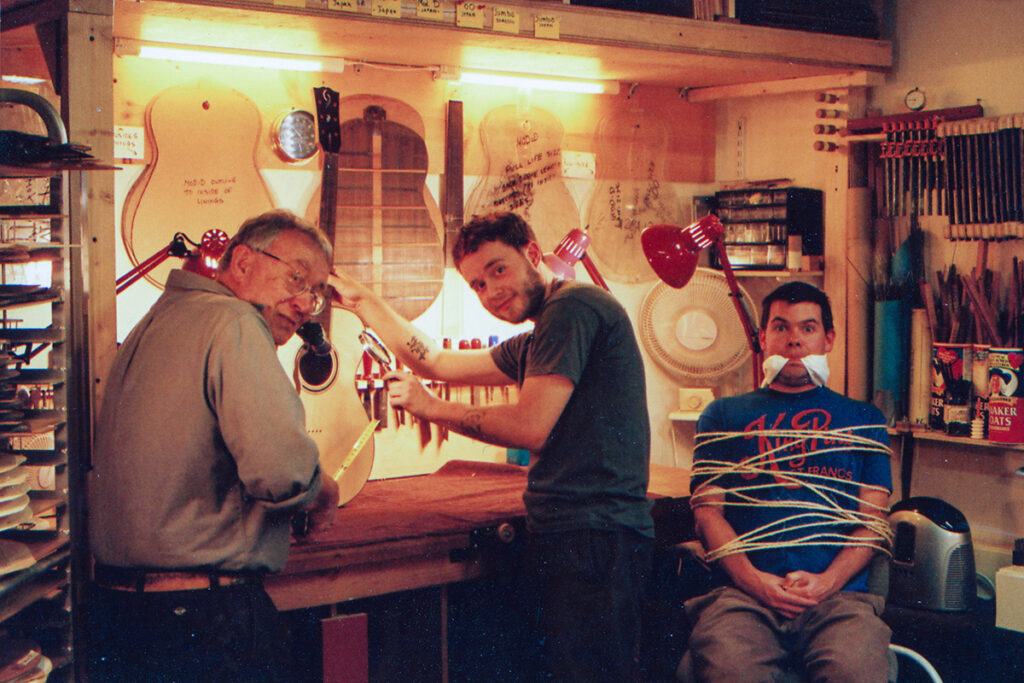
Whenever I think about where I wound up, given my starting point, I’m surprised. Years ago, when the Guild of American Luthiers was first formed, I attended pretty much every convention that organization ever had . . . we were all new at the game and the things we didn’t know vastly outnumbered those that we did. I was surprised, at first, that other G.A.L. members approached me to ask questions about this or that. Well, I told them what little I knew. And I guess I must have sounded like I knew what I was talking about. (I mean, having lived in Hungary, Austria, England, Cuba, and Mexico before arriving in the U.S. I’m pretty good with languages . . . and I’ve always liked to read . . . so I’ve picked up a literate-sounding way of speaking. Also, I’ve always stopped to think about things. And I’ve done a lot of research too (Figs. 1 & 2). So I guess I had at least some educated guesses to talk about. The questioners listened to the things I said — even when I said I didn’t know much about some of the questions they asked.) Anyway, over time, I found myself answering more and more questions. I felt myself gradually becoming a teacher-craftsman.

SOME MORE ABOUT ME
The present narrative has been an overview of my life as it pertains to making guitars – along with some context within which to understand the things I’ve done. Obviously, these things are not the whole story. I’m leaving out huge chunks of life that have to do with me as a person, as a husband, as a father, as a son of my parents, and as someone who (like all young people) spent a good many years finding out who I am and coming to terms with that.
But mainly, aside from history, genetics, and circumstance, I think that my life has been shaped by two principal factors. The first is what I’m like — that is, what kind of personality I am left with after all the major formative factors that shaped me had had their influence. And the second is Luck. I’ve had bad luck and good luck. Sometimes the good luck turned out to be bad luck in the end. And some of the things that looked like bad luck became good luck in the end. Wow. Who knew?
As I’ve been saying, none of my life would have turned out as it did if I hadn’t exhibited my guitars at the Carmel Classic Guitar Festival in 1977 and basically crashed into a brick wall. Or if I hadn’t met Art Brauner. Or known John Gilbert. Or Denis Grace. Or Tim Olsen of the Guild of American Luthiers. Or others whom I caromed off of in directions that became significant. And ditto for things that happened had I not met a lot of other people, and been in the right place at the right time, for fortunate little ripples to have been created.
Very largely, though, part of my luck was that I built my first guitar when I did. Lutherie was just beginning to be a thing to do, in the United States. It all grew from those years and continues to grow. And I’m pretty sure that my life would not have been what it has been had I built my first guitar five years earlier or five years later. That’s sobering to look at. Really.
MY POSITION AND STATUS
From what I am given to understand, I’m at this point in my life pretty hot stuff a big fish in a not-too-large pond, despite that I put my pants on one sleeve at a time just like everyone else does. A lot of people know about me and are impressed by what they’ve been told about me. I’m a recognized teacher and author. My books are being translated into other languages. And my work has from the beginning been artistic and not any attempt to copy any of the standard shapes and models of guitars. I mean, really: who needs more guitars that look exactly the same? And my guitars have audibly better sound than most of the guitars out there.
In my other books I’ve described my methods for achieving good tonal, ergonomic, and aesthetic results. I’ve also trained some talented young luthiers who are making much-better-than-average guitars, and who will continue to do ever more stellar work. Overall, my life is good. I’m getting old. I’m not going to be here all that much longer. I’m hoping that the calculating, avaricious, and morally blind criminals who are in charge of everything (as well as their witting and unwitting followers) will not get us into another world war . . . so that my work — and that of others — will not have been wasted and/or destroyed.
SOME OF MY CONTRIBUTIONS
My list of things that I have, over time, brought to the steel-string guitar making table is in the list below. The single most important thing I’ve done, as far as I’m concerned, is to have given permission (and examples of work to look at) for luthiers to do unique to their own sense of having the work done in a better way . . . and to experiment with both design and ornamental ideas, and to do even better work that what I’ve done (if they want to):
1) Permission to create artistic, colorful, and one-at-a-time-and-one-of-a-kind-cool-looking rosettes.
2) Thinking of wood mosaic (or other) rosettes that are more than just circular and/or concentric plastic rings. Soundhole inlays can be accented, in relief, organic, geometric, exploding, coalescing, angular, textured, multicolored, carved, inlaid, segmented, abstract, Celtic (or some other) aesthetic, etc.
3) Permission to introduce artistic touches in general – including the designing of guitars that have more organic and pleasing flow of line/contours than traditional guitars have had.
4) Making, and thereby giving permission to, the making of bridges that are sculpted, artistic, and otherwise looking-more-interesting-than-average.
5) Practice of, and giving general permission to, have more artistic pegheads that are shaped and cut to one’s own proprietary design, and with veneering on the back side as well as the front.
6) Offset strings that give you more playing space on the fretboard’s treble side, which they actually need.
7) Vertical binding strip elements, on the sides, that are wider than the horizontal ones (at the cutaway tip and neck-body joint), and at the butt. They give a pleasant look to the interplay between the “vertical” vs. “horizontal” elements that are the guitar body’s visible frame – as created by the angular meetings of the top, back, cutaway, and butt-inlay binding strips.
8) Design of guitar shapes that are less squat, better rounded, and more sensuous and organic (i.e., attractive) than the standard Martinesque and Gibsonesque models are.
9) Use of saddles that are angled more effectively than those on commercially made guitars.
10) Use of slanted bridge pins that are parallel to the slanted saddle, thus creating the same break-angle-of-string-over-saddle from first to last. It helps to make the strings’ volume even.
11) Use of ¼” thick saddles instead of the traditional 1/8” thick ones. They allow for better intonations.
12) For steel string guitars: bracing that’s not the same-old-same-old Martin “X” bracing. (I’m using a form of lattice-bracing now, but I’ve used at least a dozen other bracing patterns and methods. And I may move on to yet more experimentation.)
13) For steel string guitars: back-centerstrip, butt end, and cutaway corner elements that miter with the adjacent ones, instead of being the usual butt-joints.
14) Use of a parabolic line to make the cutaway contour. And/or a hyperbolic shape suggested by the look of the curve of the cutaway plus the curve at the soundhole – or the curve of the fretboard if it intrudes into the soundhole.
15) Placing a volute or similar and entirely useless ornamental detail on the back of the neck, at the head-neck junction. It’s more work, but it just looks nice.
16) Use of laminated side woods that make a more solid rim assembly, and nuts and saddles that have a strip of contrasting veneer running through them.
17) Use of a more stable “L” shaped head block.
18) I build more lightly, and/or with less wood. It allows the soundbox to make more and better sound.
19) I make deeper (i.e., extended reach) cutaways than many others do.
20) Use of a 1” diameter neck-to-heel transition curve, rather than the standard 4” diameter one, combined with less bulky heels. These allow easier access to higher positions on the fretboard. And they also look nicer.
21) Spreading the word about how differently and better contoured necks are suited to fingerpickers vs. flatpickers — for respectively better ergonomic positioning of these different players’ hands on the back of the neck.
22) Use of artistically abstract body inlays, instead of more commonly identifiable objects such as fish, dominoes, Buddhas, Celtic designs, leaves, etc.
23) Making fretboards whose ends are shaped to the curve of the soundhole, like Spanish guitars have. And also fretboard bindings that go around all four sides of the fretboard.
24) Attention to the importance of the evenness of the mechanical/tonal gradient of the top. This is essential if you are making guitars for guitarists whose music consists of many notes, not mostly chords.
25) Exploration, and permission to explore, the aesthetic and acoustic sense of not-too-much-and-not-too-little. It makes a difference, that. One doesn’t have to just copy what others do. Also, while this sounds soooo abstract, it leads to gut feelings that you will trust and use to guide you, further on down the road.
26) Awareness about listening to the guitar, and what to listen for. It’s just as important as making the thing. If you don’t know exactly what you’re producing, you’ve got a big blind spot.
27) Tap-tone guided voicing.
28) Awareness and use of the Cube Rule: i.e., the vital importance for tonal response of even minor increments of thickness/height/length of the top, the back, and all the braces.
29) Reliable use of the dynamic importance of coupled or uncoupled structural elements.
30) Teaching about and laying out the principal guidelines in guitar voicing.
31) Teaching and laying out the principal guidelines in overall design.
32) Teaching an awareness of the common-sense dynamics of sound, and how they relate to structure. And how the structure relates to sound.
33) A sense of the importance of seemingly small things — such as the strings’ break-angle over the saddle – which aren’t so small after all; they can make changes in sound that you can hear.
34) Teaching about and working with usefulness of visual accents. For instance: butt and other inlays that are in fact decorative accents.
35) Teaching and putting into effect the relationship between mass and sustain.
36) Teaching an awareness of the guitar’s aesthetics, and cutaways whose lines harmonize proportionally with the guitar’s other lines.
37) Permission to consider the possibilities of artistic and aesthetic repair/inlay work.
38) Teaching and using the advantages of compensated nuts, in addition to compensated saddles.
39) Use of artistic and colorful fretboard inlays and side-inlay position markers, as opposed to just simple dots.
40) Spreading an awareness of the monopole, cross-dipole, and long dipole.
41) Extensive innovations through bracing design, placement, shaping and treatment – and permission and encouragement for others to do likewise.
42) Spreading the word about The Golden Ratio — which is about pertinent aesthetic sense of proportions and visual balance.
43) Encouragement to do and doing of clean mitering work all over, instead of using butt-joints.
44) Practice of respecting the work, the materials, and the tools . . . and encouraging others to follow suit. . .
45) Guidance in how to think about various aspects of the work, and how to problem-solve — for and by yourself.
46) Use of bridges whose bottom gluing-surfaces are curved to match the doming of the top.
47) Increase of awareness that a guitar can be made beautiful in just about any aesthetic so long as the design is balanced and consistent: ornate, Japonesque, anatomical, geometric, less is more, visually simple or chaotic, contrasting colors or monochromatic, Bauhaus, Renaissance, Baroque, minimalist, whimsical, Kandinsky, Trompe l’oeil, Indian, etc.