Ervin Somogyi

Menu
  • About
    • Bio
    • Bio – Humorous
    • Resumé
  • Guitars
    • Guitar Models
    • Guitars: Custom Options
    • Special Projects
    • Visual Echoes & Tasteful Accents
    • Pricing
  • For Sale!
    • The Mexican Festival Model Guitar
  • Artwork
    • Lutherie-Inspired Artwork
    • Artwork (2)
    • Peghead Veneers as Art and Accents
  • Articles
  • Books
    • Books
    • Videos
  • Teaching
  • Blog
  • Contact

Author: esomogyi

A Systematic Comparison of Tonewoods

An interesting attempt to firm up the line between folklore and fact.

May, 2015

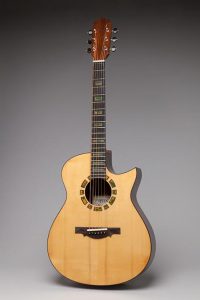
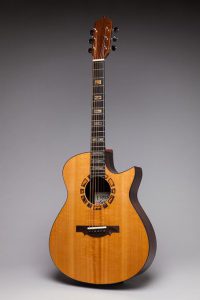
I want to tell you about a project I completed recently. In order to gain a better understanding of the tonal differences between cedar, European spruce, and Sitka spruce, I built three identical guitars that differed ONLY in the use of these soundboard woods. Backs and sides, gluing and assembly techniques, bracing, ornamentation, tuners, finish, and voicing were the same. (Technically, there was one difference besides the choice of topwood: the mosaic inlays on each of the instruments were of different colors; but I don’t think this affected sound in any way.)

The project began in 2012 when a client (who prefers to remain anonymous) bought a classical guitar from me. In the course of subsequent discussions we began to talk about a steel string guitar commission. This individual is genuinely interested in the ins and outs of guitars, guitar making, music, and sound; and he asked me a lot of questions and he patiently listened to my various answers. It eventually led to a conversation about the characteristic sound of one wood versus another… and how difficult it was to pin down those factors when comparing one maker’s work to another’s — or even two guitars built in different years that might or might not have structural or design differences significant enough to affect sound. There are too many building techniques and variables. So we began to consider the possibility of a multiple build that focused on keeping every variable — except for the choice of topwood — constant.

As far as we knew nothing like this had been done before. It would be a tricky challenge to keep everything else constant; it cannot be done in a factory setting because the ideal in that environment is dimensional consistency. And when it comes to sound, woods that are the same size/thickness/height do not predictably yield identical density, stiffness, or vibrational action. Especially if the woods are of different species.

So, the selection of materials and the construction of the soundboxes needed to be carried out with a hand, an eye, an ear, techniques, working conditions, back-and-side woods, voicing procedures, tap tones, etc. that promoted consistency. That was going to be my contribution. And after that, we would need a competent player with a sensitive touch and a discerning ear to evaluate the performance of such instruments. We both thought to ask Michael Chapdelaine, who is in our opinion second to none as a guitar player, to do this.

Finally, in order to make the resulting information available to others in a meaningful way, it seemed obvious that this ought to be written up and even accompanied by a videotape and high quality audio recording of the experience.

I am writing this up in the form of a two-part article that will appear as two chapters in my forthcoming book — with links to a website that will give access to both the visuals and the audio — so that anyone who is interested can read our comments and opinions of these guitars’ sounds, see how the tests were carried out, and also hear the guitars directly. It should be interesting.

I have been writing a second book. It is an outgrowth and continuation of my first two-volume work which is about the ins and outs of the contemporary guitar. I’m having trouble containing my writings to a single volume under a single umbrella title, though. Some of what I’ve been writing about is technical, and some is more personal, reflective, and biographic… and the material is altogether too wide-ranging to fit comfortably under one title. I mean, who wants to read about an author’s personal ups and downs in a how-to or method book? I’m pretty sure that titling this “a luthier’s further reflections on the guitar” or something like that will sound terminally boring. So, as with my last book project, this one will likely morph into a two-volume set. I’m thinking of titling these books as Guitar Making: Some of the Fine Points and A Luthier’s Life, respectively. Those titles seem more fitting than any one name I can think up.

Anyway, the prospect of getting a more scientifically-based handle on the contributions to sound of different topwoods has been an interesting one. I just thought I’d give you a heads-up on this one.
Sitka Spruce Top

Cedar Top

European Spruce Top

Posted in Lutherie & Guitars

A Surprising Insight About Drums and Guitar Tops

March, 2015

I received the following letter from one of my friends. It’s good enough to share with others. He wrote:

Dear Erv,

I had a wonderful ah-hah! Moment that startled me greatly. I was so enthralled at the time that I didn’t think to take pictures, so I hope my words will be enough to give you an idea.

We went with some friends to the new strip-mall built outside of town. I went scavenging around the back, being that kind of dude that is always looking for treasures left behind, like some cargo-cult islander or a stranger in a strange land. Near the little tin hut that houses cardboard, later to be crushed and bundled, was a strange box. I opened it to get a look at what was inside. Well, it was something I had never seen before: a brown plastic disposable keg, made like a big coke bottle, but much larger, about a 4 to 5 gallon capacity, and with a heavy-duty cap & a siphon to the bottom. In volume, it was about the same as a dreadnaught acoustic. It had a very thin skin, but the cap was industrially tough.

Of course I didn’t know anything about it, and was frustrated like a chimp because I could not unscrew the cap. I knew that if I took it back to my wife and friends, who were eating & schmoozing, they would not want me to keep it. I started to finger-drum it like a drum. It had the most amazing acoustic response. I just could not believe my ears & hands because it literally bounced with my fingers and made the loudest sound I ever got from any plastic bottle of any size. It was a wonderful drum. And because this strong drum was so wonderful I was determined to keep it.

So I got out my pocket knife and began to disassemble the cap guards so that it would be able to be all mine, minus the siphon. As I began to cut the locks on the cap, a tremendous amount of CO2 gas began leaking out… not for just a few seconds, but for a long long time. I was surprised at what great pressure this plastic bottle was under. I had to cut about 9 plastic safety locks, and even though I had done two-thirds of them, and the cap got loose, more gas kept on coming out. It was under a lot of pressure, and that kept the skin of the plastic alive and responsive.

As soon as all the gas came out and I removed the siphon, the keg was all as loose as an old man’s scrotum after 3 hours in a steam room. In more polite terms, as loose as a big balloon that had once been tight but had all the helium (or air) taken out. At that moment I was sad that I had lost my drum, but happy to just discard the now flaccid jug in the garbage where it now belonged.

All of this led me to fantasize that perhaps, in an analogous way, the braced system of a guitar gives the skin a similar “personality” — as if it were (in its own way) “pressurized”. Perhaps there is a better word, but for an example of the difference between responsive & non-responsive, I could not imagine anything better.

I’m thinking of you, and enjoying your books, of course. Someday I will do things. Progress is my most important product, elusive as it may be.

Your garbage-bandit friend, Alan

Posted in Lutherie & Guitars Tagged letters

Some Reflections On My Guitar Work

December, 2014

Steven Jay Gould is probably the most famous scientist, paleontologist, geologist, evolutionist, and scientific historian of our time. Well, even if he shares that distinction with scientific superstars Neil deGrasse Tyson (the most popular astrophysicist on television) and Steven Hawking (of Singularities and Black Holes fame), Gould is, in my opinion, the most broadly accessible. He has written many books that describe — in language that is easy to understand and that makes those subjects interesting — the natural world that preceded us. He even uses (brilliantly!) the game of baseball as a lens or prism through which to view, explain, and help us comprehend what might otherwise be considered obscure and arcane natural phenomena. All in all, Gould’s a cool dude — even though he died in 2002.

As far as evolutionary processes in general are concerned, authorities have generally taken the attitude that evolution has always been gradual and steady. You know: one step at a time. Gould, on the other hand, held that evolution was irregular and lumpy; millions-of-years-long stretches would occur in which nothing happened, and then, all of a sudden and for no apparent reason, a major leap or advance could be seen. This is certainly what the geological evidence has revealed to us. Gould called this process punctuated equilibrium, a concept he developed with colleague Niles Eldridge in 1972.

My guitars have, in their own modest way, followed this same path. That is to say, my guitars have evolved over the years; but they have not evolved at a steady pace. At times I’d have a new idea and I’d “put it into” a guitar. I do have an impulse to continually push the envelope (which is a phrase that has baffled me ever since I first heard it) and try something new. I tend to always wonder what is around the next corner; what would happen if I made something a bit thinner… or re-shaped a brace… Also, I’d be making guitars in my usual way… and keep on working like that… until I’d eventually discover or notice something, by accident, or have an insight into something that hadn’t jelled for me previously. And then, I am always looking for new ideas concerning artistry and decoration. Anyway, altogether, these kinds of alterations would result in a guitar that had a somewhat better look and free-er (freeer?) sound.

And, on the whole: how could any of this have been any different? The guitar itself has always been my best teacher. She has always revealed herself to me bit by bit, taking her own sweet time. I’ve been the student.


SOME OLDER GUITARS

Lately, some guitars of mine from the eighties and nineties have come on the market, and some of them have come to my shop for visits, checkups, or for a tweak or repair… or because the original owner was no longer playing guitar and wanted to see if I knew anyone who would want to buy their baby. And so on.

I have been pleasantly surprised in every instance by how well they’ve held up. Yes, they’ve had signs of wear and tear – if not in small scratches and such, then most notably in the look of the lacquered finish. (I used to lacquer my guitars rather than to French polish them. Mentioning this often opens the door to the lacquer-vs.-French-polish debate, but I’m not going into that now.) Lacquer has the capacity to separate from its underlayment, over time; and these guitars show small spots of lacquer separation/bubbling from the wood underneath. This is not in the least bit serious; it’s cosmetic and easily fixable; a guitar simply looks not-brand-new in this regard.

Happily, not one of the guitars that I’ve seen or heard about, from this period, has been mistreated: they seem to be structurally sound. And I’ve been pleasantly reminded of how far back I was using certain elements of decoration, or arrangements of bracing, that now seem to me like the most intelligent way to carry out this work.

One thing that I have noticed in these instruments is how my voicing work has evolved in the last twenty-five years: I’ve gotten bolder in wood removal. Everyone has always liked the sound of my guitars, and this was true even years ago. But my newer guitars give off more open tap tones. This is a result of the fact that I currently voice my guitars to a different point of physical/mechanical responsiveness than I used to. This is itself explained by the fact that I’ve allowed myself to push the envelope just a bit further, and a bit further, and a bit further, as far as my stopping-point in removing wood and manipulating physical structure are concerned. (Those of you who make guitars and voice them must also wonder, as I have done each time: what would happen if I shaved off another 1/32 of an inch off these braces, or sanded another ten thousandths of an inch off the top??? Well, I’ve traveled that road some.)

What this is all about is that I have long been aware of the adage (in Spanish guitar making, at least) that the best guitars are built on the cusp of disaster. That is, the best ones are built so that they are just able to hold together under the pull of the strings and the stresses of use. Anything less, and the guitar would be on the slippery slope toward falling apart; anything more, and the guitar would have less than its full voice. This is an intuitive concept that is central to my approach to making guitars. It also represents a metaphysical balancing act that, in its execution, is never the same for any two guitars. In any event, mostly, I’ve tried to sneak up on that balance point. I have overdone it and overstepped the mark a few times. And I can tell you with authority that these are useful experiences, because one has to have some idea of where to stop.

(Parenthetically, making a mistake isn’t the end of the world. I’ve learned a few things. One is that we’re talking about balancing acts, and not good guitar/bad guitar. If the braces are too small, then one can use lighter strings, or thin the top so that it is no longer underbraced for its stiffness. Or one can add bracing mass (or even entire braces!) through the soundhole to re-establish a previous balance point; it’s tricky, but not impossible. Finally, and not least importantly: even if I don’t like the sound of a particular guitar… someone else will eventually come along who does like it. Basically, if you can learn something from a given project it will not have been a complete failure.)

Anyway, I’ve been impressed by my older work. It’s held up well. When I act as an agent in re-selling an older guitar for a client, I show the guitar to prospective clients, talk with them about it, and along with that offer to do some retro-voicing. This is always an option with any guitar, by the way. And I do feel, when it comes to my guitars, that there is always a little bit of a responsibility for me to lead a client to an instrument that has the best possible sound… even though that is invariably a subjective quality. So I don’t push. I merely offer to do that. I do charge for this work, of course. But considering the selling price of these instruments it’s a modest one. I need to underline that I am in no way saying that there’s anything wrong with any of my older instruments; they merely have the response of older guitars of mine. And this procedure simply introduces the option of helping the sound, if not the look and feel, of these older Somogyi guitars to be more in line with my current work.

Posted in Essays & Thoughts, Lutherie & Guitars

Guitar Voicing: Different Strokes for Different Folks? – [2/2]

August, 2014

One reason that the bringing out of a guitar’s best voice is the main challenge for steel string guitar makers today is that there is no agreed-on standard to aim for. This is so for two reasons. First of all, most of the makers of this instrument have never heard a steel string guitar with a really great voice of its own. Therefore their idea of great sound is frequently based in hearsay instead of direct experience, combined with a lifelong experience of having conventionally overbuilt guitars as their models. It is understandable that they’d knowingly or unknowingly copy these models – which, despite the fact that their own guitars might look distinctive, they are really copies of copies of copies of copies of copies of copies of the same essential concept/blueprint – in the belief that their job is done when such an instrument is faithfully replicated and strung up. I say these things without intending to offend anyone, but because this is the territory as I see it.

The second reason is that whereas classic guitars are all pretty much the same size and shape, steel string guitars come in a wide variety of shape, size, and depth. This complicates the acoustic part of the work. It does so in the same way that a marksman is always called on to do the same work in shooting, but his emphasis will vary slightly as his various targets are placed at different distances away. Same skills, somewhat different factors.

Classical guitar makers, in my opinion, have more of a clue as to the sounds that better guitars are capable of: they have more of an agreed-on standard for what the Holy Grail of sound is (it is largely thought of as having the power, clarity, projection, and otherwise operatic voice that one would expect from a concert guitar). They also have had access to musicians with better-trained ears and better guitars, as well as other examples of more optimally-realized modern and historical models to study, listen to, and emulate. In comparison, the most familiar and widely accepted steel string guitar is the one that you can always plug into an amp or play into a microphone.

What I said above about “getting the most out of a steel string guitar’s potential” probably sounds too simplified and vague to be very useful. But consider the matter in this way: an OM model guitar and a Dreadnought differ in a number of specific ways: woods, scale lengths, body depth, possibly stringing, etc. How is one to factor these differences in? The best thing that a luthier can do is to make a really good OM and/or a really good Dreadnought; each will have its own voice because it will have brought different things to the table, blueprint-wise and tone-wise, from the very beginning. To repeat what I said above, the guitar maker’s task is to bring those qualities fully out without overbuilding, underbuilding, or misbuilding. And in the case of guitar makers just as much as with marksmen and cooks, it takes time and experience to learn to do the work professionally and well.

Posted in Lutherie & Guitars

Guitar Voicing: Different Strokes for Different Folks? – [1/2]

August, 2014

I was recently in a conversation with a client during which he asked whether I voice my guitars differently depending on whether they are OM models, or Modified Dreadnoughts, or Jumbos, or 00s, or whether I make accommodations within a given model depending on whether it will be played in standard or open tuning. It’s not a bad question, and it’s a topic that’s come up more than once. The assumption seems to be that something has to be done differently because these guitars are different sizes and shapes and uses, and will of course have different sounds. How could one recipe voicing approach possibly work for all of them?

My short answer is no, I don’t have different voicing tricks or techniques for my various guitar models. Not really. There may be nuances and difference of emphasis here and there, of course, but the procedures are basically the same in all cases: to progressively and systematically lighten the structure so that the voice of the guitar stops being choked by too much wood, mass, and stiffness and begins to open up. This is, in fact, no more nor less than every serious guitar maker’s challenge.

Chances are high that every luthier you will ever have a conversation with will give you his own perfectly-good-sounding reasons for whatever he does to his guitars’ woods in order to tease the best sounds out of them. These accounts will undoubtedly surprise you with their variety. And some of them are certain to be on the right track. Nevertheless, I do NOT believe that the chief task of these luthiers is to apply this or that particular recipe procedure to get “this kind” of sound out of one model guitar and “that kind” of sound out of another. The various guitar models and types, together with their individual factors of size, depth, wood selection, stringing, etc. set most of the tonal possibilities for what such a soundbox will be capable of. The luthier’s task is, simply, to get any soundbox to fully release its tonal potential. Period. Just as a cook cannot make any food taste better than what it can be, a soundbox of a given size and volume cannot do better than its best. Short of that end result one simply achieves… well… something less than that.

Posted in Lutherie & Guitars

Titebond vs. Hide Glue

September, 2013

Glue. All woodworkers use it. And what can one say about it that hasn’t been said already? — that is, aside from jokes like “My wife gave me a book titled The Complete History of Glue for my birthday. What was it like? Heck, once I picked it up I couldn’t put it down…”

Well, the principal function of any glue — outside of considerations of working time, adhesive strength, and materials compatibility — is simply to enable one surface to stick to another. Period. Therefore if the glue has been appropriately selected for the task at hand and applied correctly, all glues work satisfactorily: the glued parts all adhere together for a long time without bleeding, creeping, breaking down, discoloring the woods, or otherwise failing.

For woodworkers in general, hide glue and fish glue were the only glues available for a long time. More recently, synthetic and chemical glues have been developed which are more convenient to use, give extended working time, are waterproof, etc. For the general woodworker who is not committed to using epoxies and such for specialized purposes, Titebond (and the other aliphatic resin glues which are sold under a variety of names) pretty much heads the list of modern favorites. It works every time. The somewhat less convenient hide glue (made from animal hides and hooves) is still used by purists, craftsmen, and traditionalists. It works every time as well. Elmer’s White glue, that staple of school projects, is a polyvinyl glue which never gets really hard; hence most woodworkers don’t use it on serious projects.

The Titebonds and hide glues are certainly the favorite adhesives when it comes to making guitars despite the latter’s minor inconveniences of preparation and quick setting time. On the whole they give equivalent results, but with one significant difference. This is most noticeable to repairmen and restorers — those whose work requires them to take glue joints apart, or to deal with failed joints. The difference is that of destructive vs. non-destructive reversibility. What that means is that one can take a hide glue joint apart (if one knows how, and if one is willing to be patient) without removing of any actual wood. One cannot take a Titebonded joint apart without losing at least a little bit of the original wood: one undoes the joint and then needs to do some sanding or scraping to expose fresh wood. This might not seem like an important consideration in most woodworking, and it is pretty much irrelevant in factory-made guitars: there’s enough wood in these so that you can lose 1/64″ of thickness and still be all right. But in craftsman-level guitar work, which can allow for more carefully titrated and thicknessed parts, the loss of a few thousandths of an inch of wood may make a difference in sound.

There’s also a second consideration when it comes to doing repair and restoration work on a valuable collector’s instrument. In this realm, having the instrument be as fully original as possible is desirable: alterations and modifications of any kind can devalue the instrument. So, in these cases, it is preferable to find that the guitar has been held together with hide glue: the parts can be taken apart and reglued while maintaining fidelity to the original sizes, thicknesses, and specifications of the woods, not to mention the original intent and methodology of the maker. One can understand that a damaged Louis XIV chair that’s been epoxied together wouldn’t be considered authentic — and it would be priced accordingly.

I’d always assumed that Titebond was water soluble (after all, it dilutes easily with water when it’s still liquid) and that it could be removed completely, after it had hardened, if one wanted to spend enough time sponging and wiping it carefully away with warm water. It’s exactly what one can do with hide glue. But Titebond is a synthetic glue, not an organic one, and it has unexpected staying power. I should add that with both of these glues one heats a joint that is to be undone, so as to soften the glue and help it release its hold.

Titebond is only partially un-doable. This property of it impressed itself on me in an interesting and accidental way. I’d made a pencil holder a long time ago by pouring some Titebond into the bottom of a recycled plastic jar that had a rounded bottom edge and then dropping a bunch of ball bearings in for ballast — to ensure that it was heavy and stable enough to not tip over once I filled it with pencils and pens. The Titebond soon hardened and rendered the ball-bearing ballast permanent, and the jar held my pencils and pens nicely. Some years later I was able to afford a real pencil holder, so I transferred the pens and pencils and filled the old jar with hot water so as to melt the Titebond and reclaim the ball bearings. I thought it would take a few days of soaking for the Titebond to give way; the ball bearings were stainless steel and wouldn’t rust.
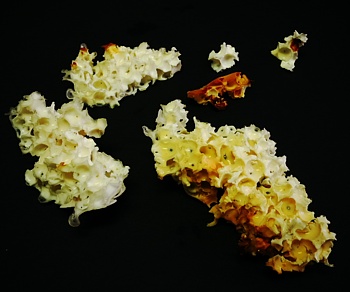
Well, to my surprise, the Titebond did soften but it didn’t dissolve at all; it was still there after three weeks of continual immersion in warmed water. It softened enough that I could squeeze the ball bearings back out, but what remained was a honeycombed, spongelike mass of rubbery aliphatic resin that looked like a coral reef — and that hardened up rock solid again as soon as it dried out. (See the accompanying photos.)

As it turns out, it’s not only the composition of the glue that makes the problem for repairmen and restorers. It also has to do with how the adhesive achieves its results. In the case of the newer glues such as Titebond, these grab onto the materials they come into contact with by means of penetrative adhesion: they sink into wood fibers and grab hold. And once there, they want to stay. The upshot is that undoing such a joint usually results in some splintering, tearing, or pulling up of wood fibers, and thus leaving a rough surface that will itself need to be smoothed before any regluing can occur.

In addition, whether or not there’s been pulling away of wood fibers, some of the Titebond will remain on the wood surface and, as I pointed out with my ball-bearings experience, Titebond will not simply wash away. Thus the usual way of post-Titebond surface preparation is to sand or scrape at the roughened sections (imagine trying to sand or scrape cold honey off a piece of plywood; it’s the same thing) until smooth wood is reached; then, one reglues.

Hide glue, on the other hand, achieves its results by molecular bonding. Titebond won’t hold very well onto something it cannot penetrate, such as glass. But hide glue will. In fact, it’ll hold on like a barnacle on a ship’s hull. In the old days before sand blasting, glass was decorated by covering the to-be-textured-or-highlighted area with hide glue; once this dried the hide glue was chipped off with a chisel and a hammer — and it would take some of the glass with it. The contrast between this newly chipped surface and the smooth original surface of the glass is how lettering and decoration in that medium used to be achieved! The really interesting part of this is that, molecular bonding aside, one can wash hide glue completely away without affecting the surface it has been applied to. Like campers, hikers, or guests with an ecological consciousness, hide glue can disappear without leaving any trace or litter behind it.

Posted in Lutherie & Guitars

Frankenfinger

May, 2013

I cut my finger on my table saw, in a moment of carelessness. (Duh!) It of course happened at the end of the day, at the end of a run of cutting and slicing, and I’d allowed my mind to wander just a little bit. . .

I must say that I’m glad that I have a SawStop, which is the table saw that has an shutoff relay that kicks into action the instant a finger (or anything with a finger’s electroconductivity) comes into contact with the blade. Had I not had this tool the cut would undoubtedly have been much worse… and a life-changer for someone like me who uses his hands and fingers with precision.

The story behind the SawStop is that, a few years ago, the inventor tried to interest the commercial table saw manufacturers in making this tool; but every single one of them turned him down, citing concerns of too-great cost. So he went into business for himself. Statistically, I’m told that 30,000 fingers are lost annually to power tools. One of them might have been mine; I’m lucky to have only needed stitches. For those of you who don’t have such a table saw… do think about getting one.

There are currently reports of woodworkers suing the makers of their table saws because they did not install such a useful safety device on their machines when there is/was such technology easily available. Somehow, I’m on the side of the woodworkers on this one, caveat emptor be damned.

Posted in What I've Been Up To

Specific Top Thickness In the Guitar

(NOTE: this article is still in progress)

© 2013 Ervin Somogyi

Top thickness is, along with bracing, the most debated and tinkered-with area of guitar making. It is so for two absolutely important reasons. The first is that the physical characteristics of the top set the stage for tone — along with the corollary that the lighter the construction of the top is, the better the sound. The second is that there’s a minimal top thickness/stiffness that must be respected if the plate is not to cave in under string load. If sound is one’s objective, then the luthier’s balancing act is in finding the correct balance point between the imperatives of ‘light construction’ and ‘not too light’.

In my work, I take my tops to a target deflection under a standard weight rather than to a predetermined, formulaic thickness. I’ve worked like this for a long time now and have written about my thinking and techniques at length. Still, my method may not work for everyone. There are a lot of guitar makers out there who swear by specific target measurements, and I’m not sure I have the right to say they’re wrong to do so; my own preferred method is simply different. The question comes up, then, of what is the proper justification for focusing on one or another specific number for top thickness? And, what would that number be? Well, it seems to me that a good place to begin would be to have some idea of where the measurements that we do know about, read about, have heard about, and use come from.

PAST GUIDANCE AND WISDOM

Many of my generation of American luthiers got our start by reading Irving Sloane’s seminal book Classic Guitar Construction, which appeared in 1966. This was, after A.P. Sharpe’s 32-modest-pages long Making the Spanish Guitar (published in 1957) the first available ‘real’ book on guitar making. Sloane advised the reader to make his tops 3/32” thick — which measurement is equivalent to.094”, or 2.34 mm. Mind you, this instruction appeared before any of the two-dozen-plus books on lutherie that are now available, and before the plenitude of secondary sources of information that now exist. How did Mr. Sloane — who was not only writing very early in the game but had, as far as I can ascertain, only built a few guitars on his own then — come up with this number? Well, perhaps by reading Sharpe’s book (he recommended the same measurements) and very likely by measuring some guitar tops and by talking with some makers.

He probably didn’t speak with Vicente Tatay, one of the early Spanish luthier-transplants to the U.S., though. Tatay came from a prominent Valencian family of guitar makers and presumably knew what he was doing, guitar-making-wise, even before he took his plunge into the New World1 . Once here, he wound up working out of a store in Greenwich Village and became, by so doing, one of Mr. Sloane’s fellow New Yorkers. There’s a wonderful article by Steve Newberry, published in American Lutherie (“Vicente Tatay and His Guitars”, issue #66, Summer 2001, pp. 47-49) about the state of lutherie and its lore in the U.S. many years ago. It is told from the point of view of the author who, as a teenager, became fascinated by Mr. Tatay’s work and talked him into being allowed to hang out in Tatay’s shop after school hours and be of some help by sweeping, cleaning, etc. In exchange he got to observe Mr. Tatay at work, of course. This turned out to be a mixed pleasure: Mr. Tatay is described as having been a gruff, cantankerous, cranky and closed-mouthed chain smoker who had an explosive temper and spoke only Spanish. Still, one afternoon toward the end of the Summer, in an uncharacteristic moment of expansiveness and letting down his guard, Mr. Tatay motioned the young Newberry over to his workbench and, using hand gestures and some coins, indicated to him that the secret to his lutherie was to make the guitar top about the thickness of a nickel in the middle, and the thickness of a dime at the edges. (I should add that a lot of Spanish guitar making in those days was done just like that: by skilled feel and eye, and with amazing accuracy.) Tatay might or might not have known the numerical values of his thicknesses but he certainly knew how to work to such tolerances at the workbench. Incidentally, the breadth of a nickel and a dime are .075” and .050” (i.e., 1.9 mm and 1.34 mm), respectively. Give yourself a treat and look that article up; it’s as well written as anything Mark Twain ever wrote.

Four other books on guitar making followed Irving Sloane’s pioneering work on guitar building. Classic Guitar Making by Arthur Overholtzer, published in 1974, immediately doubled the available information on this subject2 . The other three were Donald Brosnac’s The Steel String Guitar; Its Construction, Origin, and Design (1973), David Russell Young’s The Steel String Guitar; Construction and Repair (1975), and Irving Sloane’s follow-up book Steel String Guitar Construction (1975). These were the first sources of published information on the steel string guitar and their recommended guitar top measurements were 3/32” (.094”), 3/32” (.094”), and 7/64” (.109”), respectively. Overholtzer’s top measurements took into account wood density: for classic guitars his recommendations are 3/32” (0.094”) for soft spruce and 1/16” (.062”) for hard, dense spruce. For steel string guitar tops he recommends 3/32’ to 1/8” (.094” to .125”).

With the exception of Mr. Overholtzer, who had been a violin maker for some years previously, the others were pretty much acting as novice discoverers, craftsmen, and pioneers — as I myself was, except that I hadn’t written a book yet. I think it’s safe to assume that these young makers/authors were following each others’ and the Martin Company’s leads; and I was certainly following theirs. The Martin Guitar Company comes into this discussion because it was the premier steel string guitar producer of that time and would have been everyone’s main point of reference for making that kind of guitar. Mr. Sloane, whose second book Guitar Repair (1973) focused on steel string guitar repair procedures, was surely on this track: the book was photographed on the Martin Guitar factory premises, and the repair procedures that are described were carried out on the Martin company’s workbenches. Ditto Mr. Brosnac; I asked him, in a recent conversation, where he got his book’s recommended measurements from; he told me that he got them from Jon Lundberg, the legendary Berkeley-based Martin guitar retro-voicing pioneer, who was in those days possibly the world’s leading expert in that guitar3 . Both Overholtzer and Sloane seemed to take a lot of cues toward their classic guitar making from the work of Robert Bouchet (1898-1986), a noted and innovative French builder.

In 1987, twelve years after the last of the above books was published, the bibliography of guitar making took a major step forward when William Cumpiano and Jon Natelson published Guitarmaking: Tradition and Technology. This was the first book to address making both classic and steel string guitars and its recommended top thicknesses were the most comprehensive yet in recognition that not only does size of guitar and species of wood used make a difference, but that different makers have significantly different building designs and ways of using their materials. Accordingly, top thicknesses are suggested rather than instructed. Top thickness targets for classic guitars are given as around .100” (2.5 mm) for spruce and .110” (2.8 mm) for softer wood such as cedar. For steel string guitar the recommendation is 1/8” (.125”, or 3.17 mm) for a first-time project, but otherwise ranging from .095” up to .130” (2.4 mm to 3.30 mm) depending on size and shape of instrument as well as species of wood used. One can see that thinking about top thickness was getting more sophisticated.

CURRENT RULES-OF-THUMB FOR TOP THICKNESSES

So, according to published instructions to those dates, top-measurement for classic guitars are4 : 1/10” (.100”) to 7/64” (.110”), or 2.5 mm to 2.8 mm; 3/32” (.094”), or 2.34 mm; And for steel string guitars, they are: 3/32” (0.094”/.095”) to 7/64” (0.109”), or 2.38 mm to 2.77 mm; and from 1/8” (.125”) to a fat 1/8” (.130”), or 3.17 mm to 3.30 mm

Does this get us anywhere? Well, sort of. It tells us that, at least in the classic guitar, one can go as thin as 1/16” (about 1-1/2 mm) and still have the instrument hold together. That’s useful to know — as is the fact that Overholtzer is in a minority in promoting such thinness; he and contemporary luthier Greg Smallman go remarkably thin, but very few others follow suit. As for steel string guitars, we have no published accounts of whether there is a top-thickiness limit that’s below 3/32”; if anyone one has tried to push that envelope they haven’t written about it.

I’ll address some additional specifics further below, but for starters you should know that Tatay’s top-shaping approach is the traditional one used by Spanish classic and flamenco guitar makers: the top is made to its target dimension in the middle but it is thinned in the outermost inch and a half or two of the lower bout, from the waist down. We know this because work of this type is found in the instruments of established classical guitar makers whose work has been carefully measured and studied. Experts can even date certain classic guitars through specific variations in their measurements, which will have been documented from the various periods of their makers’ careers5 .

Flamenco guitars, unfortunately, lack the social and academic respectability of their rosewood-built brothers and have not received such formal attention; they get played a lot but not studied. Ditto steel string guitars. And speaking of these, Sloane’s and Overholtzer’s recommendations of uniformly thick classic-guitar-top measurements, previously cited, actually come out of the steel string guitar making tradition in which the top is the same thickness throughout, without any selective tapering or thinning.

VARIATION AND INCONSISTENCY

While both steel string and nylon string guitar makers tend to follow their own top thickness recipes, the former work to top measurements that are far less agreed upon or consistent than are the target measurements for the latter. Therefore those measurements — ranging, as we’ve seen, from .094” to as much as .130” — are not so useful to rely on as guides. This great variation is attributable to six main influences, the most important two of which I consider to be the following:

First, there needs to be a lack of dimensional consistency from maker to maker in steel string guitars because steel string guitars come in so many shapes and sizes. This itself is a function of industrial priorities of (1) needing to make one brand of guitar distinguished from another in the marketplace (hence different physical parameters), (2) different orchestral uses for the guitar as the provider of mass musical entertainments, and (3) the need to make mass-market products durable. There is a legitimate logic for producing workhorse/beater guitars in a mass-entertainment culture: consider the fact that there is nothing like Willy Nelson’s guitar among classic musicians.

And second, in the absence of a craft tradition in which independent luthiers ongoingly seek ways of refining their work, the newer generations of steel string guitar makers have — knowingly or not — been copying copies of copies of copies of copies of copies of copies . . . of mostly Martin guitars, but also Gibsons, Guilds, Harmonys, Epiphones, etc. 6

While copying — or imitation, as Oscar Wilde put it — is the sincerest form of flattery, it does cut down on investigation, discovery, originality, increased understanding, and improvement. Nonetheless, copying copies of copies of copies of copies of copies has worked well enough for a long time, and the top thickness measurements put forward in various books and plans are generally taken more or less as givens without being questioned. For that matter, how could it be any different unless one has had any other experience to compare against?

More important than this blind acceptance, though, is that, more or less by default, these guitars’ sound is attributed to this or that variation of “X” bracing (or fan bracing) rather than to any more reasoned and optimal thicknesses of soundboards. As far as steel string guitar making goes, ways of refining and fiddling with “X” bracing and its offshoots have consequently received lots of attention. Look in any modern guitar magazine for pictorial examples of this: every brand has its own version of the “X” with different angles, different scalloping and profiling of the main legs of the “X”, different height of their intersection, variously profiled finger braces, differently spread tone bars, etc. No one ever mentions differential top thickness, basic plate tapering, etc.7

MY OWN EXPERIENCE

I’ve made my steel string guitar tops thinner and lighter over time; I’ve found others’ typical construction to be too heavy. I’ve used many variations of “X” bracing in them, and even tried fan-bracing on a few. I’ve also made my Spanish guitars with thinner and thinner tops; I’ve mostly used traditional fan bracing on them but have done a little lattice bracing also, and even some “X” bracing.

The upshot of this trajectory is that I like the sound of my steel string guitars with comparatively thin tops and coupled “X” bracing, more than I like the sound of my (and others’) classic guitars that have thin tops plus either fan bracing or lattice bracing. I find that I can get a rich, deep, and pleasing sound from my thinnish-topped steel string guitars. But classic guitars with thin tops — both my own and others’ — have a quality of sounding a bit sharp, or harsh, or spare, and in general musically uninteresting to my ear, even though they may be loud. I like a richer, mellower, more complex sound. If any of you have heard the sound of a Friederich [also spelled Friedrich much of the time] guitar you’ll know what I’m talking about.

These are, admittedly, my personal preferences. But they are also shared by many others. Matters of tone have both subjective and objective components, of course. The objective part has to do with the things that tonewoods are known to realistically do when worked to this or that thickness. The subjective part has to do with musical tastes and with whether or not these woods produce sound and tone coloration that give pleasure.

In this regard, in the matter of nylon string guitars, we can return our attention to the matter of the differences between Sloane’s and Tatay’s recommended Spanish guitar top thickness. You’d expect that guitars with tops .094” thick would produce sounds different from those produced by guitars with tops tapered from .075” to .050”, wouldn’t you? But, oddly, along with the various instruction to “do it like this” or “do it like that” that appear in various books there’s no accompanying explanation of just exactly what it is that you get if you follow those recommendations. Sometimes, in the more scientific presentations, there are graphs or photographs of testing for monopole, dipole, and tripole Chladni patterns; these show that these guitars do have clear monopoles and dipoles, etc. [See Chladni photos from p. 121 of Engineering The Guitar] It is useful to know where various vibrational areas are most dominant, and at approximately what frequencies these tend to be most active. Most readers will not be sufficiently sophisticated to get more than this fundamental sense of how the average guitar works, though; I’m certainly not. And one is still left to infer many things from the sizes and shapes of the various blotches and wiggle-patterns in the photos. I have found them to not be of as much use as I would have liked in trying to understand some of the more specific aspects of frequency response.

An important clue is contained in Steve Newberry’s article, previously cited, when he states that Tatay’s guitars were loud (emphasis his; he really wanted to make a point). Interestingly, other words that are used to describe an impressive sound are: ‘powerful’, ‘brilliant’, ‘projective’, ‘full’, ‘rich’, ‘resonant’, ‘piano-like’, and so on. “Loud” merely suggests volume — a quality that is basic and not likely to imply character or complexity. I mean, when is the last time you heard any kind of explosion or crash described as being, say, rich or resonant? Also, the sound of an exploding volcano or an avalanche would probably be described as a roar instead of merely loud, which suggests the preponderance of a certain segment of the frequency spectrum, so I’m of the opinion that colloquial speech carries more information that one might at first think. In fact, many “sound” words such as bang, roar, thunk, and crash are onomatopoeic; that is, the word captures something of the actual sound it’s identifying. But before exploring this further — which we will do further below in the section titled ‘Correct Top Thickness’ — let us take a brief look at how woods do their tonal work.

WOODS’ AND GUITARS’ VARIOUS ACOUSTICAL TASKS

Tonewoods, by definition, make a sound — all by themselves. You have only to tap the good ones to get a surprisingly bell-like ring, when they are suspended in the air while held from just the right nodal spot. Compared with ordinary woods that merely go thud, thunk, or boink regardless of how or where they are held, such a response indicates a liveness and, especially, a high-frequency capacity. Indeed, tonewoods are sometimes described as being vitreous, which means glass-like — and of course having the ringing and sustaining vibrational quality associated with that material. If you tap these same woods while holding them at different nodal points they will also give you a lively and sustaining low-pitched hum. Such woods can do it all. Many rosewoods, spruces, cedars, redwood, cocobolo, wenge, padauk, etc. are bona fide tonewoods8 . Bubinga, teak, maple, cherry, oak, ash, African blackwood, zebrawood, Goncalo Alvez, ebony, olive, myrtle, koa, walnut, bocote, ziricote, and mahogany are generally not — or very little, at best.

There are significant differences between steel and nylon string guitars. The woods might all be the same; but the stringing, structure, and mechanical tensions these guitars operate under are hugely different. Steel string guitars want to produce a bright sound, not a bassey one, as a function of their basic construction and stringing. The natural voice of the fan-fretted nylon strung classic guitar, on the other hand, is the opposite: the bass is normally stronger than the treble. This is likewise a function of its basic design, construction and stringing.

Finally, I admit that I’m giving voice to my prejudices with a bit of factual information to justify them. The fact is that all kinds of really successful guitars have been made with exactly such “unsuitable” woods. I’m merely describing gradations of qualities, not absolutes. The real key is not what selection of wood you may have made, but what you’ll do with it. Keep in mind that beauty contests of all kinds, in which there’s a “best” followed by a bunch of “runners up” is one of the great artificialities of human culture. If this weren’t so, then only the lucky man married to the one single “best” woman would ever be happy and all the rest of us would get assorted runner-ups and rejects. Along those lines, I believe that Donald Trump believes that he has the best of the best in everything.

Yet, these are not at all the desired target sounds for these instruments. In any discussion about classic guitars it is essential to recognize that the ‘best’ instruments have treble notes that sound brilliant. They not only stand up to the bass notes, but they have their own very clear identity: that’s the standard by which these guitars are judged. ‘Best’ is here defined by the ‘romantic’ standard that Andres Segovia created, and which standard is still applied even to the newer classic guitars with thinner tops (about which I’ll say more further below). When an experienced classic guitar player puts his hands on any guitar that he’s never played before, his left hand immediately goes to the twelfth fret position and the first notes he plays will be the high ones; it’s the acid test, pretty much the first thing one does. It’s sort of like stepping into a new racing car and immediately revving the engine to get a sense of its power.

And what is this brilliance? Well, listen to some of Segovia’s early recordings in which he plays expressively and romantically. He emphasizes some of the high notes in such a way that their smoothly accented ping becomes part of the romantic sensibility of the song. Those notes are rich, very musical, and they sparkle.

On the other hand, in any discussion about the steel string guitar, the ‘best’ ones are those that have a full, good, solid, vigorous, punchy, present, and open low end response. Historically, the quest for a strong bass response has been the main factor behind the creation of the larger steel string guitar bodies such as the dreadnoughts and the jumbos. Low-end response is important in the steel string guitar; but smaller soundboxes can’t give it easily. (It is interesting to note that the Spanish guitar, in spite of having every opportunity to grow physically bigger along with its metal-strung cousin has — with only one technical exception — not done so. That exception is the Mexican mariachi bands’ bass guitar, the guitarron — which has a specific target sound and muscal use that is its own. The traditional classic guitar has long since found its optimal size.9 )

I think it is to the guitar’s credit that while its various standard designs and stringings produces sounds that are not, as I said above, the ideal target responses, the guitar’s design has sufficient internal and dynamic flexibility that any soundbox can be tweaked so as to bring out and emphasize the target frequencies. This is where the luthier’s skill comes in — and within the larger context of making Spanish and steel string guitars, the luthier’s challenges in making either one of these models of the guitar are directly opposite. I repeat: to achieve a good target sound in the steel string guitar the maker has to ‘build in’ a good bass response, which the instrument will normally lack. In the nylon string guitar — to achieve a good target sound — the maker has to ‘build in’ a good treble response, which the instrument will otherwise lack. (NOTE: these things are precisely the topic of chapter 32 of my book The Responsive Guitar.)

TONE PRODUCTION AND THE LOGIC OF MATERIALS USE

Bass response is associated with a top membrane that is loose enough, while also sufficiently ‘held together’ with bracing, to move as a single unit. This can be visualized as a sail that is billowing in and out under the wind. A thin, relatively flimsy top that is held together by any interconnected latticework of bracing will be able to billow back and forth, in unison with itself, and at relatively low frequency. In the guitar, this is called monopole movement10. Furthermore, any specific high-frequency potential or behaviors of the topwood — i.e., of the material itself, independent of the interconnected bracing lattice — are not so relevant to this mode. This is because metal strings themselves, by virtue of their own mass and stiffness, will bring plenty of high frequency signal into the system. One doesn’t need the wood to bring its own additional high-frequency contribution into the soundbox.

On the other hand, treble response is associated with a top membrane that is stiff enough to allow high-frequency/low amplitude motion, and which is not simultaneously ‘drowned out’ or overshadowed by dominance of monopole movement. The more the monopole is suppressed, and the top is prevented from moving like a sail or undulating like gentle waves — and the more it is enabled to move in rippling fashion in small-to-tiny sections — the better the high end. This is usually identified in the literature as dipole and tripole movement. Put in different words, the more that the top discharges its energy by billowing in and out like a bellows or a sail (monopole), the less energy is left over for the high end (dipole and tripole). And vice-versa. As with electronic speakers, it takes much more energy to produce low-frequency sound than it does to produce high-frequency sound.

The trick, obviously, is to not make the plate so loose that you lose the high-frequency end, nor so tight that you lose the low-frequency end. You want both, and the luthier’s task essentially becomes one of management-of-energy-budget. And thus, at this point, the question of ‘correct stiffness’ can finally meet up with some numbers that are associated with ‘correct thickness’.

SOME PROBLEM-SOLVING TOOLS

I’ve discussed the Cube Rule enough that I don’t have to repeat it here, except to remind us that it applies to length as well as height or thickness. In the matter of length, however, the Rule is inverted. The longer something with a weight on it is, the more it sags ; the shorter something with the same weight on it is, the less it sags — all in accordance with the Cube Rule. And, we should be speaking of deflection instead of stiffness in these matters: stiffness is, strictly speaking, a quality that is independent of dimension. Furthermore, if we’re comparing stiffnesses and deflections, the fact is that you don’t get the same difference going “up” from smaller to bigger as you do when going “down” from the bigger to the smaller. Cubed quantities don ‘t yield multiplicative proportional differences like that. For instance, reducing 100 by 10% brings you to 90, but increasing 90 by the same 10% doesn’t get you back to 100; it only gets you up to 99. You can get different results with the math if you’re not careful11.

Let’s assume that you’ve been making pretty successful dreadnought guitars with tops at .090”. Dreadnought soundboxes are 21” long and have scale lengths of 25.4”. Let’s also assume that you’ve been commissioned to make an 18” long parlor guitar with the same scale length, and it of course needs to also sound good. It would make sense to figure out the logical top thickness of that 18” length guitar, based in your current 21” guitar criteria; you’d want a number that represents equivalent deflection; these guitars would both, after all, be functioning under the same string load. Interestingly, there are two distinct methods whereby one could arrive at an answer: an intuitive one and a mathematical one. In the interest of comprehensibility, I’m going to describe only the former; the latter is full of complicated mathematical formulas.

THE INTUITIVE METHOD

Let’s start with the fact that Guitar A is 21” long and Guitar B is 18” long, and that the difference in lengths is 3”.

  • 3/21 = proportional difference in length, from the point of view of Guitar A, is about 14%
  • 3/18 = proportional difference in length, from the point of view of Guitar B, is about 16%

It won’t work to assume that differences of 14% and 16% can be considered to average out at 15% for the sake of convenience. Guitar B is 14% shorter than Guitar A, and guitar A is 16% longer than guitar B. We need to work with real numbers and we can’t get around this.

We could do some math around the above quantities, again keeping in mind that (1) deflection changes geometrically with thickness, and (2) geometrically as the inverse of length, and (3) that the math will give you different numbers depending on whether you’re going from smaller-to-larger or larger-to-smaller. A 14% loss or a 16% gain in length means that these guitars can be designated as having lengths of 1.00 and .86, or 1.00 and 1.16. (It would be a bad idea to label these guitar tops as 1.16 and .86 respectively; we’d be counting the difference twice.) On the other hand, the math for this involves both direct and inverse Cube relationships and it gets just a little a bit tedious.

So, instead, one could cut to the chase by recognizing that, precisely because we are dealing with Cube and Inverse Cube quantities, the change in measured deflection from a 14% decrease in length will be “cancelled out” by a 14% decrease in thickness. The Cubed loss/gain of one will match the inverse of the Cubed loss/gain of the other. As a basic example, if you make something twice as long you weaken it to 8 times the original deflection; if you make it twice as thick you increase the measured stiffness to 1/8 as much deflection (even though thinking of “increasing stiffness to less deflection“ sounds confusing). In any event, 1/8 x 8 = 1, and net gain or loss are cancelled out.

I repeat: the longer something is, the more it sags under a weight (larger deflection number); the shorter something is, the less it sags under the same weight (smaller deflection number). Now, remember that we’re at 14% and 16% levels of size difference, depending on which direction you’re looking at this from. If we’re making 21” guitars at .090”, then we’d make 14% shorter guitars 14% thinner for them to have equivalent measured deflection. The .090” top would become a .0774” top. That seems easy. But that’s not the whole story: the guitar top’s width also has some bearing on the top’s stiffness.

FACTORING IN THE PLATE WIDTH

An 18” long guitar is 86% the length of a 21” guitar; and it will probably also be narrower by some proportion. Let’s assume that the 21” guitar has a 16” lower bout and the 18” guitar has a 15” lower bout. I repeat yet again: thickness/height varies as the Cube; length varies as the inverse of the Cube; and width affects stiffness in a linear way.

The math for making these adjustments with respect to equalizing stiffness is interesting because translating width measurements into thickness measurements (as when a narrower guitar top needs to be thicker in order to maintain constant deflection, or when a wider top needs to be thinner in order to maintain constancy of deflection) involves translating a linear quantity into a cubed or cube-root one. Finally, the 16” to 15” shift is an approximation because these are not rectangular plates.

We can deal with these numbers as follows:

  • Guitar A is 16/15 (106%) the width of Guitar B,
  • and Guitar B is 15/16 (94%) the width of Guitar A;

Therefore, as far as plate width influencing plate thickness goes:

Guitar A, being wider than B, needs to be thinned by the cube root of that 106%. Reciprocally, guitar B, being narrower than Guitar A, needs to be left thicker by the cube root of the percent of difference. These calculations will yield small numbers — something on the order of .002” .

One can more easily affect these numbers by how one braces the top: it’s otherwise very difficult to remove exactly .002” of wood. Metal, yes: machine shops do that kind of work all the time; but wood shops, not so much. Otherwise one can get calculation-happy very quickly by trying to figure out these balancing acts mathematically. I can tell you, however, that after a while one simply develops a feel for what is right. And the math is still a useful, if cumbersome, guide for whenever one has a project that is way outside of one’s experience. If you really want to go ahead and remove small amounts of thickness forget about using sanders and learn to use a hand plane.

Finally, one would think that a smaller guitar will be more stressed per inch of top than a larger guitar — because the considerable pull of the strings is spread out into a smaller top plate; each inch of top has to hold up to more pull. That certainly sounds logical, yet it is incorrect — because of the inverted Cube-Rule relationship between area and resistance to deflection. As we’ve just been learning, a larger top plate is looser than a smaller one of the same thickness, in direct proportion to the Cube Rule. Therefore one can legitimately say that a larger guitar top will be more stressed per inch than the one on a smaller instrument, because its top will be more yielding to the strings’ pull. Each square inch of a larger top has less ability to hold up to string pull than each sauare inch of a smaller top of the same thickness. What we’re seeing is that smaller surfaces have enormously more resistance to deflection in an inverted Cube-Rule way. It gets wonderfully complicated.

[AS I WROTE ABOVE, THIS ARTICLE IS STILL UNDER CONSTRUCTION]

FOOTNOTE 1) Officially, Tatay wasn’t making ‘classic’ guitars. According to authority Richard Brune, this was in the days before Spanish guitar makers recognized any difference between ‘classic’ and ‘flamenco’ guitars; that distinction didn’t take hold until as late as the mid 1950s. Until then, the guitar makers simply made ‘guitars’ to order — either with cheap domestic cypress or expensive imported rosewood, depending on the client’s budget. But while Tatay, who lived from 1889 to 1942, would not ‘officially’ have been making ‘classic’ guitars he was certainly doing so technically: he was following the techniques that informed the creation of soundboxes that merely weren’t yet being called that.

FOOTNOTE 2) The earliest photograph of me as someone involved in woodworking appears in this book, on page 21. It was taken in 1972 in back of MacBeath Hardwoods, in Berkeley. The store had received a shipment of Brazilian rosewood and had given me a call to drive over and pick out some. About a hour after I arrived a van full of the Overholtzer contingent pulled up, disgorged itself like the proverbial Thousand Clowns, and they started going through the same pile. The man standing with Mr. Overholtzer is Mr. MacBeath senior, the owner. I’m the bearded guy in the background. The planks of wood on the scale (it was being sold at a princely $1.25 per pound!) next to these gentlemen were the ones I’d already picked out.

FOOTNOTE 3) I was living in Berkeley myself in those days and knew Jon Lundberg; he owned and was running Lundberg’s Music store, a great magnet for friends of the steel string guitar. Richard Johnston, who has recently written two comprehensive books on the Martin guitar’s history, was working for Jon Lundberg at the time; I remember exditedly walking into that store and showing Richard the very first guitar I ever made. Don Brosnac was living in San Francisco then. All of us in this small community knew one another.

FOOTNOTE 4) For the record, and chronologically, here’s what later authors have recommend for top thickness:

  • 1971, The Classical Guitar, by Donald Mcleod and Robert Welford: “between 2 and 3 mm” (This is a British book, unknown to Americans until much later than its date of first publication)
  • 1981, Make Your Own Classical Guitar, by Stanley Doubtfire: “2 mm at the minimum”.
  • 1986, A Guitar Maker’s Manual, by Jim Williams: .125” (3.2 mm) for steel string guitars, and .100” (2.5 mm) for nylon string guitars
  • 1993, Making Master Guitars, by Roy Courtnall (classic guitars), including:
    • (1) Daniel Friedrich: 2.1 mm in the middle; 2.2 mm at the periphery; 2.5 mm in upper bout (note that this is the only maker on this list who makes his tops thinner in the middle! I know that luthier Dake Traphagen has worked the same way, but this technique has to be the subject of a separate article)
    • (2) Jose Romanillos: appx. 2.75 mm in the middle to 2.0 or 1.9 mm at the edge
    • (3) Robert Bouchet: 2.0 to 2.1 mm thickness overall
    • (4) Roy Courtnall: no less than 2.5 mm in the middle, or 2.0 to 2.3 mm at the edge
  • 1996, The Guitar Maker’s Workshop, by Rik Middleton (classic guitars): 2.5 mm at the center to slightly less than 2.2 mm at the edge, but not less than 1.5 mm
  • 2004, Build Your Own Acoustic Guitar, by Jonathan Kinkead* (steel string guitar): “1/8” (3 mm)” * also spelled Kinkade throughout the book
  • 2006, Step-By-Step-Guitar Making, by Alex Willis (steel string): 3/32” (2.5 mm) at center, and 5/64” (2 mm) at perimeter
  • 2007, Classical Guitar Making, by John Bogdanovich (classic) .100” under the bridge, and .090” to .095” otherwise 1/16” (.0625”), or 1.59 mm;
  • Mr. Tatai: 0.075” to 0.050”, or 1.9 mm to 1.34 mm (the thicknesses of a nickel and a dime)

FOOTNOTE 5) I should add, as a caveat, that the canonic ‘Spanish lutherie tradition’ is Andalusian and Madridean — where the most famous Spanish luthiers worked — but not Valencian. Valencia, the home of the Tatay family, is on Spain’s East coast; and it seems to have been more a center of production-oriented lutherie. According to Google, the Tatay Company has grown into a concern that currently produces 40,000 instruments annually. As far as I know, no Andalusian or Madridean maker operates at that level. Also, in illustration of the importance of the Valencian school in Spanish guitar making, the Casa Zavaleta’s (Zavaleta-guitarras.com) inclusion on Google cites more than two dozen historical guitar makers of that school and region.

FOOTNOTE 6) A strong third reason — besides the absence of a strong crafts tradition, but closely associated with it — is the absence of a strong teaching tradition. I won’t beat the existing guitar schools up for doing the best they can: they are all, after all, fairly new arrivals on the scene. But their efforts don’t (and cannot) extend past a beginner’s level education in making-and-assembling-guitar-parts. This education lasts as little as ten days to as much as several months. It’s a great starter kit but, necessarily, cannot be more than that.

In comparison, there are respected schools of furniture making that turn out competent journeymen craftsmen and which put their students through several years of training — which includes design, proportion, a variety of woodworking techniques, history, joinery, and finishing. The better violin-making schools have a four-year curriculum! A large part of the problem is that many people simply don’t know that there’s any more to making a guitar than its just being a more complicated woodworking project than, say, making movie sets. You know: looking good but nothing substantial behind the façade. I think you can appreciate that just learning to put a guitar together — with very little actual joinery (sand-flat-apply-glue-line-it-up-and-then-clamp-it is not a difficult skill to master) or tone-making savvy going on — is not going to provide a realistic foundation for any kind of success. A hobby, maybe; but not an income.

The other important influences are:

  • Even if we were to consider that a viable craft tradition in this area has by now been established, there has been an absence of individual makers whose work is important enough to have set a standard worth studying. Lutherie by skilled individuals is too new. The importance of a viable craft tradition is that craftsmen — if they are paying mindful attention to the work and their materials and not simply working to recipe formulas — are in effect continually seeking and prototyping new designs.
  • Any interest in the qualities of steel string guitar construction and its relation to sound has been a scientific backwater. These instruments have been mostly considered folk instruments, designed to be bought and played, period, and uninteresting enough to be seriously looked at. They have lacked the cachet of having been subject any systematic, serious examination by scientists. Almost all of the studies that have been published are about classic guitars.
  • The whole kit-and-caboodle-issue of the relationship between structure and sound has been bypassed by a focus, among manufacturers as well as players, on the use of amplification. Who needs to worry about the fine points of dimensional optimizing when one knows that consumers will expect to get their sound by plugging their guitars in and setting the dials of their amps and effects modules?
  • Finally, there’s the bedrock influence of the Industrial Revolution. Three paragraphs before this footnote citation I’d mentioned that Sloane and Overholtzer’s recommendations of uniformly thick classic-guitar-top measurements actually come out of the steel string guitar making tradition in which the top is the same thickness throughout, without any selective tapering or thinning. This itself is rooted in the Modern Tradition of Industrial Production in which the wood is put through a sander, followed by the braces being glued onto the thinned-to-a-target measurement plate that the machine spits out at the other end. There’s much less craftsmanship, hand-work, or time-consuming concern with the fine points and subtleties expended in what are, basically, mass-produced products for a mass-market. The academic and intellectual implication of this is that if and when such instruments are formally studied, the results are based in the study of instruments that have all been made under these conditions, with no control group of a different architecture to compare against.

FOOTNOTE 7) This is a generalization, of course: there have been Spanish guitar factories cranking out guitars just as efficiently and formulaically as anything that these steel string guitar factories have done — with similar results as far as tone goes. But I believe this generalization holds up as containing some useful truth.

Also, the phenomenon of no one ever mentioning top thickness is merely a public one and, in private, it is not true that these dimensions go unquestioned. Many luthiers are fascinated by the idea of “correct” top thickness and live with a nagging suspicion that there may be ‘better’ top thicknesses out there than the ones they’re using. When luthiers get together the question ’how thick do you make your tops?’ is frequently asked. And makers often feel protective of that specific piece of information, if theirs differs from the norm.

And other makers don’t. An example of this comes from a conversation that I once had with flatpicker extraordinaire Dan Crary. He told me that when Bob Taylor — whose guitars Crary has long played and endorsed — took him on a tour of his production facilities, Taylor explained to him the tonal reasons for his guitar tops’ being made to exactly .109” thickness.

Incidentally, none of the methods, techniques, procedures, or measurements so far mentioned are “wrong”. Far from it. All of them are merely an account of How Things Have Been Done At This Or That Time. And all of them offer a peek at Truth. One can appreciate this by noticing, for example, that none of them urge that guitar tops be made 1/4” thick.

FOOTNOTE 8) Brazilian rosewood (dalbergia nigra) was originally used to make marimbas: the sections were simply cut to size and length that would produce a specific musical note!

There is, in addition, a separate category of guitar making woods that are also called ‘tonewoods’ but really aren’t so in this sense of the word. That is, they are used for making guitars and will of course therefore make sounds, but they don’t have anything like the vitreousness of true tonewoods — or perhaps only a little bit. There are also selections of normally ‘live’ woods such as rosewood, spruce, cedar, etc. that don’t give you much sound: that’s where proper wood selection comes in. A large separate category of notvery-live woods, furthermore, is made up of the visually spectacular species such as the figured/ornamental maples, walnuts, and mahoganies. Figuring is a direct function of plentiful movement and irregularity in the grain; the greater the figure the crazier the grain. This feature always makes such woods less stiff than a straightgrained sample of the same material is, and therefore less able to vibrate in a vitreous, sustained manner; they’re ropey and floppy rather than brittle. The sheer beauty of such woods sometimes makes up for their less-than-full sound, but the fact is that such materials serve, mechanically, to absorb string energies rather than to move with them. The sound will consequently be shorter in duration (less sustain), and will be mellower, less rich, and with less bite and sparkle. Nonetheless, under string load, all of these will make sound.

FOOTNOTE 9) The physics of sound-producing energies dictates this. It takes much more energy to generate bass response than it takes to generate high-frequency signal, and the nylon string guitar has a much smaller energy budget than the steel string guitar does. If you designed a nylon string guitar to use that limited energy for bass response (as in the guitarron), you wouldn’t have much treble response at all.

FOOTNOTE 10) To further underline the importance of looseness to the billowing action, imagine a ship with sails made of plywood; the billowing action will pretty much cease. While loss of monopole is not disastrous in a sailboat (it merely needs adequate surface area of sail, without it being so heavy that the boat will capsize), a guitar needs topwood that will move.

FOOTNOTE 11) You can get a fuller sense of this by looking at a table of cubed quantities. You can immediately see that the Cubed intervals are bigger in one direction and smaller in the other.

CUBED NUMBER INTERVAL DIFFERENCE CUBED NUMBER INTERVAL DIFFERENCE
1 cubed = 1 1 14 cubed = 2,744 547
2 cubed = 8 7 15 cubed = 3,375 631
3 cubed = 27 19 16 cubed = 4,096 721
4 cubed = 64 37 17 cubed = 4,913 817
5 cubed = 125 61 18 cubed = 5,832 919
6 cubed = 216 91 19 cubed = 6,859 1,027
7 cubed = 343 127 20 cubed = 8,000 1,141
8 cubed = 512 169 21 cubed = 9,261 1,261
9 cubed = 729 217 22 cubed = 10,648 1,387
10 cubed = 1,000 271 23 cubed = 12,167 1,519
11 cubed = 1,331 331 24 cubed = 13,824 1,657
12 cubed = 1,728 397 25 cubed = 15,625 1,801
13 cubed = 2,197 469
Posted in Features By Ervin, Lutherie & Guitars

The Taku Sakashta Guitar Project

February, 2013

The guitar making community lost a valued member on February 11, 2010, when Japanese-American luthier Taku Sakashta was killed outside of his workshop in Rohnert Park, California. I knew Taku for 15 years and was his colleague and friend. He was a uniquely hard-working individual as well as a luthier of rare talent. Those familiar with his work know that Taku brought a very Japanese aesthetic to it, such that his guitars were imbued with a cleanness of line that echoed the sensibility of the traditional Japanese rock garden. Taku’s workmanship was imaginative, original, and faultlessly CLEAN.

Taku’s murderer was caught, tried, and sent to prison for life. In the aftermath of these events Taku’s widow Kazuko sought to put proper closure to her husband’s affairs; so she asked a number of Taku’s closest luthier friends to take on and complete a number of guitar commissions that Taku had begun. I accepted one of these, and am close to being finished with it. It’s a guitar made mostly by me, with Taku’s woods, using Taku’s molds and templates. The result is the world’s only Somogyi-Sakashta guitar. It is presently in the hands of Larry Robinson, who is doing the final inlay work; he and Taku had already discussed an inlay motif before Taku died.

I don’t want to make this narrative very long; the whole point of it is to just announce the (almost) completion of this special project. But if anyone wants to know more of the facts and details please get in touch with me and I’ll give them the longer story.

Also, if anyone wishes to send a donation to Kazuko at this date, the gesture will be appreciated as much as if it had been offered nearer Taku’s death; the help is still needed. For those wishing to send a check or money-order, it should be made out to either Kazuko Sakashita or to Taku Sakashta Guitars (NOTE: ‘Sakashita’ is pronounced ‘Sakashta’): the account is in both these names. Donations should be sent to: Wells Fargo Bank c/o account No. 7478-148203, Elmwood branch, 2959 College Avenue, Berkeley, California, 94705. For those wishing to send a wire transfer of funds, it should be sent to the same account at the same bank, under the same name, and to the wire transfer-routing ABA number 121-000-248.

For those wishing to send woods, tools, materials, or anything else that cannot be sent into a bank account, luthier Tom Ribbecke has volunteered to be a repository of such more concrete donations, until they can be sold at auction together with Taku’s tools and woods. Todd Taggart of Allied Lutherie has generously volunteered to deal with that. Shipping of these donations should be made to Sakashta Memorial Fund, c/o Ribbecke Guitars, 498-D Moore Lane, Healdsburg, California, 75448. Tom gave me permission to also pass on his work phone number for anyone who feels the need to call him in regard to these matters: it is (707) 431-0125.

Sincerely, Ervin Somogyi

Posted in Announcements, Lutherie & Guitars

Werewood

February, 2013

I’ve been making guitars for a long time. My approach to the selection of the topwood (which is commonly agreed on as being the soul of the guitar) relies on a favorable stiffness-to-weight ratio — more so than on the grain’s evenness, count, or color. The wood’s weight is critical to me: it’s half the formula. I’ve sorted through uncounted topwood sets in the last forty-plus years and the range of their densities has never failed to impress itself on me. The same has also been true of the many piles of spruce and cedar planks I’ve sorted through and made selections from. I’d handle planks that were so heavy that they seemed fresh-felled and still full of water; they’d be next to planks that were so light that you could sneeze and they’d practically blow off the pile. These woods were of comparable size and had been kiln-dried together, so the moisture content would have been the same. I assumed that this disparity was all normal and natural — but it was only recently that I’ve learned of one of the mechanisms by which Nature produces such variety. I came upon an article written by Ernst Zurcher (with an umlaut over the “u”), a Swiss forestry expert, that explained how wood retains different weight, durability, and working properties when it is felled in synchrony with various phases of the moon.

That article is titled “Lunar rhythms in forestry traditions: lunar-correlated phenomena in tree biology and wood properties”. Zurcher wrote it for Wood Sciences magazine, HG F.21, c/o the Department of Forest Sciences, Swiss Federal Institute of Technology, Zurich, ETH-Zentrum, Zurich CH-8092, Switzerland (email: ernst.zuercher@swood.bfh.ch). Zurcher, it turns out, has written extensively on this fascinating topic.

Zurcher’s article, focusing as it does on the matter of timing in tree-felling practices, gave me an insight into the variation in woods’ mass that I’d long noticed. Traditional European forestry practices depend on a mindset of selectivity that is not possible for modern commercial lumbering businesses to even consider: these clear by the acre or square mile, and certainly not only during certain phases of the moon. European woods that are purposefully felled in relation to the moon’s cycles are in fact called “full moon wood”, among other things. Somehow, I seem to want to call this material “werewood”. I’ve also discovered, since reading Zurcher’s article, that there are lots of people who know about such wood and have known about it long before I did.

Regardless of what such wood is called, Zurcher’s thesis is this: Since before the time of Christ, foresters have noticed that the woods they cut yielded different working and stabilizing properties, in direct correlation with where in the lunar cycle those woods are felled. Woods cut during the full moon, the new moon, or the waning moon, have consistently different characteristics. Therefore, a number of especially advantageous uses for timber could be correlated with specific felling dates. [NOTE: Technically, proper assessment of felling dates also includes the moon’s cycles of height-trajectory with respect to the earth’s horizon, which shift from high to low and back again during the lunar cycle. Also, besides the phases of the moon and its height-of-travel over the earth’s horizon, the practice of paying attention to the felling date of a wood has also included which sign of the Zodiac was dominant at the time. Wood-cutting practices in places as diverse as Bhutan and Mali follow these “rules”. No, I’m not making this up; read the article.]

Zurcher points out that this body of empirically collected wisdom applies to a range of practical wood uses as diverse as house construction, roof shingles, wooden chimneys (well, they had them in the old days), barrels for storing liquids, boxes for storing foodstuffs, fuel (firewood), plows, transportation of felled woods via river floatation, and even musical instrument soundboards. Furthermore, the general rules for felling woods seem to be very similar across the continents. Whether in the Alpine regions, the Near East, in Africa, India, Ceylon, Brazil, and Guyana, these traditions all seem to be based in matching and independent observations. Zurcher quite reasonably points out that in the past, people had more time and more peace and quiet in which to observe how things work; indeed, such knowledge would have been vital to them.

Interestingly, while the empirical knowledge gotten through centuries of hands-on forestry practices has necessarily resulted in a body of oral tradition, peasant wisdom, and folklore, there’s also a significant body of historical writing in which lunar rhythms (over and above the cycles of the seasons) are mentioned as having an influence on the growth, structures, characteristics, and properties of plants. For instance, the Roman statesman and writer Pliny had advice to give on tree cutting, as well advising farmers to pick fruit for the market vs. fruit for their own stores at different phases of the moon: for the former, fruit picked just before or at the full moon would weigh more; for the latter, fruit picked during the new moon would last better.

The variations in wood density that I’ve mentioned noticing make sense within the context of modern vs. traditional wood felling practices. Today, loggers will work a forest, stand, or acreage indiscriminately, until their quota is met. The job might take weeks or months. But then, leaving a denuded hillside, they’ll move on to another patch of land and do the same. Selectivity is per acreage and tonnage, set by commercial considerations and not per specific intended use of the wood harvest. This contrasts sharply with the traditional selectivity that would have been the rule in any aware, non-industrial community of foresters: you go in and select a limited amount of wood to be used for specific purposes; you don’t cut indiscriminately and ship out by the lumber-truckfull. You take what you need, until the next trip into the forest. It’s easy to understand that these different mindsets would include or exclude ancillary, contextual, environmental, meteorological, commercial, and/or scheduling concerns.

Posted in Lutherie & Guitars

Posts pagination

Previous 1 … 5 6 7 … 9 Next

Categories

  • Announcements
  • Essays & Thoughts
  • FAQs
  • Features By Ervin
  • Humor and Odds & Ends
  • Interviews
  • Lutherie & Guitars
  • Uncategorized
  • What I've Been Up To

Ervin's Essays, Articles, and Musings:

  • “LA GUITARRA” – A Psychological Insight into Flamenco
  • (1/6) HOW I BECAME A GUITAR MAKER, AND  WHAT THAT WAS/IS ALL ABOUT
  • (2/6) HOW I FIRST MET THE GUITAR
  • (3/6) ABOUT MY LIFE AS A GUITAR MAKER
  • (4/6) THE CARMEL CLASSIC GUITAR FESTIVAL OF 1977
  • (5/6) MY LIFE AS A GUITAR MAKER: LOOKING BACK
  • (6/6) AFTERMATH: WHAT, EXACTLY, IS LUTHERIE TODAY? AND WHAT IS MY PLACE IN IT?  
  • 16. A LETTER TO WELLS FARGO BANK [June, ’18]
  • 18. ADVERTISING SLOGANS FOR GUITAR MAKERS
  • 19. ON THE MATTER OF ADVERTISING SLOGANS (2/2)
  • 20. LIFE AFTER EPIPHANY
  • 21. MARTIN LUTHER & THE LAW [1/2]
  • 25. MARTIN LUTHER AND THE LAW [2/2]
  • 31. HARLOW, SKINNER, AND WATSON:
    2-1/2 SONSOFBITCHES
  • 37. ON JEWISH CULTURE . . . AND HUMOR
  • A Candid View of Value, Prices, and Guitar Lust
  • A CHRISTMAS STORY
  • A Digression Into Matter of Top Thickness
  • A Surprising Insight About Drums and Guitar Tops
  • A Systematic Comparison of Tonewoods
  • ABOUT MY ARTWORK
  • An Amusing Experience
  • An Interview with Steven Dembroski, From Dream Guitars
  • An Ironically Good Bad Experience…
  • AN OPTICAL ILLUSION
  • Carp Classic Guitar
  • Commentaries About My DVD
  • Concerning Somogyi Knockoffs
  • Craftsmanship, Sound, ‘The Right Look’, Materials, and the Marketing of the Guitar
  • DEAR DR. DOVETAIL, Part 1
  • DEAR DR. DOVETAIL, Part 2
  • F.A.Q. #2: Working Woods to a Stiffness
  • F.A.Q. #3: More on Flexibility
  • F.A.Q. #4: Thinning Out The Back?
  • F.A.Q.#5: Soundholes and Bracing Patterns
  • FAQ #1: The Stiffness Factor
  • FAQ #6: Bracing, Thickness, or Both
  • FAQ #7: Flat Backs and Arch Tops
  • FAQ #8: Flat Vs. Domed Tops
  • Frankenfinger
  • Fun Stuff #1
  • Fun Stuff #2
  • Fun Stuff #3
  • Guitar Voicing: Different Strokes for Different Folks? – [1/2]
  • Guitar Voicing: Different Strokes for Different Folks? – [2/2]
  • Guitars, Virtue, and Nudity: The Guitar as an Icon of Culture, Class Status, and Social Values
  • Internet Lutherie Discussion Forums
  • Lutherie Trivia
  • My Adventures in Book Publishing
  • On Critiquing Other People’s Guitars
  • Principles of Guitar Dynamics and Design
  • RE: Postponement of Voicing Classes
  • SOCRATIC DIALOGUE
  • Some [More] Thoughts About the Environment, Sex, and Hillary Clinton
  • Some Reflections On My Guitar Work
  • Some Thoughts About Gender and the Environment
  • Some Thoughts on Guitar Sound
  • Some Thoughts on the Difference Between Handmade and Factory-made Guitars
  • Specific Top Thickness In the Guitar
  • STEEL STRING GUITAR BASICS
  • THE DUMPSTER DRUM
  • The Maple Andamento
  • THE MODERN GUITAR: AN ICON OF ROMANCE AND HEROISM
  • The REMFAGRI Factor in Lutherie
  • The State of the Contemporary Guitar – 1/4
  • The State of the Contemporary Guitar – 2/4
  • The State of the Contemporary Guitar – 3/4
  • The State of the Contemporary Guitar – 4/4
  • The Taku Sakashta Guitar Project
  • Thoughts About Creativity, Technical Work, and the Brain – [1/2]
  • Thoughts About Creativity, Technical Work, and the Brain – [2/2]
  • Titebond vs. Hide Glue
  • Tone Production and the Logic of Wood’s Uses
  • Tonewoods in Guitars
  • Tony McManus stopped by the shop…
  • Using Wenge as a Guitar Wood
  • Werewood
  • What I’ve Been Up To These Days
  • What I’ve Been Up To, August 2017
  • What I’ve Been Up To, February 2019
  • What I’ve Been Up To, September 2017
  • What I’ve Been Up To: November ’17 to March ‘18 – [4/4]
  • What I’ve Been Up To: November ’17 to March‘18 – [1/4]
  • What I’ve Been Up To: November ’17 to March‘18 – [2/4]
  • What I’ve Been Up To: November ’17 to March‘18 – [3/4]
  • Whence the Steel String Guitar? – 1/2
  • Whence the Steel String Guitar? – 2/2
  • Why Are There Differently Constructed Classical Guitars?
  • Why Lutherie?
  • Woodstock Guitar Show

© Ervin Somogyi 2026. Powered by WordPress