Ervin Somogyi

Menu
  • About
    • Bio
    • Bio – Humorous
    • Resumé
  • Guitars
    • Guitar Models
    • Guitars: Custom Options
    • Special Projects
    • Visual Echoes & Tasteful Accents
    • Pricing
  • For Sale!
    • The Mexican Festival Model Guitar
  • Artwork
    • Lutherie-Inspired Artwork
    • Artwork (2)
    • Peghead Veneers as Art and Accents
  • Articles
  • Books
    • Books
    • Videos
  • Teaching
  • Blog
  • Contact

Author: esomogyi

F.A.Q. #2: Working Woods to a Stiffness

October 16, 2011

Q: Obviously, your method [of working tops to stiffness than to target dimension] is going to lead to different thicknesses for every piece of wood of a certain species to get the same flexibility. I am curious, though, if you find that different species have to be worked to a different degree of flexibility? For example, say you thin your steel string Sitka tops to have X amount of flexibility with a Y weight on them. Do you use the same X amount of flexibility when you are using Engelmann or Cedar, as well, or do you find that you need to develop a Z amount of flexibility for a different species? Thanks.

A: You’re correct that in theory no two pieces of topwood will wind up being exactly the same thickness if one follows my method. That is, we’re looking to achieve a consistent level of RESISTANCE, and different woods will have different proportions and densities of xylene, cellulose, and fiber with which to achieve that level of resistance.

This level of resistance isn’t some theoretical number that’s gotten by formula — although it can be gotten that way. The level of resistance is organic to the guitar: it is set by the top’s need to work with the strings’ pull, modulated by the kind of sound (character, sustain, overtones, etc.) that you might be after. And that’s all. Various gauges of strings, of various scale lengths, exert a certain amount of pull which, when excited, provide the motive force and energy budget. This is, of course, affected by things like how hard the player plays, bridge height and torque, etc. I don’t think any of this is exactly new information to anyone who’s been paying attention.

If the top is too resistant to the strings’ pull, then the mechanical response of the guitar is hampered. It is compressed into (i.e., limited to) regions of high-frequency/low amplitude activity/signal. You might or might not like that sound, but it will be a limited sound. If the top is too wimpy and flexible then it MIGHT have to rely on the bracing to restore its dynamic balance to a higher level of stiffness and hence response. The bracing will reinforce, or undermine, or overpower, what the top itself is able to do. It’s a partnership.

Steel strings on a guitar exert a pull of around 180 pounds. Nylon strings exert a pull of nearly 100 pounds. Let’s say that the strings on your guitar exert 125 pounds of pull and torque when tuned to pitch. I’m just grabbing a number here. Now consider: it really doesn’t matter whether your guitar has a Sitka spruce top, an Engelmann top, a redwood top, a European or Lutz spruce top, a cedar top, a koa top, a mahogany top, or a plywood top. That top is, in every case, going to be driven by 125 pounds of string pull/drive/torque. We’re assuming everything else being equal here: guitar size, soundhole size, bridge height, etc.

The question is: why would you put a top with any different stiffness (than that needed to deal with a 125 pound pull and torque) on your guitar? Put it another way: if string gauge were like octane in gasoline (i.e., a measure of its ‘oomph’) and top stiffness were like tire pressure (a certain ease or hardness in car maneuverability), then regardless of what octane gasoline you fill your car’s tank with, why would you change the tire pressure every time you gassed up?

Now, there are different things than mere stiffness going on. There’s also internal damping and mass. Different woods WILL behave a bit differently, at identical stiffnesses, when excited by strings, because of these other factors. Some woods will suck the strings’ energies up pretty quickly and damp their motions. Some will be vitreous and live and allow the strings to remain excited for longer. Some will be internally brittle. Some will be internally tough and ropey. Some will be very dense; others will be like Styrofoam, etc. You get the idea. So there’s a lot to be said for familiarizing one’s self with the average tonal potential of different woods, as well as which woods tend to be more consistent in qualities and which species have a wider, less consistent, range of qualities depending on which plank or log you’re working with. The main thing is to work with woods that have the least energy loss possible. You want the energy to go into the air (sound) and not into the woods and materials of the guitar.

If you’ve ever been to a lumber yard you’ll have noticed that some planks of a given wood are dense and heavy while other planks right next to them are not. Such things affect a guitar’s behaviors, and need to be factored into your calculations — if only to the extent of your using the same selections of woods on the guitars that you make. You may or may not have a clue as to what difference any characteristic that you’re aware of might make, but it’s smart to not throw uncontrolled variables into your work if you can help it.

Having said that, EVERY guitar will produce a monopole, a cross-dipole, a long-dipole, and whatever other mode of motion you think is important enough to consider. If you don’t know about these, please stop reading this right now and read up on these fundamental vibrational modes of a guitar top: they’re critical. Every guitar has SOME mix of these modes, and every guitar has a fixed energy budget with which to excite these — depending on how the maker has knowingly or ignorantly designed his system to ALLOW, FACILITATE, INHIBIT, SUPPORT or PREVENT certain movements of the top.
Posted in FAQs, Lutherie & Guitars

Carp Classic Guitar

October 3, 2011

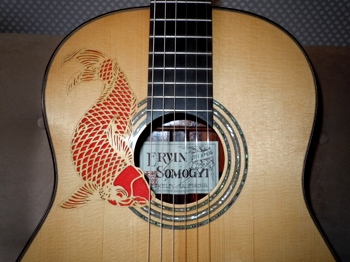
I’ve completed a new and unusual classic guitar: it’s got a koi fish carved into the top. You can see what this looks like in the accompanying photographs.

I like to make an extraordinarily decorated guitar from time to time, but when I do so I limit the ornamentation to the upper bout, which is acoustically not very important, or other non-acoustically critical parts of the instrument. The lower bout of the face (the area around the bridge) is acoustically critical and I won’t mess with that. I want those instruments to have as full a sound as anything else that I make.

This is a beautiful guitar. One of my witty friends took one look at it and commented that it ought to be great for playing scales. Ho ho ho.

Posted in Lutherie & Guitars

Commentaries About My DVD

October 1, 2011

I have a DVD out; it’s a lecture I gave on the topic of Voicing the Guitar which I delivered at the Healdsburg Guitar Festival in 2009. It’s engendered both positive and negative comments. The negative ones generally have to do with the fact that I don’t reveal my specific methods for voicing the guitar — or at least not enough of them for anyone to usefully copy.

From the outset, that DVD was intended to have a dual purpose. First, I sought to give an overview of the principles of voicing the guitar — for which work I’m fairly well known — to people who are interested in the guitar but don’t yet know much about its actual ins and outs. Second, as the Healdsburg Guitar Festival happened shortly after the publication of my two-volume work The Responsive Guitar and Making The Responsive Guitar, the DVD was put out as a way of letting people know what these books are all about and how enormously informative they are. I mean, these books took me eight years to write: the one-hour lecture took a few days to plan out and prepare for.

My experience of lectures has been, on the whole, uninspiring. I’ve sat through a zillion boring ones in my life and I wanted to at least enliven mine with helpful signage, props, and visual aids. Otherwise I threw in every important thing about the workings of the guitar that I could think of short of the kitchen sink, and organized it into an hour-long presentation. These relevant concepts are:

  1. the guitar as an air pump
  2. monocoque engineering vs. structural engineering (i.e., the guitar as a monocoque)
  3. the monopole and the cross- and long dipoles as the principal vibrating modes of the guitar
  4. the Cube Rule of materials stiffness
  5. stiffness-to-weight-ratios
  6. the different tonal functions of steel string vs. classic guitars
  7. the usefulness of tap tones as a guide to structure
  8. the Acoustic Gradient of the top
  9. the different strategies for organizing modal movement represented by “X”, ladder, lattice, and fan bracing
  10. mechanical impedance
  11. the acoustic functions of the guitar back
  12. the guitar top and back as harmonic oscillators
  13. structural coupling / connectedness / disconnectedness in bracing and structure
  14. differential rates of energy use or discharge as a function of structure, and
  15. a realistic representation, via a constructed-to-scale bracing-stiffness diorama, of ACTUAL stiffnesses of various structural members and braces.


My lecture was not intended to be an exposition of specific techniques of carving braces — which is what most people think “voicing” is. The whole point of it was to let people know that the shaping of braces is part of a package that involves a whole lot more than that.

Such considerations have not stopped others from putting out instructional DVDs that focus on the kinds of mechanical shaping and assembly operations which can be carried out serially and without reference to how the various parts combine and interact. However, Voicing work is precisely about how the different components interact dynamically. Therefore, it requires actual Thinking, Consideration, Judgment, Experience, Tracking, and Presence of Mind. It’s a bit like playing chess. Yet many people think of Voicing more as working a slot machine — and hoping that there’s a secret technique for how to pull the handle correctly to win. I don’t think there is a secret technique; instead, a specific skill set is needed. I voice each one of my guitars personally, slowly and attentively in a process that stretches out over a day and a half or two every time, and involves all the factors I listed above. It’s not any kind of quick formulaic slam-dunk.

I stopped short of showing the audience my own specific methods of profiling braces, and I erred when, in responding to an audience member’s question, I said that people would have to take my class to find out what I actually do in shaping my guitar tops’ braces. I think I blew it on that one. If I had it to do over again I would not have said that glib and flip sounding sentence — and I unfortunately didn’t think to point out that my bracing is described and illustrated at length in my books (although, if I’d had, I might have come across as being even more of a shill for them). I would have explained instead that I did not wish to do so for two reasons. First, what I do is the end result of decades of learning, experimenting, and making some really bad sounding guitars. So it’s understandable that I’d feel proprietary about the specific ways in which I’ve achieved my results: I feel they are mine to share, but I don’t do that indiscriminately in public forums. Second, to simply show what my guitars’ innards look like, mechanically, and without explaining what thinking and design variables this work entails, is bad teaching.

So, instead, I spent the hour describing the factors and variables that inform my own voicing work. While I use these principles, I don’t feel that I own them. I more or less slowly and painstakingly discovered them where Nature had left them lying around in plain sight for anyone to find. If anything, I am indebted to them for helping me to do my work successfully: they have allowed me to arrive at better methods, thinking about, and approaches to lutherie. Mainly, they are more useful than any description of any specific mechanical technique can be — in spite of the fact that today’s emphasis in teaching is to focus on specific techniques rather than on understanding how something works. My attitude is based in the fact that the principles cost me years of work and time to learn. The specific techniques, on the other hand, are easy to learn and do: glue this, cut here, profile in this way, shave that down, taper it, tuck this into that, etc.

The factors of Voicing that I outlined in my lecture lend themselves to many ways of being used and implemented to achieve a wide variety of better results in guitar making — just as different specific ingredients can be combined in many ways to make a meal. I described these factors in non-scientific everyday language because I wanted to make them accessible and easily comprehensible. I tried to give the audience a good foundation, or starter kit, toward their being able to achieve better results — instead of spoon-feeding them rote methods. All in all, I did my best to give the audience the kind of starter kit that was nowhere available when I was starting out, and as far as I know it is still not available to luthiers from any source other than my writings. There are engineering and physics texts that cover this same material, but these are generally scientific exposition written by engineers and physicists for other engineers and physicists. Get a hold of Richard Mark French’s book “Engineering the Guitar: theory and practice”, and you’ll see what I mean. It’s a fine book, but not all that easy for the layman to read.

My presentation wasn’t intended to be a strip show where I reveal everything, nor a tease in which I hold information back. I was attempting to deliver pertinent information. It’s ironic that some people feel shortchanged by my not having given them specific information about WHAT MY CURRENT BRACING LOOKS LIKE — even though my lecture includes an explanation of what every known bracing pattern does or doesn’t do. I am of the opinion that if I’d shown the audience “my secret bracing patterns”, everybody would have immediately forgotten everything I’d said and gone home and started to copy what they’d seen me do as faithfully as they could — without putting any effort at all into understanding how the things I’d discussed participate in the making of sound. I think that’s really lousy teaching; it reduces complex relationships to lowest-common-denominator factoids.

The principal subtext of my lecture is that (1) most guitars made today are waaaay overbuilt, and (2) comparatively small amounts of wood added to or taken away from certain key points of the top-as-vibrating-diaphragm make huge differences. My “secret bracing patterns” don’t look all that much different from most other guitar bracing — and various ones I’ve used are shown in my books.

I say “various ones” because my building style has always evolved and continues to evolve. What I’d be showing this year is merely what I’m doing this year. It’s different than what I was doing five years ago and different from what I’ll be doing five years from now. Same principles, different applications. I am aware that the world has changed a lot during my professional lifetime and that people want information simplified and they want it quickly. But I really can’t provide genuinely useful information in recipe form and still feel I’ve done a good job. Trust me: I’m not getting rich off DVD sales.

I’ve heard complaints that my DVD was made mostly as an adjunct toward promoting my books. Well no, not mostly — although there is some truth in it. The fact is that the books are unquestionably more informative than any one-hour presentation can ever be. Nonetheless, in both efforts I’m concerned with getting people to think and make discoveries for themselves based on a reliable map that I’d provided.

On a different track, I might say the following to someone who had approached me with these concerns: I don’t know you personally but, if I may ask: did you really not find anything useful in the DVD? Did it seem to you that I talked for an hour and said nothing important? And, for that matter, do you expect to learn anything more pertinent about any skilled hands-on and ears-on activity from watching any DVD? I’d think that the stiffness-diorama example alone is an eye-opening GENERAL concept that applies to any guitar making effort. Such dioramas are structural features in every guitar that’s ever been made and which is the strings’ job to drive and make work (or work against, in many instances); and shaving and profiling braces is meaningless outside of this context.

Finally, EVERY guitar will have it’s own slightly different and specific diorama-configuration of wood, graining, thickness, bracing, areas of greater or lesser stiffness and looseness that are necessarily part of a mechanical and tonal gradient. This is another essential concept that’s mighty useful to have regardless of how big, small, thin, thick, floppy, stiff, tapered, braced, etc., a guitar top might be; in fact, without it, any effort at shaping braces is as hit-or-miss as pulling the lever of a slot machine and hoping for a good result .

Posted in Announcements, Lutherie & Guitars

FAQ #1: The Stiffness Factor

August 8, 2011

I do as much writing for website guitar discussion forums as I can, in addition to answering questions that people email me personally. I can’t really keep up with this demand very well, especially as so many of the questions are duplicates and I wind up giving the same answers over and over again. So I thought that I could eliminate a lot of this repetition by posting some of the questions I’ve gotten, along with my answers. Here’s one such:

Q: In The Responsive Guitar book you go to great lengths to discuss importance of and your method for top “stiffness testing”. I realize you would not want to divulge the optimum number you look to achieve for your guitars. Could you give us a range of numbers that you see from you experience that a new builder could use as a starting point?

A: Yours is a good question. To my mind it’s not so much a question of there being a “right number” or “right quantity”, as finding a method that delivers that information in a way that the brain can take meaningfully. In our culture, weights and measurements and statistics are how such information is most easily taken in and digested.

In other times and other places, however, the same information was transmitted differently, using different language and different tools. But it was the same information. One alternative method that I learned (from master luthier Jose Romanillos, who is certainly a traditionalist in the school of Spanish guitar making) is the following:

Take your joined top plate and start to thin it. It doesn’t matter if you do this with a plane or with a power sander. It is only necessary that you thin evenly, and not leave the plate full of lumps and low spots. Flex it from time to time to get a sense of its stiffness along the grain. Stiffness along the grain is considered the most critical indicator of where you want to wind up, as opposed to strength across the grain or diagonally to it.

You’ll notice that the plate is stiff, of course. How stiff? Well, stiff enough so that when you are pressing your thumbs against one side while holding onto other side with your fingers, and are bending the plate by pushing it with your thumbs, you will find that the spot that your thumbs rest against will be resistant. It will be resistant to the extent that if you keep on pushing so as to bend the plate, it will crimp at the points where your thumbs are. That is, you will induce a bend at those points that is different from the bend that the wood will take between those points.

That tells you that the wood isn’t ready to bend evenly yet. Keep on removing wood. By the way, if you’ve read my chapter on the Cube Rule you’ll understand that removing seemingly small amounts of wood will make a huge difference in the wood’s measured stiffness. So don’t hack a lot of wood off too quickly: go slowly and methodically.

Keep flexing the wood and removing wood. There will come a point at which the wood will “relax” in your hands and, when you press on the long axis with your thumbs, the board will begin to make an even arc along its entire length. It’s not fighting you.

That’s your starting point. No fancy equipment other than your hands and fingers, and a bit of sense of the wood, is needed.

You can of course keep on removing wood, and you can do so until you’ve reached a threshold on the other side and rendered the wood too wimpy to be useful on a guitar. (At the extreme, you can imagine how relaxed and unresistant a paper-thin slice of wood would be, right?) Your next twenty years can be happily spent exploring the range between these two extremes — which define a range of thickness that’s probably on the order of 1/16 of an inch. It’s pretty amazing what a few thousandths of an inch can do — and that’s not even considering the possibilities of selective tapering, bracing, and thinning!

Posted in FAQs, Lutherie & Guitars

The REMFAGRI Factor in Lutherie

August 8, 2011

I teach an annual week-long class in Voicing The Guitar. Some of my students have told me, in retrospect, that they were not prepared for the kind of class that this actually is: a few days into the class, after we’d discussed basics such as the physical properties of woods and the main modes of vibration, they’d begun to wonder exactly when I’d get around to saying anything really important — such as the essential secret techniques I’d perfected over the years, along with the requisite correct specific measurements. It would be at about the third day, when various items of information had begun to connect, and pieces of the puzzle had begun to attain unexpected significance, that these good people began to see that I’d actually been giving them pertinent information all along. It simply hadn’t looked like any useful information they’d ever been given before and they hadn’t recognized it as such. They had, instead, all been waiting for the secrets of the remfagri to fall into their laps.

REMFAGRI is my personal shorthand for the idea of a Recipe-Method For Achieving Great Results Immediately. It’s much like the idea of, say, the perfect recipe for French onion soup: it doesn’t exist, and never has, but that hasn’t stopped people from seeking it. It’s well known that some chefs make absolutely heavenly French Onion soup — but there’s ALWAYS another recipe out there that might be even better, if one is willing to keep on buying cookbooks… even though the recipes ALL depend on the same basic ingredients and techniques.

It’s hard to know whom to blame for our collective focus on REMFAGRIs, but they are endemic and epidemic. One has only to go to the nearest bookstore and look at the How-To and/or Self-Help section. No subject is left unsimplified, and even ungodly complex projects such as wars and choosing mates are conceived out of the same here’s-how-to-get-the-job-done mindset.

I’m inclined to believe that what is missing in general is any sense of… well… scale. The kind of thing that induces some personal humility and awe. You know, something should I put it… profound… or at least greater than you… and worth approaching with respect… rather than it merely being an extra-large-pizza-sized chore or challenge to deal with before you check it off your list and go on to the next thing to conquer. If you react to a sunset, or the great outdoors, with any sense of it being special you’ll know what I mean. And my question is: did you ever pair that sensation with doing any of your work, or learning anything, or having a discussion with someone? When do we ever think, or do, or meet, or eat, anything that we consider to be special?

These are nutshell descriptions of Life-Attitudes that are so fundamental to one’s thinking (or absent from it) that one doesn’t usually have an awareness of having such an attitude. It’s of course expressed in humor, which every culture has its own spin on. American humor is no less complicated than anyone else’s, but an awful lot of it is about belittling, diminishing, or simplifying what’s in front of us — and thereby reducing its scale, importance, or specialness.

It’s understandable that this should be so, given all the pressures of our contemporary lives: it’s tempting to find projects and relationships that we can exercise our powers over so that we can feel in control. And then, most cultures and religions (including all the secular ones) DISCOURAGE questioning of their basic beliefs. Doing so makes people uncomfortable (I mean, it’s sooooo intolerable to suspect that even French onion soup might be bigger than we are, no?). But, heck, let’s face it: we can’t even really comprehend basics such as gravity, amoebas, or trees. What’s wrong with admitting to some sense of scale?

Posted in Lutherie & Guitars Leave a comment

The Maple Andamento

March 25, 2011

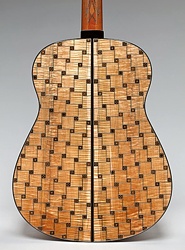
Some of you may know that I made a rosewood Andamento guitar about two years ago; it’s a wonder of design and craftsmanship if I do say so myself. The cutting, the inlaying, and the design itself took a long time to execute; and the work also included the design and making of eleven separate rosette logs. It’s the most fancily inlaid thing I’ve ever produced.
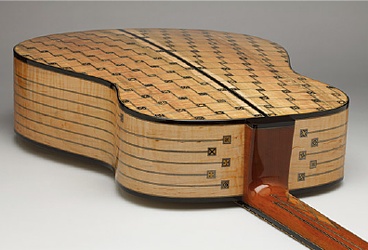
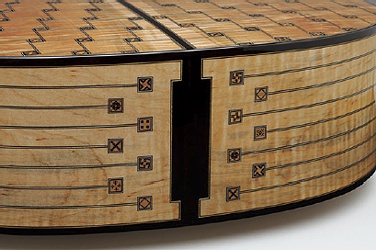
I initially thought of making something like this because I liked the design. The idea came from my dropping a spoon while having dinner at a Mexican restaurant; when I leaned over to retrieve it I noticed this same pattern in the floor tiles and was captivated by it. What a lovely pattern! I’ve since learned that this is a fairly common pattern that is used in both floor tiles and textiles. There’s even a picture of Michelle Obama, on the front page of the New York Times, wearing a dress with this print pattern on it! If the first lady is sporting the Andamento pattern, it’s got to be a winner, no?

Of course, the pattern isn’t called the Andamento; that’s a word that my associate Lewis Santer came up with after some research into inlay patterns. It turns out that inlay artists in the Renaissance gave that name to certain of their decorative patterns. Andamento refers to the movement (the going or traveling across) of a decorative pattern, through a material, or across one’s visual field. My guitar’s mosaic pattern has a lot of movement in it, so the name Andamento, invented by Italian craftsmen centuries ago, seemed to fit.


After completing the rosewood Andamento, I then embarked on a second one, in maple. I seemed to have a vague idea of making a matching pair of dark and light wood instruments.

It’s gorgeous, of course, but I learned that doing this kind of work in maple is MUCH more difficult than it is in any dark wood. You can hide mistakes in dark woods; you cannot in maple: any miscut, any splintering, any irregularity, any breakage or tear-out, any subsequent repair… all will be forever visible. If the parts don’t fit perfectly, of if there’s the slightest gap, a glue line that would have been invisible in a dark wood will stand out. White wood is simply unforgiving.

It’s ironic that, because maple is so much cheaper a wood than Brazilian rosewood is, this guitar would ordinarily command a lower value than its rosewood counterpart. But from the standpoint of sheer patient, skilled labor, there’s no comparison: the maple Andamento took significantly longer to execute and make look perfect. My helper Chris Morimoto deserves a lot of credit for this, because without his consummate attention to detail this guitar would have taken twice as long to produce.

Besides the beauty of the maple, this guitar has close to 200 mosaic tiles — of eleven different mosaic patterns — inlaid into it. The tiles are about half the size of a dime and each one is made up of 200 tiny pieces of wood. And then, of course, there are several hundred feet of (mostly) two-inch long inlaid sections of black-white-black purfling, each mitered into and butted against each other.

This needs to be a pricey guitar, for obvious reasons. It is spectacular in photographs and even more so up close. It is available now. If you’re interested, please call or email me for price information.

Posted in Lutherie & Guitars Leave a comment

On Critiquing Other People’s Guitars

March 5, 2011

I remember that, when I was starting out, years ago, I spent a lot of evenings backstage at different concert halls or clubs hoping to show that evening’s guitar player an instrument that I’d made. Some evenings were a complete waste of my time, but I learned two things from those efforts. One is that there is constructive criticism and destructive criticism (partially stemming from a set of values that various guitar-playing subcultures learn to apply differently; I describe this at length in Chapter 32 of my book The Responsive Guitar). The other thing is that if you are ever asked to render an opinion of someone else’s work — and you agree to it — you should give the guy something. The guy has a right to expect a few minutes of your honest attention; he’s earned it by having put 100-plus hours into the guitar he’s showing you.

It’s easy to spot the inadequacies in someone else’s work, especially if they’re more or less new to it. The thing is, though, effective criticism — and certainly constructive criticism — requires some real experience, thought, and standards. At a minimum, it involves the learned skill of simply looking and seeing — and getting the other person to look and see equally dispassionately; it’s possible that he had been so focused on following the instructions that he didn’t notice the details. Constructive criticism is also a learned social skill that borrows heavily from the Salesman’s Handbook: a little tact and generosity go a long way. Even the worst guitar has some good things in it, and an intelligent critic will do well to find them and acknowledge them. To do otherwise is tantamount to giving the man a business card with your name on it followed by the word “asshole.”

When asked to comment on someone else’s work I find it useful to ask them what their assessment is. What do they think the pluses and minuses are? What did they learn from this or that? That will give me a good starting point for giving feedback. I mean, if they think that they are showing me an object of transcendent beauty that they can’t imagine will receive anything but high praise, and I see only an amateurish mess, I have to be a bit tactful in turning their focus to some of the things that are not yet obvious to them. Take it from me, even experienced guitar makers can be surprisingly touchy about real or perceived negative input. On the other hand, once you ask for advice, listen to it: it is your job as a maker to learn your work and get past your fantasies, blind spots, and pet beliefs about it.

Regardless of how skilled your eye and ear might be in finding the pluses and minuses of a someone else’s work there are two main things that I have found it useful to be aware of. The first of these is easily overlooked, even though it’s actually more obvious* than the specifics of a guitar’s construction. It’s the fact that the person who is showing you that instrument actually made it. Consider that there are more people on this planet who would like to make a guitar, intend to make a guitar, plan to some day make a guitar, wish they could make a guitar, have thought about making a guitar, or at one point actually started to make a guitar but didn’t finish it… than there are people who begin such a project and carry it through to completion. Period. That simple fact counts points and needs to be acknowledged. And it’s not really (only) a simple fact: it’s a complex one made up of effort, dedication, and focus — and, not least, expended time and energy. The person you are talking to has crossed a significant threshold and has paid certain dues. If ‘the expert’ whose opinion is being asked isn’t aware of this, he’s not much of an expert.

Making a guitar is a complicated process: anyone who has made a guitar or even read a book about instrument making knows this. It’s far easier if you’re building a kit, of course, but unless you’re working in a fully automated shop the work involves literally hundreds of discrete steps, substeps, procedures, operations, and multiple materials. And besides all the time and effort it takes, there’s a learning curve loaded with twists, mistakes, dead ends and switchbacks. So, for someone to comment on the end result of such a demanding and complex project, as though it were ONLY a collection of nice tries… is to devalue the work. I repeat: find a few of the hundred things that were well done in that guitar and mention them. As a bonus, if you do this, the recipient’s opinion of you will be higher because he’ll recognize how perceptive you truly are. NOTE: I’m not suggesting an ego-stroking-compliment-fest; I’m suggesting sugar-coating the pill.

The second area of critical mindset is also one that is normally unrecognized by most people; yet, it vastly enriches the conversation if one is simply aware of the fact that a handmade guitar carries information. It is a veritable repository and warehouse of embedded (but invisible) information — in a way, moreover, that a factory made guitar is not. In fact, in a handmade guitar, the invisible information at least matches the amount of visible information. Let me explain what I mean.

A handmade guitar is, in a sense, like a photograph: something that has been frozen in time. It includes not only the woods, glues, lacquers, ivory, metals, etc. that it’s made up of, but also the engineering, physics, woodworking, acoustics, art, design, and tradition that it embodies. In addition, the guitar contains the intent, energy, focus, planning, skill, knowledge, priorities, interest, hopes, judgment, and intent of the maker. The fact is that the guitar would not have gotten made without these. One might argue that these quantities might have been “insufficient” because the guitar falls short of some standard of perfection — and that assessment may be “factually true”. But this brings us to the next important fact to consider: that guitar that you’re looking at is simply what the maker has accomplished at this point in time. If it’s not the maker’s first guitar then it ALSO contains the progress that’s been made since the previous one — and the seeds of the next, better guitar as well. As I said, it’s a frozen part of a process or progression, and the fact that you might be oblivious to this doesn’t mean it’s not any different. These things are most definitely “in there” because the maker put them in there. The instrument embodies all this.

I repeat: every item and detail in that guitar (including every lack of detail) speaks to one or more of these considerations. In case you’re thinking that I’m being fanciful, there is precedent and a reality basis to this kind of thing. Archaeologists can adduce the most amazing things out of a bone or a piece of pottery. The detailing of the formation of any aspect of an object, the fracture lines, its position in the ground and its location in relation to other things, the wear patterns, the age and composition, etc. are all clues that tell some story. Archaeologists understand the usefulness of geographic, geologic, technological, developmental, historical, meteorological, chemical, dendrochronological, etc. context. They will have some idea what came before or after in that same tribe or species and/or their neighboring tribes or species. Each clue has a part of the greater story to contribute.

Why should it be any different with the details and micro-details of a handmade guitar? Why should the visible sanding scratches on an interior surface not suggest something about the care, workmanship, prioritizing, awareness, experience, technological sophistication, etc. of the maker? Why should the straightness of the neck (or lack of it) not speak to his level of skill and conscientiousness, or even to prevailing lutherie theory? Well, they do. And speaking of context, is it surprising that someone working out of, say, Podunk, North Dakota, might be making less sophisticated guitars than someone working out of Seattle? It’s fair to assume that we’re looking at an example of the best that the maker knows/knew how to do. But why might we assume that the guitar in question does not represent, along with everything else, a point on an active learning curve? It most certainly does. It contains that information along with everything else I’ve listed. I think one’s analysis of a handmade guitar is made richer by appreciating such larger context, and any luthier will appreciate your recognition of the fact that every guitar (except the last one he’ll ever make) is, in part, an expression of Hope and Aim. Seriously. And that last guitar just might be an expression of a culmination.

As they say in Joisey, it never hoits to see past the woist in something. And, I underline: this is about nothing other than giving useful information. One goes to a doctor for medicine, not friendship. Give him the pill, but don’t make it a bitter one. I mentioned that hand made guitars contain information in the way that factory made ones do not. I’ve written at length about ‘the differences between handmade and factory made guitars’ in an article on this same website. If you’re interested in further discussion of this issue, please go read that.

* (By the way, the word obvious is interesting. It’s from the Latin “ob”, which means against — in the sense of close proximity (as opposed to contrariness) — and “via”, which means road. Something that’s obvious is something that is on the road right in front of you — in other words, something that’s so in your face that you can’t miss it.)

Posted in Essays & Thoughts, Lutherie & Guitars Leave a comment

An Ironically Good Bad Experience…

February 25, 2011

I became an official guitar entity in 1971 when I paid the City of Berkeley $20 for a license to operate a Guitar Repair business. I was young and I’d made one guitar with the help of Irving Sloane’s book. I didn’t know anything. But I was willing to drive around to music stores and do guitar repairs for them — at my workbench in my own bedroom. I lived on a shoestring income, in a shared house with other struggling and confused young adults. But I’d found a way to make a bit of money and was off and running like a herd of turtles.

I did a lot of guitar repairs in the next few years, and I made a few guitars as well. A lot of this work wasn’t all that much to be proud of, really, but I didn’t know any better. But I got to call myself a guitar maker, which gave me a much-needed sense of identity.

I was making classic and flamenco guitars. This brought me to the attention of the organizers of the 1977 Carmel Classic Guitar Festival; it was the first guitar show to ever invite my participation. This was a genuinely important and prestigious event that would attract serious performers, teachers, and amateurs from all over California and even from the rest of the country — and even a few from Canada. I’d been building guitars full-time for five or six years by then and felt happy to be invited to show my work; I was going to be one of seven exhibitors. I should tell you that my friends had been unfailingly supportive and encouraging to me in my guitar making efforts all this while — even as my parents could not fathom what the hell I was doing making guitars when I could have had such a promising career doing something reasonable. In any event, I went to Carmel feeling a little cocky and smug, thinking to wow the people there.

Instead, I ran headlong into a brick wall. My work was the worst of anyone’s there, both visibly and audibly. It was amateurish and careless and everybody could see it. It was a disastrous, humiliating, and sobering experience. I returned from that event severely shaken and depressed. My friends had, in fact, been no help to me at all with their uncritical kindness: I hadn’t learned anything. And I was now faced with the inescapable fact that I’d been wasting my time in living out a hippie fantasy — without actually having the discipline, education, skill, experience, or motivation required to do good, serious work.

As my sense of shock gradually settled down it became clear to me that I had two choices: quit making guitars and do something else, or buckle down and do better work. It took me several weeks of re-evaluating to realize that I actually liked making guitars and that the path was open to me if I wanted to apply myself and do professional level work. That was my real starting point as a guitar maker — and it took that disastrous experience to arrive at this crossroads. And it was within a year of that decision to do the best work I could, and not let things slide, that I met up with the first of my Windham Hill contacts, who were to open some important musical doors for me. The rest is (my) history.

It’s sobering for me to think that if my work had been better — say, acceptably good — at the Carmel Classic Guitar Festival, then it’s likely that I would have continued to build guitars out of an essentially immature and complacent mindset, and never feel a need to challenge my own perceptions of the worth of my work. Really, doesn’t it sometimes seem to you that the basic building blocks of the

Posted in Essays & Thoughts, Lutherie & Guitars Leave a comment

Woodstock Guitar Show

November 9, 2010

I attended the Woodstock Guitar Show on the weekend of October 23-24. I’d like to tell you a bit about it. It didn’t strictly speaking take place in Woodstock; it took place in Bearsville, which is close by.

The Woodstock area is a lovely, semi-rural, rather upscale series of townships in upstate New York that are, historically, associated with the legendary Woodstock music festival of the folk era — in spite of the fact that the event was rained out and that the property became a sea of mud. Still, with luminaries like Jimi Hendrix and Bob Dylan and others, and plenty of hallucinogens around, the mud didn’t seem to matter all that much. I didn’t go to that event myself, but I’ve heard about it for most of my life. Anyway, it’s beautiful there in October, and I got to spend the weekend (indoors) with a bunch of my fellow guitar makers. It was quite something. (There’s a photo-essay book about the Woodstock festival and its various luminary performers — and signed by Bob Dylan — currently for sale through www.abebooks.com; they want more than $5,000 for it. Wow.)

Apropos of nothing, the Woodstock area is in the Catskills, a famous resort and retreat area, that has traditionally offered lots of fishing, food, whitewater, and entertainment. The Catskills, I’m told by someone who lived near there for many years are not, technically, mountains (and indeed, the Woodstock area is not at all mountainous). The Catskills are actually a “dissected peneplain.” The real mountains (the Adirondacks) are a couple of hours north. Again, wow.

Anyway, I got there by taking my first-ever redeye flight: from eleven p.m. to eight a.m., across three time zones. An overrated experience, I must say. I cannot sleep on planes. Especially sitting upright in a padded, seat-shaped sardine can.

Guitar-wise, the Woodstock guitar show is in the stomping grounds, and the descendant of, the famous-but-no-longer-happening New York Guitar Show — for a time the most prominent American handmade guitar show. It was heavily weighted toward archtop and jazz guitars, as New York and its surrounds is the epicenter of jazz’s musico-geographical territory and home to legendary archtop guitar makers such as John D’Angelico, Jimmy D’Aquisto, John Monteleone, Ken Parker, and many other talented-to-legendary makers and jazz players. For archtop makers and players, Woodstock is very near Mecca.

Unfortunately, of course, I make flat-tops. But no one minded that. [My former apprentice] Michihiro Matsuda and I got invited to Woodstock. I think, because our names — like so many of the legendary archtop makers — end in vowels too. I think there’s some rule about that. (The vowel in Ken Parker’s last name is silent; or they make exceptions for the letter ‘r’.) Speaking of Ken Parker, spending time with him was one of the really high points of the festival for me. For those of you who don’t know him, do please look his website up; he’s creative beyond words — and whereas I kid a lot about many things I’m not at all kidding about Ken. He’s awesomely smart, capable and original — and a human being of impressive integrity.

One thing that I couldn’t help noticing about the Woodstock festival was how many collectors I met who had REALLY IMPRESSIVE COLLECTIONS of archtop guitars made by several of the most legendary makers. Usually, I meet people who have three or five or ten guitars, most of which are pretty ordinary; these collections SPARKLED. But then again this geographic region is home to a lot of people who can afford the best several times over… and they go for it.

Interestingly, one reason for the preponderance of interest in archtop guitars in this region is the climate: the marked Summer heat and humidity alternates with the severely dry Winters. Archtop guitars can survive such weather whereas flat-tops will often crack, warp, and be subject to other problems of wood movement.

The reason for this is that wood expands and contracts with changes in the weather, and of course guitar tops and backs are also more fragile and delicate than furniture is. Archtop guitars allow such ‘accordioning’ freely because they lack across-the-grain bracing. The flat-top guitar does have that. While this is good for tone in the flat-top guitar it simultaneously prevents wood movement, as the woods fibers are ‘locked’ into one configuration that allows very little movement. Therefore, if the wood wants to shrink but is prevented from doing so by the bracing, it will instead crack from the resultant pent-up tensions. As most luthiers know, making any flat-top guitar destined to live out its life on the East coast requires attention to the conditions under which the soundbox is assembled: a humidity-controlled room is a must.

I mentioned this to a friend and he is of the opinion that the sovereignty of the archtop in that area is not a function of weather but of culture. He said, quote: The NY tradition of jazz guitars going back to D’Angelico remains strong but I don’t think it’s related to weather as much as to NY’ers insularity — for one of the world’s great cosmopolitan cities, NY breeds a strong sense of local superiority. It’s the one place I know where “not a prophet in one’s own village” doesn’t apply. To a real NY’er, if you’re not from one of the five boroughs, you’re a yokel — and if you’re from Staten Island, you’re not really a NY’er either — and only things from NY are good enough for a real NY’er. So if people in Manhattan are making archtops, well, there you are: they’re the best no matter what people are doing anywhere else. End quote.

The truth is in there somewhere, I’m sure. But okay, enough technical talk.

My apprentice Jason Kostal came with me to help at my table, which was a big help to me. He also came with his partner Catherine, whom he took a few days off with to show her the area. Jason graduated from West Point Military Academy, which is not far from there; they visited his old Alma Mater and saw a few of his friends who are still in the area. From what I’ve heard West Point’s discipline and work load are legendarily fearsome: only about a third of any entering class graduates. It says a lot for Jason’s stick-to-it-ness that he made it through.

The Woodstock show itself is the brainchild of Baker Rorick, a local fellow who knows a lot of the wider guitar community. Several years ago he thought that a small showcase event for his friend Ken Parker’s work might be simpatico and fun; they started inviting a few fellow luthiers in and it grew into what has the potential to become a really special national-level show. Baker will of course now have to deal with whether to keep it small or allow it to expand — and deal with the accompanying organizational logistics. I don’t know how much money he made off this event, but he seems to have earned it: he was everywhere, all the time, running errands and problem-solving and pressing the flesh and everything else in between. I gotta say he looked tired. As a rule, first- and second- and perhaps even third-time events don’t make money; they’re too new and the costs are high. But if the show gets a good reputation and grows, then some money starts to roll in. I have been working on unusually heavily inlaid guitars of late; I made a rosewood Andamento guitar a year ago and just finished a second one in maple, which I showed at Woodstock. Working ornamentally in maple is an act of madness. The thing is, a dark wood such as rosewood is forgiving: you can make a mis-cut and no one will ever see it. You can’t get away with that in maple: any glitch or miscut will be visible. So, this project took infinite care and patience. I’m indebted to my apprentice Chris Morimoto for having the patience to take much of this work on; that guitar really shone! That guitar was quite well received and got tons of compliments. But as a matter of fact, I was surprised to be told by a good handful of people that they’d only come to the show because they’d heard that I was going to be there, and they wanted to meet me. I’m flattered that they would make the effort of driving several hours each way, to talk with me. I guess my reputation as a maker of things really worth seeing has gotten out there. Next, I’m gonna work on my reputation as someone whose work you really have to buy to be considered cool.

Michi Matsuda, by the way, also makes highly lookable-at guitars that are brilliantly designed. He was two tables away from me and attracted more of a crowd than most people and he made a sale to Steve Earle, the very prominent Nashville guitarist. Go Michi!

Lodgings in the Woodstock area require a rental car; there are lots of little communities in the surround, each a few miles from one another, and each with its Bed-and-Breakfast or small hotel. But there’s no big central area such as you’d find in any city. Ken Parker got me put up at a friend’s house, and I have to say that meeting Perry Beekman turned out to be another high point for me. Like so many people who attended the show, Perry has been in the music biz for years and is impressively knowledgeable about people whom I’ve read about for years but never before met. And I’ve got to say that Perry is one of the wittiest people I’ve met, and a pretty hot jazz guitar player. I’d like to meet him again. Perry hosted a Sunday evening dinner at his house for some of the attending luminaries; we were all in exalted company! I should add that some of our group are home vintners; we did some pretty good male bonding over some of their bottled hobbies.

I usually simply fly back home after one of these shows but this time I took an extra day off. I’d been contacted by Bob Visintainer, an audio-visual media guy who’d found out about me and my work a few months back, and liked what he found. He wondered whether he had any contacts that would be useful for me, to enhance my professional presence on the East coast — and volunteered to help me. So I spent Monday with him in Manhattan, being introduced to some of his professional network in the world of art and furniture galleries. I must say there’s some really impressive and expensive stuff in these places. I don’t know yet what can come of these introductions; they are like planted seeds. But it was a pretty amazing day. Bob makes a living by selling outrageously expensive high-quality audio-video equipment for home entertainment centers and security systems. He is the dealer for Goldmund (Swiss) speakers that have extremely high fidelity and output: the top-of-the-line system weighs 1200 pounds and is rock-solid STABLE; it’s installed in a sensurround way, all around a room. I mean, it practically takes a home remodel to install these… the speakers go into and behind walls and screens so no one sees them… and they are soooo impressive when you hear them. Bob sells to clients like Jerry Seinfeld, who is a non-guitar player I’ve actually heard of. Interestingly, Bob had a significant life-changing (and very near-death) experience about a year and a half ago; it caused him to slow down and spend some time enjoying some of the flowers growing at the sides of the road through life, which he told me he’d been zipping down at a respectable Type-A speed. So now he involves himself in things that are interesting, enjoyable, broadening, and ‘feel right’. I have to say, the world would be better if more people made those kinds of things a priority.

I got home about one o’clock on Tuesday morning. At 1:30 that afternoon I was at the Santa Rosa (about 75 miles North of me) courthouse to read a Victim Impact Statement at the sentencing event for Taku Sakashta’s murderer. Taku was a very much loved member of our Northern California lutherie community, who was killed last April by a drugged-out paychopath. The guy had been caught, a lot of forensic evidence was collected, he was judged and found guilty of murder, robbery, burglary, evading police officers, and something else. I was a close friend to Taku and Kazuko, his widow, had asked me to be part of this.

Without going into detail, I might say that it wasn’t like they show it on television. The event was hushed and ponderous and full of legalese. Everything moved slowly and inexorably forward, like the sound of a grandfather clock in the hallway at night. The culprit — who was wheeled into the courtroom shackled to a wheelchair (he’d exploded in rage when the jury announced its verdict three weeks before, and had to be restrained by the courtroom police) — was sentenced to life in prison without the possibility of parole, plus eight years (there are convoluted legal formulas for adding ‘enhancements’ to sentences, for reasons of special circumstances).

I’ll miss Taku: he was very special; and he certainly didn’t deserve to be killed with the brutality that he was subject to in the last moments of his life. I have to say that Taku was a sort of genius in lutherie, and he said more than once that he expected to die young; I don’t know how he came up with that piece of wisdom. My partner Karen and I had a Japanese maple tree planted in front of my house that we will call Taku’s tree. Otherwise, it was horrible; a real lose-lose. Kazuko lost a husband, we lost a friend and colleague, the perpetrator’s mother lost a son… the murderer is 28 years old and basically has thrown away his life; no one outside of the prosecutor’s office didn’t lose something from this.

I got home from Woodstock to find my emailbox chock full of new mail, and my shop basement a little bit flooded. Email-wise, who knew I could be so popular, or how many people know that I need viagra? I’ve spent several days answering emails, and I’m pretty much done with the flood. Now I’m almost done with this letter, too. The basement is being taken care of tomorrow.

Apropos of nothing, while I was out of town Karen saw a play that was extraordinary and that she’s recommending to anyone and everyone. It’s playing in Berkeley now, but for anyone in NY who likes theater, “The Great Game: Afghanistan” will be there, at the Public Theater, in December. It’s a British production (Tricycle Theatre). Karen chose to do it as a one day marathon, but that’s not mandatory. It’s many mini-plays clumped into three performances. The first performance starts with British imperialism, the second performance involves the USSR and the US arming Pakistan, etc and the third performance is very recent history. Well, that makes it sound like a history lesson, but it is great theater. Lots of different points of view. Brilliant acting.

Love, Ervin S.

Posted in Lutherie & Guitars, What I've Been Up To Leave a comment

Tone Production and the Logic of Wood’s Uses

October 16, 2010

Bass response in the guitar is associated with a top membrane that is loose enough, while also sufficiently ‘held together’ with bracing, to move as a single unit. This can be visualized as a sail that is billowing in and out under the wind. A thin, relatively flimsy top that is held together by any interconnected latticework of bracing will be able to billow back and forth, in unison with itself, and at relatively low frequency. In the guitar, this is called monopole movement. As an example toward illustrating the importance of materials’ looseness to the billowing action of the monopole, imagine a ship with sails made of plywood; the billowing action will pretty much cease. While loss of monopole is not disastrous in a sailboat (it merely needs adequate surface area of sail), a guitar needs topwood that will move. In steel string guitars, any specific high-frequency potential or behaviors of the topwood — i.e., of the material itself, independent of an interconnected bracing lattice — are not so relevant to this mode. This is because the metal strings themselves, by virtue of their own mass and stiffness, will bring plenty of high frequency signal into the system. One doesn’t need the wood to bring its own additional high-frequency contribution into the soundbox.

On the other hand, treble response is associated with a top membrane that is stiff enough to allow high-frequency/low amplitude motion, and which is not simultaneously ‘drowned out’ or overshadowed by prominence of monopole movement. The more the monopole is suppressed, and the top is prevented from moving like a sail or undulating like waves (think sailboat with plywood sails), and the more it is enabled to move in rippling fashion in small-to-tiny sections, the better the high end — which is usually identified in the literature as dipole and tripole movement. Or, looked at from another point of view, the more that the top discharges its energy by billowing in and out like a bellows or a sail (monopole), the less energy is left over for the high end (dipole and tripole). And vice-versa. This is mediated by the fact that — as is true of any set of speakers/amplifiers — it takes a lot more energy to generate low frequency sound than it does to make high frequency sound.

Without getting too technical the trick in guitar making, obviously, is to not make the plates so loose that you lose the high frequency end, nor so tight that you lose the low frequency end. You want both, and the luthier’s task essentially becomes one of management-of-energy-budget. This boils down to having a command of top thickness/size, bracing, profiling, wood choice, stringing, bridge torque, soundhole diameter, etc…. and that’s all a subject of endless… well… uh… endlessness.

Posted in Lutherie & Guitars Leave a comment

Posts pagination

Previous 1 … 7 8 9 Next

Categories

  • Announcements
  • Essays & Thoughts
  • FAQs
  • Features By Ervin
  • Humor and Odds & Ends
  • Interviews
  • Lutherie & Guitars
  • Uncategorized
  • What I've Been Up To

Ervin's Essays, Articles, and Musings:

  • “LA GUITARRA” – A Psychological Insight into Flamenco
  • (1/6) HOW I BECAME A GUITAR MAKER, AND  WHAT THAT WAS/IS ALL ABOUT
  • (2/6) HOW I FIRST MET THE GUITAR
  • (3/6) ABOUT MY LIFE AS A GUITAR MAKER
  • (4/6) THE CARMEL CLASSIC GUITAR FESTIVAL OF 1977
  • (5/6) MY LIFE AS A GUITAR MAKER: LOOKING BACK
  • (6/6) AFTERMATH: WHAT, EXACTLY, IS LUTHERIE TODAY? AND WHAT IS MY PLACE IN IT?  
  • 16. A LETTER TO WELLS FARGO BANK [June, ’18]
  • 18. ADVERTISING SLOGANS FOR GUITAR MAKERS
  • 19. ON THE MATTER OF ADVERTISING SLOGANS (2/2)
  • 20. LIFE AFTER EPIPHANY
  • 21. MARTIN LUTHER & THE LAW [1/2]
  • 25. MARTIN LUTHER AND THE LAW [2/2]
  • 31. HARLOW, SKINNER, AND WATSON:
    2-1/2 SONSOFBITCHES
  • 37. ON JEWISH CULTURE . . . AND HUMOR
  • A Candid View of Value, Prices, and Guitar Lust
  • A CHRISTMAS STORY
  • A Digression Into Matter of Top Thickness
  • A Surprising Insight About Drums and Guitar Tops
  • A Systematic Comparison of Tonewoods
  • ABOUT MY ARTWORK
  • An Amusing Experience
  • An Interview with Steven Dembroski, From Dream Guitars
  • An Ironically Good Bad Experience…
  • AN OPTICAL ILLUSION
  • Carp Classic Guitar
  • Commentaries About My DVD
  • Concerning Somogyi Knockoffs
  • Craftsmanship, Sound, ‘The Right Look’, Materials, and the Marketing of the Guitar
  • DEAR DR. DOVETAIL, Part 1
  • DEAR DR. DOVETAIL, Part 2
  • F.A.Q. #2: Working Woods to a Stiffness
  • F.A.Q. #3: More on Flexibility
  • F.A.Q. #4: Thinning Out The Back?
  • F.A.Q.#5: Soundholes and Bracing Patterns
  • FAQ #1: The Stiffness Factor
  • FAQ #6: Bracing, Thickness, or Both
  • FAQ #7: Flat Backs and Arch Tops
  • FAQ #8: Flat Vs. Domed Tops
  • Frankenfinger
  • Fun Stuff #1
  • Fun Stuff #2
  • Fun Stuff #3
  • Guitar Voicing: Different Strokes for Different Folks? – [1/2]
  • Guitar Voicing: Different Strokes for Different Folks? – [2/2]
  • Guitars, Virtue, and Nudity: The Guitar as an Icon of Culture, Class Status, and Social Values
  • Internet Lutherie Discussion Forums
  • Lutherie Trivia
  • My Adventures in Book Publishing
  • On Critiquing Other People’s Guitars
  • Principles of Guitar Dynamics and Design
  • RE: Postponement of Voicing Classes
  • SOCRATIC DIALOGUE
  • Some [More] Thoughts About the Environment, Sex, and Hillary Clinton
  • Some Reflections On My Guitar Work
  • Some Thoughts About Gender and the Environment
  • Some Thoughts on Guitar Sound
  • Some Thoughts on the Difference Between Handmade and Factory-made Guitars
  • Specific Top Thickness In the Guitar
  • STEEL STRING GUITAR BASICS
  • THE DUMPSTER DRUM
  • The Maple Andamento
  • THE MODERN GUITAR: AN ICON OF ROMANCE AND HEROISM
  • The REMFAGRI Factor in Lutherie
  • The State of the Contemporary Guitar – 1/4
  • The State of the Contemporary Guitar – 2/4
  • The State of the Contemporary Guitar – 3/4
  • The State of the Contemporary Guitar – 4/4
  • The Taku Sakashta Guitar Project
  • Thoughts About Creativity, Technical Work, and the Brain – [1/2]
  • Thoughts About Creativity, Technical Work, and the Brain – [2/2]
  • Titebond vs. Hide Glue
  • Tone Production and the Logic of Wood’s Uses
  • Tonewoods in Guitars
  • Tony McManus stopped by the shop…
  • Using Wenge as a Guitar Wood
  • Werewood
  • What I’ve Been Up To These Days
  • What I’ve Been Up To, August 2017
  • What I’ve Been Up To, February 2019
  • What I’ve Been Up To, September 2017
  • What I’ve Been Up To: November ’17 to March ‘18 – [4/4]
  • What I’ve Been Up To: November ’17 to March‘18 – [1/4]
  • What I’ve Been Up To: November ’17 to March‘18 – [2/4]
  • What I’ve Been Up To: November ’17 to March‘18 – [3/4]
  • Whence the Steel String Guitar? – 1/2
  • Whence the Steel String Guitar? – 2/2
  • Why Are There Differently Constructed Classical Guitars?
  • Why Lutherie?
  • Woodstock Guitar Show

© Ervin Somogyi 2026. Powered by WordPress