Ervin Somogyi

Menu
  • About
    • Bio
    • Bio – Humorous
    • Resumé
  • Guitars
    • Guitar Models
    • Guitars: Custom Options
    • Special Projects
    • Visual Echoes & Tasteful Accents
    • Pricing
  • For Sale!
    • The Mexican Festival Model Guitar
  • Artwork
    • Lutherie-Inspired Artwork
    • Artwork (2)
    • Peghead Veneers as Art and Accents
  • Articles
  • Books
    • Books
    • Videos
  • Teaching
  • Blog
  • Contact

Tag: steel string guitars

Whence the Steel String Guitar? – 2/2

PART 2 OF 2

by Ervin Somogyi

In Part 1 of this article I wrote about the origins of the steel string guitar from the vantage point of the macro socio-economic culture of the New World. I used the Spanish guitar, which was developing simultaneously with it, a point of reference and comparison whereby to have a better understanding of both. In this section I will continue to examine the genesis of this most American instrument, take a look at the structural and design elements that make it a unique instrument, and take a guess at its future.

THE SUBCULTURES OF MODERN GUITAR MAKING

The Spanish guitar has come to us out of a European tradition in which fine things are made by, and associated with, individual craftsmen. This doesn’t mean that Spanish (and pre-Spanish) guitars weren’t produced in large numbers in guilds and factories: they were. And it is not that hand craftsmanship is inherently superior to other forms of organization of production. It is rather that the roots of European lutherie predate the industrial revolution and hand craftsmanship was the main option for a long time. As such, the level of skill brought to lutherie was quite high, as a visit to any museum with a good collection of historical string instruments will show. But because this kind of lutherie was associated with real individuals — despite the historical existence of numerous major centers of large-scale production of musical instruments — a tradition has been created whereby modern Spanish guitar makers are the inheritors of some past heroes to look up to and whose work they can emulate and not depart too radically from. These revered icons are people like Antonio deTorres, Hermann Hauser, Luis Panormo, the Fletas, the Ramirezes, Francisco Simplicio, Santos Hernandez and other famous European makers. Modern Spanish guitar luthiers like to think of themselves as walking in these originators’ shoes, or at least on the path that they traveled. As I said, none of this has stopped Spanish guitars from being produced in great numbers in factory settings; but the basic design has not changed much in all this time because its acceptability is still rooted in the traditional look — as well as the fact that the design continues to be a successful tone producer.

On the other hand, American factories were for many decades the only source of steel string guitars. Lutherie in the European craftsman’s sense of the word never took hold on this side of the Atlantic, and the Martin, Gibson, Washburn and Epiphone guitar companies, more than any other brands, have provided the models and standards of what a steel string guitar ought to be. Accordingly, the design of the steel string guitar has always been subordinated to the requirements of the production process, and this has in turn dictated the possibilities of the guitar as a musical instrument. With the exception of the prolific Larson brothers, and jazz guitar makers such as John D’Angelico and Mario Maccaferri in the early 20th century, no individual luthiers became prominent, successful or famous 1. In consequence, however, the contemporary American steel string guitar maker is deprived of a personal link to the past and he must either identify with a largely production tradition, or claim independence from tradition and sort of give birth to himself 2. There is now a small core of very good contemporary individual steel string luthiers who could serve as models to others. They’re all from the postwar period, and it’s not the same as having pioneer models from a hundred and fifty years ago. Yet, it’s a beginning.

THE STEEL STRING GUITAR’S “X” BRACING

The “X” bracing associated with Martin guitars is the model, pattern, template and standard used the world over for reinforcing steel string guitar faces. Pretty much all steel string guitar bracing is based on that model (fig.1). Those who don’t copy Martin’s “X” bracing outright produce minor variations of it, making the tone bars or fan braces a little flatter or taller, or longer or shorter, or spacing them farther apart or closer together, etc. This is all for good reason: the “X” brace works. Well-crafted steel string guitars using this bracing system can produce sounds that no other arrangement of parts has been found to surpass in either volume or warmth. Not least, “X” bracing is the steel string guitar’s chief distinguishing structural and tonal feature that sets it apart from the Spanish guitar, which is almost universally constructed and voiced with fan bracing.

Fig. 1 Interior view of a Martin guitar face: it is the model for virtually all steel string guitar bracing as depicted in any book, how-to video, newspaper/magazine story, published lutherie article, or guitar magazine/trade journal advertisement.

Interestingly, the “X” brace, which we all think of as being well adapted to handling the pull of metal strings, was being used by the Martin Guitar Company as early as the 1850s, when it was (along with every other manufacturer) making only gut string guitars — a full sixty to seventy years before metal string guitars came into general use. Of course, in those early times and for those stringings, the “X” brace was comparatively small and delicate.

Structurally speaking, gut strung guitars didn’t require “X” bracing — even when soundboxes were enlarged and scale lengths increased. But the structural reason why “X” bracing works so well in the modern steel string guitar is that it is most resistant to distortion in the area in front of the bridge, where the stresses pushing down on the face are greatest. The reason for its tonal success is that it succeeds in unifying the face, for vibratory purposes, better than anything else previously devised. It seems unlikely that “X” bracing was the result of any tonal considerations in the way of improvement over the possibilities given by the fan bracing universally used in the Spanish guitar of that time: fan bracing was only first being used in these at about the same time as the earliest “X” braces appeared in the United States, and there would have been little if any frame of comparative reference at the time. Both, in fact, seem to have been developed simultaneously out of the earlier smaller fan and ladder-braced instruments, as well as from the pursuit of different social imperatives, musical challenges, commercial needs, and plain old mechanical inventiveness 3.

It seems to me undeniable that we have the Larson brothers Carl and August — already mentioned above — and not the Martin Company or any other manufacturer to thank for adapting the gut-string guitar’s “X” bracing successfully to the needs and design of the modern steel string guitar. To repeat: starting in the 1890s, they made the first steel string guitars sturdy enough to not collapse under the pull of steel strings, and yet not so overbuilt that they lacked sound. The Larsons achieved this in part by enlarging and beefing up (with increased size and laminated construction) the previously too delicate “X” bracing, by doming their guitar tops, by reinforcing the guitar necks, and by increasing the size, shape and gluing surface of the bridge. These design advances notwithstanding, it wasn’t until the 1920s that such guitars were produced in sufficient numbers by factories for them to become — as it were — principal players in the popular market.

SUMMING UP

The commercial, developmental, musical, technical and artistic history of the guitar has been a complex one. The design and parameters of the Spanish guitar have been largely set for a hundred and fifty years. Classical guitars made a hundred years ago and guitars made today don’t look all that different from one another; the traditional look of the instrument has prevailed. At the same time this instrument’s music has of course advanced and its repertoire been enlarged, and the techniques for its playing have been refined although not changed much. The steel string guitar, in comparison, is experiencing a contemporary explosion of design, shape, dazzling and original ornamentation, technique, music, and, not least of all, seriously talented makers and players.

To date, many books have been written about one or another aspect of how all these things came to be, and about the individuals who wrote and played significant guitar music — and many more will yet be. But there exist a few pivotal elements and individuals behind the success of the guitar as we know it today, without which almost none of us in the business (at any level) would be able to survive. I would say that the worldwide acceptance of the Spanish guitar can rightly be attributed to the DuPont employee who discovered nylon, if only by accident, in 1930: within fifteen or twenty years this led to making an instrument which had until then been notoriously expensive to put strings on, and therefore limited to being a middle class musical object, all of a sudden accessible to the masses 4. Also, the worldwide popularity and acceptance of the flat-top steel string guitar as we know it today is, in my opinion, attributable to the genius of the Larson brothers who, regardless of how cheaply (and therefore accessibly) a guitar could be made in their day, made the first ones that could be used without sooner or later collapsing under the pull of metal strings.

While the hand/small-scale making of guitars has grown on this continent to compare with anything that exists in Europe, so has factory guitar making grown. And then some. Industrial-level guitar making such as has dominated the American scene since the beginning has been rapidly spreading — into Japan, Korea, Mexico, the Philippines, and now China: anywhere, as a matter of fact, where there is cheap labor. I’m not optimistic in contemplating the future of American lutherie — as far as the making of any kind of guitar goes — from the standpoint of the requisite basic hand skills that an individual must master in order to become a self-sufficient and skilled workman. The roots of such skills need to be put into place rather early in life for them to be fruitfully and fully integrated into one’s adult work and, from what I’ve seen, today’s younger generation is much more deficient in such basic skills than my own was. Young people don’t seem to tinker, futz, putter, sculpt, whittle, make model airplanes, play with erector sets, fix up old jalopies very much, or participate in imaginative play/role playing with real things 5 — as opposed to engaging in virtual pastimes designed by people who have been paid to do that — and the manual arts in this culture are, in general, lagging far behind ability to manipulate 6 computers and other electronic devices. I think this is a fundamental loss the results of which won’t be understood or missed, or perhaps even noticed, for another generation. If we are or have been in any sort of golden age of guitar making, it will have been built on a combination of manual skills and creative intelligence, not labor and time management in the service of acquiring practical, technical and virtual skills.

1. Even the Larson brothers, who had made pioneering contributions and significant innovations to steel string instrument making, were forgotten after their deaths — until they were rediscovered by American musicologists, and the guitar culture, of the 1960s. A large part of the reason for this is that, unlike the Spanish luthiers whom we know of who made guitars under their own names, the Larsons produced instruments under many others’ labels, including Euphonon, Prairie State, Maurer, Dyer, WLS (“World’s Largest Store”), Stahl, Stetson, Leland, Meyer, Larson and other labels.

2. I think it’s interesting that the highest-quality European guitars are associated with an individual maker’s name, and that young luthiers try to make a career out of furthering their own names as associated with their products. In this country, however, it’s not uncommon for young luthiers to try to market their instruments under a commercial-sounding name to which they’ve subordinated their own, such as: Running Dog, Moonstone, Bear Creek, Timeless, Golden Wood, Evergreen Mountain, etc. This is an interesting cultural difference.

Another one is that since at least the 1930s, when Andres Segovia was concertizing around the world, it’s been common — in classical guitar performances or recordings — that the maker of the guitar being played is mentioned in the concert program or on the record jacket. To my knowledge this was unknown for the steel string guitar and its music until the late 1970s, when I began asking that my name be mentioned on record jackets as the maker of the guitar being played. Of course, this has a lot to do with the fact that there really was no significant steel string solo guitar outside of John Fahey, Leo Kottke and Doc Watson, until the Windham Hill label established solo guitar music as a viable musical genre in the mid 1970s.

3. Although gut-strung guitars do not and never did, strictly speaking, require “X” bracing, it undoubtedly worked to make the guitar a more successful musical instrument than the earlier, smaller, ladder-braced and fan-braced versions had been. As far as the advent of the “X” brace on American shores goes, it seems likely to me that it was noticed that (1) lightly constructed longitudinal or diagonal bracing elements made better sound than the ladder bracing which was common to earlier guitars, and that (2) diagonal bracing that bound the topwood’s fibers together in a cross-grain latticework would (3) enable guitars to survive seasonal climate changes better than braces which simply followed the grain, as fan bracing does. After all, the early American makers and players all had the greatly-changing East Coast seasons to deal with. This (4) would also have gone hand in hand with the fact that, unlike the concurrently developed Spanish classical guitar and its increasingly formal middle-class uses, Martin, Washburn, Gibson, etc. were making instruments in these greatly-changing East Coast climates for the playing of steadily increasing-scale popular and folk musical entertainments at both indoors and outdoors events. “X” bracing served the needs of wooden soundboxes played under those ambient and atmospheric conditions.

4. The DuPont company found it could make stockings and fishing line out of this new substance. But it was fishing community of Southern Spain, and the fishermen of the Spanish port of Cadiz in particular, that brought the attention of this inexpensive new guitar-string-substitute material to its guitar playing community; thus it was really the flamenco guitar players of Andalusia who discovered the nylon guitar string. My thanks to luthier and guitar authority R.E. Brune for these insights.

5. Toys, dolls, tools, furniture, paint, clay, wood, camping equipment, clothing, etc., as opposed to what might appear on a computer or television screen. It’s what Piaget called “formal operations”, which he identified as an important developmental stage in his study of how young humans grow.

6. It’s an ironic choice of a word within the context of this discussion, given that it originally meant “use of the hand to effect something”. Another irony is that “manufacture”, which has the same root [manu, mani, or manus , meaning hand], originally meant “the making of something by hand”. These things are manifestly so.
Posted in Features By Ervin, Lutherie & Guitars Tagged steel string guitars

Whence the Steel String Guitar? – 1/2

PART 1 OF 2

by Ervin Somogyi

Although guitar-like stringed instruments have been identified in tomb paintings from as long ago as biblical Egypt, guitars themselves only emerged as instruments with their own identity in sixteenth century Europe — and what we think of as the modern guitar didn’t exist before about 1850. As its “invention” by Antonio de Torres — who is considered to be the father of the modern guitar — preceded both nylon and metal string-making technologies these, and earlier, guitars were all (like violins) gut-strung.

THE GUITAR IN AMERICA

It is difficult to overestimate the importance of stringed musical instruments in nineteenth century American popular culture. The guitar, the mandolin, the fiddle, the banjo, etc. were all very user-friendly; they were portable, they were affordable, and one could learn to play recognizable music on them fairly easily. They were, along with song, the solvent for any social activity; they were how people entertained themselves, acculturated themselves, met one another, and simply passed time when they weren’t at work. Music societies and clubs, reams of printed music of simple and romantic ballads, guitar and mandolin bands and orchestras, music methods and instruction of every type, dances and musical social events, formal and informal parlor get-togethers, outdoors festive entertainment, traveling musical shows, etc. were a mainstay of social life in the days before there were movies, radio, television, theatre, widespread literacy, organized sports, the vast modern array of self-improvement activities, or easy means of traveling (and destinations to travel to) in one’s leisure time. People simply occupied themselves with music a lot 1. And what an immense musical market this was for those on the supply end! This is where factories such as Gibson, Washburn, Epiphone, Harmony and Martin come into the picture.

For all these reasons that existed within the context of the American musical, social and cultural market, the steel string guitar as we have known it has not been associated with the genius of any individual luthiers — certainly not in the way the pioneers of the Spanish guitar are thought of. The pioneer American makers whose names we associate with the guitar today, such as Martin, Washburn and Gibson, aimed at and achieved production, not lutherie. In contrast with the trained-craftsman inception of the classical guitar, the steel string guitar has been a creature of the factory. Those pioneers who survived and thrived at guitar making did it in a thoroughly businesslike way through establishment of production facilities, organized advertising campaigns, systematic catalog sales, targeting of the greater instrument-teaching community, widespread marketing of a multiplicity of features/options/designs [exactly like we sell cars today], large-scale subcontracting of assembly operations, importing and, finally, hard-working distribution, sales and shipping networks. There were scores of small and independent makers in and near the big cities all throughout the 1800s and later, to be sure, but they were serving a mass market of enormous size, and their individual identities became entirely subordinated to it 2. In consequence, the small-scale American makers — whether they made a product under someone else’s brand name or their own — are all forgotten. The single exception to this is the Larson brothers (see below), who, from the 1890s to the 1930s, made pioneering contributions and significant innovations to steel string instrument-making. Yet, even their work was largely lost to memory and would now be forgotten had it not been rediscovered in the folk music culture of the 1960s. The steel string guitar has never been the Star in the same sense that the classical guitar has been the Prima Donna in much of the music played on it: it’s been far too populist and popular an instrument 3.

THE IMPACT OF METAL STRINGS

The overwhelming majority of guitars of the mid-to-late 1800s were gut-strung. Gut strings were expensive: a single one could cost as much as a working man’s weekly disposable income; therefore the guitar tended to be owned by middle class people who could afford to feed it.

But metallurgy and wire-making technology was making great strides in the early and mid 1800s, driven largely by the huge migration of settlers moving Westward; they needed wire for fencing with which to mark their homesteads, farms, ranches, and fields. Untold thousands of miles of wire for fencing were thus made . . . and in the process some of the wire was adapted to the needs of musical instruments. When metal strings became available they were quickly found to be one-fifth the price of gut strings, and longer lasting, and louder — which of course made them doubly appealing to a growing mass market.

However, the quest for louder guitars came up against the laws of physics and most of the first guitars strung with steel strings didn’t last long: they commonly developed bent necks, warped faces, pulled-off bridges, and suffered various other failures 4. Starting in the late 1800s, brothers Carl and August Larson made the first durable steel string flat-top guitars in response to these circumstances. The success of their designs were based in two things: first, excellent workmanship; and second, the intelligent application of engineering-sense to flat-top instrument making. In fact, their seminal contributions are recognized today largely because their instruments have survived — when most of their predecessors’ and contemporaries’ have not. This is yet more remarkable in light of the fact that the Larson brothers’ overall production was minuscule in quantity compared with factories that were turning out thousands of instruments yearly 5..

At about the same time as the Larson brothers were inventing the durable flat-top steel string guitar, Orville Gibson was solving the same structural problems by making his steel-strung guitars arch-topped; while that design/technique is the subject of a separate article, it should be pointed out that here also, as far as the emergence of any individual American craftsmen whose names might be associated with improvements in the steel string guitar is concerned, only that of one other — Lloyd Loar — has come down to us.

Once the Larsons and Orville Gibson had created durable versions of the steel string guitar, it participated in all the musical fads and ferment that came and went in the late 1800s; but it didn’t become an instrument made in large numbers or with a principal identity of its own until the 1920s — surprisingly late in its history. There simply wasn’t sufficient critical mass of interest in its sound until then, and the factories had not seen it as a moneymaker. Gibson made the first factory-made steel string guitar produced in quantity — the archtop jazz L5 — in 1922. Martin & Co. switched to making mostly flat-top steel string guitars only in 1929, after almost a hundred years of having made everything else. And the rest, as they say, is history.

COMING INTO ITS OWN

While the flat-top steel string guitar became accepted into the popular musical mainstream in the 1930s, it only began to be taken as a serious instrument in the 1950s. Before then the steel string guitar was, musically — at least in white society — something fairly tame and sedate; it had found its place mostly as a parlor instrument or as a rhythm, accompanying or orchestral instrument and, as mentioned above, as an instrument of broad and frequently informal social entertainment. With the exception of the archtop guitar’s extensive use in jazz by prominent players such as Django Reinhardt, there was no solo guitar to speak of until the 1950s. There wasn’t even any serious or challenging body of music for the steel string guitar until recently and, outside of jazz and blues, most songs played or accompanied were folk melodies, simple ditties, classical transcriptions, fiddle tunes adapted to the guitar, or orchestral arrangements.

The folk music culture of the nineteen sixties brought into mainstream consciousness the Mississippi Delta blues stylists and singers who would otherwise now be forgotten but who have influenced a new generation of blues players and singers. Individuals like Hank Snow and Merle Travis pioneered the playing of actual melodies on the guitar. Doc Watson, within our lifetime, became the first serious steel string guitarist the world knew, and remained the only one for about ten years. He was eventually joined by players like Clarence White and Dan Crary, who became seminal influences in opening up the musical possibilities of flatpicked steel string guitar — and John Fahey and Leo Kottke, who are the initiators of the continually growing fingerpicking idiom which now includes players such as Alex de Grassi, Chris Proctor, Peppino D’Agostino, Duck Baker, Stefan Grossman, Peter Finger, Ed Gerhard, Tim Sparks, Martin Simpson, Pat Donohue, Doyle Dykes, Michael Hedges, Jacques Stotzem, Pierre Bensusan, John Renbourn, Lawrence Juber, Shun Komatsubara, and many, many others. This music is enriched by its receptivity to and inclusion of elements of folk, ethnic, ragtime, Celtic-Irish, jazz, blues, Latin, Caribbean, African, and classical music — and those instrumentalists such as Dale Miller and Steve Hancoff who are transcribing from such influences for the guitar must also be acknowledged. Then, one mustn’t forget to include mention of the re-popularization of Hawaiian slack-key music through the efforts of musicians such as Keola Beamer. Finally, no list is complete without mentioning Chet Atkins, whose influence and work with the guitar is impossible to overstate and requires a book all its own. obtainable. The list of individuals who have been prominent in the various types of its played music is long and includes prominent players of bluegrass, blues, folk, country, jazz, fingerpicking, ethnic, balladeering, fusion, new age, and just about every other idiom. Nonetheless it is most important to note, with regard to the history of the modern steel string guitar, that it is so new that many of the very important people in its musical development are still alive, and their music freely obtainable 6.

If the Spanish guitar was established as a serious instrument within the timeline starting with Torres and ending with Segovia, then one could equally maintain that this — now — is the golden age of the steel string guitar. Within the past fifty years it has gone from being a mostly unknown backwater to the point that it has worked itself into all music, especially ethnic music, worldwide — and is now being used to play music that is serious, complex and challenging.

In the second installment of this article we’ll continue to examine the cultural and economic forces that gave birth to the steel string guitar, although from not so Macro a point of view. We’ll also examine the main structural/tonal element that is the signature difference between the steel string guitar and its Spanish sibling — namely, the “X” brace — and how it came into being.

1. Actually, people in those days threw themselves into musical fads with an energy and on a scale that is hard for modern folks to appreciate: the mandolin craze dominated popular music for about ten years — during which guitar music took a back seat; jazz became its own craze — but not initially for mainstream white people; banjo music was extraordinarily popular for some years, during which sales of other instruments leveled off. Steel strings themselves got a major boost in 1915, when bands playing at the San Francisco Pan-Pacific Exposition ignited a serious craze for the whiny steel-string sound of Hawaiian music which had, until then, been middlingly in vogue. Hawaiian music became the style of the day and pianists, guitarists, mandolinists, etc. fell in love with and played endless Hawaiian rhythms and melodies; in fact, so huge was this new interest that for several years after the Exposition companies such as Martin were making and selling more Hawaiian guitars and ukuleles than anything else. But somehow, through all these musical fads, influences and cycles, the guitar seems to have had greater staying power than its companions the mandolin, banjo, and the ukulele.

2. Consider, also, that there were no prominent solo guitarists such as the Spanish guitar makers had already begun to make individual and personal instruments for — and would continue to make them without competition, until steel string guitar players first began to become soloists in the 1950s.

The earliest Spanish guitarists were stars such as Sor, Pujol, Tarrega, Llobet, etc., whose names we remember today. But even before these came to the fore, the Cremonese (and other) European violin makers had since the 1600s been making instruments for the likes of Sarasate, Paganini, and countless other prominent individual, court and concert violinists, etc.

By way of contrast, the earliest Heroes of the Guitar that American culture produced were the Depression-era folk singers like Woody Guthrie and the singing-cowboy heroes that were simultaneously manufactured in large numbers by 1930s Hollywood.

3. This is quite literally true. Musical culture in which individual personalities became societally prominent had its genesis in the courts and wealthy patrons of European capitals. This became fully as true for performers and for composers as for instrument makers. Socio-economically, this has always been a package-deal kind of thing.

4. Mandolins, etc, could hold up because they had shorter necks and their faces were arched to hold the bridge tensions. But guitars had no such protection: their faces were bigger but flat, their necks were long and unreinforced, and their bridges were small with inadequate gluing surfaces. Consequently, the necks warped, the bridges pulled off and the faces caved in. Furthermore, the same guitars would often be marketed with both metal and gut strings, without any structural provision being made for the increased tension other than a retrofit tailpiece.

Or, people would put the cheaper metal strings on whatever guitar they had simply because they were affordable. A steel string guitar’s high “e” cost about ten cents; a gut one about fifty cents: that was a week’s disposable money for a lot of people. And if one wanted to pick their music in vigorous Nick Lucas style rather than to pluck in the gentler, more romantic parlor-balladeering style, then one could fray one’s way through a whole set of expensive gut strings in a single evening.

5. Today there’s an appeal to the small-scale business or operator. But in the early days of rapid American economic expansion, when large immigrant populations struggled to establish themselves in the ferment of its commercial culture and plunged into business possibilities which all seemed wide open, “big” was admired and “small” was not. It’s sometimes difficult to evaluate just how large a factory or the scale of operation might actually have been, because businessmen learned quickly to aim high and to exaggerate in order to project success. Photographs of otherwise modest production facilities were sometimes doctored to make them look like sizeable industrial complexes; in musical instrument production figures were inflated, sometimes by the direct method and sometimes by including imported instruments as well as made ones, etc. The Washburn Company — which was in reality a very large complex of subcontractors, factories and importers — in 1900 alone claimed production of 100,000 instruments. If this is accurate, then it very likely included instruments imported from Europe. But it is a nice, big, round number which is remembered more than a hundred years after the fact.

6. My thanks to Dan Crary and Muriel Anderson for these perspectives.

Posted in Features By Ervin, Lutherie & Guitars Tagged steel string guitars

STEEL STRING GUITAR BASICS

Almost everybody knows that a steel string guitar has metal strings, as opposed to classical guitars, which are strung with nylon. But many people don’t know anything else about the steel string guitar’s construction, its parts, its materials, or its origins — other than that they know and associate the name Martin with such guitars. This is intended to be a beginner’s level introduction to this versatile and interesting stringed instrument.

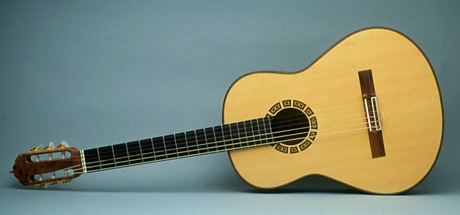
Classical Guitar
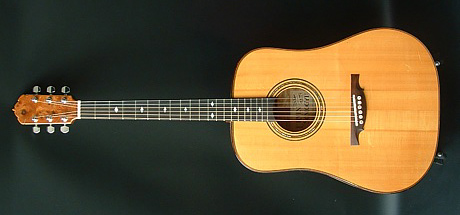
Steel String Guitar


Why are there six strings? 

Seventeenth and eighteenth century guitars had five strings, or sometimes five pairs of strings. These were used to play music which was fairly simple in structure in that much of it comprised of single note melody runs and chords made up of only a few notes. These instruments all replaced earlier, four-string ones which played even simpler monophonic music.

In due time it was found that the addition of a sixth, lower, string made the guitar a much more satisfyingly expressive instrument. It could then play a wider and more complex range of music, and also, by virtue of the addition to the bass register, the music sounded richer. Today, with the exception of a few guitars which have eight or ten strings and are used to play extended-range music, all guitars have six (or six pairs of) strings. It is, in fact, the arrangement that works best to express almost all music, as humans like it, today: if the guitar had fewer or more strings it would be limited in that it would not express some music very well, or it would become a specialist toward expressing some other kinds of music very well indeed. Six is, in effect, the most workable compromise yet found for guitars.

Lutes, interestingly, had a very similar history. The first lutes had six courses (five doubles and a single high string), or eleven strings. As lute music and technique changed, and as audiences grew larger and created a need for louder and louder lutes, luthiers kept on enlarging the beast until in the Baroque era — in which both music and decorative art were over the top in lushness and complexity — the lute had twenty-eight strings. No single one of these models of the lute ever dominated, by the way; they just kept on growing until they couldn’t grow any more. Today, lovers of early music have generally preferred the eight-course lute (seven doubles and one single) . . . as the best compromise instrument that allows them to play both the simpler early music and also the more lush Baroque repertoire. In exactly the same way — except for the fact that it is dominant — the six string guitar is a compromise that has defined what the guitar ought to be.

Were there always metal string guitars?

No. The technology for making metal strings developed late. The first guitars were strung with gut, as had been violins and early bowed and plucked instruments. The early gut was problematic: it was usually uneven, and it didn’t last very long. The ability to produce thin, strong and evenly thicknessed gut strings was made possible by adapting rope-making technology — the twisting together of a few thin strands of material into something even and strong — which had been used ever since there were sailing ships for which to make ropes.

This technology itself got a mighty boost when European nations from the fifteenth century onwards found themselves competing in the building of navies and oceangoing vessels of commerce, conquest and exploration. There was a rather sudden demand for large quantities of strong, reliable, and durable rope; and so braided rope came into being. This technology was adapted, in due time, to the smaller-scale ‘ropes’ of musical instrument string making. The first instruments that we would recognize as the modern guitar had six strings that were made of gut that was twisted and braided together just as rope was. This early (gut-strung) Spanish guitar eventually led to the birth of the steel string guitar.

Parenthetically, the ropes and rigging on large ships allowed the sailors to climb high up and do the balancing acts and high-wire maneuvering necessary to work the sails. This was delicate work, and one needed the agility of a cat up there. These ropes came to be called ‘catlines’ (pronounced ‘catlins’) — the root of which later gave us catwalk, a maneuverable path high up off the ground in theatres and other large buildings). Later, as musical instrument’s strings were produced in the same way as ‘catlines’ were — although on a smaller scale — these came to be called ‘catgut’ in spite of the fact that they were in reality made from strips of sheep’s intestines instead of fiber, cotton, or hemp.

How did the steel string guitar originate?

The steel string guitar, as we know it, developed within a few decades of the Spanish guitar. It did not come out of any of the European guitarmaking centers of Spain, Germany, France or Italy, but rather developed in the United States. It did so in response to the growing musical needs of a rapidly expanding and mobile population, and a steadily increasing popular culture. This growth was key, because it created a huge demand. And it coincided with the time when technology made possible, for the fist time, the availability of plentiful and cheap wire strings instead of the tempermental and expensive gut ones.

Wiremaking technology was itself a late development of the industrial revolution. It occurred hand in hand with the astonishingly fast conquest and subdivision of the American landmass by hordes of settlers who needed wire fencing to mark the boundaries of their land and keep their cattle from wandering off into their neighbors’. Thus, wire was produced in huge quantities. And as wire for fences was produced, so could wire strings be made cheaply for guitars. Wire strings had been made previously, but before the industrial revolution these were laborious to produce. But now, as I said, there was an exponentially growing market for musical instruments within a migrating and expanding population.

Those early metal-string guitars were made quickly, cheaply and in large quantities in the factories and production shops of the day. It was an advantage that one could learn to strum on a guitar more easily than learning to play a violin or a piano; it made chord harmonies that were pleasant to listen to; and it could accompany singing, which made it a social instrument. Moreover, metal strings would last a long time — whether you stayed put or moved around, and in all weathers. Gut strings, which had been the only choice until then, were expensive (a single string could cost a week’s disposable income for the average workingman!), were affected by weather so as to change their tuning, and frayed and wore out easily. With the advent of metal strings, the guitar became an accessible, affordable, and popular folk instrument that didn’t need to be re-tuned every time you picked it up. I should add that guitars had all been made exactly the same way up until then, and were geared to the (lesser) pull of nylon strings; the first of these guitars to have metal strings put on them didn’t last. But that problem was quickly overcome by making guitars meant for steel strings sturdier.

Nylon guitar strings were developed in the 1940s as an outgrowth of the search for uses for a new kind of stretchy fluorocarbon polymer substance that had been discovered by accident in the DuPont laboratories in 1930. Some practical uses turned out to be in nylon stockings (silk ran too easily) and nylon monofilament for fishing lines. In fact, the first musicians to put nylon monofilament on their guitars — in lieu of gut strings — were the fishermen-musicians of the Spanish Mediterranean seaports. Incidentally, as Southern Spain is the cradle of flamenco those fishermen would have been playing flamenco when they partied; thus we are all indebted to the flamenco community for helping to discover that nylon could do for the classical and flamenco guitars what metal strings did for the steel string folk guitar. Albert Augustine, in collaboration with Andres Segovia, manufactured the first successful nylon guitar strings in 1948 — thus allowing the classical guitar to be played and enjoyed by millions of people.

What is the importance of the Martin brand? 

One of the first of the steel string guitar makers to establish themselves in the United States was a transplanted German woodworker, C.F. Martin, whose great-grandson now presides over the Martin factories. While there have been many steel string guitarmakers and many steel string guitars, it has been the Martin brand more than any other — and especially the Martin dreadnought guitar — which really put steel strings on the map, just as as Henry Ford put the early automobile on the map. The Martin dreadnought is the most common, popular and familiar steel string guitar on the planet today. Everyone recognizes it. Everyone copies it. Historically, it has been the example and model for modern steel string guitars in general, and the Martin guitar in particular has been the standard against which other steel string guitars have been judged.

Besides the strings, what is the difference between a Martin and a Spanish guitar? 

The difference in stringing is obvious, but this is only a superficial difference. The most meaningful differences are internal and structural, and have to do with the fact that the steel string guitar must be built to withstand relatively great string tension, compared to the nylon or gut strung guitar. Being built differently, they produce tone differently. And being driven by metallic and polymer strings, respectively, they also will produce different tones and tonalities. From an engineering standpoint, these are different instruments that share the same name. The principal elements unique to the steel string guitar are its smaller neck size, shorter strings, the X-bracing under the face, and the design of the bridge.

How are steel string guitar necks different from Spanish guitar necks?

There are three main differences. First, given the constant pull from metal strings, a reinforcing element is needed to protect an otherwise relatively thin and flimsy neck from warping or bowing. Formerly, non-adjustable hardwood or metal rods were commonly used. Today, virtually all steel string guitars have adjustable tensioning rods with access ports either behind the nut or through the soundhole. Spanish guitar necks are under much less of a load and have not needed reinforcing rods.

The second difference is in the shape of the neck, which serves a particular playing style. Spanish guitars were developed primarily for that style of playing in which the thumb is anchored behind the neck, allowing the wrist to bend and extend the fingers of the left hand over the fretboard while the fingers of the right hand pluck the strings. Accordingly, this neck is wide and the back of it is a somewhat flattened, gentle curve. The steel string guitar was developed originally for a playing style in which the thumb of the left hand wraps itself around the neck and the right hand plays the strings with a plectrum. Therefore, the steel string guitar neck is narrow with closer string spacing. It also has a somewhat Vee-shaped cross-section with a softly rounded peak in the back. This feature optimizes the ability of the player to wrap his hand around the neck, and its “v” shape fits into the valley between the thumb and the other fingers. It’s quite an efficient design.

The third thing is that steel string guitar fingerboards are crowned or curved, whereas Spanish guitar fingerboards are usually flat. There are several reasons for this. First, it’s easier for a left hand to bar over the stiffer metal strings on a slightly curved surface. Second, a slightly arched plane of strings (as the violin’s strings are arched over the fingerboard) makes it slightly easier for a player to play the strings with a plectrum.

Why is the steel string guitar bridge different from the Spanish? 

Spanish guitar bridges are designed so the strings can tie onto them directly. This design works well within the holding power of the glue joint that attaches the bridge onto the guitar face. With the advent of metal strings, however, it was found that the forces acting on the bridge were so great that such bridges could, in time, become unglued. A better solution was to anchor the strings to the underside of the face itself, and bypassing the possibility of glue failure at the bridge. Thus, in steel string guitars, the strings pass through the bridge into the guitar’s body cavity.

There’s an equally important second difference in that the Spanish guitar saddle — the bone (or plastic) piece in the bridge on which the strings rest — is perpendicular to the strings, while the steel string saddle is at an angle. This is necessary because the mass and stiffness of metal strings affects their vibrational activity and creates out-of-tuneness. The rate of change in these factors increases with the diameter of the strings: with equal-length strings the out-of-tuneness would increase with the diameter of the string. Accordingly the heavier, stiffer strings are compensated for this function by being made longer, and the slanted saddle is called a compensated saddle.

How is bracing important? 

All guitars have internal bracing, whose acoustic functions far outweigh its structural ones in that the manner of bracing shapes the possibilities for sound. Spanish and steel string guitars have different, characteristic bracing because they need to accomplish different tonal tasks.

The Spanish guitar, being subject to the lesser pull of nylon strings, has been found to function very well with thin braces which run parallel or almost parallel to the grain of the top wood. Steel string guitars are under significantly more driving load and consequently need more substantial bracing bars to withstand the resultant pull and torque. It’s these deformational pressures which have brought about the use of the “X” brace, which is the standard internal support for steel string guitar faces. An important function of the “X” brace is to support the part of the guitar face in front of the bridge from sagging downwards, as it would otherwise do.

Why not use one kind of bracing on all guitars, but sized to the structural pull of the string tensions, and the music to be played? 

The fan-braced guitar is a European invention and the “X” braced guitar is an American one; they were invented virtually simultaneously and very likely independently on one another. The first “X” braced guitars were of course made with and for gut strings, as were the Spanish ones; but both of these were descended from earlier versions of guitars that had ladder (three or four parallel braces that went across the grain) bracing.

Consider the fact that the modern Spanish guitar was first made in Seville, and the first modern American guitars were made in New York.

The Spanish guitar makers made guitars within a climate that was reasonably consistent. The American guitar was born in the large Eastern population centers, and then traveled West into all climates, humidities, and altitudes. The seasons on the Eastern seabord are notoriously extreme . . . and guitars are made of wood, which reacts to weather. It was discovered that guitars could survive the seasonal expansion and shrinkage of their materials (in those environments) better if their braces went across the grain and locked its fibers into place against movement. The “X” brace accomplished exactly that; fan braces didn’t really need that kind of protection.

Why are there so many sizes and shapes of steel string guitars to choose from, while classic guitars are all very nearly the same size and shape?

The answer has to do with the culture of the guitar and its music. The classical guitar is considered almost perfect by its adherents, and significant innovations are not encouraged. Builders are largely of a mindset to refine the established design elements, but not to alter them. The steel string guitar world, however, is not bound by such thinking and is consequently free to invent new versions and features as long as someone will buy them. Much of this impetus comes from the commercial industry’s need to constantly develop new products — much as the automobile industry has the same need. In both, consequently, models are sometimes released which are actually worse than previous ones. If a famous classic guitar maker were to ever develop a new model of guitar which sounded worse but was instead marketed for some saleable and innovative feature of design, his professional reputation would take decades to recover. But in the world of the steel string guitar, especially on the factory level, no one thinks twice about such excursions into commercialism.

Another and more interesting reason is that steel string guitar music and its playing techniques are changing. Change creates new needs, and these call forth new design efforts. In the classical guitar world these factors are moving ahead comparatively slowly as technique, repertoire, and acceptability of design are comparatively frozen. Moreover, one of the principal changes affecting the steel string guitar is that whereas it has for most of its existence been principally an accompanying and backup instrument (for voice and/or other instruments), it has strongly grown into a new identity within the past forty years as a solo instrument. In 1950 there were no steel string guitar soloists, interpreters, arrangers or composers; today there are many, and some of them are astonishingly good. As musicians have begun to explore and discover new tonal, dynamic and compositional possibilities, the steel string guitar has for the first time experienced demands on it whereby it is expected to function at higher levels of responsiveness to technique, liveness, expressiveness in tonal coloration, texture and subtlety, dynamic range in volume as well as sound quality, evenness, projection, sustain, playability, fidelity of intonation all the way up and down the neck, and, finally, ease of amplification and recordability. And this instrument is expected to do these things on sound stages, in recording studios, concert halls, auditoriums and in small rooms, as well as outdoors. This is a very exciting time for the steel string guitar and no one is aware of any reason to think these factors will not continue to grow for decades to come.

Posted in Features By Ervin, Lutherie & Guitars Tagged steel string guitars

Categories

  • Announcements
  • Essays & Thoughts
  • FAQs
  • Features By Ervin
  • Humor and Odds & Ends
  • Interviews
  • Lutherie & Guitars
  • Uncategorized
  • What I've Been Up To

Ervin's Essays, Articles, and Musings:

  • “LA GUITARRA” – A Psychological Insight into Flamenco
  • (1/6) HOW I BECAME A GUITAR MAKER, AND  WHAT THAT WAS/IS ALL ABOUT
  • (2/6) HOW I FIRST MET THE GUITAR
  • (3/6) ABOUT MY LIFE AS A GUITAR MAKER
  • (4/6) THE CARMEL CLASSIC GUITAR FESTIVAL OF 1977
  • (5/6) MY LIFE AS A GUITAR MAKER: LOOKING BACK
  • (6/6) AFTERMATH: WHAT, EXACTLY, IS LUTHERIE TODAY? AND WHAT IS MY PLACE IN IT?  
  • 16. A LETTER TO WELLS FARGO BANK [June, ’18]
  • 18. ADVERTISING SLOGANS FOR GUITAR MAKERS
  • 19. ON THE MATTER OF ADVERTISING SLOGANS (2/2)
  • 20. LIFE AFTER EPIPHANY
  • 21. MARTIN LUTHER & THE LAW [1/2]
  • 25. MARTIN LUTHER AND THE LAW [2/2]
  • 31. HARLOW, SKINNER, AND WATSON:
    2-1/2 SONSOFBITCHES
  • 37. ON JEWISH CULTURE . . . AND HUMOR
  • A Candid View of Value, Prices, and Guitar Lust
  • A CHRISTMAS STORY
  • A Digression Into Matter of Top Thickness
  • A Surprising Insight About Drums and Guitar Tops
  • A Systematic Comparison of Tonewoods
  • ABOUT MY ARTWORK
  • An Amusing Experience
  • An Interview with Steven Dembroski, From Dream Guitars
  • An Ironically Good Bad Experience…
  • AN OPTICAL ILLUSION
  • Carp Classic Guitar
  • Commentaries About My DVD
  • Concerning Somogyi Knockoffs
  • Craftsmanship, Sound, ‘The Right Look’, Materials, and the Marketing of the Guitar
  • DEAR DR. DOVETAIL, Part 1
  • DEAR DR. DOVETAIL, Part 2
  • F.A.Q. #2: Working Woods to a Stiffness
  • F.A.Q. #3: More on Flexibility
  • F.A.Q. #4: Thinning Out The Back?
  • F.A.Q.#5: Soundholes and Bracing Patterns
  • FAQ #1: The Stiffness Factor
  • FAQ #6: Bracing, Thickness, or Both
  • FAQ #7: Flat Backs and Arch Tops
  • FAQ #8: Flat Vs. Domed Tops
  • Frankenfinger
  • Fun Stuff #1
  • Fun Stuff #2
  • Fun Stuff #3
  • Guitar Voicing: Different Strokes for Different Folks? – [1/2]
  • Guitar Voicing: Different Strokes for Different Folks? – [2/2]
  • Guitars, Virtue, and Nudity: The Guitar as an Icon of Culture, Class Status, and Social Values
  • Internet Lutherie Discussion Forums
  • Lutherie Trivia
  • My Adventures in Book Publishing
  • On Critiquing Other People’s Guitars
  • Principles of Guitar Dynamics and Design
  • RE: Postponement of Voicing Classes
  • SOCRATIC DIALOGUE
  • Some [More] Thoughts About the Environment, Sex, and Hillary Clinton
  • Some Reflections On My Guitar Work
  • Some Thoughts About Gender and the Environment
  • Some Thoughts on Guitar Sound
  • Some Thoughts on the Difference Between Handmade and Factory-made Guitars
  • Specific Top Thickness In the Guitar
  • STEEL STRING GUITAR BASICS
  • THE DUMPSTER DRUM
  • The Maple Andamento
  • THE MODERN GUITAR: AN ICON OF ROMANCE AND HEROISM
  • The REMFAGRI Factor in Lutherie
  • The State of the Contemporary Guitar – 1/4
  • The State of the Contemporary Guitar – 2/4
  • The State of the Contemporary Guitar – 3/4
  • The State of the Contemporary Guitar – 4/4
  • The Taku Sakashta Guitar Project
  • Thoughts About Creativity, Technical Work, and the Brain – [1/2]
  • Thoughts About Creativity, Technical Work, and the Brain – [2/2]
  • Titebond vs. Hide Glue
  • Tone Production and the Logic of Wood’s Uses
  • Tonewoods in Guitars
  • Tony McManus stopped by the shop…
  • Using Wenge as a Guitar Wood
  • Werewood
  • What I’ve Been Up To These Days
  • What I’ve Been Up To, August 2017
  • What I’ve Been Up To, February 2019
  • What I’ve Been Up To, September 2017
  • What I’ve Been Up To: November ’17 to March ‘18 – [4/4]
  • What I’ve Been Up To: November ’17 to March‘18 – [1/4]
  • What I’ve Been Up To: November ’17 to March‘18 – [2/4]
  • What I’ve Been Up To: November ’17 to March‘18 – [3/4]
  • Whence the Steel String Guitar? – 1/2
  • Whence the Steel String Guitar? – 2/2
  • Why Are There Differently Constructed Classical Guitars?
  • Why Lutherie?
  • Woodstock Guitar Show

© Ervin Somogyi 2026. Powered by WordPress