Ervin Somogyi

Menu
  • About
    • Bio
    • Bio – Humorous
    • Resumé
  • Guitars
    • Guitar Models
    • Guitars: Custom Options
    • Special Projects
    • Visual Echoes & Tasteful Accents
    • Pricing
  • For Sale!
    • The Mexican Festival Model Guitar
  • Artwork
    • Lutherie-Inspired Artwork
    • Artwork (2)
    • Peghead Veneers as Art and Accents
  • Articles
  • Books
    • Books
    • Videos
  • Teaching
  • Blog
  • Contact

Category: Guitar theory, history, opinions, sociology, wisdom, & insights

THE MODERN GUITAR: AN ICON OF ROMANCE AND HEROISM

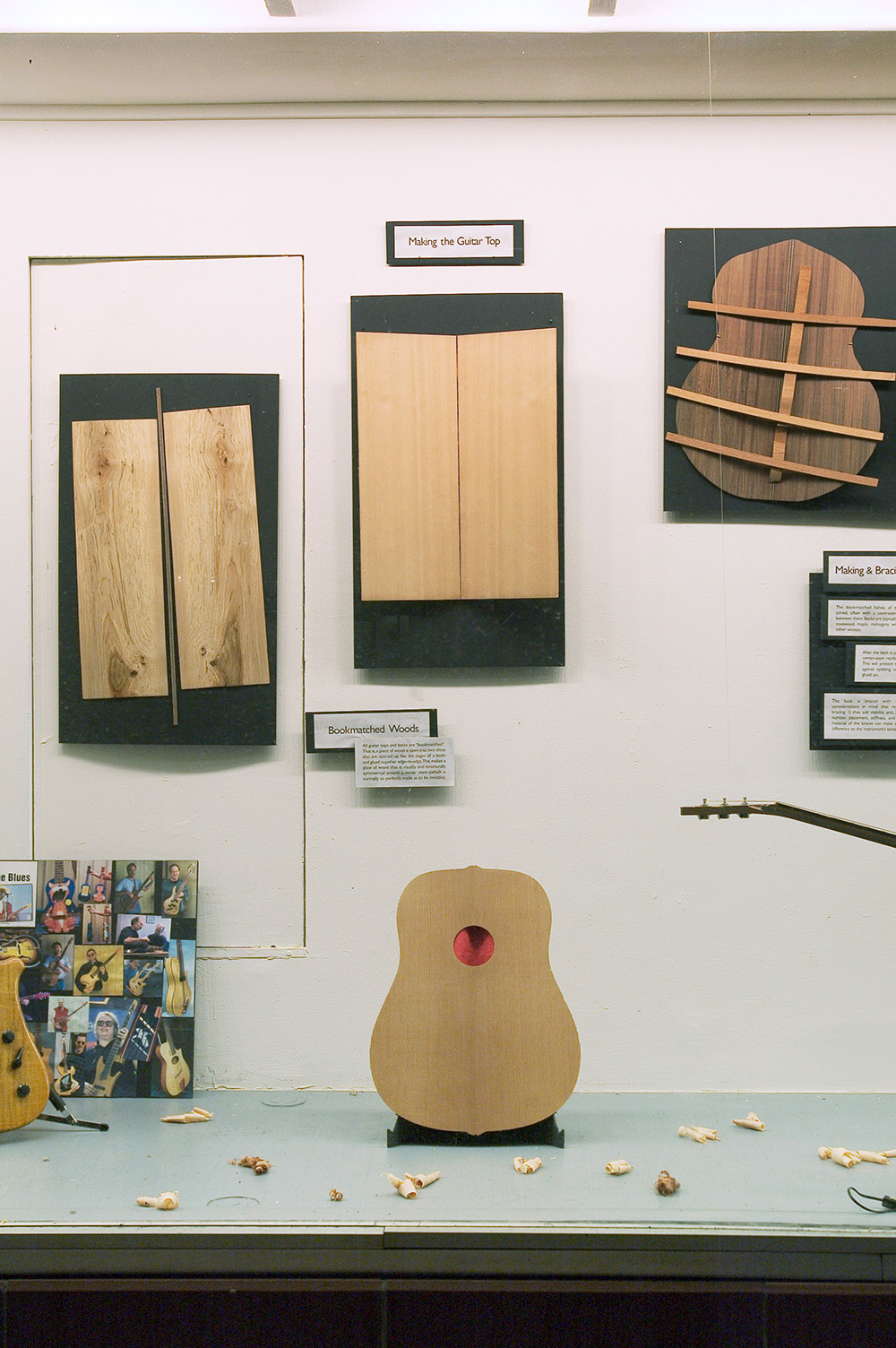
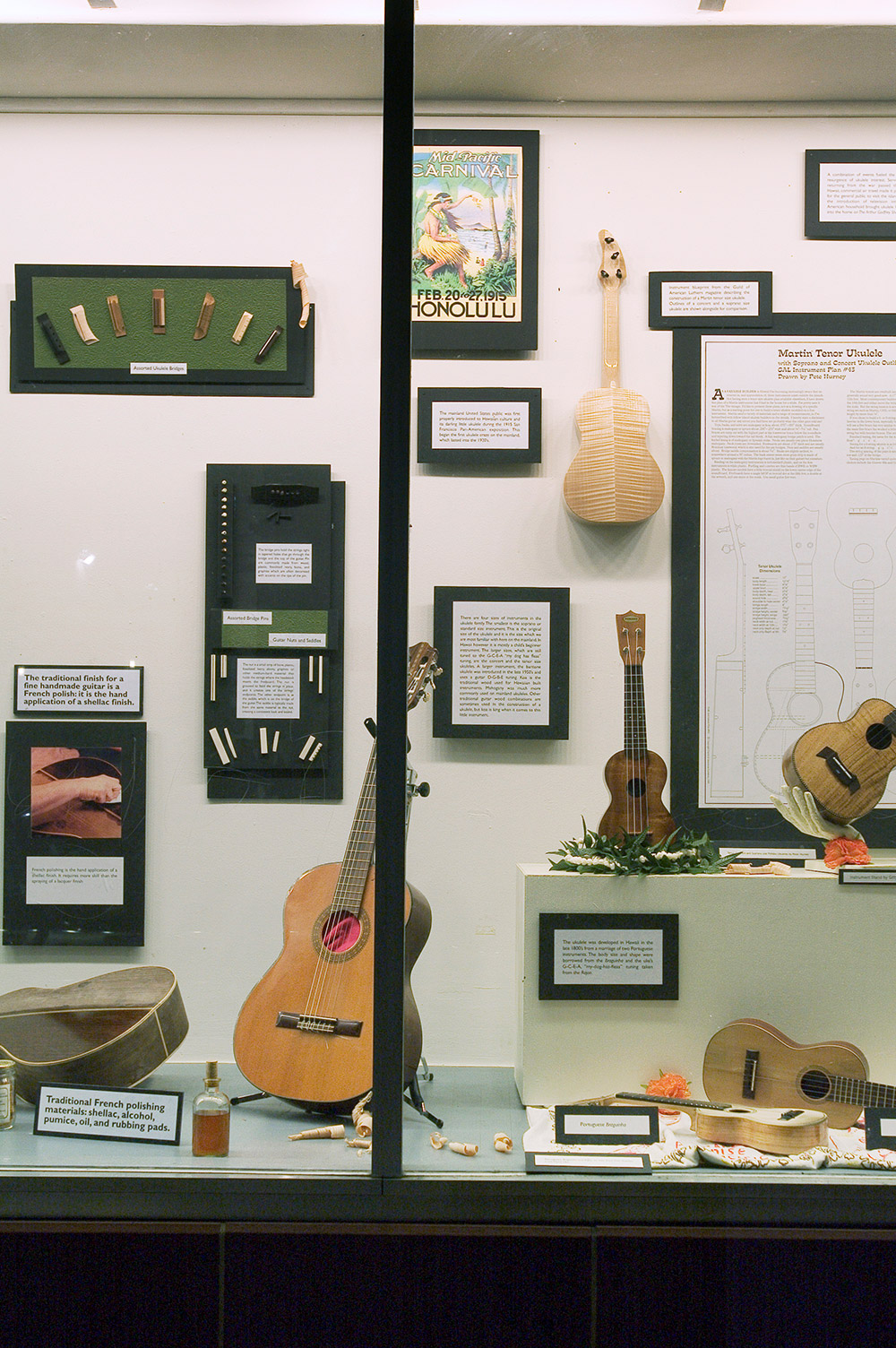
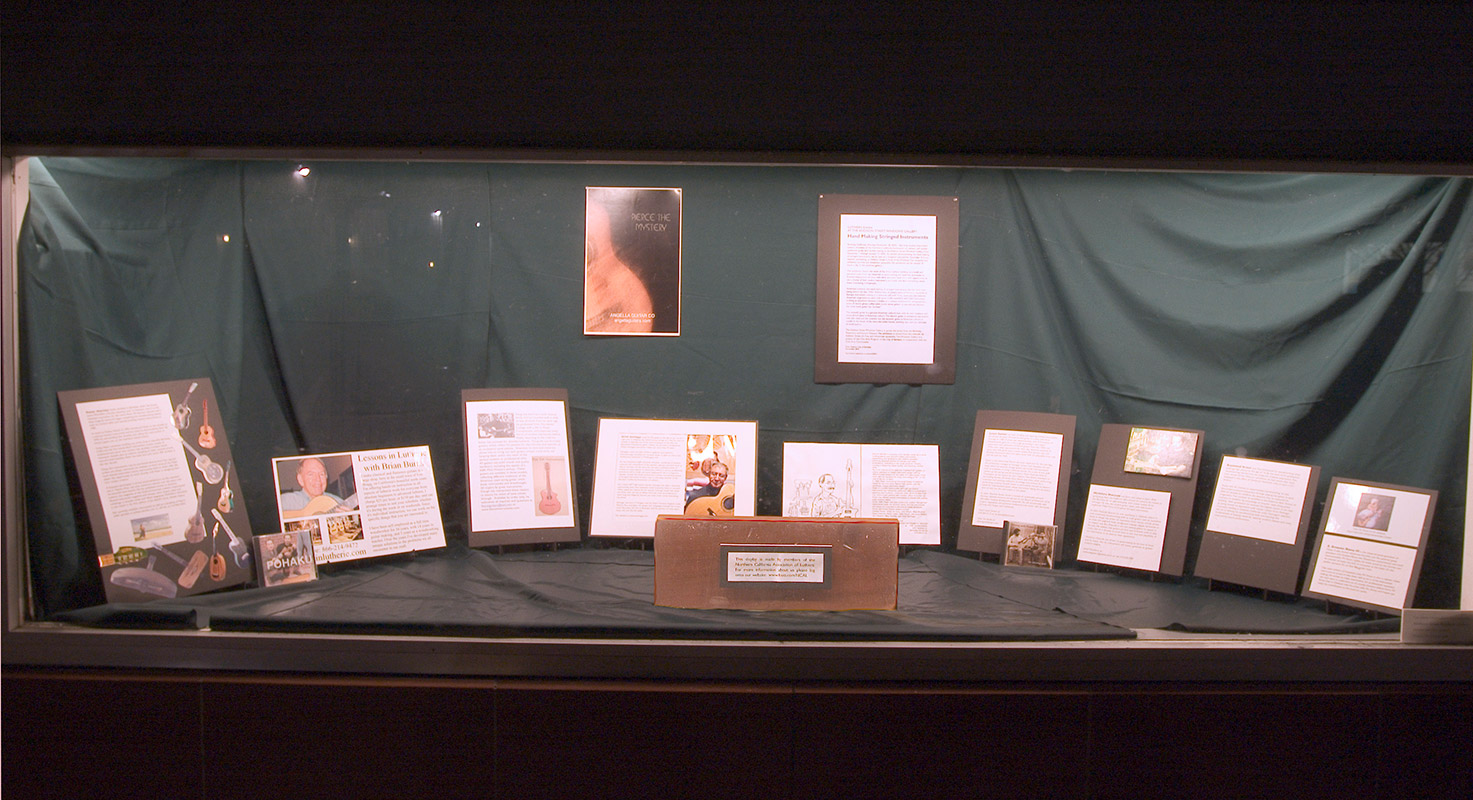
Addison St. Display Panorama
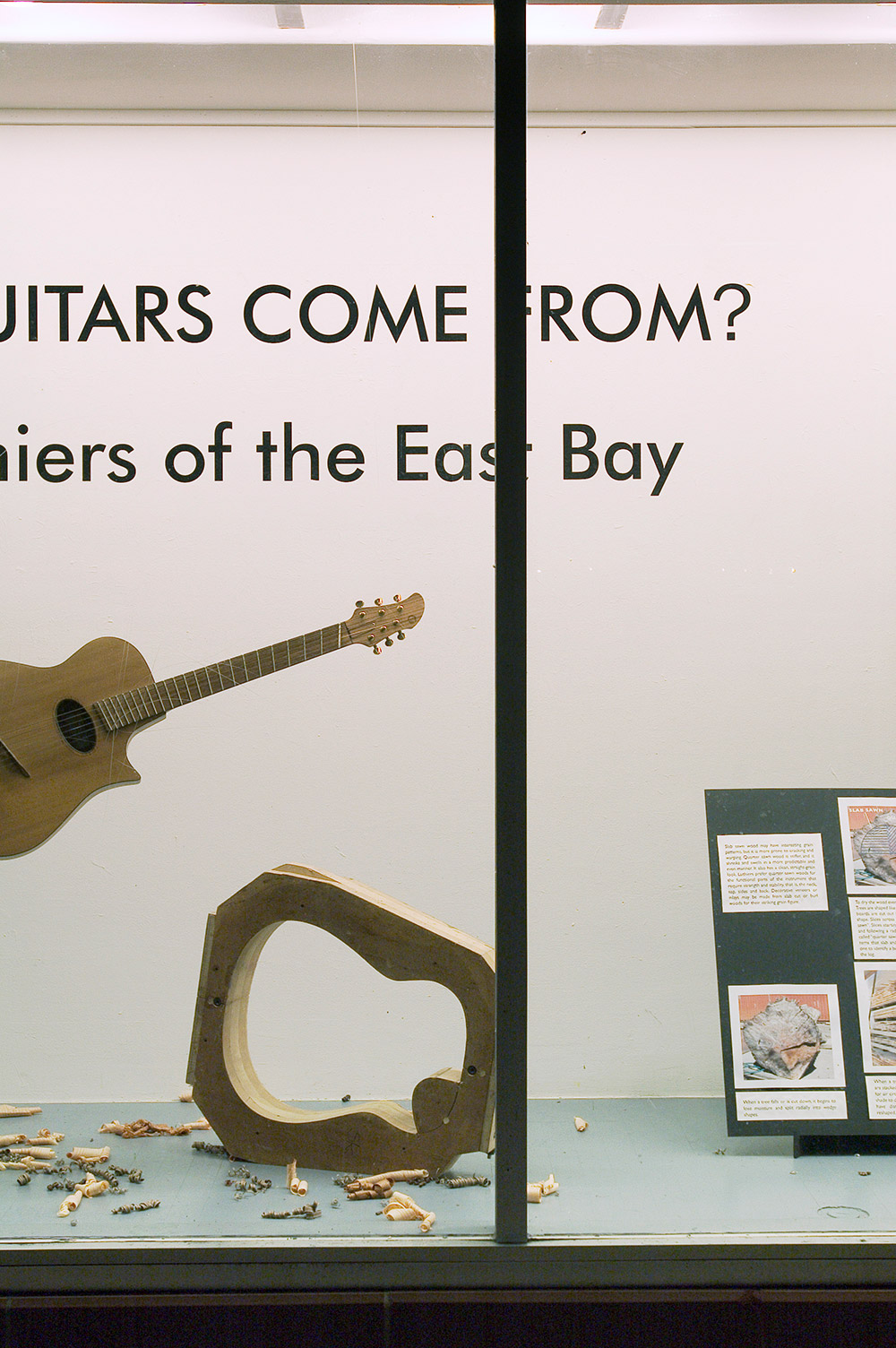
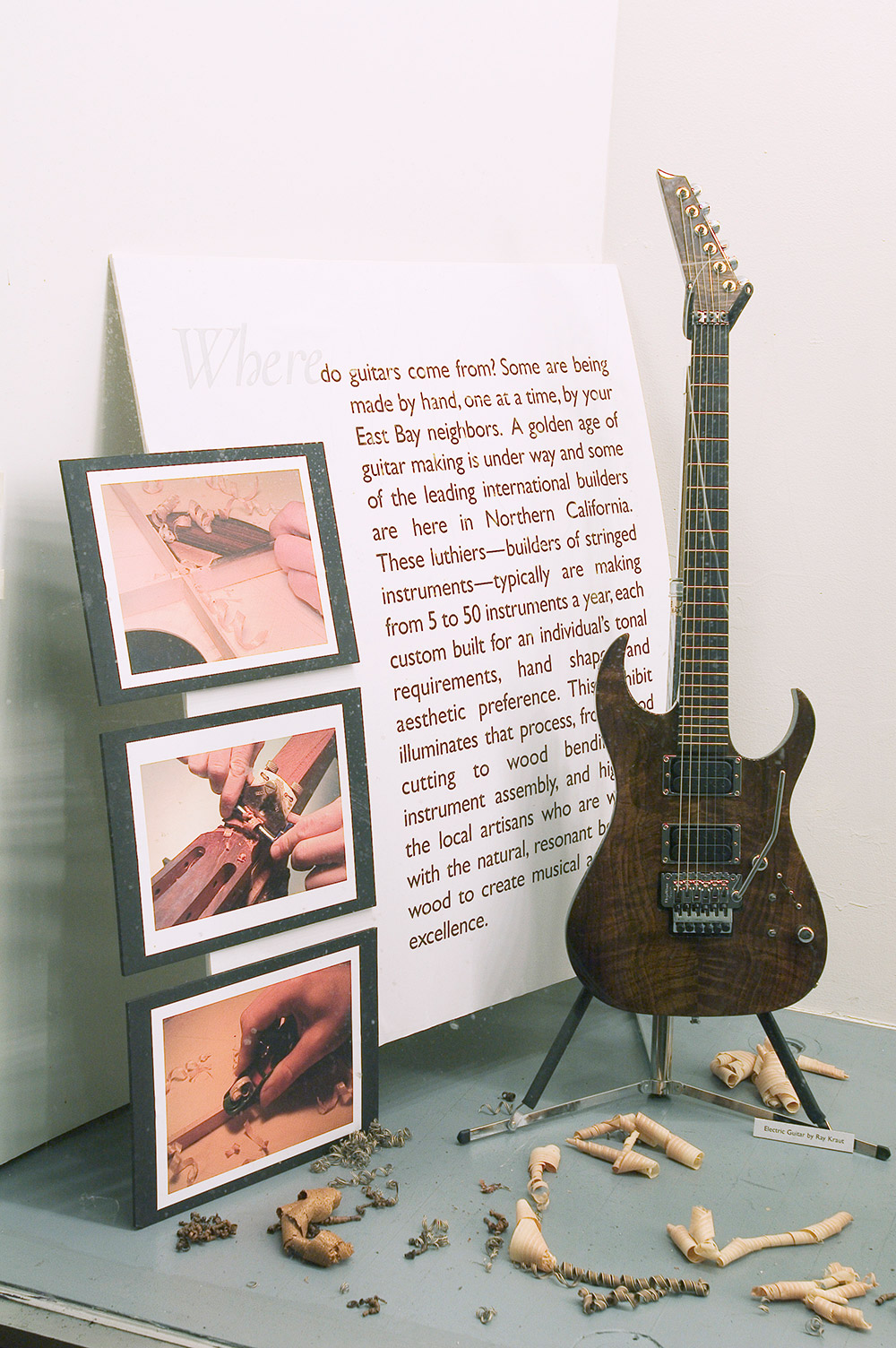
Where do guitars come from?
The installation's starting point
Getting into the story
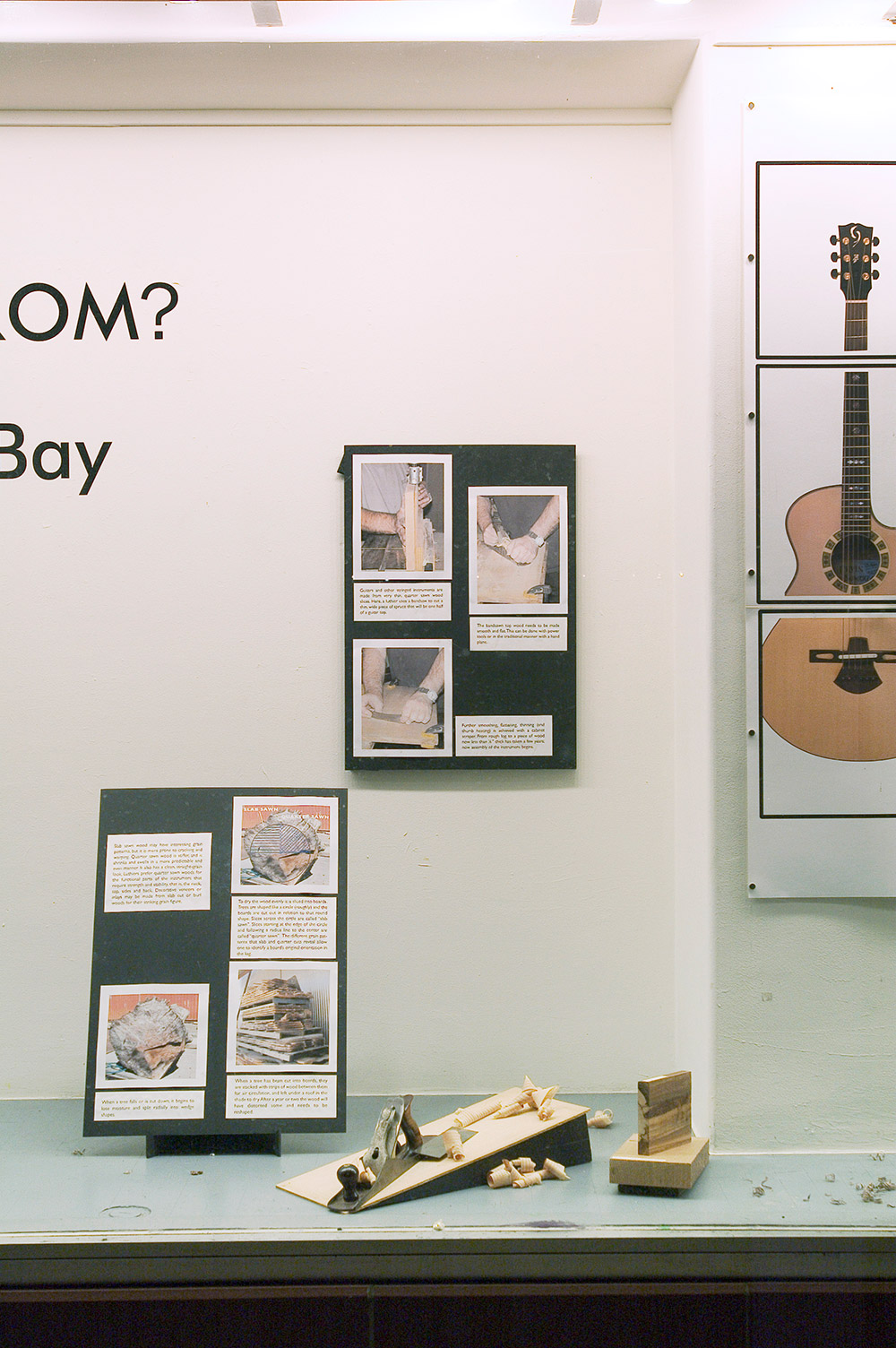
Explaining about Wood
Explaining about wood
More information
More information
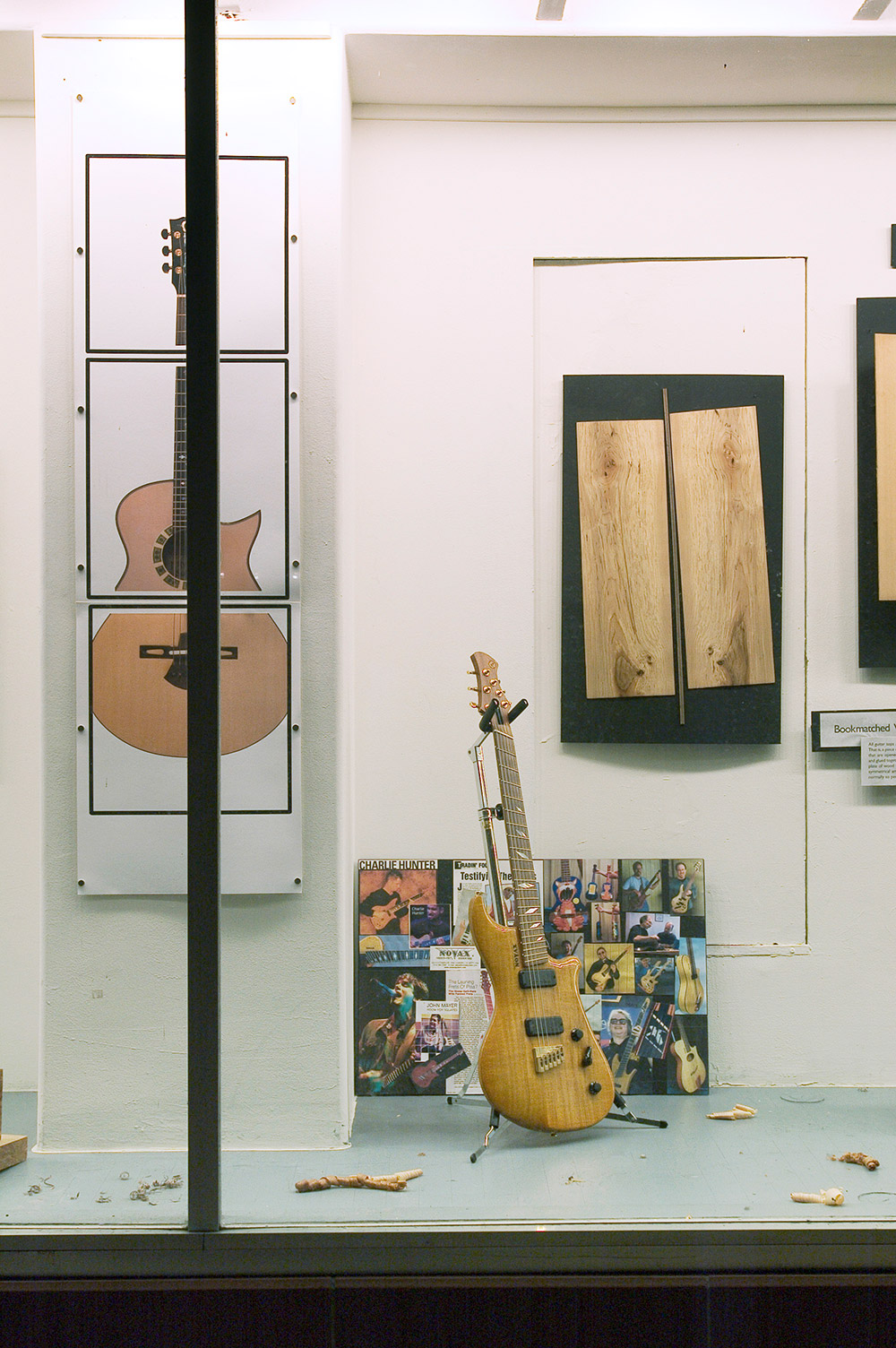
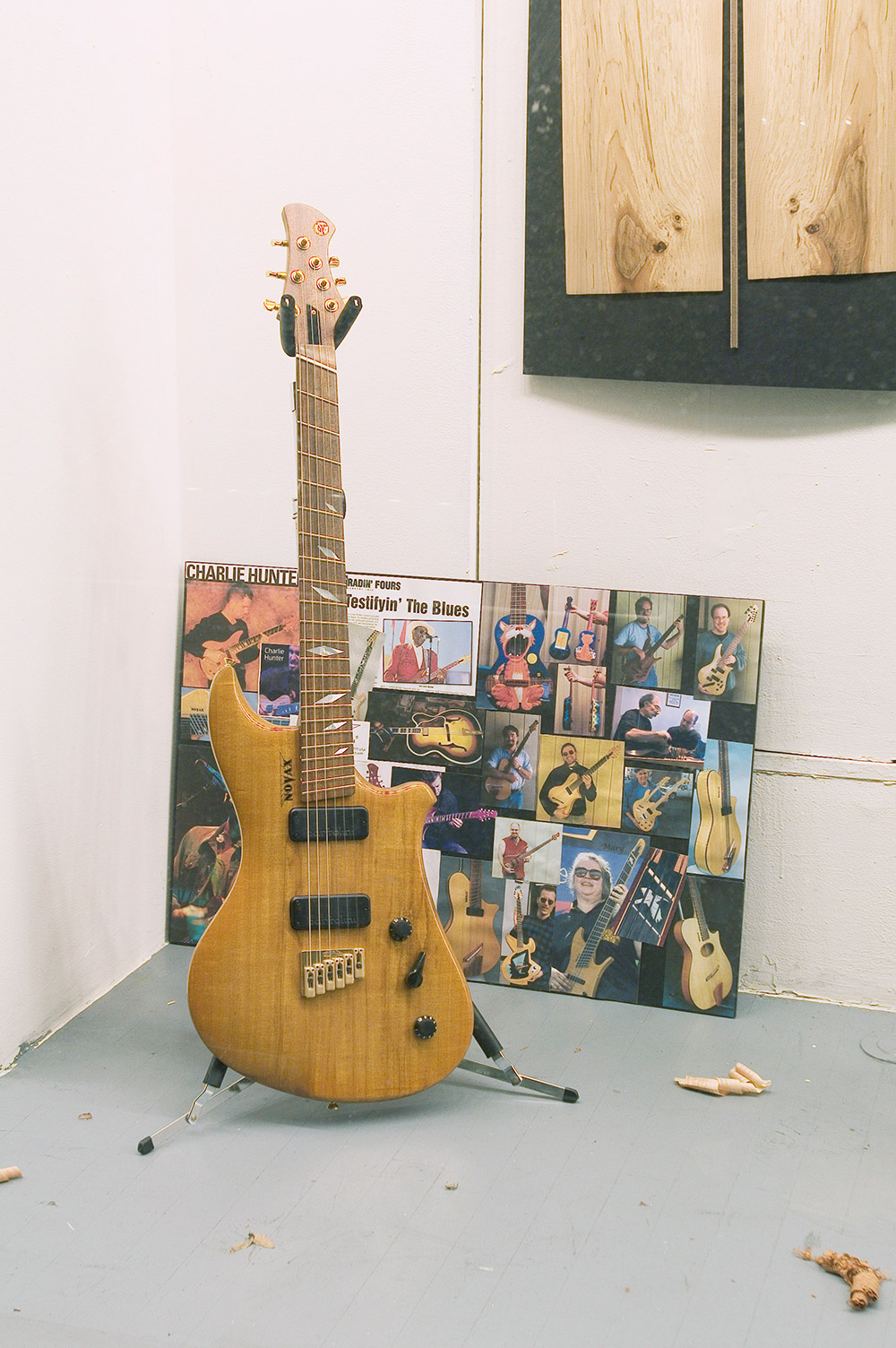
The Blues guitar
The Blues guitar
Nice, clear, uncluttered signage
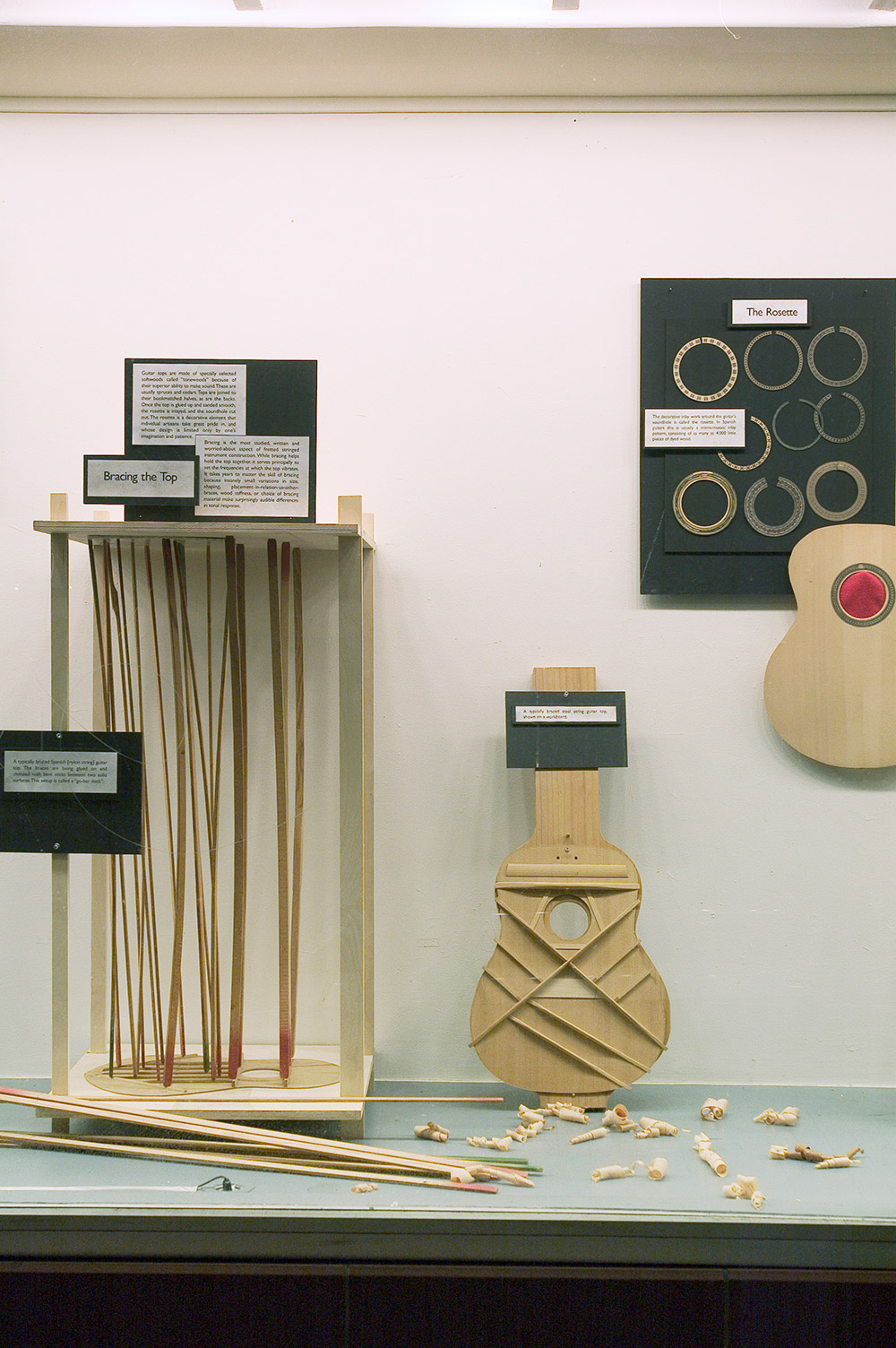
The guitar's innards
Disassemblable go bar deck
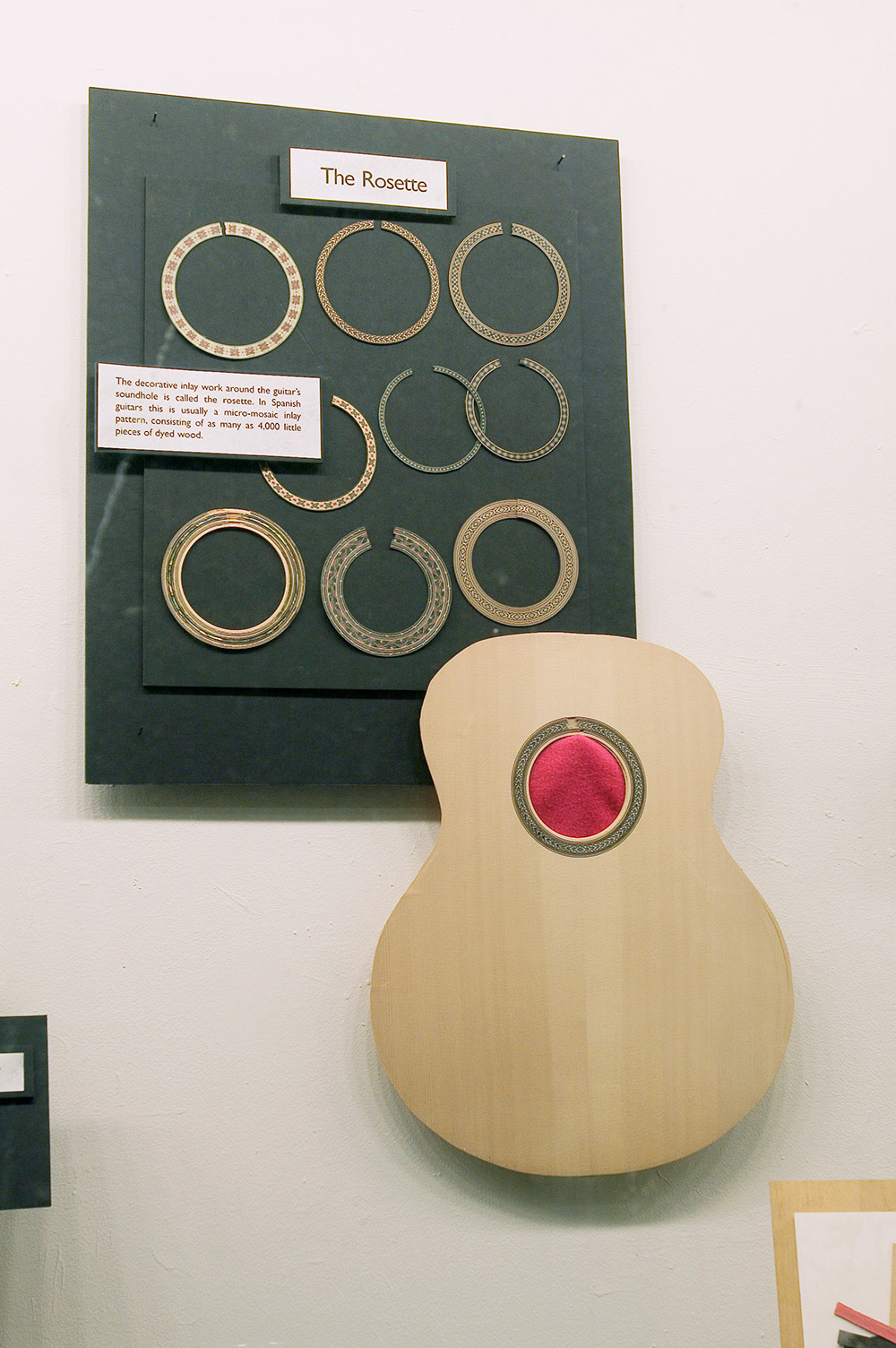
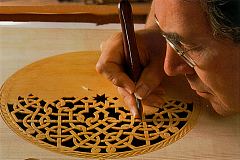
The soundhole rosette
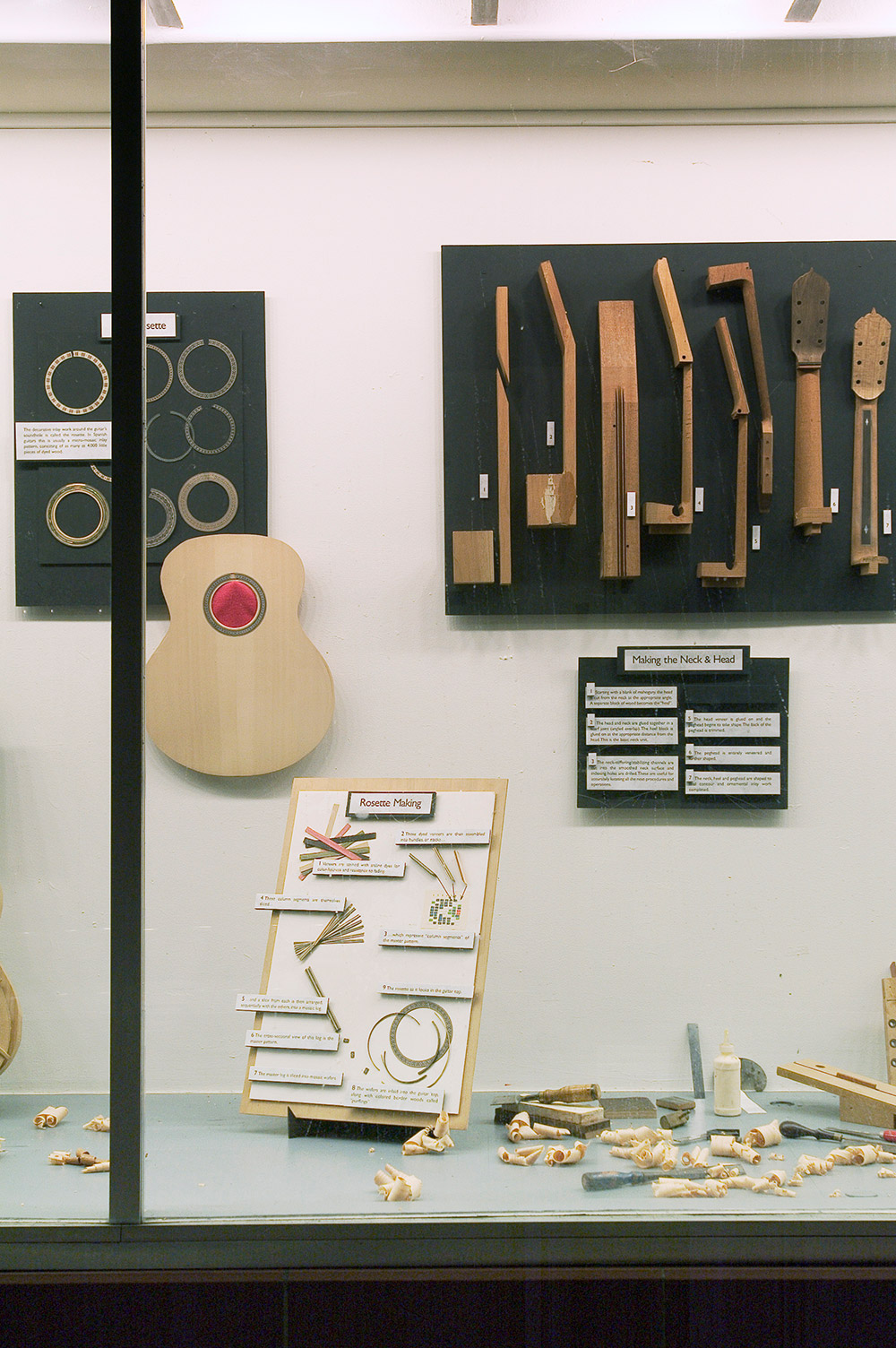
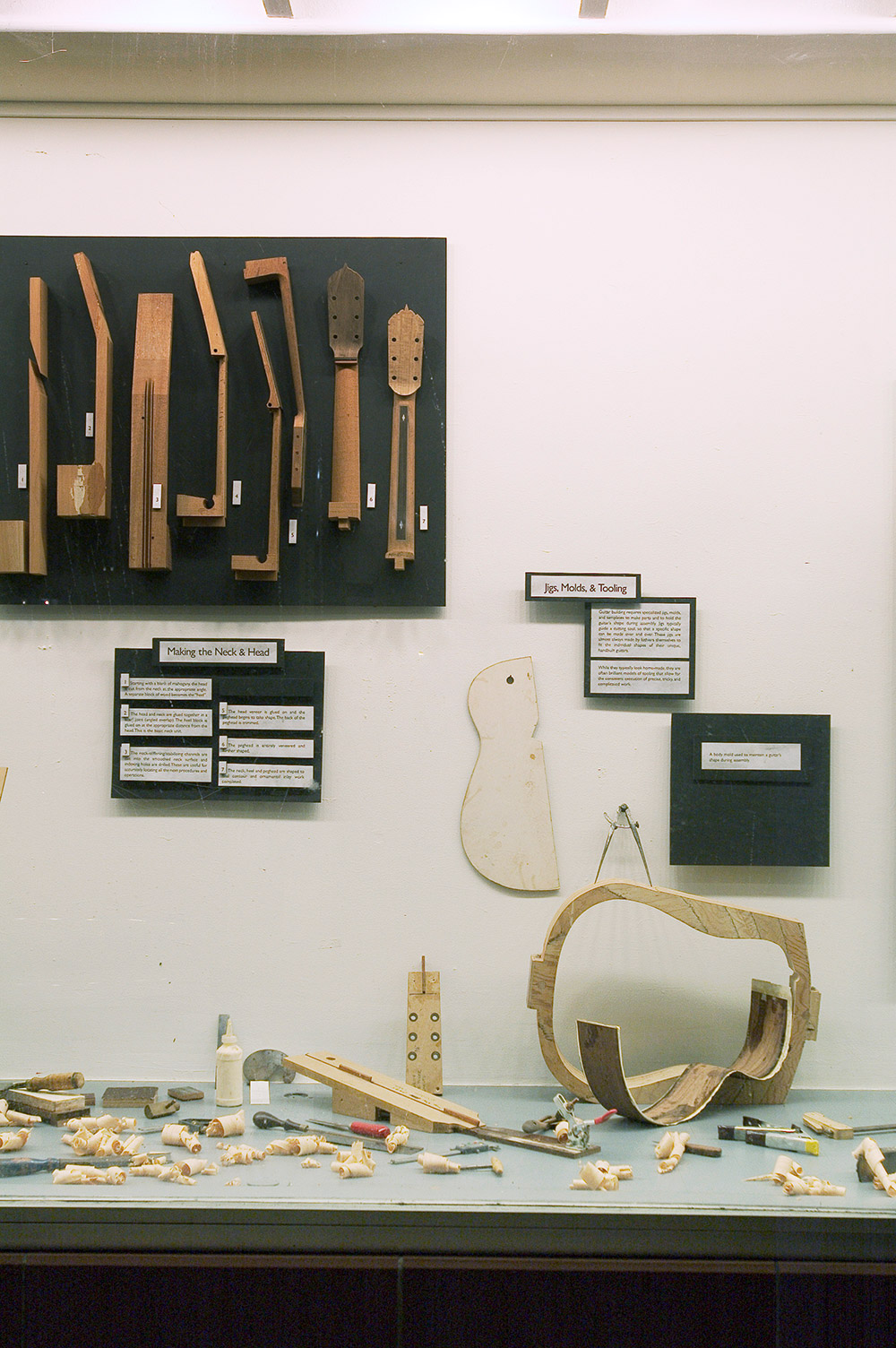
Guitar necks
Guitar necks
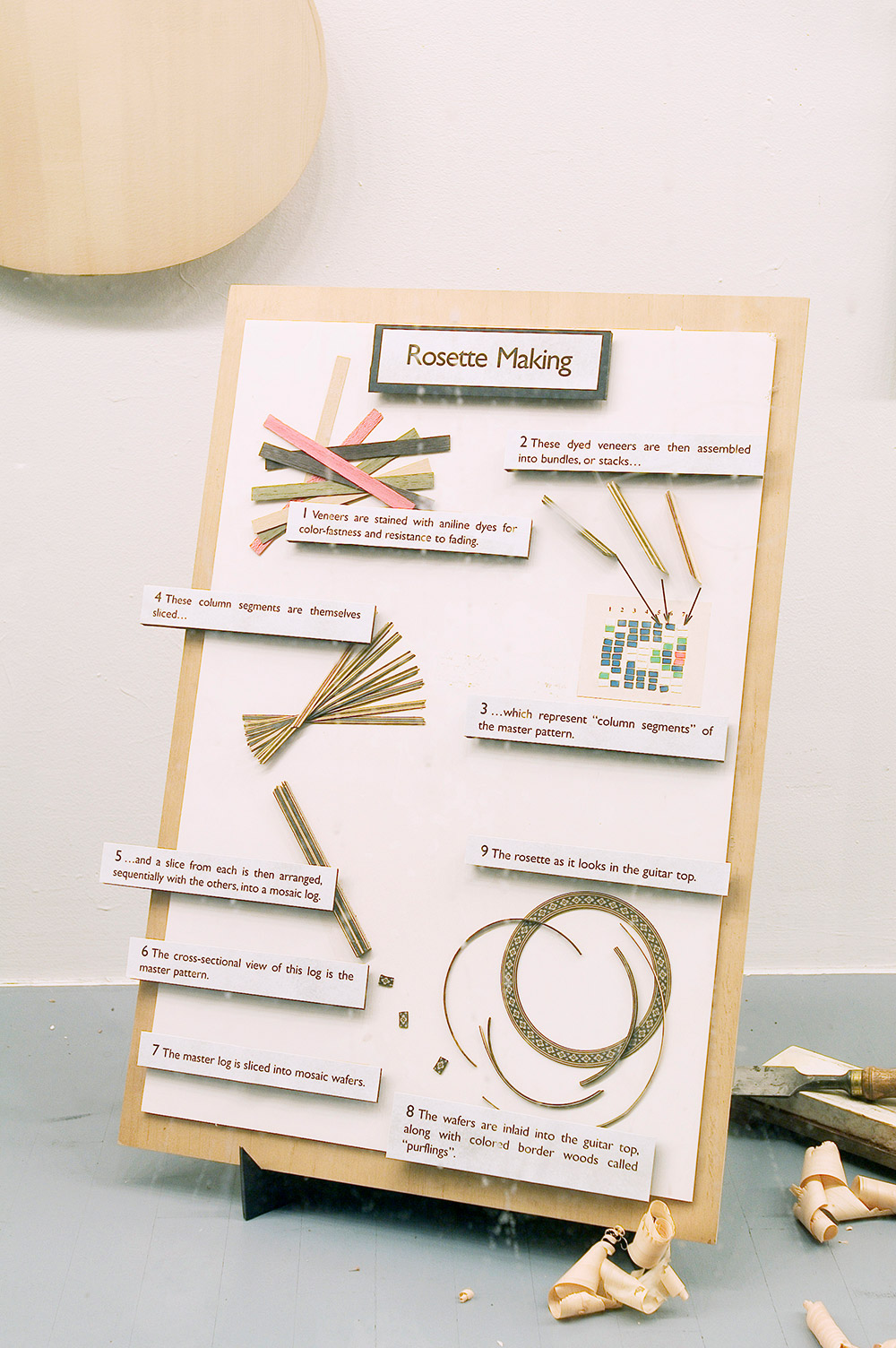
Rosette making
Rosette making
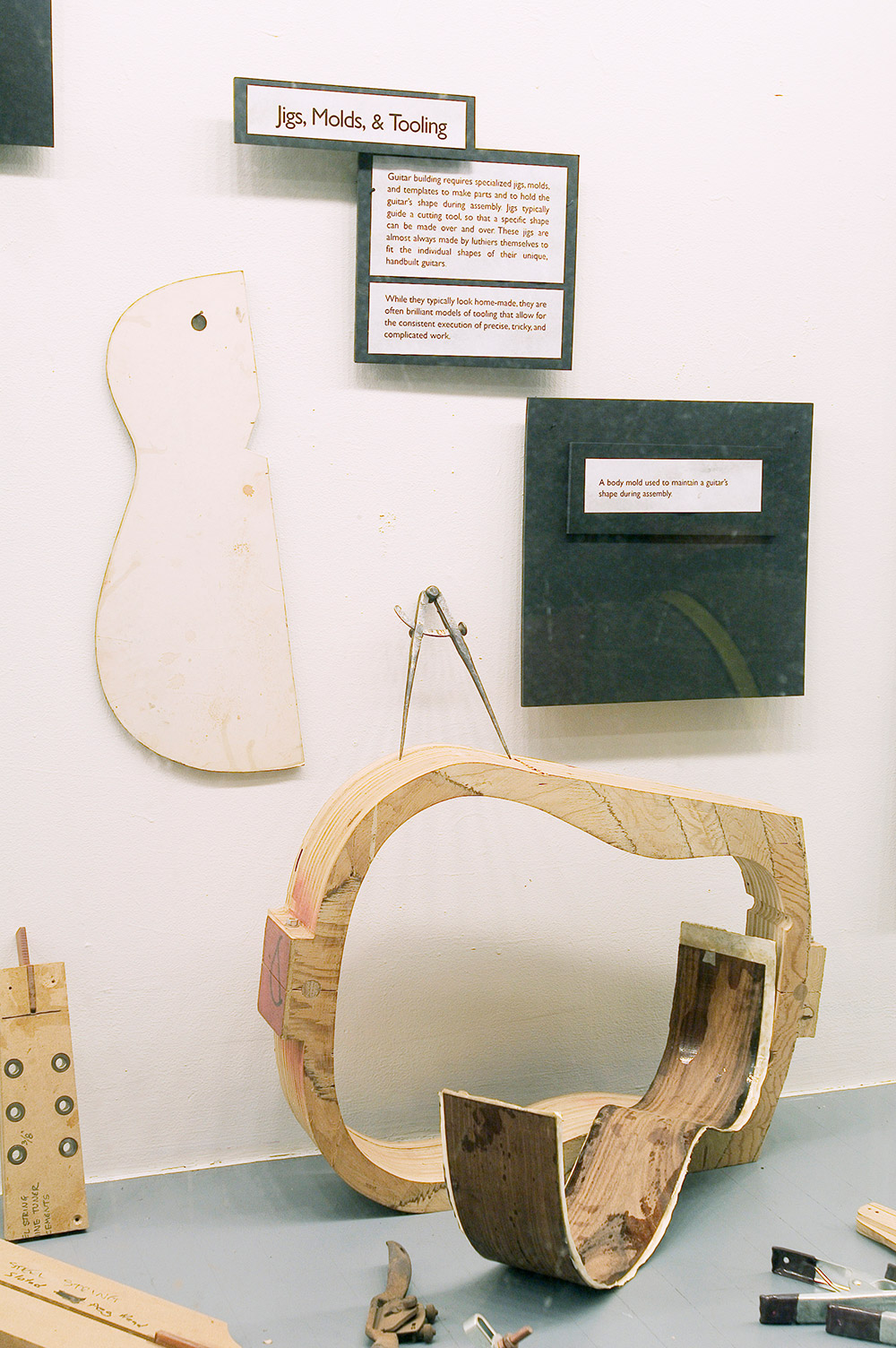
Molds and templates
Molds and templates
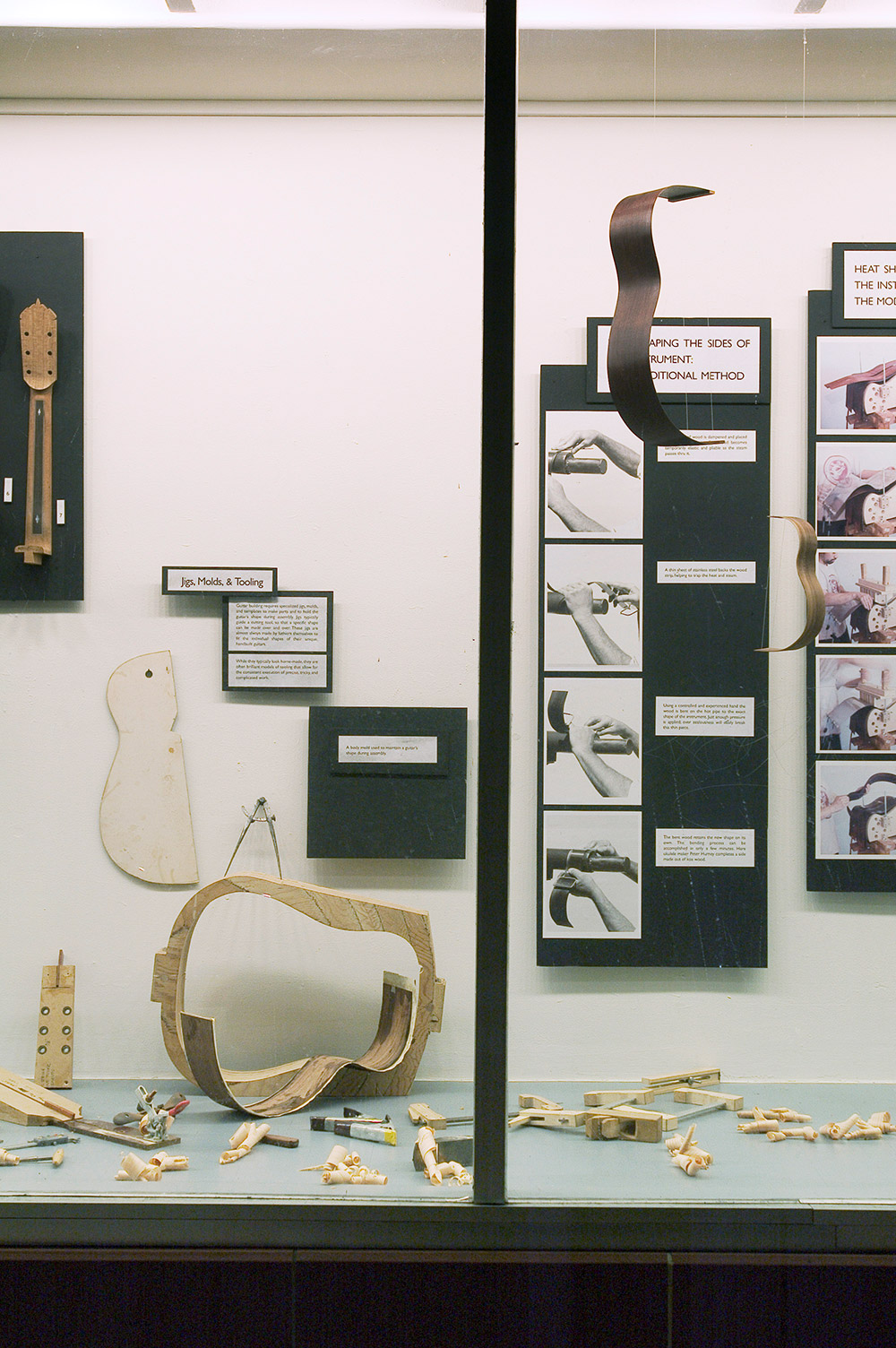
Jigs, molds, and templates
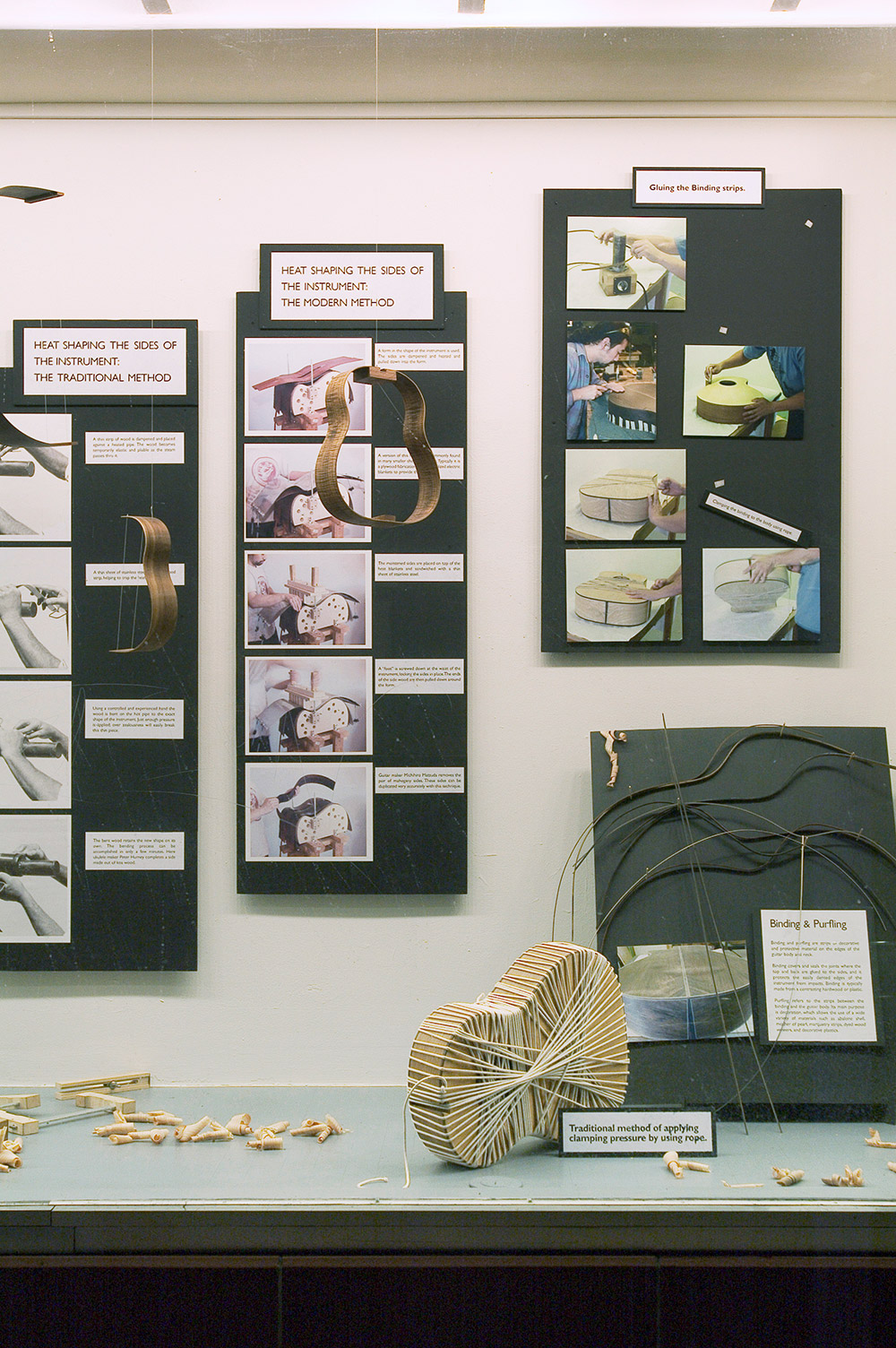
Bending sides
Bending sides
Bending sides
Bending sides
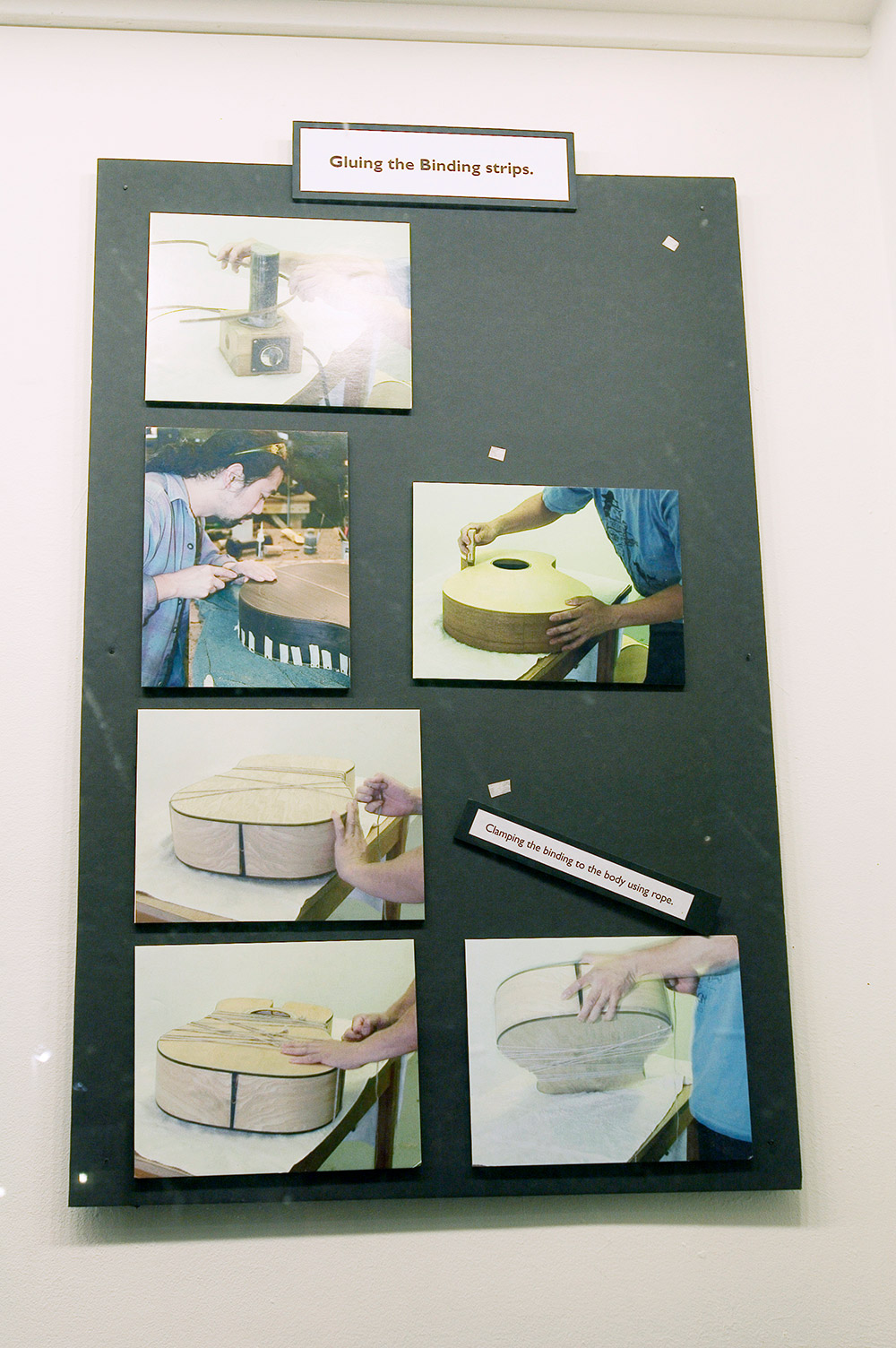
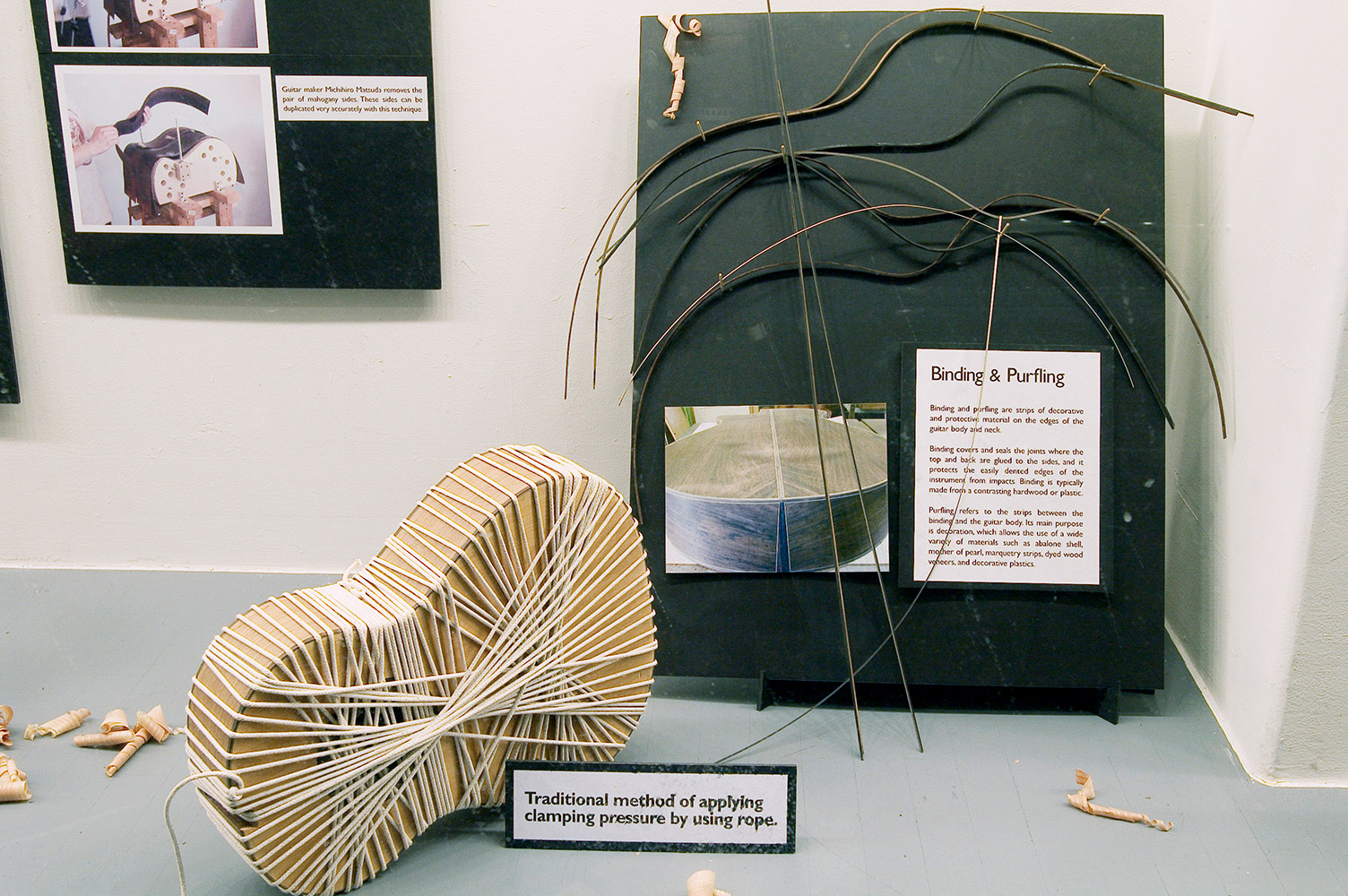
Gluing in the binding strips
Traditional rope binding
Thoughtful, informative displays
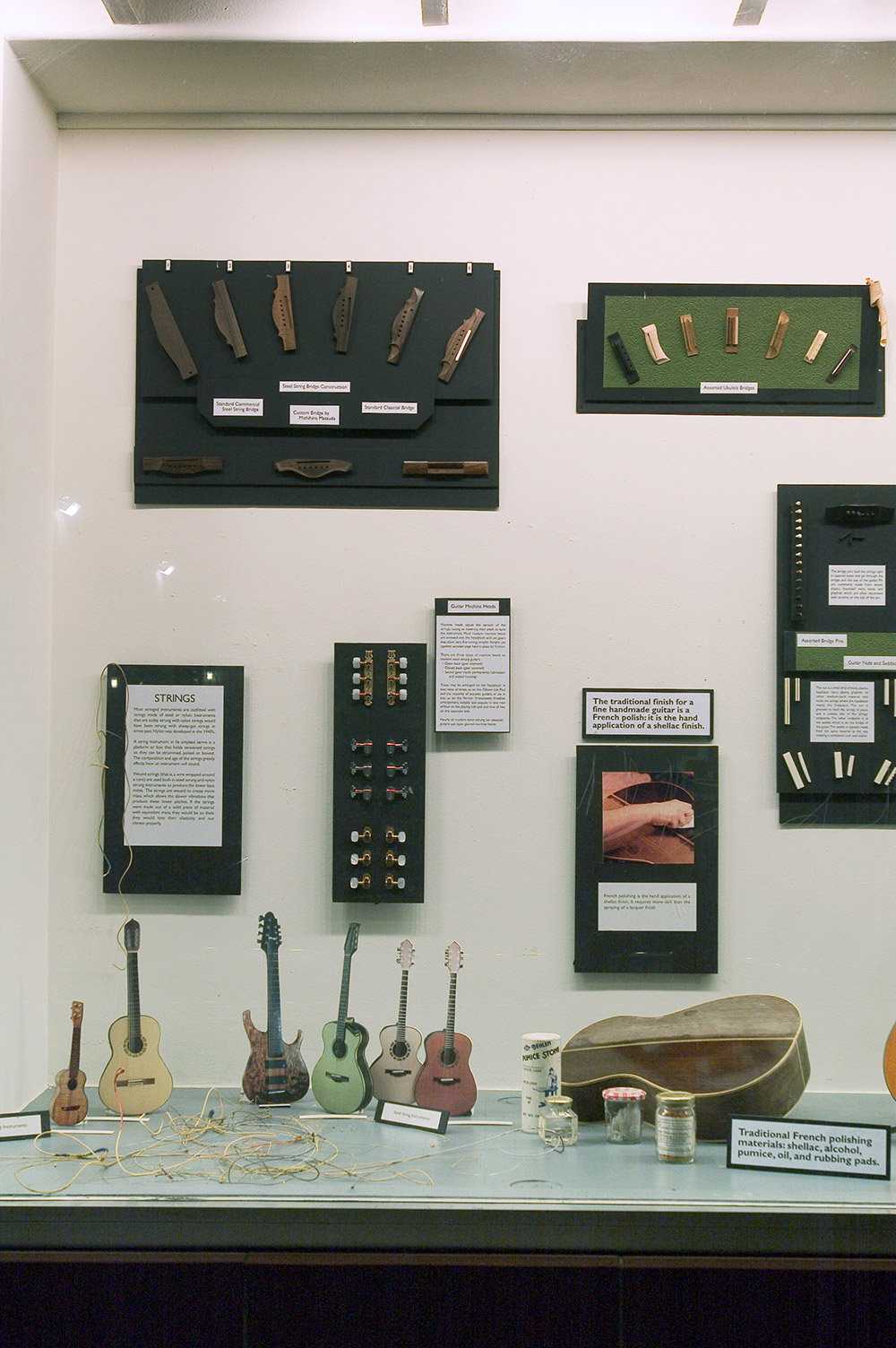
Explaining the small things
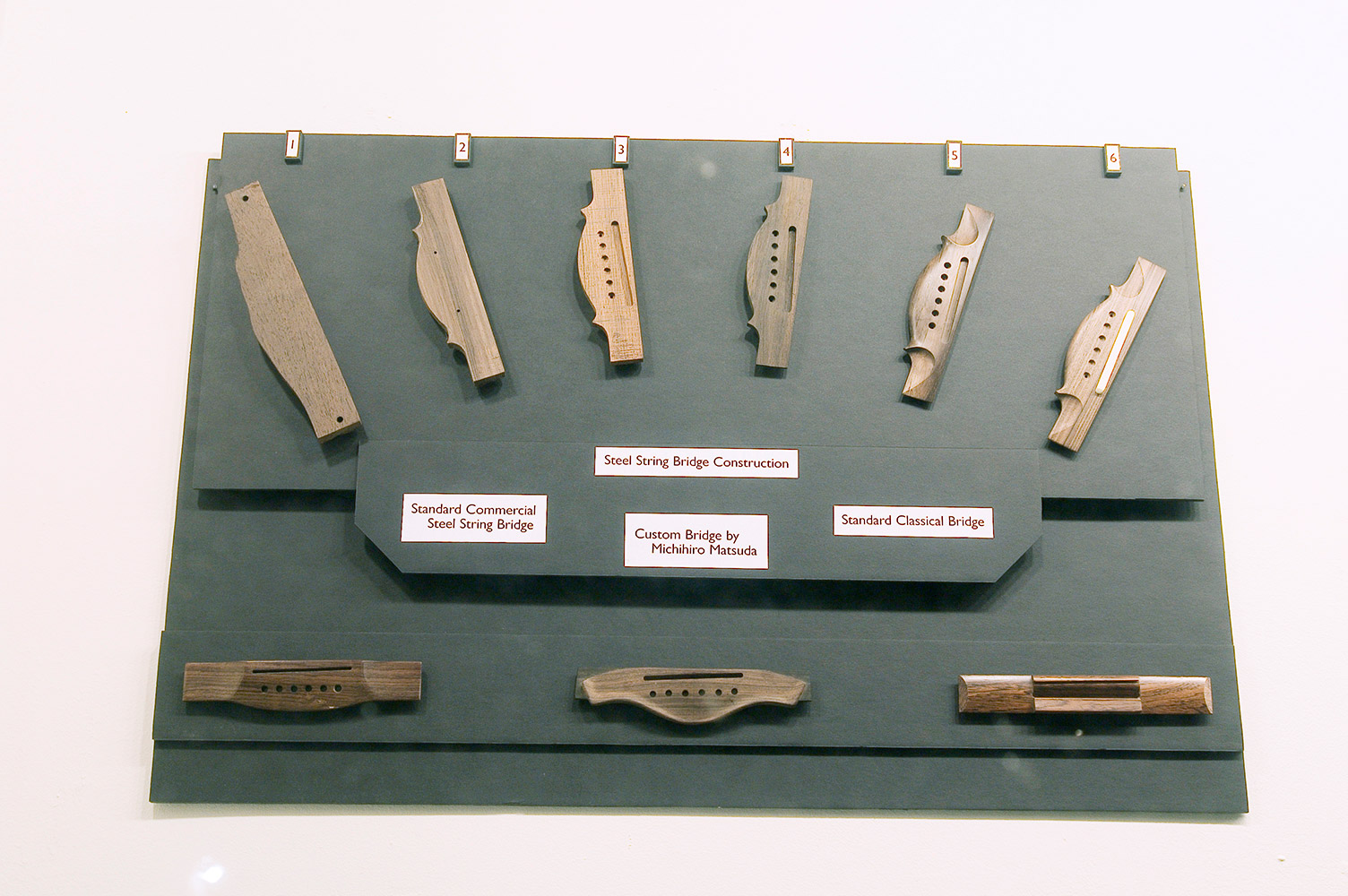
Guitar bridge making
Guitar bridge-making
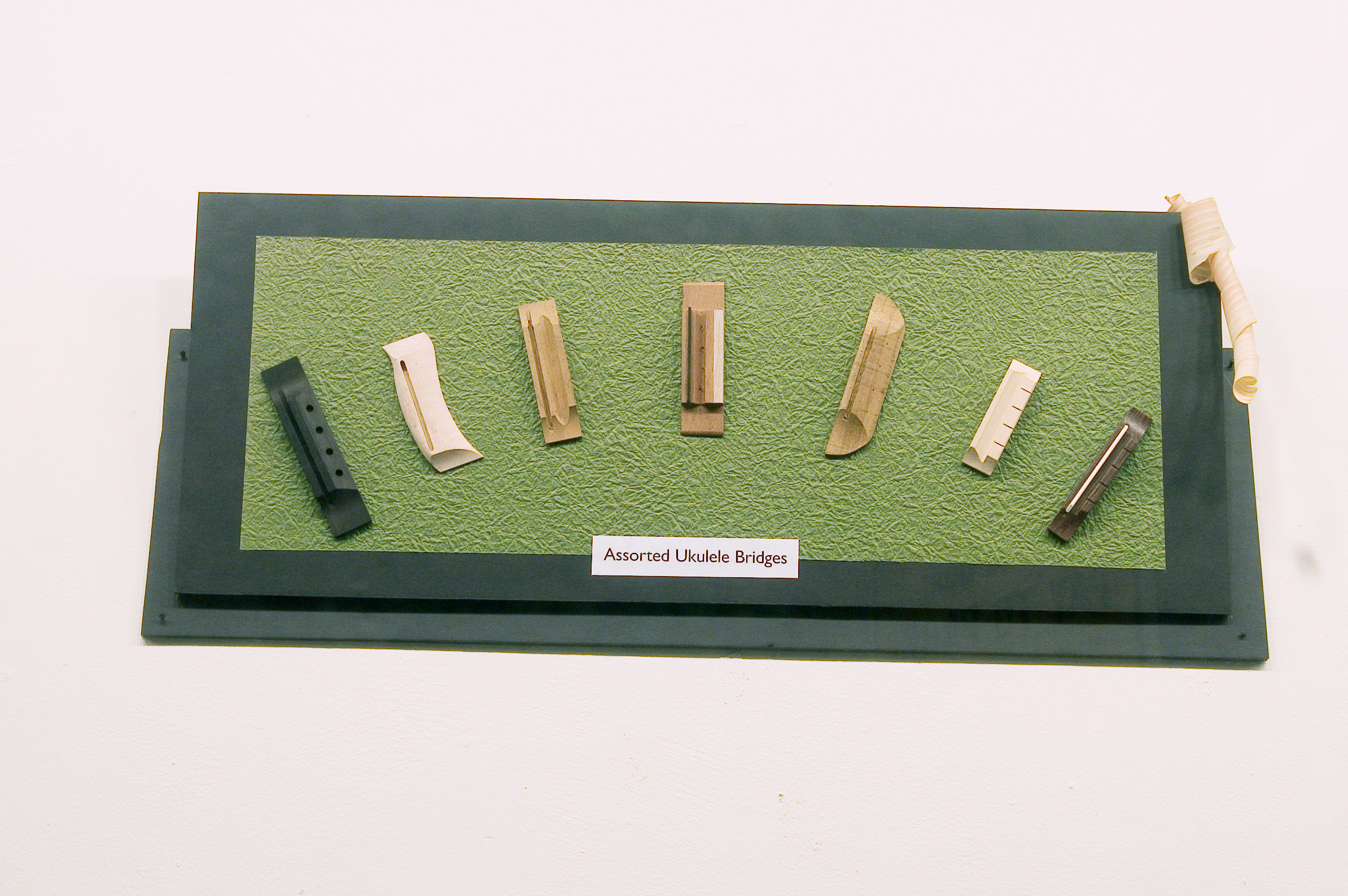
Ukulele bridges
Ukulele bridges
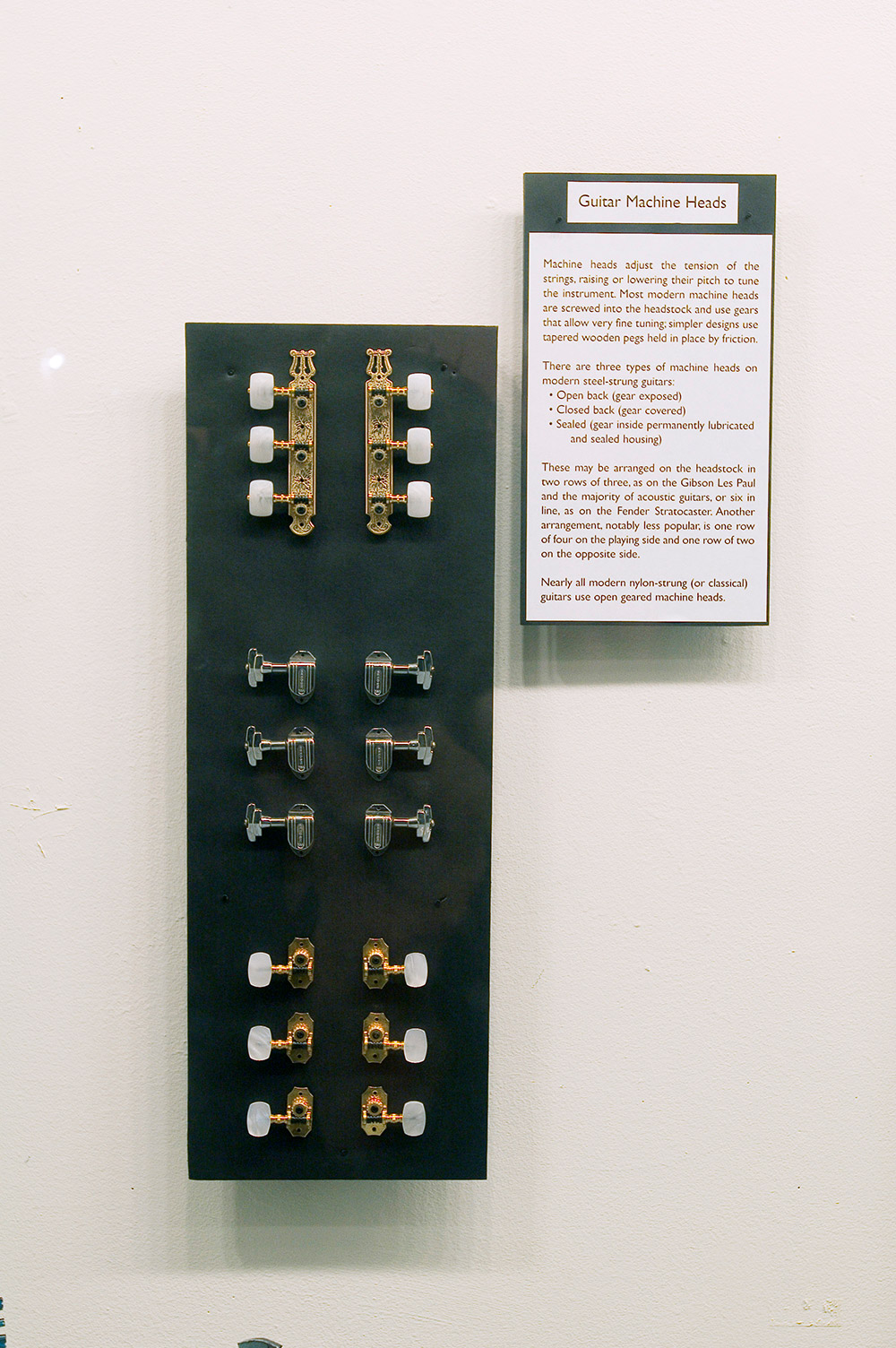
Tuners and machine heads
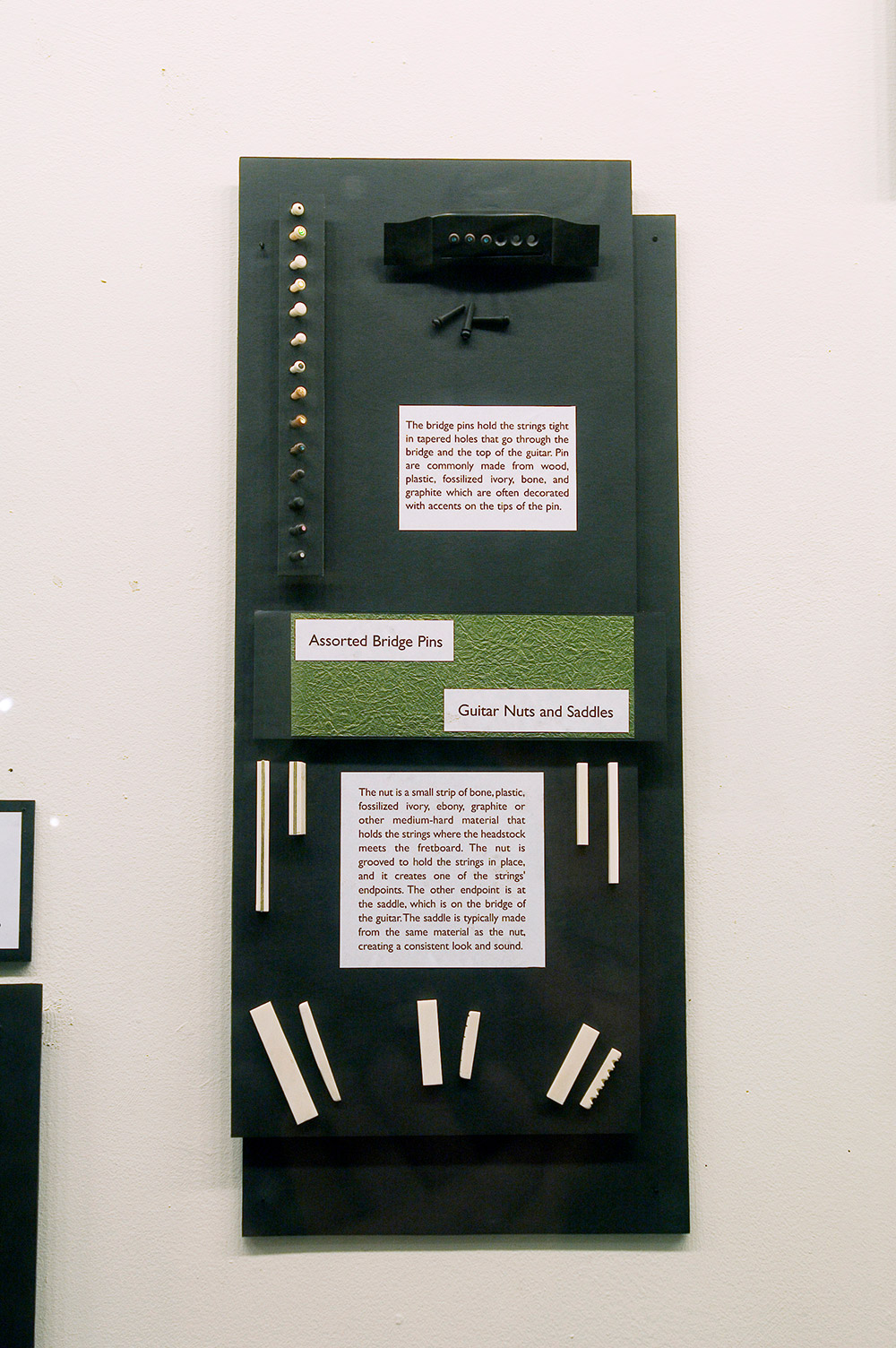
Nuts, saddles, and bridge pins
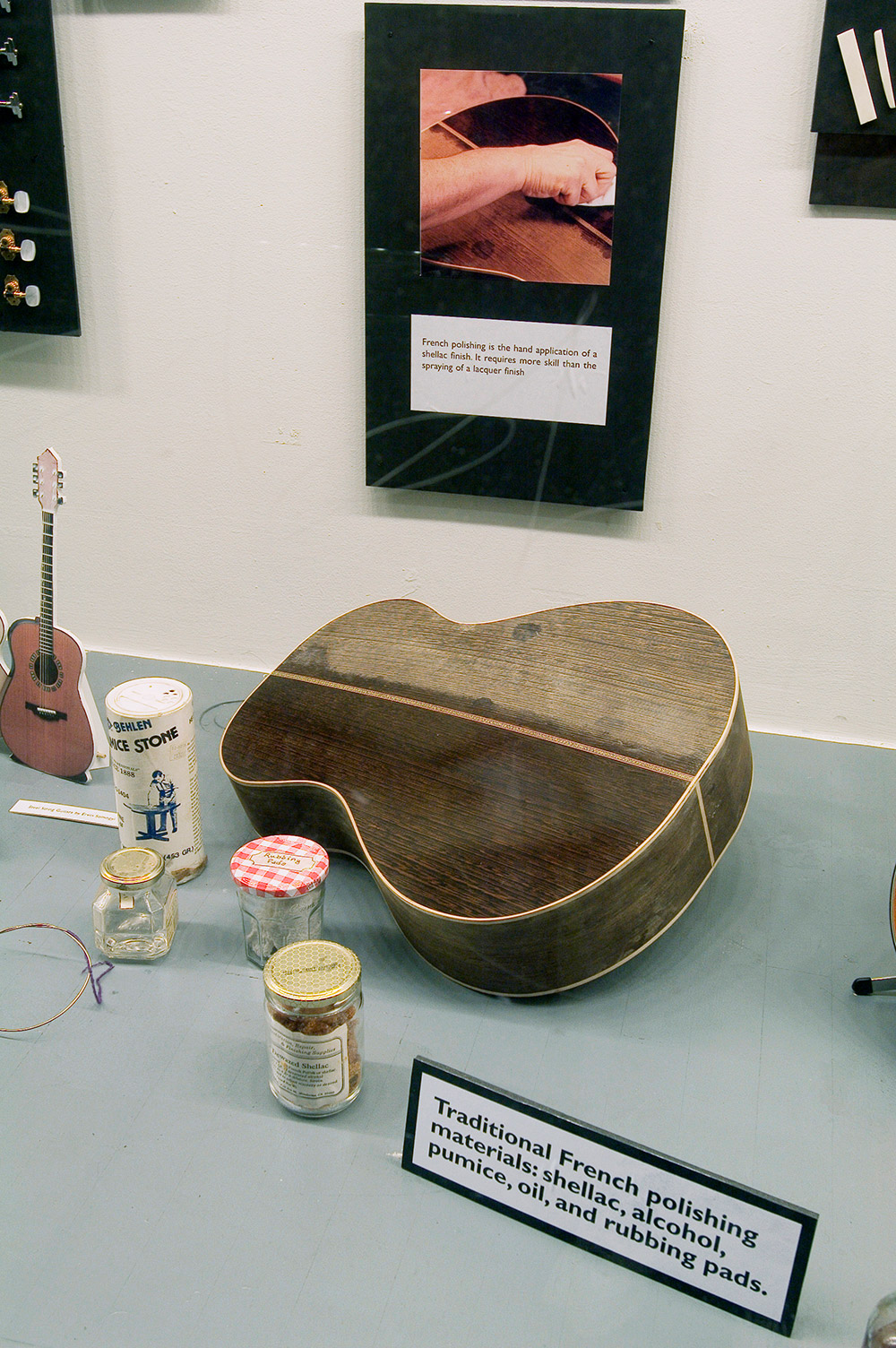
French polishing
French polishing
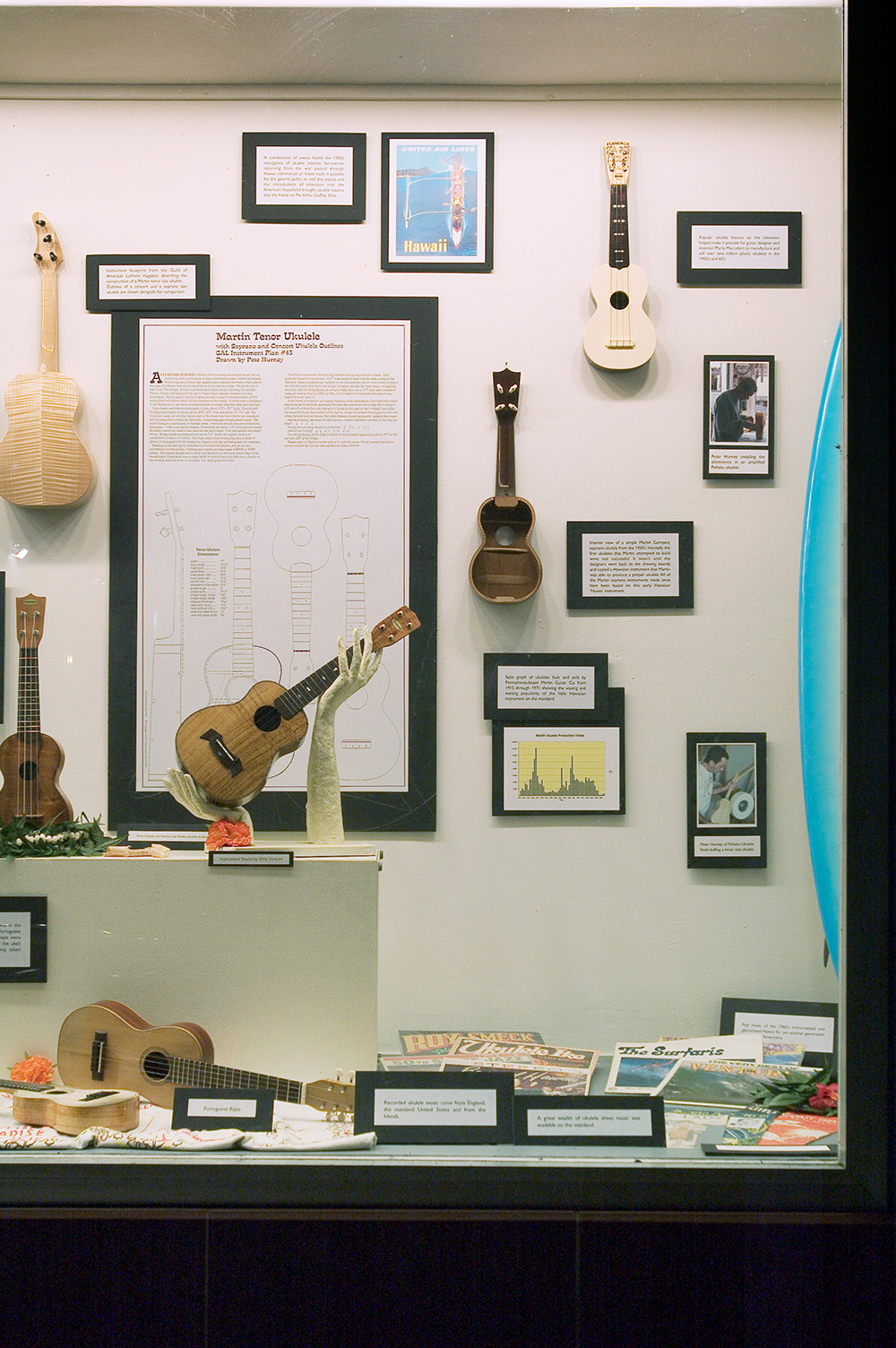
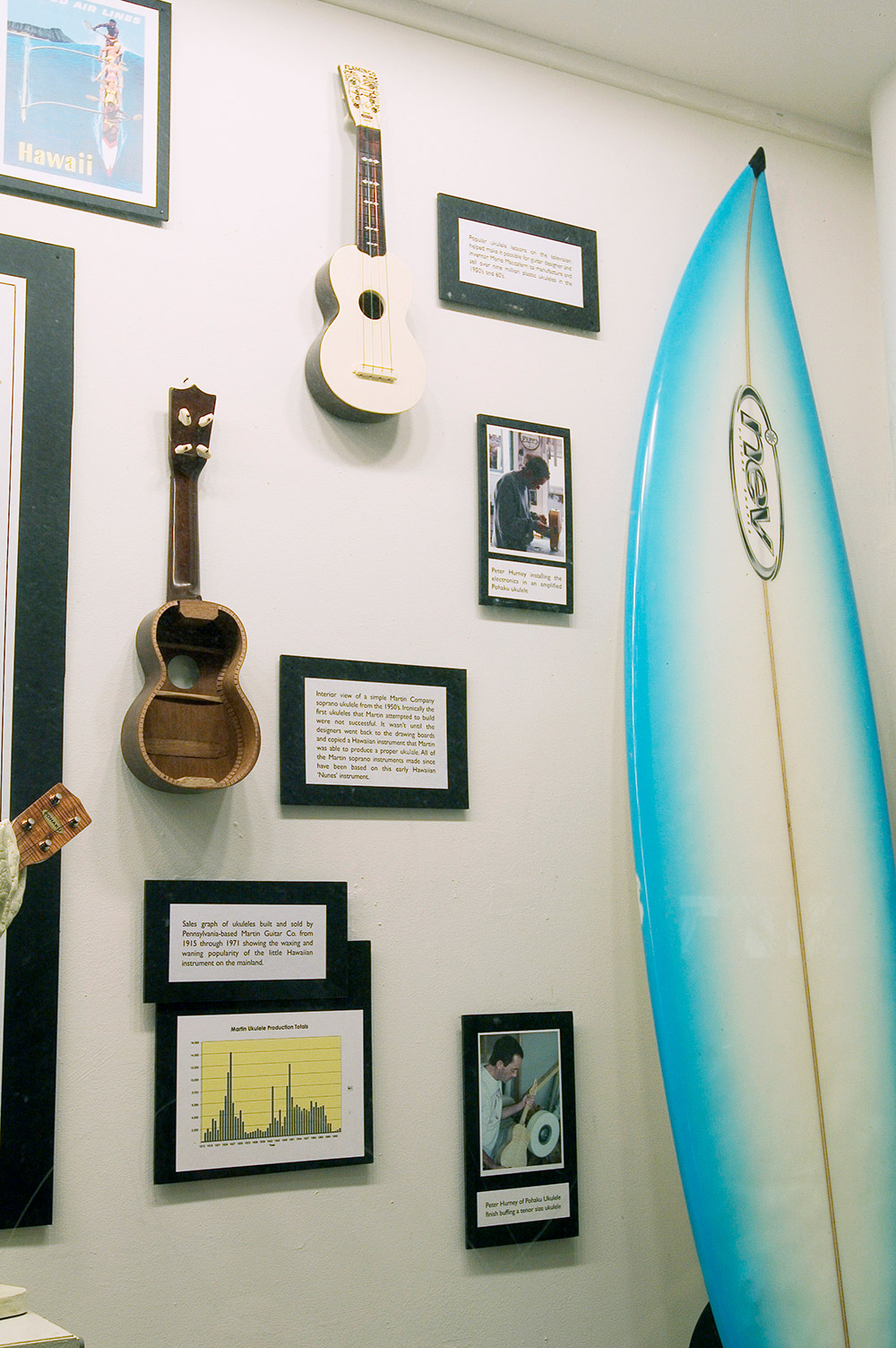
The Hawaiian ukulele
Ukulele design
Ukulele design
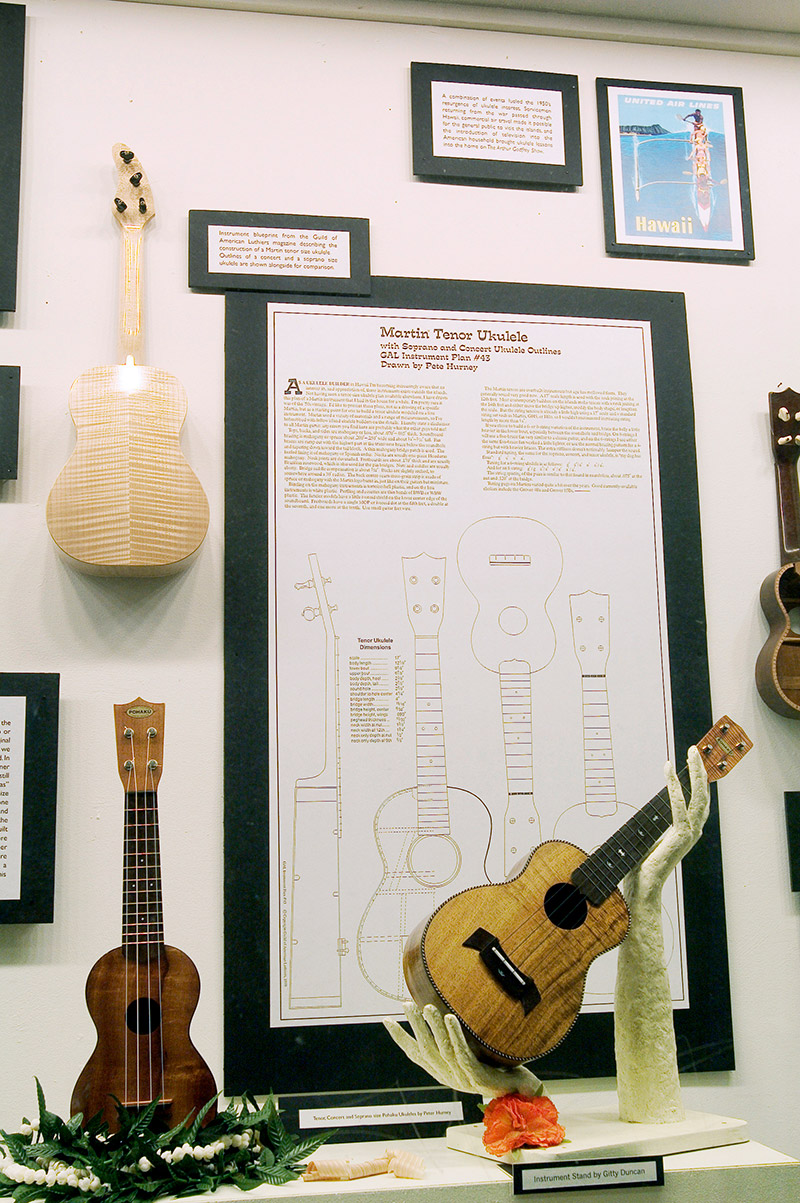
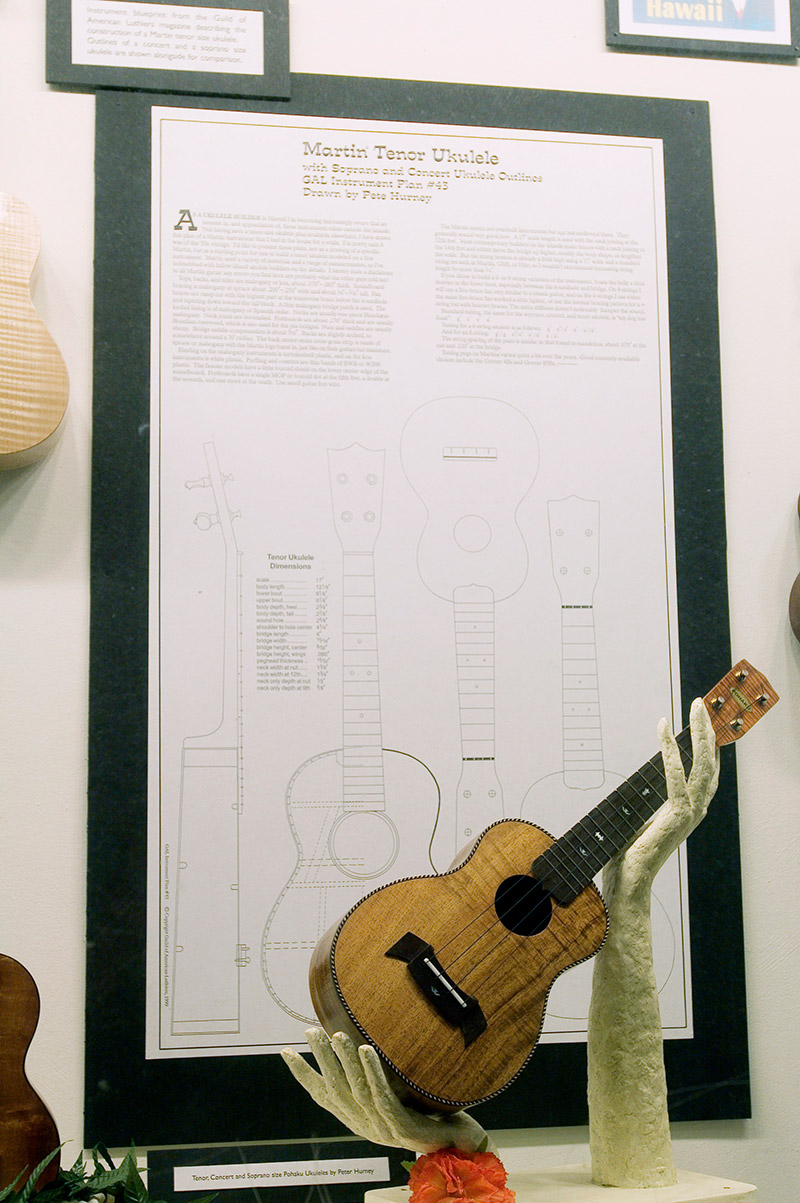
The tenor ukulele
The tenor ukulele
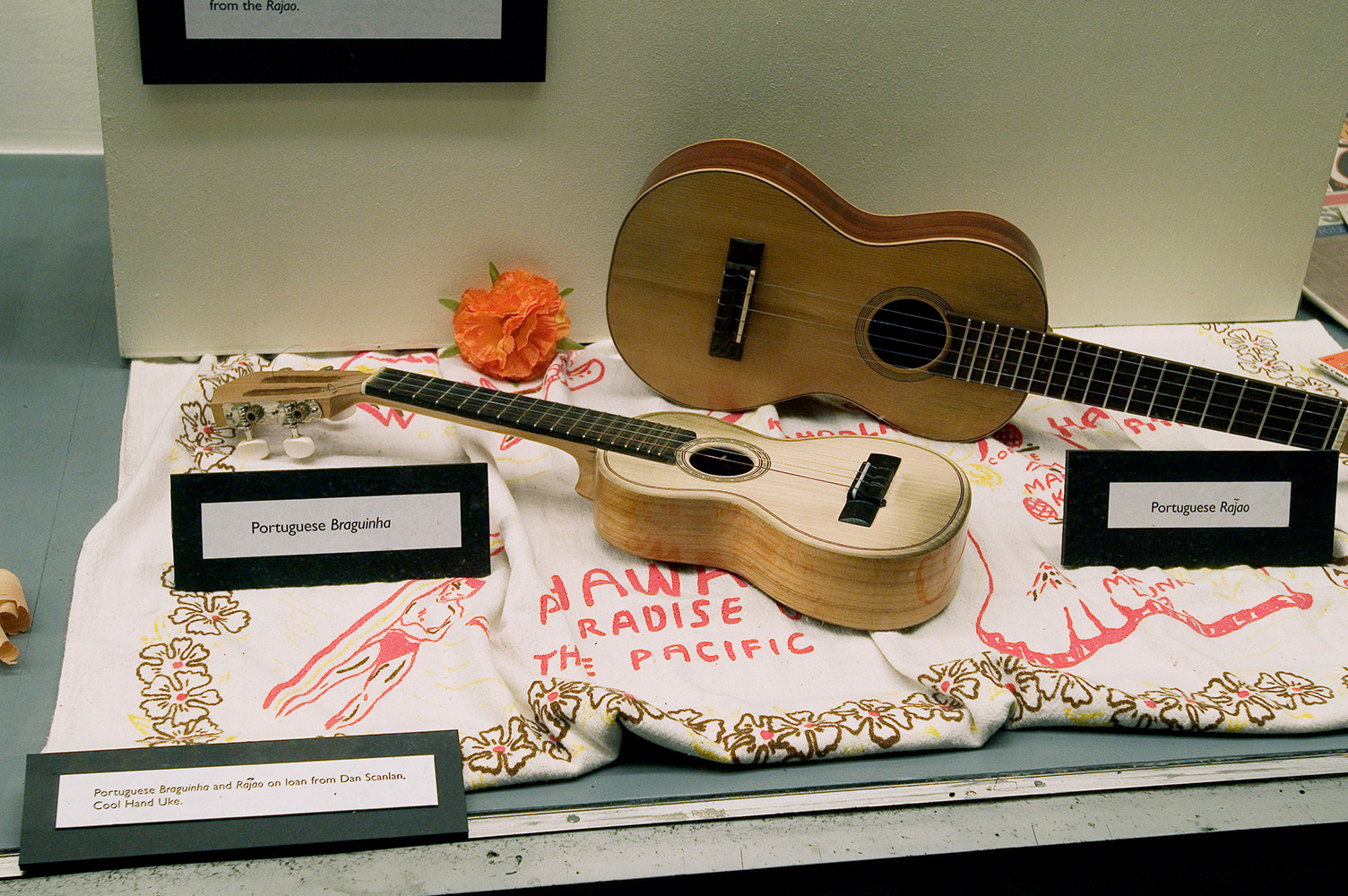
Portuguese ukuleles
Portuguese ukuleles
Ukulele lore and music
Ukulele development
Ukulele development
Guitar lore and history

I’ve spent close to fifty years by now being fascinated by the six-string guitar, exploring its possibilities, and making various versions of it — despite the fact that underneath it all it is no more than a long-term but nonetheless a contemporary convention and a fad, and not essentially different from propeller airplanes, typewriters, lutes, galleons, vinyl records, bows and arrows, and the Roman Empire.  It is simply a wonderful, useful, interesting, and effective cultural element and icon of our times . . . but by any long-range measure it is surely impermanent, and temporary.  

The guitar as we know it is only some 170 years old and has ALREADY morphed into something that the originators would only recognize with difficulty.  At the same time the challenges of daily life, of growing up, of finding meaning and significance, of the interactions between the sexes, of personal gain and loss, of identity, and the problems family and money and survival and responsibilities and bringing up children . . . are permanent and are the stuff of life itself.   The guitar itself, morphed or not, is only a part of all that.


MORPHY’S LAW

Speaking of the guitar’s having morphed, it’s morphed very interestingly.  Let’s start with the fact that the humble guitar started out as something to plunk, twang, and strum songs on, and nothing more.  I mean, Antonio Torres, the man who “invented” the modern guitar, was a carpenter, for cryin’ out loud, so there wasn’t much of a bottom line attached to making guitars.  There were proto-guitars and guitar-like stringed instruments, but nothing approaching even a hobby as far as the modern guitar is concerned! 

Actually, I mis-spoke with my comment on the guitar being useful for twanging and plunking on; that was mostly true of the American steel string guitar.  The precursor of the Spanish guitar was being used early on to compose and play sophisticated melodies on; this speaks to the different cultures that had adopted the guitar; there were people even then who saw serious musical possibilities in it.  Then, eighty-plus years later, about the time the guitar was beginning to be electrified, the acoustic steel string guitar’s voice began to be heard for the first time by itself and without accompanying instruments — in the singing cowboy movies of the 1930s and 1940s.  You know: the ones where the good guy — the one with the white hat — fought off the black-hatted evil guys and through sheer virtue and pluck overcame them and won.  As it happens, these movies served a social need.  They came to the fore in the Depression-era social landscape in which people needed something to feel hopeful about.  And Hollywood capitalized on that — and singing cowboys became stars!

At the ends of these morality-with-six-guns films the triumphant hero would pull his guitar out and sing a song.  And instead of riding off into the sunset with the girl he departed with his horse and his guitar . . . with his sexual virtue intact.  These movies were chaste; there was no sex in them and the hero’s chief love object was his horse.  I can tell you with authority that that formula really works for ten-year olds.  And it certainly did so for an American population that was beaten down by the Great Depression and sorely needed heroes and upbeat entertainment . . . especially when no one knew that the actors and actresses were, in real life, fucking like rabbits when off-camera. 

And then, in the early 1950s, Elvis Presley came along and shocked everyone by swaying his hips seductively and strumming on his guitar on national television; it was the first time a whole lot of people had ever heard the guitar’s voice more or less by itself.  In any event, while this history has failed to give the acoustic steel string guitar anything like the cachet of sophistication that the classic guitar has managed to attain, it did something else just as remarkable: it has driven the steel string guitar deeply and indelibly into people’s minds as something associated with the honest, hard-working, always-acting-in-good-faith-against-strong-odds working man and good guy.  And winning.

Consider this: not one of you reading this has EVER seen ANY movie, film, or stage play, or tuned in to ANY TV show, or read ANY magazine or book … in which the bad guy plays the acoustic guitar.  

It just isn’t done.  The acoustic guitar is the hero’s instrument.  The bad guy plays the piano, the organ, or the ELECTRIC guitar.  Check this out for yourselves.

Wow. 

Posted in Essays & Thoughts, Features By Ervin, Guitar theory, history, opinions, sociology, wisdom, & insights

A Digression Into Matter of Top Thickness

The following is an excerpt from the new book that I’ve been writing for the past three-plus years. It will be another while before it sees the light of day; but it’s copyrighted and if any of you wants to use it for anything you have to ask permission to do so, and then give me attribution for it.  Sorry about that: it’s how business works.


I had, in earlier writings, brought up the matter of top thickness and my refusal to reveal the magic numbers.  Well, the top’s thickness is, along with the layout of the bracing, the most debated and tinkered-with area of lutherie.  It is so for two absolutely important considerations.  The first is that the guitar top is the “soul of the guitar” (that is, its physical characteristics set the stage for tone) along with the corollary that “the lighter the construction of the top is, the better the sound”; in fact, there is an adage among Spanish guitar makers to the effect that “the best guitars are built on the cusp of disaster”.  And this brings us to the second consideration: there is a minimal top thickness/stiffness/strength that must be respected if the plate is not to cave in under string load.  If sheer durability were one’s principal consideration then the guitar could be made of 2 x 4s ; that will make any instrument very durable indeed. But if sound is one’s objective, then the luthier’s skill lies in finding the correct balance point between the imperatives of ‘not too light’ and ‘not too heavy’ construction; and that balance point will be where the guitar is just strong enough to hold together.

In my work, I take my tops to a target deflection under a standard weight rather than to a predetermined, formulaic thickness.  I’ve worked like this for a long time now and have written about my thinking and techniques at length.  Still, my method may not work for everyone.  There are a lot of guitar makers out there who swear by specific target measurements, and I’m not sure I have the right to say they’re wrong to do so.  My own preferred method is different; it just means that, because of the variations of specific physical characteristics of any individual guitar top, each of my tops is a little bit different in thickness. The question comes up, then, of what is the proper justification for focusing on one or another specific number for top thickness?  And, what would that number be?  Well, it seems to me that a good place to begin would be to have some idea of where the measurements that we do know about, read about, have heard about, and use come from.

Many of my generation of American luthiers got our start by reading Irving Sloane’s seminal book Classic Guitar Construction, which appeared in 1966.  This was, after A.P. Sharpe’s 32-modest-pages long Making the Spanish Guitar (published in 1957) the first available ‘real’ book on guitar making.  Sloane advised the reader to make his tops 3/32” thick, which is equivalent to .094”, or 2.34 mm.  Mind you, this instruction appeared before any of the two-dozen-plus books on lutherie that are now available, and before the plenitude of secondary sources of information that now exist.  How did Mr. Sloane — who was not only writing very early in the game but had, as far as I can ascertain, only built a few guitars on his own then — come up with this number?  Well, perhaps by reading Sharpe’s book (which recommends the same measurement), and very likely by measuring some guitar tops and by talking with some contemporary makers.

He doesn’t seem to have spoken with Vicente Tatay, one of the early Spanish luthier-transplants to the U.S., though.  Tatay came from a prominent Valencian family of guitar makers and presumably knew what he was doing, guitar-making-wise, even before he took his plunge into the New World.  Once here, he wound up working out of a store in Greenwich Village and became, by so doing, one of Mr. Sloane’s fellow New Yorkers.

There’s a wonderful article by Steve Newberry, published in American Lutherie (“Vicente Tatay and His Guitars”, issue #66, Summer 2001, pp. 47-49)about the state of lutherie and its lore in the U.S. many years ago.  It is told from the point of view of the author who, as a teenager, became fascinated by Mr. Tatay’s work and talked him into being allowed to hang out in Tatay’s shop after school hours and be of some help by sweeping, cleaning, etc.  In exchange he got to observe Mr. Tatay at work, of course. This turned out to be a mixed pleasure: Mr. Tatay is described as having been a gruff, cantankerous, cranky and closed-mouthed chain smoker who had an explosive temper and spoke only Spanish.  Still, one afternoon toward the end of the Summer, in an uncharacteristic moment of expansiveness and letting down his guard, Mr. Tatay motioned the young Newberry over to his workbench and, using hand gestures and some coins, indicated to him that the secret to his lutherie was to make the guitar top about the thickness of a nickel in the middle, and the thickness of a dime at the edges. (I should add that a lot of Spanish guitar making in those days was done just like that: by skilled feel and eye, and with amazing accuracy.)  Tatay might or might not have known the numerical values of his thicknesses but he certainly knew how to work to such tolerances at the workbench.  Incidentally, nickels and dimes are about .075” (1.9 mm) and .050” (1.34 mm) in thickness, respectively.  Give yourself a treat and look that article up; it’s as well written as anything Mark Twain ever wrote.

Four other books on guitar making followed Irving Sloane’s pioneering work on guitar building.  Classic Guitar Making y Arthur Overholtzer, published in 1974, immediately doubled the available information on this subject.  The other three were Donald Brosnac’s The Steel String Guitar; Its Construction, Origin, and Design (1973), David Russell Young’s The Steel String Guitar; Construction and Repair (1975), and Irving Sloane’s follow-up book Steel String Guitar Construction (1975).  These last three were the first sources of published information on the steel string guitar and their recommended guitar top measurements were 3/32” (.094”) . . . 3/32” (.094”) . . . and 7/64” (.109”), respectively.  Overholtzer’s top measurements took into account wood density and hence presumably stiffness: for classic guitars his recommendations are 3/32” (0.094”) for soft spruce and 1/16” (.062”) for hard, dense spruce.  For steel string guitar tops he recommends 3/32” to 1/8” (.094” to .125”).

With the exception of Mr. Overholtzer, who had been a violin maker for some years previously, the others were pretty much acting as novice discoverers, craftsmen, and pioneers — as I myself was, except that I hadn’t written a book yet.  I think it’s safe to assume that these young makers/authors were following each others’ and the Martin Company’s leads; and I was certainly following theirs.  The Martin Guitar Company comes into this discussion because it was the best known steel string guitar producer of that time and would have been everyone’s main point of reference for making a steel string instrument.  Certainly its most recognized and popular model, the Dreadnought, was that.  (The Gibson company’s guitars were almost as well known as the Martins; however, all considerations of quality and tone aside, that company simply put fewer of its resources into advertising and its level of public recognition/popularity would have been consistent with that. The Guild company would have come in third in name-recognition; but it copied the Martin dreadnought shape, thus further reinforcing that model’s dominance.)

Irving Sloane, whose second book Guitar Repair (1973) focused on steel string guitar repair procedures, was surely in the Martin camp: the photos were taken on the Martin Guitar factory premises, and the repair procedures that are described were carried out on the Martin company’s workbenches — on Dreadnought guitars.  That guitar model was David Russell Young’s and Don Brosnac’s primary focus as well, in their books.  I asked Mr. Brosnac where he got his book’s recommended measurements from; he told me that he got them from Jon Lundberg, the legendary Berkeley-based Martin guitar retro-voicing pioneer, who was in those days possibly the world’s leading expert in that guitar — at least away from the Martin factory premises.On the other hand, both Overholtzer and Sloane seemed to take a lot of cues toward their classic guitar making from the work of Robert Bouchet (1898-1986), a noted and innovative French builder.  While information in general seems to have been scarce in those days, Bouchet appears to have been relatively open with information.  The established Spanish makers weren’t talking or writing anything about their approach to guitar making.

In 1987, twelve years after the last of the above books was published, the bibliography of guitar making took a major step forward when William Cumpiano and Jon Natelson published Guitarmaking: Tradition and Technology.  This was the first book to address making both classic and steel string guitars; its recommended top thicknesses were the most comprehensive yet because it recognized that not only does (1) size of guitar and species of wood used make a difference, but that (2) different makers have significantly different building designs and ways of using their materials because (3) a guitar’s intended target sound might not be the same in every instance.  A maker might use a thinner top with increased bracing, or a thicker top with minimal bracing, or a different bracing pattern entirely, or use different strings with different string pull and torque, etc.  Accordingly, top thicknesses are suggested rather than instructed.

Top thickness targets for classic guitars are given as around .100” (2.5 mm) for spruce and .110” (2.8 mm) for softer wood such as cedar.  For steel string guitar the recommendation is 1/8” (.125”, or 3.17 mm) for a first-time project, but otherwise ranging from .095” up to .130” (2.4 mm to 3.30 mm) depending on size and shape of instrument as well as species of wood used.  One can see that thinking about top thickness was getting more sophisticated — although, given that these are all method-books, the suggested measurements must still all be considered to be Rules of Thumb.

In 2009 I published my two-volume book.  In it, I didn’t give any specific measurements for optimal top thickness; instead, I dwelt on the practice of thinning to deflection rather than to dimension; this has always seemed to me a better guide than the thickness of the wood is, in order for one to most meaningfully track their progress over time.  I also wrote at length about the balancing act that one is called on to make in matching a guitar’s bracing to its top’s stiffness.  I furthermore said that I worked to thinner target dimensions than the average luthier does.  It may have been self-serving of me to not mention a specific thickness for tops and keep that information to myself; but I don’t really believe that simply telling a young luthier to make his tops, say, two millimeters thick — and without mentioning the multiple other factors that have to be met correctly — is a high-quality communication.  And my book does dwell at length on all the dynamic factors that I consider important.

In 2011 Australians Trevor Gore and Gerard Gilet published another ambitious two-volume book, Contemporary Acoustic Guitar: Design and Build. They do not seem to have fallen into the trap of advising a fixed target number for top thicknesses.  They seem to have very intelligently advised working in an optimal range of thickness.  That’s really the way to go, I think. Besides Gore’s and Gilet’s books, a number of other volumes on guitar making have also appeared, each of which suggests certain target numbers for top thickness.

Finally, I want to call one other book to your attention: Don Brosnac’s An Introduction to Scientific Guitar Design, published in 1978.  It didn’t offer specific measurements for anything, but I want to mention it because it was the first book that looked beyond the how-to-do-it and who-did-it-first level to explore the guitar’s wider accessibility from a discipline other than that of basic woodworking.  Up until then, everything else written had been (and would for years to come) be mechanical-level-instructional, archival, historical, and otherwise full of declarative sentences.  But Brosnac’s was the first book to take a step back and address the more general topic of what else besides woodworking the guitar might be about— which made it interesting to me personally.  That publication has since been followed by a fleet of books, articles, and essays that have examined the guitar as art, science, physics, wood technology, disciplined efficiency in production, engineering, acoustics, a collectible object, a genre/cultural icon, zen, an artifact of musical and/or economic history, etc.  With the entry of many talented Born-Again-Christians into the field, I expect that there will sooner or later be a book about The Modern Christian Guitar too.  Mr. Brosnac did pioneering work and the field is still wide open to new ways of understanding, and approaches to, this interesting instrument.

PUBLISHED RULES-OF-THUMB FOR TOP THICKNESSES

Anyway, getting back to top thicknesses: according to the published instructions that I’ve cited in the three decades between 1957 to 1987, top-measurement for classic guitars are:

1/10”  (.100”)  to  7/64” (.110”),
or   2.5 mm to 2.8 mm;

3/32”  (.094”),   or   2.34 mm;

1/16”  (.0625”),   or   1.59 mm;

  0.050”  to 0.075”,   or  1.34 mm to 1.9 mm
(i.e., the thicknesses of a dime and a nickel)


. . . . . and for steel string guitars they are:

3/32” (0.094”  or   2.38 mm)  to  7/64” (0.109”
or   2.77 mm);

and from 1/8” (.125” or  3.17 mm )  to a fat 1/8” (.130”  or   3.30 mm),

Does this get us anywhere?  Well, sort of.  It tells us that, at least in the classic guitar, one can go as thin as 1/16” (about 1.50 mm) and still have the instrument hold together.  That’s useful to know — as is the fact that Overholtzer is in a minority in promoting such thinness; he and contemporary luthier Greg Smallman go remarkably thin, but very few others follow suit.  As for steel string guitars, we have no published accounts of whether there is a top-thickness limit that’s below 3/32”; if anyone one (other than me) has tried to push that envelope they haven’t written about it, to my knowledge.

You should know two things.  First, that stiffness/thickness numbers are just that: they are not very meaningful in the absence of information about doming and brace layout/treatment.  And second, that Tatay’s previously mentioned top-shaping approach is the traditional one used by Spanish classical and flamenco guitar makers: the top is made to a target dimension in the middle but it is thinned in the outermost inch and a half or two of the lower bout, from the waist down, to another target dimension.  We know this because work of this type is found in the instruments of established classical guitar makers whose guitars have been studied and carefully measured.  Experts can even date certain classic guitars through specific variations in their measurements, which will have been documented from the various periods of their makers’ careers.

Flamenco guitars lack the social and academic respectability of their rosewood-built sisters and have not received such formal attention; they get played a lot but are not studied or otherwise paid serious attention to.  Ditto steel string guitars.  And speaking of these, Sloane’s and Overholtzer’s recommendations of uniformly-thicknessed classic-guitar-top measurements, previously cited, actually come out of the steel string guitar making tradition in which the top is the same thickness throughout, without any selective tapering or thinning.  This itself follows from an efficient manufacturing methodology of putting the wood through a sanding machine and then using the wood that comes out the other end, without any further refinement– as opposed to the pre-Industrial European traditions of using hand tools in tapering, controlling, and achieving variable dimensions of the parts. Go team.

Posted in Essays & Thoughts, Guitar theory, history, opinions, sociology, wisdom, & insights Tagged top thickness

Guitars, Virtue, and Nudity: The Guitar as an Icon of Culture, Class Status, and Social Values

by Ervin Somogyi
 

In a recent conversation I was asked my thoughts on what, exactly, makes the guitar so alluring? What has made it so… well… so widely loved by people? I mean, it has managed to capture popular imagination so thoroughly that it is a bona fide world-recognized icon. Such things don’t happen by accident. So: how did it do it?

I don’t claim to definitely know what has made the guitar so easy to bond with; it’s neck-and-neck in acceptance with the violin — which, along with its separated-at-birth-twin the fiddle, has enormous currency in very different social-musical circles. I mean, I’m told that there are at least as many violins as guitars made annually world-wide, and somebody has to play them, right?

I more or less doubt that the reason we have perfected the designs of these instruments has to do with anything like a genetically innate sense of preferred shape; if it were, we’d have had guitars and violins 25,000 years ago. But the guitar has been said to be a stylized representation of the female form — the allure of which is certainly timeless. I do believe that there’s something to be said for the prettiness-in-simplicity of the guitar: it pleases the eye right off the bat: it consists visually of a few nicely curved lines (made by two bent strips of side wood rather than the violin’s broken-curved six) that contrast, in an uncomplicated way, with the (mostly) straight lines of the neck and frets. It’s a combination of line and curve that is so elemental that even Picasso found inspiration in it.

There are some obvious reasons for the guitar’s popularity. For one thing, it is portable and one can take it anywhere. In a word, it’s convenient. [NOTE: that word comes from the Latin con (with) and venire (come, or coming); in other words it comes with you; it’s at hand; things that are convenient don’t resist you or put up a fight.] Second, the guitar is capable of playing polyphonic music. Compared to wind, reed, percussion and bowed instruments which can play only one or two notes at a time, the guitar can play chords and melodically complex and interesting music. Third, the guitar is well suited to accompanying man’s primary musical instrument — the human voice — in all its ranges and registers. Indeed, this instrument’s first uses were mostly devoted to that; it was only gradually that the guitar developed its own voice.

Next, I believe that much of the guitar’s charm comes from the fact that it is a physically intimate instrument. As one strums or picks on it one hugs and enfolds it. One literally puts one’s arms around it, and even bends the body over it, as it rests on one’s lap. And there’s a genuine somatic pleasure in feeling it vibrate and respond . . . something a bit like the purring of a cat on one’s lap. At least, this is true of the nylon-string classic and the acoustic steel string guitar, when the player is sitting. I don’t think one should underestimate the sheer physical pleasure of playing this person-sized instrument. I mean, one also hugs one’s cello and harp in much the same way, and the bass drum hangs from one’s tummy; but these lack the guitar’s personal-size quality. Most other instruments don’t offer or require that much body-contact; hands yes, mouth yes, fingers yes, chin yes, ears yes . . . but not much else. The guitar is very much a physically user-friendly instrument.

A fifth reason for the guitar’s pleasingness, I think, is that it is made of wood. There’s something friendlier about wood than metal, ceramic, glass, or plastic can generally manage to provide; wood is warm and invites the touch and handling it has given pleasure ever since people began to use it. Other materials don’t offer quite so much of that.

And then, the guitar makes a lot of music easily accessible. Pretty much anyone can learn three chords in about ten minutes and actually play (strum) songs! And yet, this instrument can, from such a simple beginning, pull one in to an entire lifetime of learning and exploration without getting to the end of its musical, rhythmic, tonal, and expressive potential.

This potential is based in the guitar’s amazing versatility. Whereas most other instruments — whether they be plucked, bowed, percussion, or wind — can’t easily produce more than one voice, the guitar can express many. It can do this because it is capable of emitting a huge range of sheer sound depending on how and where it is played, plucked, strummed, hit, stroked, strung, thumped, or scratched. It can also play pretty much any mode of music and musical expression: fast, slow, rhythmic, syncopated, Phrygian, Myxolidian, Dorian, romantic, richly round and colored, tinny, sappy, sad, ominous, trills, contrapuntal, pop, percussive, sweet, ethnic, classical, blues, sea chanties, cantatas, country, flamenco, fiddle tunes, piano music, Hawaiian, fingerpicking, flatpicking, Klezmer, tremolo, bluegrass, folk, Celtic, gypsy, New Age, mariachi, spiritual, heavy metal, jazz, twelve-tone, mournful, happy, sharp and jangly, bossa nova, monophonic, polyphonic, waltzes, scherzos, schotisses, minuets, tangos, czardas, fado, lieder, Japanese/koto, tambor effects, chordal, choral, atonal, martial, Baroque, Indian, Arabic, Spanish, Balkan, Jewish, Mexican, Italian, ragtime, rock’n’roll, rubato, pizzicato, waltzes, minuets, fox trots, Huapango, madrigal, Andean, Chet Atkins style, Django style, campfire music, fusion, gospel, Caribbean/reggae, acid rock, dirges, tarantellas, show tunes, pop tunes, ballads, son, Bach, Afro-Cuban, klezmer, salsa, ska, New Age, electronic, skank, experimental, impressionistic, bebop, doo-wop, minimalist, Habaneras, Andean Huaynos and Cumbias, Christmas songs, lute and fiddle and piano transcriptions . . . and tons of arrangements of all the above, and every composer from every culture and period you can name, and more. This is sooooo awesome.
 

THE GUITAR AS SYMBOL

All these things certainly illustrate the fact that a large part of the guitar’s charm is that it is extraordinarily adaptive and user-friendly. But there’s more to the guitar’s popularity than a mere list of what music it can play and how comfy it is to hold it: the modern guitar has insinuated itself into world audiences and cultural demographics in strikingly different symbolic as well as musical ways. I don’t know if a lot of people think of the guitar as a symbol of anything, but it is. As to exactly what it symbolizes, bear with me a bit here as I lay out some context.

Symbols are proxies for, and represent clumps of, concepts. Concepts (any concept at all: “mother”, “left hand”, “river”, “love”, “Malaysia”, “protein”, “gearshift lever”, “kangaroo”, “honesty”, “blue”, “mud”, etc.) are formed by our collective sensory experiences (images, sounds, smells, touch, movement, hearing, feelings, etc.) and thoughts/ memories. Well, of course, you say: so what else is new? But the fact is that the guitar exists in a particularly rich and interesting soup of learned conscious and unconscious memories and life-associations. It involves much more of us than just our ears, fingers, and musical tastes. It’s the bedrock rolodex of what we personally know and identify with as members of any group that has any connection with the guitar. Indeed, its tremendous popularity has to be based on this being so. This personal involvement is as much an element of the guitar’s allure as are its musical adaptability and physical friendliness — particularly as one is normally not very conscious of the fine points of this personal involvement.

And, as participants a capitalist society, it is fair to say that we are discussing the guitar not from the point of view of a fan or admirer, but of a consumer (or at least citizen/member) of guitar culture.

I’ve written elsewhere and at length about the developmental, musical, commercial, technical, and cultural history of the modern acoustic guitar, but it wouldn’t hurt to quickly revisit that last one now: it’s relevant to the point I’m trying to make. In brief, the Spanish (gut or nylon string) guitar is a European invention. Originally used by the, er, disreputable and, uh, unwashed masses, Andres Segovia made it his life’s work to rescue this guitar from such ignominy and transform the [classical] guitar into a respectable instrument suitable for playing serious music in the Concert Hall. He succeeded well; the flamenco and folk guitars have had no such champion and have struggled to gain such acceptance.

The steel string guitar is an American invention that was, likewise, only a moderately accepted folk string instrument for much of its early life. It was mostly a creature of the, uh, unwashed masses. It struggled to compete with other popular string instruments such as the banjo, the fiddle, the ukulele and the mandolin — until about 1915, when the Pan-American World’s Fair brought it to people’s attention by partnering it with the then-new and gigantic Hawaiian music craze. The steel string guitar got another huge boost in popularity in the 1930s and 1940s when it became a centerpiece element in the singing cowboy movies. You know, the ones where the good guy (the one with the white hat) fought off great black-hatted odds and through sheer virtue and pluck overcame them and won. Then, at the end, he’d pull his guitar out and sing a song; and instead of riding off into the sunset with the girl he departed with his horse, his guitar, and his intact sexual virtue. I can tell you with authority that that formula really works for eleven-year olds. And it also worked for an American population that was beaten down by the Great Depression and sorely needed heroes and upbeat entertainment. An even more important source of solace and entertainment for people in these times was the radio — and the folk-and-country-music steel string guitar benefited massively by being heard over the airwaves by millions of people.

In effect, this folk guitar had begun to acquire a symbolic identity outside of and quite beyond its practical, social and musical uses.
 

O.K., SO . . . ???

Here, things get even more interesting. While this history has failed to give the acoustic steel string guitar anything like the cachet of sophistication that the classic guitar has managed to attain, it did something else just as remarkable: it has driven the steel string guitar deeply and indelibly into people’s minds as something associated with the honest, hard-working, always-acting-in-good-faith-against-strong-odds good guy. And this acculturation has been unquestioned and successful beyond belief. Consider: not one of you reading this has EVER seen ANY movie, stage play, or tuned in to ANY radio or TV show, or read ANY magazine or book . . . in which the bad guy plays the acoustic guitar. It just isn’t done. The bad guy plays piano, organ, or the electric guitar. There are NO exceptions to this that I know of: the American acoustic guitar is indelibly associated with Virtue, not Vice. Period. Isn’t this a totally cool yet never-consciously-spoken-of social identity? These things are also true, in a way, of the Spanish nylon-string guitar — except that it hasn’t had much of a supporting role in films, and it’s usually played in public by people wearing clean, pressed clothes. And really: who doesn’t want to think of themselves as the good guy?

But what about the electric guitar, you ask? Well, the electric guitar is also an American invention — and it is the black sheep of the guitar family. Played world-wide, it caters to a very different musical demographic. I don’t think it would be far wrong to posit that, given that Maestro Andres Segovia considered the flamenco/folk guitar to be something to get as far away from as fast and far as possible, the electric guitar would have been, by his standards, something to entertain Martians, but not people, with. I mean, no one particularly minds if the electric guitar player sweats while he plays his amped-up decibels under the stage lights, right? One can imagine what Segovia must have felt when his son, begotten rather late in the Maestro’s life, went through a teenage phase of being besotted with the electric guitar.

In any event, the pairing of the acoustic guitar with virtue has some interesting cultural corollaries which necessarily inform the lure and lore of today’s guitar. For instance, my own sense of the iconography of this instrument coincides, to some extent, with the iconography of the [more or less artistically photographed] nude female form. Let me explain what I mean.
 

THE GUITAR AS ICON

The guitar isn’t much of a feature in the world of historical painting as far as I know; and for good reason: much painting was done before the guitar even existed. But photography has come about within the lifetime of the modern guitar, and in the “nude art photography” books and magazines of the 1950s, 60s, 70s, especially, one can see the occasional Spanish guitar being used as a suitable accessory to highlight and contrast with the shape of the nude female form. The same is true in cheesecake pix of the same general period — except that the steel string guitar makes an appearance there. Also, in this genre, the partially clothed or perhaps hiding-behind-the-guitar model will be smiling coyly or beguilingly — and this, along with the fact that cheesecake pix are usually in color whereas “artistic” nudity is photographed in “classic” black and white — is a make-it-or-break-it factor. “Art” strives to inspire; “cheesecake” attempts to seduce. In the latter, the guitar is a prop whose job, along with the model’s coy smile and eye contact, is to suggest that there’s fun (rather than inspiration) to be had here.

The fun element I mentioned above is an ingredient that is used with some discrimination. In “real” or “serious” art photography the model does not express any emotion, much less make faces that, through any suggestion or depiction of enjoyment or pleasure, detract from the . . . cough cough . . . rarified artistic integrity of the oeuvre. The model looks off into the distance, or has her eyes closed. She’s untouchable. If she were real and you tried to approach her and chat her up she’d probably give you a withering look that would lay you out on the floor. And the props themselves (flowers, stones, and vases as well as the guitars) look equally sober. Happily, they are all usually in focus — although I suspect that this is ancillary to anything. But the point is, the Spanish guitar gives sober-looking naked people a touch of exclusivity and class that the steel string guitar doesn’t quite, and the electric guitar doesn’t at all.

To the extent that the cheesecake genre’s props are associated with fun stuff; non-electric (Spanish and steel string) guitars and smiles can go together (I mean, when is the last time you looked at a photograph of a naked babe in a negligee, in the bedroom, holding a saxophone or mandolin?) With electric guitars, on the other hand, things seem to work equally well if the player or model is enraptured, drugged, snarling, sneering, deadpan, or looking at the viewer with outright disdain. This version of the guitar is more familiarly a prop for the type of barely-clothed women who are otherwise showing off their muscles, muscle cars, Harleys, and other accessories of life in the fast lane. Finally, in contrast with its acoustic siblings, the electric guitar isn’t held against the body. At least, not in the same snug and intimate way — and especially not in action shots. There, it is usually hung on a strap and, certainly in the Rock Music version, it hangs down to the player’s crotch, There, the player plays it with largely extended arms (elbows open, definitely not in “holding” or “cradling” position) — in which position instrument’s neck suggests a certain, uh, phallic look. All in all it’s, uh, fairly lubricious. Finally, the decibel count is high. It’s definitely not the listening-to-Bert-Bacharach-in-the-background-with-a-glass-of-wine-by-the-fireplace-at-night kind of thing.

I’ve searched in vain for images of nudes (of either gender) holding trumpets or saxophones, playing pianos or drums or tambourines, plucking on the lute or Jaw harp, blowing on French horns or bagpipes, strumming a banjo or mandolin, or hammering on marimbas. There aren’t any. And one can honestly ask: why not? This must certainly mean something.

Finally, while I am hardly an expert in internet pornography, my researches have located only one image of ANY guitar whatsoever anywhere in cyperpornospace. And it was an ELECTRIC one, not an acoustic one. I think this goes with the reputation of the electric guitar as being the bad boy of the guitar family . . . but then again one suspects that adding a touch of culture and restraint is not, how should I put it, a priority in this domain. I might need to do some more research.

Parenthetically, there’s a parallel process with non-musical props. In “art” photography one will occasionally see the model with a bow and arrow; this usually suggests Diana, the Greek goddess of the hunt. It certainly suggests long-ago and classier things, albeit with a hint of danger and deadliness. There are also decorative vases and neutral outdoor scenery. On the other hand, it is exclusively in the world of contemporary pornography that one sees nudity paired not only with guitars but with rifles, pistols, knives, swords, or other implements that emphasize menace over warmth and safety. In cheesecake the non-musical accessories are generally domestic items such as fireplaces, oil paintings, beds, towels, pools and pool tables, fruit, trees and plants, wine glasses, and horses — and, I repeat, the musical props that one does see in these sets are generally not the ones you have to plug in. In that genre it somehow all works to convey a certain sense of . . . well . . . private coziness.

So, anyway, that’s it: the acoustic Spanish guitar (when it’s playing classical music, but definitely not in its flamenco or folk guise) has longstanding and amply documented associations with highbrow culchah. “Classic” and “classy” have the same root, unsurprisingly. One wonders about the pairing of “cheesecake” and “cheesy”. Insofar as the most expensive acoustic guitars are made of rosewood and spruce, the instrument echoes the formal black-white/dark-light sensibility of the average tuxedo (do you ever wonder about the significance of tuxedos and tails being pretty much only black and white? It’s a highbrow look).

The steel string guitar is currently trying to achieve greater respectability but it still has deep roots in the music of the folk — you know, people who wear brightly colored ordinary clothing, but who do not generally paint their hair nor guitars green or blue. The “rock” electric guitar, famously, doesn’t seem concerned with normal middle-class social approbation. The “country/rhythm-and-blues” electric guitar is loud and fun, but is not outrageous. Last but not least, the archtop guitar has gained a solid foothold on respectability in the rarified world of jazz . . . which was, until not long ago, exciting — but simultaneously disreputable — black people’s music: one had to go to a different part of town to hear that stuff.

In sum, I think that part of the guitar’s allure has to do with our traditional regard for its woods, design, engineering, artistry, physics, sonority, musicality, ergonomics, and historical origin. It also has to do with its phenomenal musical versatility and one’s cultural and social identification. As far as this last element goes, the guitar acts as a proxy for one’s uniform, in a way. One could say that, in addition to all the other things the guitar is and can do, it’s a sort of membership or i.d. card that helps pigeonhole one’s educational and social status. It is also an indication of people’s need for hierarchy, order, and boundaries that some versions of the guitar have been selected out for and dedicated to playing serious music, and some for playing fun music, and some for playing outrageous/outlaw music.

On a different level entirely, and without trying to be facetious, I also believe that there’s an argument to be made for a persuasive fit between the above socio-musical reality and the psychologically informed proposition that there are guitars for the ego, guitars for the superego, and guitars for the id. Not all guitar music soothes the heart of the savage beast; some stirs and stimulates it.

Posted in Essays & Thoughts, Features By Ervin, Guitar theory, history, opinions, sociology, wisdom, & insights

“LA GUITARRA” – A Psychological Insight into Flamenco

by Ervin Somogyi

This essay is about looking at some of flamenco’s roots and lore — specifically Federico Garcia Lorca’s famous poem “La Guitarra” (“The Guitar”) — through the lens of modern psychological thought. “La Guitarra” is probably the best known poem on earth about the guitar or, for that matter, about any musical instrument. In Spain, particularly in Andalusia, this ode to the guitar is as well known as the Pledge of Allegiance is in the U.S. I’ve been a student of psychology for years: that bug bit me a long time ago even before I got bitten by the guitar making bug. I’ve faithfully maintained my interest in the former as I’ve sawn, sanded, glued, bent, shaved, braced, and clamped my way through my adult life as a luthier. While lutherie isn’t particularly clinical nor touchy-feely, and psychology isn’t concretely hands-on in the way that guitar making is, it nonetheless seems to me that these disciplines have something important in common: the possibility of getting amazing results based in a person’s ability to grasp intangibles. Both of these fields, at their best, offer the possibility of functioning at the level of an art form. And for that reason I have found them, each in its own way, to be equally compelling. I’ve brought these two interests together in my writings from time to time.

Here, we’re going to be looking at “La Guitarra” from the perspective of one of today’s cutting-edge thrusts in psychological thought: Object Relations Theory. From this theory’s point of view, “La Guitarra” tells of narcissistic injuries the author received in early life, which he expresses through the form and language of Andalusian cante jondo. (Wow, you say; how interesting. Now where’d I leave the t.v. guide?) I don’t want this to come off as a pretentious exercise in undergraduate-level double-talk, so I’ll first explain some terms and then I’ll give you some background on both flamenco and Object Relations Theory; I want you to have a sense of what these are about. Bear with me: I think it’ll be worth the effort.

SOME TERMS AND BACKGROUND

As far as flamenco is concerned, cante jondo is the essence of flamenco — which has with some accuracy been described as gypsy Blues music. cante jondo is the smoldering, cathartic stuff that’s so deep down as to be almost sacred. Seen from an everyday perspective, and using everyday language, it is possible to view “La Guitarra” as being a very deep Blues riff.

To explain Object Relations we have to start by mentioning Sigmund Freud, who is the most important presence in the modern mental health field, period. Even today, when he’s become largely discredited, most psychological thought is still either based in his theories as a direct or indirect outgrowth of them, or even in more or less direct opposition to them. Any way you look at it, and like it or not, he’s the most important single point of reference in the modern field of the working of the human personality. Like, Dude, it all started with him.

Freudian psychology holds that human unhappiness is created by conflicts between incompatible but entirely natural impulses such as aggression and the sex drive on the one hand, and the conscience/voice of society’s needs on the other. Because these drives and forces are innate and necessary, human unhappiness is, consequently, a natural and unavoidable condition. In Freudian thought, resolution of conflicts are brought about by becoming consciously aware of the elements that are in conflict (hence Freud’s invention of talk-therapy); catharsis — an emotinal release of pent-up energies and repressed awarenesses — helps fix the conscious awareness by imbuing it with emotional force. But no other social or interpersonal learning, insight, growth, or maturation is otherwise necessarily involved.

Object Relations Psychology came about when psychotherapists began to notice that Freudian theory doesn’t allow any room for how one’s relational life — how one has been treated by others — to be important in how one is shaped internally and how one winds up feeling about life. Cutting to the chase: Object Relations Psychology holds that the root causes of the deepest human unhappiness can be traced to one’s very early experience of being mishandled — in any of a hundred ways — by those beings into whose hands the forces of life first entrust us. When the mishandling is catastrophic (as when an infant is sufficiently rejected, abused, and/or abandoned) Object Relations Psych calls such experiences self-object failures, meaning a failure in the bonding between an infant (self) and a caretaker (object) at a time so early in development that the infant cannot yet tell the difference between itself and others. Psychologists have their jargon, just as luthiers and academics do. But, bottom line, if the person you can’t tell yourself apart from messes with you, you develop messed up.

Narcissistic injuries is a central concept in Object Relations theory: the phrase is code for “early life experiences that are so bad that they have interfered significantly with the formation of a normally developed sense of self”. The thing is, that without a healthy sense of self one’s personal and emotional maturation more or less stops; you can’t have one without the other. Yet interestingly, at the same time, one’s intellectual, physical, and technical skills can continue to develop unimpaired. I’m sure we all know someone who more or less fits this description: people who are amazingly smart and capable in lots of things, but clueless when it comes to people; it’s because they’re essentially clueless about themselves . . . But I’m really talking about individuals who are at the extreme end of this.

Whether there will have been actual abuse done (and unfortunately there very often is) is technically moot; while parents may or may not be consciously abusive toward their very young, the fact is that infants experience things with an intensity that adults have long since lost the ability to even imagine. For the very young, things can easily be either really blissful or totally awful, in a completely direct and unfiltered way; the key word is total. They don’t have the maturational development or defenses to do or be otherwise. One can think of them as highly sensitive microphones set for maximum receptivity, with no volume knob to tweak1.

For self-object failures to be most deeply damaging to a coalescing sense of self (“narcissistically damaging”) they need to have occurred by the age of three or four. In contrast with classical Freudian thought, Object Relations psychology postulates that since deformation of the human psyche comes about through traumatic experiences with early-life primary caretakers2, then healing, resolution and change come about through not only conscious understanding but also through integration, maturation, transcendence, “working through”, and personal growth.

There’s one other thing. Since infants experience with a direct intensity that is inconceivable to most adults, conscious memories of bad early experiences — and their attendant pain — cannot be directly tolerated: they are much too uncomfortable-making. Therefore such memories are “split off” [this is more technical jargon: it’s what lay people would call ‘majorly blocked out’ or ‘really driven underground’]. Nonetheless, these buried memories remain alive internally and strive to be expressed. And they do manage to gain expression — although in hidden, disguised, and encoded form. Much art has such energies at its roots; and so do a lot of successes and failures in life, marriages, and a lot of other things.

As far as matters of mental and spiritual healing are concerned, it is the task of the sensitive helper/counselor/therapist to help the individual to become aware of, recognize, feel, and ultimately reintegrate parts of one’s own self and experience that have been forgotten . . . and from which dark areas, like unseen celestial bodies that emit pulses into the cosmos, these consciously forgotten but still active traumas send their strangely encoded and problematic signals into one’s daily life. This is what talk therapy at its best is really all about; and while this may sound awfully fanciful to many readers, those who have had successful counseling, therapy, or any kind of inner exploration will probably know and recognize such things.

LORCA AND “LA GUITARRA”

Okay, enough about psychological theory. Let’s segue to Federico Garcia Lorca, who is the most famous Spanish poet and playwright of the twentieth century, and who is still holding his own quite well in the twenty-first. While his theatrical plays have won him worldwide recognition he has been most strongly associated with, and claimed as one of their own by, the Spaniards of Andalusia. Lorca, himself an Andalusian, was killed during the Spanish Civil War. One of the strongest factors in the bond between Lorca and the Andalusians is his [quite famous in Spain] essay on duende, which captured in words and defined better than anyone else before or since the essential outlook onto the world of the Andalusian soul.

This outlook is expressed in cante jondo — literally, Deep Song. It is a plaintive, solitary cry, somewhat like the quintessential “high lonesome” sound of American bluegrass — but with a vengeance. Duende [pronounced ‘dwen-day’] refers to the quality of expression of the cante: immediate, raw, unfiltered, passionate, pained. Deep Song with duende has incredible emotional and lyrical power and can be a hair-raising experience even for non-Spaniards who cannot understand the words: it can discharge with the emotional power of a Greek tragedy. It is at the root of flamenco — although flamenco has changed more and more over the last one hundred years into commercial and theatrical entertainment.

The guitar itself, by the way, has a real and unique place in flamenco that is not matched by the relationship any other musical instrument has to any other culture or musical idiom that I know of. For the flamencos the guitar is something revered, mysterious and special. As I said before, Lorca’s poem “La Guitarra” (“The Guitar”) is probably the most widely known poem in existence about a musical instrument. While “La Guitarra” is a poem and not sung, it is pure cante jondo.

La Guitarra The Guitar
Empieza el llanto de la guitarra. The weeping of the guitar begins.
Se rompen las copas de la madrugada. The wineglasses of dawn are shattered.
Empieza el llanto de la guitarra. The weeping of the guitar begins.
Es inutil callarla. It is useless to hush it.
Es imposible callarla. It is impossible to quiet it.
Llora monotona It weeps monotonously
como llora el agua, the way water weeps,
como llora el viento the way wind weeps
sobre la nevada over the snowdrifts in the mountains
Es imposible callarla. It is impossible to silence it.
Llora por cosas lejanas. It weeps for things far, far away.
Arena del Sur caliente que pide camelias blancas. Sand of the hot South that begs for white camellias.
Llora flecha sin blanco Weeps [like] an arrow without a target,
la tarde sin manana, the afternoon without a morning
y el primer pajaro muerto and [for] the first dead bird
sobre la rama upon the branch
Oh guitarra! Oh guitar!
corazon malherido por cinco espadas. heart gravely wounded by five swords.

One cannot be unmoved or untouched by the images in this poem: it is unrelenting misery and loneliness. We have the image of the guitar weeping (interestingly, guitars playing in other idioms of music are usually said to sing, not weep). It weeps so emphatically and unstoppably that it is like forces of nature — like wind, like water flowing. It weeps like nature works: ceaselessly, monotonously, remorselessly, impersonally. It is not possible to quiet it, to calm it, to soothe it, to contain it. There is the image of hot bare sand, an arrow without a target, an afternoon without a beginning, a dead bird, and a heart pierced by swords. This landscape is as inhospitable to a man as the cold windy mountains or the hot empty desert. Comfort is far away and will not heed a call. The weeping is everywhere.

The principal themes which these images carry are endlessness (the weeping, the arrow in perpetual flight, things far away, night with no dawn, wind and water); beginninglessness (an afternoon without a morning, hot sand, day with a shattered dawn); hopelessness (unstoppable weeping, hot sands begging for flowers); emptiness (broken wineglasses, absence of images of people, deadness, the desert); qualitylessness (there are no adjectives — only nouns — until very late in the poem, and then there are only four: hot, white, far, and dead); and death (dead bird, a heart mutilated by swords).

This is pretty sad and heavy stuff. Yet, the deeply expressive nature of cante jondo is based in this kind of experience of the world and resonates to it mightily. It is what flamencos tap into when they sing their Deep Song. A sensitive listener might be moved by compassion at the thought of an inner world that can call up such images out of itself: what must one have experienced to be able to express such things? Or, perhaps one can marvel at the creative imagination which can call forth images which are powerful enough to touch so many people and put them together with such skill and unerring rightness that they cross the line of personal experience and pain to become universal, a work of art. To the flamenco, however, cante jondo is not to be compared to other possible world experiences nor enshrined as art. It is to be in, as he sings. cante jondo, to which “La Guitarra” belongs, is recognized by the flamenco as Telling It How It Is. It transcends the moral categories of right or wrong and to the flamenco it feels HERE and NOW — the essential existential Andalusian truth3.

For myself, it is also largely my existential reality. As a Holocaust survivor and a child of Holocaust survivors I can resonate to a world view of such grief and devastation. I am also a flamenco guitar player, and even though I don’t sing cante jondo the way in which the guitar itself participates in and expresses Deep Song has brought me to flamenco. The razzle-dazzle of everyday stage flamenco is nice, but it doesn’t hold a candle at all to the release I am able to experience when I play the real stuff for myself, or possibly for a friend or two. I don’t play like that very often but, like the real blues, IT FEELS GOOD to let it all hang out. Flamenco is the most cathartic music I know.

So what can a poem like “La Guitarra” tell us about Lorca the man? What kind of inner life must he have had to write something as evocative as this work? And what suppositions about these can be supported by the images, themes, and content of the poem?

This poem places us into a personal, existential geography of great alienation. In Object-Relational terms, what Lorca is expressing are the effects of significant and consistent early life self-object failures. He is telling us the story of his own emotional abandonment. As is usual in such cases the self-object failures occurred too early and/or were too painful for consciously remembered memories of them to survive. Hence the feelings are projected outward, onto the world. But the story points to a drastic failure with the mother, one’s first and most powerful self-object. For where else in one’s self can one find such scale of feeling for abandonment, useless longing and sense of alienation, loneliness and bereavement — except in one’s own and repeated and emphatic rejection by (i.e. failure to bond with) one’s own mother? The poem’s imagery supports this so strongly as to make it a virtual certainty.

Since the poem is about the guitar, let us make this our starting point in our exploration of what “La Guitarra” tells us about its author.

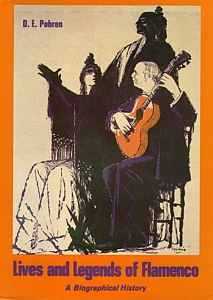
Guitars are many things: wood, gut, metal, science, music, etc. They are also female (and in Spanish explicitly so), with curves and mystery and subtlety. This is perhaps symbolized especially strongly for the flamenco, for whom even holding the guitar is a sensuous experience. For one thing, the traditional flamenco holds the guitar differently than do other guitarists. Classical guitarists carefully hold their instruments on their thighs, using footstools to help the balancing; others simply hang the guitar from a strap over their shoulders. But the flamenco literally embraces his guitar, holding it in a difficult and awkward “standing” position, balanced on his right thigh — seemingly just so as to be able to embrace it. Try it: it’s tricky. Hugging the guitar like that, once you get the hang of it, is a genuine sensual experience (fig. 1). Flamencos also use a wide array of stroking, playing, pulling, hitting, tapping, and scratching techniques which, if they lack the subtlety and sophistication of classical technique (although this is arguable), more than make up for it in the variety of achieved contact with the instrument and its strings. All in all, it’s a great physical experience for the guitarist and gives outlets for both sensuality and aggression4. The romance, the passions, and the rejections of life are all flamenco themes which Lorca would have, so to speak, taken in with his mother’s milk — and are for the flamenco closely associated with the guitar.

Fig. 1. The traditional way of holding the flamenco guitar, from the cover of Lives and Legends of Flamenco by D.E.Pohren.

From the title alone, therefore, we can have the idea that there is a woman and sensuality/physicality represented in this poem. Are there other feminine images?

Virtually all the nouns in this poem are female-gender nouns (Spanish possesses male, female and neuter nouns). Further, the camellias, which are themselves female and symbolize femininity, are also known as “japonicas” (Japaneses), suggesting the oriental eye-slits which adolescent Latin boys learn to associate with the shape of the female genitals5. This poem is awash in femaleness. But add to that the overwhelming emotional content of the work and it is no far leap to accept that what is being described is a primary association with a woman. The word “mother” does not appear in the poem, but who else is female who would carry that much of an emotional charge?6 What woman other than the mother who is so primarily and overwhelmingly linked to inner life — whatever the quality or content of that inner life?

It is a virtual certainty that Lorca’s mother served as an essential self-object for Lorca early in life, during which period his world view would have been substantially formed. What then does the poem suggest is his relationship with his mother, specifically?

Of the images that carry the thematic meaning of this poem I have already made note: this truly is a work expressing unrelenting bleakness and lack of fulfillment. A stylistic analysis of the poem, which is outside the scope of this essay (but includes analysis of the different stylistic elements of the poem: the syntax, meter, accents, position and length of key words, gender imagery, punctuation, rhythm, ambiguity, specific use of nouns and adjectives, etc. — and how these interact and add to or detract from the thematic meanings) would further bear out Lorca’s skill at maintaining congruence between the poem’s structure and its meaning. That is, that the poem expresses at the level of internal structure the same bleakness, disconnectedness and despair that it expresses in words. However bad life was for Lorca, he at least created good poetry out of it.

The most directly human image of the poem, and really the only one, is of (the guitar as) a heart seriously wounded, perhaps mortally wounded, by five swords. It’s an image of violence, both deadly and emotional. It is at the same time the image of someone playing a guitar — and wounding it! It point of fact this is an image which explains why the guitar has been crying all through the poem: it’s been being wounded by the player.

Playing the guitar is usually a purposeful activity, not a random one, and is indeed the only image of overt, purposeful, active human behavior in the entire poem: everything else is static or reactive. Therefore it is probably a good idea to scrutinize it even more closely. The image of the guitar gravely wounded by five swords (the player’s hand and fingers) suggests the purposeful wounding of the instrument.

This image has a basis in reality as the flamenco style of playing, which Lorca certainly knew, is very hard on the guitar physically: the player can literally pummel, pull, scratch, hammer, tear and wrench the rough, shrill, wailing, melancholy and certainly crying sounds out of the flamenco guitar. (As a matter of fact that’s why flamenco guitars have golpeadores [tap plates: literally, hitters or pummelers, or the things for hitting and pummeling] while classical guitars don’t: they need them.) On the other hand there are two very interesting symbolic interpretations of the meaning of a guitar being wounded by the player, and these, I believe, are (not to make a pun) at the heart of the poem’s meaning.

If there is a guitar player — an active, independent initiator of behavior — who is cradling in his arms (in the physical flamenco guitar playing position) something as wonderful and important as Andalusians think of the guitar as being, yet which also is at the same time something passive, receptive, inert and crying — something that is not a center of initiative — then cannot we recognize in this a disguised image from earliest life, that of a mother holding her child? Yet the “player” is hurting the “guitar” gravely and making it cry! If this is truly an image of an early mother-child connection/bond/cathexis then it is an image of the mother’s great insensitivity or cruelty, or perhaps even sadism, toward the child.

I believe, given the quality and intensity of the imagery in “La Guitarra”, which reflects Lorca’s feelings in life, there can be no doubt that he experienced such cruelty. That his mother might or might or might not have actually, consciously, done such things is moot: Lorca experienced much of his early life in just such a way.

And again, going back to this last image, if we accept the guitar as being a symbol for the mother/female and not the cradled child, then the image for the active and passive agents are reversed, yet still equally hostile to each other. Then, rather than the mother hurting the child, the guitar player with the sword-fingers is purposely hurting the mother and making her cry. Either way, one is inflicting pain on the other. But while poetic imagery can make it seem that either antagonist — and we must recognize the guitar and the player, the mother and the child, as being alternately victim and torturer, locked in permanent conflict — could be arbitrarily hurting the other (depending on which image we are focused on), in real life only one truth can be recognized: that children are absolutely helpless and vulnerable to the power of the mother to love, reject or punish. Children are in no position to abuse their mothers — only to defend themselves. And if this defense is in turn attacked, then the child enters a surreal, Kafkaesque world of hopelessness and despair which must cover his enormous narcissistic rage7. [NOTE: “Narcissistic rage” is psycho-speak for the kind of rage that is total and, once released, cannot be controlled. An example is given in the literature of someone hanging a picture on a wall; under normal circumstances, if the picture hanger hits his [or her] thumb with his hammer he’ll be frustrated and in pain, and probably swear a bit; this is normal anger, and it quickly subsides. If the episode is experienced as a narcissistic wound, however, the man will respond as though the nail had attacked him personally and he’ll try to get back at it. He will try to kill it . . . even if it means destroying the nail, the wall, and even the picture; narcissistic rage won’t subside until the cause of the wound has been annihilated. It is thought that much spousal abuse, many war-related behaviors, etc. come from this primitive level of mental life.] In Object-Relations theory such intense rage covers equally intense disintegration anxieties (this is psycho-speak for the intense early- life fears that the child will lose his self-object should he aggress against it); and it is known that Lorca suffered all his life from such debilitating anxieties and profound feelings of alienation8.

It is most likely that Lorca had, but was not able to be aware of, his own towering narcissistic rage toward his mother. The image of the active agent/guitar player wounding the woman/mother/guitar in such a way that she cries endlessly, deeply and inconsolably shows how strong the impulse to hurt must have been. And the quality of the intended hurt, cosmic and all-pervasive as it is shown, indicates the depth of the pain received. Lorca is unconsciously saying: “I would like to do to you what you did to me, to show you how it felt to be me; my pain was impossible to stop; I wept all the time because you were so far away from me and did not come; I wanted you but it was just as useless to long for you as it is for the desert to ask for flowers; I waited but my dark night had no morning; I felt like an arrow with no place to go; I felt like an afternoon with no point of origin; I felt like a day whose dawn had been shattered in the night; I cried forever; OH, I’d like to wound your heart like you wounded mine!”.

I have known for a long time that flamenco is a very matricentral form: much of cante jondo concerns itself with one’s mother, one’s sorrow at the loss of a mother through death, one’s betrayal of the mother through finding a mate, memories of the mother’s caring and love, and so on. Granted that the mother-images in “La Guitarra” are much more hidden and violent than the openly expressed and positive mother-images of everyday flamenco, they both get their energy from the same spark plug — a protective reverence for the memory of the mother. The father is hardly ever mentioned, in contrast.

This longing for and devoted holding onto the idealized maternal image while at the same time professing a view of the world which is a distillation of profound pessimism and expectations of rejection — the split between what the individual would like to have or to have had, and what he probably actually experienced (namely, early experiences in rejection and cause for lack of hope) — is a split which is by no means limited to Andalusians. That the flamenco seems not to notice this split and instead institutionalizes the idealization of the mother would seem to validate that area of modern psychological thought that asserts that the impulse to protect the mother — and to protect ourselves from an awareness of knowing our bad experiences with our mothers (and fathers) — is in operation. Author Alice Miller’s books, particularly For Your Own Good and Thou Shalt Not Be Aware are the most articulate and convincing writings on this topic.

As far as my love of flamenco goes, I am a bit nervous at the thought that something I have enjoyed so deeply over the years might be a cultural expression of a psychopathology that I would necessarily have a connection to, or investment in. Is this what expressive folk art forms are all about? A friend of mine argues persuasively that this is so, citing American bluegrass and country music, with their wailing laments of fickle fate, betrayal, loneliness, women lost to other men, and similar sentiments, as expressing much the same fundamental issues and world views. Yet, neither of these makes such a big deal about mothers as specifically as flamenco does. Maybe one difference is cultural between European and American parenting patterns.

It’s easy for me to believe that individuals with European backgrounds (as I have) get a heavier dose of parent-idealizing, in much the same way that Alice Miller (who herself has a European background) describes, and this comes out in folk musics. I do know that in Hungarian, my mother-tongue [and isn’t that an interesting phrase?], the common public mode of referring to one’s parents [edes apam and edes anjam ] translates literally as “sweet father” and “sweet mother”, or “dear father” and “dear mother” — as compared with, say, the “my dad and mom”, “my father and mother”, “my old man and my old lady”, “my parents”, etc. that we’re used to hearing in English. On the other hand, it’s been persuasively argued that Americans’ reverence for people like Ronald Reagan and George Bush have the same root causes: namely, projection of Godlike wisdom onto people whom you ordinarily wouldn’t want to buy a used car from.

Also, as a final example, and referring back again to Spain, today’s most prominent and revered flamenco-playing God is Paco de Lucia. Paco’s “real” name is Francisco Gomez Sanchez. But Paco has been called Paco de Lucia forever, or at least since he needed — and got — his own personal handle/nickname to identify him as a three-dimensional and separate individual, distinguishable from others, within the culture of his birth. Paco de Lucia means Paco from/of Lucia, Lucia being none other than the name of his mother. In other words, Paco de Lucia = Paco (el) de Lucia = Paco-(he)-who-who-is-of/from/came-out-of-the-woman-Lucia. Isn’t it interesting that this brilliantly talented musician is associated/known the world over with his mother’s personal name? Sorry, dad; better luck next time; ‘bye. On the other hand, Andres Segovia, who is quite equally and probably even more famous on this planet as a guitarist, affiliated with a Different Cultural World and wouldn’t ever have had such a public mother-connection mindset. Understandably, his expressive life passions would have been of a different kind.


1: ‘Volume knobs’ and ‘Off buttons’ are pretty much what adult defenses — ego strength, denial, repression, projection, sublimation, rationalization, etc. etc. — are all about. Without these, input is received on the (young people’s) default max setting,

2: It is thought that if the caretakers are adequate then one can learn to cope in a healthy way with life’s other ‘real’ traumas; it’s when the caretakers are absent or incompetent that there are developmental black holes.

3: There are plenty of flirty, light, silly, teasing, topical, etc. flamenco verses and songs. But they are not cante jondo; they are cante chico (“small song”). Flamencos understand that these are very separate things.

4: It is true that flamenco guitars often take a real pounding. Such treatment horrifies the average classical guitar player, who would not dream of subjecting a prized and valuable object such as even the flamenco regards the guitar as being to such rough treatment. There’s a clue to the nature of flamenco in this contradiction, I think.

5: I grew up in Cuba and Mexico, and that was part of my own sexual upbringing.

6: As a matter of culture in general, Latinos and Iberians are not, repeat not, into gayness. It’s all very hetero.

7: Psychologists and writers have focused on Kafka and make him a point of reference because he was so good at writing about such dislocated feeling-states. Even easy emotions are really are hard to describe verbally, but Kafka did some of the more difficult ones and did them very well indeed — especially the surreal parts, where the world looks real and yet at the same time doesn’t. Those are pretty unsettling experiences to have in real life. They have to do with the difference between (1) “ordinary” anxiety states, in which, no matter how scary and horrible they might be, the person having them knows, or can at least hang onto knowing, that he’s having anxieties, and hence can to some extent have a steady external point of reference to the real and “normal” world until the attack passes, and (2) narcissistic ones, which are worse because they’re sort of like having anxieties while on a bad drug trip: you not only lose “the real world” but you also lose yourself. Psychologists believe that this is one of the most extremely terrifying categories of experience possible. Unsurprisingly, it’s hard for anyone who hasn’t had something like that kind of experience to understand what it feels like, no matter how cleverly one uses words to try to get it across.

8: See footnote 7; it fully applies to Lorca

Posted in Guitar theory, history, opinions, sociology, wisdom, & insights Tagged flamenco

Some Thoughts on the Difference Between Handmade and Factory-made Guitars

by Ervin Somogyi

I am often asked what makes hand made guitars different from factory made ones, and whether they’re better, and if so, how. These are good questions, but complex ones. Handmade guitars are not manufactured goods in the same sense that factory made guitars are manufactured goods. Each is made differently, for different purposes and different markets, and with different intent, aim and skills. Factories need to make instruments which are good enough to sell to a mass market. Luthiers need to make instruments which are successful tools for musicians. Comparing a handmade guitar to a factory made one is analogous to comparing a painting with a toaster: the one really needs to be judged by different standards than the other. I wish to stress that I do not wish to malign either luthiers or factories, but rather to point out how very different their products are in spite of the fact that they can look almost exactly alike.

What, really, is handmade? Obviously, things were literally handmade a long time ago, when tools were simple. But what is one to think if the luthier uses routers, bandsaws, power sanders and joiners and the like? Aren’t these the same power tools used in factories? How can something made with them be handmade? These same questions were asked by American luthiers in the l960s and l970s, because the use of power tools was so very common. After much debate it was decided that the answer had to do with the freedom of use of the tool. That is, guitars could be considered handmade if the tool could be used with a degree of freedom dictated by the needs of the work and the will of the operator. Dedicated and specialized tooling capable of only one operation, as is the rule in factories, did not qualify; neither did the rote assembly, even if by hand, of components premade to identical specifications. These became the standards by which to distinguish handmade from production made.

It might be most true to say that handmade guitars differ from factory made guitars primarily in that factory guitars are mass-produced, and handmade guitars are not. While this may sound obvious and self-evident, a number of implications arise out of this basic fact:

l) Long term repairability. In the long term, a guitar is likely to need tuneups, maintenance or repair work, just like a car. Things like bolt-on necks, and the fact that the repairman may have worked on this or that brand of factory guitar before and knows what to expect, can make certain operations easiser. But otherwise factory instruments are often made with procedures and processes which, although quick, cheap and easy to do within the manufacturing context, can be difficult to undo or work with in the normal, post-factory setting. Guitar finishes are a good example of this. The traditional finishes such as lacquers and French polishes are beautiful, but are skill- and labor-intensive to apply. The increasingly popular polyurethane, catalyzed and ultraviolet-cured finishes are much easier and cheaper to apply, and look good. But, they cannot be repaired or worked with if there is damage. To fix a crack in the wood properly, the finish will need to be completely sanded off and redone. Lacquers and French polishes, on the other hand, are comparatively easy to spot-finish or touch up.

2) Personal relationships. If you deal with an individual guitar maker you will establish a personal relationship with someone which may last for years, and which may become an important one. He will almost certainly be available directly to you to consult with or to take care of some difficulty, and he will feel a responsibility to you for any work he has done. With a factory made guitar, you cannot have this personal relationship with the maker. You will have to settle for the best relationship you can have with either the store you purchased the instrument from or the factory’s customer support hotline.

3) Choices, features and options. Factory guitars are made to strictly unvarying specifications and in large numbers. Each one will be exactly the same in all particulars, and if you want anything a bit bigger or smaller, or in any way different, you will not be able to have it unless you pay extra to have it customized. An individual instrument maker can provide you with an instrument that is tailor-made for you in many ways. As musical styles and playing techniques evolve, instruments with differing scale lengths, actions, neck widths and contours, fret sizes, string spacings, tunings, tonalities, electronics, woods, body shapes and sizes, etc. all become more desirable. But proliferation of design variables complicates production. I’ve been told that in Japan many Japanese customers want guitars exactly like someone else’s, because that’s how things are done in that culture. The factory model serves this need. In the United States, however, musicians more commonly complain about things such as that the neck on a certain brand of guitar is too awkward for their size hand, and that their hands would tire less if the neck were just a little different — but all the necks are the same.

4) Value and price. A handmade guitar will carry a price which reflects its real value in terms of labor and overhead more truly than a factory made one which carries the same price. The former may take 200 hours of someone’s conscientiously invested time and skill; the latter may take 8 to 36 hours of intensely repetitive and automated work. A factory will target a price at which it wishes to sell a certain product and will do everything it can to enable its introduction into the market at that level, including using parts made by others and mounting ad campaigns. A luthier will probably want to make something that’s as open-endedly good as he can make it, without an overriding imperative from the profit motive. Because factory instruments are made for wholesaling and price markup, and handmade instruments are in general not, there is much more room for discounting within the system of retail store markups than an individual maker can offer. Discounting is a marketing tool, and factory made guitars are made and priced so that everybody in the complex chain of recordkeeping/tooling/subcontracting/assembling/advertising/retailing/delivering can share in the profit. Handmade guitars are priced so the maker can survive.

5) Quality. According to a guitar industry spokesman at a recent symposium, quality, from a factory point of view, is the same as replicability of components and efficiency of assembly. That is, the factory man considers quality to be the measure of how efficiently his parts can be identically made and how fast his instruments can be assembled in a consistent and trouble free manner. From the musician’s point of view quality has nothing to do with any of this: it has to do with how playable the guitar is and how good it sounds. This also is, normally, the attitude of the individual luthier, for whom efficiency is important but secondary to his concern for creating a personal and effective tool for the musician. The main ideal behind factory guitars is that they be made quickly, strong and salable. The main ideal behind the handmade instrument is quality of sound and playability. A really well made guitar almost plays itself.

If quality for the factory man has to do with efficiency and consistency in making identical things, it cannot be so for hand makers. And for obvious reasons: there are a lot of hand makers working at vastly different levels of skill and creative talent, and they have different concepts of “best”. Let us return to the analogy of the painting and the toaster to illustrate this point. A painting is something somebody made which may be good or bad, or beautiful, or repellent, or even personally meaningful. Or perhaps unintelligible. Then, some paintings can be amateurish or indifferent. Some are interesting. Some may be pretty damn good. And some are timeless, significant and really great. A toaster, on the other hand, will do what it was designed and built to do, every time, or one fixes it or discards it. One does not normally think of a toaster as being amateurish, meaningful, expressive, trite, evocative, profound, unintelligible, interesting, or timelessly great. This is not what toasters are all about.

6) Craftsmanship. An intelligently run factory is geared to operating smoothly in a standardized, not customized way. Its priorities are automation of procedures and dimensional standardization of parts. A hand maker, on the other hand, is generally flexible and inefficient enough to do customized work in every place where it counts. This methodology is essential due to the innate variability of woods: two identically thicknessed guitar tops can differ by as much as l00% in density, 200% in longitudinal stiffness and 300% in lateral stiffness. Bracewood also varies as much and further compounds the possibilities of mindful wood choice and use. Therefore, while certain components in handmade guitars may be roughed out to approximate dimensions in batches of 4 or 6 or more, the selection of these components, and their final dimensions in the assembled instrument, are done on an individual basis: this top gets those brace-blanks, which are then pared down to that height, which depends on the stiffness of the braced top, its tap tone, and the judgment of the luthier as applied to this particular unique instrument.

As mentioned above, the levels of skill, judgment and attitude among luthiers are variable quantities, some highly developed and some not, depending on how experienced and talented one is. In my opinion many hand makers today are insufficiently trained and experienced, and as a result many handmade guitars are less satisfactory than factory guitars of comparable price. Any luthier worth his salt, however, will continually strive to learn better techniques and improve his work, because personally achieved quality needs to be his stock in trade. He must be good in order to survive. The intent and skill level of factory work, on the other hand, tends to be constant and predictable and does not improve appreciably from one year to the next. Factory work is based more in using the best tooling and jigs available than in developing workers’ skills beyond what they must have so they can operate the tooling efficiently and safely and do work that meets the standards set by the quality control department.

This is, in fact, the essential distinction between handmade and factory craftsmanship. The factory’s craftsmanship is based in division and automation of labor: there is someone who is paid to do each step or make each part. He has to do it repeatedly, many times a day, at a level that meets the factory’s criteria for acceptability. As often as possible, this specialist is replaced by a machine. The handmaker, in comparison, has to be adept at everything. He must spend years to master all the techniques and skills necessary to produce a high quality guitar, and, until he does so, his guitars will be of less than highest quality in some way. The need to perform every operation to a high standard is not unlike an Olympic athletic performance: make one single mistake and you fall short of the goal. To aim so high is an exceedingly demanding, and noble, effort.

7) Playability and action. Since factory instruments are assembled in large quantities, they normally almost all need fine tuning and adjustment before they come into the hands of players. Music stores in the United States often have a person whose job it is to set up all new guitars so that they are most comfortable for the customer. I don’t know whether it is the same in other countries, but I’d be surprised if it weren’t. Set-ups include setting the strings over the frets at a comfortable height, dealing with buzzes, calibrating intonations at the bridge, adjusting truss rods to the stringing, and whatever else needs to be done. Hand makers, on the other hand, will usually have done these things prior to delivery because, as far as they are concerned, a guitar that isn’t as perfect as possible is not ready to be delivered.

8) Sound. The study of the factors involved in the production of tone teaches the instrument maker that small variations in structure in the right places can make important, specific, differences in response. Because there are so many places where one can take away or add a little wood, and because the difference between “a little more” or “a little less” can be critical to a specific aspect of tone, this study takes years. This is the level of work a hand maker engages in and strives to master. Ultimately, he will be able to make guitars which are consistent in quality and consistently satisfying to his clients. The factory approach, on the other hand, cannot spend so much time on any one guitar: its entire operation is based on treating all guitar assembly processes identically. Therefore all tops of a given model are equal thickness, all braces are equally high, all bodies are equally deep, and so on. Tone in a guitar is controlled by paying attention to specific qualities in the materials. Yet, the factory’s focus on treating all parts uniformly bypasses these important factors. Because dimensionally identical guitar tops and braces can be twice the mass and up to three times the stiffness of their companions in the assembly line factory guitars are, essentially and literally, random collections of these physical variables. In consequence, their sound quality will correspond to a statistical bell-curve distribution where a few will be brilliantly successful, a few will be markedly unresponsive, and most will be pretty good. To repeat: a factory work’s chief priorities and focus are production, selling and delivery. It is off the mark to compare this to a concern with making a personal best at something.

9) Durability. Here, again, the concerns a factory and a hand maker bring to their work are markedly different. And for perfectly good reasons. There is nothing wrong with a factory maker’s desire to sell guitars to the public. But each member of this anonymous guitar playing public will treat the guitar with different degrees of care, use different strings, play differently, live in different cities or even countries with different climates, temperatures, altitudes and humidities, and will sometimes take their guitars to the beach or on trips into the mountains. These guitars must be able to hold up against these unpredictable conditions. It is the factory’s concern that these instruments not come back to plague its warranty department with problems and repairwork. To ensure this, their guitars are substantially overbuilt. Hand makers are concerned with making sensitive, responsive tools for musicians who are fairly certain to treat these with some care. These guitars can therefore deliberately be made more delicate and fragile — and this makes possible a louder, more responsive instrument. The factory cannot afford to make fragile, maximally responsive instruments: for every increment of fragility a certain predictable number of damages and structural failures can be predicted, and the maker would sink under the weight of warranty work. The hand maker, on the other hand, cannot afford to overbuild his guitars: they would be the same as the factory version but at a higher price, and they would fail to have that extra dimension of responsiveness which makes them attractive to the buyer. He would soon starve.

10) Machine precision vs. the human touch. Machines will do the same operation, over and over again, to the identical level of precision; there are no bad days or sick days, and they don’t get fatigued or depressed. Hand work, on the other hand, is forever shaped by fluctuating human factors of energy, attention, concentration and skill. For these reasons, most people believe that machines can produce faster, cleaner, more consistent and more desirable products for the consumer, as well as reducing the tedium inherent in parts production. There is much truth in this.

But also, it is a fallacy. This relationship between tooling and craftsmanship only applies in direct proportion to how the machines and operations are completely free of human intervention — as is the case with computer controlled cutters, which are getting a lot of press nowadays. But as soon as any real workers enter the picture factories cannot escape from the same limitations of hand work under which hand makers suffer. This is shown by the fact that a factory’s own quality control people can tell the difference between the level of workmanship of one shift and that of another, and especially when there are new employees. Anyone who has done factory work of any kind knows that personnel problems are the larger part of production problems. Naturally, no one advertises this.

This brings us to the fundamental difference in the logic which informs these different methods of guitarmaking. The factory way to eliminate human error and fluctuation is to eliminate, or at least limit as much as possible, the human. The handmaker’s way to eliminate human error is to increase skill and mindfulness.

11) Is a handmade guitar necessarily better than a factory made one? No. Many factory guitars are quite good, and many handmade guitars show room for improvement. How successful a handmade guitar is, is largely a function of how experienced the maker is and what specific qualities of design or tone he is known for. No one ought to be surprised to realize that beginners will make beginner’s level guitars, and that more experienced makers will make better ones: this is what makes the instruments made by an experienced and mature maker so special. On the other hand, there is considerably less significance to the purchase of an instrument made by a factory simply because it’s been in operation for many years. Long, cumulative experience with the materials is not what they are about, and neither are improvements and advances in design which conflict with profitability.

12) Are factory guitars any better than hand made ones? By the standards of the factory people, yes. They believe that high-volume assembly of premade and subcontracted parts produces superior products. At least one company advertises this explicitly. By the standards of the individual maker, it is possible for factory guitars to be better than individually handmade ones, for all the reasons outlined above. But, in general, factory guitars are “better” only in a limited sense of the word, also for all the reasons outlined above. I wish to emphasize again that handmade and factory guitars are each made with a different intelligence, with different priorities and for different markets. The luthier cannot compete with the factory on the level of price. The factory cannot compete with the luthier on the level of attention to detail, care and exercise of judgment in the work.

13) Are not high-end factory guitars, at least, better? From the view of the musician, no. They are much more extravagantly ornamented and appointed and also produced in limited editions so as to justify the higher price. And they are in general aimed at a quite different market — the collector. For the average musician, the appeal of collector’s guitars is blunted by the high price; and for the serious musician by the fact that their essence, soul and sound are produced under the same factory conditions and with the same concerns as any other product of that factory — with comparable results: random variation of musical quality. But the collector has different interests. He seeks the appeal of rarity, uniqueness and “collectableness” in an instrument and his principal interests tend to be acquisition, owning and display — not playing or using.

The collector’s market of vintage and collectable musical instruments is not large but it is quite strong, and its continual hunger for new products helps drive the production of “collectable” guitars. Factories respond to the demand by producing and advertising limited edition guitars which have, for the buyer, the requisite appeal of uniqueness, scarcity, rarity, and high cost. There are individual luthiers whose work is sought in the collector’s market. But on the whole the difference between factory’s and a handmaker’s collectable work is that the individual guitarmaker’s collectable work is scarce by definition, and ends when he dies. A factory such as the Martin company can turn out limited and special edition collector’s models for generations.

14) A collaborative aspect. I like to think that an important difference between handmade and non-handmade guitars is the degree to which the process is one of collaboration. Makers want to find musicians who are able to appreciate how good their work is, and who can challenge them to do even better work. This is a fruitful partnership. The factory’s needs are overwhelmingly to sell guitars, and usually prefer to form partnerships only with endorsers.

15) How can one really know whether one guitar is better or worse than another? A key factor in the assessing of what is better and what is worse is the somewhat basic one of how educated and sensitive one is to the matters under examination. A discussion of differences cannot go very far without understanding this. The consumer is not merely a passive bystander in this debate but a participant in it, even if he doesn’t know he’s doing it. To illustrate, I want to give you an example of something that has happened to me repeatedly in my experience as a guitar repairman (and which I’m sure other repairmen have experienced as well).

A guitar player called me to report that his guitar, which had worked well for several years, was now not playing in tune. He suspected that the tuning mechanisms were worn and slipping, and he wanted to know whether I could replace these. I said yes, please bring your guitar to my shop. When the caller arrived I examined the guitar and found no problems: the tuners worked perfectly, the bridge hadn’t become unglued, the frets and nut hadn’t moved, the neck hadn’t warped; the guitar was not in any way damaged or broken; in fact, everything was exactly as it should be. What had really happened was that the musician’s ear had improved over time so that he could now hear that the guitar did not play in tune. In fact it never had; but he simply had been unable to hear the dissonances before.

Obviously, a guitar which plays in tune is better than one that doesn’t; but if one is unable to hear this then it becomes a non-issue. With an improved ear, this man was ready for an improved guitar. This same growth of ability to see and hear in an educated and experienced way affects our ability to appreciate nuances of detail, subtlety, and quality. These are the very areas in which handmade guitars can differ from, and excel, non-handmade ones. But, until a player reaches the point of capacity to discriminate, whatever guitar he has is good enough

Online Illustrated version of this article
In Spanish (pdf)
In French (pdf)

Posted in Essays & Thoughts, Features By Ervin, Guitar theory, history, opinions, sociology, wisdom, & insights, Uncategorized

Whence the Steel String Guitar? – 2/2

PART 2 OF 2

by Ervin Somogyi

In Part 1 of this article I wrote about the origins of the steel string guitar from the vantage point of the macro socio-economic culture of the New World. I used the Spanish guitar, which was developing simultaneously with it, a point of reference and comparison whereby to have a better understanding of both. In this section I will continue to examine the genesis of this most American instrument, take a look at the structural and design elements that make it a unique instrument, and take a guess at its future.

THE SUBCULTURES OF MODERN GUITAR MAKING

The Spanish guitar has come to us out of a European tradition in which fine things are made by, and associated with, individual craftsmen. This doesn’t mean that Spanish (and pre-Spanish) guitars weren’t produced in large numbers in guilds and factories: they were. And it is not that hand craftsmanship is inherently superior to other forms of organization of production. It is rather that the roots of European lutherie predate the industrial revolution and hand craftsmanship was the main option for a long time. As such, the level of skill brought to lutherie was quite high, as a visit to any museum with a good collection of historical string instruments will show. But because this kind of lutherie was associated with real individuals — despite the historical existence of numerous major centers of large-scale production of musical instruments — a tradition has been created whereby modern Spanish guitar makers are the inheritors of some past heroes to look up to and whose work they can emulate and not depart too radically from. These revered icons are people like Antonio deTorres, Hermann Hauser, Luis Panormo, the Fletas, the Ramirezes, Francisco Simplicio, Santos Hernandez and other famous European makers. Modern Spanish guitar luthiers like to think of themselves as walking in these originators’ shoes, or at least on the path that they traveled. As I said, none of this has stopped Spanish guitars from being produced in great numbers in factory settings; but the basic design has not changed much in all this time because its acceptability is still rooted in the traditional look — as well as the fact that the design continues to be a successful tone producer.

On the other hand, American factories were for many decades the only source of steel string guitars. Lutherie in the European craftsman’s sense of the word never took hold on this side of the Atlantic, and the Martin, Gibson, Washburn and Epiphone guitar companies, more than any other brands, have provided the models and standards of what a steel string guitar ought to be. Accordingly, the design of the steel string guitar has always been subordinated to the requirements of the production process, and this has in turn dictated the possibilities of the guitar as a musical instrument. With the exception of the prolific Larson brothers, and jazz guitar makers such as John D’Angelico and Mario Maccaferri in the early 20th century, no individual luthiers became prominent, successful or famous 1. In consequence, however, the contemporary American steel string guitar maker is deprived of a personal link to the past and he must either identify with a largely production tradition, or claim independence from tradition and sort of give birth to himself 2. There is now a small core of very good contemporary individual steel string luthiers who could serve as models to others. They’re all from the postwar period, and it’s not the same as having pioneer models from a hundred and fifty years ago. Yet, it’s a beginning.

THE STEEL STRING GUITAR’S “X” BRACING

The “X” bracing associated with Martin guitars is the model, pattern, template and standard used the world over for reinforcing steel string guitar faces. Pretty much all steel string guitar bracing is based on that model (fig.1). Those who don’t copy Martin’s “X” bracing outright produce minor variations of it, making the tone bars or fan braces a little flatter or taller, or longer or shorter, or spacing them farther apart or closer together, etc. This is all for good reason: the “X” brace works. Well-crafted steel string guitars using this bracing system can produce sounds that no other arrangement of parts has been found to surpass in either volume or warmth. Not least, “X” bracing is the steel string guitar’s chief distinguishing structural and tonal feature that sets it apart from the Spanish guitar, which is almost universally constructed and voiced with fan bracing.

Fig. 1 Interior view of a Martin guitar face: it is the model for virtually all steel string guitar bracing as depicted in any book, how-to video, newspaper/magazine story, published lutherie article, or guitar magazine/trade journal advertisement.

Interestingly, the “X” brace, which we all think of as being well adapted to handling the pull of metal strings, was being used by the Martin Guitar Company as early as the 1850s, when it was (along with every other manufacturer) making only gut string guitars — a full sixty to seventy years before metal string guitars came into general use. Of course, in those early times and for those stringings, the “X” brace was comparatively small and delicate.

Structurally speaking, gut strung guitars didn’t require “X” bracing — even when soundboxes were enlarged and scale lengths increased. But the structural reason why “X” bracing works so well in the modern steel string guitar is that it is most resistant to distortion in the area in front of the bridge, where the stresses pushing down on the face are greatest. The reason for its tonal success is that it succeeds in unifying the face, for vibratory purposes, better than anything else previously devised. It seems unlikely that “X” bracing was the result of any tonal considerations in the way of improvement over the possibilities given by the fan bracing universally used in the Spanish guitar of that time: fan bracing was only first being used in these at about the same time as the earliest “X” braces appeared in the United States, and there would have been little if any frame of comparative reference at the time. Both, in fact, seem to have been developed simultaneously out of the earlier smaller fan and ladder-braced instruments, as well as from the pursuit of different social imperatives, musical challenges, commercial needs, and plain old mechanical inventiveness 3.

It seems to me undeniable that we have the Larson brothers Carl and August — already mentioned above — and not the Martin Company or any other manufacturer to thank for adapting the gut-string guitar’s “X” bracing successfully to the needs and design of the modern steel string guitar. To repeat: starting in the 1890s, they made the first steel string guitars sturdy enough to not collapse under the pull of steel strings, and yet not so overbuilt that they lacked sound. The Larsons achieved this in part by enlarging and beefing up (with increased size and laminated construction) the previously too delicate “X” bracing, by doming their guitar tops, by reinforcing the guitar necks, and by increasing the size, shape and gluing surface of the bridge. These design advances notwithstanding, it wasn’t until the 1920s that such guitars were produced in sufficient numbers by factories for them to become — as it were — principal players in the popular market.

SUMMING UP

The commercial, developmental, musical, technical and artistic history of the guitar has been a complex one. The design and parameters of the Spanish guitar have been largely set for a hundred and fifty years. Classical guitars made a hundred years ago and guitars made today don’t look all that different from one another; the traditional look of the instrument has prevailed. At the same time this instrument’s music has of course advanced and its repertoire been enlarged, and the techniques for its playing have been refined although not changed much. The steel string guitar, in comparison, is experiencing a contemporary explosion of design, shape, dazzling and original ornamentation, technique, music, and, not least of all, seriously talented makers and players.

To date, many books have been written about one or another aspect of how all these things came to be, and about the individuals who wrote and played significant guitar music — and many more will yet be. But there exist a few pivotal elements and individuals behind the success of the guitar as we know it today, without which almost none of us in the business (at any level) would be able to survive. I would say that the worldwide acceptance of the Spanish guitar can rightly be attributed to the DuPont employee who discovered nylon, if only by accident, in 1930: within fifteen or twenty years this led to making an instrument which had until then been notoriously expensive to put strings on, and therefore limited to being a middle class musical object, all of a sudden accessible to the masses 4. Also, the worldwide popularity and acceptance of the flat-top steel string guitar as we know it today is, in my opinion, attributable to the genius of the Larson brothers who, regardless of how cheaply (and therefore accessibly) a guitar could be made in their day, made the first ones that could be used without sooner or later collapsing under the pull of metal strings.

While the hand/small-scale making of guitars has grown on this continent to compare with anything that exists in Europe, so has factory guitar making grown. And then some. Industrial-level guitar making such as has dominated the American scene since the beginning has been rapidly spreading — into Japan, Korea, Mexico, the Philippines, and now China: anywhere, as a matter of fact, where there is cheap labor. I’m not optimistic in contemplating the future of American lutherie — as far as the making of any kind of guitar goes — from the standpoint of the requisite basic hand skills that an individual must master in order to become a self-sufficient and skilled workman. The roots of such skills need to be put into place rather early in life for them to be fruitfully and fully integrated into one’s adult work and, from what I’ve seen, today’s younger generation is much more deficient in such basic skills than my own was. Young people don’t seem to tinker, futz, putter, sculpt, whittle, make model airplanes, play with erector sets, fix up old jalopies very much, or participate in imaginative play/role playing with real things 5 — as opposed to engaging in virtual pastimes designed by people who have been paid to do that — and the manual arts in this culture are, in general, lagging far behind ability to manipulate 6 computers and other electronic devices. I think this is a fundamental loss the results of which won’t be understood or missed, or perhaps even noticed, for another generation. If we are or have been in any sort of golden age of guitar making, it will have been built on a combination of manual skills and creative intelligence, not labor and time management in the service of acquiring practical, technical and virtual skills.

1. Even the Larson brothers, who had made pioneering contributions and significant innovations to steel string instrument making, were forgotten after their deaths — until they were rediscovered by American musicologists, and the guitar culture, of the 1960s. A large part of the reason for this is that, unlike the Spanish luthiers whom we know of who made guitars under their own names, the Larsons produced instruments under many others’ labels, including Euphonon, Prairie State, Maurer, Dyer, WLS (“World’s Largest Store”), Stahl, Stetson, Leland, Meyer, Larson and other labels.

2. I think it’s interesting that the highest-quality European guitars are associated with an individual maker’s name, and that young luthiers try to make a career out of furthering their own names as associated with their products. In this country, however, it’s not uncommon for young luthiers to try to market their instruments under a commercial-sounding name to which they’ve subordinated their own, such as: Running Dog, Moonstone, Bear Creek, Timeless, Golden Wood, Evergreen Mountain, etc. This is an interesting cultural difference.

Another one is that since at least the 1930s, when Andres Segovia was concertizing around the world, it’s been common — in classical guitar performances or recordings — that the maker of the guitar being played is mentioned in the concert program or on the record jacket. To my knowledge this was unknown for the steel string guitar and its music until the late 1970s, when I began asking that my name be mentioned on record jackets as the maker of the guitar being played. Of course, this has a lot to do with the fact that there really was no significant steel string solo guitar outside of John Fahey, Leo Kottke and Doc Watson, until the Windham Hill label established solo guitar music as a viable musical genre in the mid 1970s.

3. Although gut-strung guitars do not and never did, strictly speaking, require “X” bracing, it undoubtedly worked to make the guitar a more successful musical instrument than the earlier, smaller, ladder-braced and fan-braced versions had been. As far as the advent of the “X” brace on American shores goes, it seems likely to me that it was noticed that (1) lightly constructed longitudinal or diagonal bracing elements made better sound than the ladder bracing which was common to earlier guitars, and that (2) diagonal bracing that bound the topwood’s fibers together in a cross-grain latticework would (3) enable guitars to survive seasonal climate changes better than braces which simply followed the grain, as fan bracing does. After all, the early American makers and players all had the greatly-changing East Coast seasons to deal with. This (4) would also have gone hand in hand with the fact that, unlike the concurrently developed Spanish classical guitar and its increasingly formal middle-class uses, Martin, Washburn, Gibson, etc. were making instruments in these greatly-changing East Coast climates for the playing of steadily increasing-scale popular and folk musical entertainments at both indoors and outdoors events. “X” bracing served the needs of wooden soundboxes played under those ambient and atmospheric conditions.

4. The DuPont company found it could make stockings and fishing line out of this new substance. But it was fishing community of Southern Spain, and the fishermen of the Spanish port of Cadiz in particular, that brought the attention of this inexpensive new guitar-string-substitute material to its guitar playing community; thus it was really the flamenco guitar players of Andalusia who discovered the nylon guitar string. My thanks to luthier and guitar authority R.E. Brune for these insights.

5. Toys, dolls, tools, furniture, paint, clay, wood, camping equipment, clothing, etc., as opposed to what might appear on a computer or television screen. It’s what Piaget called “formal operations”, which he identified as an important developmental stage in his study of how young humans grow.

6. It’s an ironic choice of a word within the context of this discussion, given that it originally meant “use of the hand to effect something”. Another irony is that “manufacture”, which has the same root [manu, mani, or manus , meaning hand], originally meant “the making of something by hand”. These things are manifestly so.

Posted in Features By Ervin, Guitar theory, history, opinions, sociology, wisdom, & insights Tagged steel string guitars

Whence the Steel String Guitar? – 1/2

PART 1 OF 2

by Ervin Somogyi

Although guitar-like stringed instruments have been identified in tomb paintings from as long ago as biblical Egypt, guitars themselves only emerged as instruments with their own identity in sixteenth century Europe — and what we think of as the modern guitar didn’t exist before about 1850. As its “invention” by Antonio de Torres — who is considered to be the father of the modern guitar — preceded both nylon and metal string-making technologies these, and earlier, guitars were all (like violins) gut-strung.

THE GUITAR IN AMERICA

It is difficult to overestimate the importance of stringed musical instruments in nineteenth century American popular culture. The guitar, the mandolin, the fiddle, the banjo, etc. were all very user-friendly; they were portable, they were affordable, and one could learn to play recognizable music on them fairly easily. They were, along with song, the solvent for any social activity; they were how people entertained themselves, acculturated themselves, met one another, and simply passed time when they weren’t at work. Music societies and clubs, reams of printed music of simple and romantic ballads, guitar and mandolin bands and orchestras, music methods and instruction of every type, dances and musical social events, formal and informal parlor get-togethers, outdoors festive entertainment, traveling musical shows, etc. were a mainstay of social life in the days before there were movies, radio, television, theatre, widespread literacy, organized sports, the vast modern array of self-improvement activities, or easy means of traveling (and destinations to travel to) in one’s leisure time. People simply occupied themselves with music a lot 1. And what an immense musical market this was for those on the supply end! This is where factories such as Gibson, Washburn, Epiphone, Harmony and Martin come into the picture.

For all these reasons that existed within the context of the American musical, social and cultural market, the steel string guitar as we have known it has not been associated with the genius of any individual luthiers — certainly not in the way the pioneers of the Spanish guitar are thought of. The pioneer American makers whose names we associate with the guitar today, such as Martin, Washburn and Gibson, aimed at and achieved production, not lutherie. In contrast with the trained-craftsman inception of the classical guitar, the steel string guitar has been a creature of the factory. Those pioneers who survived and thrived at guitar making did it in a thoroughly businesslike way through establishment of production facilities, organized advertising campaigns, systematic catalog sales, targeting of the greater instrument-teaching community, widespread marketing of a multiplicity of features/options/designs [exactly like we sell cars today], large-scale subcontracting of assembly operations, importing and, finally, hard-working distribution, sales and shipping networks. There were scores of small and independent makers in and near the big cities all throughout the 1800s and later, to be sure, but they were serving a mass market of enormous size, and their individual identities became entirely subordinated to it 2. In consequence, the small-scale American makers — whether they made a product under someone else’s brand name or their own — are all forgotten. The single exception to this is the Larson brothers (see below), who, from the 1890s to the 1930s, made pioneering contributions and significant innovations to steel string instrument-making. Yet, even their work was largely lost to memory and would now be forgotten had it not been rediscovered in the folk music culture of the 1960s. The steel string guitar has never been the Star in the same sense that the classical guitar has been the Prima Donna in much of the music played on it: it’s been far too populist and popular an instrument 3.

THE IMPACT OF METAL STRINGS

The overwhelming majority of guitars of the mid-to-late 1800s were gut-strung. Gut strings were expensive: a single one could cost as much as a working man’s weekly disposable income; therefore the guitar tended to be owned by middle class people who could afford to feed it.

But metallurgy and wire-making technology was making great strides in the early and mid 1800s, driven largely by the huge migration of settlers moving Westward; they needed wire for fencing with which to mark their homesteads, farms, ranches, and fields. Untold thousands of miles of wire for fencing were thus made . . . and in the process some of the wire was adapted to the needs of musical instruments. When metal strings became available they were quickly found to be one-fifth the price of gut strings, and longer lasting, and louder — which of course made them doubly appealing to a growing mass market.

However, the quest for louder guitars came up against the laws of physics and most of the first guitars strung with steel strings didn’t last long: they commonly developed bent necks, warped faces, pulled-off bridges, and suffered various other failures 4. Starting in the late 1800s, brothers Carl and August Larson made the first durable steel string flat-top guitars in response to these circumstances. The success of their designs were based in two things: first, excellent workmanship; and second, the intelligent application of engineering-sense to flat-top instrument making. In fact, their seminal contributions are recognized today largely because their instruments have survived — when most of their predecessors’ and contemporaries’ have not. This is yet more remarkable in light of the fact that the Larson brothers’ overall production was minuscule in quantity compared with factories that were turning out thousands of instruments yearly 5..

At about the same time as the Larson brothers were inventing the durable flat-top steel string guitar, Orville Gibson was solving the same structural problems by making his steel-strung guitars arch-topped; while that design/technique is the subject of a separate article, it should be pointed out that here also, as far as the emergence of any individual American craftsmen whose names might be associated with improvements in the steel string guitar is concerned, only that of one other — Lloyd Loar — has come down to us.

Once the Larsons and Orville Gibson had created durable versions of the steel string guitar, it participated in all the musical fads and ferment that came and went in the late 1800s; but it didn’t become an instrument made in large numbers or with a principal identity of its own until the 1920s — surprisingly late in its history. There simply wasn’t sufficient critical mass of interest in its sound until then, and the factories had not seen it as a moneymaker. Gibson made the first factory-made steel string guitar produced in quantity — the archtop jazz L5 — in 1922. Martin & Co. switched to making mostly flat-top steel string guitars only in 1929, after almost a hundred years of having made everything else. And the rest, as they say, is history.

COMING INTO ITS OWN

While the flat-top steel string guitar became accepted into the popular musical mainstream in the 1930s, it only began to be taken as a serious instrument in the 1950s. Before then the steel string guitar was, musically — at least in white society — something fairly tame and sedate; it had found its place mostly as a parlor instrument or as a rhythm, accompanying or orchestral instrument and, as mentioned above, as an instrument of broad and frequently informal social entertainment. With the exception of the archtop guitar’s extensive use in jazz by prominent players such as Django Reinhardt, there was no solo guitar to speak of until the 1950s. There wasn’t even any serious or challenging body of music for the steel string guitar until recently and, outside of jazz and blues, most songs played or accompanied were folk melodies, simple ditties, classical transcriptions, fiddle tunes adapted to the guitar, or orchestral arrangements.

The folk music culture of the nineteen sixties brought into mainstream consciousness the Mississippi Delta blues stylists and singers who would otherwise now be forgotten but who have influenced a new generation of blues players and singers. Individuals like Hank Snow and Merle Travis pioneered the playing of actual melodies on the guitar. Doc Watson, within our lifetime, became the first serious steel string guitarist the world knew, and remained the only one for about ten years. He was eventually joined by players like Clarence White and Dan Crary, who became seminal influences in opening up the musical possibilities of flatpicked steel string guitar — and John Fahey and Leo Kottke, who are the initiators of the continually growing fingerpicking idiom which now includes players such as Alex de Grassi, Chris Proctor, Peppino D’Agostino, Duck Baker, Stefan Grossman, Peter Finger, Ed Gerhard, Tim Sparks, Martin Simpson, Pat Donohue, Doyle Dykes, Michael Hedges, Jacques Stotzem, Pierre Bensusan, John Renbourn, Lawrence Juber, Shun Komatsubara, and many, many others. This music is enriched by its receptivity to and inclusion of elements of folk, ethnic, ragtime, Celtic-Irish, jazz, blues, Latin, Caribbean, African, and classical music — and those instrumentalists such as Dale Miller and Steve Hancoff who are transcribing from such influences for the guitar must also be acknowledged. Then, one mustn’t forget to include mention of the re-popularization of Hawaiian slack-key music through the efforts of musicians such as Keola Beamer. Finally, no list is complete without mentioning Chet Atkins, whose influence and work with the guitar is impossible to overstate and requires a book all its own. obtainable. The list of individuals who have been prominent in the various types of its played music is long and includes prominent players of bluegrass, blues, folk, country, jazz, fingerpicking, ethnic, balladeering, fusion, new age, and just about every other idiom. Nonetheless it is most important to note, with regard to the history of the modern steel string guitar, that it is so new that many of the very important people in its musical development are still alive, and their music freely obtainable 6.

If the Spanish guitar was established as a serious instrument within the timeline starting with Torres and ending with Segovia, then one could equally maintain that this — now — is the golden age of the steel string guitar. Within the past fifty years it has gone from being a mostly unknown backwater to the point that it has worked itself into all music, especially ethnic music, worldwide — and is now being used to play music that is serious, complex and challenging.

In the second installment of this article we’ll continue to examine the cultural and economic forces that gave birth to the steel string guitar, although from not so Macro a point of view. We’ll also examine the main structural/tonal element that is the signature difference between the steel string guitar and its Spanish sibling — namely, the “X” brace — and how it came into being.

1. Actually, people in those days threw themselves into musical fads with an energy and on a scale that is hard for modern folks to appreciate: the mandolin craze dominated popular music for about ten years — during which guitar music took a back seat; jazz became its own craze — but not initially for mainstream white people; banjo music was extraordinarily popular for some years, during which sales of other instruments leveled off. Steel strings themselves got a major boost in 1915, when bands playing at the San Francisco Pan-Pacific Exposition ignited a serious craze for the whiny steel-string sound of Hawaiian music which had, until then, been middlingly in vogue. Hawaiian music became the style of the day and pianists, guitarists, mandolinists, etc. fell in love with and played endless Hawaiian rhythms and melodies; in fact, so huge was this new interest that for several years after the Exposition companies such as Martin were making and selling more Hawaiian guitars and ukuleles than anything else. But somehow, through all these musical fads, influences and cycles, the guitar seems to have had greater staying power than its companions the mandolin, banjo, and the ukulele.

2. Consider, also, that there were no prominent solo guitarists such as the Spanish guitar makers had already begun to make individual and personal instruments for — and would continue to make them without competition, until steel string guitar players first began to become soloists in the 1950s.

The earliest Spanish guitarists were stars such as Sor, Pujol, Tarrega, Llobet, etc., whose names we remember today. But even before these came to the fore, the Cremonese (and other) European violin makers had since the 1600s been making instruments for the likes of Sarasate, Paganini, and countless other prominent individual, court and concert violinists, etc.

By way of contrast, the earliest Heroes of the Guitar that American culture produced were the Depression-era folk singers like Woody Guthrie and the singing-cowboy heroes that were simultaneously manufactured in large numbers by 1930s Hollywood.

3. This is quite literally true. Musical culture in which individual personalities became societally prominent had its genesis in the courts and wealthy patrons of European capitals. This became fully as true for performers and for composers as for instrument makers. Socio-economically, this has always been a package-deal kind of thing.

4. Mandolins, etc, could hold up because they had shorter necks and their faces were arched to hold the bridge tensions. But guitars had no such protection: their faces were bigger but flat, their necks were long and unreinforced, and their bridges were small with inadequate gluing surfaces. Consequently, the necks warped, the bridges pulled off and the faces caved in. Furthermore, the same guitars would often be marketed with both metal and gut strings, without any structural provision being made for the increased tension other than a retrofit tailpiece.

Or, people would put the cheaper metal strings on whatever guitar they had simply because they were affordable. A steel string guitar’s high “e” cost about ten cents; a gut one about fifty cents: that was a week’s disposable money for a lot of people. And if one wanted to pick their music in vigorous Nick Lucas style rather than to pluck in the gentler, more romantic parlor-balladeering style, then one could fray one’s way through a whole set of expensive gut strings in a single evening.

5. Today there’s an appeal to the small-scale business or operator. But in the early days of rapid American economic expansion, when large immigrant populations struggled to establish themselves in the ferment of its commercial culture and plunged into business possibilities which all seemed wide open, “big” was admired and “small” was not. It’s sometimes difficult to evaluate just how large a factory or the scale of operation might actually have been, because businessmen learned quickly to aim high and to exaggerate in order to project success. Photographs of otherwise modest production facilities were sometimes doctored to make them look like sizeable industrial complexes; in musical instrument production figures were inflated, sometimes by the direct method and sometimes by including imported instruments as well as made ones, etc. The Washburn Company — which was in reality a very large complex of subcontractors, factories and importers — in 1900 alone claimed production of 100,000 instruments. If this is accurate, then it very likely included instruments imported from Europe. But it is a nice, big, round number which is remembered more than a hundred years after the fact.

6. My thanks to Dan Crary and Muriel Anderson for these perspectives.

Posted in Features By Ervin, Guitar theory, history, opinions, sociology, wisdom, & insights Tagged steel string guitars

Why Are There Differently Constructed Classical Guitars?

by Ervin Somogyi

I was recently asked the following question about classical guitars:

How is it that some of these guitars are very solidly made (they feel like they have a lot of wood in them, and their tap tones suggest a sturdy construction), while other guitars are quite evidently more lightly constructed and give off much more open tap tones? I know that some of these will have five fan braces, and some have seven, and some have nine, and so on . . . but outside of that shouldn’t these guitars all more or less be the same, as far as the basic structure of the soundbox goes?

This is not a bad question: having a multiplicity of fundamental constructions is confusing.

I have several answers. The first one is that the question itself comes out of an idea that “the classical guitar” is one kind of thing and one kind of thing only . . . more or less like the suggestion that “chocolate cake” is one thing only. There are in fact many recipes for, and versions of, a good chocolate cake, just as there are for classical guitars; the fact that one maker (or cook) is well known for producing one version of this or that does not mean that others cannot make perfectly good versions of their own.

People seem to have the idea that classical guitar music is . . . well . . . always pretty much the same classical guitar music. Well, no; let me offer a perspective on flamenco music by way of illustration of how every music changes. There is now “authentic” flamenco and “modern” flamenco, and “flamenco jazz”, and “fusion” flamenco, etc. But even in earlier and simpler days, when there was only “authentic” flamenco (that was more simply structured than the zippy and jazzed up modern versions, in which playing techniques were rudimentary, and in which the spellbinding riffs and fingerings that are taught today didn’t exist), it was not the monolithic thing that such a label suggests. For one thing, one couldn’t really make a living at it; most of the players had day jobs and they couldn’t practice eight hours a day. And they consequently stayed put wherever they lived and worked. And for that compelling reason, even at its earliest and simplest, flamenco was considerably varied in its local musical sensibility, emphasis, and detail. There was Jerez-flavored flamenco, Sevilla-flavored flamenco, Moron-flavored flamenco, Cordoba-flavored flamenco, Huelva-flavored flamenco, Malaga-flavored flamenco, Cadiz-flavored flamenco, etc., as well as the more rudimentary flamenco played in the smaller towns and villages. Remember: this was at a time when one’s life was town, family, and neighborhood based; electricity and entertainments that you didn’t produce for yourself were scarce, and travel and communication outside most communities were limited. Those who did travel and were more widely familiar with the music could distinguish one “version” from another. Finally, those performers who toured, and/or were more talented, and/or were in the right place at the right time, and who consequently became better known to the public, became de facto representatives of “real” flamenco. In reality, however, regardless of whether it was well known, or slightly known, or obscure, it was actually all perfectly good flamenco.

One could undoubtedly say the same things about jazz as one also could about chocolate cake, onion soup, and classical guitars. There is no way for any of these to have ever been of one type only. As far as consistency of form goes, consider that the only music that is known to always be homogeneous and consistent, from place to place and time to time, is army marching band music; and we all know how wonderful that is.

Getting back to the classical guitar: it is a creature of its time, just like anything else is, and one can gain a better understanding of it by paying attention to the relationship between this instrument, the music of its time, and the musical uses and repertoire that it has been expected to direct itself to. The modern guitar itself was first invented as an accompanying instrument for the human voice. As such, its sonorities, volume, and registers worked best when they were well adapted that most elemental of musical instruments, the human voice. For this reason the first Spanish guitar was (mostly) the folk guitar: the instrument used by ordinary people who sang everyday songs at weekend events, and which eventually evolved into the modern flamenco guitar as the accompanying instrument of choice for that music.

Of course, the same Spanish guitar* was soon put to use in “serious” musical performances that showed off the musical voice of the guitar itself. For such musical entertainments the best guitars were those with the greatest tone coloration and dynamic range (rather than any primary quality of just being bright and loud enough to be heard alongside and above the singing). And of course guitars would have been built with these “more serious” tonal qualities in mind.

[* NOTE: this was before the musical musical categories of flamenco, folk, or classical existed. Spanish guitar makers themselves, as late as the 1950s, didn’t make a distinction between “classical” or “flamenco” guitars. They made “guitars” at different price levels, using more or less expensive woods and features, etc. But the uses these instruments were put to were the owner’s affair. It should surprise no one that the middle class customers, who liked more formal music, could afford the more expensive rosewood instruments. After a critical mass was reached these dark wood guitars became associated with “serious” music, and came to be regarded as the “classical” guitar. The everyday folk, who were going to use their guitars to entertain themselves with, bought the cheaper guitars made with the local and light-colored Spanish cypress: these eventually became the flamenco guitar, by default. But even as late as the 1950s, a hundred years after the modern guitar’s size and shape were formalized, Spanish luthiers made only “white” and “black” guitars (guitarras blancas y negras), referring to the respective colors of the most common woods of choice for the backs and sides and not the musical use to which the guitar was going to be put.]

Once guitars with “more serious” tonal qualities appeared, and the Western musical repertoire became further enriched, there came further forks in the road for the guitar to negotiate. The music of the Romantic period needed to have a “romantic” voice that was rich in overtones, warmth, and nuance. Music of the Baroque repertoire is more lush and requires rich sustain and musical coloration. Music of the classical repertoire requires good separation of tone, evenness of response on all strings as well as all the way up and down the fingerboard, and also brilliant trebles. Players of the more modern atonal repertoire are happiest with guitars that have sharpness/crispness of tone, less sustain, fewer overtones, and better definition of notes. Now, the modern guitar was invented after some of these musical periods, so it could not have participated directly in those musics in their time: other musical instruments would have been in use. But, in due time, these qualities of tone were increasingly in evidence as the guitar emerged as a solo instrument and was adapted to play transcriptions of music with these varied and particular sensibilities.

On a more contemporary timeline, concert performers require projection, even if it obtainable at the cost of musical beauty; they need to be heard in the back row. For such uses, one needs a “far field” guitar — such as the Smallman lattice-braced guitars and the Dammann and Wagner double-top guitars. In these instruments and others like them, the quest for sheer volume at the expense of other qualities has come center-stage.

On the other hand chamber performers require much less projection and instead need guitars with close-up tonal warmth, interest, and complexity; the back row isn’t all that far away. For such uses one needs a “near field” guitar. Neither “far field” or “near field” guitars are better; they are simply different. One can get a sense of their musical personalities by simply listening to the quality of the notes one hears in guitar recordings; the notes played by contemporary players will have a spare sound compared to the lush warmth heard in Segovia’s older recordings.

For the player as well as the maker, today’s guitar is rather like standing in a buffet line: you can have some of this and some of that, but you can’t have some of everything. At least, not in one guitar. On the other hand you can go through the buffet line again and have more than one guitar. That’s perfectly o.k.

Posted in Features By Ervin, Guitar theory, history, opinions, sociology, wisdom, & insights Tagged classical guitars

STEEL STRING GUITAR BASICS

Almost everybody knows that a steel string guitar has metal strings, as opposed to classical guitars, which are strung with nylon. But many people don’t know anything else about the steel string guitar’s construction, its parts, its materials, or its origins — other than that they know and associate the name Martin with such guitars. This is intended to be a beginner’s level introduction to this versatile and interesting stringed instrument.

Classical Guitar
Steel String Guitar


Why are there six strings? 

Seventeenth and eighteenth century guitars had five strings, or sometimes five pairs of strings. These were used to play music which was fairly simple in structure in that much of it comprised of single note melody runs and chords made up of only a few notes. These instruments all replaced earlier, four-string ones which played even simpler monophonic music.

In due time it was found that the addition of a sixth, lower, string made the guitar a much more satisfyingly expressive instrument. It could then play a wider and more complex range of music, and also, by virtue of the addition to the bass register, the music sounded richer. Today, with the exception of a few guitars which have eight or ten strings and are used to play extended-range music, all guitars have six (or six pairs of) strings. It is, in fact, the arrangement that works best to express almost all music, as humans like it, today: if the guitar had fewer or more strings it would be limited in that it would not express some music very well, or it would become a specialist toward expressing some other kinds of music very well indeed. Six is, in effect, the most workable compromise yet found for guitars.

Lutes, interestingly, had a very similar history. The first lutes had six courses (five doubles and a single high string), or eleven strings. As lute music and technique changed, and as audiences grew larger and created a need for louder and louder lutes, luthiers kept on enlarging the beast until in the Baroque era — in which both music and decorative art were over the top in lushness and complexity — the lute had twenty-eight strings. No single one of these models of the lute ever dominated, by the way; they just kept on growing until they couldn’t grow any more. Today, lovers of early music have generally preferred the eight-course lute (seven doubles and one single) . . . as the best compromise instrument that allows them to play both the simpler early music and also the more lush Baroque repertoire. In exactly the same way — except for the fact that it is dominant — the six string guitar is a compromise that has defined what the guitar ought to be.

Were there always metal string guitars?

No. The technology for making metal strings developed late. The first guitars were strung with gut, as had been violins and early bowed and plucked instruments. The early gut was problematic: it was usually uneven, and it didn’t last very long. The ability to produce thin, strong and evenly thicknessed gut strings was made possible by adapting rope-making technology — the twisting together of a few thin strands of material into something even and strong — which had been used ever since there were sailing ships for which to make ropes.

This technology itself got a mighty boost when European nations from the fifteenth century onwards found themselves competing in the building of navies and oceangoing vessels of commerce, conquest and exploration. There was a rather sudden demand for large quantities of strong, reliable, and durable rope; and so braided rope came into being. This technology was adapted, in due time, to the smaller-scale ‘ropes’ of musical instrument string making. The first instruments that we would recognize as the modern guitar had six strings that were made of gut that was twisted and braided together just as rope was. This early (gut-strung) Spanish guitar eventually led to the birth of the steel string guitar.

Parenthetically, the ropes and rigging on large ships allowed the sailors to climb high up and do the balancing acts and high-wire maneuvering necessary to work the sails. This was delicate work, and one needed the agility of a cat up there. These ropes came to be called ‘catlines’ (pronounced ‘catlins’) — the root of which later gave us catwalk, a maneuverable path high up off the ground in theatres and other large buildings). Later, as musical instrument’s strings were produced in the same way as ‘catlines’ were — although on a smaller scale — these came to be called ‘catgut’ in spite of the fact that they were in reality made from strips of sheep’s intestines instead of fiber, cotton, or hemp.

How did the steel string guitar originate?

The steel string guitar, as we know it, developed within a few decades of the Spanish guitar. It did not come out of any of the European guitarmaking centers of Spain, Germany, France or Italy, but rather developed in the United States. It did so in response to the growing musical needs of a rapidly expanding and mobile population, and a steadily increasing popular culture. This growth was key, because it created a huge demand. And it coincided with the time when technology made possible, for the fist time, the availability of plentiful and cheap wire strings instead of the tempermental and expensive gut ones.

Wiremaking technology was itself a late development of the industrial revolution. It occurred hand in hand with the astonishingly fast conquest and subdivision of the American landmass by hordes of settlers who needed wire fencing to mark the boundaries of their land and keep their cattle from wandering off into their neighbors’. Thus, wire was produced in huge quantities. And as wire for fences was produced, so could wire strings be made cheaply for guitars. Wire strings had been made previously, but before the industrial revolution these were laborious to produce. But now, as I said, there was an exponentially growing market for musical instruments within a migrating and expanding population.

Those early metal-string guitars were made quickly, cheaply and in large quantities in the factories and production shops of the day. It was an advantage that one could learn to strum on a guitar more easily than learning to play a violin or a piano; it made chord harmonies that were pleasant to listen to; and it could accompany singing, which made it a social instrument. Moreover, metal strings would last a long time — whether you stayed put or moved around, and in all weathers. Gut strings, which had been the only choice until then, were expensive (a single string could cost a week’s disposable income for the average workingman!), were affected by weather so as to change their tuning, and frayed and wore out easily. With the advent of metal strings, the guitar became an accessible, affordable, and popular folk instrument that didn’t need to be re-tuned every time you picked it up. I should add that guitars had all been made exactly the same way up until then, and were geared to the (lesser) pull of nylon strings; the first of these guitars to have metal strings put on them didn’t last. But that problem was quickly overcome by making guitars meant for steel strings sturdier.

Nylon guitar strings were developed in the 1940s as an outgrowth of the search for uses for a new kind of stretchy fluorocarbon polymer substance that had been discovered by accident in the DuPont laboratories in 1930. Some practical uses turned out to be in nylon stockings (silk ran too easily) and nylon monofilament for fishing lines. In fact, the first musicians to put nylon monofilament on their guitars — in lieu of gut strings — were the fishermen-musicians of the Spanish Mediterranean seaports. Incidentally, as Southern Spain is the cradle of flamenco those fishermen would have been playing flamenco when they partied; thus we are all indebted to the flamenco community for helping to discover that nylon could do for the classical and flamenco guitars what metal strings did for the steel string folk guitar. Albert Augustine, in collaboration with Andres Segovia, manufactured the first successful nylon guitar strings in 1948 — thus allowing the classical guitar to be played and enjoyed by millions of people.

What is the importance of the Martin brand? 

One of the first of the steel string guitar makers to establish themselves in the United States was a transplanted German woodworker, C.F. Martin, whose great-grandson now presides over the Martin factories. While there have been many steel string guitarmakers and many steel string guitars, it has been the Martin brand more than any other — and especially the Martin dreadnought guitar — which really put steel strings on the map, just as as Henry Ford put the early automobile on the map. The Martin dreadnought is the most common, popular and familiar steel string guitar on the planet today. Everyone recognizes it. Everyone copies it. Historically, it has been the example and model for modern steel string guitars in general, and the Martin guitar in particular has been the standard against which other steel string guitars have been judged.

Besides the strings, what is the difference between a Martin and a Spanish guitar? 

The difference in stringing is obvious, but this is only a superficial difference. The most meaningful differences are internal and structural, and have to do with the fact that the steel string guitar must be built to withstand relatively great string tension, compared to the nylon or gut strung guitar. Being built differently, they produce tone differently. And being driven by metallic and polymer strings, respectively, they also will produce different tones and tonalities. From an engineering standpoint, these are different instruments that share the same name. The principal elements unique to the steel string guitar are its smaller neck size, shorter strings, the X-bracing under the face, and the design of the bridge.

How are steel string guitar necks different from Spanish guitar necks?

There are three main differences. First, given the constant pull from metal strings, a reinforcing element is needed to protect an otherwise relatively thin and flimsy neck from warping or bowing. Formerly, non-adjustable hardwood or metal rods were commonly used. Today, virtually all steel string guitars have adjustable tensioning rods with access ports either behind the nut or through the soundhole. Spanish guitar necks are under much less of a load and have not needed reinforcing rods.

The second difference is in the shape of the neck, which serves a particular playing style. Spanish guitars were developed primarily for that style of playing in which the thumb is anchored behind the neck, allowing the wrist to bend and extend the fingers of the left hand over the fretboard while the fingers of the right hand pluck the strings. Accordingly, this neck is wide and the back of it is a somewhat flattened, gentle curve. The steel string guitar was developed originally for a playing style in which the thumb of the left hand wraps itself around the neck and the right hand plays the strings with a plectrum. Therefore, the steel string guitar neck is narrow with closer string spacing. It also has a somewhat Vee-shaped cross-section with a softly rounded peak in the back. This feature optimizes the ability of the player to wrap his hand around the neck, and its “v” shape fits into the valley between the thumb and the other fingers. It’s quite an efficient design.

The third thing is that steel string guitar fingerboards are crowned or curved, whereas Spanish guitar fingerboards are usually flat. There are several reasons for this. First, it’s easier for a left hand to bar over the stiffer metal strings on a slightly curved surface. Second, a slightly arched plane of strings (as the violin’s strings are arched over the fingerboard) makes it slightly easier for a player to play the strings with a plectrum.

Why is the steel string guitar bridge different from the Spanish? 

Spanish guitar bridges are designed so the strings can tie onto them directly. This design works well within the holding power of the glue joint that attaches the bridge onto the guitar face. With the advent of metal strings, however, it was found that the forces acting on the bridge were so great that such bridges could, in time, become unglued. A better solution was to anchor the strings to the underside of the face itself, and bypassing the possibility of glue failure at the bridge. Thus, in steel string guitars, the strings pass through the bridge into the guitar’s body cavity.

There’s an equally important second difference in that the Spanish guitar saddle — the bone (or plastic) piece in the bridge on which the strings rest — is perpendicular to the strings, while the steel string saddle is at an angle. This is necessary because the mass and stiffness of metal strings affects their vibrational activity and creates out-of-tuneness. The rate of change in these factors increases with the diameter of the strings: with equal-length strings the out-of-tuneness would increase with the diameter of the string. Accordingly the heavier, stiffer strings are compensated for this function by being made longer, and the slanted saddle is called a compensated saddle.

How is bracing important? 

All guitars have internal bracing, whose acoustic functions far outweigh its structural ones in that the manner of bracing shapes the possibilities for sound. Spanish and steel string guitars have different, characteristic bracing because they need to accomplish different tonal tasks.

The Spanish guitar, being subject to the lesser pull of nylon strings, has been found to function very well with thin braces which run parallel or almost parallel to the grain of the top wood. Steel string guitars are under significantly more driving load and consequently need more substantial bracing bars to withstand the resultant pull and torque. It’s these deformational pressures which have brought about the use of the “X” brace, which is the standard internal support for steel string guitar faces. An important function of the “X” brace is to support the part of the guitar face in front of the bridge from sagging downwards, as it would otherwise do.

Why not use one kind of bracing on all guitars, but sized to the structural pull of the string tensions, and the music to be played? 

The fan-braced guitar is a European invention and the “X” braced guitar is an American one; they were invented virtually simultaneously and very likely independently on one another. The first “X” braced guitars were of course made with and for gut strings, as were the Spanish ones; but both of these were descended from earlier versions of guitars that had ladder (three or four parallel braces that went across the grain) bracing.

Consider the fact that the modern Spanish guitar was first made in Seville, and the first modern American guitars were made in New York.

The Spanish guitar makers made guitars within a climate that was reasonably consistent. The American guitar was born in the large Eastern population centers, and then traveled West into all climates, humidities, and altitudes. The seasons on the Eastern seabord are notoriously extreme . . . and guitars are made of wood, which reacts to weather. It was discovered that guitars could survive the seasonal expansion and shrinkage of their materials (in those environments) better if their braces went across the grain and locked its fibers into place against movement. The “X” brace accomplished exactly that; fan braces didn’t really need that kind of protection.

Why are there so many sizes and shapes of steel string guitars to choose from, while classic guitars are all very nearly the same size and shape?

The answer has to do with the culture of the guitar and its music. The classical guitar is considered almost perfect by its adherents, and significant innovations are not encouraged. Builders are largely of a mindset to refine the established design elements, but not to alter them. The steel string guitar world, however, is not bound by such thinking and is consequently free to invent new versions and features as long as someone will buy them. Much of this impetus comes from the commercial industry’s need to constantly develop new products — much as the automobile industry has the same need. In both, consequently, models are sometimes released which are actually worse than previous ones. If a famous classic guitar maker were to ever develop a new model of guitar which sounded worse but was instead marketed for some saleable and innovative feature of design, his professional reputation would take decades to recover. But in the world of the steel string guitar, especially on the factory level, no one thinks twice about such excursions into commercialism.

Another and more interesting reason is that steel string guitar music and its playing techniques are changing. Change creates new needs, and these call forth new design efforts. In the classical guitar world these factors are moving ahead comparatively slowly as technique, repertoire, and acceptability of design are comparatively frozen. Moreover, one of the principal changes affecting the steel string guitar is that whereas it has for most of its existence been principally an accompanying and backup instrument (for voice and/or other instruments), it has strongly grown into a new identity within the past forty years as a solo instrument. In 1950 there were no steel string guitar soloists, interpreters, arrangers or composers; today there are many, and some of them are astonishingly good. As musicians have begun to explore and discover new tonal, dynamic and compositional possibilities, the steel string guitar has for the first time experienced demands on it whereby it is expected to function at higher levels of responsiveness to technique, liveness, expressiveness in tonal coloration, texture and subtlety, dynamic range in volume as well as sound quality, evenness, projection, sustain, playability, fidelity of intonation all the way up and down the neck, and, finally, ease of amplification and recordability. And this instrument is expected to do these things on sound stages, in recording studios, concert halls, auditoriums and in small rooms, as well as outdoors. This is a very exciting time for the steel string guitar and no one is aware of any reason to think these factors will not continue to grow for decades to come.

Posted in Features By Ervin, Guitar theory, history, opinions, sociology, wisdom, & insights Tagged steel string guitars

A Systematic Comparison of Tonewoods

An interesting attempt to firm up the line between folklore and fact.

May, 2015

I want to tell you about a project I completed recently. In order to gain a better understanding of the tonal differences between cedar, European spruce, and Sitka spruce, I built three identical guitars that differed ONLY in the use of these soundboard woods. Backs and sides, gluing and assembly techniques, bracing, ornamentation, tuners, finish, and voicing were the same. (Technically, there was one difference besides the choice of topwood: the mosaic inlays on each of the instruments were of different colors; but I don’t think this affected sound in any way.)

The project began in 2012 when a client (who prefers to remain anonymous) bought a classical guitar from me. In the course of subsequent discussions we began to talk about a steel string guitar commission. This individual is genuinely interested in the ins and outs of guitars, guitar making, music, and sound; and he asked me a lot of questions and he patiently listened to my various answers. It eventually led to a conversation about the characteristic sound of one wood versus another… and how difficult it was to pin down those factors when comparing one maker’s work to another’s — or even two guitars built in different years that might or might not have structural or design differences significant enough to affect sound. There are too many building techniques and variables. So we began to consider the possibility of a multiple build that focused on keeping every variable — except for the choice of topwood — constant.

As far as we knew nothing like this had been done before. It would be a tricky challenge to keep everything else constant; it cannot be done in a factory setting because the ideal in that environment is dimensional consistency. And when it comes to sound, woods that are the same size/thickness/height do not predictably yield identical density, stiffness, or vibrational action. Especially if the woods are of different species.

So, the selection of materials and the construction of the soundboxes needed to be carried out with a hand, an eye, an ear, techniques, working conditions, back-and-side woods, voicing procedures, tap tones, etc. that promoted consistency. That was going to be my contribution. And after that, we would need a competent player with a sensitive touch and a discerning ear to evaluate the performance of such instruments. We both thought to ask Michael Chapdelaine, who is in our opinion second to none as a guitar player, to do this.

Finally, in order to make the resulting information available to others in a meaningful way, it seemed obvious that this ought to be written up and even accompanied by a videotape and high quality audio recording of the experience.

I am writing this up in the form of a two-part article that will appear as two chapters in my forthcoming book — with links to a website that will give access to both the visuals and the audio — so that anyone who is interested can read our comments and opinions of these guitars’ sounds, see how the tests were carried out, and also hear the guitars directly. It should be interesting.

I have been writing a second book. It is an outgrowth and continuation of my first two-volume work which is about the ins and outs of the contemporary guitar. I’m having trouble containing my writings to a single volume under a single umbrella title, though. Some of what I’ve been writing about is technical, and some is more personal, reflective, and biographic… and the material is altogether too wide-ranging to fit comfortably under one title. I mean, who wants to read about an author’s personal ups and downs in a how-to or method book? I’m pretty sure that titling this “a luthier’s further reflections on the guitar” or something like that will sound terminally boring. So, as with my last book project, this one will likely morph into a two-volume set. I’m thinking of titling these books as Guitar Making: Some of the Fine Points and A Luthier’s Life, respectively. Those titles seem more fitting than any one name I can think up.

Anyway, the prospect of getting a more scientifically-based handle on the contributions to sound of different topwoods has been an interesting one. I just thought I’d give you a heads-up on this one.

Sitka Spruce Top

Cedar Top

European Spruce Top

Posted in Guitar theory, history, opinions, sociology, wisdom, & insights

Posts pagination

1 2 3 Next

Categories

  • Essays & Thoughts
  • FAQs
  • Features By Ervin
  • Guitar theory, history, opinions, sociology, wisdom, & insights
  • How I Became a Guitar Maker
  • Humor & Personal Anecdotes
  • Interviews
  • Thoughts, essays, & musings
  • Uncategorized
  • What I've Been Up To

Ervin's Essays, Articles, and Musings:

  • “LA GUITARRA” – A Psychological Insight into Flamenco
  • (1/6) HOW I BECAME A GUITAR MAKER, AND  WHAT THAT WAS/IS ALL ABOUT
  • (2/6) HOW I FIRST MET THE GUITAR
  • (3/6) ABOUT MY LIFE AS A GUITAR MAKER
  • (4/6) THE CARMEL CLASSIC GUITAR FESTIVAL OF 1977
  • (5/6) MY LIFE AS A GUITAR MAKER: LOOKING BACK
  • (6/6) AFTERMATH: WHAT, EXACTLY, IS LUTHERIE TODAY? AND WHAT IS MY PLACE IN IT?  
  • 16. A LETTER TO WELLS FARGO BANK [June, ’18]
  • 20. LIFE AFTER EPIPHANY
  • 21. MARTIN LUTHER & THE LAW [1/2]
  • 25. MARTIN LUTHER AND THE LAW [2/2]
  • 31. HARLOW, SKINNER, AND WATSON:
    2-1/2 SONSOFBITCHES
  • A Candid View of Value, Prices, and Guitar Lust
  • A CHRISTMAS STORY
  • A Digression Into Matter of Top Thickness
  • A Surprising Insight About Drums and Guitar Tops
  • A Systematic Comparison of Tonewoods
  • ABOUT MY ARTWORK
  • ADVERTISING SLOGANS FOR GUITAR MAKERS (1/2)
  • An Amusing Experience
  • An Interview with Steven Dembroski, From Dream Guitars
  • An Ironically Good Bad Experience…
  • AN OPTICAL ILLUSION
  • Carp Classic Guitar
  • Commentaries About My DVD
  • Concerning Somogyi Knockoffs
  • Craftsmanship, Sound, ‘The Right Look’, Materials, and the Marketing of the Guitar
  • DEAR DR. DOVETAIL, Part 1
  • DEAR DR. DOVETAIL, Part 2
  • F.A.Q. #2: Working Woods to a Stiffness
  • F.A.Q. #3: More on Flexibility
  • F.A.Q. #4: Thinning Out The Back?
  • F.A.Q.#5: Soundholes and Bracing Patterns
  • FAQ #1: The Stiffness Factor
  • FAQ #6: Bracing, Thickness, or Both
  • FAQ #7: Flat Backs and Arch Tops
  • FAQ #8: Flat Vs. Domed Tops
  • Frankenfinger
  • Fun Stuff #1
  • Fun Stuff #2
  • Fun Stuff #3
  • Guitar Voicing: Different Strokes for Different Folks? – [1/2]
  • Guitar Voicing: Different Strokes for Different Folks? – [2/2]
  • Guitars, Virtue, and Nudity: The Guitar as an Icon of Culture, Class Status, and Social Values
  • Internet Lutherie Discussion Forums
  • Lutherie Trivia
  • My Adventures in Book Publishing
  • On Critiquing Other People’s Guitars
  • ON JEWISH CULTURE . . . AND HUMOR
  • ON THE MATTER OF ADVERTISING SLOGANS (2/2)
  • Principles of Guitar Dynamics and Design
  • SOCRATIC DIALOGUE
  • Some [More] Thoughts About the Environment, Sex, and Hillary Clinton
  • Some Reflections On My Guitar Work
  • Some Thoughts About Gender and the Environment
  • Some Thoughts on Guitar Sound
  • Some Thoughts on the Difference Between Handmade and Factory-made Guitars
  • Specific Top Thickness In the Guitar
  • STEEL STRING GUITAR BASICS
  • THE DUMPSTER DRUM
  • The Maple Andamento
  • THE MODERN GUITAR: AN ICON OF ROMANCE AND HEROISM
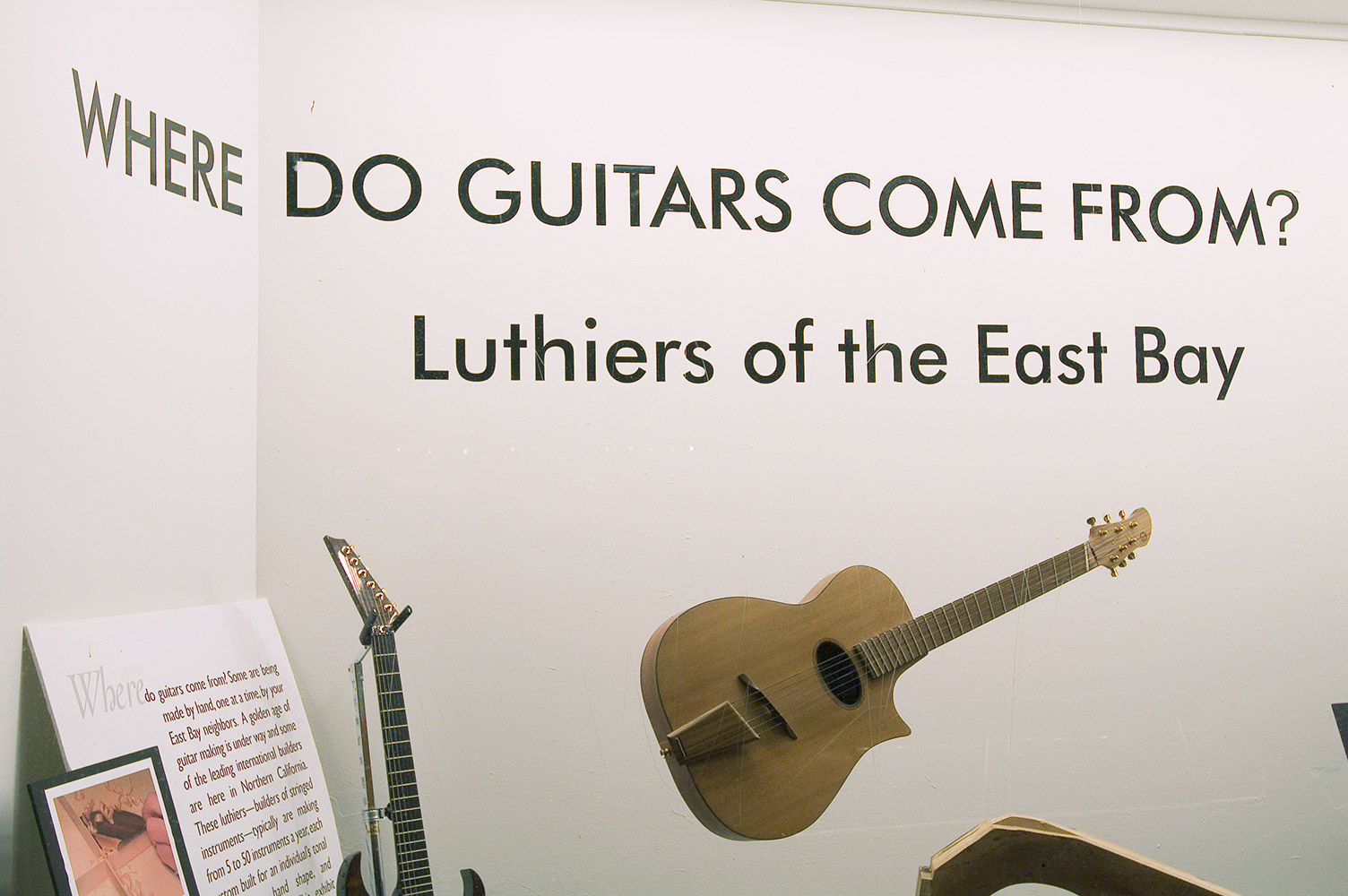
  • The REMFAGRI Factor in Lutherie
  • The State of the Contemporary Guitar – 1/4
  • The State of the Contemporary Guitar – 2/4
  • The State of the Contemporary Guitar – 3/4
  • The State of the Contemporary Guitar – 4/4
  • The Taku Sakashta Guitar Project
  • Thoughts About Creativity, Technical Work, and the Brain – [1/2]
  • Thoughts About Creativity, Technical Work, and the Brain – [2/2]
  • Titebond vs. Hide Glue
  • Tone Production and the Logic of Wood’s Uses
  • Tonewoods in Guitars
  • Tony McManus stopped by the shop…
  • Using Wenge as a Guitar Wood
  • Werewood
  • What I’ve Been Up To These Days
  • What I’ve Been Up To, August 2017
  • What I’ve Been Up To, February 2019
  • What I’ve Been Up To, September 2017
  • What I’ve Been Up To: November ’17 to March ‘18 – [4/4]
  • What I’ve Been Up To: November ’17 to March‘18 – [1/4]
  • What I’ve Been Up To: November ’17 to March‘18 – [2/4]
  • What I’ve Been Up To: November ’17 to March‘18 – [3/4]
  • Whence the Steel String Guitar? – 1/2
  • Whence the Steel String Guitar? – 2/2
  • Why Are There Differently Constructed Classical Guitars?
  • Why Lutherie?
  • Woodstock Guitar Show

© Ervin Somogyi 2026. Powered by WordPress