Ervin Somogyi

Menu
  • About
    • Bio
    • Bio – Humorous
    • Resumé
  • Guitars
    • Guitar Models
    • Guitars: Custom Options
    • Special Projects
    • Visual Echoes & Tasteful Accents
    • Pricing
  • For Sale!
    • The Mexican Festival Model Guitar
  • Artwork
    • Lutherie-Inspired Artwork
    • Artwork (2)
    • Peghead Veneers as Art and Accents
  • Articles
  • Books
    • Books
    • Videos
  • Teaching
  • Blog
  • Contact

(6/6) AFTERMATH: WHAT, EXACTLY, IS LUTHERIE TODAY? AND WHAT IS MY PLACE IN IT?  

I look out the window from my workbench . . . where I’ve done the kind of lutherie work that I’ve pursued for more than fifty years, that I’ve contributed to, and that I’ve made my life’s work.  I’ve known most of the important people in the field.  I participated in its very unfolding.  And I witnessed many of the early pioneers’ professional maturation as I was doing likewise.  I was there.  And I see things in today’s landscape that I don’t recognize.  I’ve thought about writing about this for some time now, but it’s complicated and I’m not sure that I can do a good job at describing or communicating the differences.  Many are obvious; many are quite subtle; and there are undoubtedly many that I am not aware of.  Words aren’t really up to the job of satisfactorily explaining a lot of things that are easy to point to.  

All phenomena have both deeper and more superficial layers.  I say this with the knowledge that Lutherie has “grown up” . . . into a modern world in which craftsmanship is not nearly as needed as it used to be.  By that I mean that it would be a good thing to have more of it, but almost no one thinks that there’d be much value to that; instituting its use would slow economic things down catastrophically.  

There was a panel discussion recently consisting of heads of some of the better-known commercial guitar manufacturers . . . on the topic of the evolution of the modern guitar.  The participants listed a lot of examples of forward-growth and development, focusing on improved designs, and modern tooling, and the sheer multiplicity of new kinds of guitars at every turn.  I wasn’t on that panel, but I was thinking about what I would have contributed; and I don’t think that the other participants would have liked what I would have said.   Lutherie is what I learned from and in the beginning.  Speaking neutrally and without intent to belittle, these fellows don’t engage in lutherie as I understand the word.  They engage in manufacturing . . . which ≠ lutherie; these have different mindsets, goals, and aims.

Hand work is inefficient today, and there’s not much money in it.  And that “hand work” trend extends even to things that no one would have thought of as involving craftsmanship so much as just having basic hand and hand-eye-coordination skills. Even in everyday things. Young kids today, who are i-phone and computer-screen savvy, are observed arriving at school not even knowing how to use scissors.  Yuck.  Fewer people have manual skills now than there had been before.  As I write – and as you undoubtedly already know — there are technologies that are designed to eliminate even the need to know how to drive!  Computers are increasingly displacing peoples’ need to store facts in our brains; one can Google pretty much everything.  But I don’t have to tell you this, do I?  And I don’t think that most people know that early-life use of hands is beneficial to the foundations of mental health and sense of personal development.

I was recently Googling “guitar supplies” and “guitar inlay materials”.  MY GOD WHAT A PLENITUDE OF SOURCES THERE ARE NOW!  As far as the inlay materials go there are pre-cut abalone and mother-of-pearl inlays, Abalam; and many kinds and sizes of shell inlay.  There are complete ready-to-plunk-in rosettes-and-inlay-designs that you don’t have to put any work into; there are even peel-off-the-back-and-stick-‘em-on rosette overlays!  There are also pre-slotted and-with-inlaid-position-markers fretboards, shaped and compensated nuts and saddles, ready-made bridges, and flexible bindings and purflings available.  There are also joined, sanded, and rosetted guitar tops, pre-sized and tapered bracing wood, ready-to-glue-in head blocks and tail blocks and linings, premade necks and joined and rosetted tops, and plans and blueprints of all kinds.  Everything is available for a few dollars for the hobbyist’s convenience.  And so on.  Hmm.  You know, there were plenty of actual Hobby Shops around when I was young; but they’ve disappeared.  It’s been years since I’ve seen one.  Today, “hobby shops” sell pre-made toys and electronic/video games for young people to entertain themselves with; there are cards, comic books and board games, superhero figurines, art and drawing supplies, and electric trains.  But there are very few do-it-yourself things. 

Lutherie Supply Houses themselves sell tools, woods, plans, glues, and everything else you’d ever need to make a guitar with and out of – even kits with pre-made parts.  There are also lots of books, audio tapes, DVDs, tutorials, websites, internet discussion forums, some nine-days-to-two-weeks-long build-a-guitar classes, lots of offers of one-or-two-day consultations, and so on, for anyone who wants to make a guitar.  They’re all about the standard recipe-steps and procedures for making and assembling guitar parts, and not much beyond that.  

For a country as large as this one, I’m disappointed to have found only three Schools of Lutherie that offer anything longer than a two-month stint . . . and none of them exceed six-month programs (this is in comparison with both American and European schools of violin making, that commonly offer curricula of two to four years duration!).   There are, instead, a good many individual American luthiers who offer all kinds of short-term help, from weekends (either one or a series of them) to a full week.  This is understandable, as they are busy making guitars the rest of the time.

I’m not putting anyone down here, by the way.  I’m just describing the landscape as it exists today.  It’s bloomed superficially as part of the modern world, but for anyone who has a memory of how things used to be this work has been impoverished.  The guitar has, overall, a history that goes back some 170+ years; the violin has, overall, a history that goes back some 400 years.  The guitar simply does not have the social/ economic/ cultural Oomph that the violin has.  That’s just how it is.  

The landscape is certainly different now than it used to be.  In those days, there was more room for just thinking about the work, making decisions, and problem-solving – not to mention doing things like making one’s own molds and forms, bending one’s own sides, and making one’s own rosettes and braces.  The sheer inefficiency of work at that level (compared to manufacturing processes) allowed time for thinking, and for developing manual skills and abilities.  I think that these are good things . . . but that are not valued in Commercial society . . . which the West is.

I have in mind that when I sell a guitar to a client I (or someone under my supervision) will have made everything on it, from the rosette to the bindings and to every glue joint and saw kerf (although I do buy my linings and the tuning machines).  My work is no different now than it was at the beginning.  I’m handing clients something that I (with the help of apprentices) will have made completely . . . and not something that’s been assembled out of purchased or subcontracted parts.  On the plus side, there are lots of people these days who just want a hobby activity and don’t intend it to be a career.  Guitar making has become much more mainstream, and largely in this latter form.

MY PATH FROM THE EARLY DAYS TO HERE AND NOW

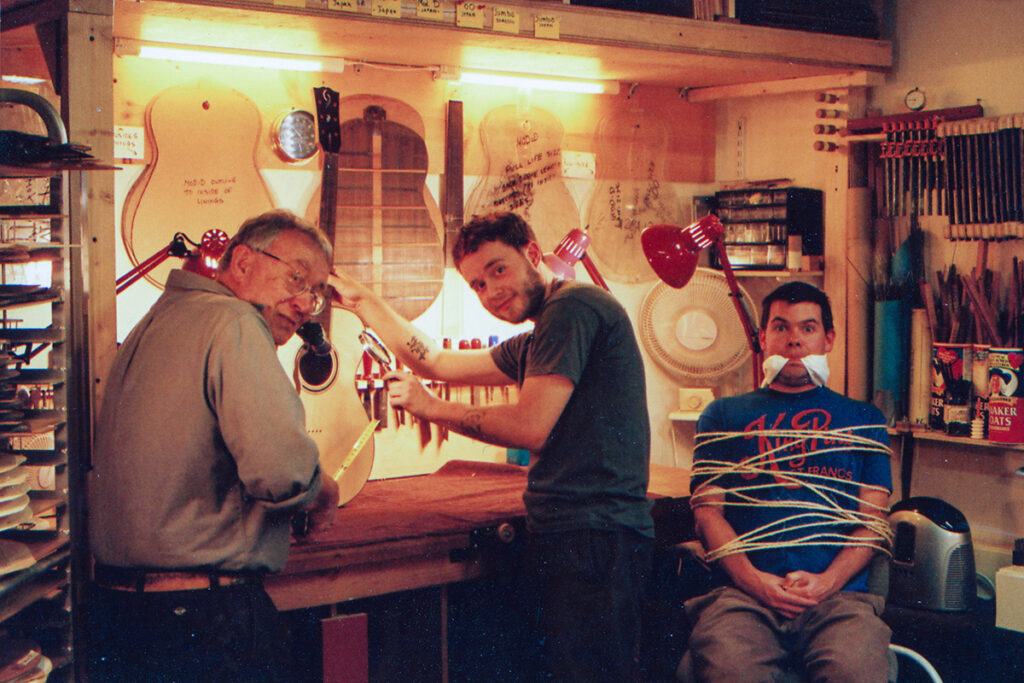
Whenever I think about where I wound up, given my starting point, I’m surprised.  Years ago, when the Guild of American Luthiers was first formed, I attended pretty much every convention that organization ever had . . . we were all new at the game and the things we didn’t know vastly outnumbered those that we did.  I was surprised, at first, that other G.A.L. members approached me to ask questions about this or that.  Well, I told them what little I knew.  And I guess I must have sounded like I knew what I was talking about.  (I mean, having lived in Hungary, Austria, England, Cuba, and Mexico before arriving in the U.S. I’m pretty good with languages . . . and I’ve always liked to read . . . so I’ve picked up a literate-sounding way of speaking.  Also, I’ve always stopped to think about things.  And I’ve done a lot of research too (Figs. 1 & 2).  So I guess I had at least some educated guesses to talk about.  The questioners listened to the things I said — even when I said I didn’t know much about some of the questions they asked.)  Anyway, over time, I found myself answering more and more questions.  I felt myself gradually becoming a teacher-craftsman.

Fig. 1: Somogyi doing risky field research
Fig. 2: Somogyi and assistant doing some daring after-hours research

SOME MORE ABOUT ME

The present narrative has been an overview of my life as it pertains to making guitars – along with some context within which to understand the things I’ve done.  Obviously, these things are not the whole story.  I’m leaving out huge chunks of life that have to do with me as a person, as a husband, as a father, as a son of my parents, and as someone who (like all young people) spent a good many years finding out who I am and coming to terms with that. 

But mainly, aside from history, genetics, and circumstance, I think that my life has been shaped by two principal factors.  The first is what I’m like — that is, what kind of personality I am left with after all the major formative factors that shaped me had had their influence.  And the second is Luck.  I’ve had bad luck and good luck.  Sometimes the good luck turned out to be bad luck in the end.  And some of the things that looked like bad luck became good luck in the end.  Wow.  Who knew?

 As I’ve been saying, none of my life would have turned out as it did if I hadn’t exhibited my guitars at the Carmel Classic Guitar Festival in 1977 and basically crashed into a brick wall.  Or if I hadn’t met Art Brauner.  Or known John Gilbert.  Or Denis Grace.  Or Tim Olsen of the Guild of American Luthiers.  Or others whom I caromed off of in directions that became significant.  And ditto for things that happened had I not met a lot of other people, and been in the right place at the right time, for fortunate little ripples to have been created.  

Very largely, though, part of my luck was that I built my first guitar when I did.  Lutherie was just beginning to be a thing to do, in the United States.  It all grew from those years and continues to grow.  And I’m pretty sure that my life would not have been what it has been had I built my first guitar five years earlier or five years later.  That’s sobering to look at.  Really.

MY POSITION AND STATUS

From what I am given to understand, I’m at this point in my life pretty hot stuff a big fish in a not-too-large pond, despite that I put my pants on one sleeve at a time just like everyone else does.  A lot of people know about me and are impressed by what they’ve been told about me.  I’m a recognized teacher and author.  My books are being translated into other languages.  And my work has from the beginning been artistic and not any attempt to copy any of the standard shapes and models of guitars.  I mean, really: who needs more guitars that look exactly the same? And my guitars have audibly better sound than most of the guitars out there.  

In my other books I’ve described my methods for achieving good tonal, ergonomic, and aesthetic results.  I’ve also trained some talented young luthiers who are making much-better-than-average guitars, and who will continue to do ever more stellar work.  Overall, my life is good.  I’m getting old.  I’m not going to be here all that much longer.  I’m hoping that the calculating, avaricious, and morally blind criminals who are in charge of everything (as well as their witting and unwitting followers) will not get us into another world war . . . so that my work — and that of others — will not have been wasted and/or destroyed.

SOME OF MY CONTRIBUTIONS

My list of things that I have, over time, brought to the steel-string guitar making table is in the list below.  The single most important thing I’ve done, as far as I’m concerned, is to have given permission (and examples of work to look at) for luthiers to do unique to their own sense of having the work done in a better way . . . and to experiment with both design and ornamental ideas, and to do even better work that what I’ve done (if they want to):

1)    Permission to create artistic, colorful, and one-at-a-time-and-one-of-a-kind-cool-looking rosettes. 

2)    Thinking of wood mosaic (or other) rosettes that are more than just circular and/or concentric plastic rings.  Soundhole inlays can be accented, in relief, organic, geometric, exploding, coalescing, angular, textured, multicolored, carved, inlaid, segmented, abstract, Celtic (or some other) aesthetic, etc.

3)    Permission to introduce artistic touches in general – including the designing of guitars that have more organic and pleasing flow of line/contours than traditional guitars have had.

4)    Making, and thereby giving permission to, the making of bridges that are sculpted, artistic, and otherwise looking-more-interesting-than-average.

5)    Practice of, and giving general permission to, have more artistic pegheads that are shaped and cut to one’s own proprietary design, and with veneering on the back side as well as the front.

6)    Offset strings that give you more playing space on the fretboard’s treble side, which they actually need.

7)    Vertical binding strip elements, on the sides, that are wider than the horizontal ones (at the cutaway tip and neck-body joint), and at the butt.  They give a pleasant look to the interplay between the “vertical” vs. “horizontal” elements that are the guitar body’s visible frame – as created by the angular meetings of the top, back, cutaway, and butt-inlay binding strips.

8)    Design of guitar shapes that are less squat, better rounded, and more sensuous and organic (i.e., attractive) than the standard Martinesque and Gibsonesque models are.

9)    Use of saddles that are angled more effectively than those on commercially made guitars.

10)  Use of slanted bridge pins that are parallel to the slanted saddle, thus creating the same break-angle-of-string-over-saddle from first to last.  It helps to make the strings’ volume even. 

11)  Use of ¼” thick saddles instead of the traditional 1/8” thick ones.  They allow for better intonations.

12)  For steel string guitars: bracing that’s not the same-old-same-old Martin “X” bracing.  (I’m using a form of lattice-bracing now, but I’ve used at least a dozen other bracing patterns and methods.  And I may move on to yet more experimentation.)

13)  For steel string guitars: back-centerstrip, butt end, and cutaway corner elements that miter with the adjacent ones, instead of being the usual butt-joints.

14)  Use of a parabolic line to make the cutaway contour.  And/or a hyperbolic shape suggested by the look of the curve of the cutaway plus the curve at the soundhole – or the curve of the fretboard if it intrudes into the soundhole.

15)  Placing a volute or similar and entirely useless ornamental detail on the back of the neck, at the head-neck junction.  It’s more work, but it just looks nice.

16)  Use of laminated side woods that make a more solid rim assembly, and nuts and saddles that have a strip of contrasting veneer running through them.

17)  Use of a more stable “L” shaped head block.

18)  I build more lightly, and/or with less wood.  It allows the soundbox to make more and better sound.

19)  I make deeper (i.e., extended reach) cutaways than many others do.

20)  Use of a 1” diameter neck-to-heel transition curve, rather than the standard 4” diameter one, combined with less bulky heels.  These allow easier access to higher positions on the fretboard.  And they also look nicer.

21)  Spreading the word about how differently and better contoured necks are suited to fingerpickers vs. flatpickers — for respectively better ergonomic positioning of these different players’ hands on the back of the neck.

22)  Use of artistically abstract body inlays, instead of more commonly identifiable objects such as fish, dominoes, Buddhas, Celtic designs, leaves, etc.

23) Making fretboards whose ends are shaped to the curve of the soundhole, like Spanish guitars have.  And also fretboard bindings that go around all four sides of the fretboard.

24) Attention to the importance of the evenness of the mechanical/tonal gradient of the top.  This is essential if you are making guitars for guitarists whose music consists of many notes, not mostly chords.

25) Exploration, and permission to explore, the aesthetic and acoustic sense of not-too-much-and-not-too-little.  It makes a difference, that.  One doesn’t have to just copy what others do.  Also, while this sounds soooo abstract, it leads to gut feelings that you will trust and use to guide you, further on down the road. 

26) Awareness about listening to the guitar, and what to listen for.  It’s just as important as making the thing.  If you don’t know exactly what you’re producing, you’ve got a big blind spot.

27)  Tap-tone guided voicing.

28)  Awareness and use of the Cube Rule: i.e., the vital importance for tonal response of even minor increments of thickness/height/length of the top, the back, and all the braces.

29)  Reliable use of the dynamic importance of coupled or uncoupled structural elements.

30)  Teaching about and laying out the principal guidelines in guitar voicing.

31) Teaching and laying out the principal guidelines in overall design.

32)  Teaching an awareness of the common-sense dynamics of sound, and how they relate to structure.  And how the structure relates to sound.

33) A sense of the importance of seemingly small things — such as the strings’ break-angle over the saddle – which aren’t so small after all; they can make changes in sound that you can hear.

34)  Teaching about and working with usefulness of visual accents.  For instance: butt and other inlays that are in fact decorative accents.

35)  Teaching and putting into effect the relationship between mass and sustain.

36)  Teaching an awareness of the guitar’s aesthetics, and cutaways whose lines harmonize proportionally with the guitar’s other lines.

37) Permission to consider the possibilities of artistic and aesthetic repair/inlay work.

38)  Teaching and using the advantages of compensated nuts, in addition to compensated saddles.

39)  Use of artistic and colorful fretboard inlays and side-inlay position markers, as opposed to just simple dots.

40)  Spreading an awareness of the monopole, cross-dipole, and long dipole.

41)  Extensive innovations through bracing design, placement, shaping and treatment – and permission and encouragement for others to do likewise.

42)  Spreading the word about The Golden Ratio — which is about pertinent aesthetic sense of proportions and visual balance.

43)  Encouragement to do and doing of clean mitering work all over, instead of using butt-joints.

44) Practice of respecting the work, the materials, and the tools . . . and encouraging others to follow suit. . .  

45)  Guidance in how to think about various aspects of the work, and how to problem-solve — for and by yourself. 

46) Use of bridges whose bottom gluing-surfaces are curved to match the doming of the top.

47) Increase of awareness that a guitar can be made beautiful in just about any aesthetic so long as the design is balanced and consistent: ornate, Japonesque, anatomical, geometric, less is more, visually simple or chaotic, contrasting colors or monochromatic, Bauhaus, Renaissance, Baroque, minimalist, whimsical, Kandinsky, Trompe l’oeil, Indian, etc.

Posted in Uncategorized

(5/6) MY LIFE AS A GUITAR MAKER: LOOKING BACK

When I made my first guitar there was only one book available on how-to-make-one: Irving Sloane’s Classic Guitar Construction, published in 1966.  Now there are more than two dozen – not counting scores more of table-top books about collectors’ guitars, this or that factory’s most prominent models, lists of various makers and their work, famous players and their guitars, etc.  And there will be yet more.  As far as how-to-make-a-guitar goes, those books list the same cutting, shaping, and assembly instructions, albeit differently worded and with different photographs.

Sloane’s book included a bit of history and background about other makers, as well as a section on how to make one’s own tools and jigs.  Most of the newer books don’t include much ancillary information (design basics, the physics of energy-use in the guitar, engineering considerations of structures, guitar history and development, musical uses of the guitar, fine points of action and intonation, different bracing layouts, who’s who and who pioneered in what, other sources of information, acoustics, monocoques, different technologies, etc.).  You’d think that a luthier would be better at his work if he knew his guitar and its history better.

SOME THOUGHTS ON GUITARS AND SOUND

Learning about the people who play different kinds of guitar, and their music, does make one a better guitar maker.  Better technically? you ask.  Well, no; but it certainly helps one to respect the guitar’s enormous appeal, sticking power, complexity, and versatility.  It helps to know, for instance, that the classical guitar community — as a culture — pays more attention to a guitar’s sounds than the steel string/folk guitar playing communities do.  In my experience, in fact, most steel string/folk guitar players don’t know how to listen to a guitar, or what to listen for – which is a topic I’ve written about elsewhere.  They learn what notes to play, ¾ time or 4/4 time, and fingering variations, about volume, etc.  But they tend to not have much of a vocabulary for sound.  The reason for this difference is twofold.  First, steel string/folk guitar music has focused mostly on rhythm, melody, and song — that is, on the music and the song.  But not so much on its musicality.

The other reason is that music for the classical guitar is purposefully written with the intent of expressing a wider and subtler range of the tonal/emotional spectrum.  This involves learning about, and appreciating, music’s and the guitar’s musicality – which includes orchestration, dynamic range, composition, warmth, projection, evenness of tonality across the strings and up and down the fretboard, etc.  Or, in other words, the qualities of the sounds that can be produced – and the playing techniques that will produce the widest range of tonalities . . . whether in single notes or various notes played at the same time.  

These are more the focus of the classical music appreciator.  Subtleties of techniques are learned and used to express nuances of tone and shadings of sound, from warm to mellow to sweet to staccatto or con brio, or sharp, cold, lingering, as well as dynamic range, tonal bloom, soothing, harmonics, harsh, crescendo & diminuendo, vibratto, etc.  To further complicate things, while music for the majority of people everywhere contains song, European culture also has had a soloist-to-orchestral class tradition of music without song.  And music without voice accompaniment can offer a palette of the subtle tonal aspects of musical sound (more so in the nylon string guitar than the steel string one) that can please the experienced ear – just as the subtleties of wine can please the experienced palate, and the subtleties and textures of food taste can please a gourmand.  

[SIDEBAR: It is true that these enjoyments of the more rarified aspects of musical tone can make such people feel superior to ordinary people.  But other groups of “ordinary” people can in turn ignore that group with equal ease because they have songs that they can all enjoy, love, and sing.  I mean, how many upper-crust wives sing, or even just hum opera, or Bach, or Chopin as they . . . uh, well, their servants, actually . . . make lunch or dinner?]

A guitar’s Dynamic Range contains many tonal elements.  It refers to the range of sound that is available depending on whether one is playing gently or normally or vigorously.  Then, a guitar’s own palette of tone coloration (as opposed to just volume or balance) comes out of how its strings are plucked or stroked with different amounts of energy, or plucked with the flesh of the finger or a fingernail or a plectrum – and even the material that the plectrum is made of — or even plucked at different distances from the bridge.  In a musical culture it’s the difference between (1) it’s this note instead of that one, and don’t worry about anything else, and/or (2) it’s this note played like this, and/or (3) it’s played like this or like that, but not this other way [ENDNOTE 1].


ENDNOTE 1:  The topic is variety and range of tone as a focus of playing technique.  There is a difference in how “serious” and “the other” musics are taught.  For the “serious” music, the teacher of course tells the student how the music should be played; but he also tells the student how the music should sound at various points.  The written music itself tells the player how it should sound at various points, because the composer wanted certain musical effects in place — such as suggested tempo, accents, rubato (delayed notes), staccato, loud or quiet or really quiet (forte, piano, & pianissimo). getting loud or even louder or quiet or even quieter (crescendo & diminuendo), speeding up or slowing down, etc.  The “non-serious” music teacher, in contrast, places more focus on what and where the notes and chords in the piece are than what its specific qualities of tone should be.  There’s a lot of overlap between these two . . . but there is different emphasis too.

These things are themselves based in the nature of these different musics.  Music for the “serious” classical guitar is informed by, and participates, in the music of the classical composers (Bach, Mozart, etc.), and Renaissance music, and modern atonal (Satie, Antheil) music, as well as Romantic, Ukranian, Russian (Scriabin, Stravinsky), Experimental, Modern, Spanish, Expressionistic, Twelve-tone, Early 20thcentury (Fauré), etc.  If you go to Wikipedia you can read about classical guitar composers from seventy countries, who have added something to the oeuvre, each with their own “flavoring”.  And not only are different national tonalities expressed in such musics, but the emotional range of the music is quite wide as a result.  It can be happy, sad, frightening, inspiring, meditative, mysterious, warm, abstract, distant and alienated, tender, seductive, screechy, descriptive of the outdoors, expressive of solitude, harmonious, dissonant, auspicious, sweet, heartbreaking, intimidating, sensuous, portentious, spiritual, soothing, languorous, hair-raising, exciting, boring, climactic, heady, thunderous, contrapuntal, smoothly melodic, dramatic, ominous, Cosmic . . . and so on.  To have a bit of a sense of this, treat yourself to listening to “Peter and the Wolf” by Sergei Prokofiev.  It’s a kaleidoscopic hoot . . . and it’s really good music too.  And listen to music by Aaron Copeland.

This is all, honestly,

Posted in Uncategorized

(4/6) THE CARMEL CLASSIC GUITAR FESTIVAL OF 1977

As I’ve been saying: when I began making my first guitar, in 1970, I was more or less a (clean) hippie — that is, a bearded and well-showered young man who was living on the edges of the mainstream culture, and not going in any particular direction in life.  Looking back, I’m of the opinion that everyone ought to have such a period in their lives — a sort of gap year, even if it lasts more than a year — in which they are relatively free to bump into people and things that they would not have encountered had they been on some career track . . . in whatever form or forms such things tend to come in.  

 A BRIEF REITERATION OF WHAT I’VE ALREADY SAID          

As I’d also said, I embarked on my first guitar-making project casually; as far as I knew it was going to be a hobby-project to tide me over until I got a “real” job.  I didn’t know any American guitar makers in those days; I had not even heard of anyone outside of Spain or Germany to be making guitars by hand.  Still, I’d spend a Summer in Spain and hung out around some of the luthiers’ shops in Granada.  And earlier, when I was in grad school in Wisconsin I’d met a man, Art Brauner, whom I’ve mentioned before, who had built a guitar with the help of Irving Sloane’s pioneering book Classic Guitar Making.  He did it just to have made one, after he’d taken his own damaged guitar into a repair shop to have his guitar re-topped; he wasn’t all that impressed with the work and he thought he could do at least an equally good job.  I was mightily impressed; having been a student much more than anything else in my young life I’d not produced much of anything other than whatever could be put on a piece of paper — but this fellow had made a real three-dimensional object!  And later, when I was making my first guitar, I met Denis Grace, a Berkeley luthier who was the first “real” guitar maker I ever met in this country.  I got a lot of support from Denis and, overall, I am seriously indebted to both of these men.

No one in my family had ever puttered with hobbies, done woodwork in the basement, played sports, built models from kits, made furniture, or anything like that.  Well . . . we were immigrants.  From Hungary.  And like immigrants everywhere my parents spoke their new country’s language badly, and started at the bottom, and worked very hard to survive.  Immigrants (if they aren’t bringing money with them) and refugees (who by definition have no money) work very hard indeed.  So, my parents never had time for a hobby, or even to just sit down and read a book.  And they INSISTED that I go to school and get an education; I was going to redeem all the hardships they’d endured.  Well, given their histories and life experiences, I can understand that they NEEDED something to tell them that it had not been all in vain.  I’m afraid I disappointed them.  And it’s too late now to tell them that I’ve achieved some success.

MY FIRST GUITAR

It’s amazing that I survived the first years of lutherie.  Having been an English major in college, I’d had training in how to write grammatically correct sentences using properly spelled words, and correct punctuation.  But, otherwise, I started with no training, no experience, no knowledge, few tools, no teachers, no work discipline, no professional standards, and marginal skills.  Still, I survived, and made a few guitars each year . . . and along with that the repair and restoration work became my real education in musical instrument woodworking.  Because I played flamenco music I was making mostly Spanish (classic and flamenco) guitars, as well as lutes, zithers, and dulcimers.  I had made a few steel string instruments but, not knowing any better, I was merely making big Spanish guitars with metal strings, that didn’t hold up to such string tension very well.  I felt more or less pleased to think of myself as a luthier.  I think the romance of it kept me going.  

Income-wise, I grossed $1800 my first year.  I grossed $2500 my second year, and I grossed $3500 my third year.  And I had a part-time job teaching guitar and wood carving at a nearby school, to supplement my income.  It didn’t help that for my first two years the Telephone Company neglected to include me to the telephone listings and telephone books.  I had a phone, but no one knew about it.  I tried to sue the phone company but they put up a defense that made it o.k. for them to have done that.  To “make up” for this oversight the phone company gave me a discount on the monthly telephone bill; so I got a 50%-of-cost telephone service and a 100% anonymity.

I didn’t really face up to how inadequate and amateurish my work was until 1977, when I was put in a situation where I could not ignore it.  That year I was invited to display my guitars, as one of seven exhibiting luthiers, at the important Carmel Classic Guitar Festival.  I’d been building guitars for five or six years by then and felt happy to be invited to show my work.  I can tell you that while my parents could not begin to fathom what I was doing making guitars when I could have had such a promising career doing something reasonable, my friends had been supportive and encouraging to me in my guitar making efforts.  Guess which set of people I put my faith in.  In any event, I went to Carmel feeling a little cocky and smug, thinking to impress the people there just as I had wowed my friends. 

THE CARMEL CLASSIC GUITAR FESTIVAL

Carmel is an upscale vacation community four hours’ drive from San Francisco.  The guitar festival — the first one I’d ever gone to — was a prestigious event that drew important people from all over this country and even a few from overseas.  It had been organized by a prominent local classical guitar teacher, Guy Horn, to whom I remain indebted to this day.  Among my fellow exhibitors were Jeffrey Elliott, Lester DeVoe, Randy Angella, and John Mello — all of whom went on to support themselves by making Spanish guitars. 

The festival was a disastrous failure for me.  I had expected the public to respond to my work with admiring approval, as my friends had.  But what really happened was that my work was publicly revealed, in its full and splendidly careless amateurishness, as the worst and clumsiest work in the entire show.  Visitors to my table looked at my work and asked “why is your bridge on crooked?” and other subtle questions like that.  The three-day long event was a dismal, humiliating, and sobering experience and I came back from that event severely shaken and depressed.  My friends had, in fact, been no help to me at all with their uncritical kindness: I hadn’t learned anything.  I stared at the fact that I had been more or less wasting my time living out a sixties fantasy.  It stared back at me.  It wasn’t exactly that I’d been doing bad work . . . but I’d thought my work was good enough and let slide things that I should have known better than that; I was really lacking any sense of professional standards.  Understandably, I experienced a crisis.  It became clear to me that I should quit making guitars and do something else, or buckle down and do better work.  It was a stark yes-no sort of realization.  It took me several months of unscrambling my brain, and re-evaluating, to get in touch with the fact that I actually liked making guitars, and that “good enough” wasn’t really good enough.  Oddly enough, I hadn’t really known this before.  But I saw that I liked the work enough to stick with it and do it better.  That was my real start in lutherie.

MY REAL START IN LUTHERIE

I still remember the day that I had my epiphany.  It’s odd, I think, to not have known that before, even though I’d been doing it for a while.  But I remember that I was struck by that thought suddenly . . . several months after the Carmel disaster.  It had the impact of clarity comparable to that of finding out that your wife has been lying to you.  And that epiphany was my real starting point as a guitar maker.  

It was within a year of that decision to do the best work I could, and not let things slide, that I started to make “real” steel string guitars.  The timing worked out: I was starting to meet a lot of steel string guitar players in that period — and specifically the first of my Windham Hill contacts, which were to become important for me.  

The timing was fortuitous in a larger sense too: that was when the making of better steel-string guitars was beginning to make a blip on the cultural radar.  The folk and rock (and other) movements of the sixties and seventies had certainly sparked the playing of guitars . . . by white people, and in the bigger coastal urban centers.  Jazz and blues had been around since at least the 40s, rock’n’roll had been around since the 50s, and cowboy and country-western had been growing since at least the 1930s (when the radio came into being) . . . but these had been incubated in the American heartland, not the big cities, and the first of these wasn’t mainstream or white enough . . . but all the famous folk and popular singers, players, duets, and groups who sang and played “folk music” (i.e., not jazz, ethnic, or rock’n’roll) in the 1960s and 70s — such as Peter, Paul and Mary, the Mamas and the Papas, Bob Dylan, the Weavers, Dave van Ronk, Johnny Cash, the Carter family, Simon and Garfunkel, Roy Orbison, Ricky Nelson, Ian and Sylvia, the Limelighters, the Beatles, the Everly Brothers, Ramblin’ Jack Elliott, Kate Wolf, the New Christy Minstrels, Phil Ochs, Joan Baez, the Kingston Trio, etc. etc. etc. etc. etc. etc. etc. etc. etc. etc. — all of whom were white and no one thought twice about any of that — were bringing their music to other white people in the larger central and coastal cities.  And they were all using store-bought guitars; handmade ones had not quite yet come into the picture.  But they soon would.  

A PEEK AT THE LARGER CONTEXT

Enter the Windham Hill music label.  It started something new, in the early 1970s: the first recordings of solo guitar music that were of the quality and clarity of classical and orchestral recordings.  And that was when recording steel string guitar artists started to notice that their commercially made instruments had limitations: they didn’t play perfectly in tune, and they were also difficult to record in high fidelity; their sound was so uneven that the guitars needed a lot of studio equalization.  Translation: they were a pain to deal with.

The appearance of individually made guitars was just starting to get off the ground when the Carmel Classic Guitar Festival happened.  It was the first event I’d heard of that was any kind of showcase for luthiers’ work.  The Guild of American Luthiers, which was to be the first meeting place for (young) Americans who were interested in this kind of work, was formed in 1972 and became THE lutherie event for all of us young guys.  In fact, the president, Tim Olsen, decided pretty early on in the game to not have an interest in inviting the public; he wanted this to be an event by the lutherie community and for the lutherie community.  One of the fortunate doors that opened up for me at about that time, as I said, was the Windham Hill door; it turned out to be one of the most important ones that had ever opened up for me.  I want to stress that that would not have happened had I not had such a disgraceful showing at the Carmel Classic Guitar Festival.  That turned out to be one of the most-horrible-and-yet-beneficial things I’d ever experienced.  

I was lucky in just being able to have a relationship to the Windham Hill musicians.  The epicenter of that musical ferment was in Palo Alto, the site of Stanford University, and I was living only an hour away from it.  It helped that I’d figured some things out about guitars by then; I’d had six years of experience that I finally began to pay serious attention to after the shock of the Carmel Festival; and my instruments were by then finally good enough that people could consider playing and buying.  I had figured out a few things about guitars by then.  I had, for one thing, done many “tuning compensation” adjustments to increase a particular commercially made guitar’s ability to play in tune; none of them play perfectly in tune.  And my work was cleaner.

Ironically, it all concerned steel string guitars, which I did not play.  And my connecting with the Windham Hill musicians started accidentally, in much the same way that you meet your future wife at a party that you’d been casually invited to.  A friend had invited me to go with him to a guitar concert; the featured performers were two guitarists whom I’d never heard of, Will Ackerman and Alex de Grassi.  And I was thunderstruck by Alex de Grassi’s music: it rang in my head for days afterwards.  It got TO me and INTO me.  I eventually made contact with him; he was starting to make recordings and his guitar couldn’t be gotten to play in tune, and he needed that fixed.  I corrected that problem with some intonation work (as I said, I’d done a lot of it by then) . . . and he told his friends about me . . . and that started me rolling toward specializing in intonation work.   And if you’re going to be making a recording (for Windham Hill or anyone else) one of the most important things to make sure of is that one’s guitar plays in tune and has no tonal unevennesses – which all commercially made guitars (that have not had work done on them) have trouble with. 

It’s sobering to know that none of any of this would have happened had I made a good showing at the Carmel Classic Guitar Festival.  Once you have had a few of these kinds of experiences, and think about them, you start to believe that the building blocks of the Universe are carbon, nitrogen, hydrogen, oxygen, and luck . . . and racial culture.  This element of cultural life niggles at me, always, because I’m aware of how racist a culture I live in.  Most of the homeless people I see on the street are Afro-American.  It is the kind of factor/fact that is NEVER mentioned in reference to any notable person or accomplishment.  If Albert Einstein and the Beatles hadn’t been Caucasian . . . would we ever have heard of them?  Most authors are white.  Most actors are white.  I think that half of American athletes are Afro-American.  Even the few women luthiers I’ve heard of have all been white.  That’s almost as jolting to me as my experience at the Carmel Classic Guitar Festival of 1977 was.   Yeah: I don’t know what or how my life would have turned out, had I merely had pigmented skin.  Not like it did, for sure.  One might point out that I’m smart and educated too; but guess what role the color of my skin played in that.  For a long time in this country dark-skinned people were not allowed into any of the “better” schools.


Like I said, this kind of thing is something that niggles at me a lot.  I think that this is on account of how I grew up in other countries in which people spoke other languages than English — and for partly that reason I never felt I “belonged” there.  I carry the feeling of not belonging with me everywhere I go; I learned that early on.  The fact is that while I look and sound American . . . I’m not.  I didn’t grow up here.  I grew up mostly in Spanish, German, and Hungarian-speaking countries.  It’s possible that because I’ve always felt “different”, and because my guitars are personal to me, instead of business . . . maybe that’s why my guitars are “different”.  It’s an interesting thought.  And, given how the human mind works, there’s probably something to this.  I don’t think that “normal” people make all that many contributions to society.

Posted in Uncategorized

(3/6) ABOUT MY LIFE AS A GUITAR MAKER

There had been another thing about living in Rockford that I felt miserable about: my parents’ continued expectations that I become someone they could be proud of.  Here I was, 25 years old, and going nowhere.  The even traveled to Rockford for a week to visit me!  I couldn’t ignore their subtle-but-constant pressuring. 

I dealt with that in the traditional way: I ran away from home.  Really.  I quit that job in late December of 1969, packed up my things into my car, and left the Midwest to return to Northern California.  I still had some friends there.  And I did this without telling anyone – and certainly not my family.  I just disappeared off their radar.  Interestingly, as I was driving to California in the dead of Winter, I made several overnight stops during that trip; I parked the car, kept the ignition going and the heater on (it was freezing outside) all night long, and slept in the car.  It was a 1968 six-cylinder Dodge Dart, a stick-shift car that NEVER let me down.  I wish I still had it. 

I arrived in the San Francisco Bay area just after Christmas of 1969, without a plan, job, or lodgings.  I was 25 years old.  I stayed on various friends’ couches here and there for a few months.  I thought I’d be able to find a job fairly easily . . . but I didn’t.  I applied for all kinds of jobs but didn’t get hired for any of them: I was overqualified, underqualified, outcompeted, etc. every time.  I was running low on savings; so I got a job as a paperboy for the Oakland Tribune — delivering newspapers to people’s porches.  It was an “Adult Paper Route” in which I delivered 200 newspapers in a section of Oakland, daily, seven days a week.  I did that for 14 months.  

That job took 2-½ to 3 hours a day.  It wasn’t exactly stimulating work but it gave me enough of an income to survive, and a lot of free time.  I was single and I could live on $300 a month.  Lodgings-wise there were lots of inexpensive “communes”, rooms for rent, shared housing and such, for free-spirited (i.e., young and aimless) people . . . and I lived in a series of such places.  I wasn’t exactly a hippie, but I could live like one.  And I might add that though a lot of these “communes” were called that, they weren’t; they were comparatively cheap housing for people who had very little in common.  

That was, however, my first experience of having any truly free time.  Even in Peru my bosses always knew where I was.  Now, no one knew where I was.  I didn’t have to do anything other than that to pay my rent.  It was as close to Heaven as I’d ever felt, even next to my rather unstructured and unscheduled day-to-day life in Peru.  I audited some classes, played guitar, read, wandered around . . . and Art Brauner, the fellow in Wisconsin whom I’d met and who had so impressed me by making a guitar, came to mind.  I’d liked the guitar since High School; and if he had made one . . . maybe I could too?!  I certainly had the time to engage in a hobby.  And I was utterly unaware of what would come out of this one. 

So, I decided to give it a try.  I made a workbench with some 2x4s and half of a ping-pong table, got some guitar woods, a few hand tools . . . and Irving Sloane’s book Classical Guitar Making . . . and, working in the dilapidated garage of the shared house I was living in at the time, I started to make a guitar!   Sloane’s book was perfect for those times: it instructed the reader in how to make one’s own tools and parts — from purfling cutters to clamps to rosettes to bending forms to molds and jigs.  I even made my own thickness caliper out of coat-hanger wire and a bolt and nut.  Not all that long afterwards the need to make one’s own tools vanished, as supply houses sprang up that would sell you anything you needed and a lot of stuff you didn’t.  That first guitar took me a year to complete.  It wasn’t, honestly, the best guitar ever made . . . but it was 100% mine.  I made it with an electric power drill and a few hand tools.  As far as making the guitar mold itself I glued together a block of wood, took it to a woodshop, and paid them $9 to bandsaw my guitar outline out of it.  I didn’t notice that that quickly-bandsawn mold wasn’t symmetrical, and for a long time my guitars were a bit lumpy and lopsided.  (They may be collectors’ items by now.) 

Making the guitar had been a hobby project.  But friends of mine who knew about it started to ask me to tweak the action on their guitars, do fretwork, and to fix minor cracks and fractures, and to do various other not-too-complicated things that they were unwilling or unable to do by themselves.  And they paid me to do it!  Wow!  I’d discovered a new source of income!  With this newfound realization that I might be able to do something remunerative other than to deliver newspapers, I began to canvass more widely for guitar-related repair work.  Using the guitar I’d made as a calling card, I went to all the music stores in my area and offered to do repair work for them, if they had any they were willing to let me do.  Several of these accepted my offer to pick up repair work from their stores, do the fixes, and return them.  And they paid me.  I also put quite a bit of effort into driving to both the San Francisco and Oakland airports and visiting EVERY airline, with an offer to do repairs on any airlines-related guitar damage.  I knew people who’d had guitars damaged during air flights, (United Airlines was at the time the worst in this regard).  As for myself, I was so young and innocent that I didn’t even have business cards when I visited the airlines offices: I gave them xeroxes with my name, address, and number on it.  I think I must have seemed very cute to them. 

It also occurred to me to contact every jigsaw-puzzle company I could find, and ask them whether they’d consider turning out jigsaw puzzles of some of my guitars.  None of them took me up on my offer . . . but given how I’d grown up not feeling permission to do anything of my own accord I’m astonished to know that I actually took the initiative to do any of these things.  Wow indeed.  In my childhood and young adulthood, at home, I’d not been allowed any initiative whatsoever.  This was a new realm of life!!!  

At one point, in late 1971, I was living in two rooms in a shared house, and had very little going for me other than the fact that I’d made one guitar.  As I’d mentioned, I used that guitar to solicit repair work.  A few stores were willing . . . although I didn’t get enough work from them.  So I went down to City Hall and bought a Business License for $20, and became official.  I put up an “L” shaped post made of 4×4 wood, in front of that house (it was zoned for business) and suspended a beaten-up guitar on the horizontal bar, with some screw-hooks.  I painted the word “repairs” on both side of that guitar and I was off and running like a herd of turtles.  And I repeat: no one had told me to do this; I did it on my own!  That I could do so was a revelation. 

It was in this period that I met Denis Grace, a classical guitar-maker in Berkeley.  He was the first guitar maker I ever got to know.  I did some repair work for him that he was too busy to get to.  And I think I did it well.  He offered me use of one of his workbenches at his shop – which was a step up for me because my workbench space was minimal — and Denis had a bandsaw, sander, and drill press that I could use!  I made my second and third guitars in his shop – and as it was an established business to which customers came, I got to meet some actual guitar players.  And a few makers: Gabe Souza, Mario Martello, Campbell Coe, Richard Bruné, Eugene Clark, and Warren White, who were some of the earliest American guitar makers.  Actually, Gabe Souza was Portuguese and Mario Martello was Argentine, and Campbell Coe was a guitar repairman.  But as makers of guitars, Clark and White were two of the very first American pioneers. 

[SIDEBAR: I should tell you that for an American to have turned to guitar making before 1965 was an act of foolish optimism.  As I’ve mentioned, NO American was doing artisanal guitar making work at the time.  There were a few Puerto Ricans, Mexicans, Spaniards, etc. doing such work in this country . . . but they all came out of cultures that had long histories of support for artisanal work.  The United States had almost NOTHING of that type then.  No American guitar maker was in any position whatsoever to know anything about guitar making aside from looking into some handmade Spanish or factory-made steel string guitar soundboxes.  It should not be surprising, then, that every one of the very early American guitar makers I ever met was a bona-fide oddball and/or misfit who could not have tolerated having a regular job and a boss to be responsible to.  I’m not passing judgment on these pioneers; I’m just describing them as being far outside of the mainstream.  And, to be honest, I myself meet those criteria.  Today, however, an American lutherie tradition does exist, and people who are attracted to the work no longer need to be weirdos.]

After I’d known Denis Grace for about a year, he told me that he was leaving the guitar making business to go back to school in Oregon . . . and would I be interested in taking operation of the shop over?  I’d never done anything remotely similar to that, and I really had no idea what that entailed.  But I was a lowly and inexperienced itinerant luthier/repairman at the time, and I literally didn’t have anything better to do.  I agreed.  And as of March 1, 1972, I took over the running of The Guitar Workshop in Berkeley, California.  Looking back, I owe Denis for a lot of my start in lutherie.

1972 was also the year that I signed up to be a member of the Guild of American Luthiers, the first such organization anywhere that served (mostly) the guitar-making crowd.  The G.A.L. was headquartered in Tacoma, Washington, and it was a Godsend for me – and every aspiring luthier around.  It was a national organization of people who shared my passion and interest.  It was, in a way, my professional family.  I was a member until about 2005, until which time I attended almost every convention that the G.A.L. had.  I also wrote articles for its newsletters, gave lectures, did workshops, had discussion sessions, and donated equipment and materials for the G.A.L.’s fundraising auctions.  The G.A.L. has since the beginning been under the leadership of Tim Olsen, whom I admire for his tireless efforts over the past 50 or so years in holding together an organization that was dedicated to the furthering of my profession, dissemination of information about this work, and also guiding the organization through some pretty rocky growing pains.  I take my hat off to him.  I would not be the luthier I am today without having everything that I’ve known and done having been filtered through repeated and faithful attendance at the conventions over a long span of time.  Both Tim and the G.A.L. have been important to me past my ability to verbalize. 

Attendance at G.A.L. events notwithstanding, I still had a lot to learn.  I mainly wanted to make guitars, and I did make a handful of them in the early years; but they were not very good.  Plus, no one knew me.  This was waaay before being able to spread the word through the internet, discussion sites, or even magazines to take out ads in.  I got most of my income for about the first eight years through doing repair and restoration work, supplemented by a part-time job teaching, and by countless (mostly unsuccessful) backstage meetings with guitar players who came through town – from Tony Rice to Leo Kottke to Emmylou Harris to Bob Dylan to Julian Bream to Paco de Lucia . . . and zillions of others . . . as my way of advertising myself.   

I should say that while my association with the G.A.L. carried me through the lean times, it wasn’t so much an education for me as it was a reason to keep on working.  The two most important educational experiences I had were, first, doing every possible kind of repair and restoration work you can imagine, for some eight years.  I worked on guitars of all kinds, banjos, mandolins, harps, dulcimers, zithers, balalaikas, sitars, sarods, kotos, African stringed instruments, thumb pianos, bandonions (they’re small accordions), drums and drumsticks, and whatever else you could possibly think of.  I learned a hell of a lot about woods and strings and fixes and instruments and how their parts worked together.  I also learned a lot about what happened to a guitar’s sound when you did this or that to its top or back.  But along with that, I have to tell you that it was a hard way to make any kind of living.  I grossed $1800 the first year.  I grossed $2500 the second year.  I grossed $3500 the third year.  I had a part-time job teaching guitar and wood-sculpting at a nearby school, to supplement my otherwise low income.  It would be impossible to survive at that level now. 

The second most educational experience I had was at the Carmel Classic Guitar Festival of 1977 which was, for me, one of the best disasters I’ve ever had.    

Posted in Uncategorized

(2/6) HOW I FIRST MET THE GUITAR

I was living in San Diego, California when I was in High School — and the hottest guitarist/singer entertainers at that time were The Kingston Trio.  They were big.  Bigger than big.  Huge.  Everybody was singing their songs.  And we young High School boys learned that if we got some cheap guitars, and learned three chords, and sang some Kingston trio songs, WE COULD GET THE GIRLS TO PAY ATTENTION TO US.  That was a massively important discovery.  San Diego is an hour’s drive from Tijuana, where there were plenty of cheap guitars to buy; My first one cost $22.   

I did learn to sing a few chords and songs . . . but at the same time I also learned that I can’t sing.  I can hear subtleties of sound in a guitar’s voice, but I can’t manage my own voice beyond just talking.  That’s weird.  But there went my singing career.  However, I did befriend the guitar in a different way: I got attracted to flamenco — in which the traditional singing sounds as tortured and as bad as my own.  I’ve been attached to that music ever since — I think because of its rhythms and cadences, and because of how they make me feel.    

I pretty much ignored the guitar during my college years, as my classes took up most of my time and energy.  I was on a pre-medical school track, but I kept on finding that I wasn’t really interested in that.  I’ve always liked to read, so I became an English major.  But I didn’t have a goal or aim in life yet . . . much to the disappointment and worry of my parents.  

SOME CONTEXT

I’m going to detour a bit into some personal history that I’ve already written about elsewhere, and that has nothing to do with guitars or guitar making, but that I lived through, and that led me up to the making of guitars.   

I graduated from college in 1966 and immediately joined the Peace Corps, and lived in Peru for two years.  Those were two good years of learning some things about the world. When I returned to the U.S. I went straight into graduate school at the University of Wisconsin in Madison, where I’d chosen to major in Latin American Studies.  What else might I have been interested in after two fascinating and broadening years in Latin America?  As it turned out, I didn’t enjoy graduate school.  I learned more about academic and interdepartmental politics than I did about Latin America – and what I did learn about Latin America was dry, with statistics obtained by observing things from a distance, and analyses of this and that on paper . . . and boring histories.  I wasn’t all that interested in the academic politics, which differ from corporate politics largely in that there are diplomas instead of sales charts on the walls.   

In any event, to my parents’ horror, I dropped out of grad school.  I floated around Madison for a while, taking odd jobs of various kinds, including playing guitar in restaurants and coffee houses.  I liked flamenco so much that I went to Spain for the Summer of 1969 to study it.   I spent that Summer in Madrid and Granada . . . where I happened to visit some guitar makers’ workshops.  There were some two dozen luthiers in Granada at the time.  But I was just hanging out there; this was still before any idea of making guitars ever hit me.

I MET A MAN WHO’D MADE A GUITAR 

One of those little-things-that-eventually-turned-out-to-be-important happened to me while in grad school.  I had met a man, Art Brauner, who with the help of Irving Sloane’s recently-published book Classical Guitar Making had made a guitar all by and for himself!  I was impressed.  I’d been an artsy-craftsy kid when I was young.  I had done a lot of creative and craftsy thingies with modeling clay, plaster, paint, real clay, paper, etc. I assembled kits of all kinds; I did things in wood, etc..  I’d stopped doing all that artsy-craftsy stuff by the time I went to High School, though . . . and then College . . . and then Graduate School.  You know, NO ONE EVER MAKES ANYTHING IN THOSE PLACES.  Everything is on paper.  One learns things that one is expected to regurgitate at test times . . . and then one gets another piece of paper at the end that certifies that one had done all that previous paperwork.  But this fellow I’d met had made a real three-dimensional object that one could play music on!  You bet I was impressed.  I had no direction yet, though; and I had no thought to make a guitar.  Yet.   

My having met Art Brauner was going to become a turning point for me a bit later on; meeting him provided me with a clue as to what I’d been looking for all my life . . . but, as usual, without my having been able to find words for that at the time.  I think that I’m still, even now, doing the same things I did when I was young — when I entertained myself with tinkering with things, making things, painting things, shaping pieces of wood, and assembling kits of tanks and cars and and model airplanes.  I think I’m still assembling wooden kits of tanks and cars and model airplanes . . . and then putting strings on them.

THE MIDWEST 

I floated around Madison and was thinking of getting a job as a taxi driver when I met a recruiter from a mental health center in Rockford, Illinois, which is about an hour away from Madison.  He was looking for “enthusiastic and forward-looking young people who were willing to take on a challenge” and had done some real things (such as having been in the Peace Corps).  So I accepted a job at the H.D. Singer Mental Health Center in Rockford, into a training program directed to my doing alcoholism rehabilitation therapy.  

My stint in alcohol rehab work has been the only Institutional/ Corporate job I’ve ever had.  I learned from it that such work was not going to make me happy for very long.  I saw behind the scenes politics, personal agendas for advancement, incompetence, and dishonesty up close.  I didn’t like the Winters there either, with the sun going down at 4:00 and the days being pitch-black by 4:45 . . . and the subzero temperatures along with that.  Entire lakes froze over in Winter — and so thoroughly that cars would drive across it.  Wow. 

Overall, the vibe and culture of life in the American Midwest hadn’t really worked for me, either.  I hadn’t worn a watch or carried a wallet while in Peru; it was liberating.  Once I came back to the U.S.  everything was now scheduled and looked at by bosses who had administrative – but not work – priorities.  Coming back to the U.S. was like having walked through an orchard with all of its fruity and leafy smells, and fresh air, and then entering a house where someone had used too much Lysol and Clorox.  I was not happy.  So, at the end of 1969, I quit my job at the H.D. Singer Mental Health Center and drove back to California.

Posted in Uncategorized

(1/6) HOW I BECAME A GUITAR MAKER, AND  WHAT THAT WAS/IS ALL ABOUT

PART 1: AN INTRODUCTION

Instead of just jumping in and starting with a description of the first American luthiers – of which I am one – let me tell you something about how this group started, and what it came out of. It’s an interesting story that’s full of lessons that no one has yet learned anything from yet. And then, after having told you something about the “fertilizers” that we young guitar makers grew out of, I’ll tell you about how I started to make guitars. That’s also an interesting story; however, this is the before-me chapter. If you’re not interested in historical/economic background and just want to know my own story, feel free to skip this chapter.


American lutherie – the work of craftsmen who make guitars one at a time — was born in the period of the late 1960s to the early 1970s, about 190 years after this country had become a nation.  European traditions of such work had existed for centuries; but no such tradition — outside of that carried out by a few European or Latin American immigrants who continued the practice of making mandolins and guitars as they’d been made in their old countries – existed here.  American production of all consumer products, guitars included, was done and being done in factories.  Period.  I might add that there were a few American oddballs who threw themselves into this work even as early as the 1950s, but none of that “caught on” until the dates mentioned above.  And one important reason for this “catching on” was, in 1972, the formation of the Guild of American Luthiers – the first organization of any kind that attracted young men who wanted to have and use hand skills to make nice things with.  I owe my start to that organization. 

My lutherie career started in the early 1970s.  This was in spite of the fact that in my younger years I hadn’t — and no one in my family ever had, and indeed almost no one in the U.S. had ever had — heard of this kind of work being done by individuals.  The basic reasons for my being a luthier are, bluntly, that (1) I spent most of my childhood doing artsy-craftsy things like carving and whittling wood, working with clay, putting models of ships and cars together, drawing and painting, and so on; that (2) I’m a Caucasian male, that (3) I’ve been to college, that (4) the Viet-Nam war was escalating in the 1960s, and (5) the demographic that I was part of (i.e., educated Caucasians) opposed the war by participating in the Folk-Protest Song movement of that time.  And one of the things that the Folk-Protest Song movement accomplished was to expose the demographic I’ve been describing to the guitar, and for the first time in a meaningful way.  And by that I mean that this population took the guitar in as “their own thing” for the first time.  Up until then the guitar had “belonged” to cowboys, Tex-mex music players, ethnic groups, Mariachi bands, bluegrass enthusiasts, jazz players, Hawaiian music players, Appalachian and old-timey folk music singers and players, etc.  But not young college-educated white kids.

And, one more thing: (6) the U.S. had in general been experiencing unprecedented prosperity, growth, and expansion in the years that followed the end of World War II.  The significance of this was that the post-war generation of Americans grew up in the first ever environment of comparative economic freedom and lack of desperation such as previous generations had dealt with.  They’d grown up reasonably happy, and had other things to look ahead to than another war, and had a sense of being able to argue with the government.  That was a historical first.

THE FOLK SONG/PROTEST MOVEMENT, AND ITS CONTEXT

I made my first guitar in 1971.  I’m one of first [then young] Americans who turned to this not-paid-much attention-to-previously craft.  And the immediate spark for making guitars by hand rose out of the Folk/Protest Song Movement that was itself, as I said above, a response to the escalation of the Viet-Nam war.  And this movement-toward-craftsmanship came out of the American demographic that (1) had gone to college, that (2) didn’t like the idea of being at war with Viet-Nam, and that (3) was drawn to the Folk-Protest Music.  

That protest divided this country into two opposing groups; and that became a seriously conflicted time.  It’s worth commenting on the fact that interest in lutherie became the work of more-or-less middle-class male American Caucasians — but not Afro-Americans, and not working-class Americans.  Afro-Americans were caught up in their own Protest movement; they were after Civil Rights that would bring them up to par with those that white people had.  It was a worthy challenge to take on . . . and it was a challenge that was not focused on protesting the Viet-Nam war.  One implication of that split is that despite my having been in the guitar business for more than 50 years now, and I’ve never become aware of a single Afro-American luthier in this country.  That is, making acoustic guitars (there are some Afro-American luthiers who make electric guitars).  I’ve made presentations at a number of regional luthiers’ groups , and I’ve attended many of the Guild of American Luthiers (the G.A.L.) and Association of Stringed Instrument Artisans (A.S.I.A.) national conventions, over the years . . . and I’ve never seen a single Afro-American guitar maker in any of them.  Ever.

All of this happened within the socio-economic context of the tremendous economic and social prosperity [NOTE: primarily for Caucasians] that happened in the U.S. in the years after World War II — and which this country had won at long-distance.  Europe and Japan had been torn to shreds.  But not us.  We merely lost 50,000 soldiers but our cities and businesses were relatively undamaged.  More specifically, I cannot ignore that the United States has always been a racist country; and this new prosperity floated and benefited the Caucasian population much more than it did any other minority.  That’s just how it was.  And that resulted, as I said, in the creation of the first generation ever of Americans that didn’t have to struggle and scrabble in order to survive – as their parents and grandparents had struggled through the years of lack of work opportunities, misery, and losses of the Great Depression.   

The members of this post-war generation knew they’d never starve to death.  They’d never have hardships such as their parents and grandparents had dealt with.  The Post-War generation had been born into a previously unknown economic prosperity.  They grew up knowing that they’d always be able to find a job if and when they needed one.  That they’d never starve to death.  And that they could make significant decisions on their own.  And that they even had the right to choose (i.e., including to deny and protest) things.  This was a Historic First.  Adding everything up, and my describing the contextual forces of my life . . . as a guitar maker and everything else . . . and the greater socio-economic-cultural tide that lifted my personal boat . . . I cannot ignore the fact that the amount of pigment in my skin (plus the fact that I’d been to college) allowed me to get on that boat.

POST-WAR PROSPERITY; SOME DREARY CONTEXT

Put in other words, one of the results of this socio-demographic liberalization was the existence of a generation of Americans that was willing to challenge our nation’s leaders, planners, and schemers.  That was a first!  Being the first generation of Americans that didn’t have to struggle — as their families going back several generations had, they could focus on a life of “getting ahead” in one way or another. 

  And when the Viet-Nam war came along, these young folks (1) knew that there wasn’t any good reason to get into a war with a country on the other side of the world that hadn’t attacked us, and to (2) to join the army to go there and fight and kill and die.  And (3) they had lots of better things to do; so they didn’t want to go to war.  Previously, men had enlisted in the army because, aside from “patriotism”, it gave them a job to do, and an income, such as was difficult to obtain elsewhere.  These conditions were particularly prevalent in the American South.  But these new middle-class kids didn’t need the army, nor an armed conflict, in order to survive economically.   

“Why am I telling you all this”, you may be asking?  I’m describing the conditions that were the origin of my first impulse to make a guitar; and these were also the condition out of which my social consciousness was formed.  So, dreary though this history might sound, I don’t want to just gloss over it.  This is particularly true because I suspect that had I internalized the ”freedom to make choices” aspect of the Folk-Protest Music era, and that allowed me to make guitars in the way that I wanted to, and not just the way others (particularly the factory-made ones) had always been made. 

Anyway, one of the factors in this transition was that returning G.I.s — through the very helpful G.I. Bill — were for the first time able to go to college.  The G.I. Bill gave them new opportunities.  College had never been possible for them before, both for economic reasons and also the fact that academia didn’t think that less-than-middle-class males were smart or able enough to deal with becoming educated.  They were surprised.  The incoming G.I.s were smarter than they’d been supposed to be, and they were motivated to get ahead.  So a lot of Caucasian male college-grads appeared on the scene.  And these all wanted to “get ahead” by doing whatever it took to not go back to being poor and disadvantaged.  Or be killed in wars.  Corporations sent out recruiting teams to College Campuses at the end of each term!  They were hiring!  And they had their choice of eager and smart Caucasian employees!  And these Caucasian college-graduates’ kids would go on to college also!  And this prosperity and culture of jobs and education, of course, mostly benefited Caucasians.  If you’re old enough then you’ll remember the tremendous resistance there was, at the time, of allowing Afro-Americans into better schools!  Congress, in 1954, passed a law that schools for whites and schools for blacks were to be “separate but equal”.  That sounded good . . . but it was a stupid attempt to put a bandaid on a deeply unfair system.

So, the post-war prosperity most greatly affected Caucasians Americans.  Afro-Americans were much less advantaged by the post-World-War-II prosperity.  And for strong reasons, too.  For one thing, they weren’t invited or encouraged to get into this area of increased opportunities.  And instead of signing up with the anti-war community they focused on their own struggle: the Afro-Americans’ Civil Rights War – gatherings, protests, and meetings in which they voiced their grievances — and in which none of those days’ ordinary Caucasian entertainers were on a stage singing folk/protest songs.  American society was racist and Afro-Americans had had enough.  Their issues of inequality are not yet solved, even now.  But they made a mighty try for it then.  These things are relevant to how my social consciousness (and even guitar-making consciousness) was formed. 

So, put most simply . . . young more-or-less-middle-class young white Americans protested the war.  Lower economic class and ethnic citizens supported it.  And given the controversy over the Viet-Nam war, the “Protest” component bespoke of a different but legitimate kind of Patriotism, not treason.  That was one of the three most significant conflicts this country has experienced; one was the Civil War, and the second is what’s going on today.   The national debate in each was and is that of outraged “how could you be so blind and stupid?” on the one side, and “how dare you oppose our leaders?!” on the other.

So . . . there were musical events, like the Woodstock festival, for these post-war hippies and radicals at which people sang both folk songs and protest songs . . . to music . . . that was played and sung by middle-class Caucasian entertainers/ singers/ bands . . . and in which there was extensive use of the acoustic guitar.  The Folk/Protest Song movement became a vehicle for a lot of more-or-less likeminded people who shared the anti-war/ anti-suffering/ there’s-something-really-wrong-with-all-of-this thoughts that were floating around . . . to guitar music.

ENTER THE HUMBLE GUITAR 

The guitar had, until then, “belonged” to various musical communities such as the Tex-Mex, folk, gospel, jazz, blues, country-western, ballads, Latino, ethnic, Appalachian, European, Dixieland, klezmer, Afro-American, flamenco, rock’n’roll, ballads, formal and informal celebrations and parties, etc. crowds.  But these were mostly the uses of the steel string guitar.  Its older brother, however, the first-gut-and-then-nylon-string Classical guitar addressed its voice to a different demographic: that of culturally, educationally, and socio-economically advantaged middle-class-and-above white people.  You know: the Ruling Class.  And it had been in existence since the 1600s. 

And this period that I’ve been describing was when young white middlish-class Americans got a hit of the acoustic guitar that was played . . . for them . . . for the first time, in a way that spoke to them — and it was helped by exposure through the recently-expanded national television media.  So, half the country adopted and accepted the steel string guitar.  Incidentally, if you Google the Folk/Protest culture of those times, you’ll find a long list of singers, writers, entertainers, etc. . . . all of who were Caucasian.  I don’t know if that’s anything anyone ever noticed; but I’ve never heard a single comment about that, ever.

So: the guitar became interesting.  And even personal.  Considering all of these factors, it didn’t horrify anyone to . . . uh . . . start to begin to consider thinking about commencing to muse about taking the first steps toward iffy new things like making guitars — which had been work that everyone in this culture had, until then, avoided and ignored.  And in this after-war period of new-found prosperity, if the instrument-making idea didn’t pan out, one could always segue to something else.  But the guitar had become a friend.  And a new market was being created for it.  And especially so for better versions of it.

NO, I’M NOT BEING RACIST

I don’t think I’m being racist in saying these things and I’m not much prejudiced against any ethnic group or race.  I’m just commenting on how things were.  And are.  My parents were racist (i.e., prejudiced against many groups) and I naturally picked up some of that from them.  But I don’t act any of that out.  My parents had been crushed by World War II, and then the ordeal of traveling around the world for fourteen years looking for a country that wanted us.  Me, I was a kid and not aware of those conflicts; and my family and I’ve lived in Austria, England, Cuba, Mexico, and Peru, and I’m comfortable among “foreigners”.  I was born in Hungary and arrived in the U.S. when I was 15; my personality had already been formed.  I’m a foreigner myself.  I stress the Caucasian aspects of this Folk/Protest Song culture in its far-reaching effects and its particular connection to American lutherie because, with a few Asian and Latino exceptions, all of today’s American guitar makers of both Spanish and steel string acoustic guitars are, as I said, Caucasian.  Lutherie is a white-culture activity.   

TWO FULCRUM POINTS

Outside of the fact that young educated white Americans had caught the scent of the acoustic guitar, there were no traditions, schools, teachers, sources of information, books, magazines, or even other luthiers around.  Another spark was needed to start things off.  And the specific spark that set things off was the publication, in 1966, of Irving Sloane’s seminal book Classic Guitar Construction.  All of us beginner American makers started with that book.

A FINAL GUITAR MAKING FACTOR: THE MUSICAL MIND

Aside from the fact that there were no educational resources for anyone for making guitars back when I started (this was way before computers, the internet, YouTube, tutorials, DVDs, etc.), I noticed something that was not exactly a resource, but had to do with how differently the early guitar makers’ minds worked.  Every member of our group of first-generation guitar makers played guitar, of course, and most of them played music of more than one style; but EVERY ONE OF THEM played at least some flamenco guitar music – as I myself have done since high school.  

I think this speaks to how someone’s brain is wired up; how one’s mind can be organized to recognize (1) the intelligence/sensibility of flamenco/folk music or (2) the intelligence/sensibility of classical guitar music.  One functions much more easily in one of these realms, but not both.  More to the point, I’ve noticed a number of times that when it is time for a flamenco player to move on to something else, it is easy for him to segue into making guitars.  When it is time for a classical guitar player to move onto something else, then he or she will much more likely go into computer work.  There really are deep differences in how our brains work – even in something as mundane as what music we like — that have implications about the decisions that we make in our lives.  

ON THE VARIOUS HISTORIC, SOCIO-ECONOMIC, MUSICAL, AND PSYCHOLOGICAL IDENTITIES OF THE GUITAR

What I just said above might sound really dumb to a lot of people.  But think of Republicans talking with Democrats.  Think of war hawks talking with peaceniks.  Now, however, years after guitar making has become much more mainstream than it was at first, you don’t have to play flamenco in order for the bug to bite you.  Being part of a crowd of people with similar interests is quite enough.   

Okay, enough background and introduction.  Now I’ll tell you how I got to be a guitar maker.

(see Part 2)

Posted in Uncategorized

31. HARLOW, SKINNER, AND WATSON:
2-1/2 SONSOFBITCHES

You might remember having studied about Harry Harlow back in college.  Harlow was a Harvard psychologist who experimented with young monkeys.  He subjected them to stresses, and showed that monkeys in their cages would have a preference for a terry-cloth surrogate mother monkey instead of a cold, hard, metal one.  The monkeys obviously felt safer and more nourished by the softer of the two mother-replicas.  This was considered a breakthrough discovery.  

[EDITORIAL NOTE FOR SOME WIDER CONTEXT: I don’t know about other species of monkeys, but chimpanzees spend the first five years of their lives basically clinging to their mothers and subsisting on mother’s milk.  The first five years!!!  That kind of creature comfort is VERY important to the developmental life of chimps.  And people too.]

Harlow was severely criticized a generation late, for brutalizing his test subjects, by people who had sympathy for other-than-human mammalian life forms.  He of course had done exactly that — and in so doing irreparably ruined his young monkeys’ lives.  

But rather few people thought in these modern terms at the time.  In fact, Harlow was specifically attempting to show people that young life forms need love and nurturing connection, at a time when a good portion of the American psychological establishment — and especially followers of the Behaviorist theories of John B. Watson (1878-1958) and B.F. Skinner (1904-1990) — did not possess that concept.  

You may also have read about Mr. Watson; he was chairman of the psychology department at Johns Hopkins University.  Skinner’s own illustrious academic history includes having taught at Minnesota University; after that he was chairman of the psychology department at Indiana University; and after that he joined the teaching staff at Harvard.  

Behaviorism believes in stimuli and observable behaviors — essentially, Pavlov’s classical conditioning — but not in anything else.  Certainly not in attempts to understand thoughts, perceptions, needs, and feelings.  Indeed, it makes no allowance for emotions, introspection, the life of the mind or the soul, or anything that cannot be directly observed and measured.  According to the Behaviorists if it cannot be measured it isn’t “real”; only observable behaviors are considered “real”.  Consequently all the things that make life worth living — the life of the spirit, the mind, the soul, the imagination, sympathy, creativity, empathy, beauty, love, and the intuition — are not real and not worth our serious attention.  Neither are feelings of uncertainty, fear, anger, confusion, inspiration, attraction, revulsion, moral repugnance, admiration, respect, playfulness, and gratitude real.  It’s perfectly all right to ignore these entirely.

It’s like the mindset of the society depicted by George Orwell in 1984, the tale of a dystopian futuristic society in which all but the most basic words necessary for communication had been deleted from the language.  Entire categories of human concepts and possibilities disappeared.  The entirety of moral, ethical, emotional, and both meditative and interpersonal human thought were basically eliminated and replaced with basic pragmatic thought. Everything was reduced to the meager and superficial spectrum of: 

  “double-plus good”, 

    “plus good”, 

      “good”, 

        “ungood”, 

          “plus ungood”, and 

              “double-plus ungood”.   Can you imagine theatre, literature, poetry, fiction, biography, etc. using such words?  Or even any intimate, honest, and intelligent conversation?  Any meaningful sense of emotional thought, ethical thought, critical thought, rational thought, or even just plain old human drama will have ceased to exist.

NOTE: George Orwell was British and evidently prescient.  He also wrote Animal Farm (in 1943-44), which is a tale about a very rigid and authoritarian society in which all animals were equal but some were more equal than others.  He was actually writing about the Soviet Union back in those days; he saw it for the brutal dictatorship, cult of personality, and reign of terror that it was . . . at a time when the British intelligentsia held Stalin in high esteem.  Well, Orwell had the clearer vision.  And his timing was good: this book gained popularity because it was published just as the Cold War began and everyone began to dislike and fear the Russians.

———-<>———-

But we were talking about Behaviorism.  In its heyday (and specifically as regarded the rearing of young people) Behaviorism suggested a casual and businesslike relationship between mother and child that was predicated on “technologies of behavior” — precisely the rewarding of desired behaviors and giving negative reinforcement for undesirable ones — exactly as one does with laboratory rats and monkeys — instead of supporting parental attitudes and behaviors of attachment, warmth, love, kindness, moral sense, and affection.  Watson is known for having promoted the idea that picking up a crying baby and attending to its needs was a bad thing to do; the infant “needed” to be conditioned to behave like a reasonable adult.  

Skinner himself was heavily influenced by Watson, and held attitudes in opposition to those of humanistic psychology during his entire career.  Putting it in a nutshell, Skinner thought of behavior as a function of environmental histories of one’s having had reinforcing consequences (you know, what we’d call programming, conditioning, and reinforcing) and nothing more.  His thinking denied that people possessed freedom and dignity and, like Watson, he instead promoted “behavioral engineering” through which people were — and needed to be — controlled through the systematic allocation of external rewards.  Basically, Skinner didn’t see that people were any different from rats or trained seals.  No, I’m not kidding.  

EDITORIAL NOTE: Can you imagine someone being “trained” to be a cook whose food is worth seeking out?  Or to be an artist whose stuff is worth buying?  Or to think mathematically, like any of the mathematicians who come to mind?  Or to be a writer whose stuff is worth reading?  Or to be a good mother or father?  Or to be a good teacher?  Or to be a good athlete?  Or to have a good sense of humor?  I mean, you can train people to be Republicans, or good consumers of goods,  soldiers, C.E.O.s, etc. . . . but none of these are exactly creative occupations.  They’re managers of sorts, who problem-solve on the level of the things that they have been assigned to manage.  “Operant conditioning” does not recognize the world or imagination, nor the world of authentic feelings.

Both Watson and Skinner were influenced by the “operant conditioning” work of Ivan Pavlov — the man who got dogs to salivate upon hearing the sound of a bell.  More than Pavlov, however, Watson and Skinner influenced a great deal of the psychological thinking of the mid-twentieth century, and particularly as it applied to the rearing of children.  These men did incalculable harm to millions of people . . . many of whom, incidentally, are now running our institutions and our country.

   ———-<>———-

While Skinner lived out his life as a tenured professor at Harvard, Watson capped his career by taking his expertise at classical conditioning away from the pursuit of trying to control children’s development via a “scientifically approved” system of rewards and punishments, and into the world of manipulating adult behaviors — through advertising.  Watson went to work for the J. Walter Thompson advertising agency, where he eventually became wealthy from persuading (i.e., classically conditioning) consumers to buy Pond’s cold cream, Maxwell House coffee, and other such products.  

As far as marketing coffee is concerned, Watson is credited with having invented the coffee break: our reason for buying and drinking lots of coffee.  Right: you drink as much coffee as you do, and Starbucks is as successful as it is, because of John Watson.  But his legacy — as well Skinner’s — also includes being responsible for untold numbers of mothers of that generation buying into being impersonal toward their infants, under the pernicious fantasy that abandoning their children emotionally is good for them; or, at least, that a child’s feelings about being abandoned are irrelevant to anything and should be dismissed.  As I said, these men did incalculable harm to millions of people.  I hope they’re in a place where they need 2,500-power sunblock.

I’m not making any of this up.  If you think I might be, please read up on Watson, Skinner, and Behaviorism – if only on Wikipedia.  But getting back to Harry Harlow, this is a lot of what he was trying to offset, disprove, and counteract in his work.  Parenthetically, from what I’ve read, both Watson and Skinner had shitty childhoods that featured quite a bit of abandonment.  Neither one of them ever examined their own emotional roots, but instead simply ran with how they themselves had been conditioned . . . aided by the boost that they received from being respected and prominent academicians — and, in Watson’s case, a successful businessman.  Talk about reward and reinforcement!!!  It brings to mind former vice-president Dick Cheney’s habit of ONLY listening to Fox news and forbidding liberal journalists from joining his entourages.  I mean, who needs to listen to both sides of a question, right?  

Finally, Harlow wasn’t exactly a paragon of sensitivity either; from what I’ve read, he was a gruff, abusive, and extraordinarily unpleasant person to be around.  Go figure.  It seems to me that, given the dominant modes of thought about parenting that were universally acted out in those generations, no one was brought up feeling appreciated as though they were valuable by themselves (I know that my own parents weren’t brought up like that . . . and because of that neither was I).  For anyone interested in an account of society’s parenting styles of those generations — and of how Skinner, Watson, and Harlow were undoubtedly parented — sit down and read For Your Own Good,  The Drama of the Gifted Child,  and/or Thou Shalt Not Be Aware  by psychoanalyst Alice Miller.

– – – – – – – – – – – – – – – – – – – – – – – – – – – – – – – – – – – – – – – – – – – – – – – – – – – – – 

     DISCLAIMER

This essay, including any and all images, is for the sole use of the author and may contain confidential and/or privileged or overprivileged information pertaining to reporting conducted under the supervision and direction of the author and/or his collection of dolls, as well as is the property of the author and his mother, and are otherwise protected from disclosure.  This story does not represent in any way the policies, positions, or opinions of the publisher, myself, my editor, my girlfriend, my sister, my friends, my lawyer, or my cat.  Don’t quote me on that.  Don’t quote me on anything.  Ever.  For external use only.  For a limited time only.  Unauthorized review, tweeting, blogging, reblogging, tumbling, liking, redistributing of any such information contained within this article and/or its images for profit and without written permission is strictly prohibited.  Violators will be executed.  Prosecuters will be violated.  This article is void where prohibited.  Sentences are limited while words last.  Author is not liable for damages arising from use or misuse.  I claim no responsibility if sniffling, sneezing, coughing, acing, stuffy head, fever, hirsutism, crying spells, slurred speech, unexplained reverse aging develops.  If this story begins to smoke, step away immediately.  That is not normal.  You are on fire.  Read only with proper ventilation.  Avoid extreme temperatures and store in a cool, dry place.  Text may contain explicit materials some readers may find objectionable.  Keep away from pets and small children.  Are you really still reading this?  Thanks, mom.  All rights reserved.  Any resemblance to actual persons, living or dead, is unintentional and purely coincidental.  Please read at your own risk.  Do not bend, fold, spindle, or mutilate.  Story is provided as is without any warranties.  Reader assumes full responsibility.  All previous discount vouchers are void.  This is an equal opportunity story.  Avoid contact with eyes and skin, and avoid inhaling fumes.  Safety goggles may be required during use.  Smoking this story could be hazardous to your health.  This story is gluten-free.  If ingested, and if you smell burned toast, consult a physician.  Contents may settle during shipment.  Use only as directed.  Do not read while operating heavy equipment or a motor vehicle.  Freshest if read before date on paper.  Contains a substantial amount of non-active ingredients.  No animals harmed during the making of this essay.  Except one and that was a terrible tragedy.  R.I.P., Pickles.  Colors may, in time, fade.  All rights reserved.  Other restrictions may apply.  Do not remove this disclaimer under penalty of law.  Terms are subject to change without notice.

– – – – – – – – – – – – – – – – – – – – – – – – – – – – – – – – – – – – – – – – – – – – – – – – – – – – – 

More later.

Posted in Uncategorized

20. LIFE AFTER EPIPHANY

I’d been writing about Martin Luther.  Not Martin Luther King; he was one of the good guys.  I mean the Martin Luther who founded Protestantism and became the father of modern-day Evangelicalism – which is the doctrine of salvation by grace through Faith.  Luther is much revered today . . . but he really wasn’t a very nice person.  And he wasn’t in it to help people, as Mr. King was; he was in it to see that people toed the line and Obeyed The Rules of God and the Church.  The line to be toed was the defense of the absolute authority of the Bible, and against those whom Luther considered enemies of Christ. He was firm about that, to the point of denying people who thought differently the right to live.  Luther was a bright example of the Authoritarian Personality . . . but that’s a topic for a separate conversation.

At one point, Martin Luther had had a transformative experience.  And, according to him, that transformation was like being reborn.  Wow.

I had a similar sort of experience last August after I collapsed with episodes of cardiac syncope.  I was taken to the hospital, and came back home five days later with a pacemaker device installed under my left clavicle.  I came home to a wonderful feeling of peace.  I might have died but I hadn’t.  My worldly worries fell away.  It was as though all the mental noise I’d been surrounded by to such an extent that I had stopped hearing it ceased . . . and I was lost in blissful silence.  I saw the Promised Land.  I felt a wonderful sense of Liberation and Calm.  I lost my desire to eat compulsively.  The only responsibility I really felt was to inhale and exhale.  I even wrote about all that in one of my early newsletters.  I guess it was like feeling reborn.  I say “I guess” because I have no other similar experience of my own to compare this one with.

The thing is . . . my old life came back after a while.  Unsurprisingly, getting back to my work all of a sudden, with its responsibilities and appointments and deadlines . . . You know: the concerns.  The worries. The bills. The people and things depending on me.  ALL of these things had fallen away during my “re-birth”.  But none of that had gone permanently away.  And all my old habits came back.  

Well, the body and the brain want to revert to homeostasis; they always want to go back to the way things were.

I don’t know if it works any differently for anyone else who’s had a born-again experience.  Martin Luther started out as a radical and reformer, but ended up as a reactionary and authoritarian.  In other words, he started out as “reasonable” but turned into someone who in the second phase of his life was known for being combative, opinionated, intransigent, and inflexible.  He had his epiphany right between those phases . . . or so he said.  As far as human beings go, having a major insight and turning point is generally accompanied by feelings of liberation and going easy on one’s self and others.  

Martin Luther did not exhibit those symptoms for very long.  He did NOT remain a tolerant, softer, easier-going man who had a wider appreciation of the complexities of life.  He did NOT love his neighbor; in fact, if Luther’s neighbor disagreed with him, he was all for eradicating him.  Like you-know-who also does.

Speaking of “change”, I have a friend who is a very smart and argumentative Conservative.  He can vigorously defend some intellectual positions that make me cringe.  Years ago, he used to be a passionately argumentative Liberal, and even a Radical.  He told me that he experienced a crisis shortly after he, as a young man, got married: he was now in a position of having to take care of a wife and partner, but certainly not in a position to do so economically.  Arguing in support of Marxism will do that, it seems.  My friend emerged from this crisis — like a caterpillar emerging from a cocoon in the shape of a moth — as a Conservative . . . with greatly expanded economic possibilities.  And he took advantage of them.  Unsurprisingly, he was just as passionate and argumentative as ever.  

It was an interesting insight for me when I first understood that he had been an intellectual gunslinger and . . . he continued to be an intellectual gunslinger.  That didn’t change at all.  He was just wearing a different uniform and gunslinging for a different team.  Well, external changes seem to be easier than internal ones, and his desire to win remained unchanged.

One hears of people who have been in prison and “finding Christ” or something equivalent.  They return to society with a newfound need to be helpful — and not to escalate their previous motivations, fury, intransigence, irresponsibility, and lawlessness.  Of course, such transformations are accomplished slowly, over time. Perhaps years.  Martin Luther’s experience was sudden, and seems to have had a short half-life. After the honeymoon was over, he doubled down.  Fiercely.  And he was both incapable of admitting error and unwilling to apologize for it.  That’s a lot like, well, you-know-who.  Both Luther and Trump seem driven by something that eats them from the inside . . . but that they are in denial about.  And probably without the capacity to be self-aware.   It’s sort of like someone who has leprosy but has no idea that he has it.

I’m wondering about how long a half-life others’ experience of anything “liberating” has lasted.  Did they really become different people because of their re-birth?  Have you ever had such an experience”?  Did it stick?  Was it permanent?  

I don’t know; it might have to do with how “rebirth” is defined.  I know of several men who have had very intense combat experiences who, after they left the military, vowed to live a life that was devoid of ANY further violence or killing; they’d seen and done enough of that.  You might think that qualifies as being “reborn” . . . although while it does leave one with a different attitude and focus it does not alleviate them of any of the problems, burdens, or worries about daily life.  They get on with life, without any spiritual or religious afterglow.  If they have been lucky enough to find God, it’s only after having been unlucky enough to need to do so.  And in none of the cases I know about was the transformation accomplished in a moment.  It took a year or two.

Does finding Christ (or having any other kind of rebirth) put one on a path that is free of burdens?  I ask not to cast aspersions, but because I really don’t know.  If any of you out there have any information about the being reborn thing, I’d like to hear about it.  All I can tell you is that I had what amounts to a heavenly vacation — but, for me, the experience of caroming off a single life event (my cardiac problems) as a changed man did not last automatically.  I’ve had to work hard to reclaim and reimagine it.  After a while I needed to go back to work and pick up my shovel and get my hands dirty and start sweating again, if I can put it like that.  That sort of messes with bliss.

Of course, I’m a Taurus, so maybe being reborn just won’t stick.  

But I do know one thing: if you want to change something, it takes practice and repetition.  One has to practice, and to have a practice.  Unless we’re talking trauma, a one-shot intense experience is like newspaper headlines: possibly exciting, but old news by the next day.

– – – – – – – – – – – – – – – – – – – – – – – – – – – – – – – – – – – – – – – – – – – – – – –

COMIC RELIEF: here’s a joke that might tickle you:

         THE LAW OF DIMINISHING RETURNS:

  1. The sport of choice for the urban poor is BASKETBALL. 

  2. The sport of choice for maintenance level employees is BOWLING.

  3. The sport of choice for front-line workers is FOOTBALL.

  4. The sport of choice for supervisors is BASEBALL.

  5. The sport of choice for middle management is TENNIS.

And . . .

  6. The sport of choice for corporate executives and officers is   GOLF.   

The amazing fact is that the higher you go in the corporate structure, the smaller your balls become.

There must be a boatload of people in Washington playing marbles.

– – – – – – – – – – – – – – – – – – – – – – – – – – – – – – – – – – – – – – – – – – – – – – –

More later.

Posted in Uncategorized

19. ON THE MATTER OF ADVERTISING SLOGANS (2/2)

WE’VE been talking about luthiers’ marketing slogans.  They are – like slogans in general — perhaps partly truthful and often entirely superficial, but also cute while benefitting from a good tweak.  In my previous sending I quoted from the Glossary of Advertising Terms and Their Exact Meanings, and commented that most of the examples in it apply to guitar making.

Well, we need only to open any guitar or music publication these days to see what sloganeering strategies are being used by guitar makers to pull customers through their workshop doors to their sales counters . . . and also perhaps see in what ways these can be improved.

        Here are some real-life examples.

TOM RIBBECKE

Take, for instance, luthier Tom Ribbecke’s slogan “The Tradition Continues”.  When broken down into its constituent components and examined critically it gets points for being (1) concise, (2) pithy.  Also, by way of invoking the power of positive associations, it (3) lays claim to the cachet of Being Part of Something Bigger Than Itself — if only something as quotidian as tradition . . . which, as everyone knows, is simply an upscale way of saying the same old thing everybody and their cousin in the biz have been doing in much the same old way all along.  

Well, that’s a downside for sure.  The focal power of this slogan is blunted by Tom’s stated participation in the rather whimsical continuation of this amorphous tradition.  This is as vague and hard to pin down as the location of a fleeing felon, or a Specific Point on a Line.  Surely you remember that from high school geometry. 

The question is: how to improve this?  It’s far better, we think, to tighten this up by taking a Decisive and Authoritative Tone so no one will think Tom is Fooling Around.  A macho echo of the unforgettable and deeply noble statement of personal responsibility once made by one of our Great Presidents would suggest recasting Tom’s slogan into: “The Tradition Stops Here”.  This has got Vintage written all over it!  It has the advantage of locating Tom’s work more firmly in time and unmistakably fixing its contribution to that tradition, while simultaneously suggesting to the consumer that this is all there is, get ‘em while they’re red hot and available, ‘cause This Is It And There Ain’t No More.  Wow!  This really goes for the maximum jugular.

HENRY GUITARS

Another great guitar advertising slogan is Henry Guitars’ “The Sound of Quality Craftsmanship”.  At first sight this is an A-O.K. sentiment.  But a second look reveals its limitations: this is really frighteningly vague and confusing as to referent.  

After all, what sounds of quality craftsmanship, exactly, will this guitar be replicating?  A saw cutting through expensive rosewood?  The groaning sounds of bending and clamping the laminated elements of a designer chair?  A polishing wheel screechily bringing the final luster to a cut glass decanter?  Or a ball-peen hammer skillfully crafting the tone-sections of a steel drum?  Maybe the evocative sounds of someone making a beautiful clay vase?  Or, perhaps, the sound of a wood sculptor using a chainsaw to carve a replica of Michaelangelo’s “David” out of a tree stump?  You see, “The Sound of Quality Craftsmanship” just won’t do.  

We feel this luthier would do better to make a marketing statement that is (a) sufficiently general to bypass the specific criticisms which the existing slogan’s logic invites, but which (b) also is simultaneously Bull’s-Eye Right-On, No-Nonsense, and Claims Decisive Excellence, and which most importantly (c) does not lose the All-Important Nexus With SOUND, which is at the slogan’s heart.  This caveat leads immediately to an improved formulation of the original statement: “Henry Guitars: Much Better Than They Sound!”  There!  Can you see how much more satisfactory this is?  Only the most obtuse reader would fail to be impressed.

HARRY FLEISHMAN

On the ground-floor front, slogan-wise, it is widely known that luthier Harry Fleishman is seeking to expand his new line of classic dovetail-topped guitars and is at this very moment scratching his head over which one-sentence sentiment most effectively will project Buy Me into the minds of his customer base—a tricky problem for all of us, actually.  We would suggest referring to the previous list of slogan-making principles to come up with something classic (no pun intended).  For instance, if Mr. Fleishman would combine the elements of (1) pithiness, (2) humor, (3) claim of excellence and (4) contrast—which are by themselves always an appealing mix—and add to these the kicker of (5) great personal humility, he might just come up with a winner of a slogan such as: “Fleishman: Great Guitars … from a Substandard Guy”.  We call it to his attention.

DAVE MAIZE

Northwest luthier Dave Maize is our point man on political correctness in lutherie and his slogan announces the use of sustainable yield domestic woods.  While this is laudable, we feel that such a thrust would benefit from a bit more oomph than his bald statement that only by implication distances itself from the killing of endangered woods.  We suggest a reformulation of Mr. Maize’s abortive arboreal conscientiousness into something more decisive, like: “I don’t kill exotic trees like other luthiers do.  My instruments are made from woods harvested from trees felled solely by disease, age, natural disaster, beavers, or P.G.&E. malfeasance.  My trademark Petrified Wood Travel Guitars are stronger than Samsonite luggage and have the ultimate in aged sound.  Oh, and no trees are endangered or killed in the making of them!”.  Putting this much information on a business card wouldn’t leave room for Mr. Maize’s name, address, or other information about how to reach him, but we feel strongly that this message would be so compelling that customers would be moved to track him down and find him even if he were in the Federal Luthier’s Protection Program.

ERVIN SOMOGYI

As we underlined previously, we have read with heady bewilderment the plethora of lutherie slogans in the latest issues of all the trade magazines and tried to imagine the average reader’s experience of wading through all the claims made so as to choose their next dream guitar.  It cannot be done.  There are too many luthiers Clamoring Excellence by one standard or another: best value, best sound, best craftsmanship, and most waterproof.  It’s way too confusing.  We also commented on Ervin Somogyi’s brilliantly efficient cutting-to-the-chase-while-also-cutting-out-the-competition slogan of claiming to produce the best guitars anywhere, anytime, and certainly of all the ones mentioned in this or that magazine.  

Well, Somogyi has improved on that in his current campaign – by enlisting the influence of someone with Official Power and Authority to speak for him!  (That way, he’s not going to be selfishly lying about his own products.)  Accordingly, Somogyi now attaches the following official statement to all his posts:  

SURGEON GENERAL’S WARNING: It has been determined that the sound of Somogyi guitars is so intoxicating that users are warned against playing them while driving or operating heavy machinery.

We think that this will also put in their place the envious wags who, for instance, amend the slogan “NOTHING sounds better than a Somogyi guitar” by bitterly adding the bon mot of: “Much better, in fact”. 

RAINSONG GUITARS

Finally, the previous mention of waterproof brings us to Rainsong Guitars, which are facing tremendous marketing challenges.  The fact that they are made entirely of synthetic and water-repellent materials forms the thrust of much of their advertising, in which water-resistance has been prominently and repeatedly mentioned.  

The manufacturers have clearly decided that their guitars’ relation to WATER is key.  As such, we must recognize that this hasn’t been developed to its full potential.  According to selling rules #5 (hyperbole), #8 (think big), #9 (moral rectitude), and #13 (think even bigger) of the Businessman’s Marketing Guidelines, the advertisers should immediately drop mention of water on the level of mere rain.  Rain is way too humble and ordinary, while this calls for Something Huge and Epic.  Much better to invoke Really Big Important Bodies of Water, and Equally Big Geopolitical Realities Associated With Big Important Bodies of Water — such as the Panama Canal. We modestly suggest: “A Man, A Plan, a Canal, A Guitar . . . Rainsong!!! — and, oh, by the way, we don’t kill trees like those other luthiers do”.  And see those sales lines jump off the charts.

Space and time limitations force us to stop here on this important topic, but you get the idea.  This message has been brought to you courtesy of A.F.C.I. (The American Federation of the Conceptually Impaired) — where friends don’t let friends make guitars. 

———————————< >——————————————

EDITORIAL NOTE: this humorous and totally un-serious article was written several years ago, with the permission of everyone mentioned.  Well, pretty much.  Somogyi objected at first; but we sent Guido and Vinnie, our . . . uh . . . motivational facilitators, to have a talk with him and he quickly changed his mind — and then also generously offered to defray their considerable traveling expenses out of pocket.

Posted in Uncategorized

18. ADVERTISING SLOGANS FOR GUITAR MAKERS

I’ve been taking a class in marketing and have learned a lot.  Marketing for handmade guitars such as the ones I make has not been well studied.  The luthier’s slogan is the luthier’s initial statement about his work to the yet unseen customer that creates the all-important first impression; and the crucial importance of The Right Slogan is often overlooked.  Slogans are effective insofar as they are concise, immediate, and serve to encapsulate a complex message into an easy to assimilate sound-byte sized phrase or sentence.  It is the way of the new millennium, and everybody knows this.

The raison d’etre of the slogan is to get the client’s attention and invoke a receptive mental state in him.  An effective slogan is formed by strict adherence to principles of marketing long known to professionals in important fields such as advertising and politics.  These are: pithiness, contrast, understatement, humor, hyperbole, mellifluous glibness, humility, claim to excellence, authority of tone, and flat-out lying. There’s also Putting Down The Competition … but we’re honest people and we don’t do that. We leave that to the politicians.

We have received a Glossary of Advertising Terms and Their Exact Meanings from the Sum, Wan, & Orother Advertising Corporation of Compton, California.  It is a primer for education about some basic building blocks to successful sloganeering.  Amazingly, all their examples apply to lutherie. Here is a sampling:

Improved: some of the most obvious faults eliminated

New Improved: we also changed the box

All-purpose: does a mediocre job in several ways

Jumbo: too big to fit in the airplane’s overhead compartment

Compact: understanding or agreement (such as our no refund policy)

Disposable:  can be used only once

Durable: can be used twice

Delicate: breaks easily

Fine:  imposition of a monetary penalty

Subtle: inaudible or invisible

Compensated nuts and saddles: these have been paid for

Posted in Uncategorized

Posts pagination

1 2 … 7 Next

Categories

  • Announcements
  • Essays & Thoughts
  • FAQs
  • Humor and Odds & Ends
  • Lutherie & Guitars
  • Uncategorized
  • What I've Been Up To
  • (6/6) AFTERMATH: WHAT, EXACTLY, IS LUTHERIE TODAY? AND WHAT IS MY PLACE IN IT?  March 8, 2026
  • (5/6) MY LIFE AS A GUITAR MAKER: LOOKING BACKMarch 7, 2026
  • (4/6) THE CARMEL CLASSIC GUITAR FESTIVAL OF 1977March 7, 2026
  • (3/6) ABOUT MY LIFE AS A GUITAR MAKERMarch 7, 2026
  • (2/6) HOW I FIRST MET THE GUITARMarch 7, 2026
  • (1/6) HOW I BECAME A GUITAR MAKER, AND  WHAT THAT WAS/IS ALL ABOUTMarch 7, 2026
  • 31. HARLOW, SKINNER, AND WATSON:
    2-1/2 SONSOFBITCHES
    June 15, 2024
  • 20. LIFE AFTER EPIPHANYJune 15, 2024
  • 19. ON THE MATTER OF ADVERTISING SLOGANS (2/2)June 15, 2024
  • 18. ADVERTISING SLOGANS FOR GUITAR MAKERSJune 15, 2024
  • Fun Stuff #3June 2, 2024
  • 37. ON JEWISH CULTURE . . . AND HUMORJune 2, 2024
  • 25. MARTIN LUTHER AND THE LAW [2/2]June 2, 2024
  • 21. MARTIN LUTHER & THE LAW [1/2]June 2, 2024
  • Fun Stuff #2June 2, 2024
  •  16. A LETTER TO WELLS FARGO BANK [June, ’18]June 2, 2024
  • Fun Stuff #1June 2, 2024
  • AN OPTICAL ILLUSIONMarch 15, 2021
  • DEAR DR. DOVETAIL, Part 2June 23, 2020
  • DEAR DR. DOVETAIL, Part 1June 23, 2020
  • What I’ve Been Up To, February 2019February 17, 2019
  • Internet Lutherie Discussion ForumsNovember 13, 2018
  • Some [More] Thoughts About the Environment, Sex, and Hillary ClintonMay 24, 2018
  • Some Thoughts About Gender and the EnvironmentMay 10, 2018
  • What I’ve Been Up To: November ’17 to March ‘18 – [4/4]March 26, 2018
  • What I’ve Been Up To: November ’17 to March‘18 – [3/4]March 26, 2018
  • What I’ve Been Up To: November ’17 to March‘18 – [2/4]March 26, 2018
  • What I’ve Been Up To: November ’17 to March‘18 – [1/4]March 26, 2018
  • RE: Postponement of Voicing ClassesMarch 26, 2018
  • Thoughts About Creativity, Technical Work, and the Brain – [2/2]December 10, 2017
  • Thoughts About Creativity, Technical Work, and the Brain – [1/2]December 10, 2017
  • What I’ve Been Up To, September 2017September 4, 2017
  • What I’ve Been Up To, August 2017August 4, 2017
  • A CHRISTMAS STORYNovember 14, 2016
  • What I’ve Been Up To These DaysAugust 20, 2016
  • A Systematic Comparison of TonewoodsMay 4, 2015
  • A Surprising Insight About Drums and Guitar TopsMarch 4, 2015
  • Some Reflections On My Guitar WorkDecember 4, 2014
  • Guitar Voicing: Different Strokes for Different Folks? – [2/2]August 4, 2014
  • Guitar Voicing: Different Strokes for Different Folks? – [1/2]August 4, 2014
  • Titebond vs. Hide GlueSeptember 4, 2013
  • FrankenfingerMay 4, 2013
  • The Taku Sakashta Guitar ProjectFebruary 4, 2013
  • WerewoodFebruary 4, 2013
  • Concerning Somogyi KnockoffsDecember 4, 2012
  • Using Wenge as a Guitar WoodNovember 30, 2012
  • FAQ #8: Flat Vs. Domed TopsSeptember 22, 2012
  • An Amusing ExperienceSeptember 22, 2012
  • FAQ #7: Flat Backs and Arch TopsSeptember 22, 2012
  • FAQ #6: Bracing, Thickness, or BothDecember 18, 2011
  • F.A.Q.#5: Soundholes and Bracing PatternsDecember 18, 2011
  • Some Thoughts on Guitar SoundNovember 3, 2011
  • F.A.Q. #4: Thinning Out The Back?November 3, 2011
  • F.A.Q. #3: More on FlexibilityNovember 3, 2011
  • F.A.Q. #2: Working Woods to a StiffnessOctober 16, 2011
  • Carp Classic GuitarOctober 3, 2011
  • Commentaries About My DVDOctober 1, 2011
  • FAQ #1: The Stiffness FactorAugust 8, 2011
  • The REMFAGRI Factor in LutherieAugust 8, 2011
  • The Maple AndamentoMarch 25, 2011
  • On Critiquing Other People’s GuitarsMarch 5, 2011
  • An Ironically Good Bad Experience…February 25, 2011
  • Woodstock Guitar ShowNovember 9, 2010
  • Tone Production and the Logic of Wood’s UsesOctober 16, 2010
  • Tony McManus stopped by the shop…September 3, 2010
  • A Candid View of Value, Prices, and Guitar LustMay 4, 2010
  • Craftsmanship, Sound, ‘The Right Look’, Materials, and the Marketing of the GuitarMay 4, 2010

© Ervin Somogyi 2026. Powered by WordPress